 Photograph · NASA/JPL-Caltech
Planet · Deep guide · orbits The Sun
Uranus
The sideways planet: an ice giant that rolls around the Sun on its side.
What is it?
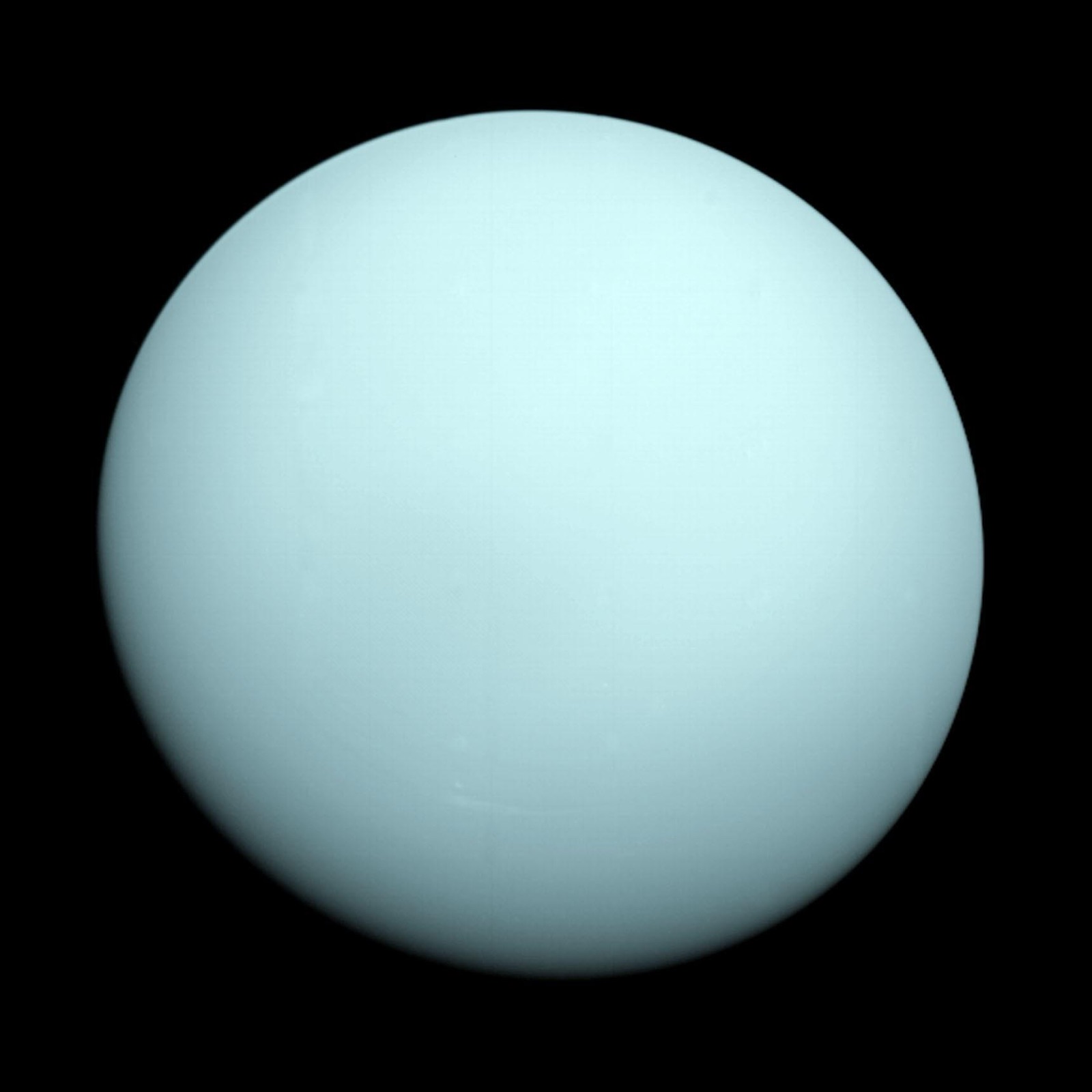
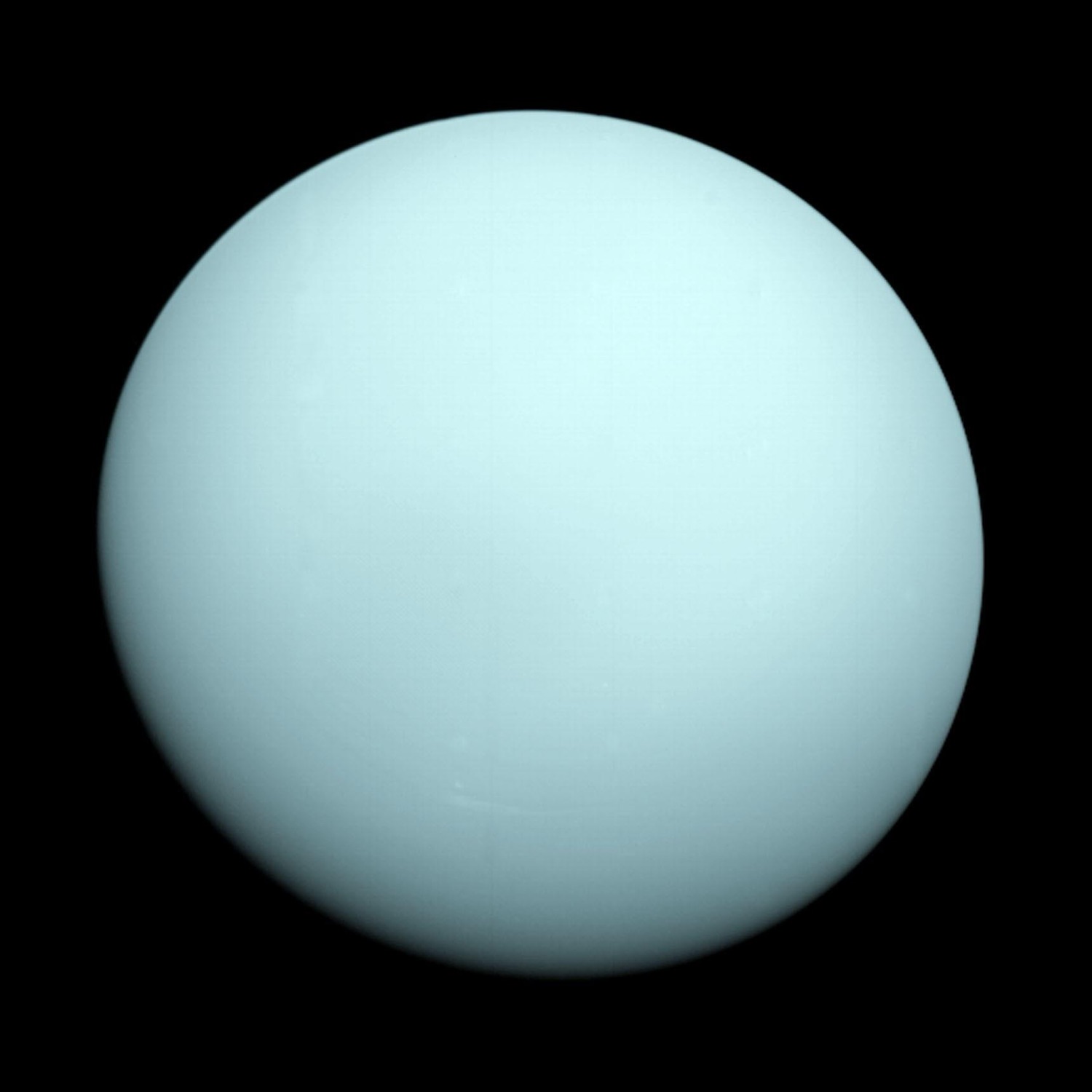
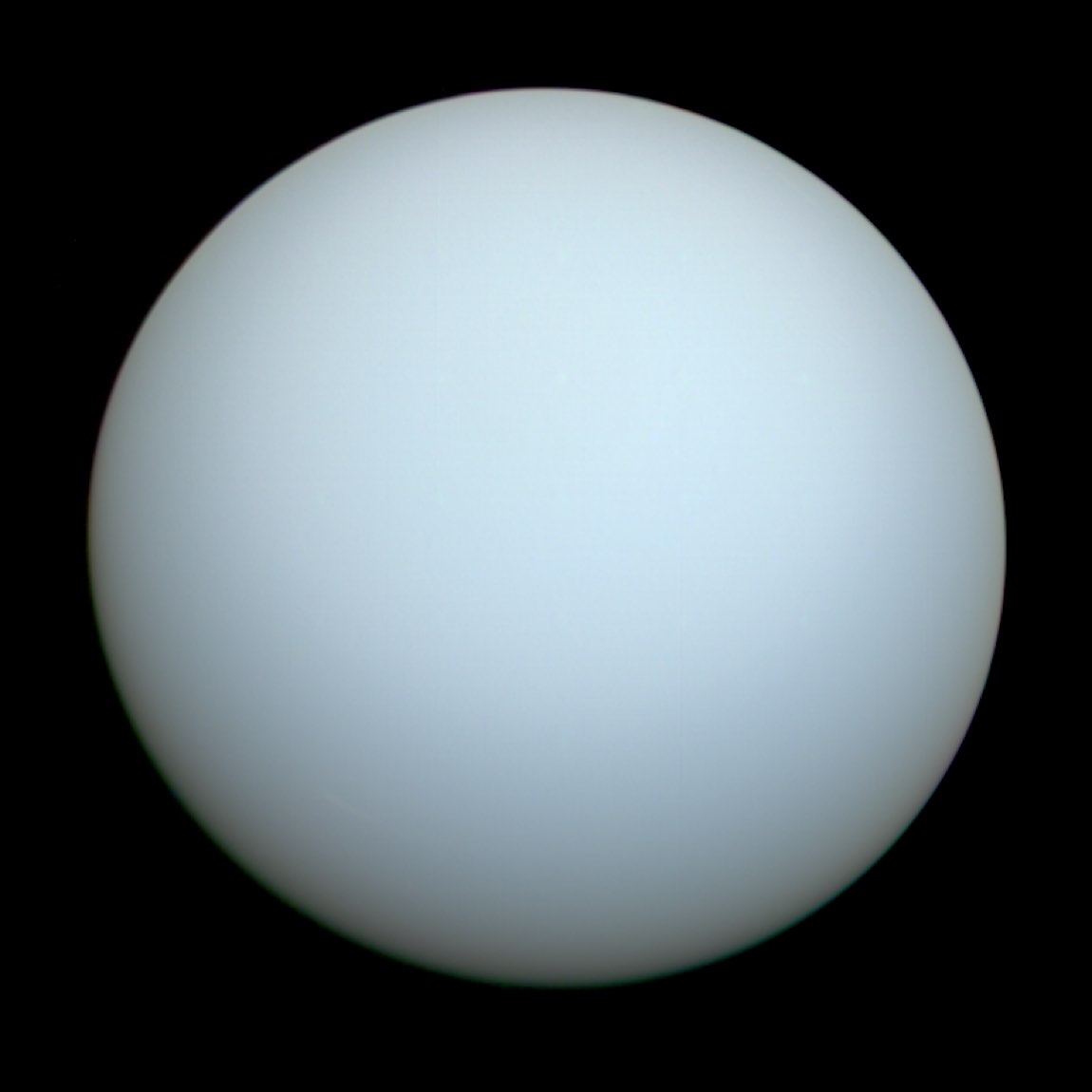
Uranus is the seventh planet from the Sun and the first ever discovered with a telescope (by William Herschel in 1781). It is an 'ice giant' — smaller than Jupiter and Saturn, with more water, methane, and ammonia inside. Its strangest feature: it spins on its side, tilted 98°, so its poles take turns pointing almost straight at the Sun. Methane in its atmosphere gives it a calm, pale blue-green color.
Go deeper
Uranus's extreme obliquity likely records one or more giant impacts early in its history. Each pole gets 42 years of continuous sunlight, then 42 of darkness — the most extreme seasons in the Solar System — yet Voyager 2 (the only visitor, 1986) found a surprisingly bland face; near-equinox imaging since has revealed real weather. Its magnetic field is off-center and tilted 59° from the spin axis, tumbling messily as the planet rotates. The 2023 US planetary decadal survey ranked a Uranus orbiter as the highest-priority new flagship mission, so this neglected world is next in line for a dedicated explorer.
01 Why is it sideways?
Something enormous probably hit Uranus when the Solar System was young — one or more Earth-sized bodies. The crash (or crashes) knocked the planet over, so today it rolls around its orbit like a ball instead of spinning like a top. Each pole gets 42 straight years of sunshine, then a 42-year night.
02 What is an ice giant? Deeper
'Ice' here means water, methane and ammonia — compounds that were ices in the cold outer nebula — not frozen solid today. Inside Uranus they form a hot, dense, electrically conducting fluid ocean. Ice giants may be the most common kind of planet in the galaxy, which is a major reason scientists want a dedicated orbiter: we have exactly one grainy flyby's worth of close-up data.
03 Diamond rain? Deeper
Lab experiments compressing methane to ice-giant interior pressures produce nanodiamonds, supporting the idea that diamonds literally rain toward the depths of Uranus and Neptune. Status: laboratory-supported hypothesis — plausible physics, not yet observed in the planet.
The deep dive
Researched for the Atlas from Wikipedia — Uranus (52,517 characters read) · updated Sep 20, 2026
 ⤢
⤢
04 How Uranus was actually discovered
William Herschel did not set out to find a new planet on the night of 13 March 1781. Working from the garden of his house at 19 New King Street in Bath, England — now the Herschel Museum of Astronomy — he was methodically measuring the positions of stars with a homemade 6.2-inch reflecting telescope when he noticed an object that behaved differently. Stars stay pinpoint-sharp no matter how much magnification you apply; this object swelled proportionally as he increased power from 227× to 460× to 932×, exactly as a nearby body would. Even so, he reported it to the Royal Society as a comet. It was Finnish-Swedish astronomer Anders Johan Lexell, working in Russia, who first computed its orbit and showed it was nearly circular — the signature of a planet, not a comet. By 1783 Herschel himself conceded to Royal Society president Joseph Banks that "the new star" was "a Primary Planet of our Solar System." The discovery effectively doubled the known size of the Solar System, because Uranus lies roughly twice as far from the Sun as Saturn.
05 The long fight over what to name it
Naming the new planet provoked nearly 70 years of argument. Herschel wanted to call it Georgium Sidus — "George's Star" — in honour of King George III, who rewarded him with an annual stipend of £200 (equivalent to about £26,000 in 2025) and a move to Windsor. The name was unpopular outside Britain and Hanover. Astronomer Jérôme Lalande pushed for "Herschel." Swedish astronomer Erik Prosperin suggested Astraea, Cybele, and Neptune — the last of which was eventually given to the next planet out. Johann Elert Bode proposed Uranus in a March 1782 treatise, arguing that the name should follow mythological convention: just as Saturn was father of Jupiter, the new planet ought to be named after Saturn's own father, the sky god Ouranos. In 1789, Bode's colleague Martin Klaproth named the newly isolated element uranium to support the choice. Despite all this, the British Nautical Almanac stubbornly printed "Georgium Sidus" until 1850, when it finally switched to Uranus, making the name universal at last.
06 Uranus's bizarre, off-centre magnetic field Deeper
Before Voyager 2 arrived in 1986, scientists expected Uranus's magnetic field to align neatly with its rotational poles. What Voyager found was far stranger. The magnetic dipole is tilted 59° away from the rotation axis and, crucially, is not centred in the planet at all — it is offset from Uranus's centre toward the south rotational pole by as much as one-third of the planetary radius. The result is a wildly lopsided field: magnetic field strength at the surface ranges from as low as 0.1 gauss (10 μT) in the southern hemisphere to as high as 1.1 gauss (110 μT) in the northern hemisphere, with an average of 0.23 gauss (23 μT). The dipole moment is 50 times that of Earth. One hypothesis is that the field is generated not deep in a core but at relatively shallow depths, perhaps in the water–ammonia ocean. A 2024 reanalysis of Voyager data added a twist: the lopsided magnetosphere observed during the flyby may have been an anomalous compressed state caused by unusually high solar wind density — conditions estimated to occur less than 5% of the time. Neptune has a similarly displaced and tilted field, hinting this may be a trait shared by all ice giants.
 ⤢
⤢
07 Inside the atmosphere: layers, clouds, lightning Deeper
Uranus's atmosphere divides into three formal layers. The troposphere runs from 300 km below the 1-bar level up to 50 km above it, with pressures spanning 100 bar down to 0.1 bar and temperatures dropping from about 320 K (47 °C) at the base to 53 K (−220 °C) near the top. Above that sits the stratosphere, reaching 4,000 km altitude, where temperature climbs back up to 800–850 K at its top — heated by methane absorbing solar ultraviolet and infrared radiation. The thermosphere and corona extend as far as 50,000 km from the surface, or two Uranian radii, at a uniform 800–850 K. No one fully understands what sustains those extreme thermospheric temperatures. Deep inside the troposphere, cloud layers are thought to be stacked by composition: water clouds at 50–100 bar, ammonium hydrosulfide at 20–40 bar, ammonia or hydrogen sulphide at 3–10 bar, and the directly observed thin methane clouds at 1–2 bar. In 1986, Voyager 2's radio astronomy experiment detected 140 lightning flashes over 24 hours from 600,000 km away. Each Uranian lightning bolt carries roughly 10⁸ W, releases 10⁷–2×10⁷ joules of energy, and lasts an average of 120 milliseconds — far more powerful than typical terrestrial lightning and comparable to Jovian lightning.
08 Extreme seasons on a sideways world
Because Uranus's rotational axis lies almost in the plane of its orbit, its seasons are unlike anything else in the Solar System. Each pole spends roughly 42 years bathed in continuous sunlight, then 42 years in total darkness. Near a solstice, only a narrow strip around the equator sees a normal day–night cycle, with the Sun skimming low over the horizon. Paradoxically, despite polar regions receiving more total solar energy averaged over a Uranian year than the equatorial band, the equator is actually warmer than the poles — a reversal scientists cannot yet fully explain. The weather consequences are dramatic and delayed. From March to May 2004, enormous storm clouds erupted and wind speeds hit a record 820 km/h (510 mph). In 2007, as Uranus passed its equinox, the bright southern collar nearly vanished and a faint northern collar appeared near 45° latitude. Photometry stretching back to the 1950s shows brightness peaks at solstices and dips at equinoxes. Because Uranus's orbital period is 84 Earth years, humanity has had less than one full Uranian year of good observational data, making it genuinely hard to separate seasonal patterns from random variation.
09 The ring system and how we found it
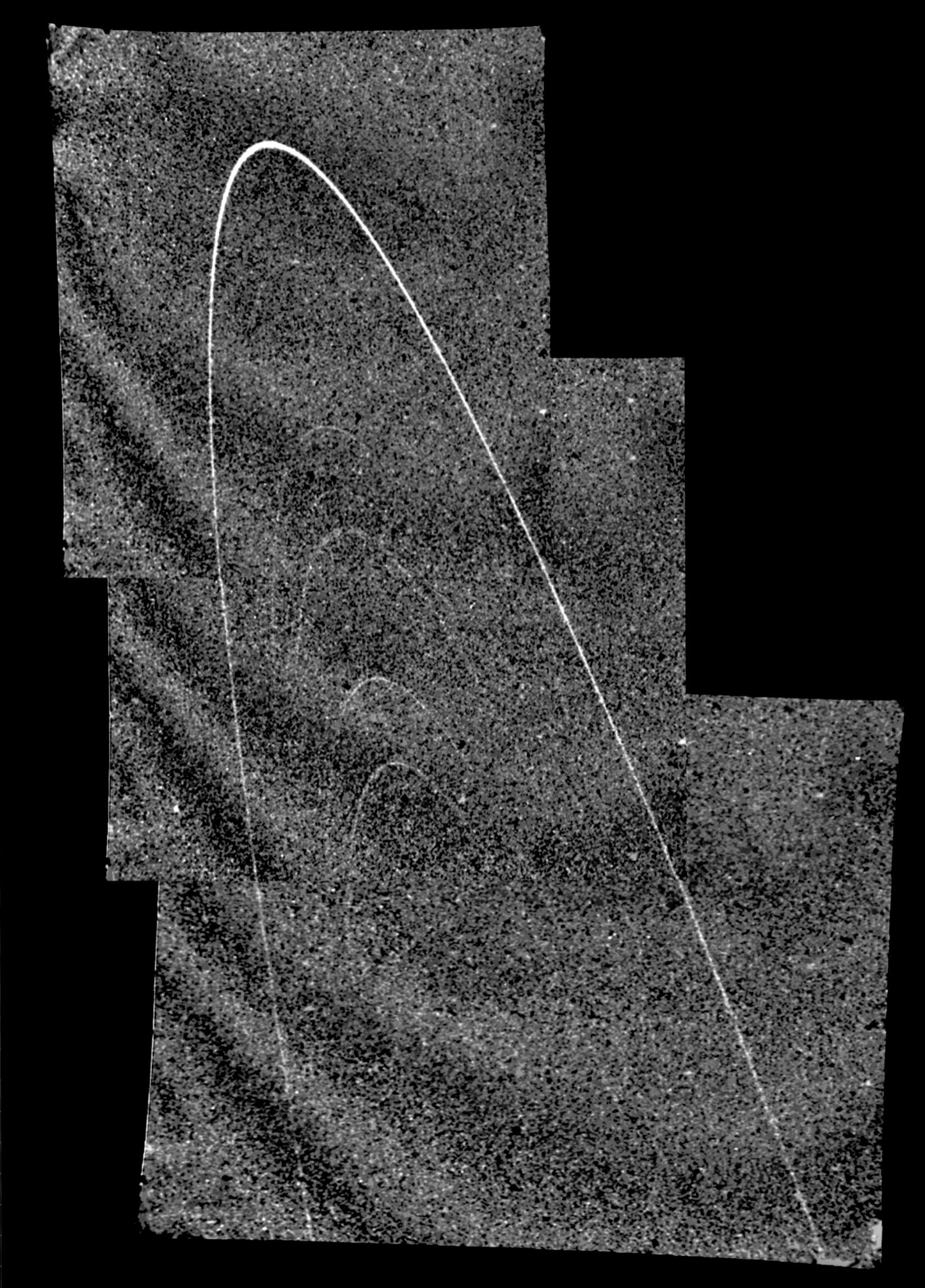
Uranus's rings were discovered entirely by accident on 10 March 1977. Astronomers James L. Elliot, Edward W. Dunham, and Jessica Mink were aboard the Kuiper Airborne Observatory, planning to use the occultation of the star SAO 158687 by Uranus to probe the planet's atmosphere. To their surprise, the star blinked out five times before Uranus reached it, and five times again afterward. The only explanation was a ring system. Voyager 2 directly imaged the rings in 1986 and added two more, bringing the count to eleven. In December 2005, the Hubble Space Telescope found two additional outer rings, one of them twice as far from Uranus as any previously known ring, raising the total to thirteen. Keck Observatory images from April 2006 revealed that the outermost ring is blue — possibly because it is fed by tiny water-ice grains from the small moon Mab, which shares its orbit, and those grains are small enough to scatter blue light preferentially. The inner rings appear grey. All of the rings are extremely dark, reflecting only about 2% of incoming light, and nearly all are only a few kilometres wide. The rings are thought to be geologically young and may be debris from one or more moons shattered by high-speed impacts.
 ⤢
⤢
10 The five major moons and their strange surfaces
Uranus has 29 known natural satellites, all named from characters in the works of William Shakespeare and Alexander Pope — making it unique among planetary moon systems. The five major moons, in order outward from Uranus, are Miranda, Ariel, Umbriel, Titania, and Oberon. Even the largest, Titania, has a radius of only 788.9 km — less than half that of our Moon — yet still ranks as the eighth-largest moon in the Solar System. The combined mass of all five would be less than half that of Neptune's moon Triton alone. All are ice-rock mixtures of roughly 50% ice and 50% rock, with surfaces darkened to low albedos ranging from 0.20 for Umbriel to 0.35 for Ariel. Miranda is the most dramatic geologically: it hosts fault canyons 20 km deep, terraced layers, and wildly mixed terrain ages — probably the result of tidal heating when its orbit was more eccentric during a former 3:1 orbital resonance with Umbriel. Ariel shows the fewest impact craters and thus the youngest surface, while Umbriel's heavily cratered face marks it as the oldest of the group. The magnetosphere's charged particles are energetic enough to darken all the moons' surfaces through space weathering on a timescale of just 100,000 years.
11 Voyager 2: the only visitor, ever
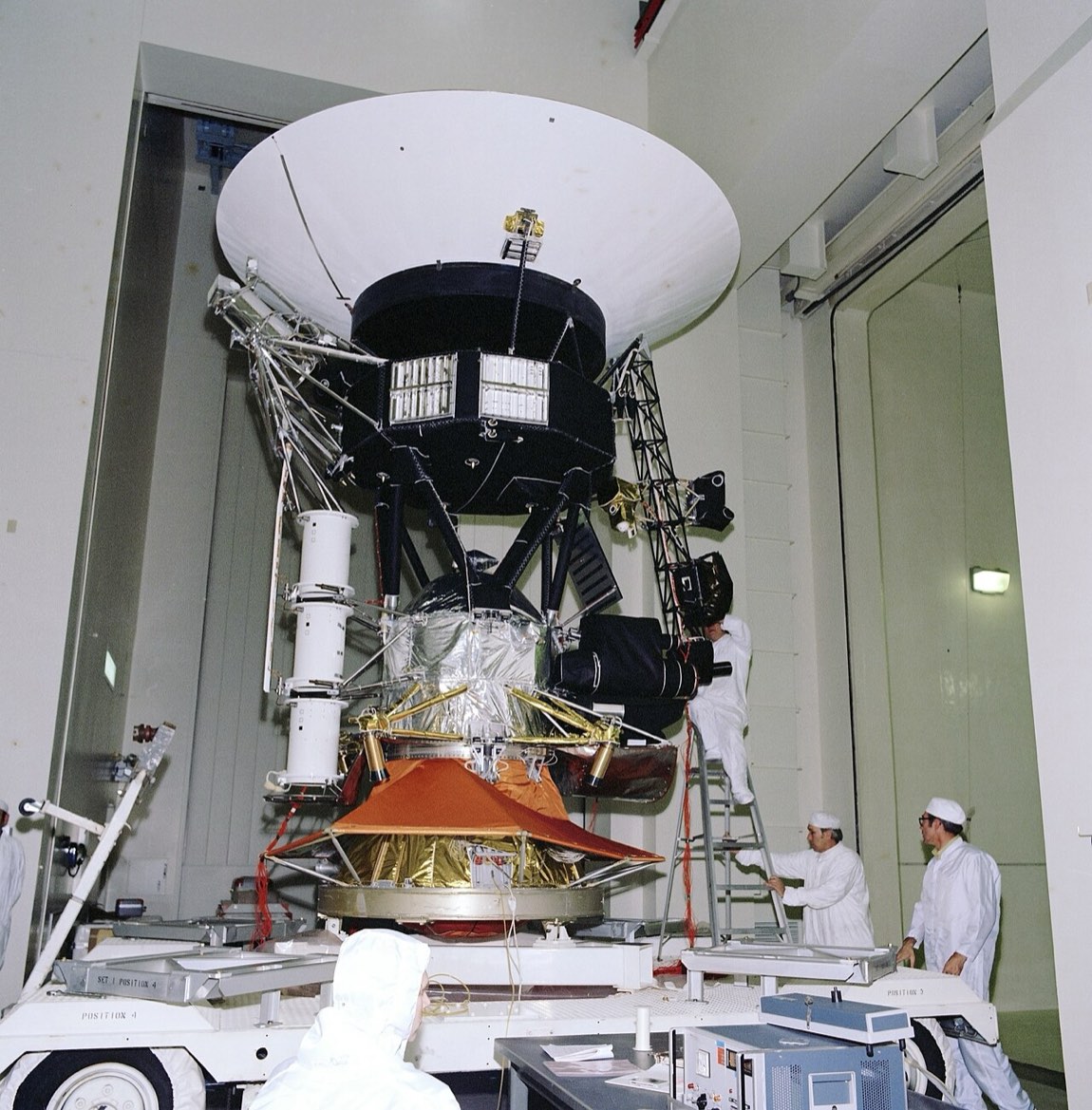
Launched in 1977, Voyager 2 remains the only spacecraft to have visited Uranus. It made its closest approach on 24 January 1986, passing within 81,500 km (50,600 mi) of the cloud tops before swinging onward to Neptune. In those few hours of close observation, the probe accomplished an extraordinary amount: it characterized the structure and chemistry of the atmosphere, made the first detailed studies of the five major moons, discovered 10 previously unknown moons, examined all nine then-known rings and found two more, and mapped the bizarre asymmetric magnetosphere with its corkscrew magnetotail. Yet Voyager 2 arrived at the height of Uranus's southern summer solstice, meaning the northern hemisphere was entirely in darkness and could not be observed. In 2009, mission planners briefly evaluated redirecting the Cassini spacecraft from Saturn to Uranus, but rejected the idea because the trip would have taken roughly 20 years. The 2022 Planetary Science Decadal Survey placed a Uranus Orbiter and Probe mission at its highest priority. China's Tianwen-4 mission, planned for launch in 2029, is expected to deploy a subprobe that would fly by Uranus in March 2045.
12 How Uranus's orbit revealed Neptune Deeper
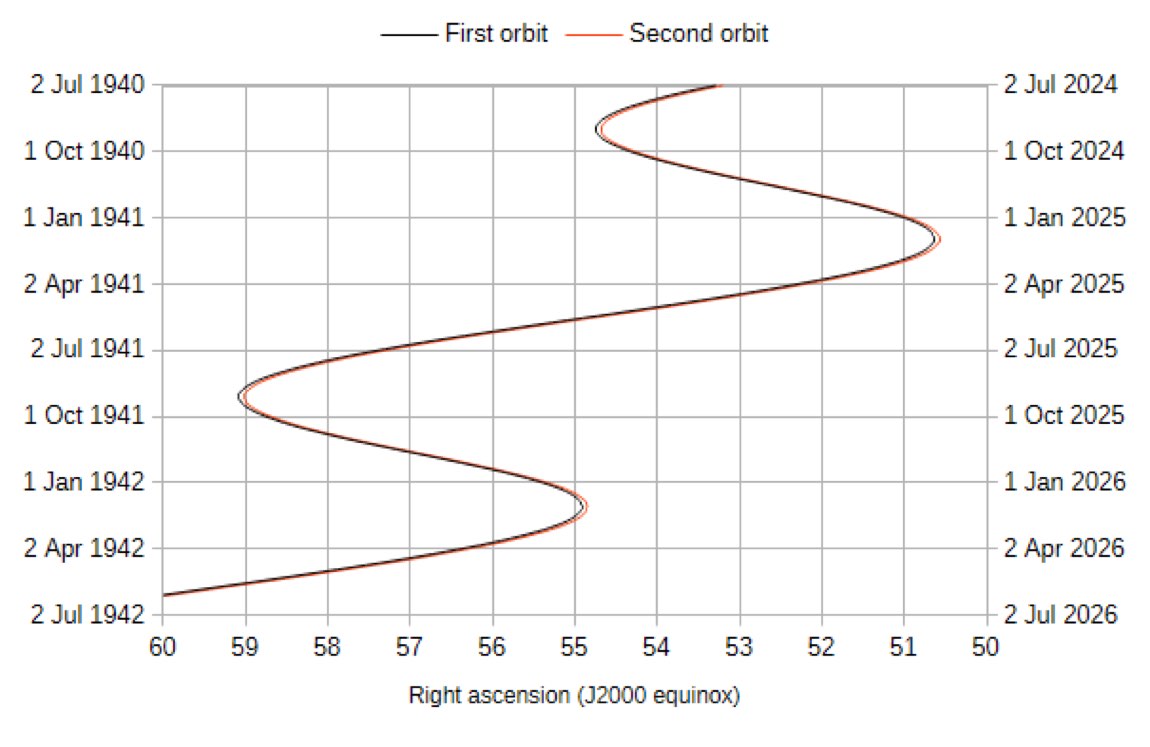
The mathematics of Uranus's motion led directly to the discovery of an eighth planet. Pierre-Simon Laplace first calculated Uranus's orbital elements in 1783, but as decades passed, the planet stubbornly refused to follow its predicted path. In 1841, British mathematician John Couch Adams first proposed that the discrepancies could be caused by the gravitational pull of an unseen planet farther out. Independently, in 1845, French mathematician Urbain Le Verrier began his own analysis of Uranus's orbit. On 23 September 1846, Johann Gottfried Galle at the Berlin Observatory pointed his telescope to the position Le Verrier had calculated and found Neptune within a degree of the predicted spot. Uranus's average distance from the Sun is roughly 20 AU (about 3 billion km), and sunlight reaching it is only about 1/400 as intense as at Earth, following the inverse-square law. The difference between Uranus's closest and farthest points from the Sun is 1.8 AU — larger than that variation for any other planet, though smaller than for the dwarf planet Pluto.
 ⤢
⤢
13 Why Uranus is so mysteriously cold inside Deeper
Of all the giant planets, Uranus emits the least internal heat, and scientists still do not understand why. Neptune, nearly identical in size and composition, radiates 2.61 times as much energy as it receives from the Sun. Uranus, by contrast, emits only 1.06±0.08 times the solar energy it absorbs — barely more than nothing. Its measured internal heat flux is a mere 0.042±0.047 W/m², actually lower than Earth's internal heat flux of about 0.075 W/m². The consequence is that Uranus holds the record for the lowest measured temperature of any planet: 49 K (−224 °C) in its tropopause. Two leading hypotheses compete to explain this. One suggests that the ancient collision that knocked Uranus sideways also expelled most of its primordial heat, leaving a cold core. The other proposes that layered compositional boundaries inside the planet trap heat and prevent it from reaching the surface, perhaps through a process called double-diffusive convection. A 2021 laboratory study offered a third possibility: experiments mimicking ice-giant interior conditions showed that magnesium dissolves readily into liquid interiors, and if Uranus contains more magnesium than Neptune, it could form a thermally insulating layer that locks heat inside permanently.
14 Observing Uranus with your own eyes
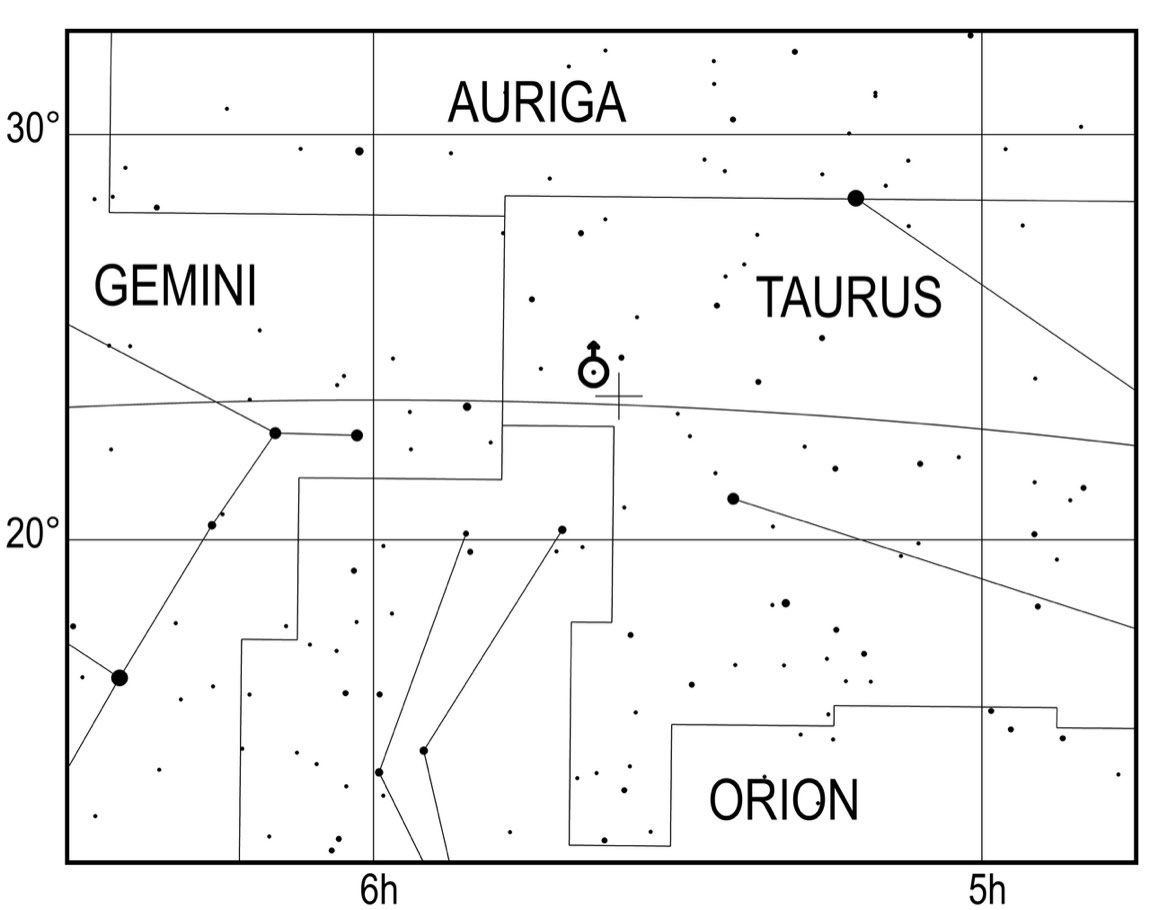
Uranus hovers right at the boundary of naked-eye visibility. Its mean apparent magnitude is 5.68, with extremes of 5.38 at its brightest and 6.03 at its faintest — the limit most people can detect under ideal dark skies. Its angular diameter is only 3.4 to 3.7 arcseconds, compared with 16 to 20 arcseconds for Saturn, so it looks like nothing more than a very faint star to the unaided eye. Binoculars make it an easy target even from cities at opposition. A telescope with an objective of 15 to 23 cm will show a pale cyan disk with subtle limb darkening. Step up to 25 cm or more, and on steady nights you may glimpse cloud banding and even the two largest moons, Titania and Oberon. The planet completes one orbit every 84 Earth years, moving slowly enough that ancient observers catalogued it as a star — John Flamsteed listed it as 34 Tauri after observing it at least six times in 1690, and Pierre Charles Le Monnier recorded it at least twelve times between 1750 and 1769, including four consecutive nights, without realising what he was seeing. Amateur astronomers with cameras and red or infrared filters and apertures as small as 36 cm have even succeeded in photographing the ring system.
15 Formation: why Uranus ended up so far out Deeper
Uranus and Neptune are thought to have formed much closer to the Sun than they are today. Current models of Solar System formation propose that the presolar nebula — a rotating disk of gas and dust — coalesced first into solid protoplanets. The ice giants accumulated only a few Earth masses of the nebula's leftover hydrogen and helium gas, never reaching the critical threshold at which gas accretion becomes runaway and exponential, as it did for Jupiter and Saturn. That is why they are dominated by "ices" — water, ammonia, and methane in a supercritical state — rather than hydrogen and helium gas. Recent planetary migration simulations, embodied in the Nice model, suggest that Uranus and Neptune formed closer to the Sun and were gravitationally scattered outward to their present positions. Uranus now orbits at an average of roughly 20 AU, where sunlight is about 1/400 as intense as at Earth. Its mass is about 14.5 times Earth's — the least of all four giant planets — with a density of 1.27 g/cm³, making it the second least dense planet after Saturn. Its rocky silicate-iron-nickel core, with a mass of only 0.55 Earth masses, makes up less than 20% of the planet's radius, dwarfed by the enormous icy mantle above it.
 ⤢
⤢
You would weigh…
Surface gravity 8.87 m/s² vs Earth’s 9.81 m/s². Try every world →
Could life exist here?
No surface, −195 °C cloud tops, and a crushing exotic-fluid interior: not a serious candidate. Its large moons are icy and quiet, though Voyager images of Miranda and Ariel hint at past internal activity worth revisiting.
Our labels: Confirmed · Strong Evidence · Estimated · Hypothesis · Theoretical · Speculative (see Methodology).
Could humans live here?
No realistic scenario with foreseeable technology. Uranus is a place for robotic orbiters and atmospheric probes.
How would we get there?
Voyager 2 took 8.5 years with a rare planetary alignment. A dedicated orbiter would take 12–15 years with current rockets — one reason mission planners want to launch in the early 2030s to catch a Jupiter gravity assist.
| Technology | Status | Travel time (one way, straight line) |
|---|---|---|
| Apollo-style spacecraft, about 39,000 km/h | Flown technology | 8 years |
| Ion-propulsion probe, about 90,000 km/h | Flown technology | 4 years |
| Voyager 1, about 61,000 km/h | Flown technology | 5 years |
| Parker Solar Probe, about 690,000 km/h | Flown technology | 174 days |
| Nuclear-thermal rocket, about 120,000 km/h cruise | In development | 3 years |
| Laser light-sail at 20% of light speed | Proposed concept | 13.3 hours |
| Light itself, 299,792 km/s | Physical limit | 2.7 hours |
Simplified straight-line times at cruise speed. Real missions fly curved orbital paths and take longer. Full travel calculator →
Weird & wonderful
- Uranus's seasons last 21 years each — and each pole gets a 42-year day.
- It is the only planet named from Greek rather than Roman mythology.
- Its moons are named for Shakespeare characters: Titania, Oberon, Miranda, Puck…
- Voyager 2 remains the only spacecraft ever to visit — for one day, in 1986.
- Uranus is colder than Neptune despite being closer to the Sun — it barely leaks internal heat, and nobody is sure why.