Moon · Deep guide · orbits Uranus
Cupid
Also called: Uranus XXVII · S/2003 U 2
A tiny moon hiding just 863 km from Belinda's orbit, possibly on a collision course.
What is it?
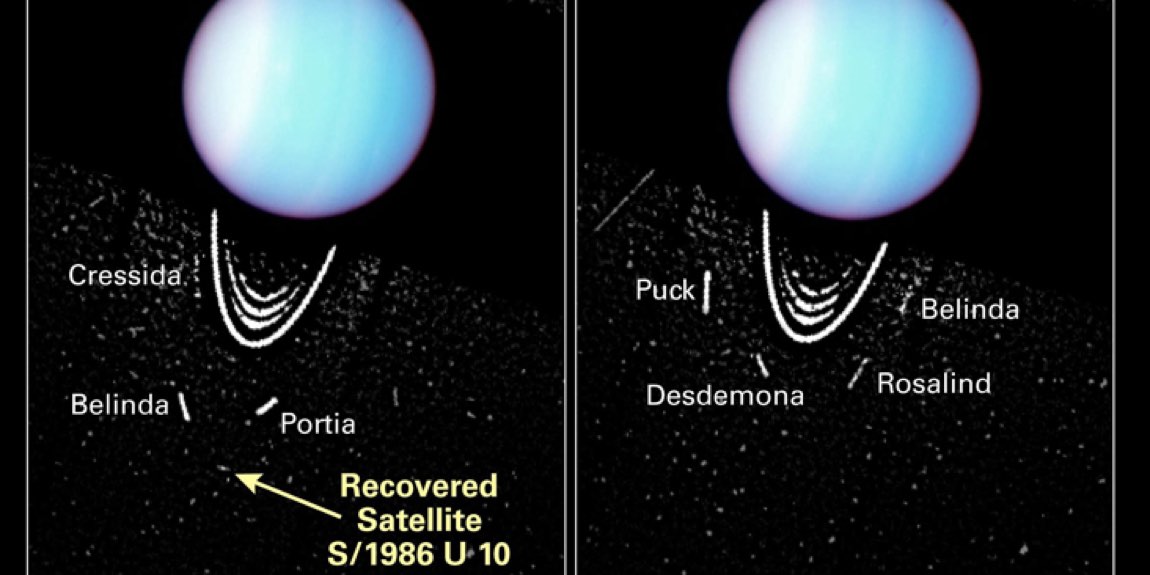
Cupid is one of Uranus's smallest known moons, too faint for Voyager 2 and first found in Hubble Space Telescope images in 2003. It is only about 18 km across and orbits remarkably close to the larger moon Belinda. Studies disagree about its future: one predicted a collision with Belinda in 100,000 to 10 million years, while others argue a resonance between Belinda and Perdita protects it. Its name comes from a character in Timon of Athens.
The deep dive
Researched for the Atlas from Wikipedia — Cupid (moon) (1,685 characters read) · updated Nov 15, 2026
01 Discovered hiding in plain sight
Cupid was discovered in 2003 by astronomers Mark R. Showalter and Jack J. Lissauer using the Hubble Space Telescope, nearly two decades after Voyager 2 had swept past Uranus and photographed its inner moon system in 1986. The reason Voyager missed it is straightforward: Cupid is simply too faint. Its small size — roughly 17.8 km (11.1 mi) across, comparable to a mid-sized city — reflects so little sunlight that it fell entirely below the detection threshold of Voyager 2's cameras. Only the sharper, more patient eye of Hubble, pointed deliberately at the Uranian system years later, was sensitive enough to tease the moon out of the glare. After its detection, Cupid received the provisional label S/2003 U 2 before being formally numbered Uranus XXVII. It is a reminder that even a spacecraft flying directly through a planetary system can miss small, dark objects lurking nearby.
02 A moon named from Shakespeare
Uranian moons follow a tradition unlike any other moon family in the solar system: they are all named after characters from the works of William Shakespeare or Alexander Pope. Cupid is no exception, taking its name from a character in Shakespeare's play Timon of Athens. This play is one of Shakespeare's less celebrated works — a bitter, rarely staged drama about a wealthy Athenian who bankrupts himself through generosity and then retreats in misanthropic fury. The choice of Cupid from that particular play is a small curiosity, since Timon of Athens is far from the most famous source in the Shakespearean canon. Nevertheless, the naming convention gives Uranus's moon system a distinctly literary personality, setting it apart from the mythological naming schemes used for the satellites of Jupiter, Saturn, and Neptune. Each new confirmed Uranian moon must be assigned a character from the same literary tradition.
03 The crowded Portia group neighborhood
Cupid belongs to a cluster of small inner moons known as the Portia group, a family of satellites packed into a surprisingly narrow band of orbits around Uranus. These moons share similar physical properties and orbit very close together, making the region feel almost claustrophobically dense by solar system standards. Within this group, Cupid is especially close to two neighbors: Belinda and Perdita. The separation between Cupid's orbit and Belinda's orbit is only 863 km (536 mi) — less than the driving distance across Texas. In cosmic terms, that is an extraordinarily thin margin between two independently orbiting bodies. This tight proximity is not merely an interesting geometric fact; it has profound consequences for the long-term dynamical stability of Cupid's orbit, since gravitational nudges accumulate over time whenever moons pass that closely and repeatedly.
04 Why Cupid's future is genuinely uncertain Deeper
Few places in the solar system illustrate the difficulty of predicting orbital fate better than Cupid's neighborhood. A 2012 study concluded that resonance interactions would gradually push the smaller Cupid into an increasingly dangerous orbit, making a collision with the larger moon Belinda likely within the next 100,000 to 10 million years — an enormous range that reflects genuine uncertainty in the models. Then, a 2022 analysis offered a reprieve: it found that a 44:43 orbital resonance between Belinda and Perdita effectively shields Cupid, suggesting the moon could survive for at least 50 million years. That would have settled the debate, except that a separate 2022 study reached the opposite conclusion — finding that Belinda and Perdita are not actually in that resonance at all, and that Cupid is unlikely to survive even the next 50,000 years. Two independent analyses published in the same year produced contradictory answers, which honestly reflects the state of knowledge: Cupid's fate is an open and contested question.
05 What 44:43 resonance actually means Deeper
Orbital resonances occur when two bodies complete orbits in a ratio of small whole numbers, so their gravitational pulls reinforce in a regular, repeating pattern. A 44:43 resonance between Belinda and Perdita means that for every 44 orbits Belinda completes, Perdita completes almost exactly 43 — a ratio separated by just one step. This near-integer relationship means the two moons are nudging each other in a consistent, locked rhythm rather than at random. According to the 2022 study that identified this resonance, the locked interaction creates a kind of gravitational fence around Cupid's orbit, preventing it from drifting freely into Belinda's path. Resonances like this are well known elsewhere: Jupiter's moons Io, Europa, and Ganymede share a famous 1:2:4 resonance that has persisted for billions of years. Whether the Belinda-Perdita 44:43 resonance is real and strong enough to protect Cupid, however, is precisely what the conflicting 2022 studies disagree about.
06 A young moon by solar system standards
The solar system itself is about 4.6 billion years old, yet Cupid is estimated to be at most 500 million years old — meaning it formed relatively recently in the grand timeline, during an era when complex life was already flourishing on Earth. This youth suggests Cupid did not form alongside Uranus during the planet's original accretion. Instead, it likely formed later, possibly from debris produced by collisions among earlier inner moons, or from material that was gradually swept into its current orbit through dynamical processes. The inner moon systems of the giant planets are thought to be relatively impermanent and self-renewing in this way, with moons forming, colliding, and reforming on timescales far shorter than the age of the solar system. Cupid's youth makes it a product of comparatively recent activity in the Uranian system rather than a primordial survivor.
07 Brighter behind than in front Deeper
One of the more puzzling measured properties of Cupid is its brightness asymmetry: its trailing side is 2.3 times brighter than its leading side. This is the opposite of the pattern seen on many other small moons and airless bodies in the outer solar system, where the leading hemisphere tends to accumulate dark material swept up during the orbit, making it darker than the trailing side. The trailing-side brightening on Cupid could imply a different process at work, though the article does not specify the mechanism. Possibilities studied elsewhere in planetary science include ejecta from impacts preferentially coating one hemisphere, or interactions with the Uranian magnetosphere redistributing fine particles — but the article does not confirm which explanation applies to Cupid. The asymmetry is a real, measured fact that remains an intriguing detail about a moon we have only glimpsed from great distance and have never visited with a dedicated spacecraft.
08 Estimating size without a close-up visit
Calculating the diameter of a tiny, distant moon like Cupid requires assumptions, because no spacecraft has ever photographed it up close. Astronomers measure how bright the moon appears from Earth or from Hubble, then work backward using an assumed reflectivity — called geometric albedo — to estimate physical size. For Cupid, scientists assumed its albedo matches that of the other Portia group moons, arriving at a diameter of roughly 17.8 km (11.1 mi). The word 'crudely' appears in descriptions of this estimate for good reason: if Cupid's actual surface is significantly darker or brighter than assumed, the true diameter could be meaningfully different. At 17.8 km, the moon is small enough that it would fit comfortably inside the city of Los Angeles with room to spare. This size also means its self-gravity is very low — far too weak to pull it into a spherical shape, so Cupid is almost certainly an irregularly shaped chunk of rock and ice.
09 Voyager 2's missed opportunity
When Voyager 2 made its historic flyby of Uranus in January 1986, it became the only spacecraft ever to visit the planet and provided the first close-up imagery of its ring and moon system. It discovered ten new inner moons during that encounter — a remarkable achievement. Yet Cupid was not among them. The moon's faintness placed it below the sensitivity limit of Voyager's cameras, meaning it passed undetected even as the probe flew through the very system it inhabits. This gap in Voyager's catalog was only closed seventeen years later when Hubble's more capable instruments and long, deliberate observations revealed the moon in 2003. The story underscores a recurring theme in planetary exploration: a single flyby, however successful, rarely tells the complete story of a planetary system. Small, dark, faint bodies can remain hidden until better technology or longer observation campaigns specifically go looking for them.
10 Open questions that keep researchers busy Deeper
Cupid sits at the center of several unresolved scientific debates. The most pressing is whether it will survive: the conflicting 2022 studies leave planetary dynamicists without a consensus answer, and resolving the question likely requires longer numerical integrations, better observational data on Belinda and Perdita's exact orbital parameters, and a firmer understanding of whether the proposed 44:43 resonance is real. The brightness asymmetry between leading and trailing hemispheres is also unexplained. More broadly, the age estimate of at most 500 million years raises questions about what collision event created Cupid and what the previous generation of inner Uranian moons looked like before it formed. All of these questions are difficult to answer from Earth or from Hubble alone. A future mission to the Uranian system — which has been recommended as a high-priority target by planetary science community surveys — would provide the close-up measurements needed to begin settling them.