Moon · Deep guide · orbits Uranus
Stephano
Also called: Uranus XX · S/1999 U 2
A small reddish moon that may share a common origin with Caliban.
What is it?
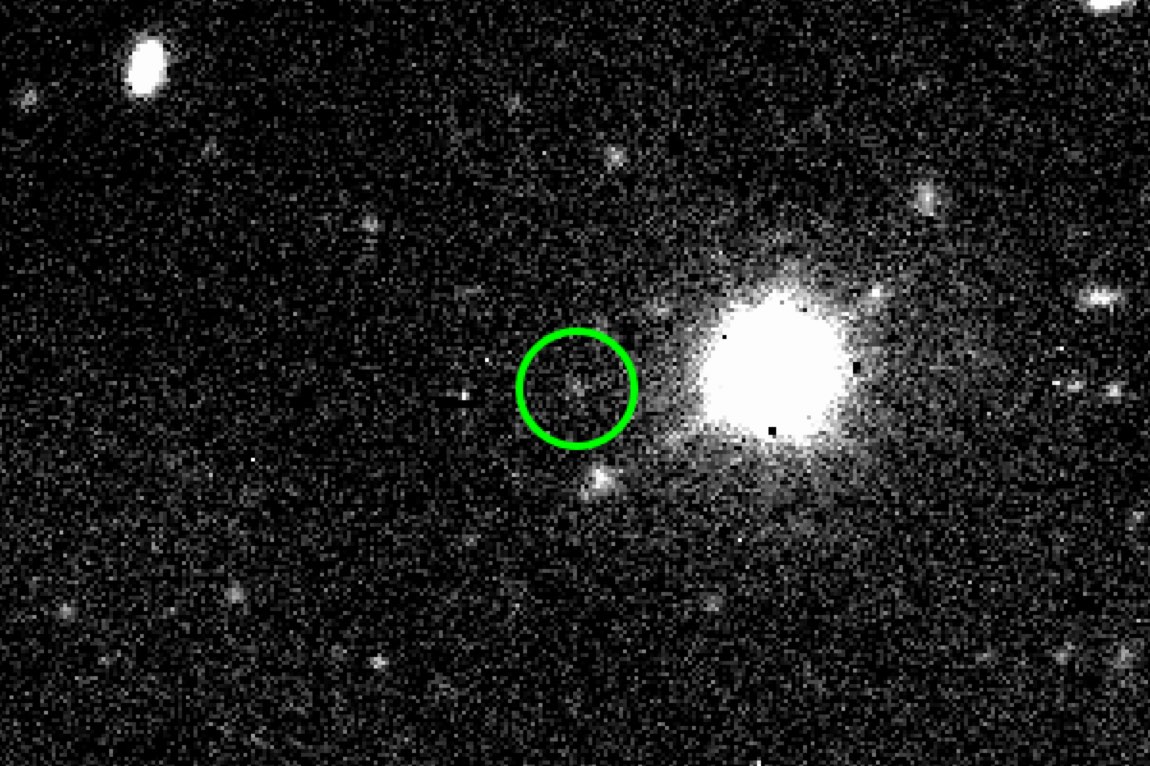
Stephano was discovered on 18 July 1999 in images from the Canada–France–Hawaii Telescope, alongside Prospero and Setebos. It is roughly 32 km wide and follows a retrograde orbit about 8 million km from Uranus, taking around 677 days to go around once. Stephano appears reddish and belongs to the Caliban group, so it may be a fragment of the same captured parent body. It is named after the drunken butler in The Tempest.
The deep dive
Researched for the Atlas from Wikipedia — Stephano (moon) (2,913 characters read) · updated Nov 15, 2026
01 Discovered alongside two siblings
Stephano did not arrive on the astronomical stage alone. On 18 July 1999, Brett J. Gladman and his colleagues announced three Uranian moons at once: Stephano, Prospero, and Setebos. This kind of triple discovery is a hallmark of modern wide-field survey campaigns, where a single night of deep imaging can sweep up multiple faint targets orbiting the same planet. The discovery was made possible by the generation of large CCD detectors that became available in the late 1990s, sensitive enough to catch objects only a few tens of kilometres across at the distance of Uranus. When the find was reported, the Minor Planet Center gave Stephano the placeholder label S/1999 U 2 — a dry but practical code that simply means the second new Uranian satellite reported from 1999 observations. That temporary name stuck for over a year until the International Astronomical Union's Working Group for Planetary System Nomenclature formalised things on 21 August 2000, assigning the permanent designation Uranus XX and the literary name the moon carries today.
02 A Shakespearean drunk in the outer solar system
The name Stephano comes from the drunken butler in William Shakespeare's play The Tempest — a deliberately comic character who stumbles across the island where the action unfolds and immediately starts plotting with the monster Caliban over stolen wine. That choice of name is not accidental. By convention, Uranian irregular moons are named after characters from Shakespeare's plays, and the Caliban group of moons — to which Stephano belongs — takes its name from that very same scheming creature. So Stephano and Caliban are neighbours in myth as well as in orbit, circling Uranus together just as their theatrical counterparts shared a drunken conspiracy on Shakespeare's enchanted island. This layered naming convention gives the Uranian moon system an unusually coherent cultural identity: rather than a random assortment of mythological figures, the irregular moons form a loose Shakespearean cast, with the groupings echoing dramatic relationships from the plays themselves.
03 What makes an orbit retrograde
Stephano travels around Uranus in the opposite direction to the planet's rotation — a motion called retrograde. Its orbital inclination is approximately 144°, which places it well past the 90° threshold that separates prograde from retrograde motion. To picture this, imagine watching Uranus from far above its north pole: its inner moons and rings sweep counterclockwise, while Stephano loops clockwise at a mean distance of roughly 8 million km. That distance is enormous — about 21 times the distance from Earth to the Moon — yet Stephano still needs about 677 Earth days, nearly 1.8 Earth years, to complete a single circuit. The orbit is also noticeably elliptical, with an eccentricity of 0.200, meaning Stephano's distance from Uranus varies considerably around the loop. On top of that, the gravitational tugs of the Sun and other planets continuously nudge the orbit, so the precise inclination and eccentricity drift over time in a process astronomers call secular perturbation.
04 The Caliban group: a family in fragments Deeper
Stephano belongs to the Caliban group, described as the first identified group of irregular Uranian moons sharing similar orbital characteristics. The members cluster at orbital distances between 7 and 8 million km from Uranus and carry inclinations between 141° and 144°. That tight clustering in orbital space is a strong statistical signal: it is far too orderly to be a coincidence of independent captures. The leading interpretation is that the Caliban group is a collisional family — the debris field left behind after a single parent body was shattered in a high-speed impact long ago. Under this model, Stephano is not an independent world so much as a surviving shard of something larger, flung into its current path by the energy of that ancient collision. Confirming the family interpretation fully requires precise measurements of each member's composition and rotation, data that do not yet exist for most members including Stephano. The grouping itself, however, is well enough established that it anchors our understanding of how the outer Uranian system was sculpted by violent events early in solar system history.
05 Captured from elsewhere: a probable origin story
Stephano almost certainly was not born where it now orbits. The prevailing view is that it formed somewhere else in the early solar system and was later captured by Uranus's gravity. The retrograde, inclined, and eccentric nature of its orbit is a key clue: objects that condense from the same disk of gas and dust as a planet tend to orbit in the same direction and on nearly circular, low-inclination paths. Stephano does none of those things. Exactly when and how the capture happened is unknown, but the leading scenario links it to a turbulent phase of planetary migration billions of years ago when the giant planets were shuffling positions, flinging small bodies onto wildly different trajectories. Some of those wanderers passed close enough to Uranus to be gravitationally snared. If Stephano and its Caliban group siblings were captured together as fragments of a single parent — or if one body was captured and later broken apart — the two processes of capture and collision are intertwined parts of the same story.
06 Colour as a clue to surface chemistry Deeper
Despite knowing almost nothing about Stephano's surface in detail, astronomers have measured its colour with enough precision to draw meaningful inferences. Stephano appears distinctly reddish in visible light, with colour indices of B–V = 0.97 ± 0.07 and V–R = 0.66 ± 0.05. These numbers describe how much brighter or fainter an object appears through different coloured filters; higher values mean the object reflects more red light relative to blue or green. Stephano's values place it in the same colour territory as many trans-Neptunian objects — the distant icy bodies beyond Neptune — suggesting a surface rich in complex organic compounds called tholins, which are reddened by prolonged exposure to cosmic radiation. Intriguingly, the available data hint that Stephano may even be redder than its Caliban group companions Caliban and Sycorax, though the article notes that additional observations are needed to confirm this. If true, it could imply subtly different surface compositions among siblings from the same parent body — a puzzle that future spectroscopic studies will need to unravel.
07 How astronomers estimate its size
Stephano has never been photographed up close, so its diameter of about 32 km cannot be measured directly — it is too small and too distant to show a resolved disk even to the best current telescopes. Instead, astronomers work backwards from the moon's brightness. If you know how far away an object is and how bright it appears, you can calculate how much surface area it must have — provided you also assume how reflective that surface is. That reflectivity is called albedo. For Stephano, astronomers assume a low albedo of 0.04, meaning the surface reflects only 4 percent of the sunlight that strikes it, as dark as charcoal. This assumption is based on the observed albedos of other Uranian irregular moons. If Stephano's surface were brighter, the same observed brightness would imply a smaller object; if darker, a larger one. At 32 km across, Stephano would fit comfortably inside many mid-sized cities, making it a genuinely tiny world — a tumbling rock in the outer solar system whose physical properties remain almost entirely unknown.
08 Open questions: what we simply don't know Deeper
The honest summary of Stephano's physical science is one of pervasive uncertainty. The article is candid: very little is known about its physical properties. The diameter of approximately 32 km rests entirely on an assumed albedo. The mass is unknown, which means density is unknown, which means interior composition is a complete blank. The rotation period — how fast Stephano spins — has never been measured. Its shape is unresolved; it could be roughly spherical or wildly elongated. The colour data hint at a reddish, tholin-rich surface, but no spectrum has confirmed the presence of specific minerals or ices. Even the precise orbital elements are not static: continuous perturbations from the Sun and other planets shift the inclination and eccentricity over time, requiring ongoing astrometric monitoring to maintain an accurate ephemeris. Each of these unknowns matters for understanding whether the Caliban group truly is a collisional family and what its parent body was made of. Stephano is a reminder that for most irregular moons in the outer solar system, discovery is just the first, smallest step.
09 The Uranus Orbiter and Probe: future hope
The only spacecraft ever to visit the Uranian system was Voyager 2, which flew past in 1986 — long before Stephano was even discovered. No probe has since imaged Stephano up close, and none is currently en route. The best near-term prospect is the proposed Uranus Orbiter and Probe, or UOP, which planetary scientists have identified as a high-priority mission for the coming decades. The plan calls for the UOP to study Uranian irregular moons including Stephano as distant observation targets rather than close flyby subjects. Watching how a moon's brightness rises and falls as it rotates allows scientists to measure its rotation period and get rough information about its shape — without ever approaching it. However, the article notes a specific limitation: the UOP may not be able to perform a close flyby of Stephano because the moon does not orbit near the ecliptic plane, the flat region of the solar system where spacecraft trajectories are easiest to arrange. Stephano's steeply inclined retrograde orbit makes close encounters costly in fuel and mission design.
10 Placing Stephano in the irregular moon census
Stephano sits within a broader population of irregular moons — distant, tilted, often retrograde satellites found around all four giant planets. What sets Uranus apart is that its irregular moons were largely unknown before the late 1990s survey campaigns that netted Stephano and its companions. The Caliban group, to which Stephano belongs, is specifically described as the first identified group of irregular Uranian moons sharing similar orbital characteristics, making it a landmark in the inventory of the outer solar system. The identification of collisional families among irregular moons is scientifically valuable because it constrains the population of small bodies that must have existed in the early solar system to generate such collisions. Each family member carries a record of that primordial impact in its orbit and potentially in its composition. Stephano's modest diameter of about 32 km makes it one of the smaller confirmed members of this family, but even small fragments preserve chemical and dynamical clues that larger surviving bodies might have erased through geological activity.