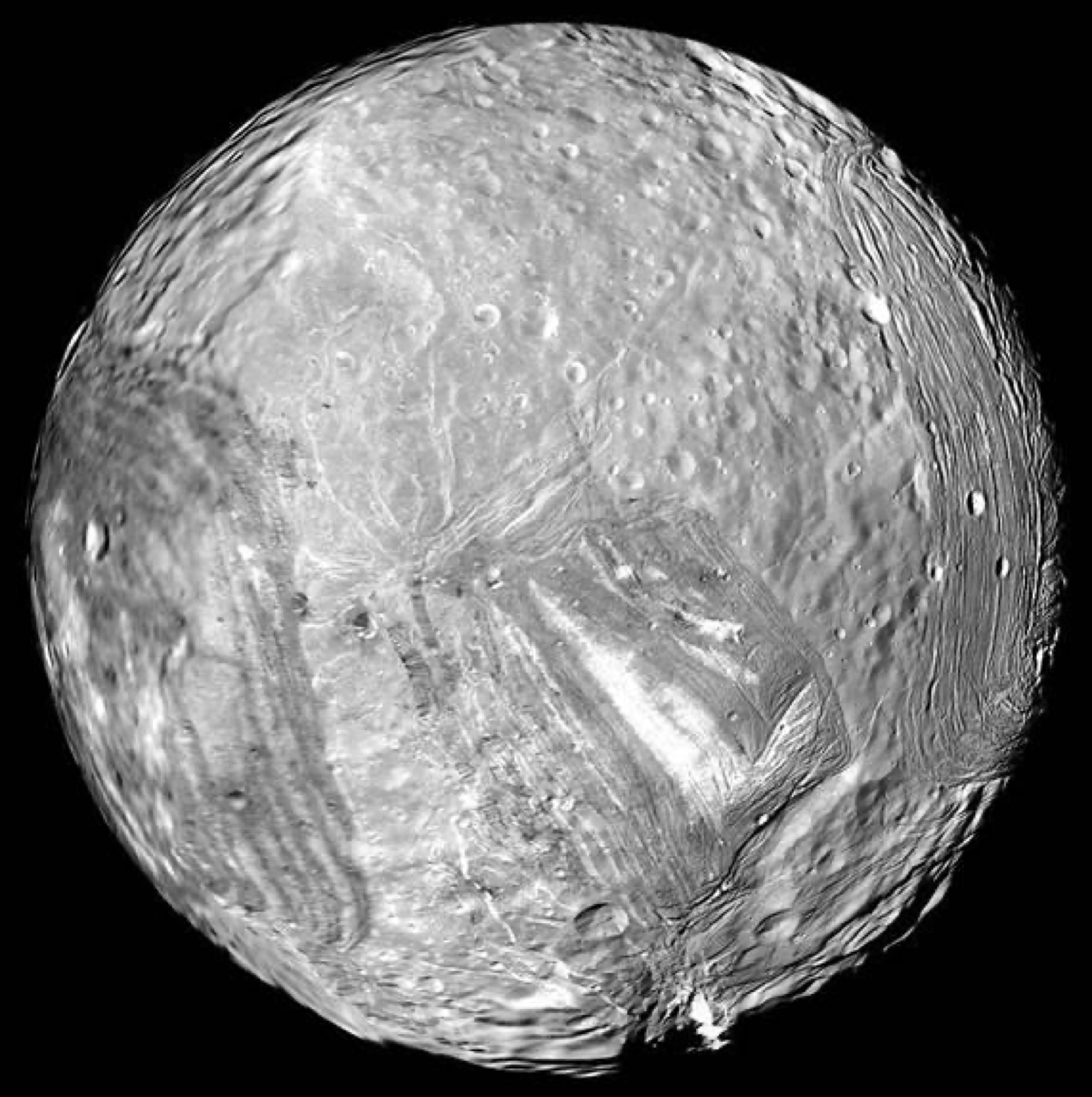
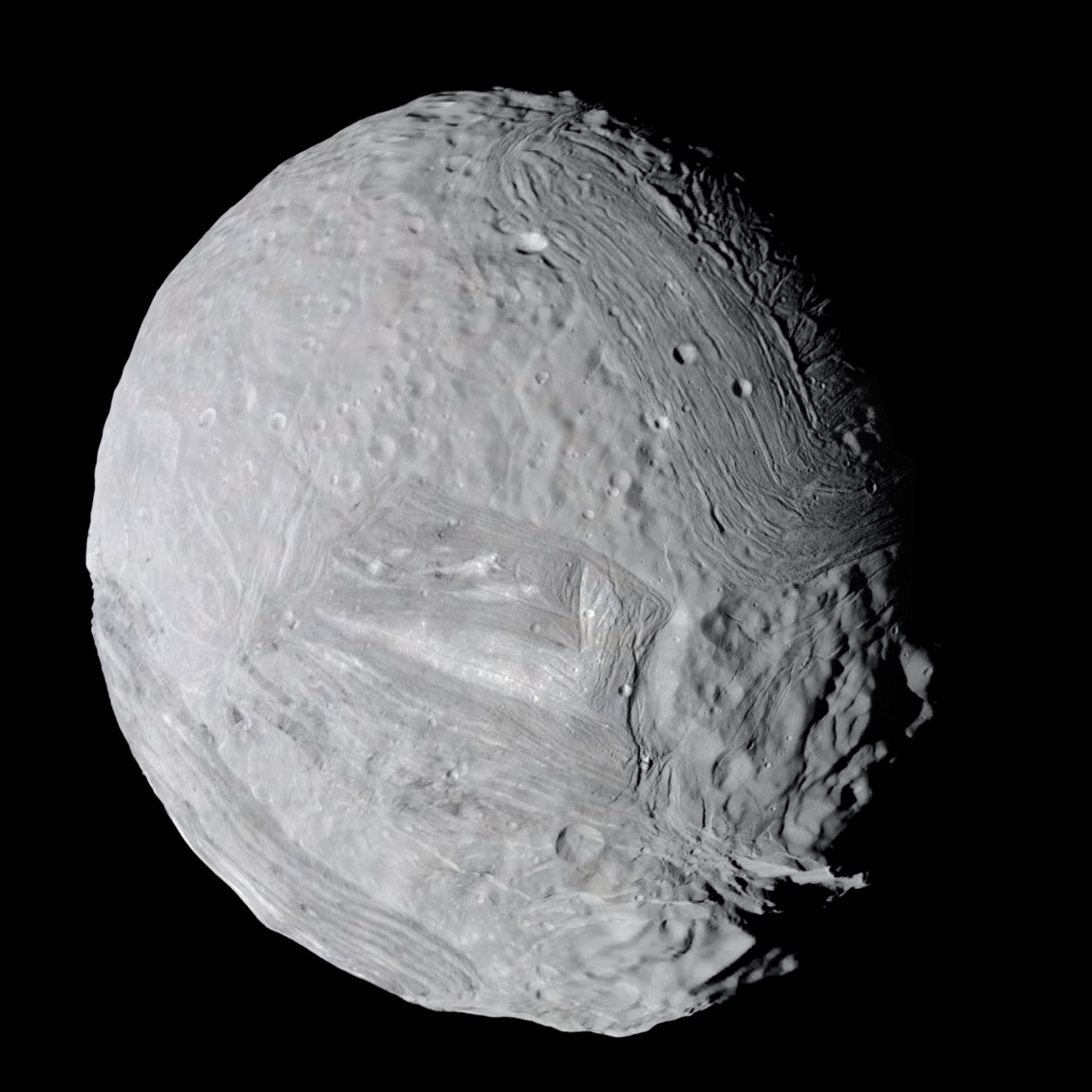
 Photograph · NASA/JPL-Caltech
Moon · Deep guide · orbits Uranus
Miranda
Home to the tallest cliff known, Miranda is Uranus's patchwork moon.
What is it?
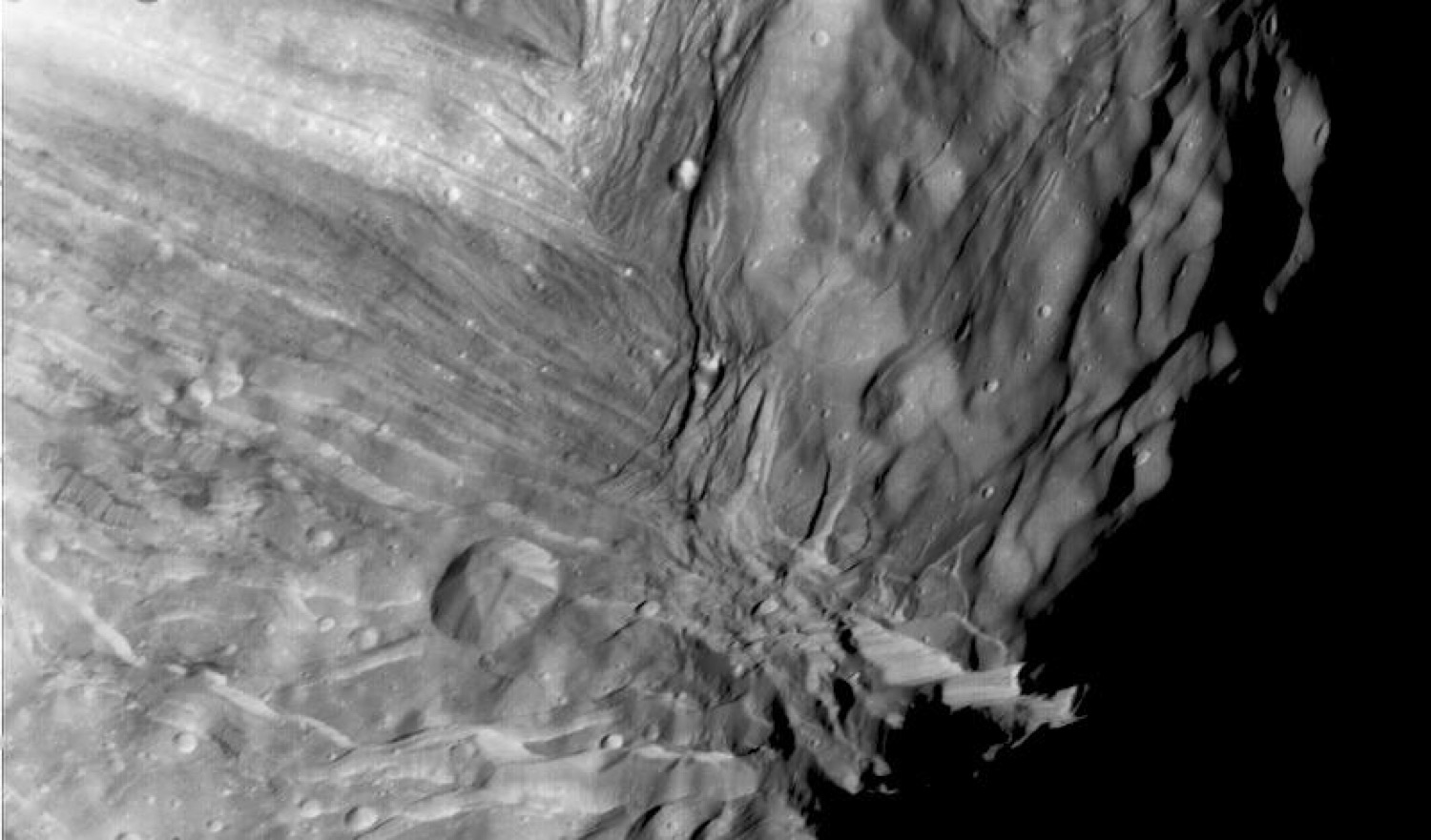
Miranda looks like a world assembled from mismatched parts: cratered plains butt against vast grooved ovals ('coronae') and fault canyons twelve times deeper than the Grand Canyon. Verona Rupes, a cliff perhaps 20 km tall, is the highest known — jump off in the low gravity and you would fall for roughly ten minutes. Ancient internal heating, not a shattering-and-reassembly, is the leading explanation.
The deep dive
Researched for the Atlas from Wikipedia — Miranda (moon) (26,149 characters read) · updated Sep 20, 2026
01 How Gerard Kuiper Found Miranda
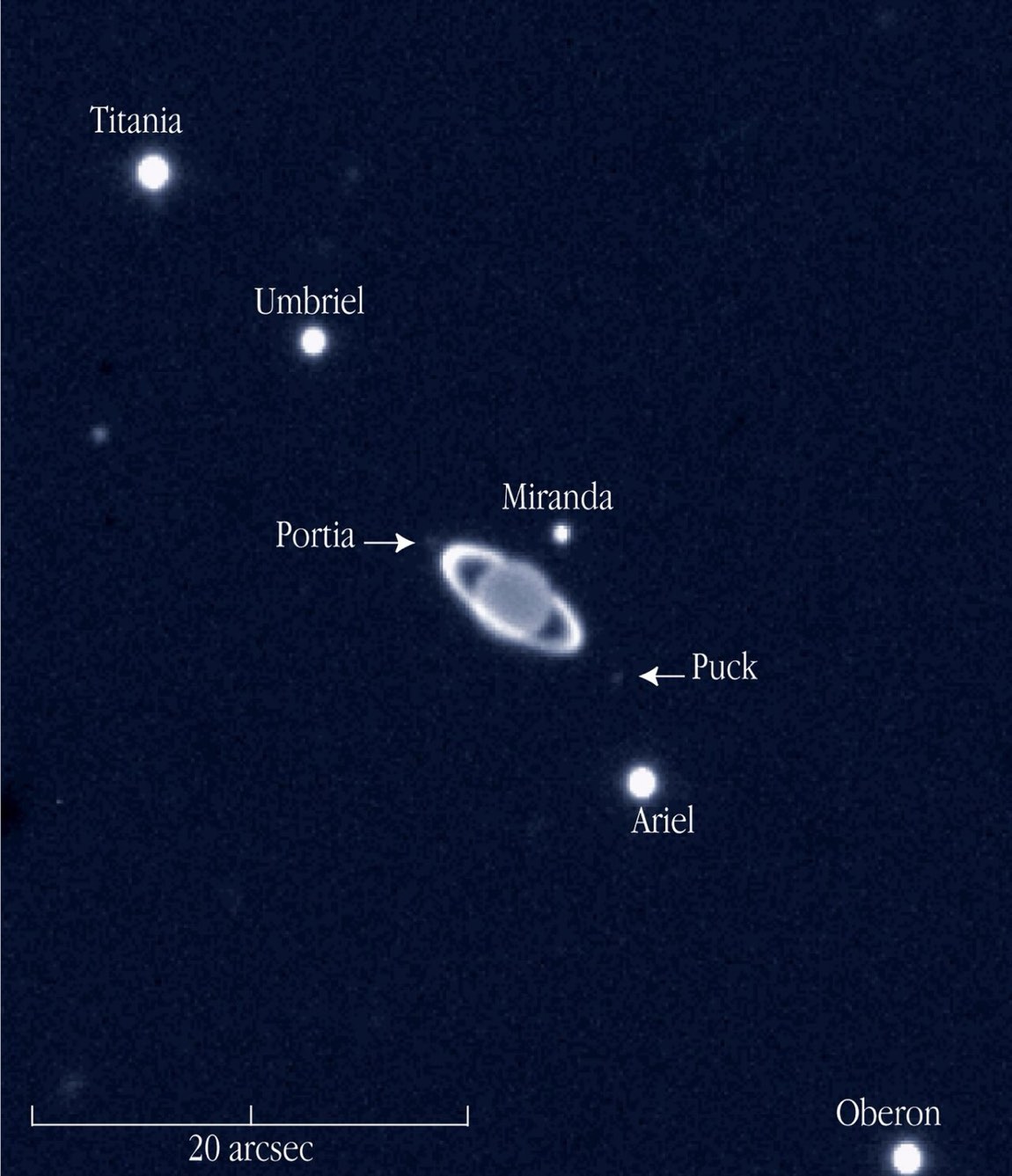
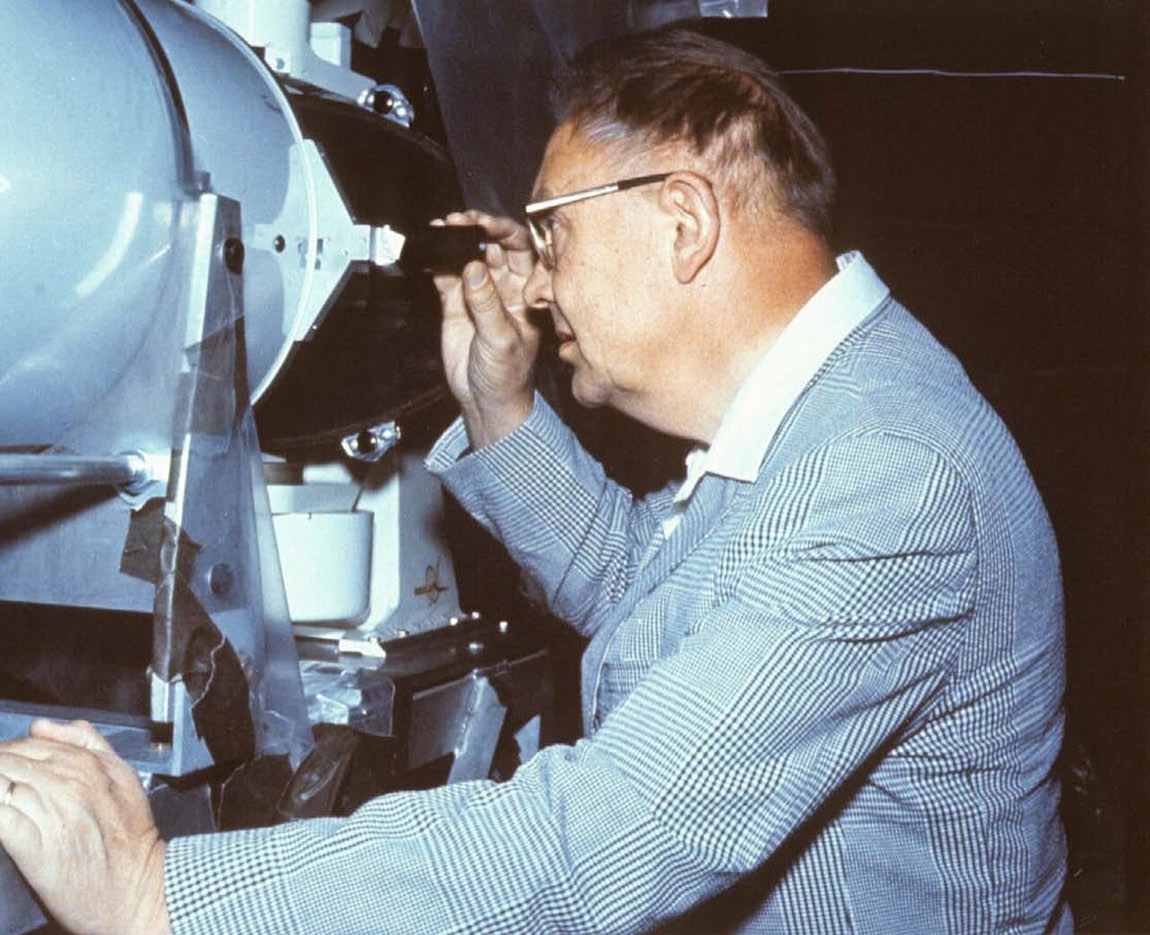
Gerard Kuiper spotted Miranda on 16 February 1948 using the McDonald Observatory's 82-inch Otto Struve Telescope in Texas, confirming its motion around Uranus just two weeks later, on 1 March 1948. It was the first new Uranian moon found in nearly a hundred years, a remarkable gap that reflects how difficult these faint, distant objects are to detect. Kuiper deliberately chose the name Miranda, after the human character in Shakespeare's The Tempest, to continue the tradition set by the four previously discovered Uranian moons — Ariel, Umbriel, Titania, and Oberon — which had all been named after characters from Shakespeare or Alexander Pope. There was one subtle break from tradition, however: those earlier moons had been named specifically after fairies, while Miranda is human. The choice stuck, and all subsequently discovered satellites of Uranus follow the same broader Shakespearean and Popean convention. Miranda is also formally designated Uranus V. A symbol was later proposed by software engineer Denis Moskowitz — an M combined with Jérôme Lalande's Uranus globe symbol — but it has never come into widespread use.
02 An Orbit Unlike Any Other Round Moon
Miranda hugs Uranus more tightly than any other round satellite, orbiting at roughly 129,000 km from the planet's surface — about a quarter again as far as Uranus's most distant ring. Its orbital period is just 34 hours, and like Earth's Moon, it is tidally locked: it always shows the same face to Uranus. What makes Miranda's orbit genuinely puzzling is its inclination of 4.34°, which is roughly ten times higher than those of the other major Uranian moons and an astonishing 73 times that of the outermost large moon, Oberon. For a body so close to its planet, gravitational theory would predict a very flat, nearly circular orbit, so this tilt demands an explanation. No straightforward mean-motion resonance between the present-day moons can account for it. The leading hypothesis involves secondary resonances that, at some point in the past, locked Miranda into a 3:1 resonance with Umbriel, before chaotic dynamics ejected it from that resonance. Escape from such resonances is apparently easier in the Uranian system than around Jupiter or Saturn, because Uranus is less oblate and its moons are proportionally larger relative to the planet.
03 One Spacecraft, One Chance, 24 Hours
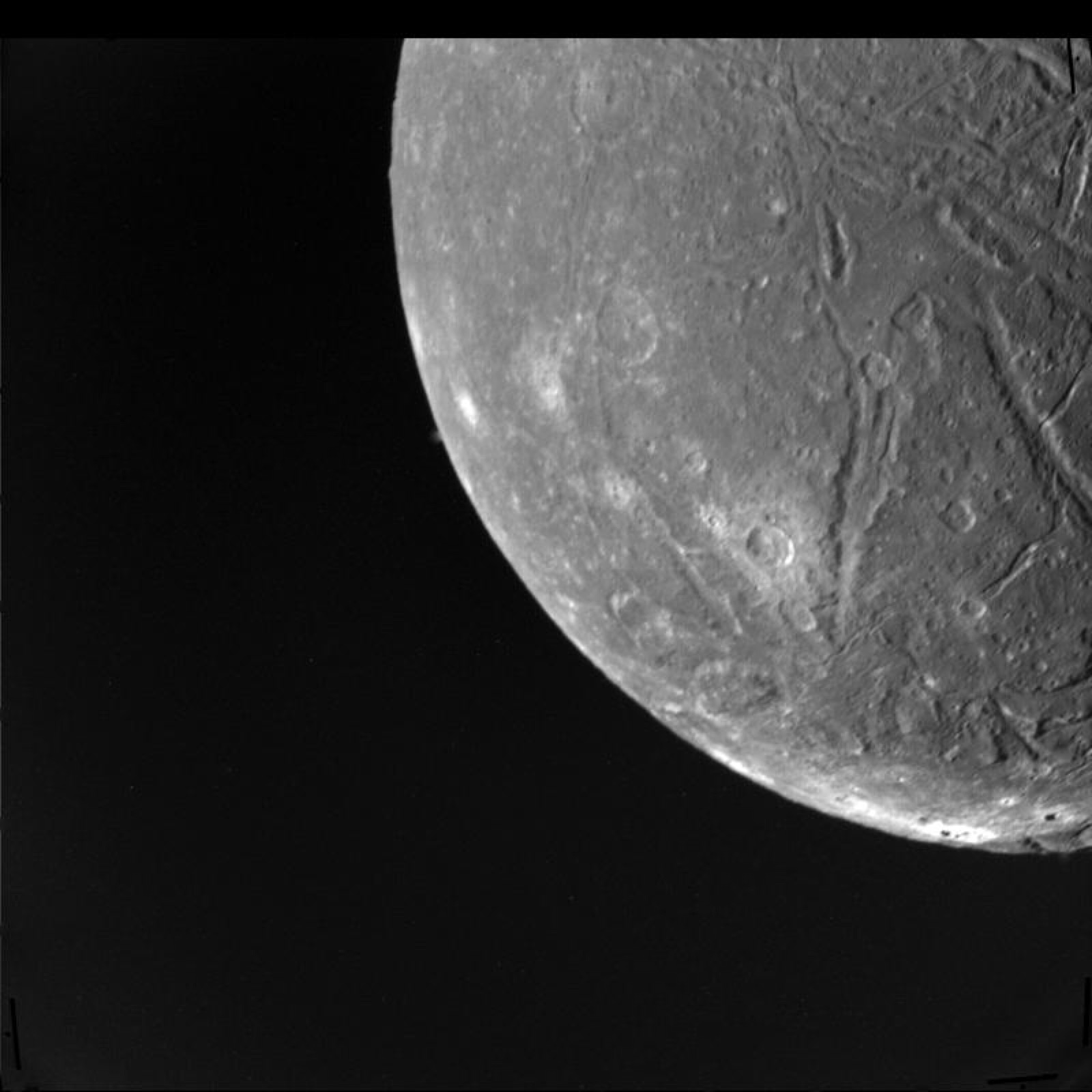
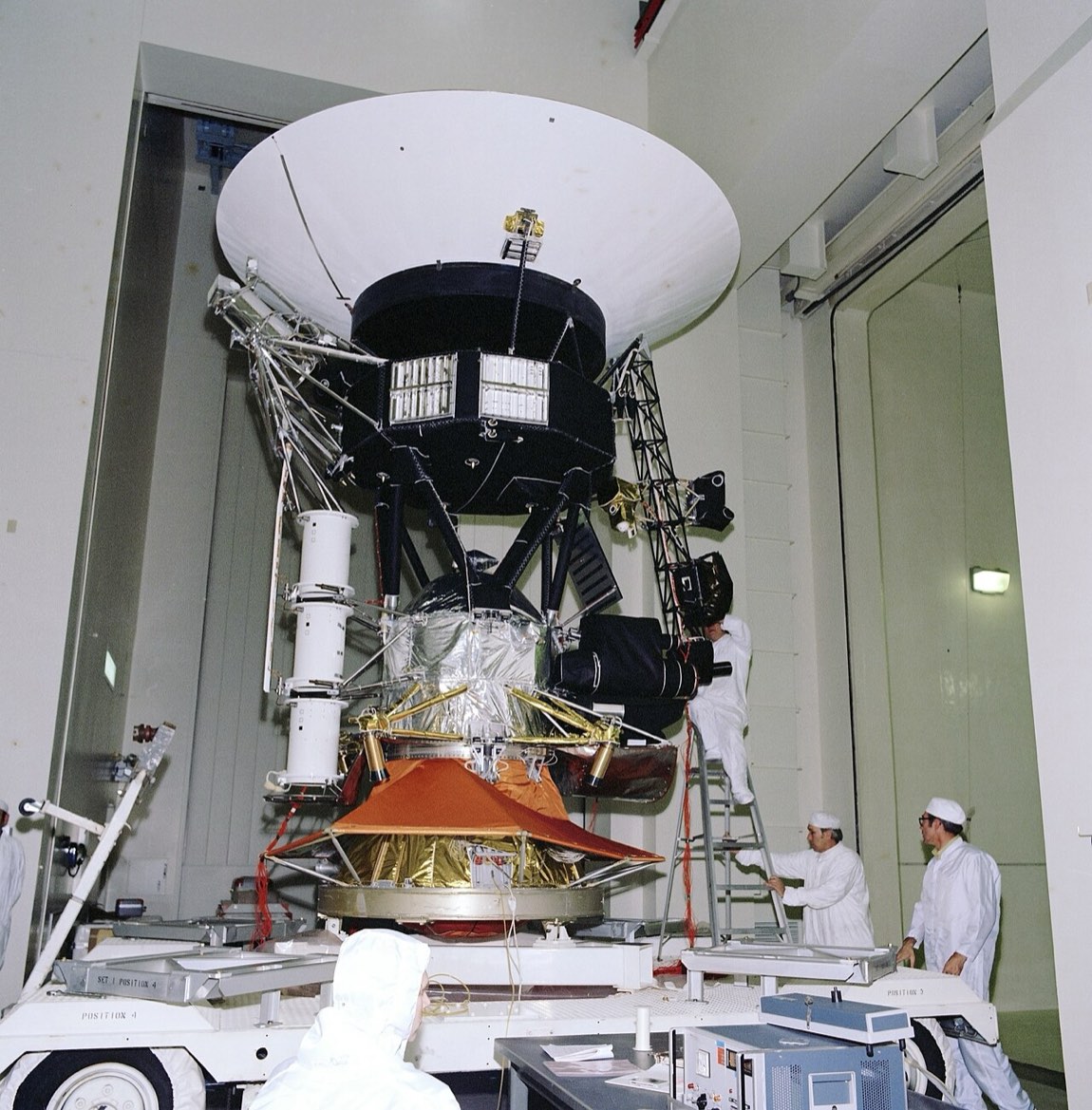
Everything we know in close-up detail about Miranda's surface comes from a single encounter: Voyager 2's flyby of the Uranian system on 24 January 1986. Of all Uranus's satellites, mission planners directed Voyager 2 to pass closest to Miranda, reaching a minimum distance of just 29,000 km — far closer than its approach to any other Uranian moon, which is why Miranda's surface ended up being the most thoroughly imaged. The science team had expected Miranda to resemble the heavily cratered and geologically bland moon Mimas, so what the images revealed left them scrambling. They had less than 24 hours before they were due to release the pictures to the press, and in that window they struggled to explain the moon's bizarre, patchwork landscape. A significant limitation of the flyby was geometry: Miranda's southern hemisphere was pointing toward the Sun at the time, so the northern hemisphere was in polar night and remains unimaged to this day. In 2017, NASA's Planetary Science Decadal Survey evaluated returning to the Uranian system with an orbiter in the 2020s, preferring Uranus over Neptune because favorable planetary alignments would allow shorter flight times.
 ⤢
⤢
04 Ice, Rock, and a Surprisingly Dense Interior Deeper
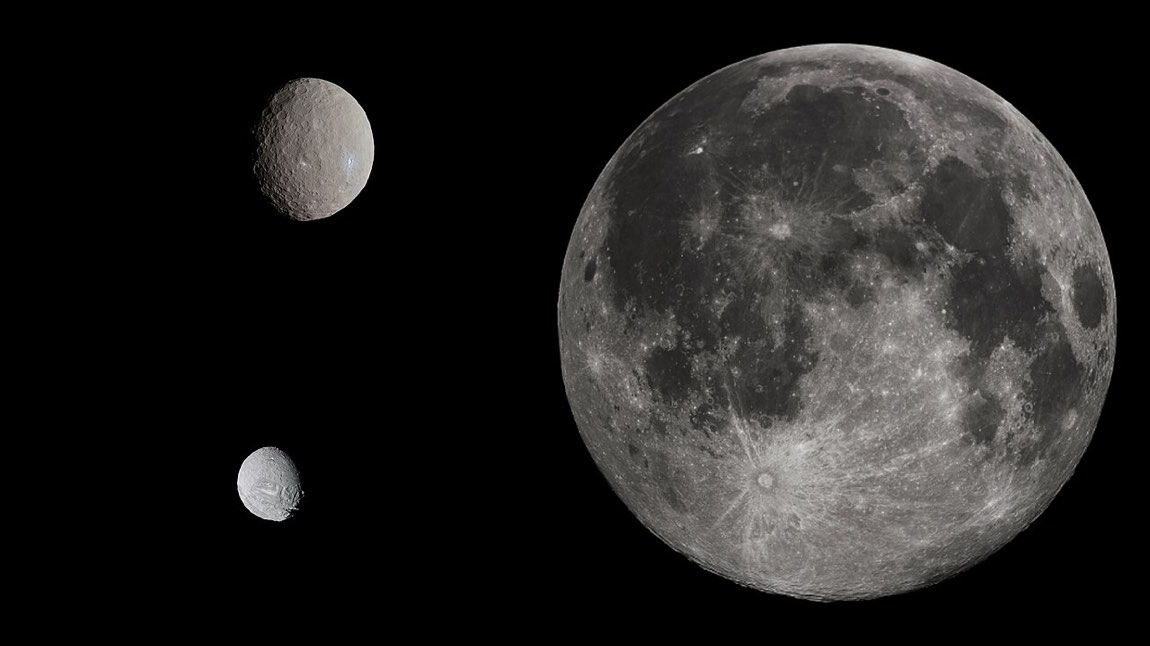
Miranda has a bulk density of just 1.15 g/cm³, the lowest among Uranus's five round satellites, implying a composition of more than 60% water ice. Despite its icy nature, Miranda is noticeably rockier than analogous moons in the Saturn system — a fact scientists interpret as evidence that heat from radioactive decay drove some internal differentiation, allowing denser silicate rock and organic compounds to settle toward the center while ice remained near the surface. That said, Miranda is too small to have retained internal heat over the full age of the Solar System, so it should, by simple thermal models, be cold and geologically dead. Only water ice has actually been detected on its surface; methane, ammonia, carbon monoxide, and nitrogen have been speculated to exist at concentrations of around 3%, but not yet confirmed. Miranda is also the least spherical of Uranus's round moons, with an equatorial diameter about 3% wider than its polar diameter. In bulk properties it resembles Saturn's moon Mimas, though Mimas is smaller, less dense, and more oblate. A 2024 study by Strom et al. combined geological mapping of Voyager 2 images with tidal stress modelling, suggesting that Miranda may have harbored a subsurface liquid ocean roughly 100 km thick within the last 100 to 500 million years.
05 The Mystery of Where the Heat Came From Deeper
Miranda's surface is shockingly young and active-looking for such a small, cold body, and explaining the necessary heat source has occupied planetary scientists for decades. The leading hypothesis centers on tidal heating during a past 3:1 orbital resonance with Umbriel. In that resonance, Miranda's orbital eccentricity could have risen to about 0.1. As Miranda moved closer to Uranus in its elliptical orbit, the tidal pull from the planet increased; as it swung farther away, that pull decreased. This rhythmic squeezing and stretching would have warmed Miranda's interior by as much as 20 K — enough to trigger partial melting and drive geological activity. The tidal flexing period may have lasted up to 100 million years. A secondary contribution could have come from a past 5:3 resonance with Ariel, though the heating attributable to the Umbriel resonance was likely about three times greater than Ariel's contribution. Clathrates — cage-like ice structures that can trap gas molecules — may also have played a role: if present inside Miranda, their lower thermal conductivity compared to water ice would have acted as insulation, raising internal temperatures further. After Miranda escaped the resonance, the orbital eccentricity diminished and tidal heating switched off, leaving the moon geologically frozen in its present, tortured state.
06 Coronae: Miranda's Most Puzzling Landforms
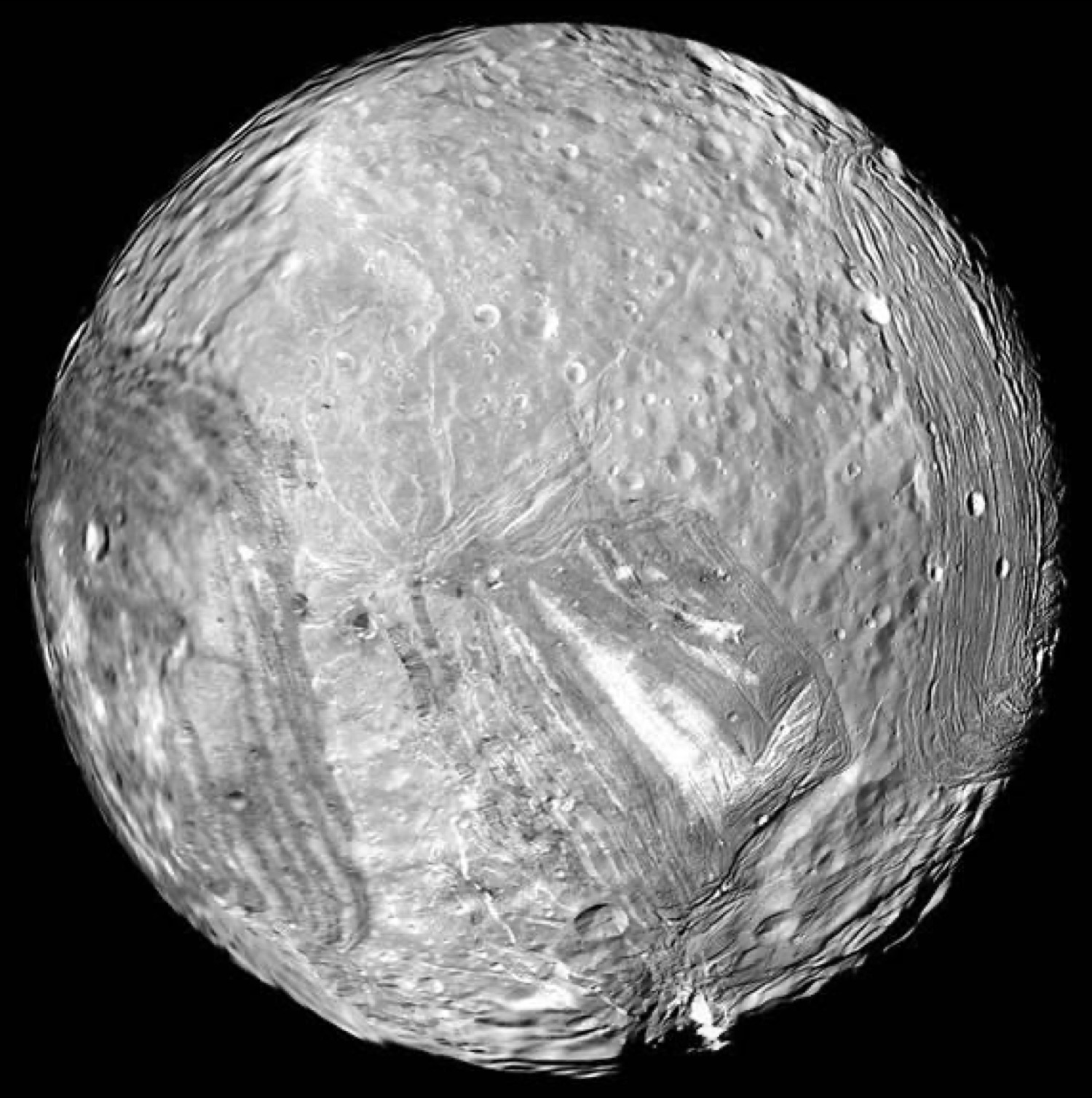
Miranda is one of very few objects in the Solar System to bear coronae — roughly ovoid or rectangular regions of intensely deformed terrain. Three are known. Inverness Corona, the youngest of the three, sits near the south pole and spans about 200 km on a side. It is trapezoidal in outline, dominated by parallel gorges spaced a few kilometers apart, and features a high-albedo central chevron shape that makes it one of the most visually striking patches on any moon. Arden Corona, located on Miranda's leading orbital hemisphere, stretches at least 300 km from east to west, though its full extent was cut off by the nightside boundary during Voyager 2's pass. Its interior appears relatively smooth and mottled, surrounded by concentric dark albedo bands composed of fault scarp faces. Elsinore Corona, on the trailing hemisphere, is broadly similar in size and structure to Arden, featuring intersecting troughs and ridges in its core that are truncated by a surrounding belt of concentric linear ridges; some of its troughs resemble the sulci — long furrows — seen on Jupiter's moon Ganymede. Arden and Elsinore appear to have formed during the same geological episode, which preceded the formation of Inverness.
 ⤢
⤢
07 Verona Rupes and Miranda's Giant Cliffs
Miranda hosts some of the most dramatic vertical relief found anywhere in the Solar System. A network of enormous escarpments traces across its surface, some predating the coronae and some postdating them. The most famous is Verona Rupes, a sheer cliff face roughly 20 km high that may be the tallest cliff yet identified in the Solar System — for comparison, Mount Everest rises about 8.8 km above sea level, so Verona Rupes could be more than twice that height. The fault system of which Verona Rupes is a part begins on the northwest side of Inverness Corona, forming a deep gorge along the outer edge of the corona before the main cliff extends toward the terminator. The graben associated with the bright edge of Verona Rupes is 10 to 15 km deep, and the fault itself is approximately 20 km wide. Because this structure sits near the edge of the region that was sunlit during Voyager 2's pass, its full extent into the unobserved northern hemisphere remains unknown. A related system, Argier Rupes, begins at the northwest of Inverness and forms a deep gorge along the outer boundary of the corona. The formation of Inverness appears to have induced surface tensions that directly gave rise to these spectacular ruptures.
08 Reading Time from Craters on Miranda Deeper
Planetary scientists use impact crater counts as chronometers: the more craters packed onto a surface, the older that surface is. On Miranda, this technique reveals stark age differences across the moon's patchwork terrain. The ancient cratered plains — regions like Sicilia Regio and Ephesus Regio — carry the highest crater densities and represent Miranda's oldest surviving surfaces, dating back to shortly after the moon's formation around 3.5 billion years ago. By contrast, craters in the coronae are statistically up to ten times less numerous than in the heavily bombarded anti-Uranian hemisphere, confirming that the coronae are geologically younger. Even within a single corona, crater counting adds nuance: within Inverness, detailed density measurements show that the zone separating the central chevron from Argier Rupes is the youngest part. Within Arden, the superposition of craters on bands in the central core indicates the core formed before the surrounding fault scarps. An intriguing anomaly complicates the picture: crater counts suggest the anti-Uranian hemisphere should be the apex of Miranda's orbital motion — the hemisphere that sweeps up more debris and therefore accumulates craters fastest. One proposed explanation is that Miranda underwent a 90° reorientation of its rotation axis at some point in its past, so what is now the anti-Uranian hemisphere was once the apex hemisphere.
09 Three Billion Years of Geological Episodes Deeper
Miranda's geological history is thought to have unfolded over more than 3 billion years in a sequence of distinct episodes. The first epoch began about 3.5 billion years ago with the accretion of the moon and its rapid cooling, producing the heavily cratered plains. Even then, something surprising was already happening: the bottoms of the oldest craters show evidence of endogenous resurfacing — material welling up from depth — indicating an internal heat source was already at work. A second epoch saw overall cooling that caused Miranda's core to expand, cracking and fracturing the surface mantle into grabens. A third major episode involved the orbital reorientation of the moon and the formation of Elsinore and Arden coronae, possibly driven by a diapir — a blob of buoyant material — rising from the interior, which may have partially differentiated the moon and changed its moment of inertia enough to trigger the 90° reorientation. A final episode produced Inverness Corona and, with it, the grabens of Verona Rupes and Argier Rupes. After this last burst of activity, Miranda's total volume may have increased by about 4%. The heat source that powered all of this activity was ultimately silenced when Miranda escaped its resonance with Umbriel, the eccentricity faded, tidal heating shut down, and the moon became the cold, inert but scenically extraordinary world seen today.
 ⤢
⤢
10 Named Regions and How They Were Mapped
The major terrain units visible in Voyager 2 images are called regiones, and four have been formally identified: Mantua Regio, Ephesus Regio, Sicilia Regio, and Dunsinane Regio. These names — like everything else on Miranda — are drawn from the Shakespearean universe: Mantua from Romeo and Juliet, Elsinore and Inverness and Arden from Hamlet, As You Like It, and Macbeth respectively. The regiones are characterized by hilly terrain and plains punctuated by ancient impact craters, and they are cut by normal faults. Some of these fault scarps are as old as the regiones themselves, while others are visibly younger than the coronae that formed later. The surfaces of the regiones are generally uniformly dark, but the cliffs bordering some impact craters expose much brighter material at depth, hinting that a more reflective layer lies beneath a dark surface coating. In some parts of the anti-Uranian hemisphere, craters are so densely packed they nearly touch each other, while elsewhere the same regiones have widely spaced craters separated by gently rolling plains. A possible ancient impact basin about 170 km in diameter, very heavily degraded, has been identified in Mantua Regio between craters Truncilo and Fransesco, though it is so eroded that its identification as a basin remains tentative.
11 Why Miranda's Apparent Magnitude Matters
Miranda sits at an apparent magnitude of +16.6 as seen from Earth, which places it well beyond the reach of most amateur telescopes. For context, the human eye can detect objects down to about magnitude +6 or +7 under dark skies, and a typical backyard telescope might push to magnitude +13 or +14 under ideal conditions. Reaching Miranda requires a large professional instrument or long-exposure astrophotography with careful guiding. Even when it is within instrumental reach, distinguishing Miranda from the glare of Uranus itself — and from its sibling moons — demands precise timing and knowledge of the satellite's orbital position. Its tiny angular diameter, corresponding to a physical size of just 470 km across at the enormous distance of Uranus from Earth, means that no surface detail is resolvable from the ground. This is why Voyager 2's 29,000 km close approach in 1986 remains the only source of any real geological knowledge about the moon. The case for a dedicated Uranian orbiter, evaluated by NASA in 2017, rests in large part on the recognition that ground-based and even Earth-orbital observations can never substitute for in-situ spacecraft data when studying worlds as small and distant as Miranda.
12 Open Questions Science Has Yet to Answer Deeper
Despite decades of analysis of Voyager 2 data, Miranda remains one of the Solar System's most scientifically unresolved worlds. The origin of its anomalously high orbital inclination of 4.34° — roughly ten times that of the other major Uranian moons — is still uncertain, with the secondary resonance hypothesis remaining just that: a hypothesis. The full geometry of the moon's surface is unknown because the northern hemisphere has never been photographed; it is entirely possible that Miranda's reorientation history is more complex than a single 90° flip, with the ancient apex hemisphere located somewhere in the as-yet-unseen north. Whether the coronae formed from diapirs, solid-state convection, tidal stress, or some combination of these mechanisms remains actively debated. The 2024 study by Strom et al. introduced the striking possibility of a geologically recent subsurface ocean up to 100 km thick, which would place Miranda alongside a growing list of icy moons with potential liquid interiors — but this finding awaits confirmation from future missions. Whether the catastrophic breakup-and-reaccretion scenario, largely deprecated in 2011 in favor of tidal heating models, can be fully ruled out also remains an open question. Resolving any of these issues will almost certainly require a new spacecraft in orbit around Uranus.
 ⤢
⤢
You would weigh…
Surface gravity 0.08 m/s² vs Earth’s 9.81 m/s². Try every world →
More real images of Miranda
Genuine spacecraft and telescope imagery, every frame credited and licensed. Tap any photo to enlarge.