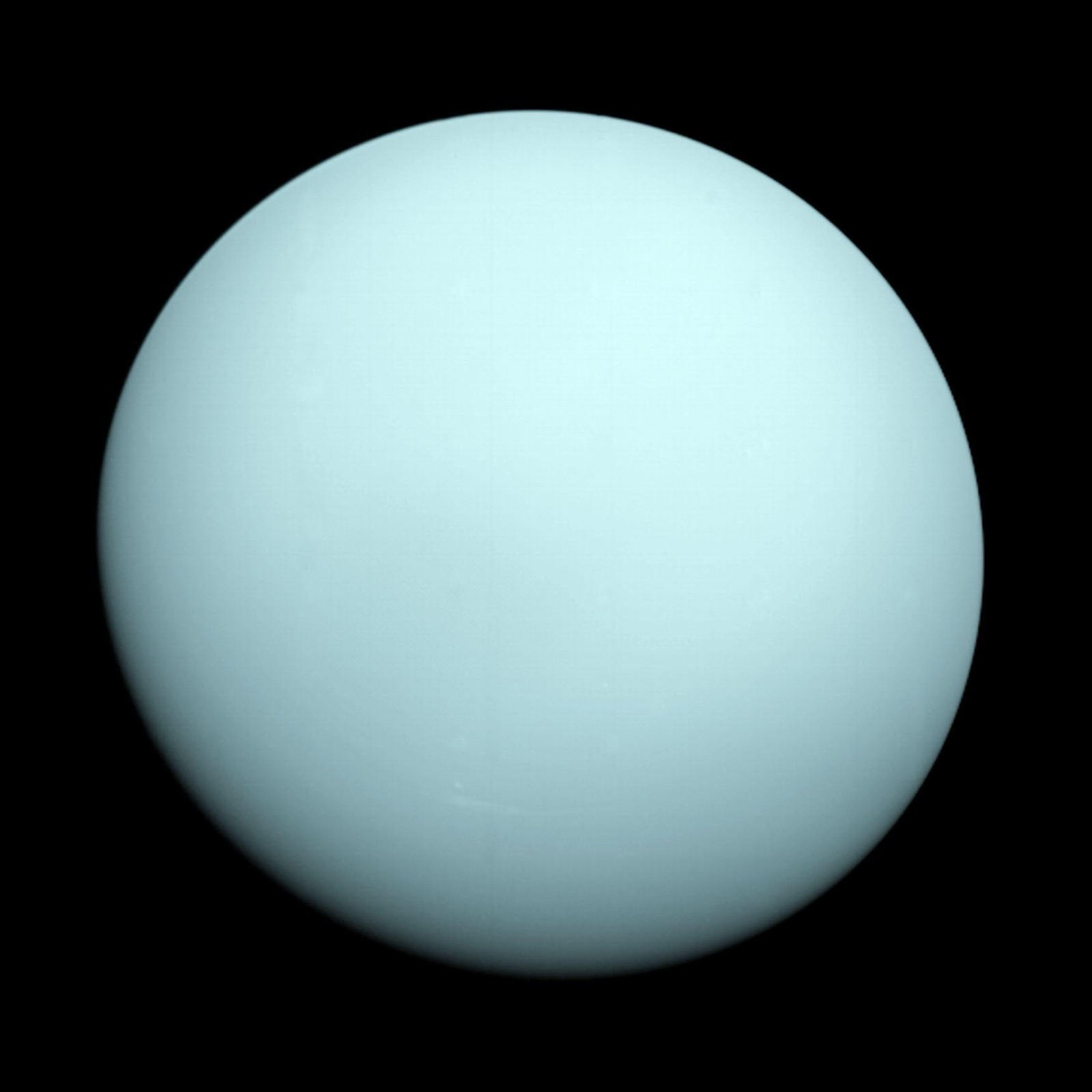
 Photograph · NASA/JPL · Public domain
Moon · Deep guide · orbits Uranus
Cordelia
Also called: Uranus VI · S/1986 U 7
The innermost moon of Uranus, herding the inner edge of the planet's brightest ring.
What is it?
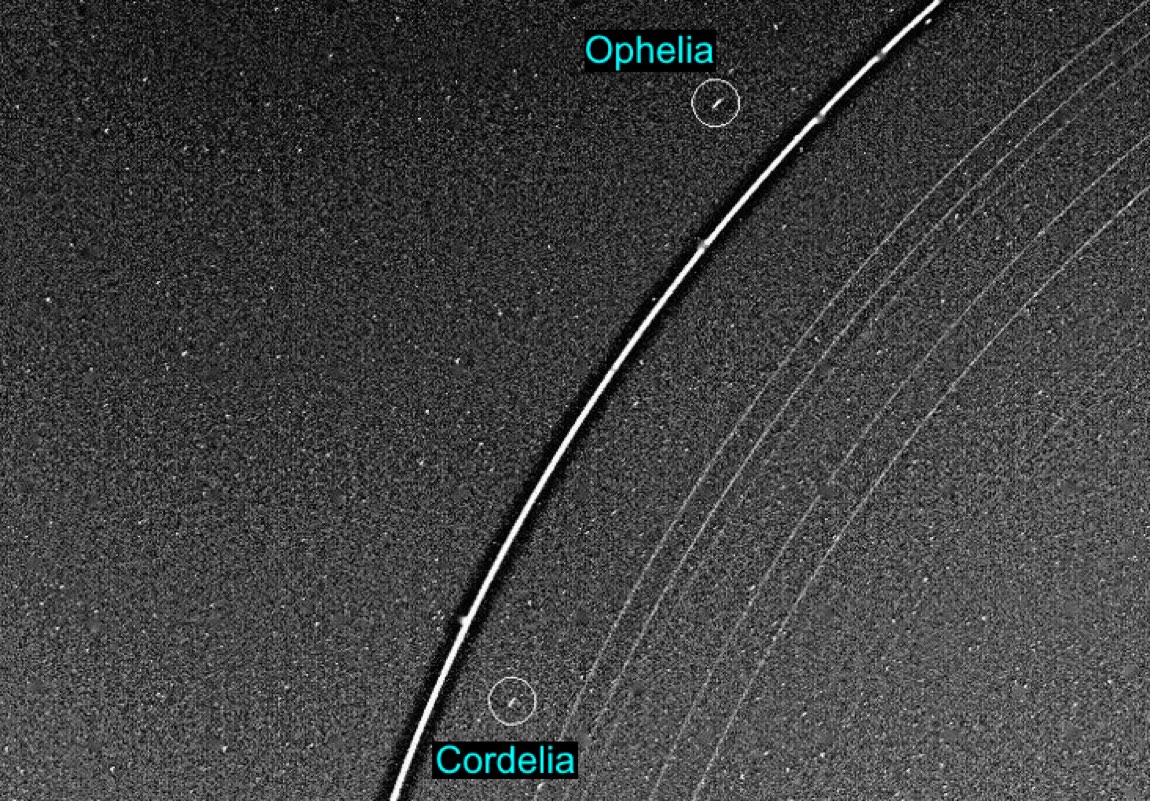
Cordelia is the closest known moon to Uranus, a small, stretched-out chunk spotted in Voyager 2 images in January 1986. It circles the planet in about eight hours and works as the inner 'shepherd' of the epsilon ring, its gravity helping keep the ring's edge sharp; Ophelia guards the other side. Because it orbits faster than Uranus spins, tides are slowly dragging it inward. Like the other moons in this crowded zone, it is named after a Shakespeare character, the youngest daughter in King Lear.
The deep dive
Researched for the Atlas from Wikipedia — Cordelia (moon) (1,224 characters read) · updated Nov 15, 2026
01 A Moon Found in a Single Flyby
Cordelia owes its discovery to a fleeting moment in planetary exploration. Voyager 2 spotted it in images taken on January 20, 1986, during the spacecraft's only close pass of Uranus, and scientists gave it the cautious temporary designation S/1986 U 7. Because Cordelia orbits so close to Uranus and is so faint, no telescope on Earth could confirm it at the time. The moon then effectively vanished from science's reach for more than a decade. It was not detected again until the Hubble Space Telescope re-acquired it in 1997 — eleven years after its discovery. That gap underscores just how difficult inner Uranian moons are to study: they sit deep inside the planet's glare, lost against the brightness of the giant world they orbit. Cordelia is now formally designated Uranus VI, marking it as the sixth Uranian moon to receive an official number, and it retains its place as the innermost known moon of Uranus.
02 Named for Shakespeare's Most Loyal Daughter
The name Cordelia comes from William Shakespeare's tragedy King Lear, where Cordelia is described as the youngest daughter of King Lear — a character renowned for her honesty and loyalty in the face of her father's poor judgment. The moons of Uranus follow a distinctive naming convention drawn entirely from Shakespearean characters and, in a few cases, characters from Alexander Pope's poetry. This sets the Uranian system apart from every other planetary family in the solar system, where moon names tend to come from classical Greek and Roman mythology. Cordelia's name was chosen after the temporary S/1986 U 7 designation was retired. The choice is fitting in a small astronomical irony: just as the character Cordelia is easy to overlook amid the drama surrounding her, the moon itself is easy to miss — tiny, dark, and buried close to its massive parent planet.
03 An Oddly Stretched, Flattened Little World Deeper
Cordelia is not a tidy sphere. Voyager 2 images show it as an elongated object measuring 50 km by 36 km (31 mi by 22 mi) — roughly the length of Los Angeles laid end to end, though far narrower. Its shape is described as a prolate spheroid, meaning it is stretched along one axis like a rugby ball, and the ratio of its axes is 0.7 ± 0.2, though the uncertainty of ±0.2 is large enough to leave the precise shape genuinely ambiguous. Even more intriguing, Voyager 2 caught Cordelia with its major axis pointing directly toward Uranus, a tidally locked orientation consistent with many small, close-orbiting moons. Observations made between 2001 and 2007 introduced a fresh complication: Cordelia had dimmed by roughly a factor of five compared to 1986. Researchers attribute this dramatic brightness drop to a change in viewing geometry since the Voyager flyby, which in turn suggests Cordelia may actually be much more flattened in shape — and significantly smaller in true size — than the original Voyager measurements implied.
04 A Shepherd Keeping the Epsilon Ring in Line
Cordelia's most consequential role in the Uranian system is not as an individual world but as a gravitational gatekeeper. It acts as the inner shepherd satellite for Uranus's epsilon ring, the brightest and most prominent of the planet's narrow rings. Shepherd satellites work by gravitationally nudging ring particles that stray too far inward, effectively herding them back and preventing the ring from spreading out and dissipating over time. Without Cordelia on the inside and another moon, Ophelia, on the outside, the epsilon ring would gradually dissolve. This shepherding mechanism was one of the great practical demonstrations of celestial mechanics that the Voyager 2 flyby confirmed, turning a theoretical prediction into an observed reality. Cordelia is thus far more important to the architecture of the Uranian ring system than its modest 50 km size would suggest.
05 Tidal Forces Are Pulling It Inward Deeper
Cordelia orbits inside Uranus's synchronous orbit radius — the distance at which a moon would orbit at exactly the same rate as the planet rotates. Any moon sitting closer than this boundary faces a relentless gravitational drag. Uranus's tidal forces continuously steal angular momentum from Cordelia, causing the moon's orbit to decay slowly but steadily inward. This process is called tidal deceleration, and it means Cordelia is on a long, one-way journey toward Uranus. The timescale for this orbital decay is not specified in current measurements, but the direction is certain: Cordelia is drifting closer to the planet with every orbit it completes. This situation raises a pointed question about the long-term fate of both the moon and the epsilon ring it shepherds — if Cordelia eventually spirals too far inward, its shepherding influence will weaken and the ring's inner boundary may destabilize.
06 Almost in Step with Rosalind Deeper
Cordelia is not entirely isolated in its orbital neighborhood. It sits very close to a 5:3 orbital resonance with Rosalind, another small Uranian moon. A 5:3 resonance means that for every five orbits Cordelia completes, Rosalind completes approximately three. Orbital resonances like this are significant because they create repeating gravitational nudges between two bodies, which can either stabilize or destabilize orbits over long timescales depending on the geometry involved. The word "close" here matters: the article describes this as nearly, but not exactly, a 5:3 resonance, leaving open questions about whether the two moons are locked in a true resonance or simply passing through a near-coincidence. Either way, the relationship between Cordelia and Rosalind adds a layer of dynamical complexity to the innermost region of the Uranian moon system that scientists continue to study.
07 How Dark Is Dark? Understanding Its Albedo
Cordelia's geometric albedo — the measure of how much light its surface reflects — is just 0.056. To put that in context, fresh asphalt reflects roughly 4–5% of incoming light, making Cordelia's surface only marginally brighter than a freshly paved road. This extremely low reflectivity is consistent with the other inner Uranian moons and with the ring particles they shepherd, all of which share a similarly dark, possibly carbon-rich or radiation-processed composition. The albedo value comes from Voyager 2 observations, but the subsequent discovery that Cordelia's brightness dropped by a factor of five between 1986 and the 2001–2007 observation period complicates how confidently scientists can interpret even this basic measurement. If the apparent brightness change is explained by viewing geometry rather than a real surface change, the albedo derived from different viewing angles could look very different, adding uncertainty to what might seem like a settled number.
08 Why It Disappeared for Eleven Years
The eleven-year gap between Cordelia's 1986 discovery and its 1997 redetection by Hubble is not a mystery of physics so much as a problem of practical astronomy. Cordelia is small — at most 50 km across — and dark, with an albedo of only 0.056. It orbits extremely close to Uranus, a planet that blazes brilliantly in comparison. Ground-based telescopes of the 1980s and early 1990s simply lacked the resolution and light-suppression technology to pick out such a faint speck so near its parent planet's overwhelming glare. Even Hubble, when it finally reacquired Cordelia in 1997, was working at the edge of what was technically feasible. This practical invisibility explains why so little is known about Cordelia beyond the basic parameters gleaned from Voyager 2's brief encounter: it has had almost no follow-up observation time compared to more accessible moons in the solar system.
09 Open Questions That May Take Decades to Resolve Deeper
Despite being discovered in 1986, Cordelia remains deeply mysterious. Its true shape is uncertain: it appears elongated in Voyager 2 images, but the factor-of-five brightness drop seen between 1986 and the 2001–2007 observations suggests the moon may be considerably flatter and smaller than originally measured, with the precise dimensions still unresolved. Its interior structure, composition, and surface geology are entirely unknown — no spectral data detailed enough to identify surface materials exists in the published record. Whether its near-5:3 resonance with Rosalind is dynamically meaningful or merely coincidental remains an open question. And the timescale of its orbital decay, while qualitatively understood to be inward due to tidal deceleration, has not been pinned down with precision. Answering these questions would likely require a dedicated Uranus orbiter with modern instruments, a mission that as of the article's coverage has not yet flown.