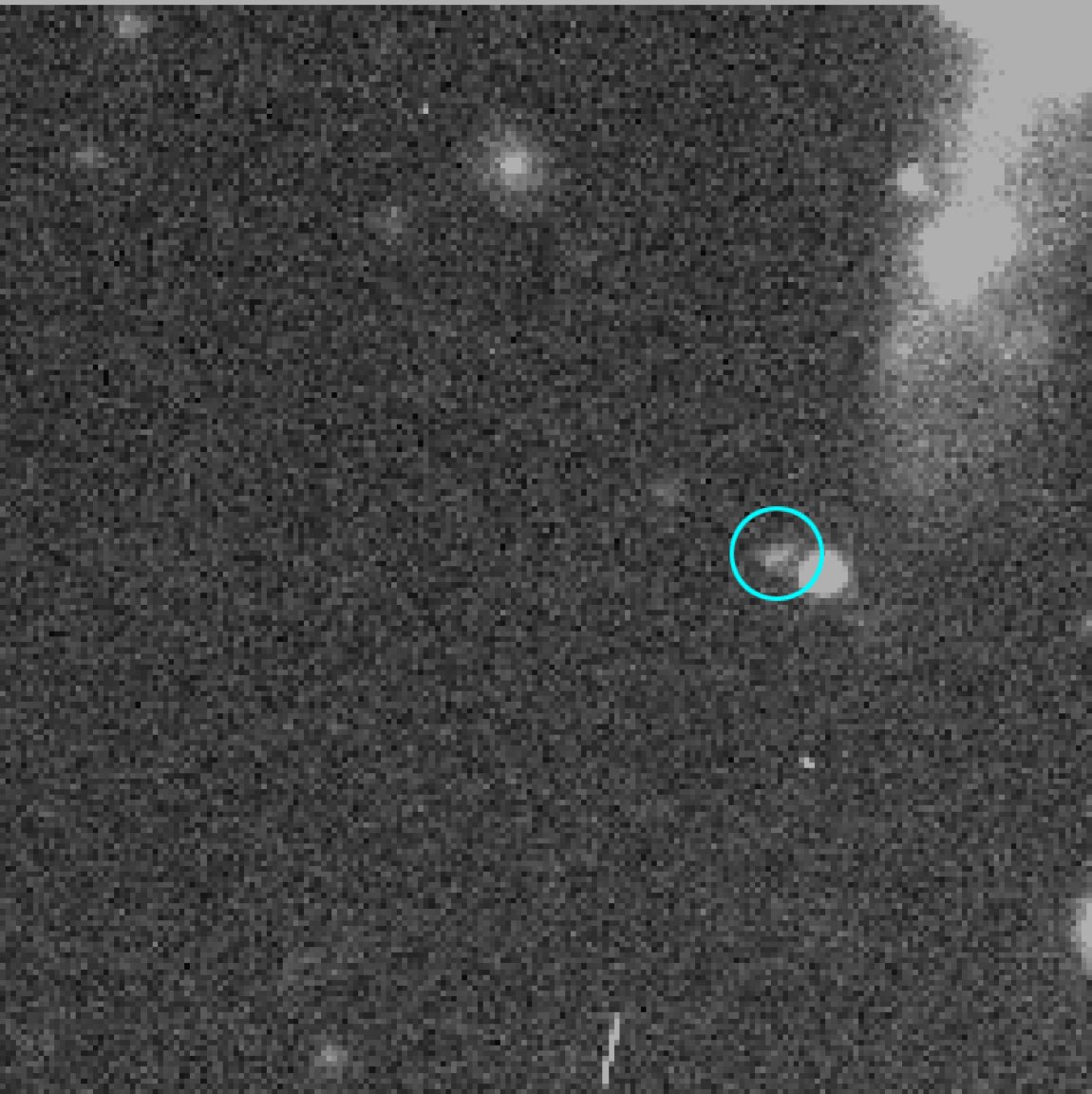
 Photograph · Brett J. Gladman/Observatoire de la Cote d'Azur · CC BY-SA 2.0
Moon · Deep guide · orbits Uranus
Prospero
Also called: Uranus XVIII · S/1999 U 3
A grey, elongated captured moon tumbling around Uranus on a backwards orbit.
What is it?
Prospero was discovered on 18 July 1999 in Canada–France–Hawaii Telescope images by a team that also found Setebos and Stephano. It is roughly 50 km wide, with a neutral grey colour. Its orbit is retrograde and strongly stretched, averaging about 16 million km from Uranus and taking about 5.4 years per circuit. Brightness changes recorded by the Kepler telescope suggest it is elongated, at least 1.4 times longer than it is wide. It is named after the sorcerer in The Tempest.
The deep dive
Researched for the Atlas from Wikipedia — Prospero (moon) (3,511 characters read) · updated Nov 15, 2026
01 Three Moons Found in a Single Night
Prospero did not arrive in the catalogue alone. On 18 July 1999, Matthew Holman and his team discovered Prospero, Setebos, and Stephano all in the same observing session — a remarkable haul that underscores how thoroughly the outer reaches of Uranus had been overlooked before the era of large digital sky surveys. The discovery triggered the standard pipeline of the Minor Planet Center, which issued the provisional label S/1999 U 3 while the object awaited confirmation and a permanent name. That formal recognition came just over a year later, on 21 August 2000, when the International Astronomical Union's Working Group for Planetary System Nomenclature officially christened the moon and assigned it the Roman numeral designation Uranus XVIII. The relatively short gap between discovery and naming reflects how well-established the Shakespearean naming convention for Uranian moons had already become by the turn of the millennium.
02 A Name Drawn from Shakespeare's Magic Isle
Every irregular moon of Uranus carries a name from the works of William Shakespeare or Alexander Pope, and Prospero is no exception. The moon was named after the sorcerer Prospero, the exiled duke and central figure of Shakespeare's play The Tempest — a character defined by his command of magic, his remote island domain, and his complicated relationships with the spirits and creatures that serve him. The choice is thematically fitting: Prospero the moon is itself a remote, poorly understood wanderer trapped in a distant and chaotic orbit far from the planet it circles. The naming decision was made by the IAU's Working Group for Planetary System Nomenclature, the body responsible for standardising names across the solar system. That same working group also named Setebos and Stephano, the two sibling moons found alongside Prospero, after other characters from the same Shakespeare play.
03 An Extreme Orbit Far from Uranus Deeper
Prospero's orbit is unusual even by the standards of irregular moons, which are generally defined by their large distances and tilted paths. It circles Uranus at a mean distance of approximately 16,256,000 km — for comparison, that is roughly 42 times the distance from Earth to the Moon. The orbit is retrograde, meaning Prospero travels in the direction opposite to Uranus's rotation, and it is steeply inclined at approximately 152° to the ecliptic. Even more striking is its high orbital eccentricity of 0.445, which means the path is far from circular: at its closest Prospero swings significantly inward, and at its farthest it retreats to a much greater distance. This eccentricity, combined with the inclination, makes the orbit vulnerable to ongoing gravitational nudges. The article notes that Prospero's orbital elements are subject to continuous variations caused by solar and planetary perturbations, so its exact path shifts measurably over time.
04 Why Prospero Probably Wasn't Born Here
The conventional view among planetary scientists is that Prospero is a captured object rather than a moon that formed alongside Uranus from the same disk of material. The evidence is circumstantial but consistent: its retrograde orbit, high inclination, and large distance from the planet are all signatures that point to a body that arrived from somewhere else and was gravitationally ensnared rather than assembled in place. The article also notes that Prospero's orbital parameters suggest it may belong to the same dynamic cluster as Sycorax and Setebos, hinting that all three could share a common origin — perhaps fragments of a single captured body that broke apart, or objects swept in from the same region of the early solar system. However, Sycorax complicates the picture: it is considerably redder in color than Prospero and Setebos, which are predominantly gray, so the colour evidence does not cleanly support a single shared source.
05 Colour Clues and What Grey Tells Us Deeper
Although Prospero is too small and distant for detailed surface mapping, astronomers can still extract meaningful information from its colour. Prospero appears neutral — that is, grey — in visible light, with measured colour indices of B−V = 0.80 and R−V = 0.39. These values are very similar to those of Setebos, the moon discovered alongside it. In the broader context of outer solar system bodies, a grey or neutral colour often indicates a surface dominated by silicate rock or processed material rather than the reddish organic compounds called tholins that give many trans-Neptunian objects their ruddy appearance. The fact that Prospero and Setebos share both similar colours and similar orbital characteristics has led researchers to suggest they may share a common origin. That hypothesis remains unconfirmed, however, and further observations — particularly at different wavelengths — would be needed to build a stronger case.
06 An Elongated Body Caught Tumbling
Even though no spacecraft has ever photographed Prospero up close, astronomers have managed to work out something about its shape by watching it brighten and dim as it rotates. As an irregularly shaped object turns in space, different cross-sections are presented toward Earth, causing the amount of reflected sunlight to vary in a periodic pattern. Kepler space telescope observations in 2017 detected a brightness variation of 0.41 magnitudes in Prospero's light, which implies that its equatorial semi-axis ratio — the ratio of its longest to its next-longest dimension — is at least 1.4. In plain terms, Prospero is definitely not round; it is stretched out, perhaps resembling a lumpy potato or a flattened ellipsoid. With an estimated diameter of about 50 km, that elongation is comparable to the longest dimension of a mid-sized asteroid — a body large enough to have interesting internal structure but too small for gravity to have pulled it into a sphere.
07 The Rotation Period Nobody Can Pin Down Deeper
One of the more frustrating ambiguities in Prospero's story is that its rotation period cannot be determined with certainty from available data. The problem is a classic one in asteroid and small-moon science: a light curve — the graph of brightness against time — can be interpreted in more than one way. If Prospero's light curve is single-peaked, meaning it shows one maximum and one minimum per rotation, then the rotation period is approximately 7.145 ± 0.092 hours. If instead the light curve is double-peaked, showing two maxima and two minima per rotation as would be expected for an elongated body seen tumbling end-over-end, then the period is approximately 14.29 ± 0.183 hours — exactly twice the single-peak value. Both interpretations are mathematically consistent with the Kepler 2017 data. Resolving the ambiguity would require additional high-quality light curves observed over a long baseline, something that may eventually be accomplished by the proposed Uranus Orbiter and Probe.
08 Prospero's Assumed Darkness
Estimating the size of a small, distant moon requires making an assumption about its surface reflectivity, known as albedo. Because Prospero has never been visited by a spacecraft and no thermal infrared observations have pinned down its true albedo, astronomers fall back on a standard assumption: that it reflects roughly as much light as other known Uranian irregular moons, which have a low albedo of approximately 0.04. That figure means the surface absorbs about 96 percent of the sunlight that hits it, reflecting only 4 percent — making it about as dark as fresh asphalt. Working backward from Prospero's observed brightness and that assumed albedo, the estimated diameter comes out to approximately 50 km. If the actual albedo turned out to be higher — say, if the surface were coated with brighter ices — the moon would be correspondingly smaller. The 50 km figure should therefore be treated as an order-of-magnitude estimate rather than a precise measurement.
09 No Known Family Among Uranus's Moons Deeper
Planetary scientists have worked hard to identify groupings among Uranus's irregular moons that might reveal the history of collisions or captures in the outer Uranian system. Some moons around other giant planets cluster together in ways that betray a common ancestor — a larger body that was disrupted, leaving a debris family with similar orbits and similar colours. For Prospero, the situation is inconclusive. The article states explicitly that Prospero is not known to be part of a collisional family or group, meaning no confirmed cluster of moons shares its orbital signature closely enough to imply they are pieces of the same original object. The tantalising similarity between Prospero and Setebos — in colour and in orbital characteristics — raises the possibility of a shared origin, but that remains a hypothesis requiring further observations. The orbital parameter overlap with Sycorax complicates the picture further, since Sycorax's very different colour makes a direct genetic link harder to defend.
10 What the Uranus Orbiter and Probe Could Reveal
As of the article's information, no spacecraft has ever returned a close-up image of Prospero. The proposed Uranus Orbiter and Probe, or UOP, represents the best near-term hope for learning more. All Uranian irregular moons, including Prospero, are planned to be distant observation targets for the UOP, which would monitor their brightness variations over time to measure rotation periods and constrain shapes — essentially doing from orbit what the Kepler telescope did from Earth orbit, but far more precisely and over a sustained period. However, the UOP faces a practical limitation with Prospero specifically: because Prospero does not orbit near the ecliptic plane, the mission may not be able to execute a close flyby. The moon's steep orbital inclination of approximately 152° places it in a region of space that would require a costly trajectory change to reach. Distant photometric monitoring is therefore the realistic expectation rather than the kind of resolved imagery that revealed the geology of Uranus's inner moons during the Voyager 2 flyby in 1986.
11 Solar and Planetary Forces Reshaping the Path Deeper
Prospero's orbit is not static. The article explicitly notes that its orbital elements are subject to continuous variations caused by solar and planetary perturbations. At a mean distance of roughly 16.3 million km from Uranus, the moon sits in a gravitational environment where the Sun's pull is a meaningful fraction of Uranus's own tug, and where the gravity of the other giant planets — particularly Saturn — can nudge the orbit on timescales of thousands to millions of years. These perturbations act on the inclination, eccentricity, and orientation of the orbit over time, meaning that the 152° inclination and the 0.445 eccentricity measured today are snapshots of a continuously evolving trajectory rather than permanent values. This dynamical instability is part of why irregular moons are interesting to theorists: by running computer simulations of these perturbations backward in time, researchers can probe where captured moons came from and how long they are likely to remain bound to their host planet.
12 Observing Prospero from Earth
Prospero is not an object for casual backyard observers. It was discovered only in 1999 despite Uranus itself having been known since 1778, which speaks directly to how faint and difficult it is to detect. With an estimated diameter of only about 50 km and an assumed albedo of just 0.04, Prospero reflects very little light. The Kepler space telescope — a facility primarily designed to find exoplanets by monitoring stellar brightness — was pressed into service in 2017 to obtain the light curve data needed to study Prospero's rotation, illustrating that even dedicated ground-based observatories struggle to get useful photometry of such a dim target. Future studies are likely to depend on the largest ground-based telescopes equipped with adaptive optics, or on space-based assets. The proposed Uranus Orbiter and Probe would transform this situation entirely, but its launch and arrival at Uranus lie well in the future.