 Photograph · NASA · Public domain
Moon · Deep guide · orbits Uranus
Oberon
Old, dark, and barely explored, Oberon is the outermost of Uranus's great moons.
What is it?
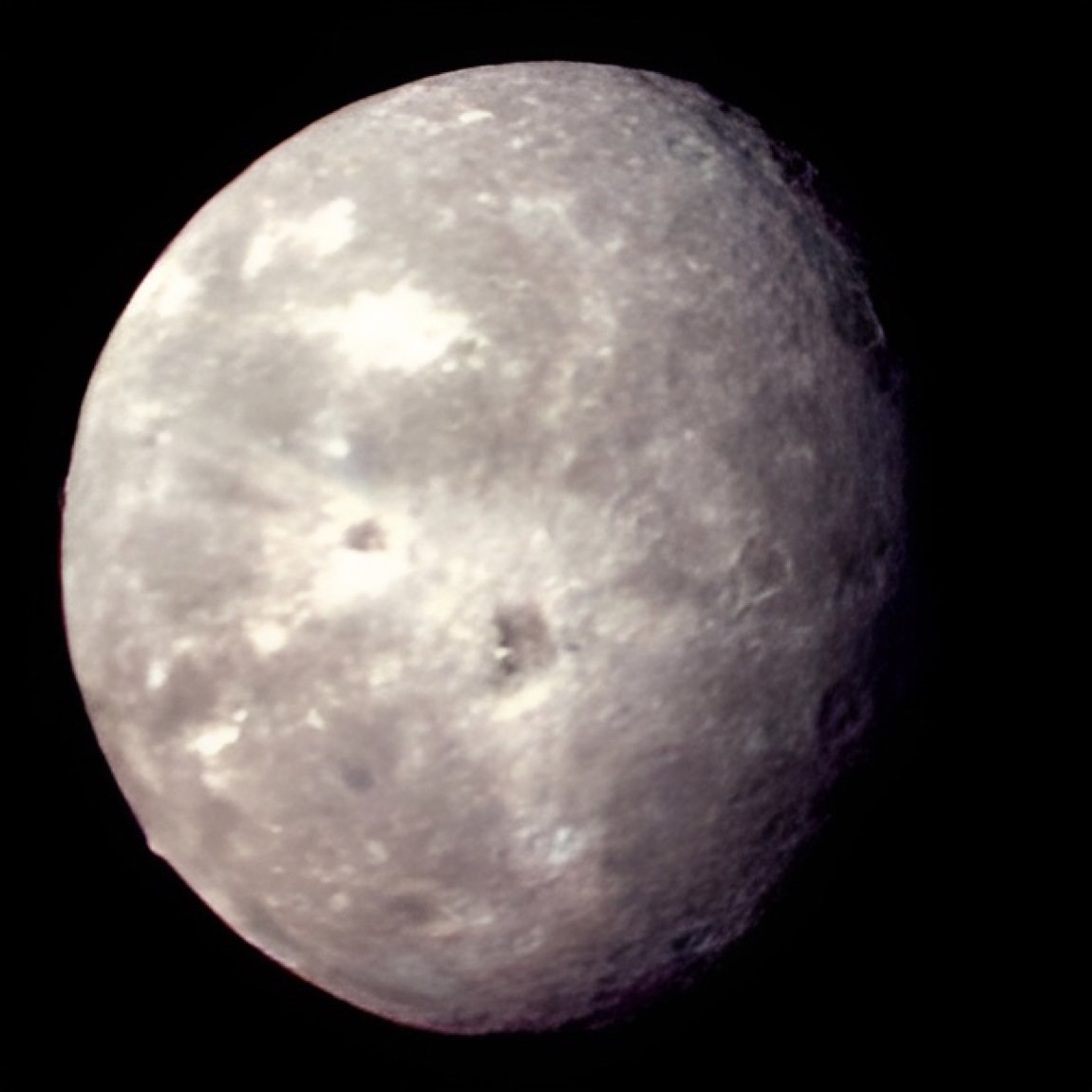
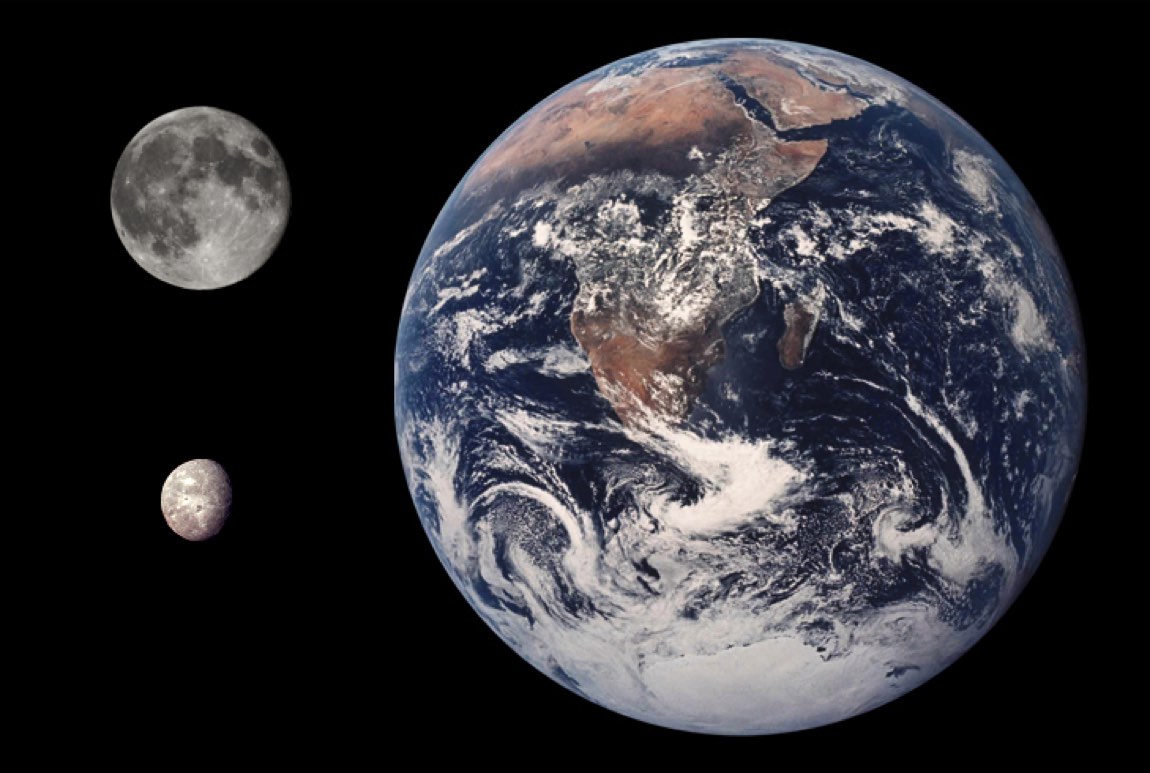
Oberon is Titania's slightly smaller twin, 1,523 km across, with the oldest and most cratered surface of Uranus's major moons. Dark material — possibly organic-rich — floors many of its craters, and a lone mountain some 6 km tall pokes over its limb in Voyager 2's images. One flyby, one lit hemisphere: most of Oberon has never been seen.
The deep dive
Researched for the Atlas from Wikipedia — Oberon (moon) (13,738 characters read) · updated Sep 20, 2026
01 William Herschel's Remarkable Double Discovery
On January 11, 1787, William Herschel pointed his telescope at Uranus and, in a single night, discovered not one but two new worlds: Oberon and Titania, the planet's largest moon. It was a feat that would not be matched for decades. Despite this triumph, Herschel later claimed to have spotted four additional Uranian satellites, reports that turned out to be false. More telling still, for nearly fifty years after that January night, no other instrument on Earth could confirm what Herschel had seen — Titania and Oberon remained exclusive to his telescopes alone. Today, a high-end amateur telescope can pick them out, but in the early nineteenth century their existence rested entirely on one man's word. The name Oberon itself came later, suggested by John Herschel in 1852 at the request of William Lassell, who had just discovered Ariel and Umbriel. Whether the elder Herschel devised the name or Lassell did and simply sought permission remains uncertain to this day.
02 A Name Drawn from Shakespeare's Fairy King
Every moon of Uranus carries a name borrowed from the works of William Shakespeare or the poet Alexander Pope — a tradition unique in the Solar System. Oberon takes its name from the king of the fairies in Shakespeare's A Midsummer Night's Dream, a character associated with magic, mischief, and the hidden workings of the natural world. The adjectival form of the name is Oberonian. In the bookkeeping of nineteenth-century astronomy, the moon went through several identities: first called simply "the second satellite of Uranus," then designated Uranus II by William Lassell in 1848, before finally settling as Uranus IV in 1851 when Lassell numbered all four known moons by distance from the planet using Roman numerals. More recently, software engineer Denis Moskowitz proposed a symbol for Oberon — the letter O combined with Jérôme Lalande's low-globe Uranus symbol — but this has not entered widespread use.
03 An Extreme Seasonal Clock Unlike Any Other
Uranus orbits the Sun nearly on its side, tipped over at an extreme angle, and Oberon follows along in the planet's equatorial plane. The consequence is a seasonal cycle of staggering length and severity. Each of Oberon's poles endures 42 years of total darkness followed by 42 years of unbroken sunlight, with the Sun rising close to directly overhead at one pole each solstice. When Voyager 2 flew past in January 1986, it arrived right at the southern hemisphere's summer solstice, meaning Oberon's entire northern hemisphere was plunged in darkness and impossible to photograph. Once every 42 years, when Uranus reaches its equinox and its equatorial plane aligns with Earth's line of sight, the moons can pass in front of one another as seen from our planet. On May 4, 2007, observers watched Oberon slide in front of Umbriel in an occultation that lasted about six minutes — a rare celestial alignment produced entirely by the planet's bizarre axial tilt.
04 Half Ice, Half Rock: What Oberon Is Made Of Deeper
Oberon's measured density of 1.68 grams per cubic centimeter is the key to understanding what lies beneath its surface. That figure sits well above the typical density of Saturn's icy moons, pointing toward a body made of roughly equal parts water ice and denser material — rock and carbonaceous matter, possibly including heavy organic compounds. Spectroscopic observations back this up by revealing crystalline water ice on the surface. Strangely, the water ice signature is stronger on the trailing hemisphere than the leading one — the reverse of what is seen on other Uranian moons. The cause is unknown, but one hypothesis involves impact gardening: meteorite strikes on the leading hemisphere churn up and sputter away surface ice, leaving darker non-ice material behind. That dark residue may itself be the product of radiation processing of methane clathrates or the darkening of other organic compounds under the relentless bombardment of space. The Uranian subnebula from which Oberon formed may also have been relatively water-poor compared to Saturn's environment, containing carbon and nitrogen more in the form of carbon monoxide and N₂ rather than methane and ammonia.
05 Inside Oberon: Core, Mantle, and a Possible Ocean Deeper
If Oberon is differentiated — and the evidence leans in that direction — its interior divides into a rocky core and an icy mantle. The core would have a radius of about 480 km, representing roughly 63% of the moon's total radius, and would account for around 54% of its total mass. Pressure at the center reaches approximately 0.5 GPa, equivalent to 5 kilobars. At the boundary between that rocky core and the icy mantle, conditions might support a liquid water ocean, but only if enough ammonia or other antifreeze is present to lower the freezing point. If such an ocean exists, it could be up to 40 km thick, sitting at a temperature of around 180 K — close to the water-ammonia eutectic temperature of 176 K, which is the point at which that mixture freezes. If interior temperatures have dropped below 176 K, the ocean would now be frozen. The thermal history of Oberon is poorly understood, but more recent analyses have leaned toward the likelihood that the larger moons of Uranus, including Oberon, do harbor active subsurface oceans.
06 The Most Cratered Face in the Uranian System
Among all the major moons of Uranus, Oberon wears the most battered face. Its crater density approaches saturation — the point at which new impacts are balanced by the destruction of older craters, leaving no room to add more. This crowded record of collisions indicates that Oberon's surface is the most ancient of any Uranian moon, preserving a landscape shaped over billions of years. The largest confirmed crater is Hamlet, which stretches 206 kilometers across — roughly the distance from London to Manchester. Many large craters are encircled by bright rays of fresh ice thrown out by the impacts. The craters named Hamlet, Othello, and Macbeth share a peculiar feature: their floors are filled with very dark material that was deposited after the craters themselves formed. Near the moon's south-eastern limb, Voyager 2 images revealed a peak rising about 11 km, possibly the central peak of an ancient impact basin estimated at roughly 375 km in diameter — though this identification has not been confirmed with certainty.
07 Canyon Country: Oberon's Tectonic Cracks
Running across Oberon's icy crust is a system of chasmata — deep, elongated, steep-sided depressions that would be called rift valleys or escarpments if they were found on Earth. These features are the scars of an ancient episode of crustal stretching, when Oberon's interior expanded and the outer shell cracked open under extensional stress. The most prominent of these is Mommur Chasma. The canyons are less widespread than the similar features found on Titania, but they cut across older terrain, and in some places newer faults slice right through the bright ejecta deposits surrounding large craters, proving those cracks are younger than the craters they intersect. Scientists calculate that Oberon's interior expanded by about 0.5% during its early history, occurring in two phases that correspond to the old and young generations of canyons. This cracking episode likely lasted roughly 200 million years, after which endogenic activity from this cause essentially ceased, leaving the surface to be shaped almost entirely by incoming impacts ever since.
08 Dark Patches and the Cryovolcanism Debate Deeper
One of the most puzzling aspects of Oberon's surface is the presence of dark patches concentrated on the leading hemisphere and on the floors of several large craters. Their origin is genuinely contested. One school of thought holds that they are cryovolcanic in nature — analogous to the dark basaltic maria on Earth's Moon, produced by material welling up from the interior. The alternative view is that impacts excavated dark material buried beneath a cleaner ice crust, in which case Oberon must be at least partially differentiated, with a distinct ice crust overlying a less-processed interior. These two explanations carry different implications for the moon's geological history: cryovolcanism would require a warm, active interior during some period after formation, while the excavation hypothesis demands a layered structure but no surface-reaching volcanism. The redness of Oberon's leading hemisphere also requires explanation; the leading-hemisphere color asymmetry is most likely caused by accretion of reddish material spiraling inward from the outer Uranian system, possibly shed by irregular satellites — a process similar to what reddens Saturn's moon Iapetus.
09 How Oberon Was Born and Grew Hot Deeper
Oberon is thought to have assembled from an accretion disk of gas and dust that surrounded Uranus shortly after the planet formed, or possibly after a giant impact that tilted Uranus to its current extreme obliquity. Accretion probably took several thousand years. The bombardment of infalling material heated the moon's outer layer to a maximum temperature of around 230 K, reached at a depth of about 60 km. Once accretion ended, that near-surface layer began cooling and contracting, while the interior continued to warm from the decay of radioactive elements within the rock, causing it to expand. The tension between a shrinking outer shell and an expanding interior drove the crustal cracking that produced Oberon's canyon system. If ammonia or salts were present as antifreeze, the combined heat from accretion and radioactive decay may have been sufficient to melt the ice, separate it from the rock, and build the layered structure — rocky core, icy mantle, and potentially a liquid ocean — that scientists infer today. Present knowledge of Oberon's full thermal evolution remains limited.
10 Voyager 2: Forty Percent of a World in Six Days
The entirety of humanity's close-up knowledge of Oberon comes from a single spacecraft during a single flyby. Voyager 2 passed through the Uranian system in January 1986 and photographed Oberon from a closest approach distance of 470,600 km. At that range, the best images achieved a spatial resolution of about 6 km — meaning features smaller than roughly the length of Manhattan Island were invisible. Those images covered approximately 40% of the moon's total surface, but only 25% was imaged at a quality good enough for proper geological mapping. The geometry of the encounter was shaped by Uranus's extreme axial tilt: with the southern hemisphere aimed toward the Sun at the 1986 solstice, the northern hemisphere was entirely in darkness and could not be observed at all. No spacecraft has visited the Uranian system since. The 40% of Oberon seen by Voyager 2 has been our only detailed view for nearly four decades.
11 Living Outside the Magnetosphere's Shield
Oberon occupies a gravitationally privileged position — it is the outermost of Uranus's five major moons, orbiting at a distance of about 584,000 km from the planet's center — but that location has consequences for its surface. A significant part of its orbit lies outside Uranus's magnetosphere, meaning the solar wind strikes Oberon's surface directly rather than being deflected. This matters because moons that orbit inside a planetary magnetosphere experience a different environment: magnetospheric plasma co-rotating with the planet batters their trailing hemispheres, gradually darkening them. Since Oberon spends so much time outside that magnetic bubble, its trailing hemisphere escapes this particular darkening process, which is actually observed on all other Uranian moons. The orbital period is about 13.5 days, and Oberon is tidally locked, always keeping the same face toward Uranus — so the leading and trailing hemispheres are permanently fixed, accumulating their distinct space-weathering histories over the age of the Solar System.
12 Open Questions That Still Haunt Researchers Deeper
Oberon leaves scientists with more unresolved questions than answers, largely because Voyager 2's brief glimpse covered less than half the surface. The nature of the dark patches on the leading hemisphere and crater floors remains actively debated: cryovolcanism or excavation of buried dark material, with no consensus. The cause of the reversed water-ice asymmetry — stronger on the trailing side rather than the leading side — is unknown. Whether a liquid ocean persists today at the core-mantle boundary depends on the moon's thermal history, which is poorly constrained. More recent analyses favor the existence of active subsurface oceans across the larger Uranian moons, but confirmation awaits future exploration. The 60% of Oberon's surface never seen by any spacecraft could hold geological features that reshape current models entirely. And the tall peak near the south-eastern limb, possibly the remnant of a 375 km impact basin, has not been confirmed. All of these open questions hinge on the same fundamental gap: no spacecraft has returned to Uranus since 1986.
 ⤢
⤢
You would weigh…
Surface gravity 0.35 m/s² vs Earth’s 9.81 m/s². Try every world →