Astronomy A–Z
158 terms, defined in plain language. Every piece of jargon on this site, explained.
The six people look up most
Browse by theme26
Stars17
- Binary star
- Two stars orbiting each other. Roughly half of all Sun-like stars have at least one companion.
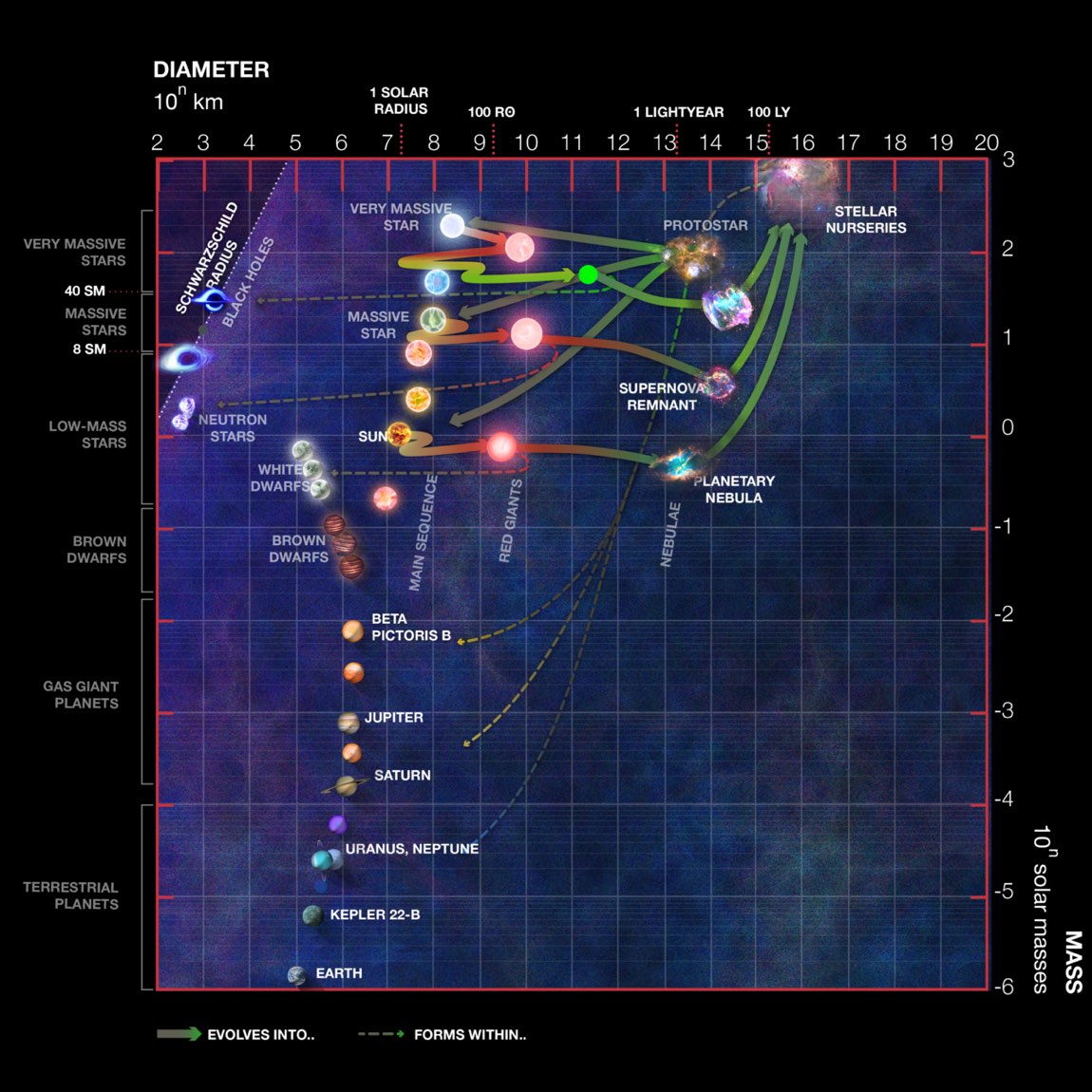
- Brown dwarf
- A 'failed star' — bigger than a planet but too small to ignite hydrogen fusion. It glows dimly with leftover heat.
- Cepheid variable
- A pulsing giant star whose rhythm reveals its true brightness — astronomy's classic distance ruler.
- Flare star
- A star (usually a red dwarf) prone to sudden brightening as its magnetic field snaps — bad news for close-orbiting planets.
- Globular cluster
- A dense ball of hundreds of thousands of ancient stars orbiting a galaxy — some nearly as old as the universe.
- Main sequence
- The long, stable adulthood of a star, fusing hydrogen in its core. The Sun is about halfway through its ~10-billion-year run.
- Molecular cloud
- A cold, dense cloud of gas and dust — the raw material and birthplace of stars.
- Nebula
- A cloud of gas and dust in space — a star nursery, a dying star's shed skin, or an explosion's wreckage.
- Planetary nebula
- The glowing shells a dying Sun-like star exhales — nothing to do with planets; early telescopes just saw round disks.
- Red dwarf
- A small, cool, dim star — the most common type in the galaxy, burning so slowly it can live trillions of years.
- Red giant
- The swollen late-life phase of a Sun-like star — cooler at the surface but enormously bigger and brighter. The Sun's turn comes in ~5 billion years.
- Spectral type
- A star's temperature class — O, B, A, F, G, K, M from hottest blue to coolest red. The Sun is G2. (Mnemonic: Oh Be A Fine Girl/Guy, Kiss Me.)
- Star
- A ball of gas massive enough to ignite nuclear fusion in its core and shine by its own light.
- Star cluster
- Stars born together and still traveling together — loose 'open' clusters like the Pleiades, or dense ancient globulars.
- Supergiant
- A star in the most massive stars' brief, brilliant late phase — like Betelgeuse — destined for a supernova.
- Variable star
- A star whose brightness changes — by pulsing, erupting, or being eclipsed by a companion.
- White dwarf
- The Earth-sized, still-glowing ember left when a Sun-like star dies — a teaspoon weighs tonnes; it will cool for trillions of years.
Planets13
- Atmosphere
- The layer of gases held around a world by its gravity.
- Axial tilt
- The lean of a planet's spin axis relative to its orbit. Earth's 23.4° tilt is why seasons exist.
- Crater
- A bowl-shaped scar left by an impact. Airless worlds keep them for billions of years.
- Exoplanet
- A planet orbiting a star other than the Sun. Nearly 6,000 are confirmed, with thousands more candidates.
- Exosphere
- An atmosphere so thin its atoms almost never collide — Mercury and the Moon have only this.
- Gas giant
- A planet made mostly of hydrogen and helium with no solid surface — Jupiter and Saturn.
- Ice giant
- A planet like Uranus or Neptune: a deep fluid interior of water, methane and ammonia under a hydrogen envelope.
- Planet
- A world orbiting a star that is round under its own gravity and has cleared its orbital lane. The Solar System has eight.
- Protoplanetary disk
- The spinning disk of gas and dust around a newborn star, from which planets condense — many are now directly photographed.
- Regolith
- The layer of loose, broken rock and dust blanketing airless worlds — lunar regolith is powder-fine and razor-sharp.
- Rings
- Disks of orbiting ice and rock particles around a planet. All four giant planets have them; Saturn's are simply the masterpiece.
- Rogue planet
- A planet wandering the galaxy without a star, ejected during its system's rough youth — microlensing suggests billions exist.
- Terrestrial planet
- A rocky world like Mercury, Venus, Earth or Mars — metal core, rocky mantle, solid surface.
Orbits11
- Aphelion
- The point in an orbit farthest from the Sun.
- Barycenter
- The shared balance point two bodies actually orbit around. For Pluto and Charon it lies in open space between them.
- Eccentricity
- How stretched an orbit is: 0 is a perfect circle; closer to 1 is a long ellipse like a comet's.
- Escape velocity
- The speed needed to leave a world's gravity without further pushing: 11.2 km/s from Earth, 2.4 km/s from the Moon.
- Lagrange point
- One of five places where two bodies' gravity and orbital motion balance, letting spacecraft 'park'. JWST lives at Sun–Earth L2.
Go deeper
L1 (SOHO's sunward perch) and L2 are meta-stable; L4/L5 are stable and collect Trojan asteroids.
- Orbit
- The path of one body around another — falling forever and always missing.
- Perihelion
- The point in an orbit closest to the Sun.
- Prograde & retrograde
- Moving with (prograde) or against (retrograde) the usual direction of spin or orbit. Venus spins retrograde; Triton orbits retrograde.
- Roche limit
- The distance inside which tides tear a moon apart — stray closer and you become a ring.
- Tidal locking
- When tides brake a body's spin until one face permanently faces its partner — the Moon to Earth, and many exoplanets to their stars.
- Yarkovsky effect
- The tiny push sunlight gives a spinning asteroid as it re-radiates heat — enough to reshape orbits over millennia, and measured directly on Bennu.
Galaxies11
- Blazar
- A galaxy whose central black hole fires a jet of particles almost straight at Earth, making it appear brilliantly bright and variable.
- Dwarf galaxy
- A small galaxy of millions to a few billion stars. They are the most common galaxies — and big galaxies grow by eating them.
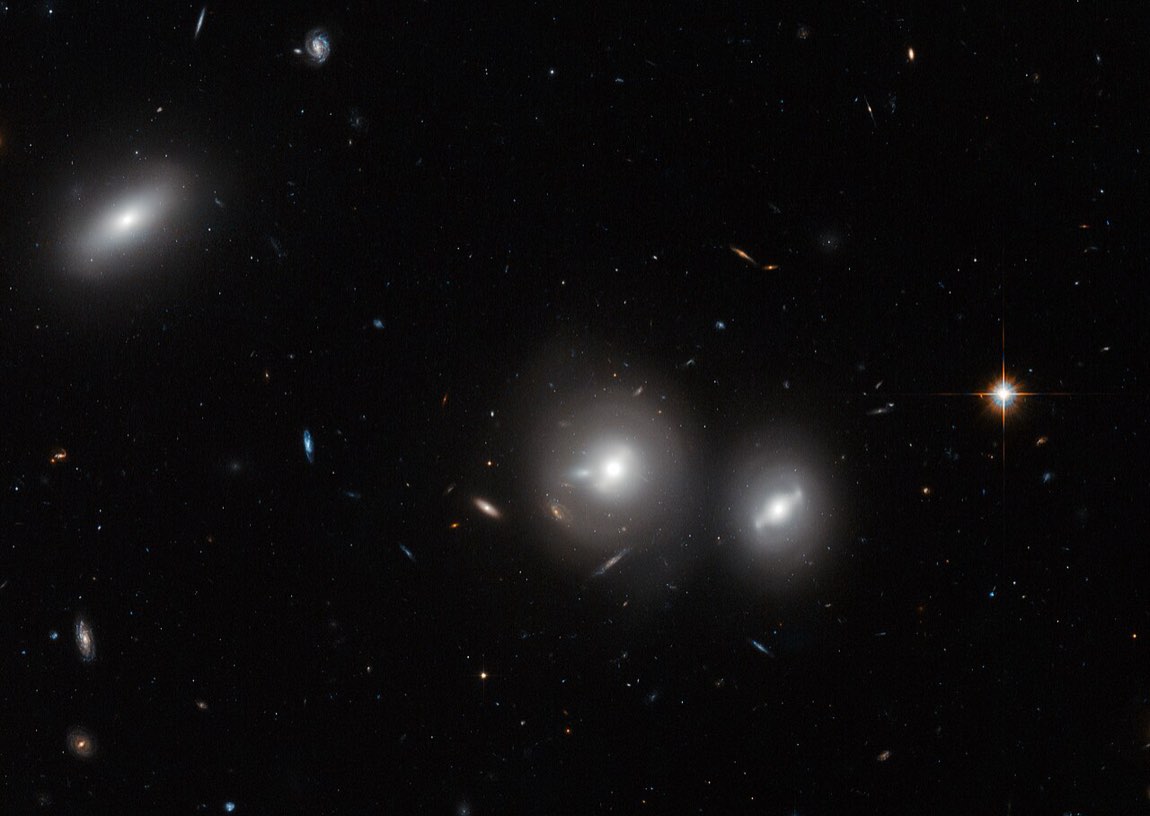
- Elliptical galaxy
- A smooth, egg-shaped galaxy of mostly old stars, usually built from galaxy mergers.
- Galaxy
- A gravitationally bound city of stars, gas, dust and dark matter — from dwarfs of a few million stars to giants of trillions.
- Galaxy cluster
- Hundreds to thousands of galaxies bound together — the largest gravitationally settled structures in the universe.
- Interstellar medium
- The thin gas and dust between stars — about one atom per cubic centimeter, yet enough to build new suns.
- Irregular galaxy
- A galaxy without tidy spiral or elliptical shape — often small, gas-rich, and star-forming, like the Magellanic Clouds.
- Milky Way
- Our home galaxy of 100–400 billion stars — and the glowing band across dark skies, which is its disk seen from inside.
- Quasar
- The blazing core of a distant galaxy whose supermassive black hole is feeding — often outshining its entire galaxy from billions of light-years away.
- Spiral galaxy
- A rotating disk galaxy with winding arms of stars and gas — like the Milky Way and Andromeda.
- Supercluster
- A collection of galaxy clusters — like Laniakea, the 'immeasurable heaven' our Milky Way belongs to.
Light11
- Blueshift
- The squeezing of light waves toward bluer colors when a source moves toward you.
- Doppler effect
- The change in waves from a moving source — sound rising as an ambulance nears, starlight shifting color as a star moves.
- Electromagnetic spectrum
- The full family of light: radio, microwave, infrared, visible, ultraviolet, X-ray, gamma-ray. Our eyes catch one narrow slice.
- Infrared
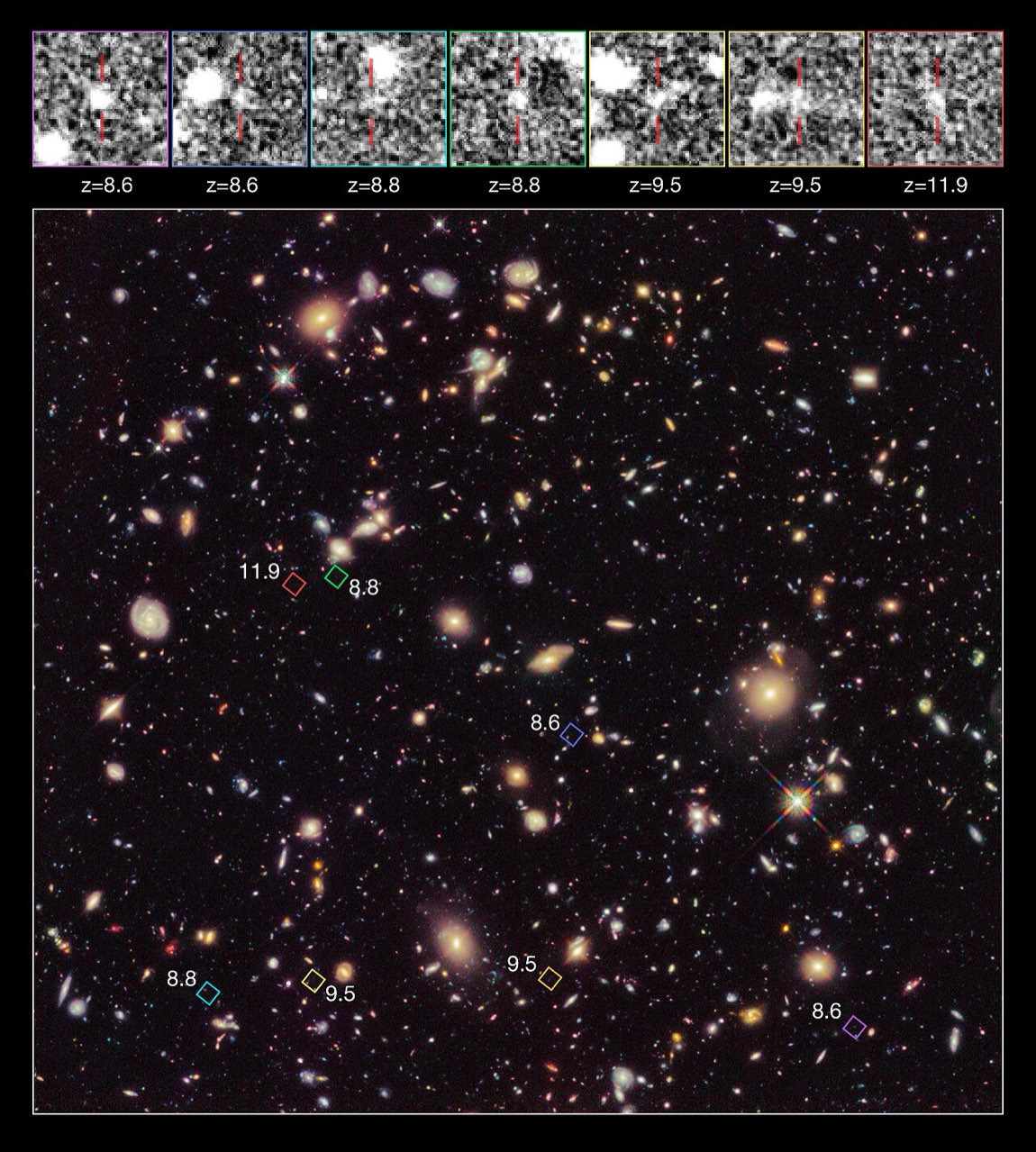
- Heat-light with waves longer than red. It pierces dust clouds and carries the stretched light of the first galaxies — JWST's specialty.
- Photon
- A particle of light — the messenger carrying almost everything we know about the universe.
- Radio astronomy
- Astronomy with radio waves — revealing pulsars, quasars, the CMB, black-hole images, and gas invisible to optical telescopes.
- Redshift
- The stretching of light waves toward red as a source recedes — for distant galaxies, space itself expanding en route does the stretching, making redshift cosmology's odometer.
- Spectroscopy
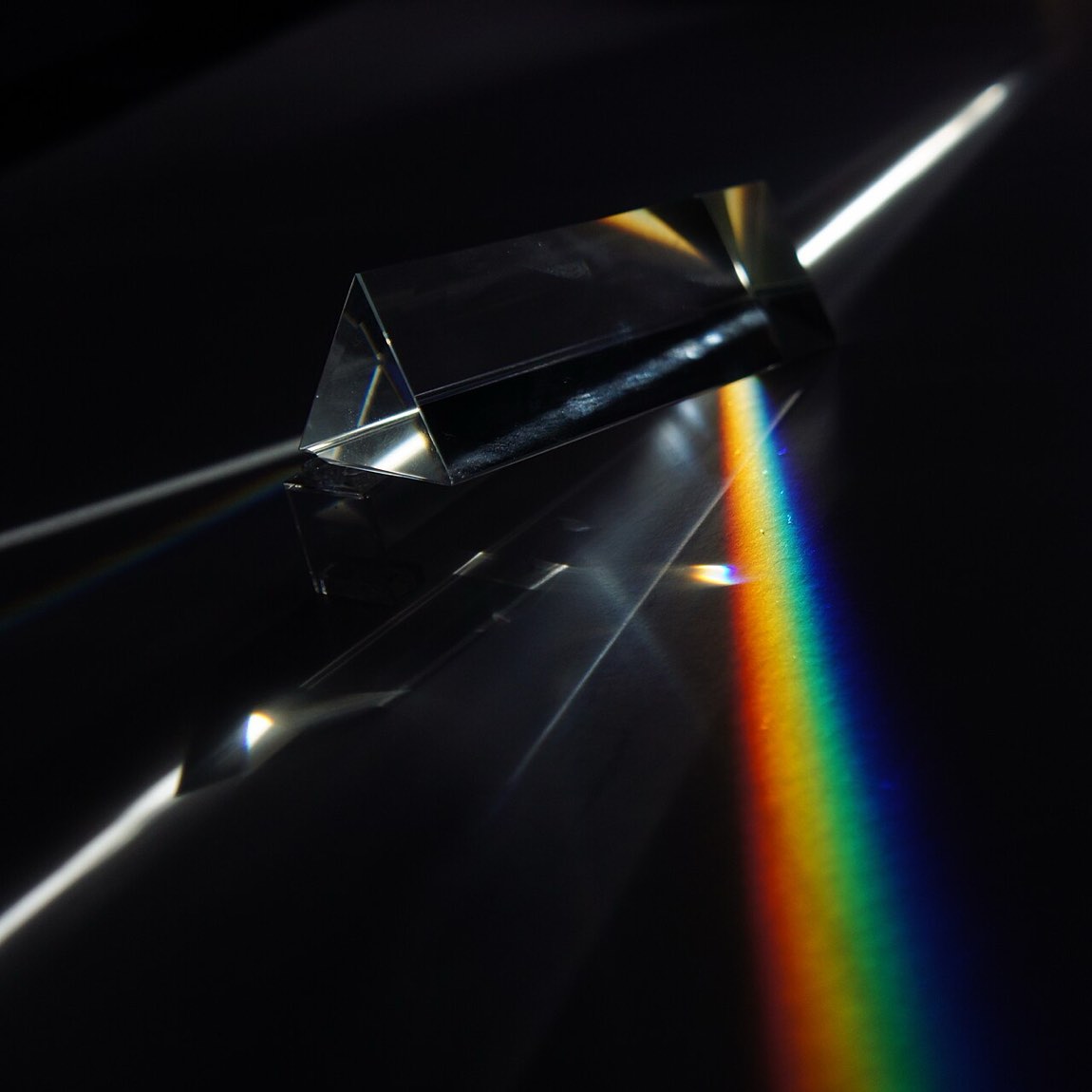
- Splitting light into its rainbow of colors to read chemical fingerprints — how we know what stars are made of without visiting.
Go deeper
Every element absorbs/emits at signature wavelengths. Spectroscopy also yields temperatures, speeds, magnetic fields, and exoplanet air.
- Ultraviolet
- Light with waves shorter than violet — sunburn light — revealing hot stars and energetic processes; mostly blocked by our atmosphere.
- Wavelength
- The distance between wave crests — what distinguishes radio from visible from gamma-ray light.
- X-ray astronomy
- Astronomy with X-rays — the light of million-degree gas around black holes, neutron stars, and galaxy clusters. Must be done from space.
Sky events11
- Conjunction
- When two objects appear close together in the sky — like the Moon passing a bright planet.
- Eclipse
- One body passing through another's shadow — the Moon darkening in Earth's shadow, or the Sun hidden behind the Moon.
- Elongation
- A planet's apparent angle from the Sun. Big elongation = high, dark-sky views; small = lost in twilight.
- Equinox
- The two moments each year when the Sun crosses the celestial equator and day and night are nearly equal everywhere (around March 20 and September 22).
- Lunar eclipse
- The full Moon passing through Earth's shadow, often turning sunset-red — safely visible to everyone on the night side.
- Meteor shower
- Many meteors radiating from one point, seen when Earth crosses a comet's dust trail on the same dates each year.
- Occultation
- One body hiding another — the Moon covering a star, or an asteroid briefly blocking one (how rings around small worlds were found).
- Opposition
- When an outer planet sits opposite the Sun in our sky — rising at sunset, up all night, and closest to Earth. Prime viewing.
- Solar eclipse
- The Moon covering the Sun. Totality — day turning to night, corona blazing — is widely called nature's greatest spectacle.
Go deeper
Only safe to look at with proper eclipse glasses except during the seconds-to-minutes of totality itself.
- Solstice
- The Sun's northernmost or southernmost day of the year (around June 20 and December 21) — longest and shortest days.
- Zodiacal light
- A faint pyramid of light on the horizon after dusk or before dawn — sunlight scattered off comet and asteroid dust in the plane of the Solar System.
Measuring10
- Absolute magnitude
- How bright a star would look from a standard distance of 32.6 light-years — a fair way to compare stars' true power.
- Albedo
- The fraction of light a surface reflects. Fresh snow is near 0.9; charcoal-dark asteroids sit near 0.04.
- Apparent magnitude
- How bright something looks from Earth. Confusingly, smaller numbers are brighter — magnitude 1 outshines magnitude 6.
Go deeper
The scale is logarithmic: 5 magnitudes = 100× brightness. Negative values are brightest: the Sun is −26.7, Sirius −1.46; the faintest naked-eye stars are ~+6.
- Astronomical unit (AU)
- The average Earth–Sun distance: 149.6 million km. The Solar System's everyday ruler.
- Density
- How much mass is packed into a given space. Saturn's average density is lower than water's.
- Light-year
- The distance light travels in one year: 9.46 trillion km. A ruler for the space between stars.
Go deeper
Light speed makes telescopes time machines: see something 1,000 light-years away and you see it as it was 1,000 years ago.
- Luminosity
- An object's true total power output, regardless of distance.
- Parallax
- The tiny apparent shift of a nearby star against the background as Earth circles the Sun — geometry that yields true distances.
Go deeper
The parsec (3.26 ly) is defined from it. ESA's Gaia has measured parallaxes for nearly two billion stars.
- Parsec
- 3.26 light-years — the professional unit of stellar distance, defined by parallax geometry.
- Proper motion
- A star's slow drift across the sky from its real velocity — Barnard's Star, the fastest, crosses a Moon-width in 180 years.
Cosmology9
- Big Bang
- The event 13.8 billion years ago when the universe began expanding from an extremely hot, dense state — the start of space, time, matter and energy as we know them.
- Cosmic microwave background
- The oldest light in existence: a faint glow from when the universe first became transparent, 380,000 years after the Big Bang.
- Cosmology
- The study of the universe as a whole — its origin, contents, shape and fate.
- Dark energy
- The name for whatever is making the universe's expansion speed up. It behaves like an energy of empty space — and nobody knows what it is.
Go deeper
Discovered in 1998 via distant supernovae; it makes up ~68% of the universe's energy budget. Its nature is arguably the biggest open problem in physics.
- Dark matter
- Invisible material that outweighs normal matter five to one. We map it by its gravity — galaxies spin and cluster as if held by unseen mass.
Go deeper
Candidates range from undiscovered particles (WIMPs, axions) to primordial black holes. Every direct-detection experiment so far has come up empty — the mystery is real and quantified.
- Hubble constant
- The universe's current expansion rate. Two rigorous methods disagree by ~8% — the 'Hubble tension', possibly a crack pointing at new physics.
- Inflation
- The proposed burst of exponential expansion in the universe's first fraction of a second — explaining its smoothness and seeding all structure. Strongly motivated, not yet directly proven.
- Multiverse
- The speculative idea that our universe is one of many. Some versions follow naturally from inflation theory — none is currently testable, which is exactly what 'Speculative' means on this site.
- Universe
- Everything there is: all space, time, matter and energy. The observable part spans ~93 billion light-years — the whole may be far larger, possibly infinite.
Black holes7
- Accretion disk
- A spinning disk of gas spiraling into a massive object like a black hole, heated to glowing by friction.
- Black hole
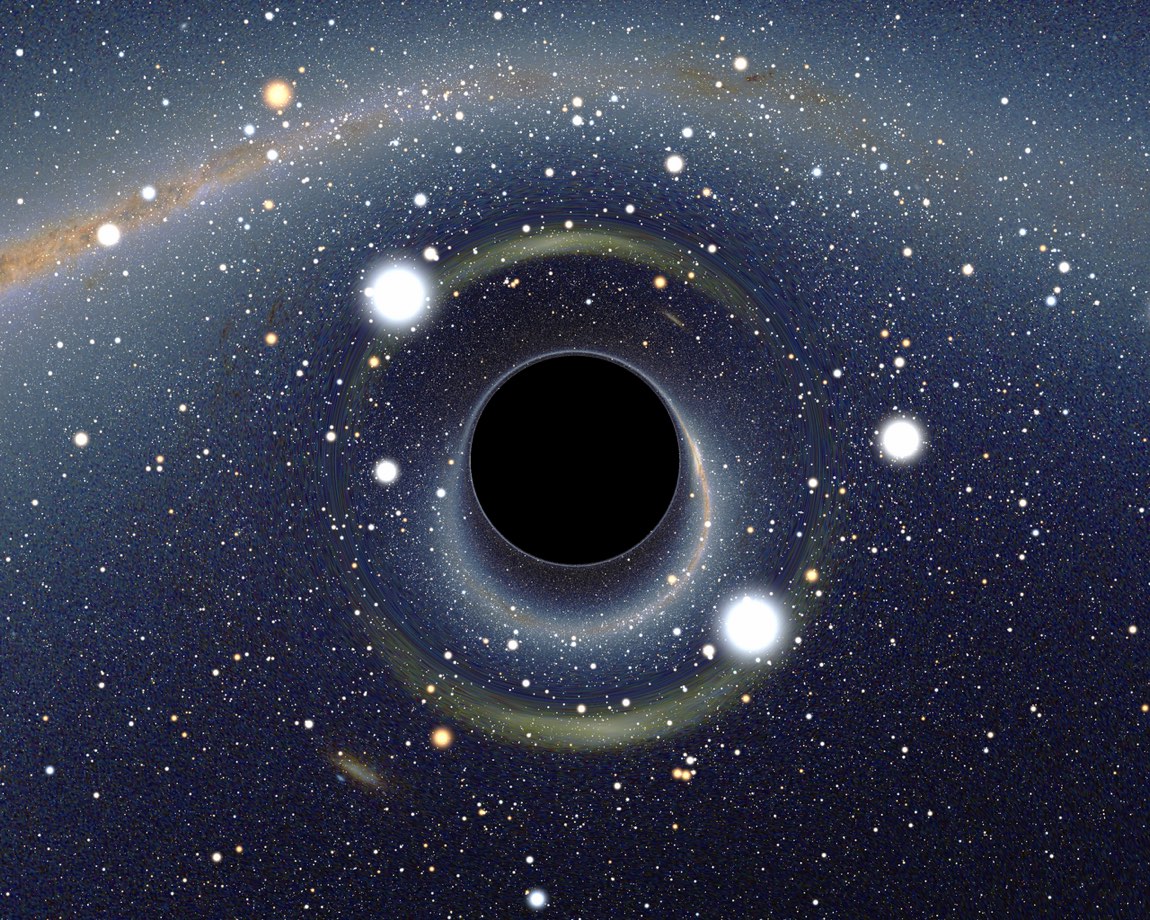
- An object so dense that inside a boundary called the event horizon, nothing — not even light — can escape its gravity.
- Event horizon
- A black hole's point of no return — the boundary where escape would require faster-than-light travel.
- Jet
- A beam of particles flung out near light speed along a feeding black hole's or neutron star's spin axis.
- Singularity
- The point of infinite density general relativity predicts at a black hole's center — usually read as the place where the theory itself breaks down and quantum gravity must take over.
- Spaghettification
- The stretching of anything falling into a small black hole, as gravity pulls far harder on your feet than your head. Real physics, real term.
- Supermassive black hole
- A black hole of millions to billions of solar masses, found at the center of nearly every big galaxy.
Small bodies7
- Asteroid
- A rocky object orbiting the Sun, smaller than a planet — most live in the belt between Mars and Jupiter.
- Comet
- A mountain-sized body of ancient ice and dust that grows a glowing head and tails when sunlight heats it.
- Interstellar object
- A body passing through our Solar System from another star — three known so far: 'Oumuamua, Borisov, and 3I/ATLAS.
- Meteor
- The streak of light — a 'shooting star' — as a space pebble burns up in the atmosphere.
- Meteorite
- A piece of space rock that survives the fall and lands. (In space: meteoroid → burning: meteor → on the ground: meteorite.)
- Meteoroid
- A small rock or particle traveling through space — sand-grain to boulder-sized.
- Trojan asteroid
- An asteroid sharing a planet's orbit at the stable Lagrange points 60° ahead or behind — Jupiter has over 10,000 known.
Solar System6
- Asteroid belt
- The zone between Mars and Jupiter holding millions of asteroids — leftovers that Jupiter's gravity never let become a planet.
- Dwarf planet
- A round world orbiting the Sun that hasn't cleared its orbital lane — like Pluto, Eris, and Ceres.
- Heliosphere
- The vast bubble blown by the solar wind, enclosing all the planets. Both Voyagers have crossed its edge into interstellar space.
- Kuiper Belt
- The ring of icy worlds beyond Neptune — home of Pluto, Arrokoth, and millions of frozen leftovers.
- Oort Cloud
- The hypothesized shell of trillions of comets extending halfway to the next star — the deep-freeze source of long-period comets. Inferred from comet orbits; never directly seen.
- Planetesimal
- A building block of planets — the km-scale bodies that merged into worlds 4.5 billion years ago.
Extreme events6
- Gamma-ray burst
- The brightest explosions known: seconds-long flashes from collapsing giant stars or colliding neutron stars, visible across the universe.
- Magnetar
- A neutron star with the strongest magnetic field known — a trillion times Earth's — capable of galaxy-visible outbursts.
- Neutron star
- The city-sized, Sun-massed corpse of an exploded giant star — matter at nuclear density, one teaspoon outweighing a mountain.
- Nova
- A sudden brightening when a white dwarf's stolen hydrogen detonates on its surface — the star survives to flash again.
- Pulsar
- A spinning neutron star sweeping lighthouse beams of radiation past Earth — some keep time better than atomic clocks.
- Supernova
- The explosion of a star — collapsing giant or detonating white dwarf — briefly outshining its whole galaxy and forging heavy elements.
Go deeper
Type II: core collapse of a giant. Type Ia: white dwarf detonation — standardizable candles that mapped cosmic acceleration.
Life5
- Astrobiology
- The science of life in the universe: how it starts, where it could survive, and how we would detect it.
- Biosignature
- A measurable clue that life exists somewhere — like oxygen and methane coexisting in a planet's atmosphere.
- Habitable zone
- The distance band around a star where a planet with the right atmosphere could keep liquid water on its surface — neither boiled nor frozen.
Go deeper
A necessary-but-not-sufficient test: Venus and Mars technically skirt the Sun's zone. Atmosphere, magnetic field, and geology decide the rest.
- SETI
- The Search for Extraterrestrial Intelligence — listening for signals deliberately or accidentally broadcast by other civilizations. Decades of silence so far constrain only a tiny slice of possibilities.
- Technosignature
- Evidence of technology elsewhere — a radio signal, city lights, industrial pollution in an atmosphere. None found; the search is young.
Space weather5
- Aurora
- Glowing curtains of light near a planet's poles, painted by solar particles guided along magnetic field lines.
- Coronal mass ejection
- A billion-tonne eruption of magnetized solar gas. If one hits Earth, expect auroras — and stressed power grids.
- Magnetosphere
- The magnetic bubble around a planet that deflects charged particles. Earth's is life's invisible shield.
- Solar flare
- A magnetic explosion on the Sun releasing the energy of billions of bombs in minutes, flashing across the spectrum.
- Solar wind
- The million-km/h stream of charged particles flowing off the Sun — sculptor of comet tails and auroras.
Sky patterns4
- Asterism
- A recognizable star pattern that isn't an official constellation — like the Big Dipper (part of Ursa Major) or the Summer Triangle.
- Circumpolar
- Stars that never set from your latitude, endlessly circling the celestial pole — like the Big Dipper from most of Europe and North America.
- Constellation
- One of 88 official regions the sky is divided into, each named for the figure its brightest stars suggested to earlier cultures.
- Zodiac
- The band of constellations along the ecliptic that the Sun, Moon and planets travel through. Astronomy maps it; astrology (a belief system, not a science) borrows its names.
Sky coordinates4
- Celestial equator
- Earth's equator projected onto the sky, dividing it into northern and southern halves.
- Celestial pole
- The point the sky appears to rotate around — directly above Earth's pole. Polaris sits almost exactly on the northern one.
- Ecliptic
- The Sun's yearly path across the sky — really Earth's orbital plane. The planets always wander close to this line.
- Zenith
- The point straight overhead.
The Sun4
- Chromosphere
- The thin reddish layer of the Sun's atmosphere just above its visible surface, glimpsed during total eclipses.
- Corona
- The Sun's wispy outer atmosphere, visible during total eclipses — mysteriously heated to over a million degrees.
- Photosphere
- The Sun's visible 'surface' — the layer where its gas becomes transparent, at about 5,500 °C.
- Sunspot
- A cooler, darker patch on the Sun where magnetic fields choke the heat flow — some grow larger than Earth.
Gravity4
- Gravitational lens
- Mass bending light like a glass lens: massive galaxies can magnify, distort and multiply the images of things behind them.
- Gravitational wave
- A ripple in space-time itself, launched by accelerating masses like colliding black holes — first detected in 2015.
Go deeper
LIGO's detectors measure arm-length changes of 1/10,000th a proton's width. The 2017 neutron-star merger was seen in both waves and light, opening 'multi-messenger' astronomy.
- Gravity
- The attraction between masses — the force that shapes orbits, stars, galaxies and the universe's fate. In Einstein's picture, mass curves space-time and things follow the curves.
- Tides
- The stretching of one body by another's gravity varying across it — raising Earth's oceans twice daily and heating moons like Io and Europa.
Physics3
- Hydrostatic equilibrium
- The balance between gravity squeezing inward and pressure pushing outward — what makes stars and planets round.
- Nuclear fusion
- Squeezing light atomic nuclei together into heavier ones, releasing energy — the engine of every star and the origin of most elements.
- Plasma
- Gas so hot its electrons roam free — the state of matter stars are made of, and most visible matter in the universe.
Particles2
- Cosmic ray
- An atomic nucleus or particle traveling near light speed, launched by supernovae and other cosmic accelerators.
- Neutrino
- A ghostly particle that barely interacts with matter — trillions from the Sun pass through you every second. Supernovae announce themselves in neutrinos first.
History2
- Geocentric
- The ancient model placing Earth at the universe's center — overturned by Copernicus, Galileo and Kepler.
- Heliocentric
- The Sun-centered model of the Solar System — Copernicus's revolution.
Exoplanet hunting2
- Radial velocity
- The wobble-speed of a star along our line of sight — reading it from starlight's Doppler shift revealed the first exoplanets.
- Transit
- A planet crossing its star's face, dimming it slightly on a rhythm — the method that has found most known exoplanets, and a window into their atmospheres.
Observing1
- Light pollution
- Artificial light washing out the night sky. A third of humanity can no longer see the Milky Way.
Spaceflight1
- Satellite
- Anything orbiting something else — moons are natural satellites; thousands of artificial ones now circle Earth.
Space settlement1
- Terraforming
- The theoretical engineering of a planet into an Earth-like state. Even for Mars, the accessible CO₂ falls far short — a concept for centuries hence, not decades.
Speculative physics1
- Wormhole
- A theoretical tunnel connecting distant points of space-time, allowed by Einstein's equations under exotic conditions never observed. Firmly Theoretical — traversable versions require unknown 'negative energy' matter.