Moon · Deep guide · orbits Uranus
Margaret
Also called: Uranus XXIII · S/2003 U 3
The only irregular moon of Uranus that orbits in the same direction as the planet.
What is it?
Margaret was discovered in August 2003 by Scott Sheppard and David Jewitt using the 8-metre Subaru Telescope on Mauna Kea. About 20 km wide, it stands out because it is the only known irregular Uranian moon on a prograde orbit. Its orbit is wildly stretched, with an average eccentricity near 0.64, and the Sun's pull makes its tilt and shape swing back and forth over about 500 years (the Kozai effect). One lap takes about 4.5 years.
The deep dive
Researched for the Atlas from Wikipedia — Margaret (moon) (8,676 characters read) · updated Nov 15, 2026
01 The Only Prograde Oddity at Uranus
Among the dozens of irregular moons scattered around the outer planets, Margaret stands out as a genuine singleton. Every other irregular moon known to orbit Uranus travels in a retrograde direction — that is, opposite to the planet's own path around the Sun. Margaret alone orbits the right way around, making it unique in the entire Uranian system. Irregular moons are generally thought to be captured objects, snagged by a planet's gravity long ago rather than assembled in place. Exactly how a prograde irregular moon ends up in a stable orbit is a puzzle, because the same gravitational dynamics that allow capture tend to favor retrograde trajectories. Simulations by Matija Ćuk and Brett Gladman in 2006 suggested that Margaret could have been directly captured if its orbit happened to lock into a 1:2 orbital resonance between Saturn and Uranus at the right moment — a narrow gravitational window that would have stabilized what might otherwise have been a fleeting encounter.
02 A Moon Nearly Lost Twice
Margaret's path into the catalog was neither smooth nor certain. Matthew J. Holman and JJ Kavelaars first spotted it on 13 August 2001 at Cerro Tololo Inter-American Observatory while systematically hunting for distant Uranian moons. Their plan was to reobserve it by September, but poor conditions intervened and the moon slipped away — a single night of data is not enough to pin down an orbit, so Margaret effectively vanished. It resurfaced on 29 August 2003 when Scott S. Sheppard and David C. Jewitt used the 8.3-meter Subaru Telescope at Mauna Kea Observatory in a fresh search. After a follow-up with Gemini North on 20 September, Brian G. Marsden of the Minor Planet Center realized the new object matched the 2001 sighting. Kavelaars then identified a corroborating Canada–France–Hawaii Telescope image from 25 August 2001, clinching the connection. The discovery was formally announced on 7 October 2003, with Sheppard and Jewitt recognized as the official discoverers by NASA and the International Astronomical Union.
03 An Orbit on the Ragged Edge of Stability Deeper
Margaret's orbital eccentricity of 0.64 is extraordinary even by the standards of irregular moons. As of 2026, only four known moons in the entire Solar System have higher average orbital eccentricities. That elongated path means Margaret's distance from Uranus swings dramatically: near periapsis during high-eccentricity phases, it can close to within 1.7 million km (1.1 million mi; 0.011 AU) of the planet, while at apoapsis it can wander as far as 27 million km (17 million mi; 0.18 AU) away. Its average inclination of 61° with respect to the ecliptic is itself part of why Margaret teeters near a boundary. N-body simulations show that if the average inclination were even slightly higher — above roughly 60° — the Kozai resonance would amplify the eccentricity until the moon either collided with Uranus or was flung out of the system entirely. Jet Propulsion Laboratory astrophysicists Marina Brozović and Robert A. Jacobson noted in 2009 that ejection from the Uranian system in the far future remains a real possibility. Margaret is stable for now, but only just.
04 The Kozai Resonance: A 520-Year Heartbeat Deeper
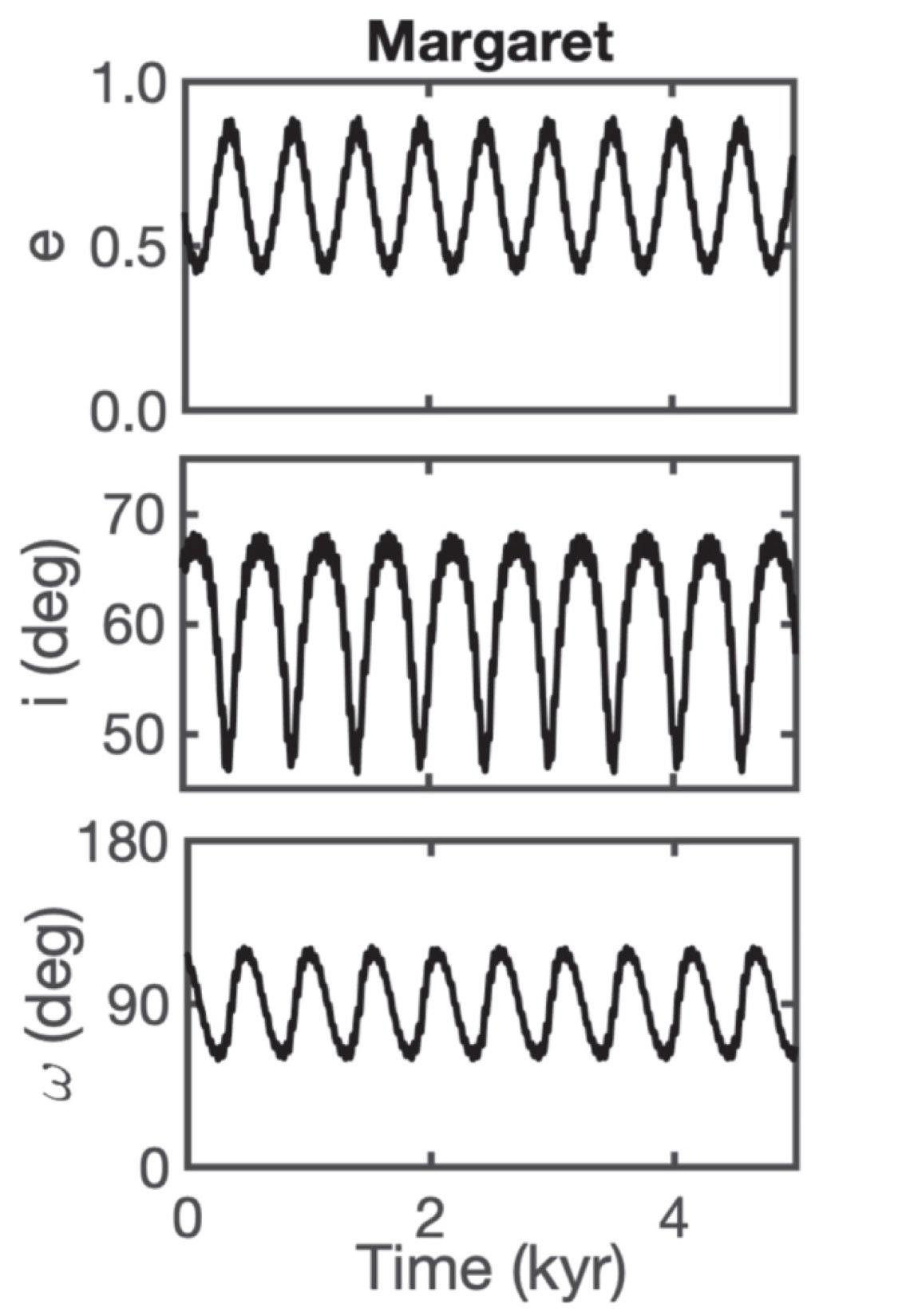
The gravitational pull of the Sun does more than merely tug at Margaret — it drives a slow, rhythmic exchange between the moon's inclination and its eccentricity, a phenomenon known as the Kozai resonance. Kavelaars and colleagues first recognized Margaret's Kozai-resonant orbit in 2004. N-body simulations reveal the cycle clearly: over roughly 520 years, the eccentricity oscillates between 0.41 and 0.89, while the inclination swings in the opposite sense between 46° and 69°. When eccentricity peaks, inclination is at its lowest, and vice versa. A distinctive signature of Kozai dynamics is that the argument of pericenter — the angle describing where in the orbit the closest approach to Uranus occurs — does not circulate through a full 360° as it would in a simple orbit. Instead it librates, rocking back and forth around 90° with that same 520-year period. The practical consequence is that Margaret always reaches its closest point to Uranus above the ecliptic plane. Separately, the orbit also undergoes nodal precession on a 1,002-year period, adding another slow wobble to an already complex choreography.
05 Why Simple Orbital Math Breaks Down Here
For the regular moons close to Uranus, a straightforward Keplerian ellipse works well enough to describe the orbit. At Margaret's enormous distance — an average of 14.4 million km (8.9 million mi; 0.096 AU) from the planet — the grip of Uranus's gravity weakens substantially, leaving the moon vulnerable to gravitational nudges from the Sun and other planets. These perturbations shift the orbit in ways that accumulate over time, so a snapshot of its path today tells you little about where it will be centuries from now. Astronomers therefore use what are called proper or mean orbital elements, calculated by mathematically averaging out the perturbed motion over an extended time span of 10,000 years in Margaret's case. The resulting numbers — the 14.4-million-km average semi-major axis and the 4.53-year (1,655-day) average period — are the most honest representation of where this moon actually lives in space over the long run, rather than any single moment's measurement.
06 A Faint Speck: What We Can See
Even with modern telescopes, Margaret is an extremely challenging target. In red light it shines at an apparent magnitude of 25.2 — far dimmer than anything visible to the naked eye or even a typical amateur telescope. Only large-aperture instruments using long-exposure imaging can detect it at all. The physical properties that astronomers have been able to establish are slim: an absolute magnitude of 12.7, from which a diameter can be inferred. Assuming Margaret shares the low reflectivity typical of Uranian irregular moons — a geometric albedo of 0.04, meaning it reflects just 4 percent of sunlight — the estimated diameter comes out to about 20 km (12 mi), roughly the size of a small city. By analogy, that is comparable to the length of Manhattan Island. Everything else about its surface and interior must be inferred rather than directly observed. By analogy with other Uranian irregular moons, Margaret is expected to have a dark surface of water ice, hydrated silicates, and organic compounds, but no spacecraft has ever confirmed this.
07 A Name With a Double Meaning
Margaret carries a Shakespearean label drawn from the comedy Much Ado About Nothing, in which Margaret is a servant of the character Hero. The International Astronomical Union's Working Group for Planetary System Nomenclature formalized the name on 29 December 2005, also assigning it the Roman numeral designation Uranus XXIII. The Shakespearean choice follows the convention for naming Uranian moons, but the specific name had a personal dimension. In a 2014 interview with the Folger Shakespeare Library, Sheppard revealed he had searched his mother's name on the internet in 2002, found that it matched a Shakespearean character, and decided then to use it. His mother's name is Margaret. When Kavelaars — who had first observed the moon in 2001 — heard the proposal, he was pleased to support it for his own reason: Margaret is the middle name of his elder daughter, Ruth Ann Margaret Kavelaars. A single name thus honored both a Shakespeare play and two separate family connections across the discovery team.
08 The Long Campaign to Nail Down Its Path
Even after Margaret's discovery was announced in 2003, its orbit remained uncomfortably uncertain for years, raising the genuine risk that the moon could be lost again. To address this, a dedicated observational campaign led by Robert A. Jacobson and Marina Brozović ran from 2009 to 2011, targeting Margaret alongside several other poorly characterized Uranian moons. Despite that effort, orbital uncertainty persisted. Margaret then went unobserved until 8 September 2021, when Sheppard returned to the Subaru Telescope for another Uranian moon search. A final recorded observation on 7 December 2021 extended the data set further. As of 2026, the total observation arc for Margaret spans 20.32 years, or 7,421 days — stretching back to the original Holman and Kavelaars sighting on 13 August 2001. That two-decade baseline significantly improves orbital confidence, though the story of recapturing faint, distant moons makes clear how precarious the monitoring of outer-planet irregulars can be.
09 Voyager 2's Accidental Close Pass
No mission has ever been designed to study Margaret up close, but history offered one near-miss. When NASA's Voyager 2 spacecraft flew past Uranus in January 1986, it happened to pass within 15 million km (9.3 million mi) of where Margaret was at the time. That figure sounds large — and it is — but in the context of the outer solar system it was a coincidental proximity that no one noticed at the time, because Margaret itself would not be discovered for another 15 years. Voyager 2 carried no instructions to look for it and returned no data about it. The encounter is a historical footnote rather than a scientific windfall. Margaret remains entirely unimaged at close range, and there are no current missions en route to change that.
10 What a Future Uranus Mission Might Learn
The proposed Uranus Orbiter and Probe, identified as a high-priority flagship mission by the planetary science community, includes Margaret and the other Uranian irregular moons as planned distant observation targets. The strategy would be to monitor the brightness of each moon as it rotates, detecting periodic variations in reflected light that reveal the rotation period and hints about the shape of the body. This photometric approach does not require a close flyby and can be carried out from a distance, making it feasible even for moons in inconvenient orbits. Margaret, however, presents an extra complication: its orbit does not remain near the ecliptic plane, which is where most spacecraft trajectories naturally travel. That geometry may make a dedicated close flyby impractical. If the Uranus Orbiter and Probe ever launches and operates successfully, it would likely improve knowledge of Margaret's rotation and shape while still leaving its surface composition and interior structure largely a matter of inference.
11 Open Questions About Capture and Survival Deeper
The existence of a single prograde irregular moon at Uranus raises questions that remain genuinely unresolved. The general framework — that irregular moons are captured objects from the early solar system — is widely accepted, but the mechanism for capturing a prograde body is poorly understood. The 2006 Ćuk and Gladman simulations offered one pathway: temporary stabilization through a 1:2 Saturn-Uranus orbital resonance. However, that resonance would have operated only during a specific phase of planetary migration in the early solar system, making the capture a narrow-window event. It is also unclear whether Margaret was always the sole prograde irregular at Uranus or whether others once existed and were subsequently lost through the same Kozai dynamics that currently threaten Margaret's long-term survival. Brozović and Jacobson's 2009 speculation about eventual ejection underlines that the current census of Uranian irregulars may not reflect the initial capture population. Margaret may be a survivor, a rarity, or simply the last of a former group — the article record does not yet allow a definitive answer.
 ⤢