 Photograph · NASA · Public domain
Moon · Deep guide · orbits Uranus
Perdita
Also called: Uranus XXV · S/1986 U 10
A 'lost' moon hidden in Voyager 2 photos for 13 years before anyone noticed it.
What is it?
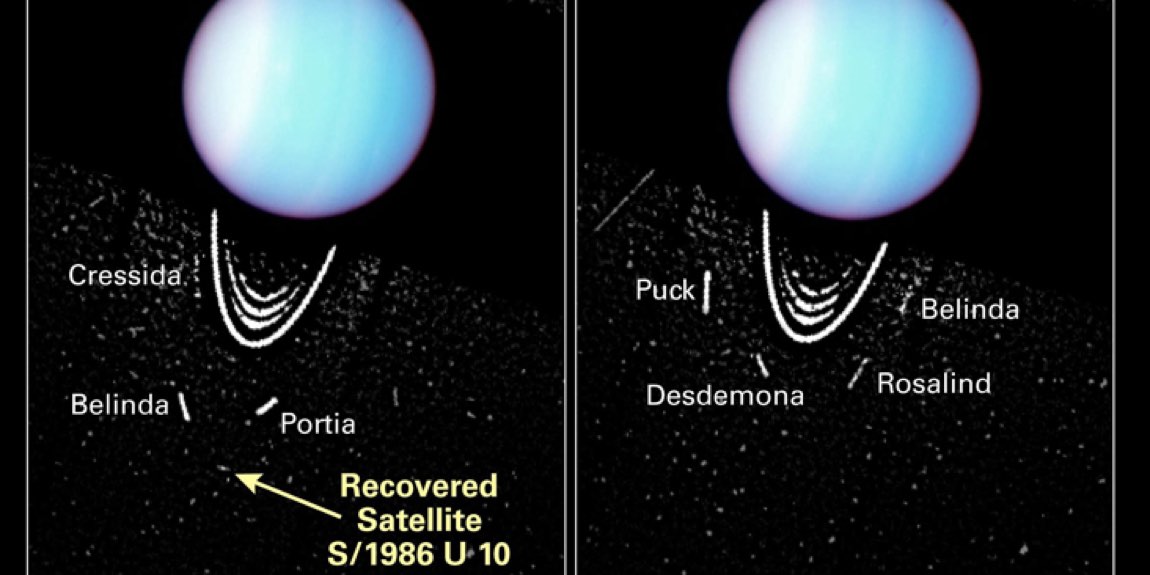
Perdita was photographed by Voyager 2 in January 1986, but nobody recognised it until Erich Karkoschka re-examined the images in 1999. Its existence was then confirmed by Hubble in 2003. The moon is only about 27 km across and orbits between Belinda and Puck. It is caught in a 44:43 resonance with Belinda, which tells astronomers Belinda is roughly 26 times more massive. Its name, from The Winter's Tale, is Latin for 'lost'.
The deep dive
Researched for the Atlas from Wikipedia — Perdita (moon) (1,836 characters read) · updated Nov 15, 2026
01 A Moon Lost in Plain Sight
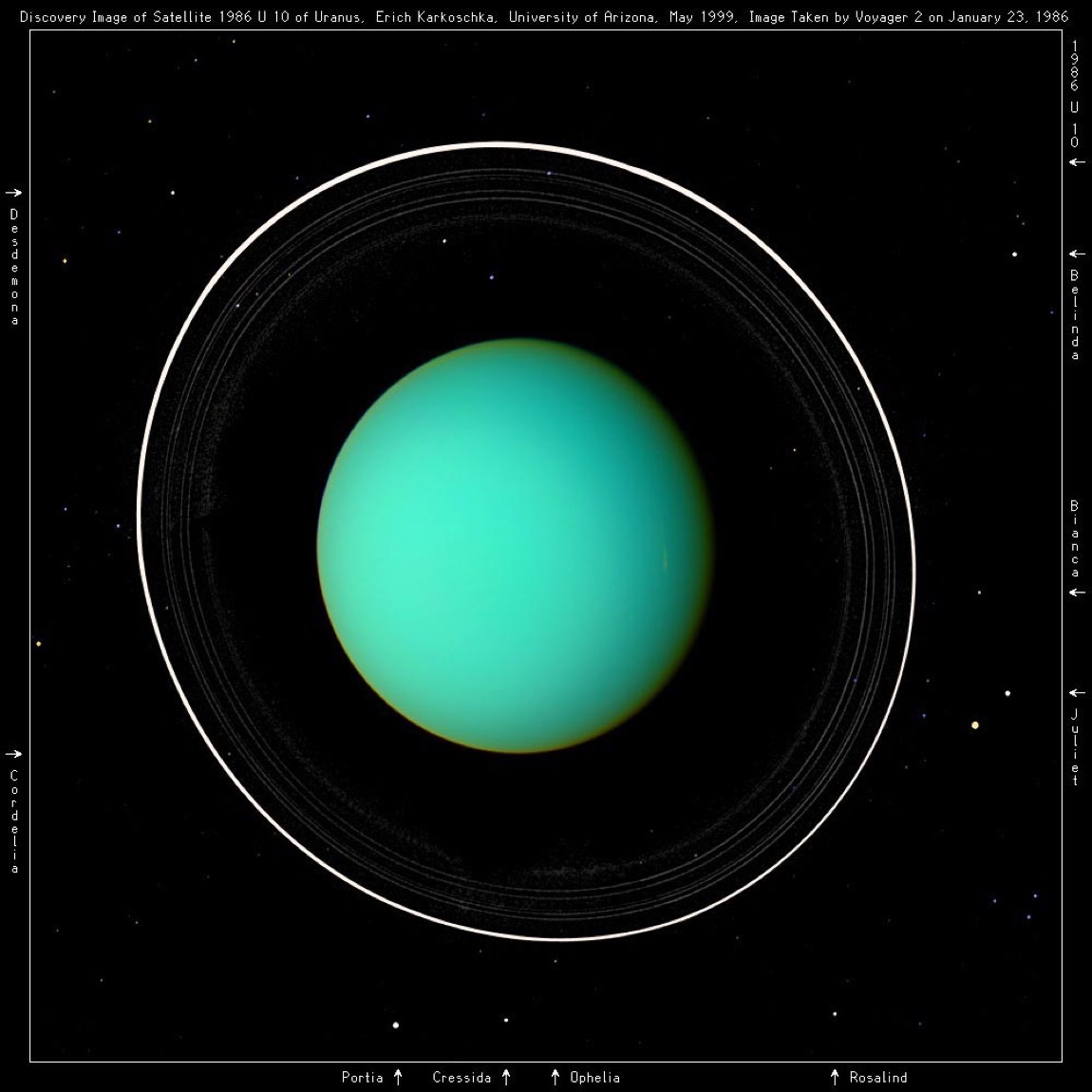
Perdita's story is one of the strangest discovery narratives in planetary science. The Voyager 2 spacecraft photographed it in 1986 during its historic flyby of Uranus, capturing the tiny moon on film without anyone realizing it. The images sat in archives for more than a decade until 1999, when astronomer Erich Karkoschka combed back through the old Voyager data and noticed something that had been overlooked. He reported the find and the moon received the provisional designation S/1986 U 10, but the astronomical community required confirmation from follow-up observations — observations that proved impossible to arrange in time. Without corroborating imagery, the International Astronomical Union officially demoted Perdita in 2001, essentially erasing it from the list of recognized moons. It took the sharp eye of the Hubble Space Telescope in 2003 to spot an object precisely where Perdita was predicted to be, finally vindicating Karkoschka's claim. The gap between first photograph and official confirmation spanned seventeen years, an unusually tortured path to recognition for any world in the solar system.
02 What Shakespeare Has to Do With It
The name Perdita carries a quiet poetry that fits its history almost too well. In Latin, 'perdita' means 'lost,' and the moon was famously lost twice — once in the archives after Voyager's 1986 flyby, and once officially when it was demoted in 2001. The name was drawn from William Shakespeare's play The Winter's Tale, where Perdita is the daughter of Leontes and Hermione. In the play, the infant Perdita is abandoned and believed lost before eventually being found and restored to her rightful place — a narrative arc that mirrors the moon's own journey from obscurity to confirmed existence. This naming follows a long tradition for Uranian moons: nearly all of them take their names from characters in Shakespeare's works or from Alexander Pope's poetry. The moon also carries the formal numerical designation Uranus XXV, marking it as the twenty-fifth recognized satellite of Uranus in the official catalog.
03 Sandwiched Between Neighbors
Perdita occupies a narrow slot in the crowded inner system of Uranus, orbiting between the moons Belinda and Puck. This region is remarkably busy for a planetary neighborhood, packed with small, dark satellites whose orbits lie relatively close together. What makes Perdita's position particularly interesting is not simply where it sits but how it moves. Hubble Space Telescope measurements revealed that Perdita does not follow a straightforward Keplerian orbit — the idealized elliptical path that a lone moon would trace under gravity from Uranus alone. Instead, its motion is measurably pulled and shaped by gravitational interactions with its neighbors, particularly Belinda. This deviation from simple Keplerian motion was itself a clue pointing toward a resonance relationship, and teasing out that resonance gave astronomers a rare lever for probing the masses of these otherwise poorly characterized moons.
04 Orbital Resonance and What It Reveals Deeper
Perdita is caught in a 43:44 orbital resonance with Belinda, meaning that for every 44 orbits Perdita completes, Belinda completes exactly 43. This kind of near-integer ratio creates a repeating gravitational tug that links the two moons' motions in a stable, synchronized pattern — or at least that is the leading interpretation. The resonance turns out to be scientifically valuable beyond simply describing how the moons move. By carefully modeling the gravitational influence Belinda exerts on Perdita, researchers were able to estimate Belinda's mass: it appears to be roughly 26 or 27 times the mass of Perdita. This kind of indirect mass measurement is one of the few tools available for small moons that no spacecraft has visited closely. Perdita also sits near an 8:7 resonance with Rosalind, adding another layer of gravitational complexity to its environment. However, a 2022 study challenged the entire resonance picture, arguing that Perdita and Belinda are not actually in resonance at all. Two subsequent studies pushed back, concluding that the resonance does exist and is stable — leaving the question genuinely open in the current scientific literature.
05 The Portia Group: A Family of Dark Worlds
Perdita belongs to the Portia group, a cluster of inner Uranian satellites that share similar orbits and strikingly similar surface properties. The group includes Bianca, Cressida, Desdemona, Portia, Juliet, Cupid, Rosalind, and Belinda alongside Perdita — nine moons in all, orbiting in a relatively tight band around Uranus. What unites them is not just proximity but photometric similarity: they reflect light in roughly the same way, suggesting their surfaces are composed of comparable materials and have comparable textures. This family resemblance is itself a scientific clue, hinting that the group may share a common origin, possibly from the breakup of a larger precursor body long ago. Despite their shared classification, very little is concretely known about any individual member of the Portia group. Perdita is representative of the group in this respect: beyond its orbital parameters and overall brightness, its physical nature remains poorly constrained.
06 Estimating a Size With Almost No Data Deeper
Because no spacecraft has photographed Perdita up close since Voyager 2's unrecognized 1986 images, and because Hubble cannot resolve its disk directly, Perdita's physical size cannot be measured in the conventional sense. Instead, astronomers use a modeling approach rooted in an assumed geometric albedo — a measure of how reflectively bright a surface is. If the albedo is assumed to match that of the other Portia group members, whose surfaces are similarly dark and presumably composed of similar material, then the observed brightness of Perdita translates to a radius of approximately 13.3 km, or about 8.3 miles. To put that in everyday terms, Perdita would comfortably fit within the borders of a mid-sized city. This estimate, however, is only as reliable as the albedo assumption underpinning it. If Perdita's surface is brighter or darker than its neighbors, the true radius could differ meaningfully. The article is careful to present 13.3 km as an estimate rather than a confirmed measurement, reflecting the genuine uncertainty surrounding even this basic physical property.
07 Voyager 2: The Accidental Photographer
When Voyager 2 swept past Uranus in January 1986, it was humanity's first and, to date, only close encounter with the ice giant and its system of moons. The spacecraft captured an enormous volume of imagery during that brief flyby, documenting the planet, its rings, and its satellites in unprecedented detail. Unknown to anyone at the time, frames containing Perdita were among those images — but the moon was simply not recognized from the photographs. This was not unusual given the challenges of identifying faint, small objects against complex backgrounds in archival data, and the sheer volume of material Voyager returned. It was only thirteen years later, when Erich Karkoschka undertook a systematic re-examination of the Voyager image archive, that the overlooked moon surfaced. Karkoschka's detective work demonstrated how much scientific discovery can still be extracted from decades-old mission data, and how first contact with a world does not always come with immediate recognition.
08 The Hubble Confirmation That Saved Perdita
After Perdita was officially demoted in 2001 due to the absence of confirmatory observations, its status depended entirely on whether future telescopes could locate it. The Hubble Space Telescope provided that confirmation in 2003, detecting an object at the position where Perdita was predicted to be based on Karkoschka's orbital calculations. This was not a trivial observation: Perdita is an extremely faint, small object orbiting a planet nearly 2.7 billion kilometers from Earth at its closest approach, embedded in a system crowded with other small moons. That Hubble could pick it out at all speaks to the precision of both the original orbital prediction and the telescope's capabilities. The 2003 observations also yielded the Hubble measurements that revealed Perdita's deviation from simple Keplerian motion, providing the data that led to the resonance analysis with Belinda. A confirmation observation thus turned into one of the most scientifically productive datasets yet obtained for this otherwise obscure moon.
09 Open Questions That Remain Unanswered Deeper
Even after its hard-won confirmation, Perdita remains one of the least characterized moons in the solar system. Its radius of 13.3 km is an estimate dependent on an assumed albedo. Its mass is known only indirectly through the resonance analysis with Belinda, and even that method is contested. The debate over whether the 43:44 resonance with Belinda is real and stable — with a 2022 study denying it and two subsequent studies affirming it — means that even the basic orbital dynamics of Perdita are unresolved. Nothing is known about its internal structure, composition, or surface geology. Whether the Portia group formed from a single disrupted ancestor body or accumulated separately remains an open question for the entire group. Without a future mission to the Uranian system capable of imaging Perdita closely, these questions are unlikely to be answered soon. Perdita stands as a reminder of how much of our solar system remains genuinely unknown despite decades of exploration.
 ⤢