Moon · Deep guide · orbits Uranus
Belinda
Also called: Uranus XIV · S/1986 U 5
An elongated inner moon whose gravity shapes the orbits of tiny Cupid and Perdita.
What is it?
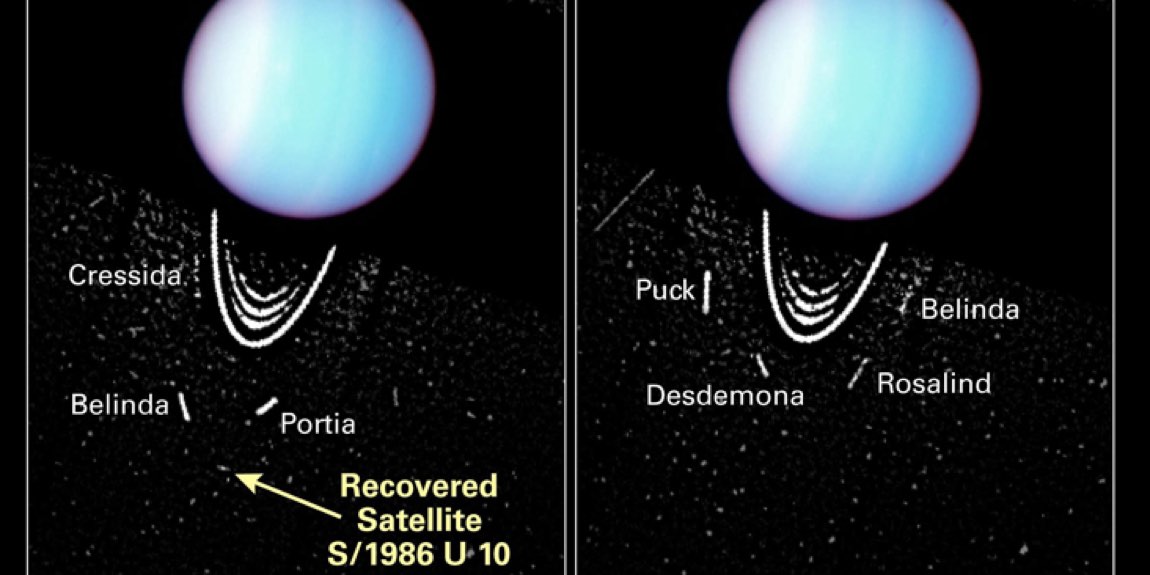
Belinda was found in Voyager 2 images on 13 January 1986. It is a grey, stretched-out moon about 128 km long, with its short axis only half the length of its long one. Belinda is locked in a 44:43 orbital resonance with the much smaller Perdita, which let astronomers estimate their mass ratio. Its gravity also dominates the fate of nearby Cupid. Unlike most Uranian moons, it is named after a heroine of Alexander Pope's poem The Rape of the Lock rather than Shakespeare.
The deep dive
Researched for the Atlas from Wikipedia — Belinda (moon) (1,796 characters read) · updated Nov 15, 2026
01 Discovered in a Single Fleeting Flyby
Belinda owes its entire discovery to a single spacecraft passing through the Uranian system just once. Voyager 2 captured the images that revealed Belinda on 13 January 1986, during humanity's only close encounter with Uranus to date. The moon was initially catalogued under the unglamorous temporary designation S/1986 U 5, a placeholder that simply recorded the year and sequence of discovery. Because Voyager 2 was moving fast and the encounter window was brief, scientists had to work with whatever images the spacecraft happened to collect. This means virtually everything directly observed about Belinda comes from that single pass. No follow-up spacecraft has visited Uranus since, so the data gathered in those few hours in 1986 remain the foundation of almost everything scientists know about this small, dim moon. That extraordinary dependency on one fleeting visit underscores how much of the outer solar system is still known only through snapshots rather than sustained observation.
02 A Moon Named After a Literary Heroine
The name Belinda comes not from mythology but from English literature. It honors the heroine of Alexander Pope's mock-heroic poem The Rape of the Lock, published in the early eighteenth century. This makes Belinda part of a broader naming tradition for Uranian moons, which are drawn from characters in the works of William Shakespeare and Alexander Pope rather than from the Greco-Roman mythological pantheon used for moons of other planets. Pope's Belinda is a fashionable young woman whose stolen lock of hair becomes the center of an elaborate comic epic — an unlikely inspiration for a chunk of dark, grey rock orbiting billions of kilometers from Earth. The moon also carries the formal numerical designation Uranus XIV, reflecting the order in which it was officially recognized among Uranus's satellites. These dual identities — a poetic name and a cold catalog number — neatly capture the tension between the romance of exploration and the rigorous bookkeeping of planetary science.
03 Shape, Color, and What Little We Can See
Voyager 2 images reveal Belinda as a noticeably elongated object, measuring 128 km by 64 km (roughly 80 miles by 40 miles), making it about as long as the state of Connecticut but only half as wide. Its short axis is 0.5 ± 0.1 times the length of its long axis, confirming that this is far from a spherical body. What immediately strikes planetary scientists is that Belinda's major axis points toward Uranus — a configuration maintained by tidal forces that lock the moon's longest dimension in line with the planet, much like our own Moon always shows the same face to Earth. The surface appears grey in color and is quite dark, with a geometric albedo of only 0.067, meaning it reflects less than seven percent of the sunlight that hits it. This low reflectivity is typical of the Portia group and suggests a surface dominated by dark, possibly carbonaceous or radiation-processed material, though without more detailed observations the exact composition remains unknown.
04 Member of a Crowded Inner Family
Belinda is not an isolated world but a member of the Portia group, a cluster of small inner satellites that also includes Bianca, Cressida, Desdemona, Portia, Juliet, Cupid, Rosalind, and Perdita. The moons in this group share similar orbits and similar photometric properties — their surfaces reflect light in broadly comparable ways — which hints at a shared origin, possibly the breakup of a larger parent body long ago. Within this already crowded neighborhood, Belinda orbits particularly closely to two neighbors: Cupid and Perdita. This proximity is not incidental; it has profound dynamical consequences for all three moons. The Portia group as a whole occupies a narrow band of orbital space around Uranus, and the gravitational nudges these moons exchange with each other accumulate over time, making the entire group's long-term future uncertain. Belinda, sitting in the middle of these interactions, plays a central role in the region's chaotic orbital ballet.
05 How a Resonance Revealed a Hidden Mass Deeper
One of the most elegant results to emerge from studying Belinda is a mass estimate derived entirely from orbital mechanics rather than direct measurement. Belinda is locked in a 44:43 mean-motion resonance with its neighbor Perdita, meaning that for every 44 orbits Belinda completes, Perdita completes exactly 43. This precise ratio creates a repeating gravitational relationship between the two moons that leaves a detectable imprint on their motions. By analyzing how this resonance operates, scientists were able to calculate that Belinda's mass is roughly 26 or 27 times the mass of Perdita. It is a remarkable piece of celestial detective work: using the rhythm of orbital motion as a scale to weigh two objects that no spacecraft has ever closely approached. This kind of indirect mass determination is especially valuable for small, faint moons where direct imaging of gravitational effects on other bodies or surface features is not possible.
06 A System on a Countdown to Chaos Deeper
The Portia group, including Belinda, is not dynamically stable over the long term. Scientists have established that the gravitational interactions among these tightly packed moons will destabilize their orbits over timescales of several millions of years. The group is essentially a slow-motion collision course playing out across deep time. A 2012 study identified Belinda and the much smaller Cupid as the most likely pair to collide first, with the event expected somewhere between 100,000 and 10 million years from now — the wide range reflecting uncertainty about the actual densities of the Portia-group satellites, which are still not precisely known. The collision, if it occurs, would be a low-speed crunch by cosmic standards but would still dramatically reshape the local environment, potentially scattering debris into the rings of Uranus or creating new smaller moonlets.
07 The Resonance Debate: Survival or Doom for Cupid? Deeper
Few questions in Uranian moon science have produced more contradictory answers in a short time than the question of Cupid's orbital fate. A 2022 analysis argued that the 44:43 resonance between Belinda and Perdita actually shields Cupid from destabilization, suggesting Cupid is likely to survive for at least 50 million years — a dramatic extension compared to the 2012 estimate. Yet another study published in the same year, 2022, reached the opposite conclusion: it found that Belinda and Perdita were not actually in the resonance, and that Cupid is unlikely to survive the next 50,000 years — a figure a thousand times shorter than the optimistic estimate. The disagreement hinges on whether the resonance is real and robust. A 2026 study subsequently found that Belinda and Perdita were indeed in resonance, lending support to the more optimistic survival estimates. This ongoing scientific debate, with studies published across just a few years reaching radically different conclusions, illustrates how much uncertainty remains about even the basic dynamics of Uranus's inner moon system.
08 Why Belinda's Neighborhood Is So Hard to Study
The difficulty of studying Belinda comes down to distance, darkness, and the limits of existing data. Uranus sits so far from Earth that even the best ground-based and space telescopes struggle to resolve individual small moons in its inner system. Belinda's geometric albedo of just 0.067 makes it one of the darker objects in the solar system, reflecting barely more light than a fresh asphalt road. Combined with its modest size of 128 km along its longest axis, it is simply too dim and too small to study in detail from Earth. The only close-up data comes from Voyager 2's 1986 flyby, and those images, while groundbreaking at the time, lack the resolution needed to map surface features or determine composition. Until a dedicated Uranus mission returns to the system — something planetary scientists have strongly advocated for but that has not yet been approved for flight — Belinda will remain one of the solar system's most poorly understood moons.
09 Tidal Locking and What It Tells Us Deeper
The fact that Belinda's long axis points toward Uranus is a direct consequence of tidal locking, the same physical process that keeps our Moon showing only one face to Earth. When a moon is not perfectly spherical — and Belinda, with its short axis roughly half its long axis, is far from it — gravity from the parent planet pulls more strongly on the nearer, more extended parts of the body than on the farther parts. Over time, this differential gravitational pull torques the moon until its longest dimension aligns with the direction toward the planet, locking it in that orientation. For Belinda this alignment is clearly visible in Voyager 2 images. The degree of elongation, with the short axis 0.5 ± 0.1 times the long axis, also constrains what scientists can infer about the moon's internal strength. A body with that shape must either be held together by gravity or be a solid fragment strong enough to maintain the form against tidal deformation — but without density or composition data, distinguishing between these possibilities remains impossible.
10 Orbital Proximity and Gravitational Whispers
Among all the Portia-group moons, Belinda is noted for orbiting particularly closely to both Cupid and Perdita. This tight spacing means the gravitational forces these moons exert on one another are relatively significant compared to what more distant neighbors would experience. Even though these are small bodies — Belinda itself spans only 128 km at its longest — their proximity amplifies the cumulative effect of repeated gravitational nudges over millions of years. These interactions are described as resonant when the orbital periods fall into simple integer ratios, as with Belinda and Perdita's 44:43 resonance. Resonances can either stabilize an orbit, acting like a gravitational anchor, or destabilize it, depending on the specific configuration. In Belinda's neighborhood, the interplay of resonant and non-resonant interactions among multiple moons simultaneously creates a system whose future evolution is genuinely difficult to predict with current models, as the conflicting published studies from 2012, 2022, and 2026 clearly demonstrate.
11 What Future Missions Might Reveal
Because Voyager 2 remains the only spacecraft to have visited Uranus, Belinda has never been observed up close with modern instruments. A future dedicated Uranus orbiter — the kind of mission that planetary scientists have prioritized in recent decadal surveys — would transform understanding of Belinda and its neighbors almost overnight. An orbiting spacecraft could measure the moon's mass directly by tracking gravitational perturbations, determine surface composition through spectroscopy, and image surface features at resolutions far beyond anything Voyager 2 achieved. It could also settle the ongoing debate about whether Belinda and Perdita are truly in the 44:43 mean-motion resonance, and what that means for Cupid's survival. Even relatively brief observations from a Uranus orbiter passing through the inner moon system would generate more new data about Belinda than the entire four decades of study since its discovery, putting into sharp relief just how much a single flyby in 1986 has had to carry on its own.