Moon · Deep guide · orbits Uranus
Mab
Also called: Uranus XXVI · S/2003 U 1
A tiny icy moon that feeds Uranus's faint blue outer ring.
What is it?
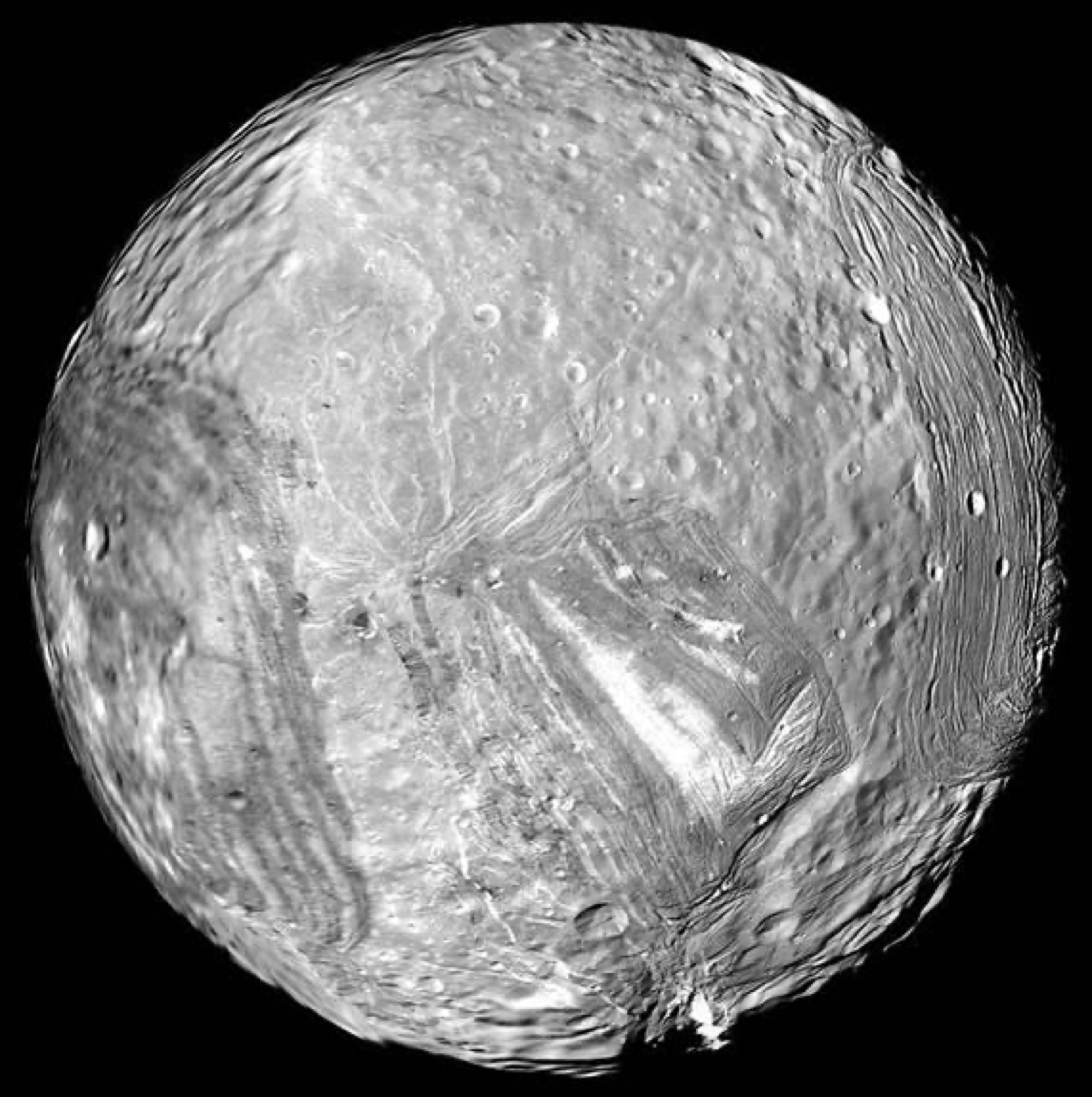
Mab was found in Hubble Space Telescope images in 2003; afterwards it was also picked out of old Voyager 2 photos. It is the outermost of Uranus's inner moons and likely only about 12 km wide. Mab is thought to be the source of the mu ring, a diffuse blue ring made of tiny ice particles blasted off its surface by impacts. Its bluish colour resembles Miranda's, hinting at an ice-rich surface.
The deep dive
Researched for the Atlas from Wikipedia — Mab (moon) (4,016 characters read) · updated Nov 15, 2026
01 How Mab was finally spotted
Mab's discovery required one of the most powerful space telescopes ever built, yet even then it almost stayed hidden. Mark R. Showalter and Jack J. Lissauer found it in 2003 using the Hubble Space Telescope, nearly two decades after Voyager 2 had swept past Uranus in 1986 and photographed the planet's inner moon system in exhaustive detail. The irony is that Mab is actually brighter than Perdita, a moon that was successfully identified from those very Voyager images back in 1997. That brightness comparison prompted scientists to go back and scrutinize the old Voyager frames one more time, and Mab was eventually found lurking in them all along — it had simply been overlooked. The moon was assigned the temporary designation S/2003 U 1 after its confirmed discovery. Its elusiveness comes down to sheer smallness: with a radius likely somewhere between 6 and 12 km, Mab is one of the tiniest worlds in the entire Uranian system, faint enough to hide in plain sight for seventeen years.
02 A fairy queen's name from Shakespeare
Following the tradition established for Uranian moons, Mab was named after a character from English literature rather than from classical mythology. The honoree is Queen Mab, a fairy queen drawn from English folklore who appears in William Shakespeare's play Romeo and Juliet. In the play she is described as the midwife of the fairies, a whimsical and mercurial figure — a fitting namesake for such a small, elusive, and behaviorally puzzling moon. All of Uranus's inner moons carry names from Shakespearean plays, so Mab joins neighbors like Puck, Miranda, Perdita, Cupid, and Belinda in a solar-system neighborhood that reads like a cast list from the Elizabethan stage. The formal designation Uranus XXVI reflects its order of official numbering among Uranian satellites, though in everyday astronomical usage the name Mab is universally preferred.
03 The only blue ring beyond Saturn
Mab orbits at exactly the same distance from Uranus as the μ ring, formerly catalogued as R/2003 U 1, which was discovered at essentially the same time as the moon itself. That spatial coincidence is not accidental: Mab is the presumed source of the ring. The leading explanation is that micrometeoroid impacts — tiny space-rock pellets constantly raining onto Mab's surface — kick small water ice particles off the moon and into orbit, where they spread out to form the ring. What makes the μ ring genuinely remarkable is its color. It is blue, and it is the only blue ring in the Solar System known other than Saturn's E Ring. Crucially, that blue hue is not thought to reflect the intrinsic color of whatever material the ring is made of. Instead it arises because the ring particles are extremely small; fine particles scatter shorter wavelengths of light preferentially, giving the ring its striking appearance. Mab's size turns out to be nearly optimal for sustained dust production: a larger moon would gravitationally recapture escaping particles, while a smaller one would not have enough surface area to keep the ring supplied.
04 Why nearby moons don't have rings Deeper
Mab's neighbors Perdita and Cupid might be expected to generate dusty rings of their own through the same micrometeoroid-impact mechanism, yet no rings have been detected around either of them. The article attributes this absence to the influence of Belinda, another inner Uranian moon. Belinda apparently limits the lifetimes of any dust that Perdita and Cupid do manage to produce, disrupting or sweeping away ring material before it can accumulate into a detectable structure. This highlights how dynamically crowded the inner Uranian moon system is: the moons are packed closely enough that each one's gravitational influence reaches into its neighbors' neighborhoods. Mab, sitting at the outermost edge of this inner group between Puck and Miranda, enjoys a position just clear enough of Belinda's reach to maintain a persistent ring. The μ ring's very existence thus depends not only on Mab's particular size and surface properties, but also on the specific gravitational geography of the entire inner moon system — remove or reposition Belinda, and the picture might look very different.
05 Mab's mysterious orbital wobbles Deeper
For a time, Mab appeared to be one of the most dynamically unstable objects in the solar system. Observations showed its position shifting by as much as 100 km from its predicted location in as little as six days — an extraordinary deviation for a moon on what should be a relatively stable orbit. Scientists proposed a genuinely exotic explanation: perhaps Mab shares its orbital path with a swarm of undetected small moonlets, whose combined gravitational tugs perturb Mab in irregular and hard-to-predict ways. This would have made the μ ring region a far more complex and populated place than it appears. However, the mystery was eventually resolved in a more mundane but important way. The apparent orbital variation was traced back to an instrumental error rather than any real physical effect. The wobbles were an artifact of the measurements, not a property of Mab's actual motion. The episode serves as a useful reminder that at the edge of detectability, distinguishing genuine astrophysical phenomena from subtle instrumental systematics can be extraordinarily difficult.
06 Pinning down Mab's size is surprisingly hard
Because Mab is so small and distant, its size has never been directly measured. Instead, astronomers infer it by assuming a certain reflectivity and working backward from the moon's observed brightness. The catch is that two very different reflectivity assumptions give two very different answers. If Mab is as dark as its neighbor Puck, which has an albedo of 10%, then its radius works out to about 12 km — roughly the width of a mid-sized city. But if Mab has a bright surface like Miranda, which reflects 46% of incoming light, then the radius shrinks to about 6 km, which would make it smaller than Cupid and place it among the smallest known Uranian satellites. A factor-of-two uncertainty in the size of a world is striking by any standard, and it has driven multiple teams to attempt increasingly sophisticated observations in an effort to settle the question.
07 Decades of failed infrared detections Deeper
The story of trying to characterize Mab in infrared light is one of repeated near-misses. A 2006 study using the Keck telescope attempted observations at a wavelength of 2.2 μm and simply could not detect the moon. The team proposed that Mab must be covered in ice similar to Uranus's classical moons, estimating its radius at somewhere in the 6–8 km range on that basis. Then in 2019, a different observing group returned to Keck and tried again at approximately 1.6 μm — and again Mab refused to appear. This second non-detection, combined with the first, actually strengthened the ice hypothesis rather than undermining it. Water ice has dark absorption bands at approximately 1.5 μm and 2.0 μm, meaning an icy surface would naturally be dim at both wavelengths tested. Rather than being failures, the two non-detections together painted a coherent picture pointing toward an ice-rich surface, even if no direct signal had yet been obtained.
08 The 2023 detection that changed things
After nearly two decades of near-misses, Keck telescope observations published in 2023 finally achieved a genuine near-infrared detection of Mab. The key methodological breakthrough was the shift-and-stack technique, which involves aligning and combining multiple individual images in a way that builds up signal while keeping noise from accumulating at the same rate. The results favored a Mab with a radius of 6 km and a bright, Miranda-like surface rich in water ice — consistent with both the 2006 and 2019 non-detections at ice-absorption wavelengths. That said, the data could not fully rule out the alternative: a 12 km radius body with a dark, Puck-like surface. The brighter, smaller, icier picture is now the preferred one, but the question is not entirely closed. What the 2023 detection did confirm is that Mab is spectrally blue, just like Miranda, further supporting the water ice interpretation.
09 An icy oddity among dark neighbors Deeper
Among Uranus's inner moons, Mab appears to be a genuine outlier in surface composition. Its spectral slope — the way its brightness changes across different wavelengths — is the only one among the inner Uranian moons that resembles Miranda's rather than the dark, spectrally neutral surfaces typical of the other inner moons like Puck. The article notes that Mab likely has an ice-rich surface comparable to Miranda's, which sets it apart from the broader inner moon population. This compositional distinction is scientifically interesting because it raises questions about why Mab ended up with a different surface than its neighbors. One possibility consistent with the evidence is that Mab's surface is continuously refreshed by the same micrometeoroid impacts that feed the μ ring, exposing fresh interior ice rather than allowing a dark refractory coating to build up over time. The connection between Mab's surface properties, its ring-forming role, and its unique spectral character may all be facets of the same ongoing physical process.
10 Where Mab sits in the Uranian family
Mab occupies a distinctive position within Uranus's moon system. It orbits between Puck and Miranda, and it holds the title of outermost inner moon of Uranus — the boundary marker between the tightly packed inner group and the classical mid-sized moons beyond. Despite sitting at the outer edge of the inner group, Mab is physically one of the smallest members, with a likely radius of only 6 km (or at most 12 km), compared to Puck's radius of about 81 km and Miranda's roughly 236 km. Its formal designation, Uranus XXVI, places it as the twenty-sixth confirmed moon of Uranus in the official numbering. Because of its small size and extreme faintness, it was the last of its orbital neighborhood to be discovered, found only in 2003 even though spacecraft had visited the Uranian system seventeen years earlier. Its orbital distance from Uranus is shared with the μ ring, blurring the line between moon and ring-source in a way that makes it as much a ring component as an independent satellite.
11 Open questions science has yet to answer Deeper
Despite the progress made through decades of Hubble and Keck observations, Mab remains poorly understood in several fundamental respects. Its size is still not definitively settled: the 2023 detection favors a 6 km radius icy body but cannot exclude a 12 km dark one, and without a spacecraft visit or a resolved image, the ambiguity may persist for years. The exact mechanism sustaining the μ ring — how the balance between micrometeoroid ejection and gravitational recapture plays out over time — has not been quantitatively confirmed. Whether Mab truly harbors undetected co-orbital moonlets, once a live hypothesis before the apparent orbital variations were attributed to instrumental error, has not been exhaustively ruled out by independent methods. And the question of why Mab alone among the inner moons has a Miranda-like, ice-rich surface remains without a definitive explanation. No mission to Uranus has been approved with a launch date, meaning close-up observation of Mab lies comfortably in the realm of future science rather than near-term planning.