Moon · Deep guide · orbits Uranus
Setebos
Also called: Uranus XIX · S/1999 U 1
A distant moon of Uranus that spins once every four and a quarter hours.
What is it?
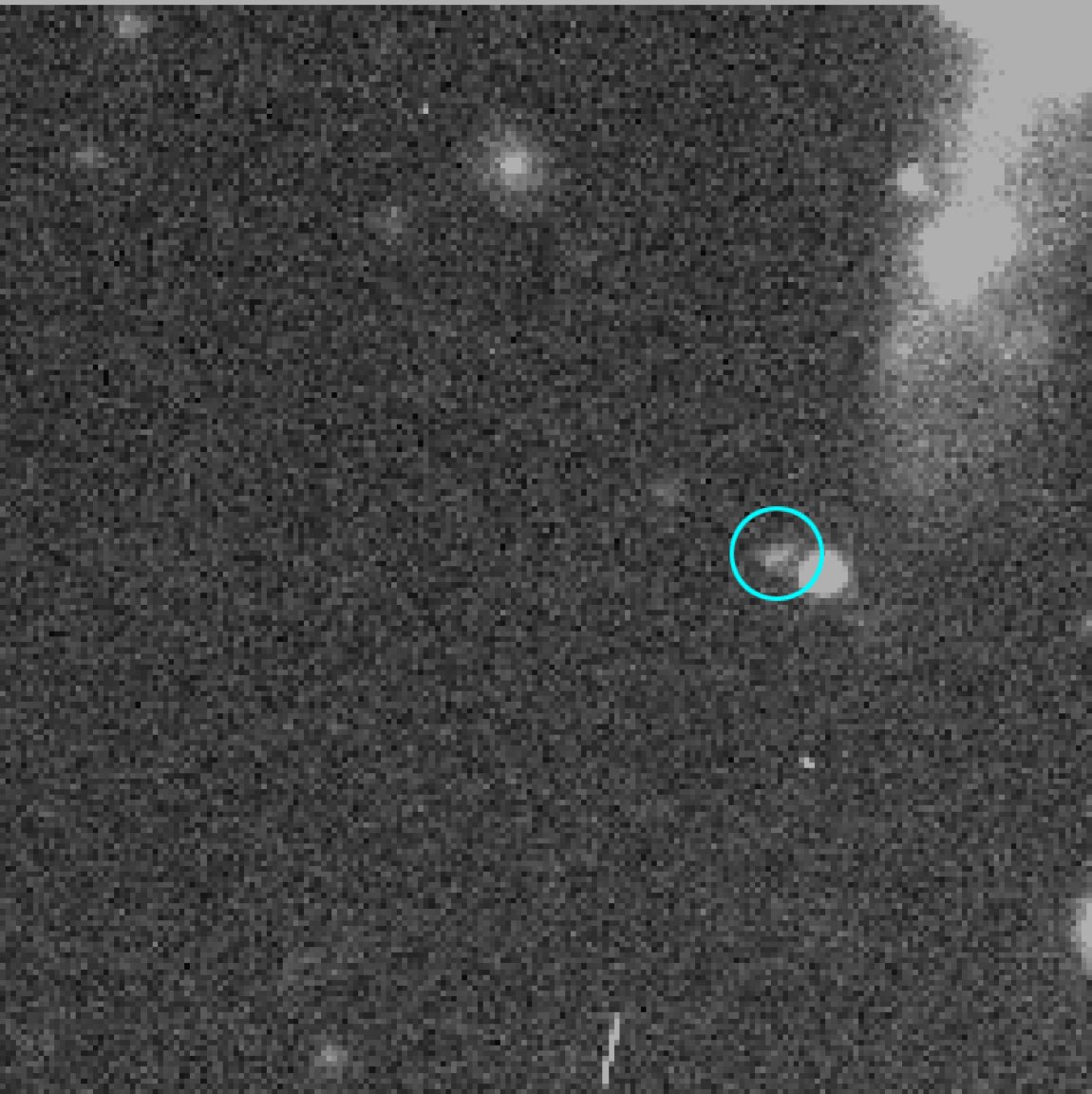
Setebos was discovered on 18 July 1999 together with Prospero and Stephano. About 47 km across, it is one of the larger irregular moons of Uranus and follows a stretched, backwards orbit more than 17 million km from the planet, taking over six years per lap. Its grey colour matches Prospero's. Setebos rotates in about 4.3 hours, among the fastest spins of any known moon. Like Sycorax and Prospero, it was probably captured by Uranus.
The deep dive
Researched for the Atlas from Wikipedia — Setebos (moon) (1,928 characters read) · updated Nov 15, 2026
01 A moon discovered at the turn of a millennium
Setebos was spotted on 18 July 1999 by astronomer John J. Kavelaars and colleagues, right at the cusp of a golden era for outer-planet moon hunting enabled by digital sky surveys. It entered the record books under the provisional designation S/1999 U 1 before being formally confirmed as Uranus XIX — the nineteenth moon of Uranus to receive an official number. The discovery came nearly two decades after Voyager 2's 1986 flyby of Uranus, which missed Setebos entirely because the spacecraft's cameras were focused on the planet's inner system and the irregular satellites were simply too faint and too distant to detect at the time. Finding it required patient ground-based telescope work, stacking multiple long exposures to tease out a dim moving speck against the star field.
02 The Shakespearean name behind the moon
All of Uranus's moons are named after characters from the works of William Shakespeare or Alexander Pope, and Setebos is no exception. The name comes from The Tempest, where Setebos is the god worshipped by both the witch Sycorax and her monstrous son Caliban. In the play, Setebos is a savage, fearful deity — a fitting choice for a cold, dark, and distant captured body lurking at the edge of the Uranian system. The connection runs deep enough that two other Uranian irregular moons — Sycorax and Caliban — share the same literary family. Adding a small layer of confusion, a crater on the moon Umbriel is also named after the same deity, but spelled differently: Setibos. The variant spelling is there precisely to avoid any ambiguity in scientific databases between the moon and the crater.
03 An orbit that defies the solar system's grain Deeper
Setebos moves in a direction opposite to Uranus's rotation, a retrograde orbit that is itself a strong hint the moon is not a native object. Its average distance from Uranus is 17,256,000 km — far enough that the journey around the planet takes 1,978 days, well over five Earth years per orbit. That distance is roughly 115 times the distance from Earth to the Moon, to put it in a familiar frame. What makes the orbit especially striking is its high eccentricity of 0.445, meaning the path is a noticeably stretched ellipse rather than anything approaching a circle. The orbital inclination sits at about 152° to the ecliptic. Crucially, none of these orbital elements are fixed: the article notes that solar gravity and gravitational nudges from other planets continuously perturb them, so the orbit Setebos traces today is not quite the orbit it will trace in a few thousand years.
04 One of the solar system's fastest-spinning moons
Despite being so remote and so small, Setebos earned a remarkable distinction in rotational dynamics. Measurements of its light curve made by the Kepler space telescope revealed a rotation period of about 4 hours and 15.3 minutes, placing it among the fastest-rotating moons in the entire Solar System. For comparison, Earth's Moon takes about 27 days to complete one rotation. Kepler detected this spin not by imaging Setebos directly — it is far too small and dim for that — but by tracking the periodic brightening and dimming as differently reflective faces of the irregularly shaped moon rotated into and out of view. The measurement is a beautiful example of repurposing a planet-hunting telescope for small-body science, squeezing precise rotational data out of a pinprick of light billions of kilometers from the Sun.
05 Size, color, and what that grey hue suggests Deeper
Setebos is estimated to be about 47 kilometers in diameter, a figure that depends on an assumed albedo of 4% — meaning the surface reflects only 4 percent of the sunlight that strikes it, making it quite dark, comparable to coal. That albedo assumption matters because no spacecraft has ever resolved Setebos into a disk; its size is inferred by combining its measured brightness with a reasonable guess about how reflective its surface is. In visible light Setebos appears neutral, or grey, with color indices of B−V = 0.77 and R−V = 0.35. This grey color is similar to that of the irregular moon Prospero, also in the Uranian system. The color is thought to reflect surface composition, though no direct spectroscopic breakdown of its minerals is yet available from the article.
06 A family of moons with a complicated history Deeper
The orbital parameters of Setebos place it in what researchers describe as the same dynamic cluster as two other Uranian irregular moons — Sycorax and Prospero — suggesting the three may share a common origin. The leading idea is that they could be fragments of a single captured body that was subsequently broken apart, or objects captured during the same event from the same source population. This would make them a kind of loose family in the outer Uranian system. But the picture is complicated by one stubborn fact: Sycorax has a noticeably redder color than Setebos or Prospero, which both appear grey. If all three descended from the same parent object, their surfaces should look similar. The color discrepancy is an open question — it may point to different surface processing histories, or it may mean the three moons are not as closely related as their orbital clustering implies.
07 A captured stranger, not a local
Planetary scientists believe Setebos almost certainly did not form in orbit around Uranus alongside the planet's regular moons. Its retrograde orbit, steep inclination, and high eccentricity are tell-tale signs of a captured object — something that formed elsewhere in the solar system and was gravitationally snagged by Uranus at some point in the distant past. Exactly when and how such a capture happened is uncertain; it likely required a dissipative mechanism such as passing through a disk of gas and dust, or a three-body interaction during the solar system's turbulent early history. Objects with orbits like Setebos's are thought to have originated in the outer solar system, possibly from populations similar to the Kuiper Belt or the scattered disk, though the article does not specify a confirmed source region.
08 Why no spacecraft has ever seen it up close
Setebos remains one of the least-characterized sizeable moons in the solar system largely because only one spacecraft — Voyager 2, in January 1986 — has ever visited the Uranian system, and it did not observe the distant irregular satellites. Setebos has never been imaged up close by any space probe. The proposed Uranus Orbiter and Probe, or UOP, would change that in a limited way: all Uranian irregular moons including Setebos are planned as distant observation targets. The UOP would study their rotation periods and shapes by monitoring brightness variations over time, the same technique Kepler used. However, a close flyby of Setebos is considered unlikely because its orbit does not lie near the ecliptic plane, making it a difficult target to reach without a costly trajectory detour.
09 What a future orbiter could actually learn Deeper
Even without a close flyby, the Uranus Orbiter and Probe represents the best near-term opportunity to learn more about Setebos. By watching how the moon's brightness changes as it rotates, the UOP could confirm and refine the Kepler rotation period measurement of roughly 4 hours and 15.3 minutes. Changes in brightness amplitude can also reveal whether the moon is elongated or more rounded, providing a rough shape model without ever resolving it into a detailed image. If the orbiter carries sensitive enough photometric instruments, color measurements could help settle the question of whether Setebos and Sycorax truly share a compositional heritage. What remains out of reach for such a mission, based on the current plan, is surface geology, internal structure, or any kind of close-range imaging — all of those would require a dedicated flyby spacecraft that does not yet exist in any funded mission plan.
10 The puzzle of continuous orbital change Deeper
One underappreciated aspect of Setebos's situation is that its orbit is not stable in a simple, locked sense. The article explicitly notes that the orbital elements — the eccentricity, inclination, and other parameters that define the shape and tilt of the orbit — are continuously changing due to perturbations from both the Sun and other planets. This kind of ongoing orbital evolution is common for irregular satellites in the outer solar system, where the host planet's gravitational grip is weaker relative to solar tides and the influences of Jupiter and Saturn. For Setebos, this means that over long timescales its path around Uranus slowly morphs, and the orbital snapshot we have today is just one frame in a long dynamic movie. Understanding the full history of that evolution could help reveal more about how and when Setebos was captured.
11 Setebos among the irregular moons of Uranus
Uranus hosts a collection of irregular satellites — distant moons with inclined, eccentric, often retrograde orbits that contrast sharply with the well-behaved regular moons closer to the planet. Among these, Setebos is described as one of the largest, though at an estimated 47 kilometers across it is hardly a giant. Its grey color and orbital grouping with Sycorax and Prospero make it an important data point in understanding whether Uranus's irregular moon population arrived in clusters from common parent bodies or as a jumble of unrelated captures. Irregular satellites across the outer solar system — around Jupiter, Saturn, Uranus, and Neptune — are thought to record the chaotic migration of the giant planets billions of years ago, so each one studied adds a piece to a much larger puzzle about how the solar system reached its current arrangement.