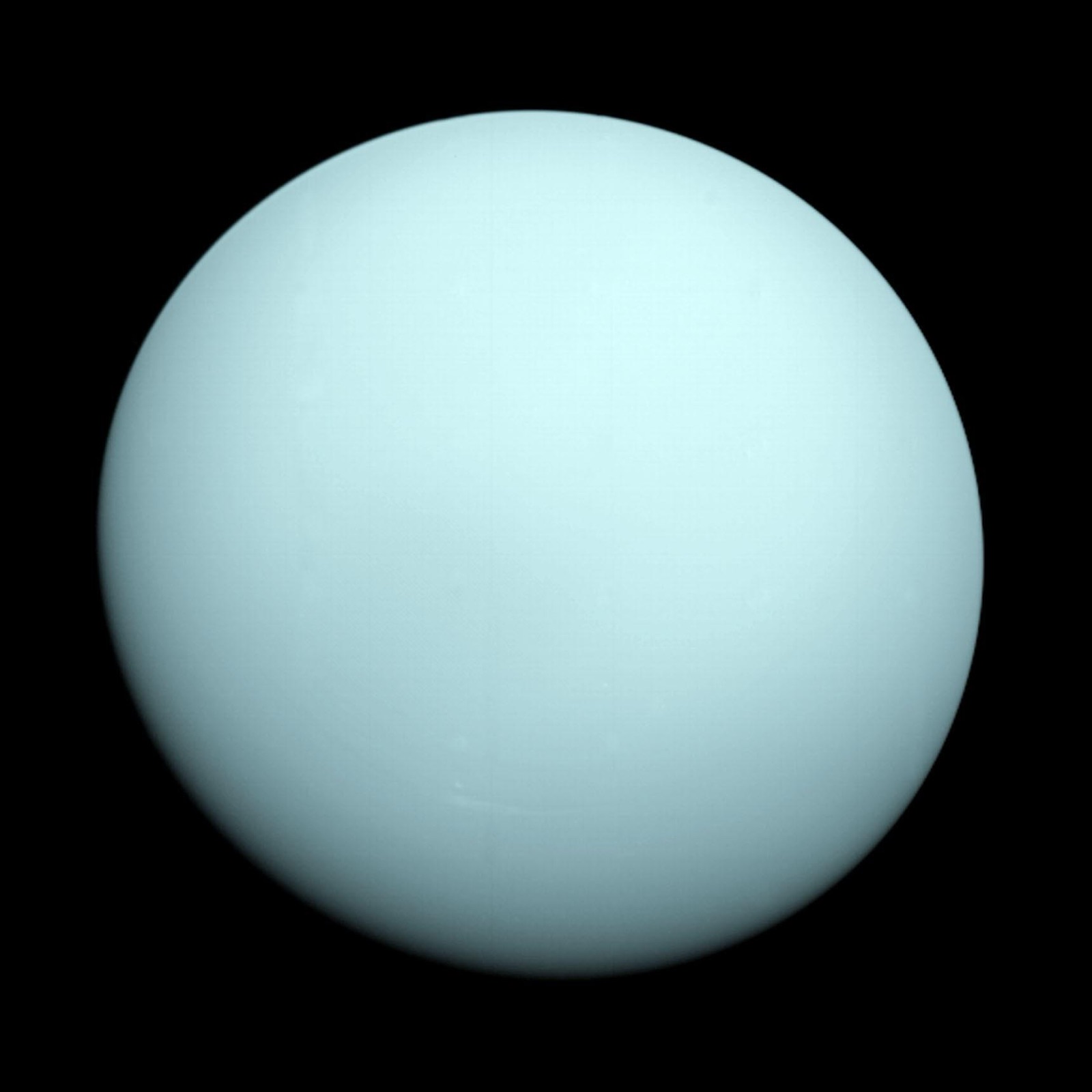
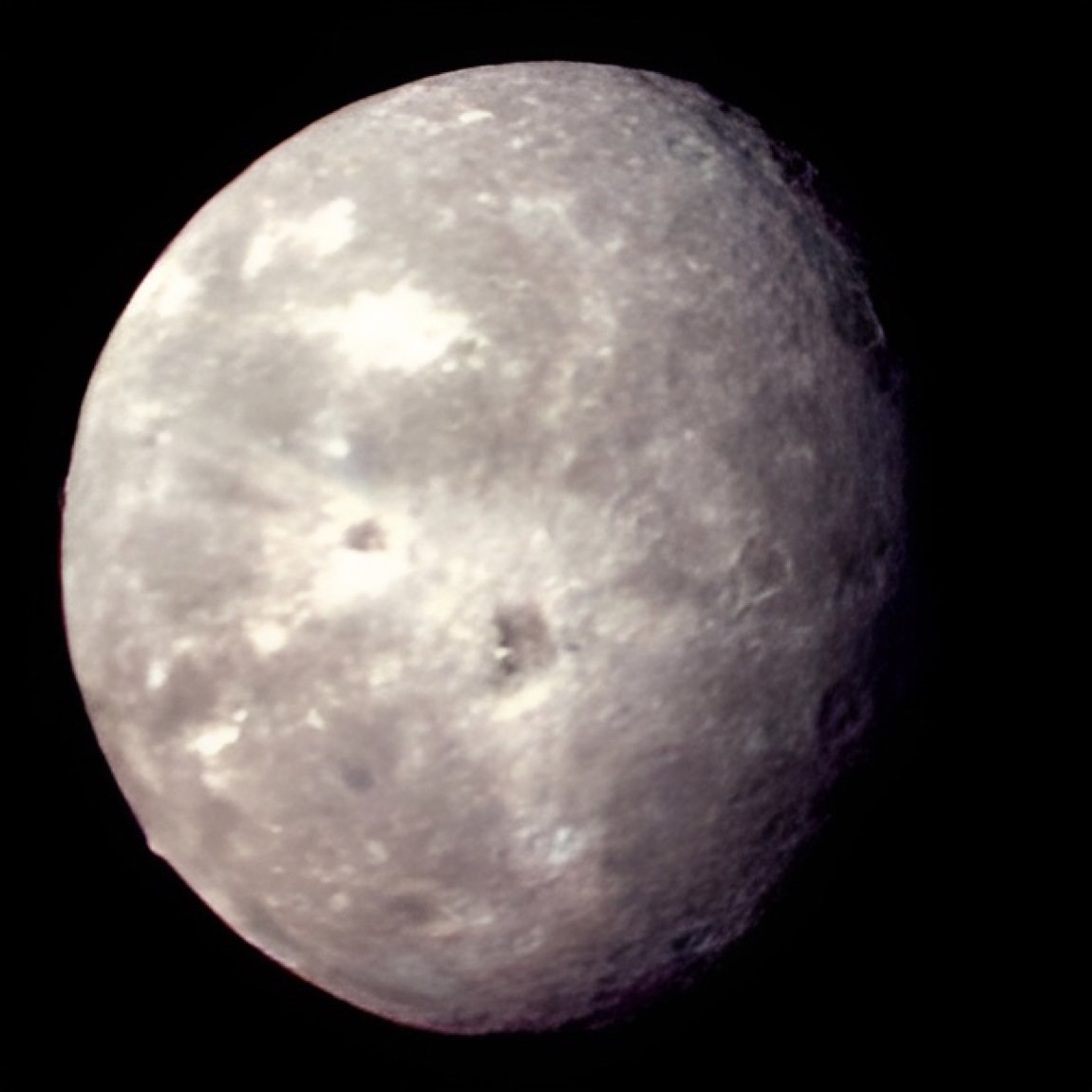
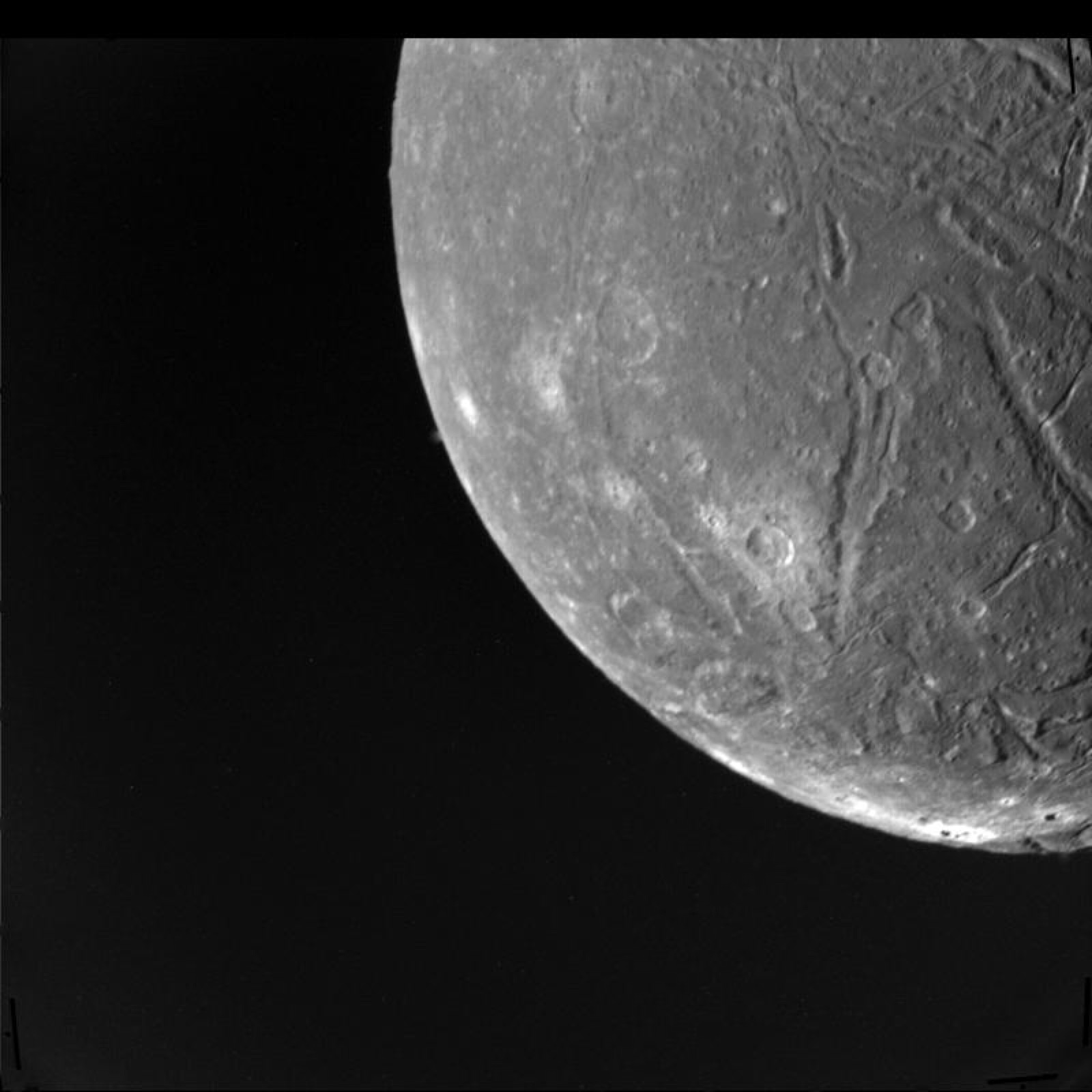
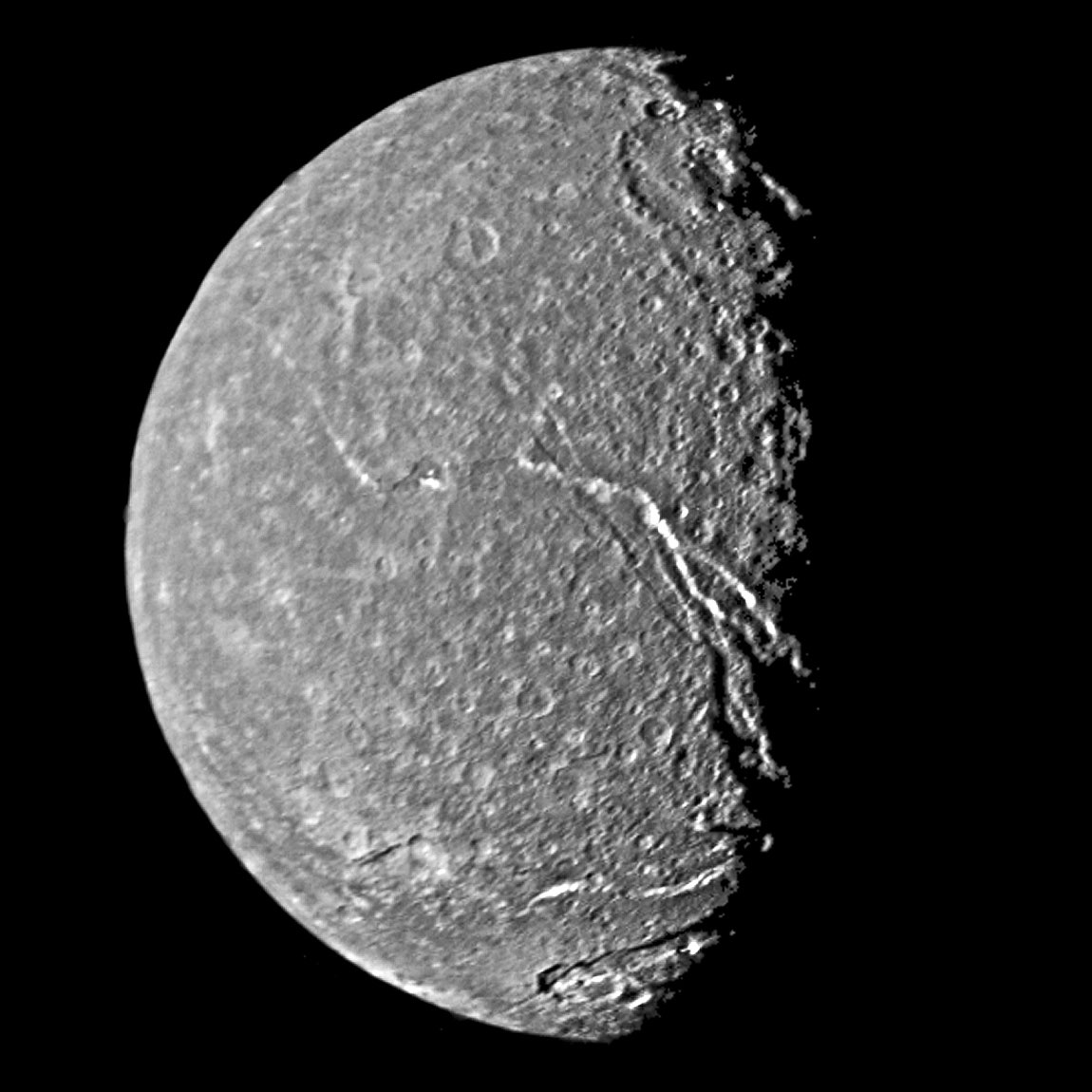
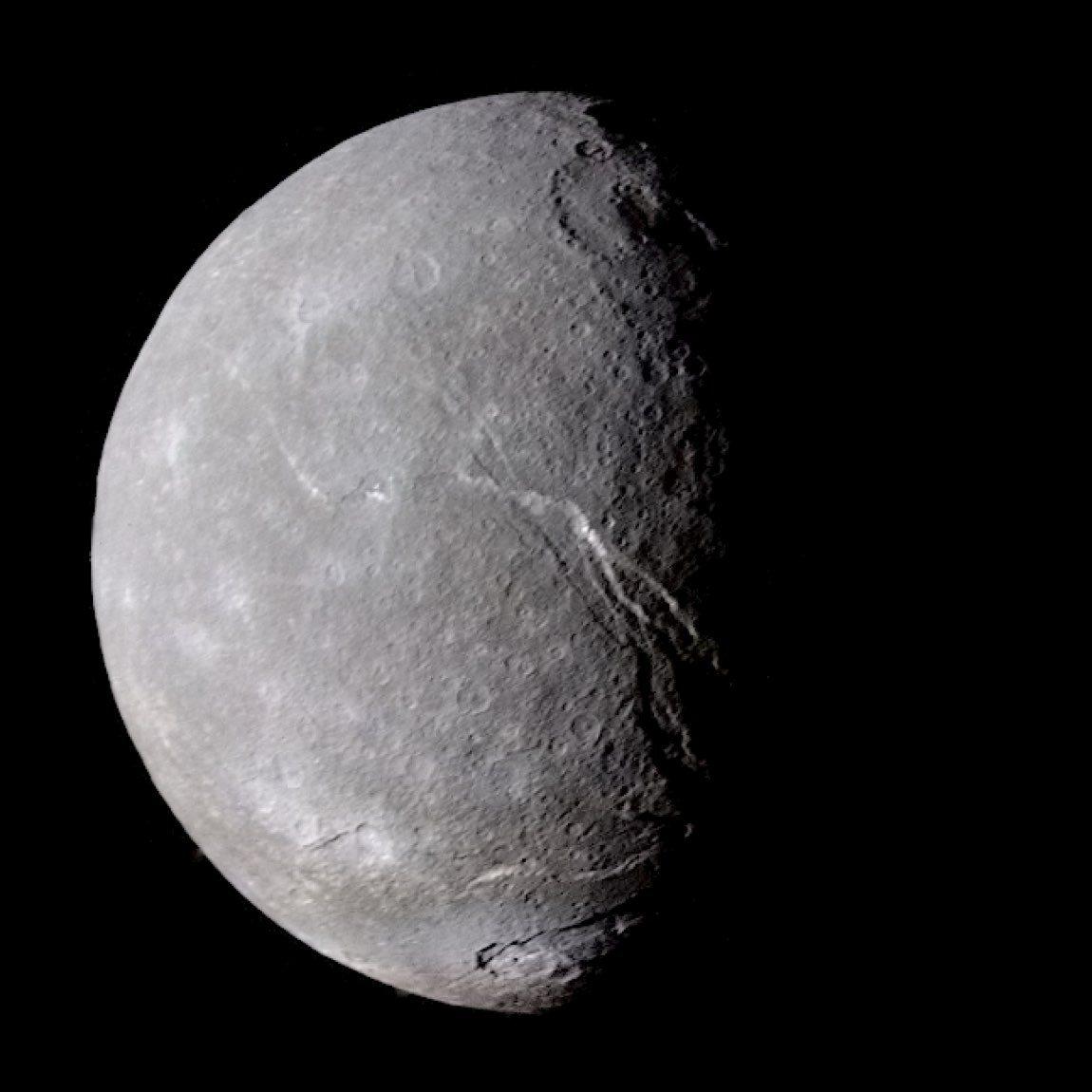
 Photograph · NASA/JPL · Public domain
Moon · Deep guide · orbits Uranus
Titania
Uranus's largest moon has canyons, frost, and a possible hidden sea.
What is it?
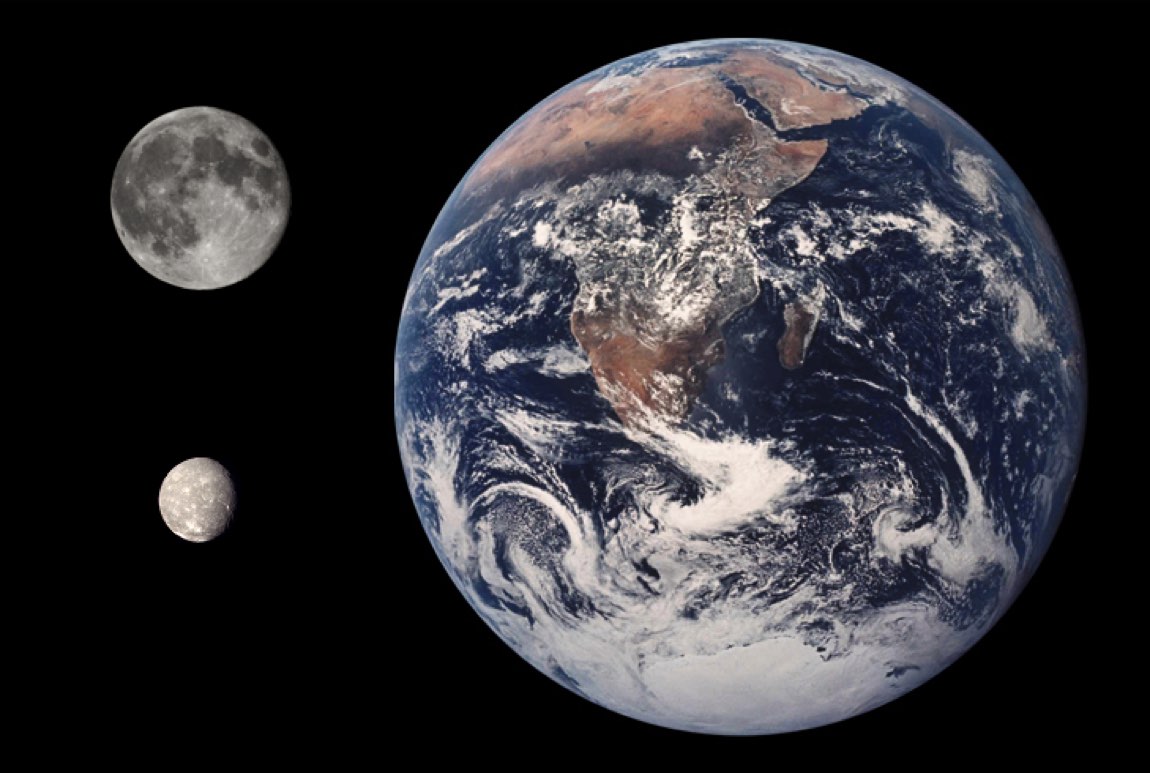
Titania, 1,577 km across, is the largest moon of Uranus and the eighth largest anywhere. Voyager 2's single 1986 flyby revealed enormous fault canyons slicing its icy face — signs the moon expanded and cracked as its interior froze. Models allow a thin liquid layer to survive at depth even today.
The deep dive
Researched for the Atlas from Wikipedia — Titania (moon) (19,022 characters read) · updated Sep 20, 2026
01 William Herschel's double discovery night
On January 11, 1787, William Herschel pointed his telescope at Uranus and spotted not one but two new moons in a single observing session — Titania and Oberon on the same night. That feat would prove nearly impossible to repeat: for close to fifty years afterward, no other instrument in the world could confirm the discovery. Only Herschel's own telescope had sufficient light-gathering power to pick them out. His son John gave the moons their Shakespearean names in 1852, at the request of William Lassell, who had recently discovered Ariel and Umbriel. Whether the elder Herschel actually devised the names or simply granted permission for Lassell's suggestions remains uncertain. The naming tradition itself is unique across the Solar System — all of Uranus's moons draw from characters in Shakespeare or Alexander Pope, nowhere else in planetary astronomy does a single literary tradition govern an entire moon system.
02 A name with a pronunciation problem
Shakespeare's fairy queen is pronounced with the stress on the first syllable, but the moon is commonly said with the stress on the second syllable — by analogy with the element titanium, which shares its root. The confusion has a further wrinkle: the adjective "Titanian" is identical to the adjective used for Saturn's giant moon Titan, so planetary scientists writing about both moons must rely on context to avoid ambiguity. The name itself reaches further back than Shakespeare: Titania is ancient Greek for "Daughter of the Titans." Adding one more layer, a software engineer named Denis Moskowitz proposed an astronomical symbol for Titania — the letter T combined with the low-globe element of Jérôme Lalande's historic Uranus symbol — but the symbol has not gained wide adoption. Even the moon's designation number has a history: William Lassell labeled it Uranus I in 1848, then shuffled the numbering until 1851, when he settled on the order-from-planet system that gives Titania its current designation, Uranus III.
03 How ice and rock split Titania's interior Deeper
Titania's measured density of 1.68 g/cm³ sits well above the fluffy icy moons of Saturn, pointing to a roughly equal mix of water ice and dense material — rock and carbonaceous compounds including heavy organic molecules. If the moon is fully differentiated, as scientists expect, a rocky core extends to a radius of about 520 kilometres, making up roughly 66% of the total radius and about 58% of the total mass. An icy mantle surrounds that core, and pressure at the very center reaches approximately 0.58 GPa, equivalent to about 5,800 atmospheres — significant, but far below the crushing interiors of larger worlds. Infrared spectroscopy carried out between 2001 and 2005 confirmed crystalline water ice at the surface, and the absorption signatures are detectably stronger on the leading hemisphere than on the trailing side. This is the opposite pattern seen on neighboring Oberon, and its cause is still debated, possibly linked to charged-particle bombardment from Uranus's magnetosphere sputtering and darkening the trailing side.
04 The hidden ocean that might still be liquid Deeper
At the boundary between Titania's rocky core and its icy mantle, conditions may be just right for a layer of liquid water to persist today. For that ocean to exist, the water would need an antifreeze — most likely dissolved ammonia — to depress its freezing point to around 176 K, the eutectic temperature of a water-ammonia mixture. The ocean, if it exists, could be up to 50 kilometres thick. Whether it has survived depends entirely on Titania's thermal history, which remains poorly constrained. Early heat came from the impacts of accretion and from the decay of radioactive elements in the rocky core; that warmth drove differentiation and possibly kept the ocean liquid for hundreds of millions of years. More recent analysis, however, has shifted the scientific consensus: studies now suggest that large Uranian moons like Titania are not merely capable of hosting subsurface oceans but are actually presumed to have them. That revision makes Titania a far more interesting astrobiological target than it appeared just a decade ago.
 ⤢
⤢
05 Canyons carved by an expanding interior
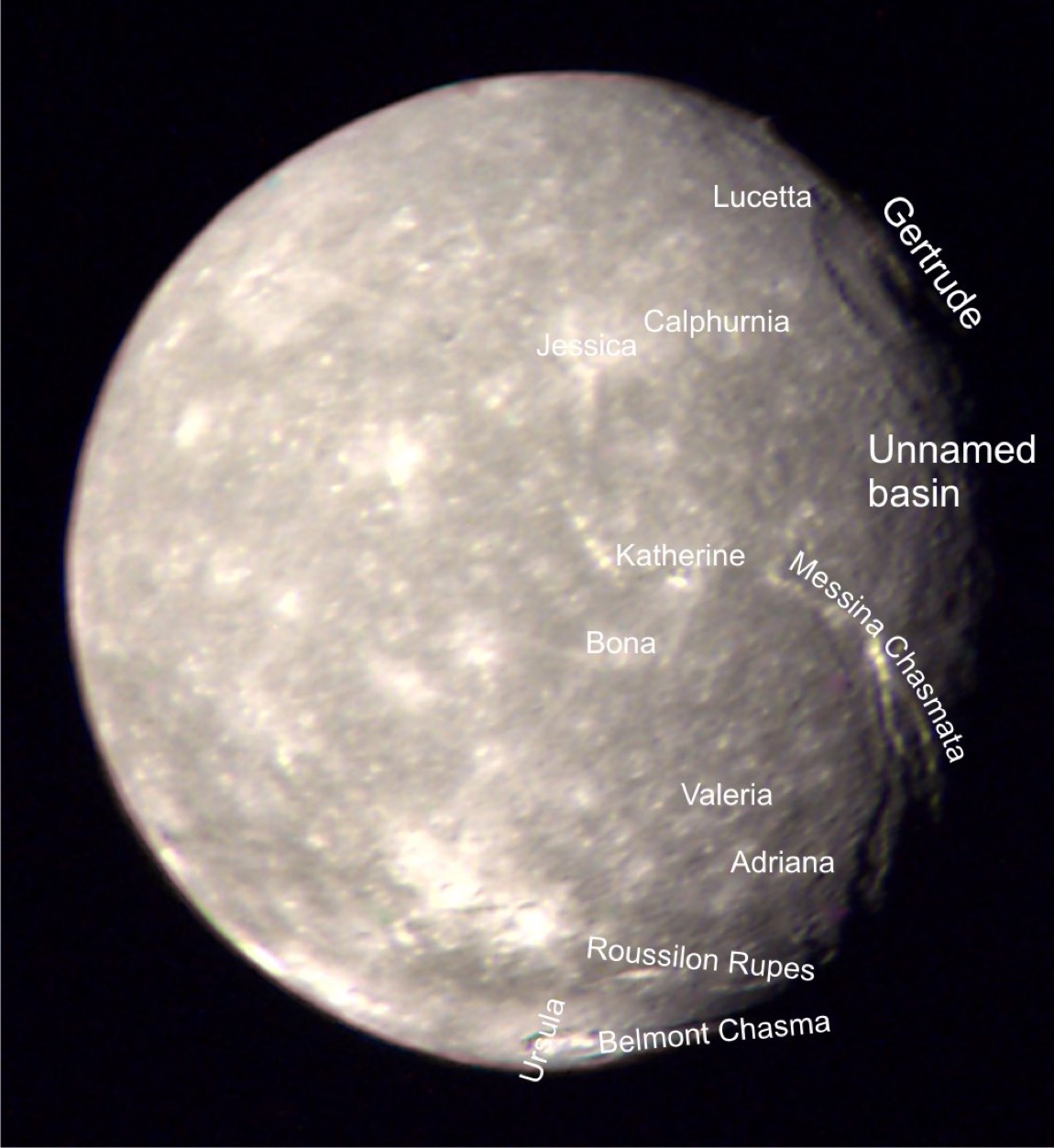
Titania's most dramatic surface feature is Messina Chasma, a canyon that stretches roughly 1,500 kilometres from near the equator almost to the south pole — long enough to span the continental United States from coast to coast. It belongs to a planet-wide system of grabens, places where two parallel fault scarps dropped a strip of crust downward to form a trough. These grabens run 20 to 50 kilometres wide and sink 2 to 5 kilometres below the surrounding terrain. The mechanism that cracked the crust open was global expansion: as radioactive decay heated Titania's interior and a freezing interior ocean expanded, the outer ice shell was stretched until it broke. Calculations suggest the crust grew by about 0.7% overall. The grabens are considered the youngest geological features on Titania because they cut across older craters and even across the smooth plains that were themselves deposited after most cratering occurred. Scarps that stand alone without a paired partner are classified separately as rupes; Rousillon Rupes near the crater Ursula is one example.
06 Giant craters and a resurfaced past
The largest confirmed impact crater on Titania is Gertrude, with a diameter of 326 kilometres — wide enough to swallow Belgium. Nearby lies an unnamed, heavily degraded basin of comparable size, roughly 330 kilometres across, though its battered state makes measurement uncertain. Despite these enormous scars, Titania's surface is noticeably less cratered overall than Oberon or Umbriel, which tells geologists that something erased an older, more heavily bombarded surface early in the moon's history. Nearly all of Titania's large craters share a similar architecture: flat floors and central peaks, suggesting the icy crust partially relaxed after each impact. Ursula is the striking exception — it has a central pit rather than a peak, hinting at a different excavation or collapse process. Some craters, including Ursula and Jessica, are still surrounded by bright rays of fresh ice thrown outward during the impact, appearing bluer than the surrounding terrain in color maps produced from Voyager 2 data.
07 A whisper-thin carbon dioxide atmosphere Deeper
Carbon dioxide detected on Titania's surface by infrared spectroscopy between 2001 and 2005 raises the possibility of a tenuous seasonal atmosphere, similar in character to the thin CO₂ envelope around Jupiter's moon Callisto. At Titania's warmest summer temperatures, around 89 K, carbon dioxide has a vapor pressure of about 300 μPa — vanishingly thin by any terrestrial standard. Heavier gases such as nitrogen or methane could not persist; Titania's gravity is too weak to hold them. On September 8, 2001, Titania passed in front of a magnitude-7.2 star designated HIP 106829, and astronomers used that occultation to search for an atmosphere. No absorption was detected, setting an upper limit of 1 to 2 mPa on surface pressure — still well above the maximum that CO₂ alone could supply, so the measurement does not rule out a carbon dioxide atmosphere, it just cannot confirm one. The peculiar Uranian geometry means Titania's poles, not its equator, receive the most sunlight, so CO₂ is thought to migrate seasonally between the poles and lower latitudes through a slow carbon cycle driven by sublimation and condensation.
08 Titania's extreme 42-year seasons
Because Uranus orbits the Sun nearly on its side — its rotational axis tipped about 98 degrees — its moons experience the most extreme seasons in the Solar System. Titania spends 42 years with one pole drenched in continuous sunlight while the opposite pole endures 42 years of complete darkness. When the sun finally rises at a previously frozen pole, it climbs almost to the zenith. Voyager 2 arrived during the southern hemisphere's summer solstice in January 1986, so virtually the entire southern face was bathed in sunlight while the northern hemisphere sat in darkness — and beyond Voyager's cameras. Once every 42 years, when Uranus reaches equinox, the orbital planes of its moons intersect Earth's line of sight and mutual eclipses become possible. During the 2007–2008 equinox season, Umbriel occulted Titania twice: on August 15 and December 8, 2007, giving astronomers a chance to refine orbital parameters and probe each moon's edge.
 ⤢
⤢
09 How magnetospheric plasma darkens the surface Deeper
Titania's entire orbit lies inside Uranus's magnetosphere, which has a concrete consequence for its surface chemistry. Plasma trapped in the magnetosphere rotates with the planet, sweeping past the moon and preferentially striking its trailing hemisphere — the side facing backward along its orbital path. Energetic charged particles do several things when they hit: they sputter water ice molecules free from the surface, break down methane clathrates, and chemically alter organic compounds, leaving behind a dark, carbon-rich residue. This process is thought to explain why the trailing hemispheres of most Uranian moons are darker than their leading sides. Oberon is an exception, and Titania's own leading hemisphere is slightly redder than its trailing side by about 8% — an asymmetry scientists believe may partly reflect the accretion of reddish dust swept inward from Uranus's irregular outer satellites, which would settle preferentially on the leading hemisphere. Carbon dioxide concentrated on the trailing hemisphere may itself be a product of magnetospheric particles reacting with carbonates or organic material.
10 What Voyager 2 saw in 48 hours
Voyager 2 remains the only spacecraft ever to have visited the Uranian system, and its encounter with Titania in January 1986 lasted only a matter of hours. At its closest approach, the probe passed within 365,200 kilometres of the moon's surface — farther than its closest approaches to Miranda and Ariel, which is why those two moons were imaged at finer detail. Titania's best images from Voyager 2 have a spatial resolution of about 3.4 kilometres per pixel, good enough to map large craters and major canyon systems but too coarse to reveal fine geological textures. The images covered about 40% of the surface, but only 24% of that was sharp enough for rigorous geological mapping. The southern hemisphere was illuminated during the flyby, so the northern hemisphere remains completely unimaged. In the decades since, no follow-up mission has reached Uranus, leaving roughly 60% of Titania's surface entirely unknown.
11 The long road back: planning a return mission
Mission planners have floated several concepts for returning to Uranus over the years. One idea — redirecting the Cassini spacecraft from Saturn to Uranus after its primary mission — was evaluated and ultimately discarded. Around 2010, a Uranus orbiter and probe concept was formally studied. Uranus even appeared as a waypoint in a trajectory study for the Innovative Interstellar Explorer precursor probe concept. The turning point came with the 2023–2032 Planetary Science Decadal Survey, which named the Uranus Orbiter and Probe the highest-priority NASA Flagship mission for that decade, explicitly citing questions about the Uranian satellites' bulk properties, internal structure, and geological histories as key scientific drivers. A 2026 report by Amy Simon and colleagues added a specific recommendation about Titania: because it is the largest and most massive moon in the system, multiple gravitational flybys of Titania should be used to decelerate the orbiter as it enters orbit around Uranus, making Titania not just a scientific destination but an essential navigation tool.
12 Titania's birth inside Uranus's debris disk Deeper
Titania is thought to have formed inside an accretion disk of gas and dust that surrounded Uranus either shortly after the planet's own formation or in the aftermath of the giant impact that tilted Uranus onto its side. The precise makeup of that disk is unknown, but Titania's relatively high density compared to Saturn's moons hints that the disk was water-poor. Carbon and nitrogen may have been present mainly as carbon monoxide and molecular nitrogen rather than as ammonia and methane, producing moons with more rock and less ice than their Saturnian counterparts. Accretion itself probably lasted several thousand years. The rain of impacting material heated the outer 60 kilometres or so, reaching a peak temperature of about 250 K at roughly that depth. After accretion ended, the warm subsurface layer contracted as it cooled, while radioactive decay kept the deep interior expanding — a mechanical mismatch that stretched and cracked the crust, likely carving some of the earliest canyons. This active internal phase lasted roughly 200 million years, implying that most endogenous geological activity wound down billions of years ago.
 ⤢
⤢
13 Observing Titania from your backyard
Despite lying more than 2.7 billion kilometres from Earth at its closest, Titania is just within reach of a high-end amateur telescope, a fact confirmed by how long it went unobserved after Herschel's discovery — no one else could match his equipment for nearly 50 years. Today, a modern large-aperture amateur instrument under dark skies can pick up the moon's faint glimmer, though separating it from Uranus's glare requires careful technique and knowledge of its orbital position. Titania reflects only about 17% of incoming sunlight on average — its Bond albedo — making it a dim target. Its geometric albedo is somewhat higher at 35%, but that drops sharply to 25% even at a phase angle of just 1 degree, an opposition surge that suggests a porous or microstructured surface. Its orbital period of 8.7 days means its position relative to Uranus shifts noticeably from one night to the next, which can actually help an observer confirm a detection by tracking its movement against the planet's other satellites.
You would weigh…
Surface gravity 0.38 m/s² vs Earth’s 9.81 m/s². Try every world →