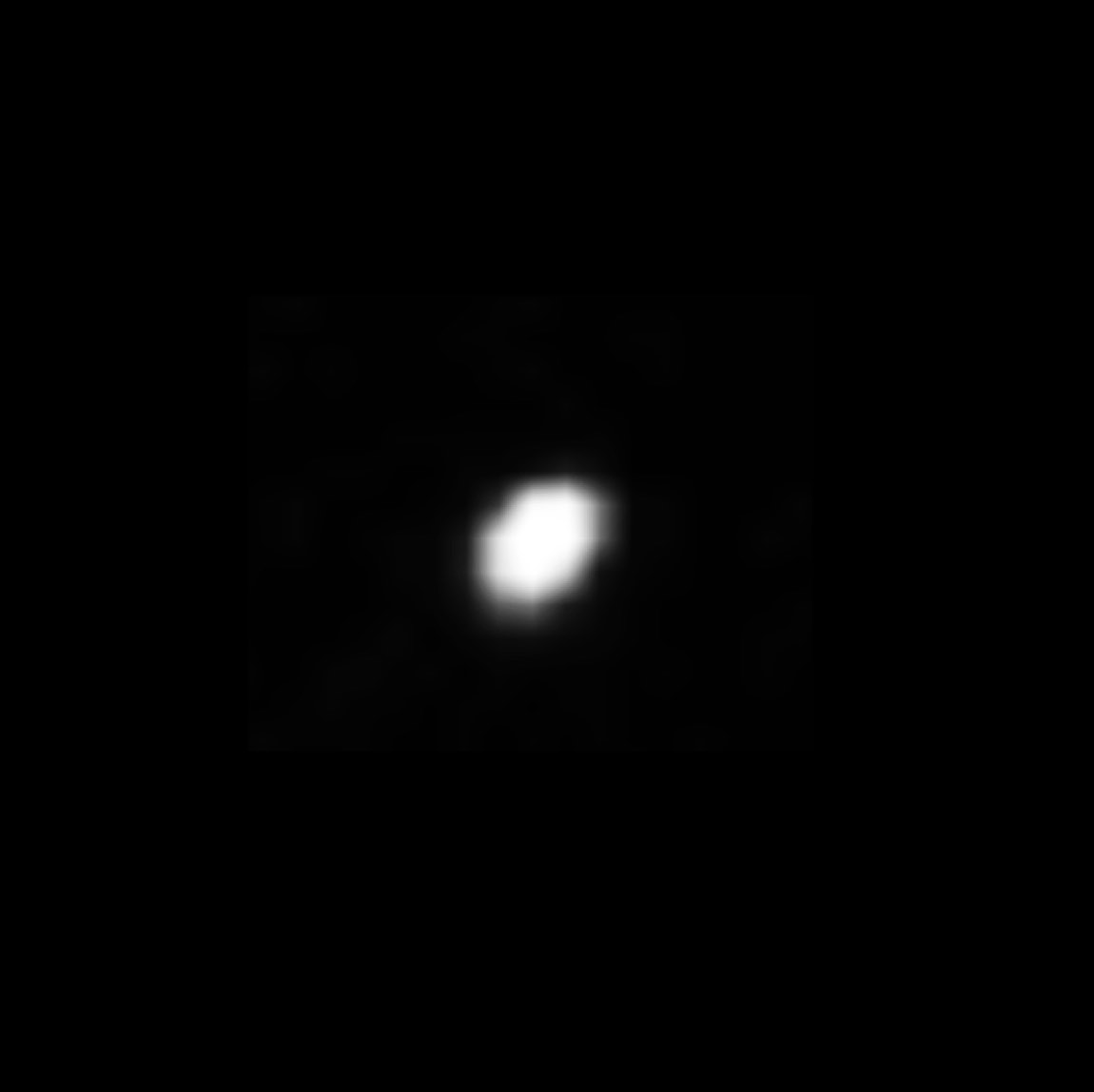
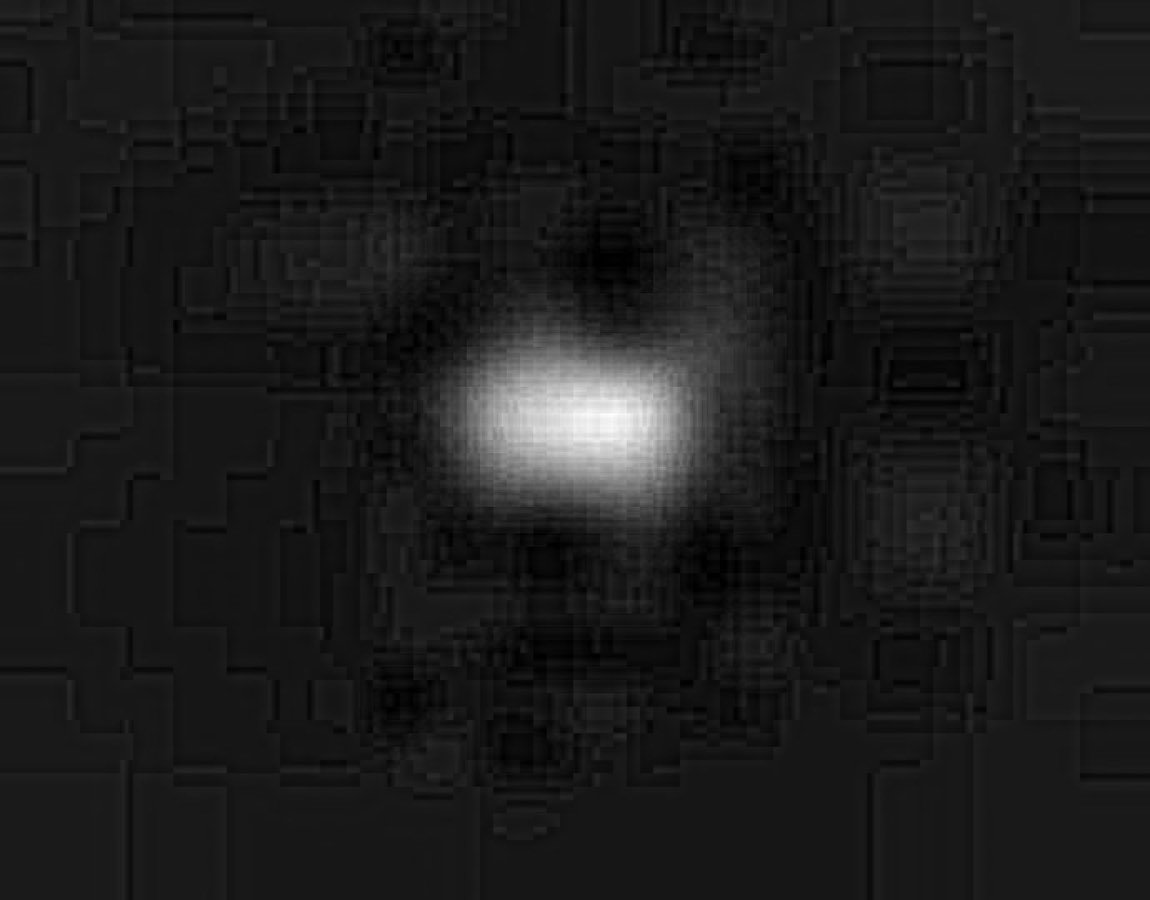
 Photograph · Voyager 2 and whoever made and/or updates PDS Image Atlas and/or OPUS. · Public domain
Moon · Deep guide · orbits Uranus
Portia
Also called: Uranus XII · S/1986 U 1
The largest of Uranus's tightly packed inner-moon family that bears its name.
What is it?
Portia was found in Voyager 2 images on 3 January 1986 and is the second-largest inner moon of Uranus after Puck. It is a grey to slightly reddish body about 156 km long that circles the planet in about 12 hours. Portia leads the Portia group, a crowd of small moons with similar orbits between the rings and Puck. Because it orbits inside Uranus's synchronous distance, tides are slowly shrinking its orbit. A 2023 James Webb Space Telescope study found hints of water ice or hydrated minerals on its surface.
The deep dive
Researched for the Atlas from Wikipedia — Portia (moon) (2,365 characters read) · updated Nov 15, 2026
01 How Voyager 2 Found Portia
Portia was discovered from images taken by Voyager 2 on 3 January 1986, during the spacecraft's historic flyby of Uranus. Because the discovery was made so quickly and the object needed a formal name to follow, it was assigned the temporary designation S/1986 U 1 while scientists worked through the bureaucratic process of naming it officially. It eventually received the permanent designation Uranus XII, reflecting its place in the ordered catalog of Uranian moons. The discovery came as part of a broader haul: Voyager 2 was the first and so far only spacecraft to visit Uranus, and its cameras swept up an entirely new family of small inner moons that ground-based telescopes had been too far away to detect. Without that single flyby, Portia and its sibling moons might still be unknown today, since no follow-up mission has since traveled to the Uranian system to take a closer look.
02 A Moon Named for Shakespeare's Heroine
The name Portia comes from William Shakespeare's play The Merchant of Venice, where Portia is the clever and resourceful heroine at the center of the story. This follows a long-standing convention for Uranian moons: unlike satellites of other planets, which are typically named after figures from mythology, Uranian moons draw their names from characters in Shakespeare's plays and, in some cases, from Alexander Pope's poetry. Portia is not alone in this Shakespearean neighborhood — the group of moons it leads includes Bianca, Cressida, Desdemona, Juliet, Rosalind, Belinda, Cupid, and Perdita, all names drawn from the same literary tradition. This gives the inner Uranian system a distinctly theatrical flavor, a cluster of characters from Renaissance drama orbiting a distant ice giant more than 2.7 billion kilometers from the stage where their namesakes were first imagined.
03 The Portia Group: A Family of Moons
Portia is the largest member and the namesake of the Portia group, a collection of inner Uranian satellites that share similar orbits and photometric properties. The group includes Bianca, Cressida, Desdemona, Juliet, Rosalind, Cupid, Belinda, and Perdita alongside Portia itself. The fact that these moons travel in similar orbital paths and reflect light in broadly similar ways suggests they may share a common origin, possibly the breakup of a larger parent body long ago. Within this family, Juliet, Belinda, Cressida, Desdemona, and Rosalind have spectra that are particularly similar to Portia's own, hinting at a shared surface composition. The group occupies a tightly packed region of space close to Uranus, where gravitational interactions among the members and with the planet itself shape their long-term fates.
04 An Elongated World Locked Toward Uranus
Portia is not a neat sphere. Voyager 2 imagery shows it as an elongated object with dimensions of roughly 156 km × 126 km — about as long as the state of Connecticut is wide. Its major axis points toward Uranus, a configuration that is not accidental. Tidal forces from Uranus lock the moon so that its longest dimension always faces the planet, in the same way Earth's gravity keeps the same face of the Moon turned toward us. The shape can be described mathematically as a prolate spheroid, something like a slightly squashed rugby ball, and the ratio of its axes is measured at 0.8 ± 0.1. Portia's surface appears grey or slightly reddish, which is consistent with other dark inner moons of Uranus and suggests a surface of rocky or carbon-rich material rather than bright fresh ice. Beyond these broad strokes, its geology remains essentially unknown.
05 A Decaying Orbit With a Dramatic Ending Deeper
Portia's orbit lies inside Uranus's synchronous orbital radius — the distance at which a moon would orbit at exactly the same rate as the planet rotates. Any moon sitting inside this boundary experiences tidal deceleration: gravitational interactions with Uranus slowly sap the moon's orbital energy, causing the orbit to shrink over time. This process is gradual but relentless, and it has only one of two possible outcomes for Portia. If the decaying orbit brings the moon close enough to Uranus's Roche limit — the distance inside which tidal forces overpower the moon's own gravity and self-cohesion — Portia will be torn apart and its debris will spread into a new planetary ring. If instead the moon holds together until it gets very close, it may simply collide with Uranus's upper atmosphere. Either way, Portia is a temporary fixture in the solar system, though the timescales involved are almost certainly enormous.
06 The Long Debate Over Water Ice Deeper
Whether water ice exists on Portia's surface has proven surprisingly difficult to settle. Hubble Space Telescope observations in 1997 found a small dip in the spectra of the Portia group moons that was tentatively attributed to water ice. A second team observed Portia individually with Hubble in 1998, but the moon's orbital motion carried it out of the camera's field of view before observations were complete. Working from partial data, that team noted a resemblance to Puck, which did show a water ice absorption feature, and extrapolated that Portia likely has water ice as well — a reasonable but indirect conclusion. Then in 2003, observations with the W. M. Keck II telescope failed to detect any water ice absorption features at all. A 2019 Keck campaign also suggested the absence of water ice, though the researchers acknowledged they might have missed a small absorption feature. The debate did not fully resolve until 2023, when James Webb Space Telescope observations found evidence for water ice or hydrated minerals on Portia's surface.
07 What the James Webb Telescope Revealed
The James Webb Space Telescope, with its exceptional infrared sensitivity, turned its instruments toward Portia in 2023 and found evidence for water ice or hydrated minerals on the moon's surface. This was a meaningful step forward in a debate that had stretched across more than two decades of observations with different telescopes and produced conflicting results. The JWST result does not necessarily mean the surface is blanketed in bright, clean ice — the phrasing 'water ice or hydrated minerals' leaves room for a range of compositions, from patches of frost to minerals that have chemically incorporated water molecules over time. What it does confirm is that the earlier Hubble hints and the extrapolations from Puck were pointing in the right direction, while the Keck non-detections were likely limited by the sensitivity of the instruments available at the time rather than by an actual absence of water-bearing material.
08 Portia's Size Among Uranian Moons
Among the inner satellites of Uranus, Portia ranks as the second largest, surpassed only by Puck. This is a meaningful distinction in a system filled with small, dark, poorly understood objects. Puck, the largest of the inner group, became the first of the small inner moons to be discovered by Voyager 2, and it has received somewhat more observational attention than Portia — including spectral observations that helped anchor the extrapolated conclusion about Portia's possible water ice content in 1998. Being the largest member of the Portia group places Portia in a mild gravitational leadership role within that cluster of moons, though the gravitational dynamics among objects of these sizes are subtle. Its dimensions of about 156 km × 126 km make it a mid-sized body by the standards of small moons across the solar system, comparable in scale to some of the smaller Saturnian inner moons.
09 Open Questions and What We Still Don't Know Deeper
Despite being discovered nearly four decades ago, Portia remains one of the least-understood moons in the solar system. Beyond its approximate dimensions, orbital parameters, and geometric albedo of about 0.069, almost nothing is known with certainty. Its internal structure is entirely unconstrained — whether it is a solid intact body, a loosely bound rubble pile, or something in between cannot be determined from existing data. The question of water ice or hydrated minerals on its surface has only just begun to be answered by JWST, and much finer compositional mapping remains to be done. The long-term timescale of its orbital decay is not precisely calculated in publicly available literature. The origin of the Portia group — whether these moons are fragments of a disrupted ancestor or primordial objects that formed in place — is still debated. A dedicated Uranus orbiter mission, which has been recommended as a high scientific priority, would be the most direct way to address these gaps.
10 Observing Portia from Earth
Portia is an extraordinarily difficult object to observe from Earth. Its geometric albedo of about 0.069 means it reflects only about 7 percent of the sunlight that strikes it, making it a very dark moon. Combined with its small size — roughly 156 km × 126 km — and its location deep in the gravity well of a planet nearly 3 billion kilometers away, it falls far below the threshold of even large amateur telescopes. Professional ground-based observatories, including the W. M. Keck II telescope in Hawaii, have been able to gather some spectral data, but the observations are challenging and the results have sometimes been ambiguous or incomplete, as the history of the water ice debate clearly shows. The James Webb Space Telescope's 2023 results demonstrate that cutting-edge space-based infrared observatories are now capable of extracting meaningful science from Portia's faint signal, opening a new era of remote observation for this otherwise elusive moon.