Moon · Deep guide · orbits Uranus
Sycorax
Also called: Uranus XVII · S/1997 U 2
Uranus's largest irregular moon, a red captured world on a long, backwards orbit.
What is it?
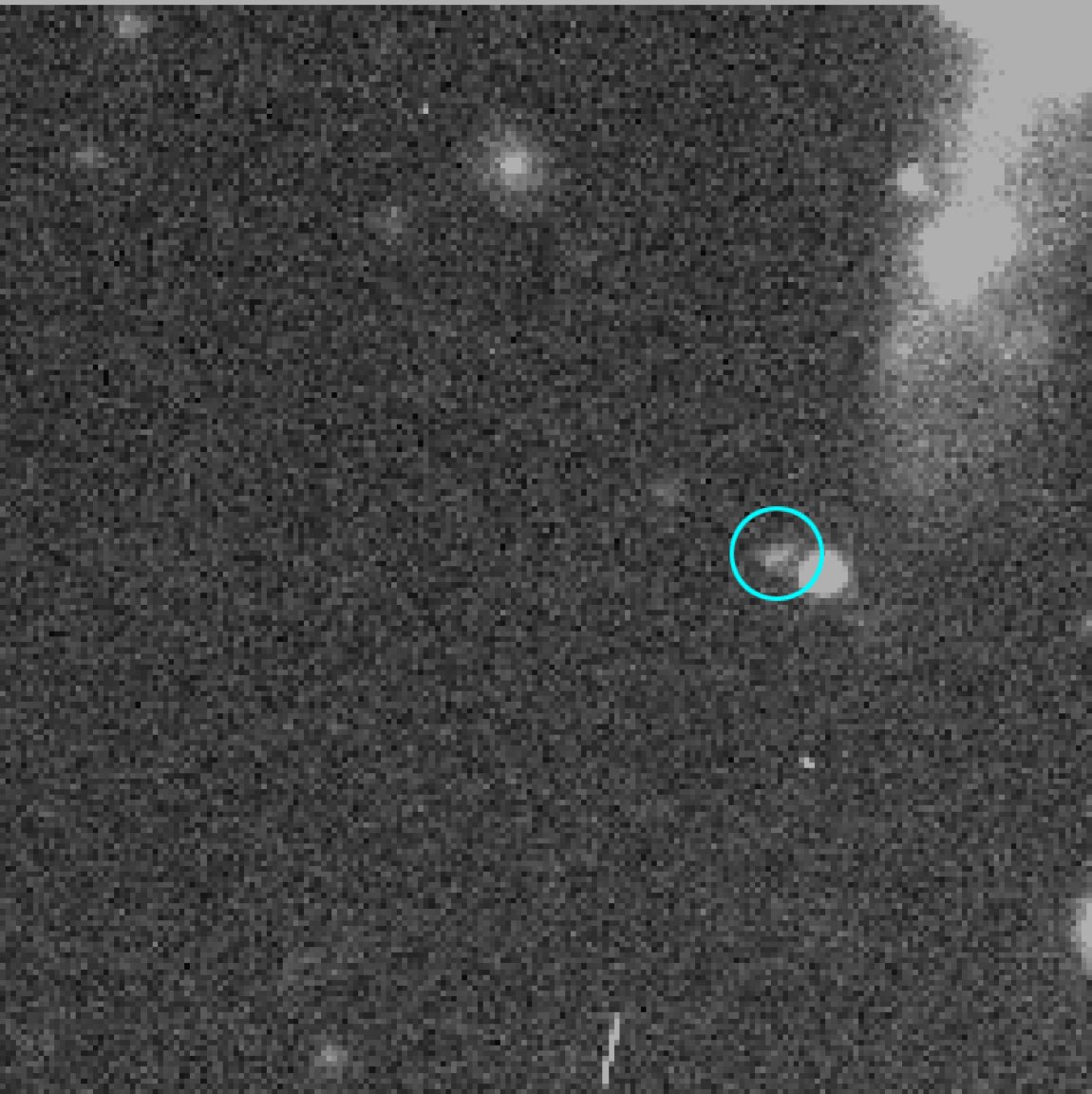
Sycorax was discovered with Caliban in September 1997 using the Hale Telescope at Palomar. About 157 km across, it is the largest of Uranus's irregular moons and the planet's seventh-largest moon overall. It orbits backwards on a stretched, tilted path averaging about 12 million km from Uranus, taking about three and a half years per lap. Its light-red colour sets it apart from Uranus's greyer moons, and it is thought to be a captured object. No spacecraft has imaged it up close.
The deep dive
Researched for the Atlas from Wikipedia — Sycorax (moon) (3,071 characters read) · updated Nov 15, 2026
01 Discovered alongside a sibling in one night
Sycorax did not come to light in isolation. On 6 September 1997, astronomers Brett J. Gladman, Philip D. Nicholson, Joseph A. Burns, and JJ Kavelaars were working at the 200-inch Hale Telescope in California when they found two new moons of Uranus in the same session — Sycorax and Caliban. The 200-inch (roughly 5-metre) aperture of the Hale Telescope was essential; Sycorax is so small and so distant that it reflects only a faint trickle of sunlight back toward Earth. The temporary designation handed out immediately was S/1997 U 2, a placeholder label that simply encodes the year and planet. Official recognition as Uranus XVII came later, with the International Astronomical Union approving the permanent name Sycorax no later than March 1999. That two-year gap between discovery and formal naming is typical for outer solar system objects, reflecting the careful confirmatory observations required before a provisional designation is retired.
02 A Shakespearean name with a family twist
Every moon of Uranus carries a name drawn from the works of William Shakespeare or Alexander Pope's poem The Rape of the Lock, a naming convention that makes the Uranian system unique among the giant planets. Sycorax is named after the witch who is Caliban's mother in Shakespeare's play The Tempest — and the moon discovered in the same night was named Caliban itself. This mother-and-child pairing in mythology was entirely coincidental from an astronomical standpoint; the two moons are not physically related in any confirmed way. In The Tempest, Sycorax is a powerful, unseen presence — she died before the play begins but casts a long shadow over its events. That sense of a significant but mysterious influence feels oddly appropriate for a moon we have never visited and can barely resolve, one whose nature we can only infer from the faint light it sends our way.
03 An orbit far beyond the regular moons
Sycorax travels a path around Uranus that is strikingly different from those of the planet's well-known inner moons. Its orbit lies more than 20 times farther from Uranus than Oberon, which is itself the most distant of the regular moons. To put that in perspective, if Oberon's distance from Uranus were a city block, Sycorax would be orbiting from more than 20 blocks away. The orbit is also retrograde — meaning Sycorax travels in the opposite direction to Uranus's rotation — a strong hint that it did not form in the same orderly disk that produced the regular moons. On top of that, the orbit is moderately inclined and eccentric, meaning the path is an elongated ellipse rather than a neat circle, and it is tilted relative to Uranus's equatorial plane. These combined characteristics — retrograde, distant, inclined, and eccentric — are the classic hallmarks of a captured body.
04 Could Sycorax share ancestors with other moons? Deeper
Orbital dynamics offer a subtle way to search for family relationships among irregular moons: objects that broke apart from a common parent body long ago tend to cluster together in the space of orbital parameters even as individual orbits slowly evolve. When researchers analyzed the orbital parameters of Uranus's irregular satellites, they found that Sycorax may belong to a dynamic cluster together with two other retrograde moons, Setebos and Prospero. If this grouping is real, it would suggest that all three descended from a single captured progenitor that subsequently shattered, perhaps through a collision. However, there is a complication that makes the case uncertain: Sycorax has a much redder color than Setebos and Prospero, which tend to appear gray. Color is a proxy for surface composition, so the mismatch hints that either the objects formed separately, or that Sycorax's surface was altered in some way after any original breakup event. The debate has not been resolved.
05 A surprisingly red surface — but not uniformly so Deeper
The color of Sycorax's surface is one of its most scientifically interesting features, and also one of its most puzzling. In visible light, the moon appears distinctly light-red, with measured color indices of B–V = 0.839 ± 0.014 and V–R = 0.531 ± 0.005 in one careful study. This redness places Sycorax in an interesting middle ground: redder than Himalia, the largest irregular moon of Jupiter, yet still less red than most Kuiper belt objects, which are often the reddest bodies in the solar system. The redness in visible wavelengths likely reflects organic-rich or irradiated material on the surface. What makes Sycorax especially strange is what happens at longer wavelengths. In the near-infrared, the spectrum actually turns blue between 0.8 and 1.25 micrometres, then becomes roughly neutral at even longer wavelengths. This reversal — red in visible light, blue in the near-infrared — is unusual and difficult to explain with simple surface compositions, and it remains an open question in planetary science.
06 Size in context: the giant of Uranus's outer moons
With a diameter estimated at 157 kilometres, Sycorax is the largest irregular satellite orbiting Uranus — but that title requires some unpacking. The estimate comes from thermal emission data collected by the Herschel Space Observatory, which detected the heat radiated by the moon's surface and used it to calculate size independently of assumptions about reflectivity. At 157 km across, Sycorax is comparable in size to Puck, one of Uranus's inner moons, and to Himalia, the biggest irregular satellite of Jupiter. Despite being the largest irregular moon of Uranus, it ranks only seventh among all of Uranus's moons when regular and irregular satellites are counted together. That ranking illustrates how dramatically larger the regular moons are: the smallest of them still dwarfs the biggest captured object in Uranian orbit.
07 A fast spin and a lopsided shape
Sycorax rotates once every 6.9 hours — a brisk pace compared with many small bodies in the outer solar system. That spin is not directly observed like a clock hand turning, but inferred from the way the moon's brightness varies over time. As an irregularly shaped object rotates, it presents different cross-sectional areas and different surface regions toward Earth, causing its apparent magnitude to oscillate. For Sycorax, this variation has an amplitude of 0.12 magnitudes, a relatively modest wobble that suggests the moon is not dramatically elongated but is not a perfect sphere either. The orientation of Sycorax's rotation axis is still unknown. Analysis of the light curve does suggest, however, that Earth happens to view Sycorax from a near equator-on configuration — meaning we are looking roughly at its equatorial belt rather than down onto one of its poles, which affects how we interpret the brightness variations.
08 How a moon gets captured by a planet Deeper
The leading hypothesis is that Sycorax was not born in Uranus's neighborhood but was captured from elsewhere — most likely from the population of small bodies drifting through the early outer solar system. The challenge with any capture scenario is that a simple close flyby of a planet is not enough; orbital mechanics demands that some energy must be dissipated for an object to transition from a passing trajectory to a bound orbit. Scientists have proposed several mechanisms that could have provided this energy loss in the early solar system. Gas drag within the protoplanetary disk — the cloud of gas and dust still surrounding the young Uranus — could have slowed an interloping body just enough. Alternatively, three-body gravitational interactions, in which a third object carries away the excess energy, could have done the work. A third possibility is so-called pull-down capture: if Uranus was rapidly gaining mass during a phase of its growth, its deepening gravitational well could have swept nearby objects into permanent orbits. No single mechanism has been confirmed for Sycorax.
09 What we still cannot see from Earth
Every piece of information scientists have about Sycorax has come from ground-based telescopes; no spacecraft has ever flown close enough to image it. At its distance from Earth, the moon is simply a point of light — its disk cannot be resolved by any current telescope. This means that surface geology, crater counts, composition maps, and interior structure all remain beyond reach with existing technology. The diameter estimate of 157 km itself depends on thermal emission data from the Herschel Space Observatory, an inference rather than a direct measurement. The rotation period comes from brightness variations, and even the color data carry measurement uncertainties that different observing teams have reported with slightly different values. All the numbers that describe Sycorax are therefore best understood as well-reasoned estimates, not precise facts, and any future mission to the Uranian system would likely revolutionize our understanding of this moon.
10 Sycorax and the broader family of irregular moons Deeper
Irregular moons like Sycorax are scientifically valuable precisely because they are foreign objects — bodies captured from the wider solar system rather than assembled locally. They serve as frozen samples of the small-body population that existed in the outer solar system during the era of planetary formation. Sycorax's intermediate redness — redder than Jupiter's irregular moons, less red than typical Kuiper belt objects — provides a data point for understanding the compositional diversity of that ancient population and how surface colors are modified by space weathering and radiation over billions of years. Its unusual near-infrared spectral reversal, turning blue between 0.8 and 1.25 micrometres, adds another constraint that any surface composition model must satisfy. Because Sycorax is the largest of Uranus's irregular satellites, it has the highest surface brightness and has consequently attracted more observational attention than its smaller siblings, making it something of a reference object for the entire irregular moon population of Uranus.
11 The long wait for a close-up view
Since its discovery in 1997, Sycorax has been observed exclusively from Earth, and the situation is unlikely to change soon. The Voyager 2 spacecraft flew past Uranus in 1986 — more than a decade before Sycorax was even known to exist — and no mission has returned since. Various proposed Uranus orbiters have been studied over the years, and in 2022 the Planetary Science Decadal Survey identified a Uranus orbiter and probe as the highest-priority flagship mission for the coming decade. Even if such a mission launches in the late 2020s or early 2030s, travel time to Uranus would add roughly 13 years, meaning a close encounter with Sycorax remains a prospect for the 2040s at the earliest. When and if a spacecraft does arrive, Sycorax's status as the largest irregular moon makes it a natural primary target among the outer satellites, and its puzzling spectrum virtually guarantees it a place on the science agenda.