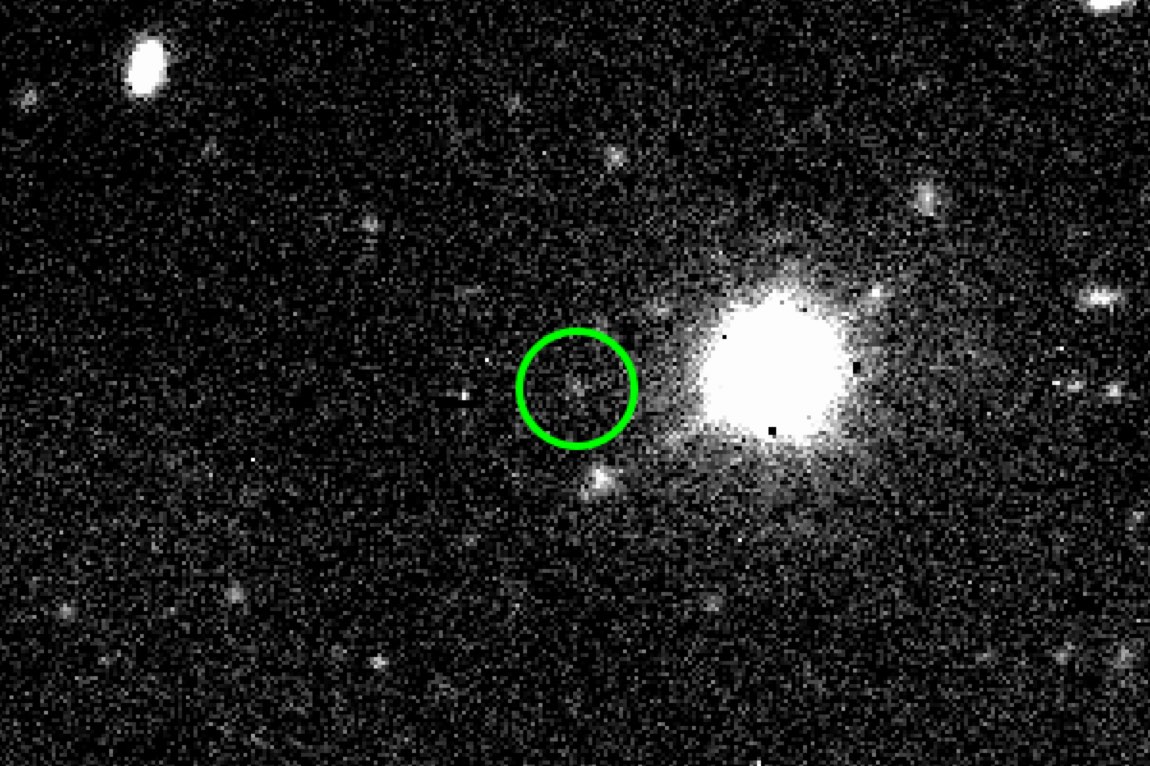
 Photograph · Image processed by Nrco0e . Original frames were taken by P. Rousselot, O. Mousi · CC BY 4.0
Moon · Deep guide · orbits Uranus
Trinculo
Also called: Uranus XXI · S/2001 U 1
A faint grey moon about 18 km wide, found by stacking telescope images.
What is it?
Trinculo was discovered on 13 August 2001 at Cerro Tololo in Chile, where astronomers combined many exposures from the 4-metre Blanco Telescope to reveal objects too faint for a single image. It is only around 18 km across and orbits Uranus backwards about 8.5 million km out, taking about 749 days per lap. Its colour appears neutral grey. Orbit models suggest it passed within tens of thousands of kilometres of Sycorax about 9,700 years ago.
The deep dive
Researched for the Atlas from Wikipedia — Trinculo (moon) (6,869 characters read) · updated Nov 15, 2026
01 Four moons found in one night
The discovery of Trinculo was part of a remarkably productive single observing session. On 13 August 2001, Matthew Holman, JJ Kavelaars, and Dan Milisavljevic were systematically hunting for distant moons of Uranus using the 4.0-meter Víctor M. Blanco Telescope at Cerro Tololo Observatory in Chile. In one sweep, they captured not just Trinculo but also Francisco, Ferdinand, and Margaret — four new irregular moons at once. The key to their success was a computational technique called shift-and-adding: a software algorithm tracked the motion of Uranus across a sequence of images and then co-added those frames so that anything moving with the planet brightened against the background noise. Without this method, Trinculo — with an average apparent magnitude of 25.4, far too faint for the naked eye or casual telescopic inspection — would have remained invisible in any single exposure. Trinculo was the sixth irregular moon known around Uranus at the time of its identification, adding meaningfully to a family of outer satellites that had barely begun to be catalogued. Confirmation came just twelve days later, on 25 August 2001, when Kavelaars secured follow-up images with the Canada–France–Hawaii Telescope to verify the orbit.
02 A two-year paper trail to official discovery Deeper
Even after a moon is spotted and confirmed, the formal process of announcing a discovery can stretch for years. Trinculo's case illustrates this vividly. After the August 2001 observations, the team continued tracking the moon from multiple major facilities, including the 200-inch Hale Telescope at Palomar Observatory and the 8.2-meter Very Large Telescope at Paranal Observatory, to pin down its orbit precisely. Brian G. Marsden, then director of the Minor Planet Center, computed the orbital solution and generated positional predictions for 2002. Those predictions proved essential: they allowed Brett Gladman to link a faint candidate spotted in VLT images taken by Philippe Rousselot and Olivier Mousis on 5 September 2002 back to Trinculo. That identification was then clinched when Gladman and Tommy Grav found the moon in earlier Blanco telescope images from 13 August 2002. The Minor Planet Center did not formally announce the discovery until 30 September 2003 — more than two years after the original detection. It is a reminder that discovering a moon is as much a detective exercise in archival cross-matching and orbital computation as it is a moment of first light.
03 Why a drunken jester fits a wandering orbit
The names of Uranian moons are drawn exclusively from characters in the works of William Shakespeare and Alexander Pope, a tradition set by the International Astronomical Union. Trinculo takes its name from the bumbling, drunken jester in Shakespeare's play The Tempest — a figure defined by erratic, stumbling movement. The IAU's Working Group for Planetary System Nomenclature made the name official on 29 December 2005, assigning the Roman numeral designation Uranus XXI at the same time. Before that, the moon carried the provisional label S/2001 U 1. In a 2014 interview with the Folger Shakespeare Library, Kavelaars offered a candid explanation for the choice: his team felt they were "drunk with power" after their prolific discovery night, and he noted that Trinculo's irregular, wandering orbit genuinely reminded him of a drunken sailor lurching across a deck. It is one of the more self-aware naming stories in planetary science, blending literary tradition with a dry joke about the sociology of discovery. The Tempest has supplied several names to the Uranian system, since the play — which features a magician stranded on an island surrounded by supernatural beings — maps loosely onto a planet surrounded by a strange retinue of captured objects.
04 Captured asteroid or homegrown moon?
Trinculo belongs to the class of irregular moons, and the leading explanation for how such objects came to orbit a giant planet at enormous distances is gravitational capture during the chaotic early Solar System. The idea is that small bodies — essentially asteroids or Kuiper Belt objects — wandered close enough to a giant planet at a time when conditions allowed the planet's gravity to trap them permanently rather than fling them away. For Uranus, this capture window is thought to have coincided with the period of planetary migration and gravitational reshuffling described by dynamical models of the early Solar System. Trinculo's retrograde orbit — it circles Uranus in the opposite direction from the planet's own motion around the Sun — is consistent with a capture origin, since bodies on prograde and retrograde orbits can both be snagged depending on the geometry of the encounter. Because Trinculo does not appear to share its orbit with any known companion moon, it probably did not arrive as part of a larger captured body that subsequently broke apart, or if it did, the other fragments are currently too small and faint to detect with existing telescopes.
05 An orbit that never quite stays the same Deeper
Trinculo's orbit is a moving target. Over a 10,000-year baseline, its mean semi-major axis — the average distance from Uranus — is 8.05 million km, but that figure oscillates by up to ±12,200 km as the Sun and other planets continuously tug at the moon. Its orbital eccentricity averages 0.22, fluctuating by ±0.02, while its inclination of 167° relative to the ecliptic varies by ±1°. These are not trivial jitters; a swing of ±12,200 km in semi-major axis is comparable to the diameter of Earth itself. Because of this instability, astronomers cannot rely on a simple Keplerian ellipse to predict Trinculo's location over long timescales. Instead they use proper or mean orbital elements, which are computed by mathematically averaging out the perturbing forces over an extended period. The orbit also undergoes nodal and apsidal precession — the orientation of the orbital plane and the direction of closest approach to Uranus both rotate slowly — with average periods spanning several thousand Earth years. This level of complexity in what looks like a simple two-body orbit underscores how thoroughly the outer Solar System remains a gravitationally busy place.
06 A close shave with Sycorax, 9,700 years ago Deeper
Because the eccentric orbits of Uranian irregular moons overlap in distance from the planet, close approaches between different moons are not just possible — they are historically documented through simulation. In 2022, Marina Brozović and Robert Jacobson ran orbital computations and found that Trinculo came within several tens of thousands of kilometers of the much larger irregular moon Sycorax approximately 9,700 years ago. That is a hair's breadth in solar-system terms: tens of thousands of kilometers is roughly the distance between Earth and the Moon divided by ten. Such an encounter would have altered both orbits measurably, though it apparently did not trigger a collision or family-forming breakup. Trinculo is currently not associated with any known collisional family — its orbital niche appears to be unique among the confirmed Uranian irregular moons. Scientists suspect that if Trinculo ever was part of a larger body that shattered, any sibling fragments would be smaller and dimmer than current telescope surveys can detect, leaving the question of its ultimate origin unresolved.
07 What Trinculo's surface might look like
Nobody has ever photographed Trinculo up close, so its surface is inferred from two indirect lines of evidence. First, its color: Keck II telescope observations from 2003 suggest a neutral or gray tint, placing it in the same colorimetric category as the larger Uranian irregular moons Prospero and Setebos. A gray, neutral spectrum generally points to a surface made of a mixture of dark materials — water ice, hydrated silicates, and organic compounds are the standard suspects for outer Solar System irregular moons. Second, its brightness constrains its size and reflectivity: the Herschel space telescope found no detectable infrared thermal emission from Trinculo, which means the moon must reflect more than 3 percent of incoming sunlight (a geometric albedo above 0.03) and must be smaller than 50 km in diameter. Working from that constraint, Scott Sheppard estimates a diameter of about 18 km — smaller than the island of Manhattan is long. Attempts in 2005 to measure how fast Trinculo rotates by watching its brightness vary with the Very Large Telescope were unsuccessful; no periodic signal could be extracted from the data, so the rotation period remains unknown.
08 Why Trinculo is so hard to study
With an average apparent magnitude of 25.4, Trinculo sits at the very edge of what modern ground-based astronomy can detect, even with the largest telescopes on Earth. For comparison, the faintest stars visible to the unaided human eye hover around magnitude 6 or 7; Trinculo is roughly 50 million times dimmer than that threshold. Capturing meaningful data requires long-exposure imaging on 8-meter-class mirrors or larger. Even then, measuring something as basic as the rotation period — usually done by tracking how a moon's brightness waxes and wanes as differently reflective patches rotate in and out of view — has defeated observers. The 2005 Very Large Telescope campaign could not extract a reliable periodic signal from Trinculo's light curve. The moon's small size means its reflected light is simply too faint and variable-noise-dominated for current instruments to pick apart. This situation is common among the smallest irregular moons throughout the outer Solar System, and it means that many fundamental physical properties of Trinculo — rotation rate, precise shape, surface composition in detail — remain genuinely unknown rather than merely unmeasured.
09 The Uranus Orbiter and Probe's distant view
The proposed Uranus Orbiter and Probe, recommended as a high-priority mission in the 2023–2032 Planetary Science Decadal Survey, is currently the best near-term hope for learning more about Trinculo. All of the Uranian irregular moons, including Trinculo, are listed as distant observation targets for the spacecraft. The plan is to monitor their brightness over time — essentially running extended photometry campaigns — to extract rotation periods and approximate shapes from the resulting light curves. This is precisely the measurement that ground-based campaigns have failed to achieve for Trinculo. However, the mission planners acknowledge a significant constraint: because Trinculo does not orbit close to the ecliptic plane, the spacecraft is unlikely to be able to arrange a close flyby of the moon. Any encounter would almost certainly be a distant observation rather than the kind of detailed imaging that produced rich science at, say, the small moons of Saturn during the Cassini mission. So even in the optimistic scenario where the Uranus Orbiter and Probe launches and operates successfully, Trinculo will likely remain a smudge of light measured from afar rather than a world seen in detail.
10 Trinculo's place among Uranian irregulars Deeper
Uranus is known to host a collection of irregular moons, and Trinculo occupies a somewhat solitary position among them. Unlike irregular moon systems at Jupiter and Saturn, where moons cluster into distinct dynamical families that betray common collision ancestors, Trinculo does not share its orbital region with any confirmed grouping. Its average inclination of 167° places it firmly in the retrograde camp — orbiting opposite to Uranus's revolution around the Sun — but its specific combination of semi-major axis, eccentricity, and inclination appears unique. The color observations that place Trinculo alongside Prospero and Setebos offer a tentative physical kinship, but color similarity alone does not establish a shared origin. It is possible that Trinculo is a surviving fragment of an ancient collision whose other debris has either been ejected from the system or fallen below the detection limits of current surveys. It is equally possible that it was captured independently. Without a close-approach mission or dramatically more sensitive telescopes, distinguishing between these scenarios will remain one of the small but genuine open questions of outer Solar System science.