 Photograph · NASA/JPL-Caltech
Galaxy · Deep guide
The Cartwheel Galaxy
This cosmic bullseye is the wreckage of a galaxy shot through the heart.
What is it?
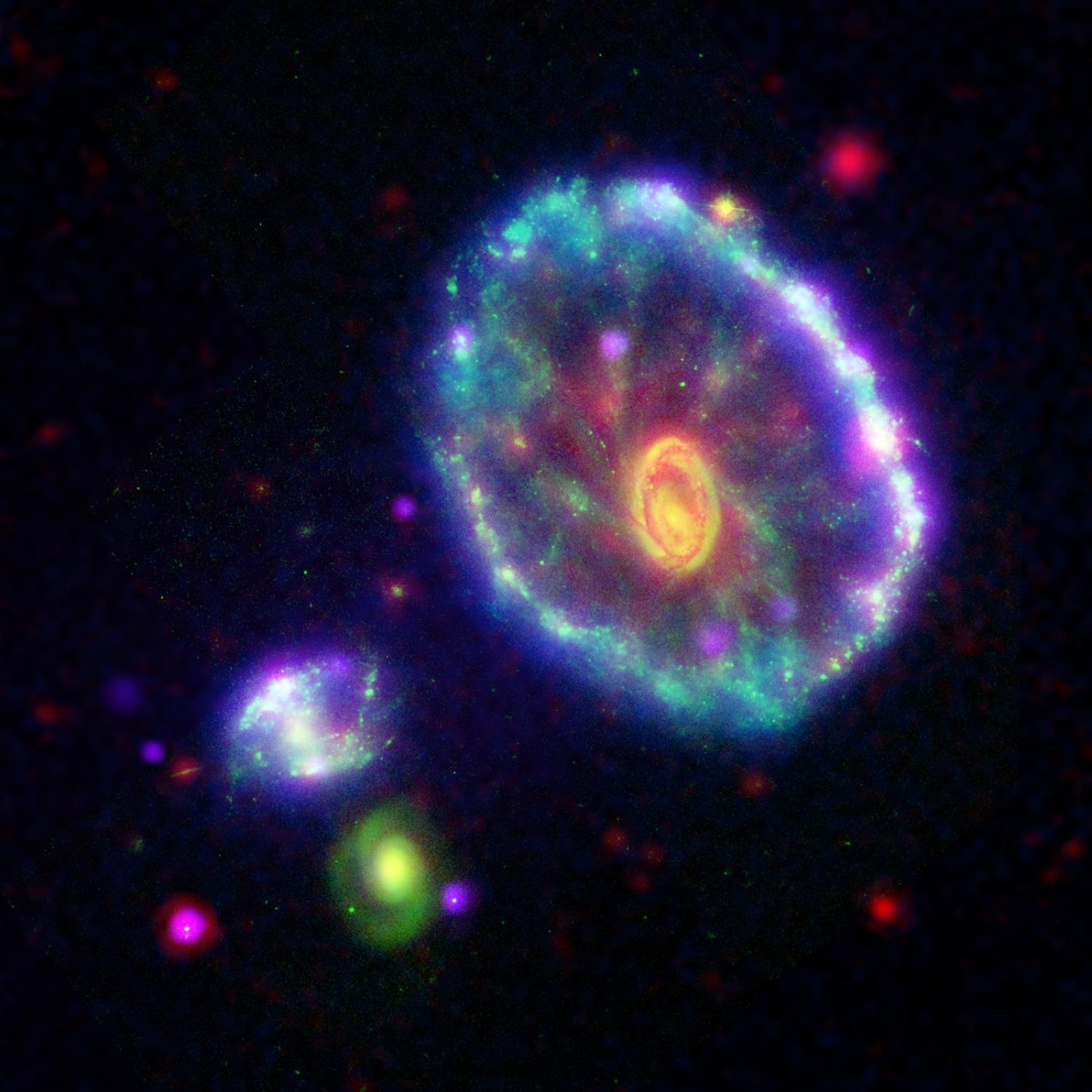
The Cartwheel, 500 million light-years away, is a ring galaxy: several hundred million years ago a smaller galaxy plunged straight through its center, sending a ripple of star formation outward like a stone dropped in a pond. The expanding outer ring, ablaze with newborn blue stars, now spans 145,000 light-years. JWST's 2022 portrait of it became an instant classic.
The deep dive
Researched for the Atlas from Wikipedia — Cartwheel Galaxy (6,287 characters read) · updated Sep 20, 2026
01 Fritz Zwicky and a puzzling discovery
Fritz Zwicky first spotted the Cartwheel Galaxy in 1941, and he was immediately struck by how strange it looked. He described it as "one of the most complicated structures awaiting its explanation on the basis of stellar dynamics" — high praise for complexity from a man who spent his career cataloguing unusual cosmic objects. At the time, the tools and theoretical frameworks needed to explain ring galaxies simply did not yet exist, so the Cartwheel sat as an open puzzle for decades. Its formal catalogue designations, ESO 350-40 and PGC 2248, reflect the later systematic surveys that eventually pinned down its distance and dimensions. Zwicky's instinct that something deeply unusual had happened here turned out to be exactly right, though the full story — a catastrophic head-on collision — would only emerge as radio, X-ray, and eventually space-based infrared observations became available in the latter half of the twentieth century.
02 A galaxy slightly bigger than Andromeda
The Cartwheel's D25 isophotal diameter — measured at the level where its surface brightness drops to 25 magnitudes per square arcsecond — comes in at 57.69 kiloparsecs, equivalent to about 188,200 light-years. That figure is derived from a Third Reference Catalogue of Bright Galaxies measurement of roughly 60.9 arcseconds on the sky, combined with a redshift-based distance of 132.2 megaparsecs, or about 431 million light-years. Strikingly, that diameter is slightly larger than the Andromeda Galaxy, our nearest large galactic neighbor. The Cartwheel's total mass, however, is far more modest, estimated at between 2.9 and 4.8 billion solar masses. Andromeda contains roughly a trillion solar masses, so while the Cartwheel spreads itself across a comparably vast patch of space, it is a relatively lightweight structure — spread thin, in a sense, by the violent collision that shaped it.
03 The shock wave that sculpted a cartwheel
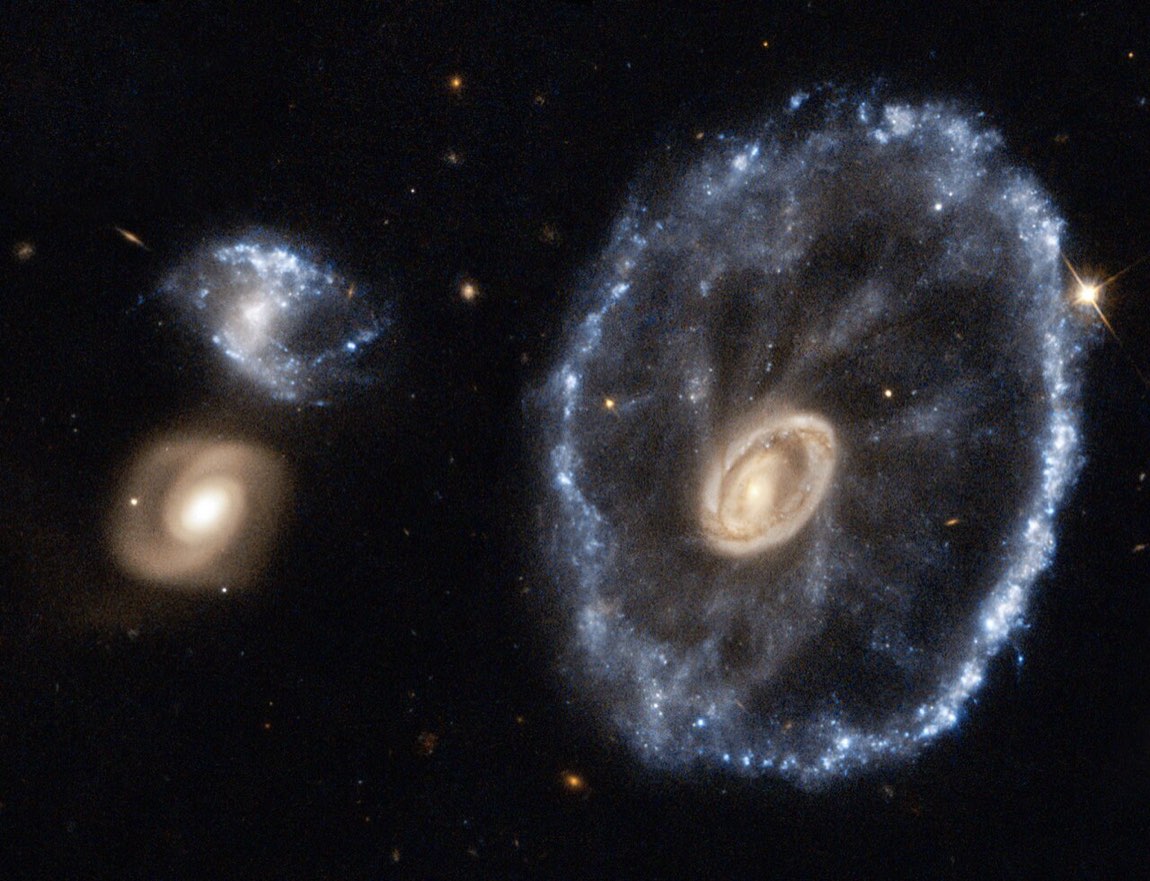
Before the collision that defined it, the Cartwheel was almost certainly an ordinary spiral galaxy. Then, roughly 200 to 300 million years ago, a smaller companion plunged straight through its disk in what astronomers describe as a "bullseye" style head-on impact. The intruder's gravity triggered a powerful shock wave that expanded outward through the disk at high speed, sweeping up and compressing gas and dust as it went. This compression ignited a ring-shaped starburst around the galaxy's center, which remained largely unscathed at the core of the expanding wave. The result is the brilliant outer ring we see today, blue with the light of newly born massive stars. Meanwhile, the structural memory of the original spiral has not been entirely erased — spoke-like arms still connect the outer ring to the inner one, hinting at the galaxy's pre-collision architecture, and astronomers note that the Cartwheel is already beginning to rebuild itself into a spiral form.
04 Two rings, spokes, and a dust-dark nucleus Deeper
The Cartwheel's internal architecture is unusually elaborate. At its heart sits an inner ring that encircles the galactic nucleus, and embedded within that nucleic region is a band of dark absorbing dust that dims the light trying to escape. Surrounding all of this, at a much larger radius, is the famous outer ring — the site of intense, ongoing star formation driven by gas and dust compression. Connecting the two rings are several optical features called spokes or arms, visible in optical wavelengths. Interestingly, astronomers have also detected non-thermal radio continuum emission that traces its own spoke-like pattern, but the radio spokes and the optical spokes do not appear to overlap spatially. This offset is still not fully understood and adds another layer of complexity to a structure that Zwicky himself found bewildering. The outer ring's circular velocity has been measured at 217 km/s, giving researchers a handle on the gravitational mass distribution within this disturbed system.
 ⤢
⤢
05 Pinning down the "bullet" galaxy Deeper
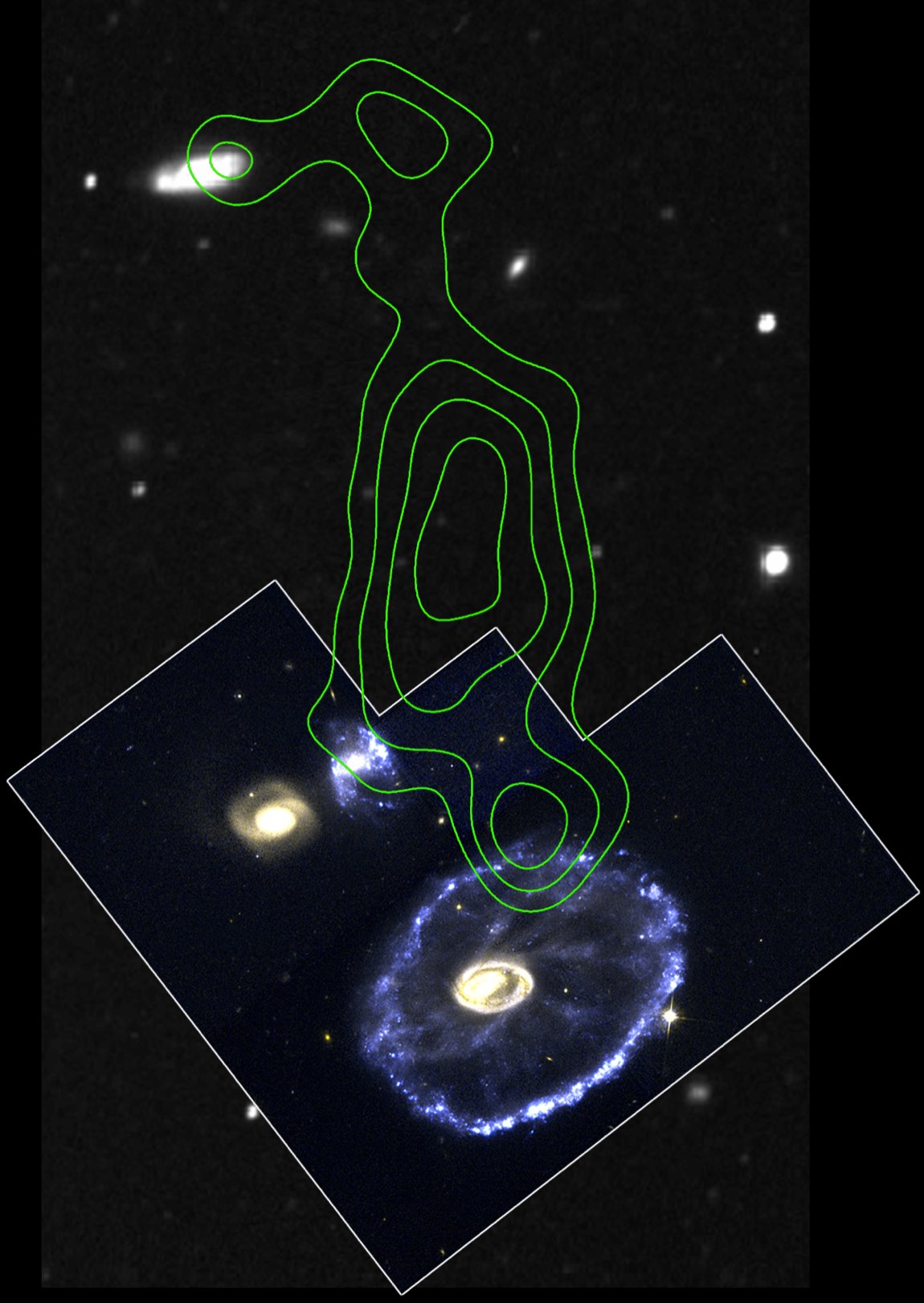
Identifying which galaxy actually fired through the Cartwheel's disk took careful detective work. Early images showed two obvious companions, G1 and G2, sitting close by: G1 is a smaller irregular blue Magellanic-type spiral, and G2 is a yellow compact spiral trailing a tidal tail. Both look like plausible culprits. But mapping neutral hydrogen gas — HI — changed the picture entirely. A faint HI tail connects G3, a more distant spiral often only visible in wide-field images, directly to the Cartwheel. Because hydrogen is the lightest and most abundant gas in galaxies, gravitational forces strip it away readily, leaving a trail that points back toward the source of the disturbance. The HI tail's geometry strongly implies that G3, located roughly 88 kiloparsecs (about 287,000 light-years) away, is the intruder. Its greater current distance is consistent with the estimated 300-million-year age of the ring structure — G3 has had time to travel that far after punching through.
06 Leading tails versus trailing tails Deeper
The HI tail connecting G3 to the Cartwheel tells a specific physical story about how the gas was displaced. When a galaxy falls into a galaxy cluster, the intergalactic medium pushes back against it in a process called ram-pressure stripping, which almost always produces a trailing-dominant tail of neutral hydrogen gas — like hair blown backward in a headwind. The Cartwheel collision is a different beast entirely. In a direct impact or merger event, the culprit galaxy's own gravity actively pulls on the victim galaxy's gas in the direction of the culprit's motion, tending to create a leading-dominant tail instead. The HI structure seen around the Cartwheel group fits this collision-and-merger signature rather than the ram-pressure pattern, further supporting the interpretation that G3's passage was the triggering event and providing a textbook example of how neutral hydrogen mapping can reconstruct galactic collision histories.
07 A temporary structure built to collapse
The spectacular ring we see today is not permanent. Astronomers expect the current structure to disintegrate over the next few hundred million years as the remaining gas, dust, and stars that have not yet escaped begin to fall back toward the galactic center. Once that infall process completes and spiral density waves have an opportunity to reform, the Cartwheel is expected to regain something resembling a normal spiral shape. This recovery hinges on one important condition: companions G1, G2, and G3 must stay distant and not collide with the Cartwheel again. A second impact would scramble the reformation process entirely. In this sense, the Cartwheel is a galaxy caught mid-transformation, offering astronomers a rare snapshot of a transitional state that most galaxies pass through too quickly — or too quietly — to be observed in such detail.
08 Starburst rings and extreme X-ray sources
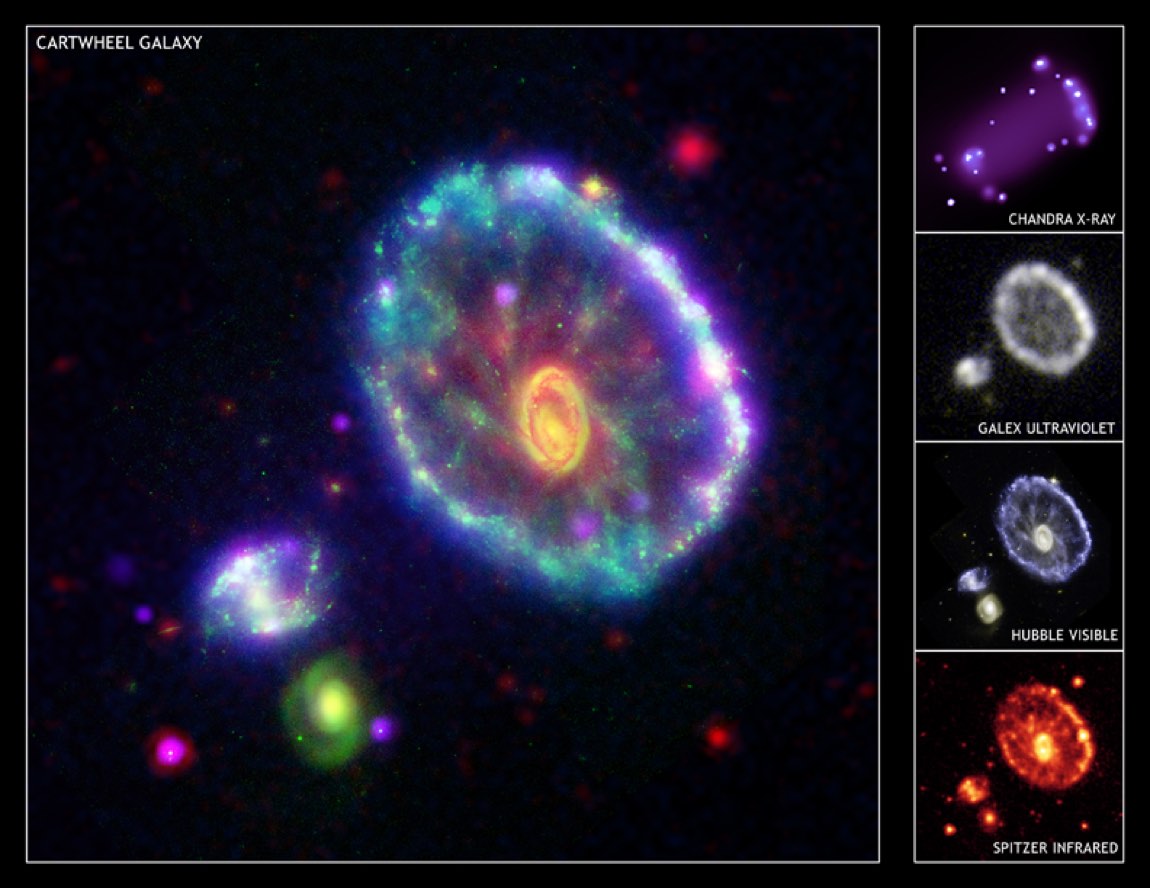
The shock-driven star formation in the Cartwheel's outer ring does not produce ordinary stars in ordinary numbers. Starburst conditions generate enormous, extremely luminous stars in rapid succession. These massive stars burn fast and die violently as supernovae, leaving behind neutron stars and black holes. When such a compact remnant has a nearby companion star, it can pull matter off that companion through gravity, heating the infalling gas to temperatures that radiate powerfully in X-rays. The Cartwheel contains an exceptionally large number of these binary X-ray sources — far more than a typical galaxy its size — precisely because so many massive stars formed in the ring all at once. The brightest of these sources, appearing as bright dots along the galaxy's rim in X-ray imaging, are thought to be black holes actively accreting material from companion stars, classified as ultra- and hyperluminous X-ray sources.
 ⤢
⤢
09 An alternative theory that didn't quite fit Deeper
Not everyone immediately accepted the collision model. A competing explanation invoked the gravitational Jeans instability — a mechanism by which small perturbations in a gas or stellar disk can grow spontaneously into clumps through their own self-gravity. In this framework, both axisymmetric perturbations, which grow radially and could produce ring-like structures, and nonaxisymmetric perturbations, which grow in a spiral pattern and could produce spoke-like features, might together mimic the Cartwheel's appearance without requiring any collision at all. It is an elegant idea because it relies on physics already operating inside any galaxy, with no external intruder needed. However, when researchers tested this Jeans instability model against the actual observational data available for the Cartwheel, it did not hold up. The evidence points firmly toward the collision interpretation, and the alternative model is now considered inapplicable to this specific galaxy, though it may still be relevant for other ring galaxies.
10 The galaxy group the Cartwheel dominates
The Cartwheel is not alone in space — it is the dominant member of its own small galaxy group, a gravitationally bound collection of four physically associated galaxies. The three companions each have distinct characters. G1 is smaller and irregular with a blue color suggesting active star formation, resembling the Magellanic-type spiral class. G2 is more compact with a yellowish hue and displays a tidal tail, the stretched streamer of material that forms when gravity deforms a galaxy during an encounter. G3 is a spiral galaxy positioned farther from the main trio, often only appearing in wider-field observations. The four galaxies are linked not just by gravity but by the shared history of their interactions, most dramatically the event that turned the Cartwheel into what it is today. This small group, located about 500 million light-years away in the southern constellation Sculptor, offers a compact laboratory for studying galaxy interactions.
11 The Cartwheel's one observed supernova
Despite being a galaxy undergoing intense starburst activity, the Cartwheel has produced only one confirmed supernova detected in modern observations. SN 2021afdx was discovered on 23 November 2021 by ATLAS, the Asteroid Terrestrial-impact Last Alert System, which monitors the sky for transient events. It was classified as a Type II supernova — the category that results from the core collapse of a massive star that has retained its hydrogen envelope — and was recorded at a magnitude of 18.796, making it faint but detectable with appropriate equipment. Type II supernovae are the expected outcome for the kind of short-lived massive stars that starburst conditions produce in abundance, so finding one in the Cartwheel is consistent with the ongoing star formation in its outer ring. The relative scarcity of observed supernovae there likely reflects observational limitations rather than a true dearth of stellar deaths in such an active environment.
12 Why the Cartwheel is hard to observe simply
The Cartwheel Galaxy sits about 500 million light-years away in the constellation Sculptor, a southern constellation that sits low or below the horizon for most observers in the Northern Hemisphere. Its catalogue magnitude and angular size on the sky — just under 61 arcseconds across as measured by the RC3 — make it a challenging target for amateur telescopes; it is genuinely a galaxy best appreciated through deep professional imaging. The distance used to derive its physical size comes from redshift measurements, specifically a redshift-derived distance of 132.2 megaparsecs or 431 million light-years, which differs slightly from the round figure of 500 million light-years cited in general descriptions because different measurement conventions and corrections produce modestly different values. This is a normal feature of extragalactic distance estimation rather than an error, and it illustrates why reading the precise units and methods behind any quoted galaxy distance matters.
 ⤢
⤢