 Photograph · NASA/JPL
Moon · Deep guide · orbits Uranus
Ariel
The brightest and youngest face among Uranus's moons.
What is it?
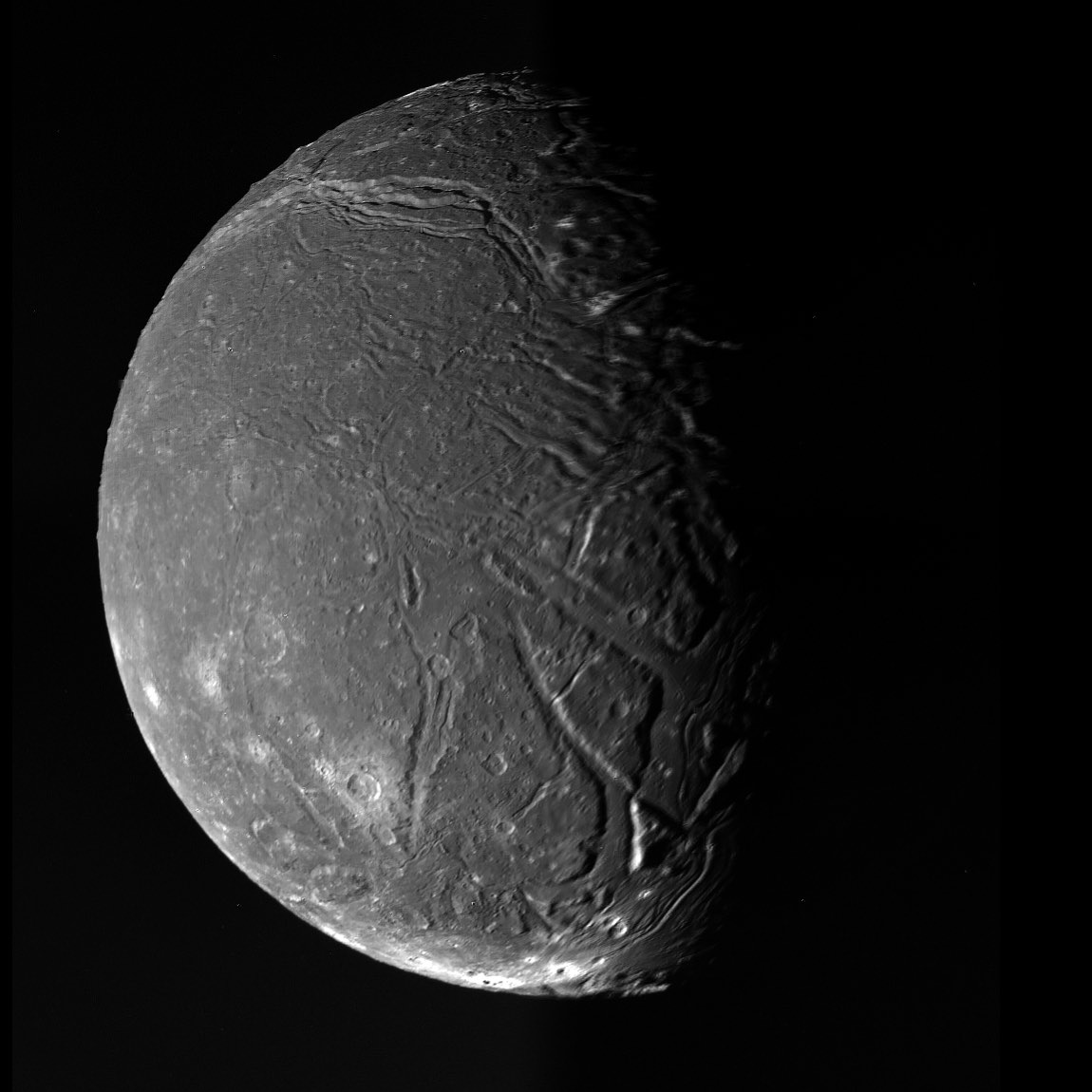
Ariel has the youngest, brightest surface of Uranus's five big moons — broad valleys smoothed by ancient icy flows cut across its cratered plains, evidence that this 1,158-km world was internally active. JWST has detected carbon-dioxide ice concentrated on its trailing side, hinting at chemistry that may involve a buried ocean past or present.
The deep dive
Researched for the Atlas from Wikipedia — Ariel (moon) (20,490 characters read) · updated Sep 20, 2026
01 Discovery by William Lassell in 1851
William Lassell spotted Ariel on 24 October 1851, the very same night he found its neighbour Umbriel — a remarkable double discovery made from his private observatory in Liverpool. Lassell was a successful brewer who funded his astronomical passion himself, and his high-quality reflector gave him the light-gathering power needed to pick out moons as faint as these. The naming of Ariel and the other Uranian satellites was left largely to John Herschel, son of Uranus's discoverer William Herschel, who in 1852 suggested names drawn from English literature rather than classical mythology. Ariel takes its name from two sources at once: it is the leading sylph in Alexander Pope's comic poem The Rape of the Lock, and also the airy spirit who serves Prospero in Shakespeare's The Tempest. Every Uranian moon follows this literary tradition, making Uranus's system unique among the planets. Officially the moon also carries the designation Uranus I. Interestingly, William Herschel had earlier claimed to see four additional moons of Uranus beyond Titania and Oberon, but those observations were never confirmed and are now considered spurious.
02 An extreme orbit almost on its side
Ariel orbits Uranus at a distance of about 190,000 km — close enough that its entire path lies inside Uranus's magnetosphere — and completes one lap every 2.5 Earth days. Because its rotational period matches its orbital period exactly, Ariel is tidally locked: one face permanently points toward Uranus, much like our own Moon always shows Earth the same side. What makes Ariel's orbital situation truly unusual is the extreme tilt of Uranus itself. Uranus orbits the Sun almost on its side, and Ariel orbits in Uranus's equatorial plane, so Ariel's poles alternately bask in continuous sunlight and sit in endless darkness for half a Uranian year at a stretch — that is, 42 Earth years at a time. When Voyager 2 flew past in January 1986, Ariel was near its southern summer solstice, leaving almost the entire northern hemisphere in darkness and unobservable. The orbit's eccentricity is small and its inclination relative to Uranus's equator is minimal, yet these modest orbital parameters still have profound consequences for the moon's geology and heat budget.
03 Inside the magnetosphere: darkening and particle traps Deeper
Because Ariel's orbit sits fully within Uranus's magnetosphere, the moon is continuously bathed in co-rotating magnetospheric plasma. This plasma moves with the planet's spin and preferentially strikes Ariel's trailing hemisphere — the face pointing away from the direction of travel — bombarding it with energetic charged particles. The bombardment has two documented effects: it sputters water ice from the surface, decomposes methane trapped in ice as clathrate hydrate, and darkens organic compounds, leaving a carbon-rich residue that explains why the trailing hemisphere appears about 2% redder than the leading hemisphere. Ariel also acts as a physical obstacle to the flow of these charged particles, sweeping them out of a band in Uranus's magnetosphere. Voyager 2 detected a pronounced dip in the energetic particle count near Ariel's orbit in 1986, a clear signature of the moon intercepting particles that would otherwise continue circling the planet. Observations of Uranian moons during mutual occultations between 2007 and 2008 — including Ariel being occulted by Umbriel on 19 August 2007 — provided additional opportunities to probe these effects from Earth-based platforms.
04 Rock, ice, and what sits between them
Ariel's bulk density of 1.52 g/cm³ places it in a compositional sweet spot: roughly equal parts water ice and a denser component likely made of rock and carbonaceous material, possibly including complex organic compounds called tholins. Infrared spectroscopy confirms crystalline water ice on the surface, and water-ice absorption bands are noticeably stronger on the leading hemisphere than the trailing one — an asymmetry whose exact cause is still debated, though magnetospheric bombardment of the trailing side is a leading explanation. Beyond water ice, two other compounds have been identified. Carbon dioxide is concentrated on the trailing hemisphere, and Ariel holds the distinction of being the first Uranian moon on which CO₂ was ever detected; it also shows the strongest spectroscopic CO₂ signal of any Uranian satellite. Whether that CO₂ forms from radiation processing of surface organics or escapes from the interior as primordial gas is unresolved. Ammonia has also been tentatively identified, spread more uniformly across the surface, and its presence hints at geologically recent activity because ammonia breaks down quickly under magnetospheric bombardment and must be actively replenished somehow.
 ⤢
⤢
05 A layered interior — and a possible hidden ocean Deeper
If Ariel is differentiated — and its size and composition make this likely — it harbours a rocky core with a radius of about 372 km, representing roughly 64% of the moon's total radius and about 56% of its total mass. Surrounding that core would be a mantle of ice, and at the core–mantle boundary a layer of liquid water rich in dissolved ammonia may once have existed. The eutectic temperature of that water–ammonia mixture is 176 K, low enough that tidal heating and radioactive decay could potentially sustain it. A 2006 study argued that radiogenic heating alone would be insufficient to maintain a liquid ocean, but more recent research concluded that an active subsurface ocean remains possible for the four largest Uranian moons, including Ariel. A 2025 study pushed further, using the pattern of surface fractures and Ariel's inferred past orbital eccentricity — which may have reached as high as 0.04 — to estimate that the subsurface ocean could have been as deep as 170 km. Central pressure in Ariel's interior reaches about 0.3 GPa (3 kbar), roughly 3,000 times sea-level atmospheric pressure on Earth.
06 Canyons, scarps, and a fractured face
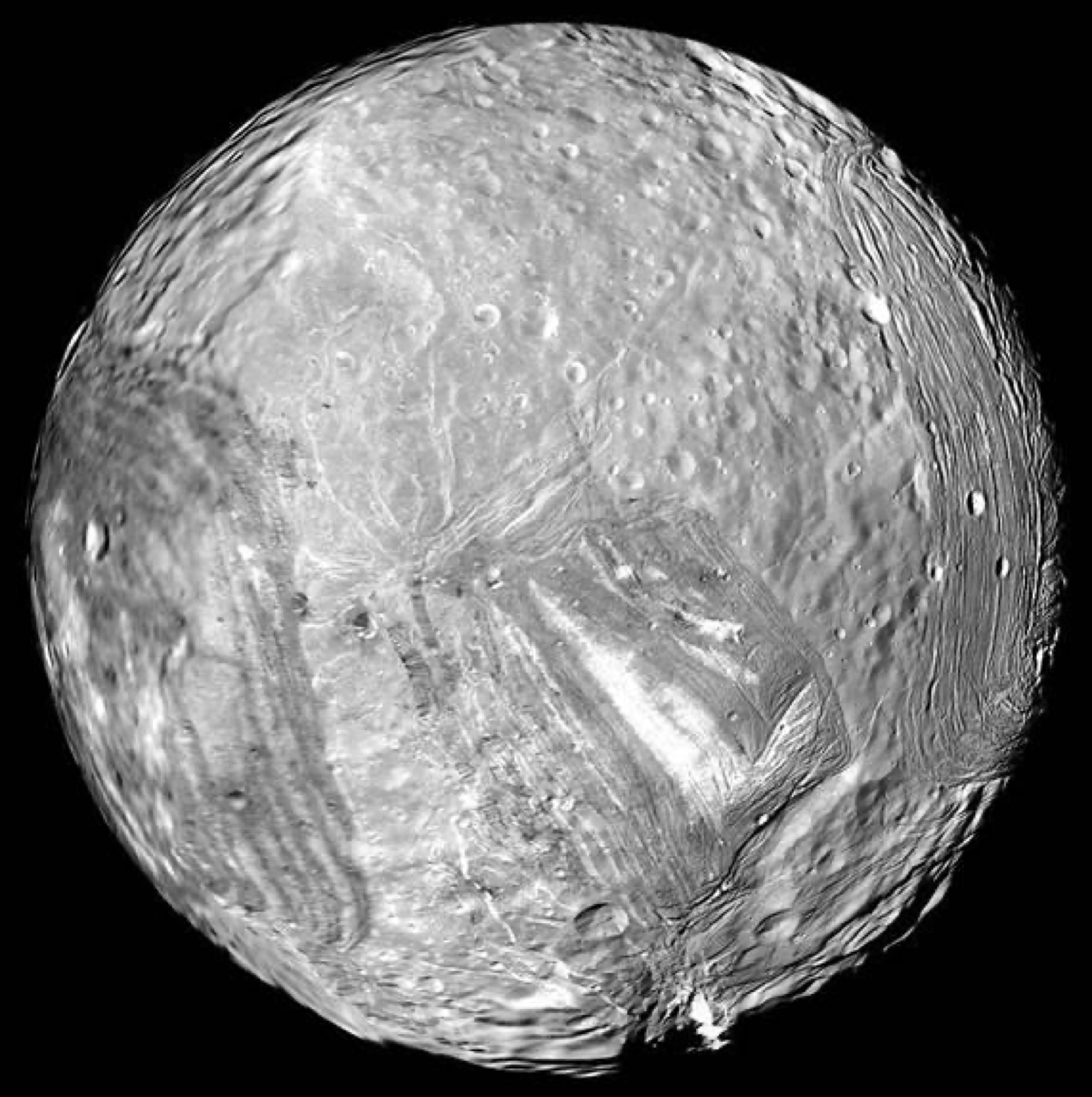
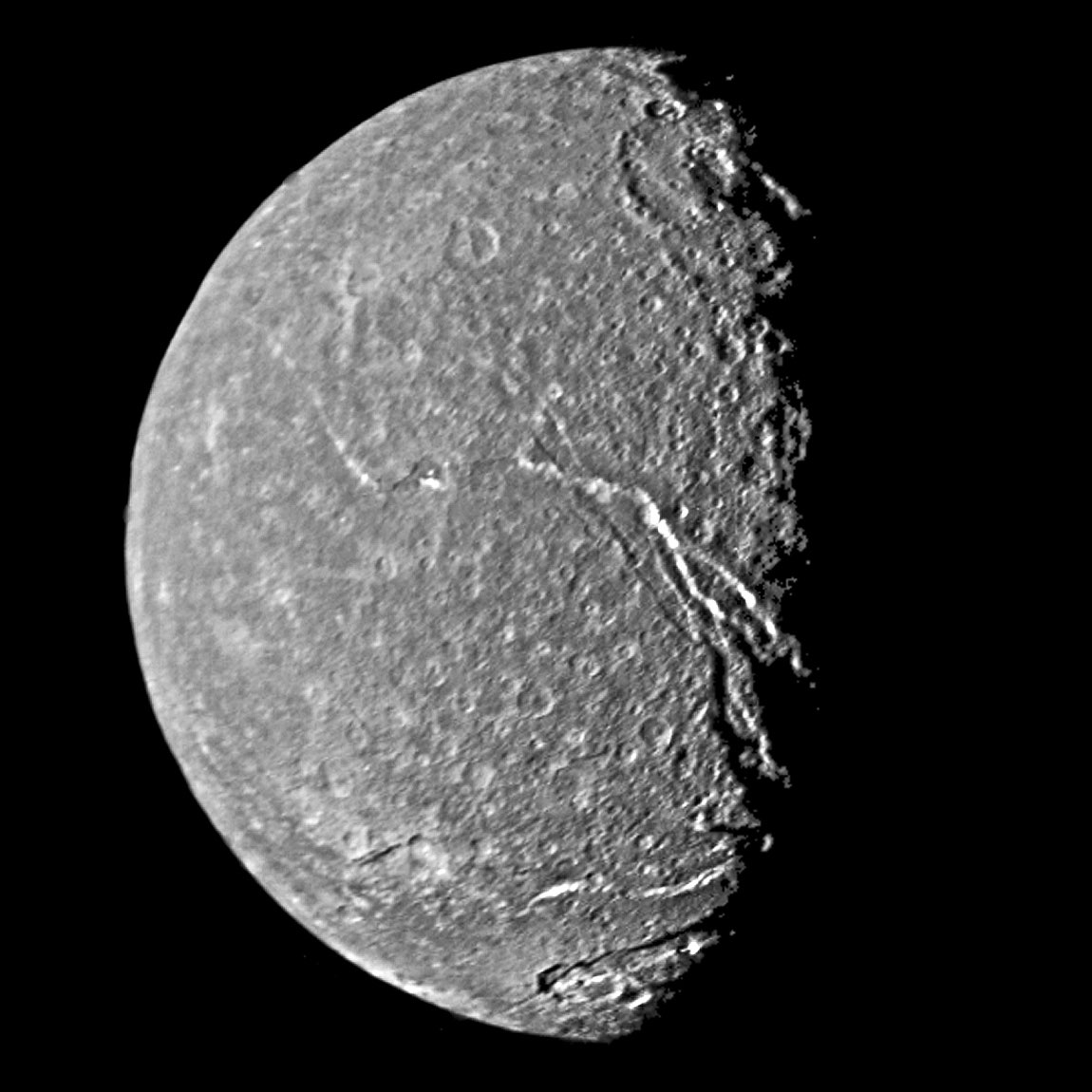
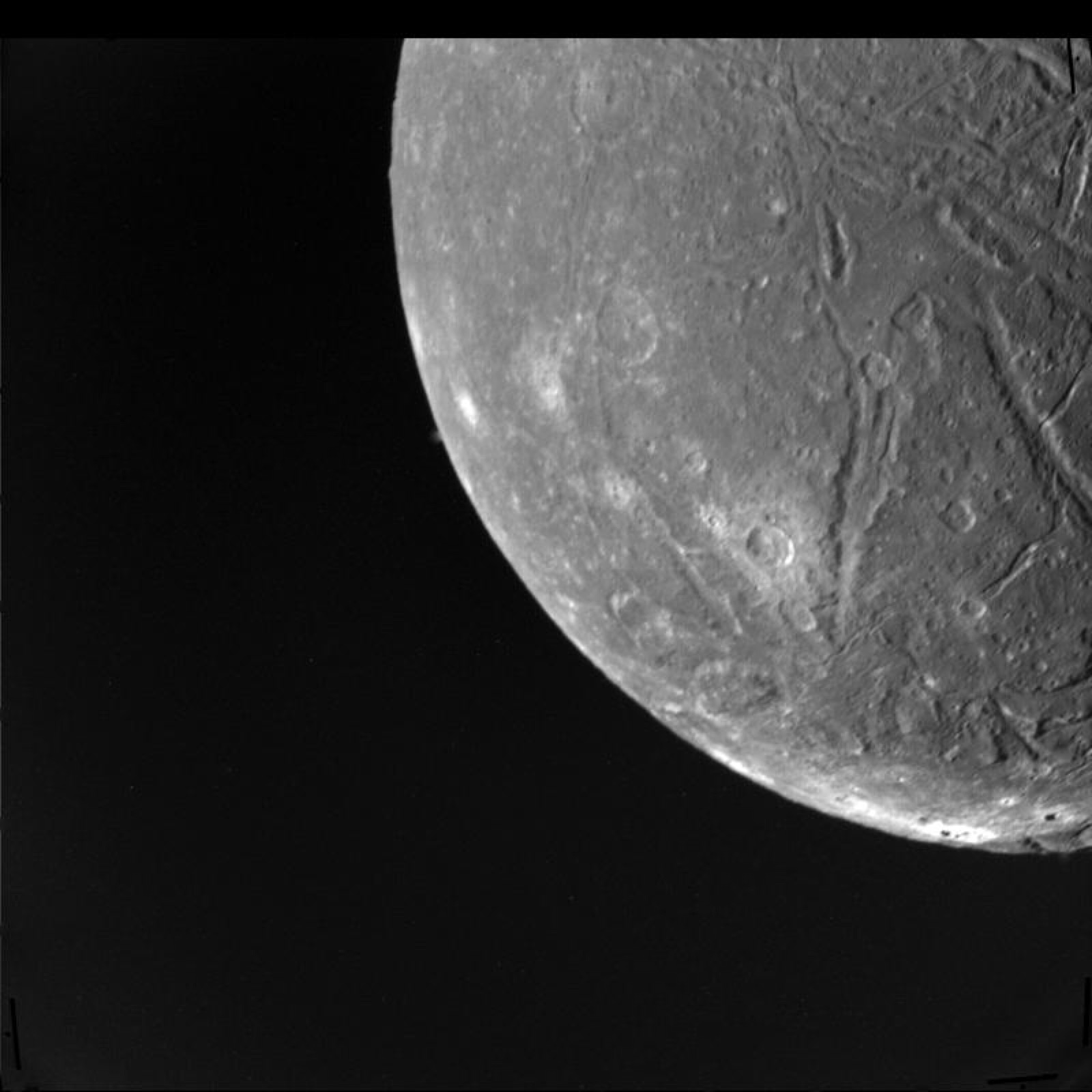
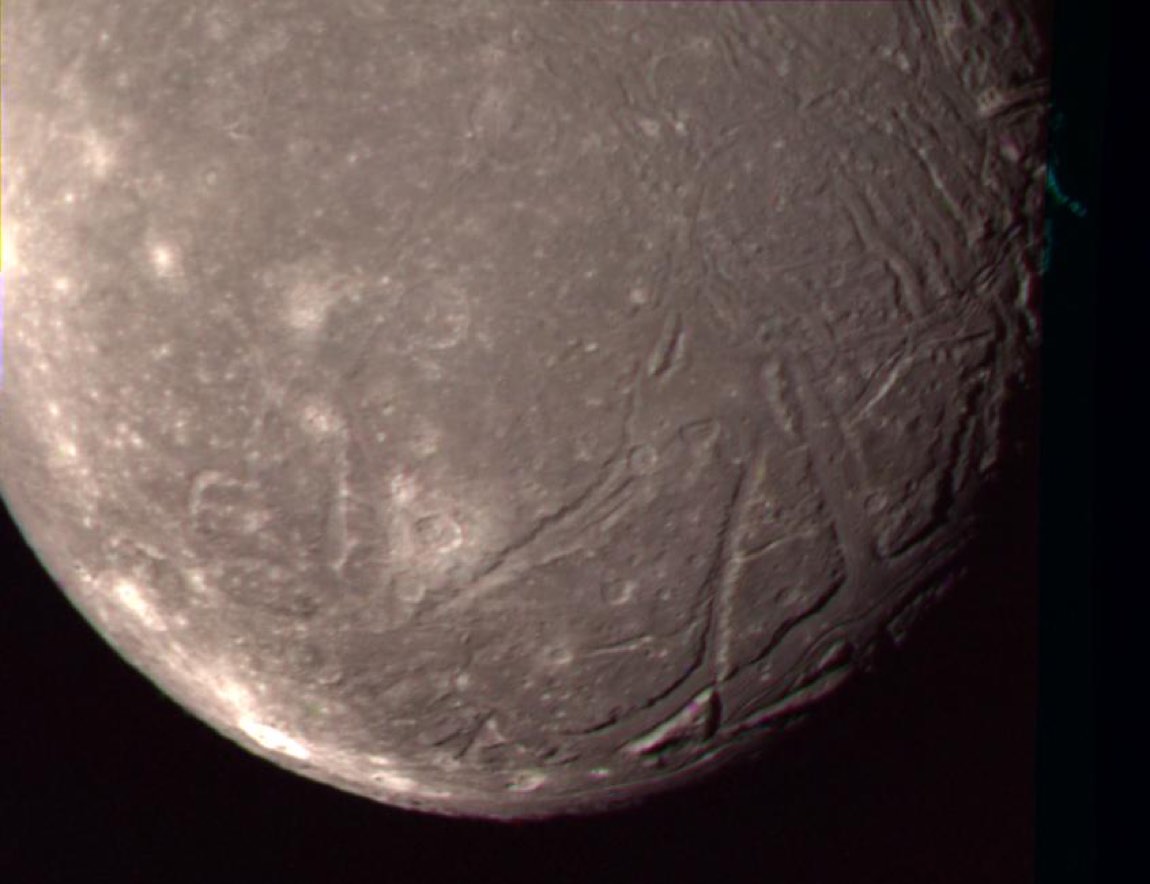
Ariel's photographed surface divides neatly into three terrain types. The oldest and most widespread is the cratered terrain, a rolling, heavily pocked landscape centred on the south pole. Cutting through it is a network of scarps, canyons called chasmata, and ridges. These canyons are interpreted as grabens — troughs dropped between parallel faults when the crust was pulled apart — formed when water or aqueous ammonia froze inside the moon, causing the interior to expand and crack the overlying shell. They range from 15 to 50 km wide, their floors are often convex and bulge upward by 1–2 km, and some floors are edged by narrower 1 km-wide grooves. The longest of these canyons, Kachina Chasma, stretches over 620 km — and even that figure is a lower limit because the feature extends into the hemisphere Voyager 2 never saw illuminated. The second terrain type, ridged terrain, forms bands 25 to 70 km wide containing individual ridges and troughs up to 200 km long. These bands often connect directly to canyon systems, suggesting a shared origin in the same extensional stresses.
07 Young plains and hints of cryovolcanism Deeper
The youngest features on Ariel are its smooth plains, found mainly on canyon floors and in scattered depressions within the older cratered terrain. Their comparatively sparse cratering means some areas may be less than 100 million years old — geologically youthful for a moon this size. The leading explanation for their origin is cryovolcanism: eruptions of viscous, supercooled water-ammonia solutions, or possibly solid-ice volcanism, that flooded low-lying areas and buried whatever structures existed before. The plains' linear vent geometry resembles terrestrial shield volcanoes, and their topographic margins are sharply defined. Estimated flow thickness for the hypothetical cryolava is 1–3 km. A February 2025 study from Johns Hopkins University added a striking analogy: the grooves and grabens may record liquid water oozing up from a subsurface ocean and pushing apart the icy crust much as lava pushes apart oceanic crust along Earth's Mid-Atlantic Ridge, but with water as the working fluid. As that water froze on the surface it would create fresh crust, making the grooves potential windows into ocean chemistry. The study specifically flagged them as good sources of carbon oxide samples.
08 Impact craters and a resurfaced history
Compared to other Uranian moons, Ariel's cratering is relatively even across its surface, but the absence of very large, ancient craters is telling: it means Ariel's surface is not a pristine record of the Solar System's early bombardment. At some point in the past the moon was essentially completely resurfaced, wiping the slate clean. The largest crater yet identified, Yangoor, spans only 78 km across — roughly the driving distance from London to Oxford and back — and even it shows signs of later deformation. All large craters on Ariel share flat floors and central peaks; few are ringed by bright ejecta. Many are polygonal in outline, suggesting the pre-existing network of fractures guided how the impacts played out. A circular depression 245 km in diameter at approximately 10°S 30°E has been proposed as a large, highly degraded impact structure. A few 100 km patches of lighter material within the cratered plains may be palimpsests — ghost craters softened beyond recognition — similar to features on Jupiter's moon Ganymede.
 ⤢
⤢
09 Past orbital resonances and interior heating Deeper
Ariel is not currently in any orbital resonance with its Uranian siblings, but its past may have been far more dynamic. Around 3.8 billion years ago, Ariel is thought to have been locked in a 4:1 mean-motion resonance with Titania, from which it eventually escaped. That resonance would have pumped up Ariel's orbital eccentricity, generating time-varying tidal forces from Uranus and warming the moon's interior by as much as 20 K. Ariel may also have once shared a 5:3 resonance with Miranda, contributing some heat to that notoriously chaotic small moon. Escaping resonances is notably easier for the Uranian moons than for those of Jupiter or Saturn because Uranus is less oblate than those giants and therefore exerts weaker resonance-sustaining torques. The extensional stresses that cracked Ariel's crust — estimated at up to 30 MPa — likely trace back to the combination of resonance-driven tidal heating, radioactive decay, and the thermal expansion of a warming interior. The first roughly 200 million years of Ariel's life appear to have been especially active, as contraction of a cooling surface layer fought against expansion of a warming deep interior.
10 What Voyager 2 actually saw — and missed
Every detailed fact known about Ariel's surface ultimately traces back to a single spacecraft encounter: Voyager 2's flyby of Uranus in January 1986. At closest approach, the probe passed within 127,000 km of Ariel — far closer than it came to any other Uranian moon except Miranda — and the best images it returned have a spatial resolution of about 2 km, fine enough to distinguish features the size of a small city. Those images cover roughly 40% of the moon's total surface, but only 35% was photographed at the quality needed for geological mapping and crater counting. The timing of the flyby was both an opportunity and a limitation: because Ariel was near its southern summer solstice, the northern hemisphere was completely dark and invisible. Subsequent study from Earth has been hampered by Ariel's apparent magnitude of 14.8 — similar to Pluto near perihelion — and by its proximity to Uranus's glare, which makes it difficult to observe even with a 40 cm aperture telescope. The Hubble Space Telescope recorded a transit of Ariel across Uranus on 26 July 2006, casting a visible shadow on the planet's cloud tops, and the European Southern Observatory captured another transit in 2008, but these events yield little surface detail.
11 Formation from Uranus's birth disc Deeper
Ariel almost certainly formed in an accretion disc — sometimes called a subnebula — that surrounded Uranus either shortly after the planet coalesced or after the giant impact that gave Uranus its dramatic sideways tilt. The composition of that disc remains uncertain, but the fact that Uranian moons are denser than Saturnian moons suggests the Uranian subnebula was relatively water-poor. Carbon and nitrogen may have been present mainly as carbon monoxide and molecular nitrogen rather than as methane and ammonia, leading to moons richer in rock and with less water ice. The accretion process itself probably lasted several thousand years. As material piled on, impact energy heated Ariel's outer layers to a modelled maximum of about 195 K at a depth of roughly 31 km. After accretion ended, the surface cooled and contracted while radioactive decay continued heating the deeper interior, which expanded — a mechanical mismatch that drove the extensional cracking seen today. Thermal modelling drawing on comparisons with Saturn's similarly sized moon Dione suggests solid-state convection could have persisted in Ariel's interior for billions of years, with temperatures near the ammonia–water eutectic of 173 K surviving close to the core for nearly a billion years.
12 Future missions and what we still don't know
As of 2019 there are no active plans to send another spacecraft to Uranus or Ariel, though the concept of a Uranus Orbiter and Probe has been studied and discussed. The planetary science community has noted that only 35% of Ariel's surface has been mapped at geological quality, the entire northern hemisphere has never been seen in detail, and a host of fundamental questions remain open: whether the subsurface ocean is still liquid, what drives the replenishment of short-lived ammonia on the surface, what the full extent of Kachina Chasma really is, and whether any cryovolcanism is ongoing today. The possibility of sending Cassini to Uranus was evaluated during that mission's extension phase, but the twenty-year travel time made it impractical and the spacecraft was ultimately directed into Saturn's atmosphere instead. Ground-based observations are severely limited by Ariel's closeness to Uranus's glare; even a 40 cm telescope often cannot resolve the moon. A dedicated orbiter visiting the Uranian system would be transformative, since every major conclusion about Ariel currently rests on data collected during a single three-day window in January 1986.
 ⤢
⤢
You would weigh…
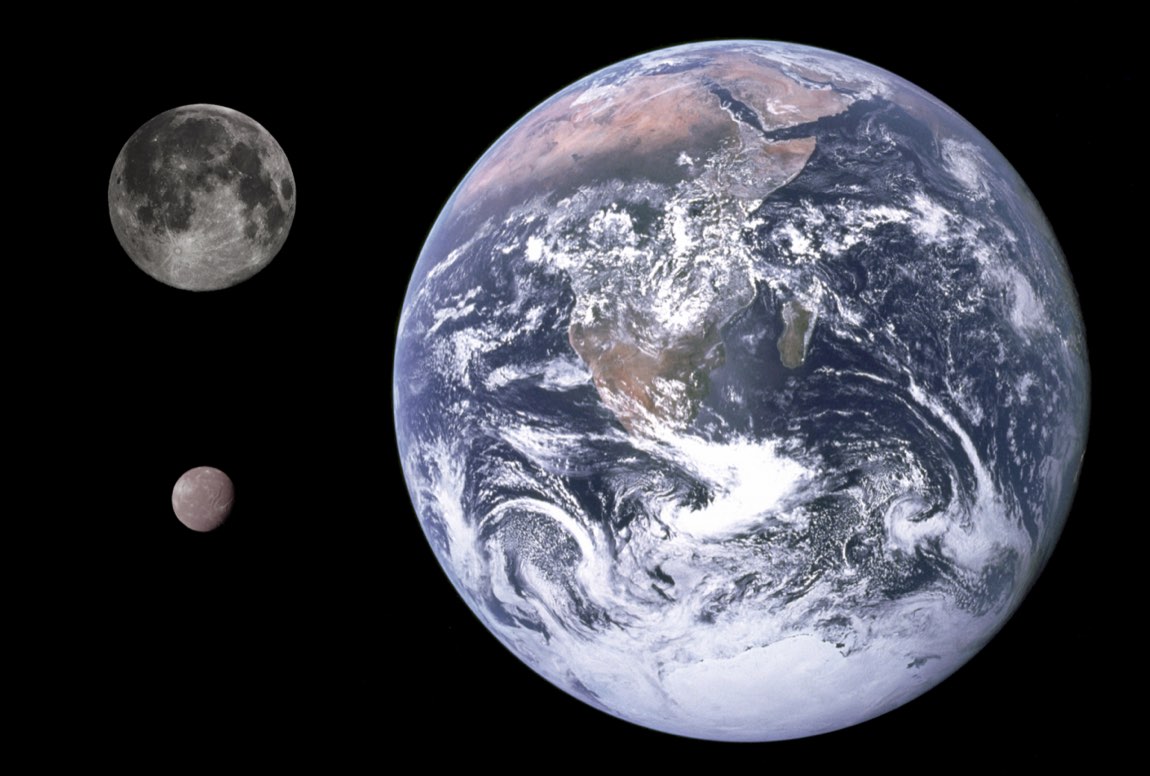
Surface gravity 0.27 m/s² vs Earth’s 9.81 m/s². Try every world →