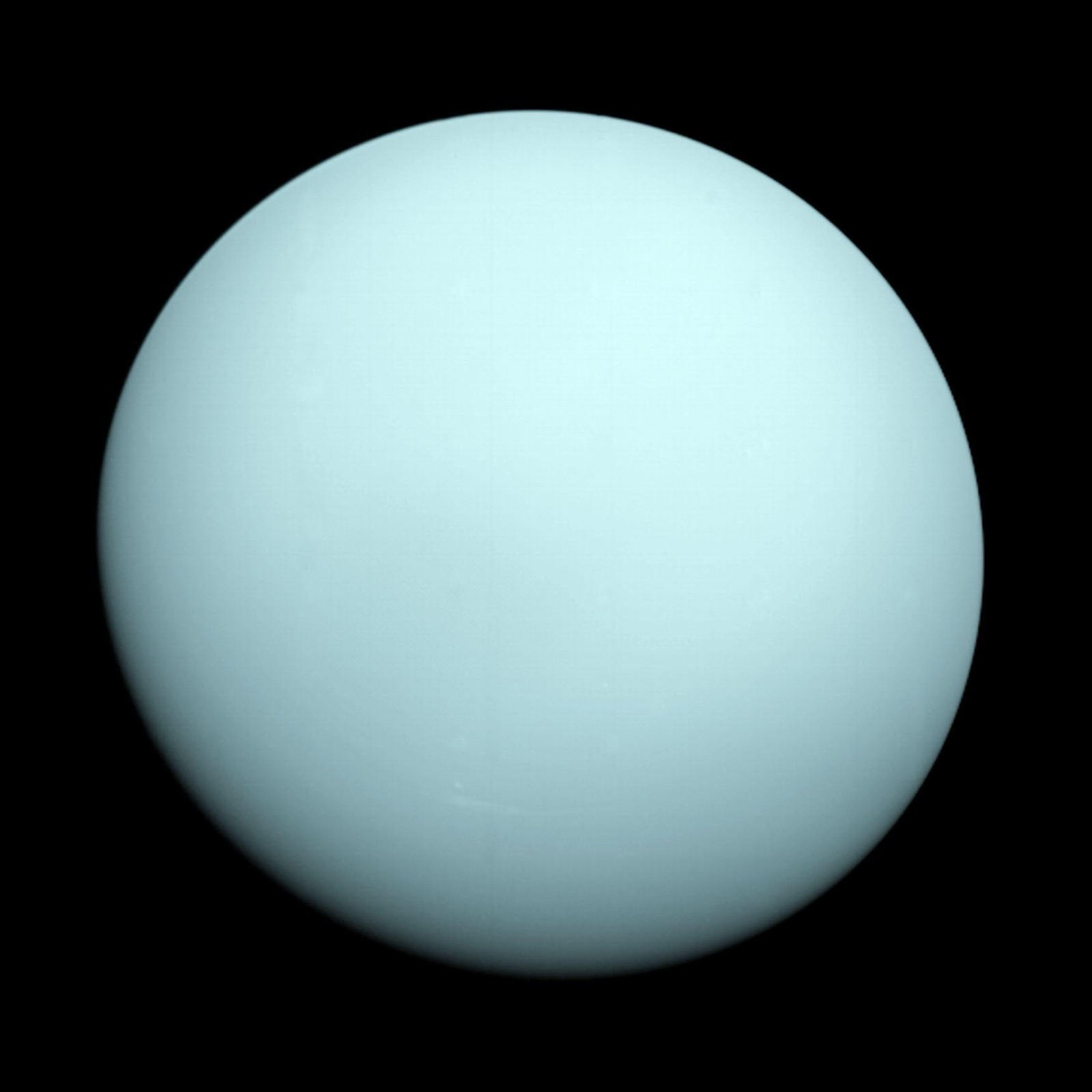
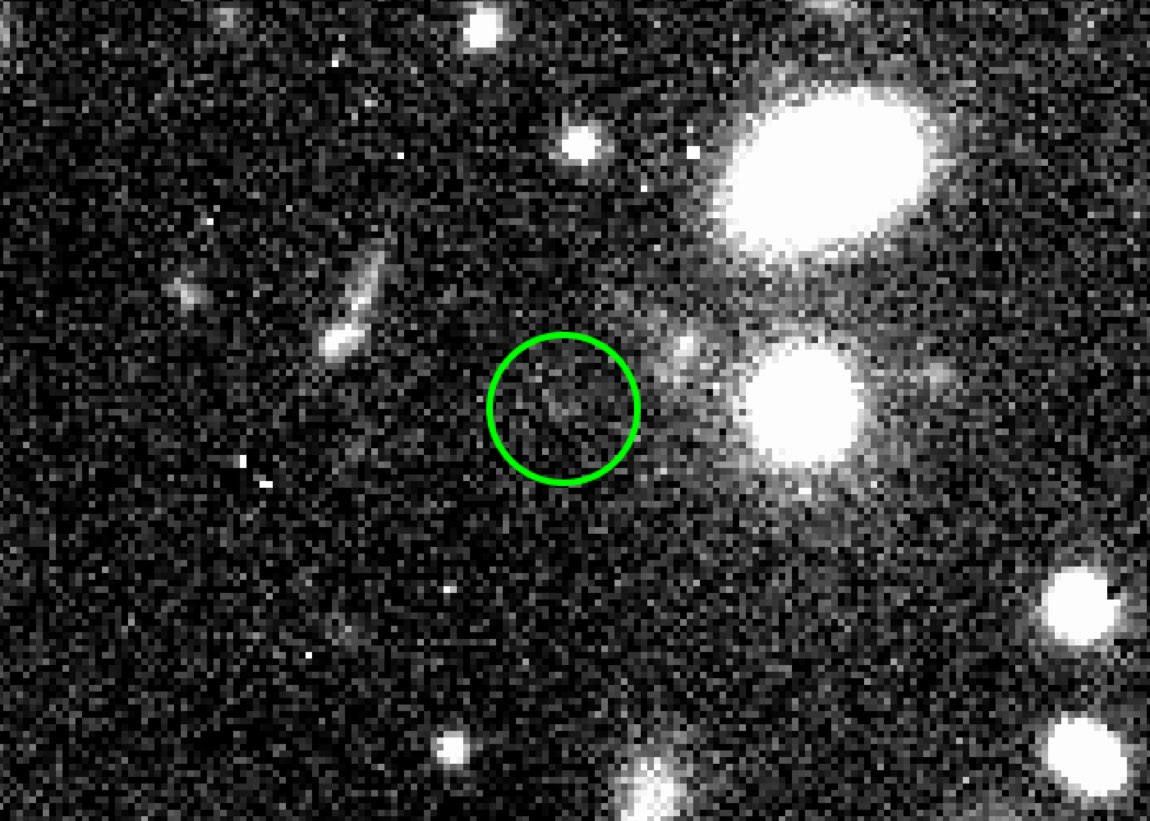
 Photograph · Image processed by Nrco0e . Original frames were taken by P. Rousselot, O. Mousi · CC BY 4.0
Moon · Deep guide · orbits Uranus
Francisco
Also called: Uranus XXII · S/2001 U 3
The innermost of Uranus's distant, captured irregular moons.
What is it?
Francisco is a small moon roughly 22 km across, discovered in August 2001 with the 4-metre Blanco Telescope in Chile by stacking many faint exposures. It travels backwards (retrograde) around Uranus on a tilted orbit about 4.3 million km out, taking about 267 days per lap. That still makes it the closest of Uranus's irregular moons, bodies thought to be captured rather than formed with the planet. Its orbit doesn't match any known family of irregulars.
The deep dive
Researched for the Atlas from Wikipedia — Francisco (moon) (5,977 characters read) · updated Nov 15, 2026
01 How astronomers teased Francisco out of the dark
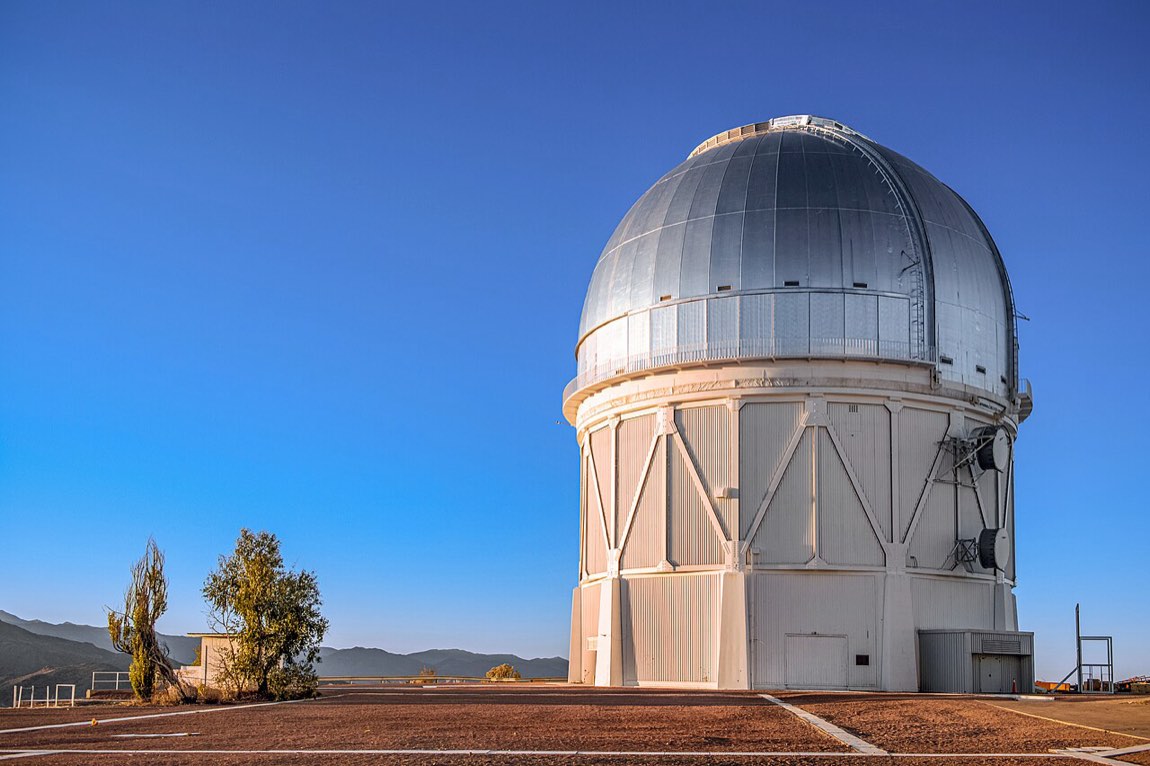
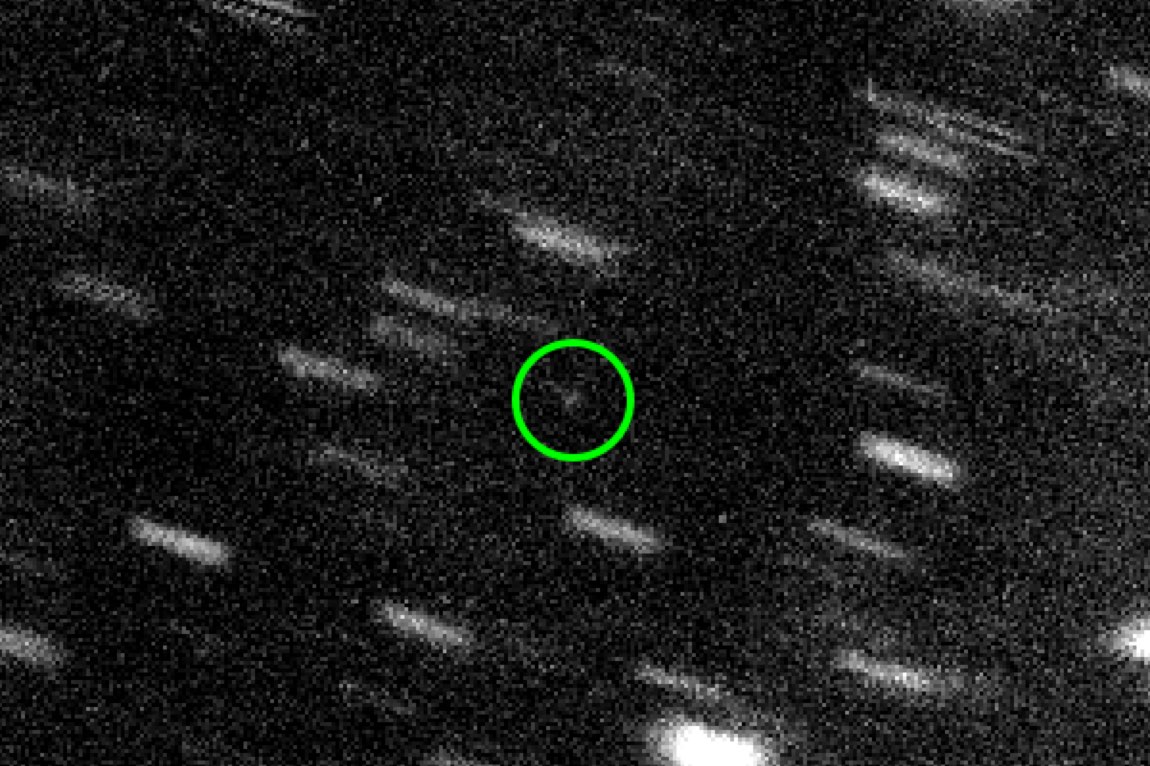
Finding Francisco required coaxing an extraordinarily faint signal out of deep-sky images. The discovery team — JJ Kavelaars, Matthew Holman, Dan Milisavljevic, and Tommy Grav — worked at Cerro Tololo Inter-American Observatory in Chile, using the 4-meter Víctor M. Blanco Telescope fitted with a wide-field camera. Rather than relying on a single long exposure, they applied the shift-and-add technique: multiple images are aligned to track Uranus's own slow drift across the sky and then stacked together, so that any moon tagging along with the planet brightens while background stars and noise average out. The payoff was finding Francisco alongside three other previously unknown Uranian irregular moons — Trinculo, Ferdinand, and Margaret — all in the same batch of images. Even with that clever stacking approach, Francisco glows at an apparent magnitude of only 25.0 in red light, making it invisible to any but the largest professional telescopes. The initial discovery date was 13 August 2001, but pinning down a reliable orbit demanded follow-up imaging that continued until 5 September 2002, using the 5.1-meter Hale Telescope at Palomar Observatory and the 8.2-meter Very Large Telescope at Paranal Observatory. The Minor Planet Center formally announced the discovery on 6 October 2003 — more than two years after those first images were taken.
02 A Shakespeare lord and a daughter named Frances
When the Minor Planet Center first registered Francisco, it carried the unglamorous temporary label S/2001 U 3. The name Francisco arrived on 29 December 2005, when the International Astronomical Union's Working Group for Planetary System Nomenclature officially christened it and assigned the Roman numeral designation Uranus XXII. All of Uranus's moons are named after characters from Shakespeare or Alexander Pope, and this moon takes its name from Francisco, a lord in Shakespeare's play The Tempest — a character who is shipwrecked alongside King Alonso and a party of nobles. The choice has a quietly personal dimension: in a 2014 interview with the Folger Shakespeare Library, discoverer JJ Kavelaars revealed that he selected the name partly because it closely resembled his younger daughter's middle name, Frances. It is a small but charming reminder that even the naming of a chunk of dark rock orbiting 2.7 million miles from Uranus can carry a human story inside it. The Tempest connection is shared by several other Uranian moons, reinforcing the tradition that links the entire Uranian system to one of Shakespeare's most imaginative and otherworldly plays.
03 Why Francisco's orbit refuses to stay put Deeper
Francisco sits at an average semi-major axis of 4.28 million km — a distance so great that Uranus's gravitational grip on it is relatively weak. That looseness leaves the moon's orbit vulnerable to constant nudging by the Sun and other planets. The result is that Francisco's path around Uranus is never truly fixed. Over a 10,000-year span, its semi-major axis oscillates by ±700 km, and its orbital period shifts by ±1 day. On a timescale of several thousand years, its eccentricity drifts slowly between 0.09 and 0.19, while its orbital inclination with respect to the ecliptic wanders between 146° and 149°. Because of these ongoing perturbations, astronomers cannot rely on a simple Keplerian ellipse to describe where Francisco will be far in the future. Instead, they use what are called proper or mean orbital elements, which average out the perturbing forces over long periods to give a more stable mathematical description of the orbit. Francisco's orbit also precesses — both the direction its orbital plane faces (nodal precession) and the orientation of the ellipse itself (apsidal precession) — with average periods estimated between 10,000 and 20,000 Earth years. These are not minor curiosities; they reflect the fundamentally chaotic character of life on the outer edge of a planetary gravity well.
04 The innermost irregular — and what that boundary means Deeper
Francisco holds a specific orbital distinction: it is the innermost known irregular moon of Uranus. That boundary between irregular and regular moons matters physically, not just categorically. Regular moons orbit close to Uranus in nearly circular, nearly equatorial paths, almost certainly formed from the same disk of material as the planet. Irregular moons, by contrast, travel on wide, elliptical, and steeply inclined paths, and are thought to have been captured by the planet during the Solar System's chaotic early history. Francisco's average inclination of 147° with respect to the ecliptic places it firmly in retrograde territory — it orbits Uranus in the direction opposite to Uranus's own motion around the Sun. Its orbital period of about 267 Earth days (0.73 Earth years) means Francisco completes roughly 1.4 laps around Uranus for every year that Earth circles the Sun. Sitting at the inner boundary of the irregular population, Francisco's orbit may preserve clues about the minimum distance from Uranus at which a captured object can remain gravitationally stable over billions of years, though that question remains open.
05 A tiny, dark body with a barely known surface
Almost everything about Francisco's physical nature falls into the category of educated inference rather than confirmed measurement. Its absolute magnitude of 12.9 is the most solid number available, and from that figure astronomers estimate a diameter of 22 km — roughly the length of Manhattan Island — but only by assuming a geometric albedo of 0.04, a very dark reflectivity similar to what other Uranian irregular moons appear to have. If Francisco's actual albedo is different, the diameter estimate shifts accordingly. At that assumed darkness, Francisco's surface is expected to be a mixture of water ice, hydrated silicates, and organic compounds, a composition broadly consistent with objects that formed in the outer Solar System and were later captured. No detailed spectral measurements of Francisco have been published, so the surface chemistry remains unconfirmed. Rotation period, internal structure, shape, and mass are all unknown. In practical terms, Francisco is little more than a moving point of faint red light that happens to follow a consistent path around Uranus — everything else is extrapolation from its brightness and from what we know about similar objects.
 ⤢
06 Voyager 2's accidental close approach in 1986
There is a historical near-miss buried in Francisco's story. When Voyager 2 swept past Uranus in January 1986 — the only spacecraft ever to visit the planet — it happened to pass within 2.4 million km of where Francisco was at the time. That is closer than the Moon is to Earth by a factor of roughly six, which sounds promising. The catch is that Francisco had not been discovered yet; astronomers would not know it existed for another fifteen years. Voyager 2's cameras were pointed at Uranus and its inner moons, not at a faint unknown irregular sitting millions of kilometers away. So the encounter left no images of Francisco and contributed nothing to our understanding of it. It is a small irony of exploration timing: humanity's only Uranus mission brushed past this moon in complete ignorance. With no return mission currently approved, Francisco remains unimaged at close range, and that situation is unlikely to change in the near future.
07 A loner with no known family of fragments Deeper
Among the irregular moons of Uranus, many are suspected to belong to collisional families — groups of objects that share similar orbital parameters because they all broke off from a single larger body when it was struck long ago. Francisco does not fit into any known family. Its orbit appears to be unique among the confirmed Uranian irregular moons, with no close orbital neighbors that might suggest a shared ancestry. This does not necessarily mean Francisco was never part of a larger collision event. The article acknowledges that if a collisional family associated with Francisco does exist, the related fragments are probably still undiscovered — presumably because they are smaller and even fainter than Francisco itself, pushing them below the detection threshold of current surveys. At an apparent magnitude of 25.0, Francisco is already near the limit of what ground-based telescopes can routinely detect. Any siblings would be dimmer still. Francisco's orbital isolation raises questions about whether it is a surviving fragment, a pristine captured object, or something whose family has simply not yet been found.
08 What a future Uranus orbiter might learn
The proposed Uranus Orbiter and Probe, or UOP, has identified all of the Uranian irregular moons — Francisco included — as distant observation targets. The science goal would be relatively modest but genuinely useful: by monitoring how Francisco's brightness changes over time as the probe watches from orbit around Uranus, scientists could work out the moon's rotation period and get a rough sense of its shape. A body that rotates quickly and has an elongated form will brighten and dim in a predictable pattern, and that light curve encodes physical information unavailable from Earth-based observations. However, the article is candid about a significant constraint: Francisco's orbit does not lie near the ecliptic plane, which is where spacecraft trajectories naturally travel. That geometry may make a dedicated close flyby of Francisco impractical even for a Uranus orbiter. So the most realistic scientific return from UOP would likely be improved photometry from a distance rather than the kind of close-up imaging that would reveal surface geology or confirm composition. For now, Francisco remains one of the solar system's most poorly characterized moons.
09 Capturing an irregular moon: the leading theory
Francisco's wide, tilted, retrograde orbit is the core piece of evidence for how it arrived where it is today. Regular moons form from a disk of gas and dust rotating around a young planet, so they end up orbiting in the same direction and roughly in the planet's equatorial plane. Francisco does none of that. Its steep inclination of 147° and its retrograde motion are the hallmarks of a captured object — something that formed elsewhere in the Solar System and was later grabbed by Uranus's gravity. The leading model is that such captures happened during the early Solar System when the giant planets were migrating and the region was crowded with smaller bodies. During brief periods when a third body or a temporary drag mechanism could bleed off enough energy from an approaching object, Uranus could trap it into a permanent orbit. Once captured, gravitational perturbations from the Sun and other planets would have reshaped the orbit over billions of years into something like what we see today. The exact original source of Francisco — whether it was a Kuiper Belt object, a scattered disk body, or something else — is unknown.
 ⤢