Moon · Deep guide · orbits Uranus
Puck
Also called: Uranus XV · S/1985 U 1
The largest of Uranus's small inner moons, a dark, cratered ball named after a mischievous sprite.
What is it?
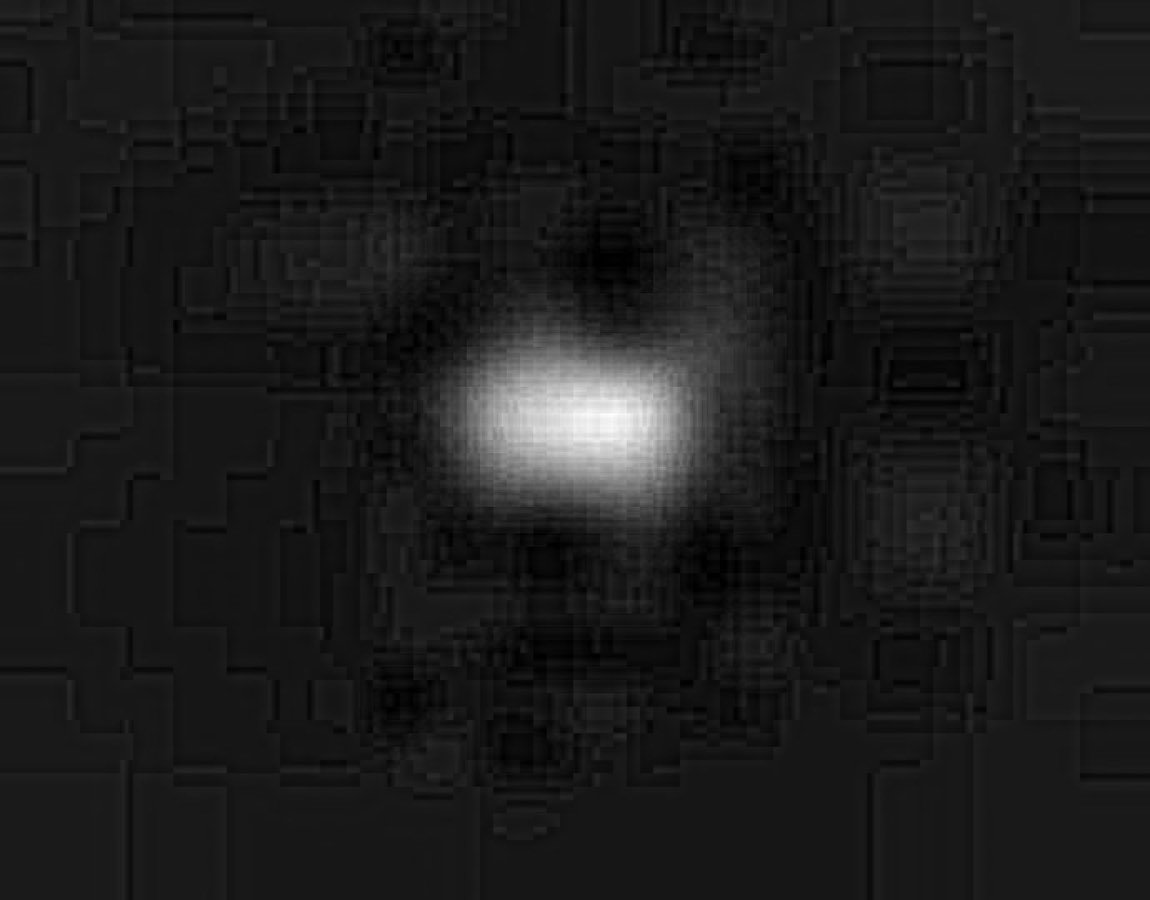
Puck was the first moon Voyager 2 discovered at Uranus, spotted in images on 30 December 1985. About 162 km wide, it is the biggest of the planet's inner moons and nearly round. Voyager imaged its grey, heavily cratered surface, and three craters now carry names: Bogle, Butz and Lob. Hubble and ground telescopes have detected water ice mixed with dark material, and it may be a loosely bound rubble pile.
The deep dive
Researched for the Atlas from Wikipedia — Puck (moon) (3,556 characters read) · updated Nov 15, 2026
01 How Voyager 2 spotted Puck just in time
Puck holds a special distinction among the moons Voyager 2 discovered during its January 1986 Uranus flyby: it was the only one found early enough to allow mission controllers to reprogram the spacecraft and point its cameras for a detailed look. The discovery image was taken on 30 December 1985, giving engineers precious weeks to adjust the probe's observation sequence. Every other inner moon found during that encounter was spotted too late for anything beyond incidental coverage. This fortunate timing means Puck is far better characterised than its siblings. The spacecraft's closest imaging was good enough to constrain Puck's shape in all three dimensions — a rare achievement for such a small, distant body. Without that early detection, Puck would be little more than a point of light in the Voyager data, and most of what we know about its shape, craters, and surface colour would remain unknown.
02 A sprite's name with deep folkloric roots
The name Puck follows Uranus's established tradition of honouring Shakespearean characters, in this case the mischievous sprite from A Midsummer Night's Dream described as a little spirit who travels around the globe at night with the fairies. But the character's origins run deeper than Shakespeare. In Celtic mythology and English folklore, a puck is a mischievous sprite with a long pre-literary history, and early Christian tradition reimagined such figures as outright evil demons. That layered cultural identity — playful fairy, ancient trickster, demonised outsider — gives the name an unusual richness. The moon also carries two formal designations: the provisional label S/1985 U 1, assigned at discovery, and the permanent number Uranus XV. The three named craters on its surface continue the mischievous-spirit theme, honouring folkloric tricksters from Scotland, Germany, and Britain.
03 Puck's craters and what they reveal Deeper
Three craters on Puck have been officially named: Bogle, Butz, and Lob, drawn from mischievous spirits in Scottish, German, and British folklore respectively, keeping the naming theme consistent with the moon itself. The largest of the three spans about 45 km in diameter — roughly the distance from one side of a major city to the other — yet detailed information about all three features remains scarce. More telling than what craters are present is what is absent: none of them show the bright ejecta rays that fresh, energetic impacts normally leave behind. On bodies where ice and rock have separated into distinct layers, impacts punch through dark surface material and excavate bright subsurface ice, creating those telltale rays. Their absence on Puck suggests the moon is not differentiated — meaning ice and non-ice components are still thoroughly mixed together rather than sorted into a core and mantle.
04 The rubble pile hypothesis for Puck's interior Deeper
Almost nothing is directly known about Puck's internal structure, but planetary scientists have assembled circumstantial clues. The moon is probably composed of a mixture of water ice and rocks, a composition consistent with the broader family of inner Uranian satellites. More provocatively, Puck may have been collisionally disrupted at some point in its history — shattered by an impact — and then reaccreted under its own gravity as a loosely bound rubble pile. If true, its interior would be porous and chaotic rather than solid, more like a gravel heap than a coherent rock. This scenario is not confirmed, and the article is careful to frame it as possibility rather than fact. The spectral detection of a 3.0-micron absorption feature attributed to the O-H stretching mode independently supports the presence of water ice or hydrated minerals as a common surface component, adding a chemical dimension to the structural picture.
05 Why Puck's surface is so dark
Puck reflects only about 10% of the visible light that strikes it — a geometric albedo that makes it one of the darker objects in the solar system, comparable in darkness to a charcoal briquette. Its surface is coated with a dark material chemically similar to what is found in Uranus's main ring system, suggesting a shared origin or ongoing exchange of material. That coating is thought to be either rocky debris or radiation-processed organics — complex carbon-bearing molecules that have been chemically altered by decades of bombardment from solar ultraviolet light and charged particles. There is also a directional subtlety: Puck is about 10 to 15 percent brighter on its trailing hemisphere than on its leading hemisphere. One proposed explanation is that material spiralling inward from Uranus's μ ring preferentially coats the leading face, adding an extra layer of darkening on that side.
06 Water ice hiding beneath the darkness
Despite its uniformly dark and grey appearance, Puck is not simply a lump of rock. Observations made with the Hubble Space Telescope and large ground-based telescopes detected water-ice absorption features in Puck's spectrum, revealing that ice is present even if it is hidden beneath a dusky veneer. The 3.0-micron feature tied to the O-H stretching mode — a molecular vibration characteristic of water bonds — strengthens this picture, pointing to water ice or hydrated minerals as a common component across the surface. The dark coating apparently masks the ice visually without eliminating its spectral signature. This combination of dark exterior and icy composition is a recurring theme among the inner Uranian moons, and it complicates simple interpretations: a quick glance suggests rock, but the chemistry says something far icier lies underneath.
07 Puck's shape: almost but not quite a sphere Deeper
With a radius of about 81 km, Puck is large enough that gravity has pulled it into a broadly spherical form, but it is not a perfect one. The single high-resolution Voyager 2 image that covered all three dimensions showed that the ratio between its two equatorial axes, a divided by b, falls between 0.93 and 1.0 — meaning it is at most 7% flatter across one equatorial direction than the other. The polar axis c is at least 95% of b. Within the measurement uncertainties these numbers are consistent with a true sphere, but they also allow for mild elongation. For context, Puck sits in size between Portia, the second-largest inner Uranian moon, and Miranda, the smallest of Uranus's five major moons. That intermediate position makes it an interesting transitional object between the small, irregular inner moons and the larger bodies that have been extensively reshaped by geology.
08 Where Puck sits in the Uranian system
Puck occupies a distinctive niche in the architecture of the Uranian system. Its orbit lies in the gap between the planet's ring system and Miranda, the innermost of the five large moons. This placement means Puck essentially marks the outer boundary of the inner moon population and the inner boundary of the major moon region. The inner moons share orbital space with the rings, and the dark material coating Puck's surface mirrors the composition of those rings, hinting at a physical and perhaps evolutionary connection between the rings and the small moons embedded near them. As the largest of the inner moons, Puck is both a gravitational actor capable of influencing ring dynamics and a likely recipient of material shed from the rings themselves — a two-way relationship that researchers are still working to understand.
09 How Puck compares to Neptune's inner moons Deeper
Planetary scientists have noted that Puck and the other inner satellites of Uranus are systematically darker than the average inner moon of Neptune. Two competing explanations have been proposed and neither has been definitively ruled out. The first points to solar irradiation: Uranus receives more solar ultraviolet flux than Neptune does simply because it is closer to the Sun, so radiation-driven chemical darkening of organic surface compounds could be more intense there. The second explanation invokes composition: the Uranian inner moons may simply be made of intrinsically darker material than their Neptunian counterparts, reflecting different formation environments or different histories of cometary and dust bombardment. Distinguishing between these two scenarios would require more detailed compositional data than Voyager 2 was able to provide, and no subsequent spacecraft has visited the system.
10 Seeing Puck from Earth: a real challenge
Puck was invisible to astronomers until Voyager 2 stumbled upon it in late 1985, and it remains a difficult target from Earth. Its dark surface — reflecting only about 10% of incoming light — makes it intrinsically faint, and its proximity to the overwhelming glow of Uranus compounds the problem. After Voyager's discovery, the Hubble Space Telescope became one of the few instruments capable of detecting Puck's water-ice spectral features, requiring careful subtraction of Uranus's own bright light. Large ground-based telescopes have also contributed spectroscopic observations. No spacecraft has returned to Uranus since Voyager 2's January 1986 flyby, so Earth-based and Earth-orbital observations remain the only current means of studying Puck, leaving enormous gaps in our knowledge of its detailed geology, true composition, and internal structure.
11 Open questions that keep researchers curious Deeper
For all that Voyager 2 revealed in its brief encounter, Puck raises more questions than it answers. The rubble-pile hypothesis for its interior is plausible but unconfirmed; measuring Puck's density would help, but that requires tracking an orbiting spacecraft or observing gravitational effects on a nearby body — neither of which has been done. The exact nature of the dark surface material remains debated: radiation-processed organics and rocky debris are both candidates, and distinguishing them requires spectroscopy beyond what Voyager carried. The directional brightness asymmetry between the leading and trailing hemispheres needs an explanation that accounts for all the ring-sourced material, solar wind effects, and impact gardening simultaneously. And the three named craters — Bogle, Butz, and Lob — are described in the scientific literature as features whose details are currently unknown, meaning even basic measurements like exact size and depth are still unresolved.