 Photograph · NASA/JPL-Caltech/SwRI
Planet · Deep guide · orbits The Sun
Jupiter
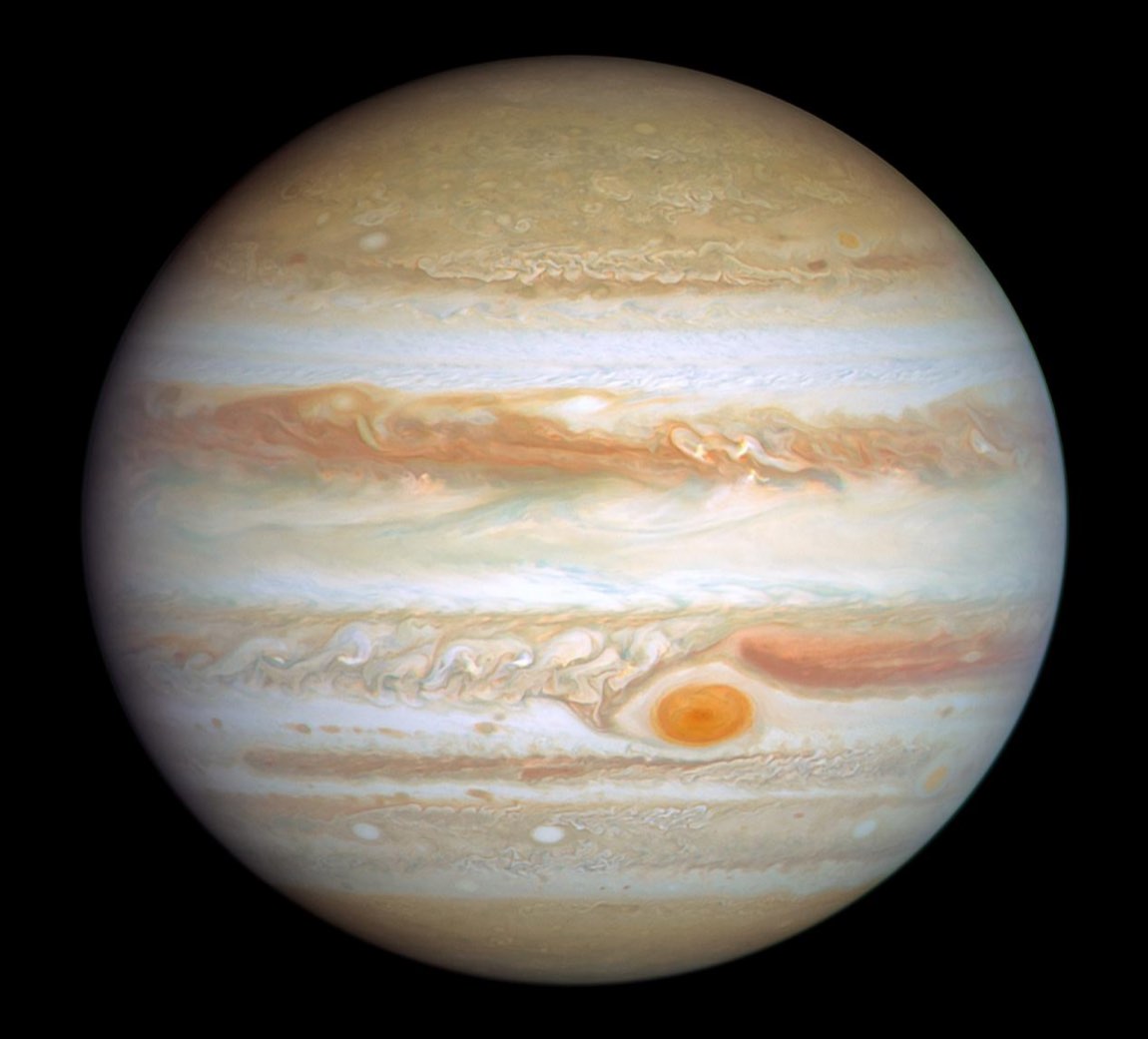
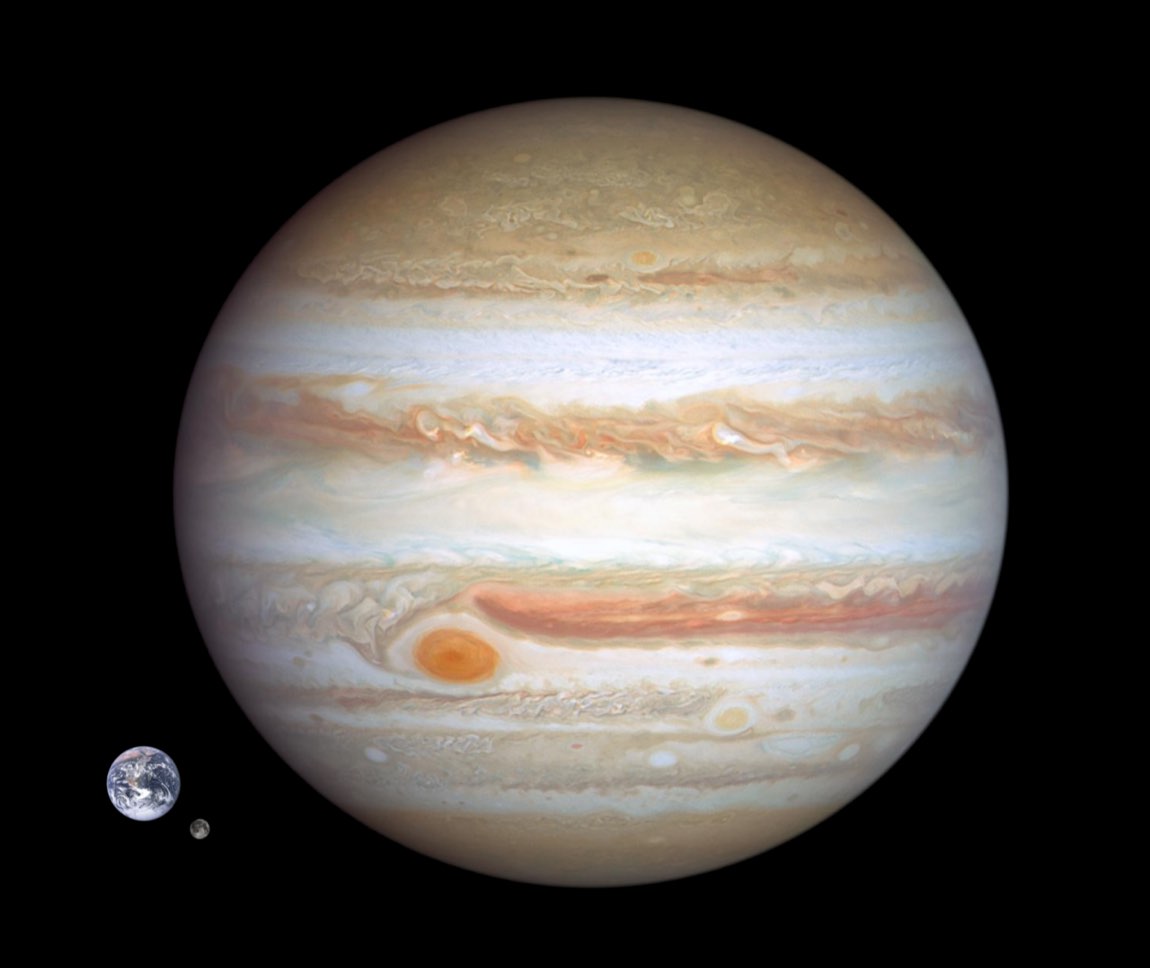
The giant of the Solar System. This striped gas world could swallow 1,300 Earths.
What is it?
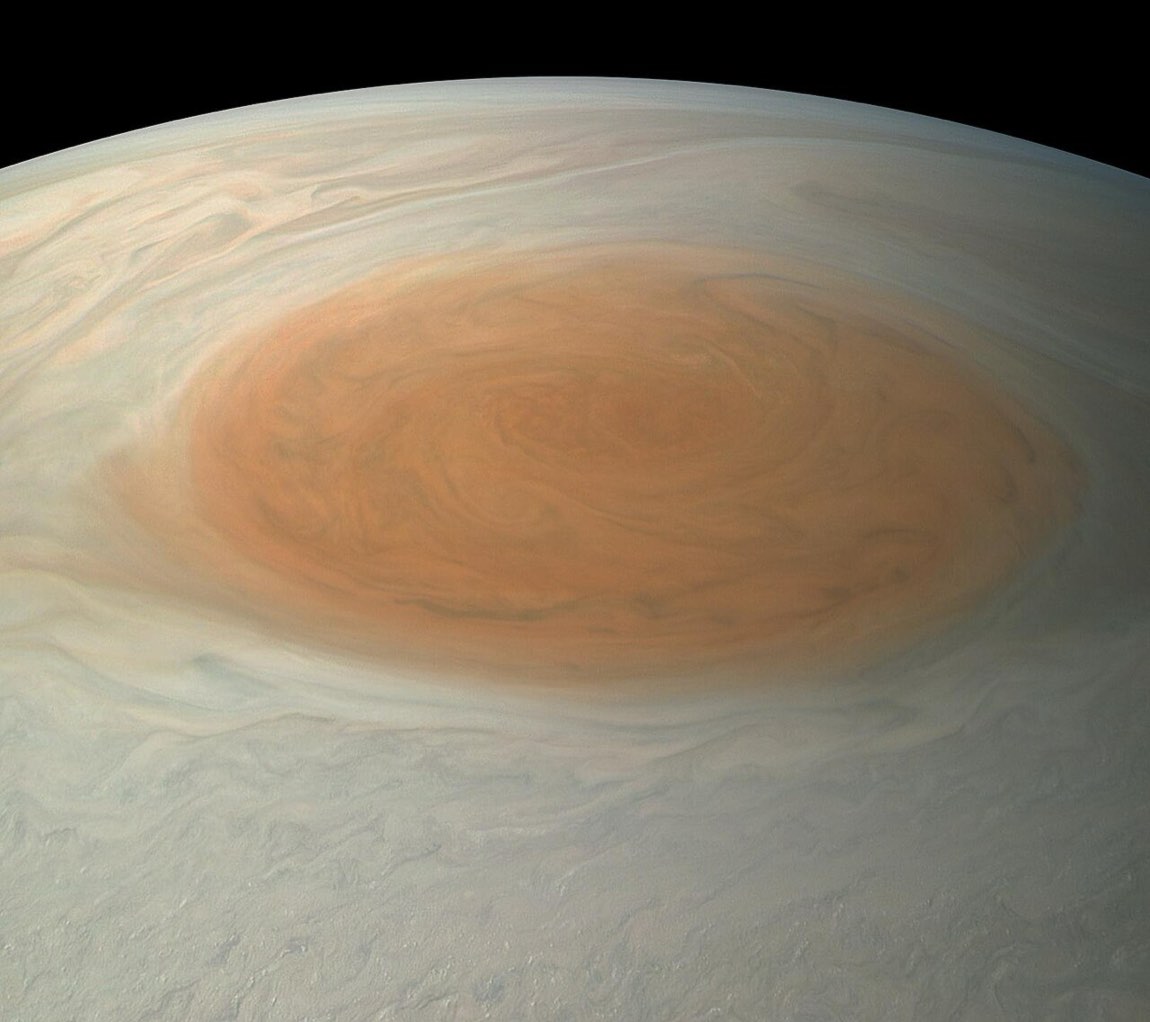
Jupiter is the fifth planet from the Sun and by far the largest — more than twice as massive as all the other planets combined. It is a gas giant: mostly hydrogen and helium with no solid surface. Its famous Great Red Spot is a storm bigger than Earth that has raged for centuries, and its family of moons — 95 known — is like a solar system in miniature.
Go deeper
Jupiter is a window into planet formation: it grabbed the lion's share of the gas left over after the Sun formed, and its gravity has been sculpting the Solar System ever since — scattering comets, shaping the asteroid belt, and possibly shielding (or occasionally redirecting) impactors toward the inner planets. Juno's gravity data revealed a 'fuzzy' dilute core rather than a compact one. Deep down, hydrogen compresses into a liquid metallic state whose currents drive the strongest planetary magnetic field in the Solar System — its radiation belts are lethal to unshielded electronics.
01 What is it like there?
There is nowhere to stand — Jupiter is weather all the way down. Descend and the hydrogen air thickens under crushing pressure, from ammonia cloud decks through lightning storms bigger than continents, until the gas gradually becomes a hot, bottomless ocean of fluid hydrogen. The Galileo probe, dropped in 1995, survived 58 minutes and about 150 km before being crushed.
02 A miniature solar system
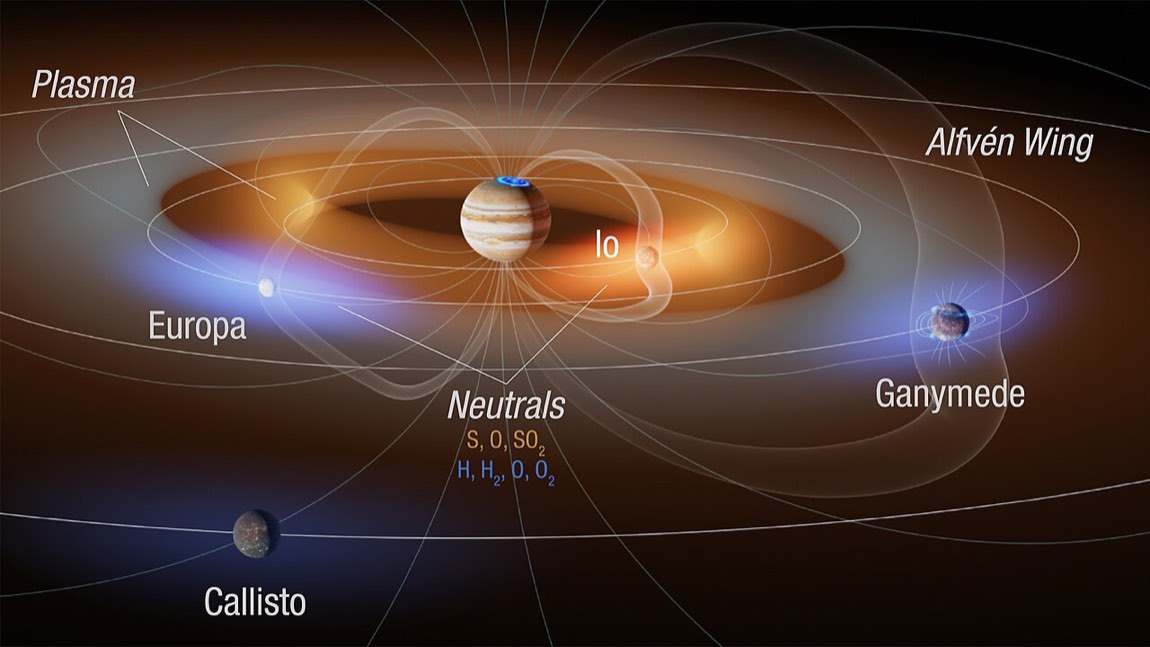
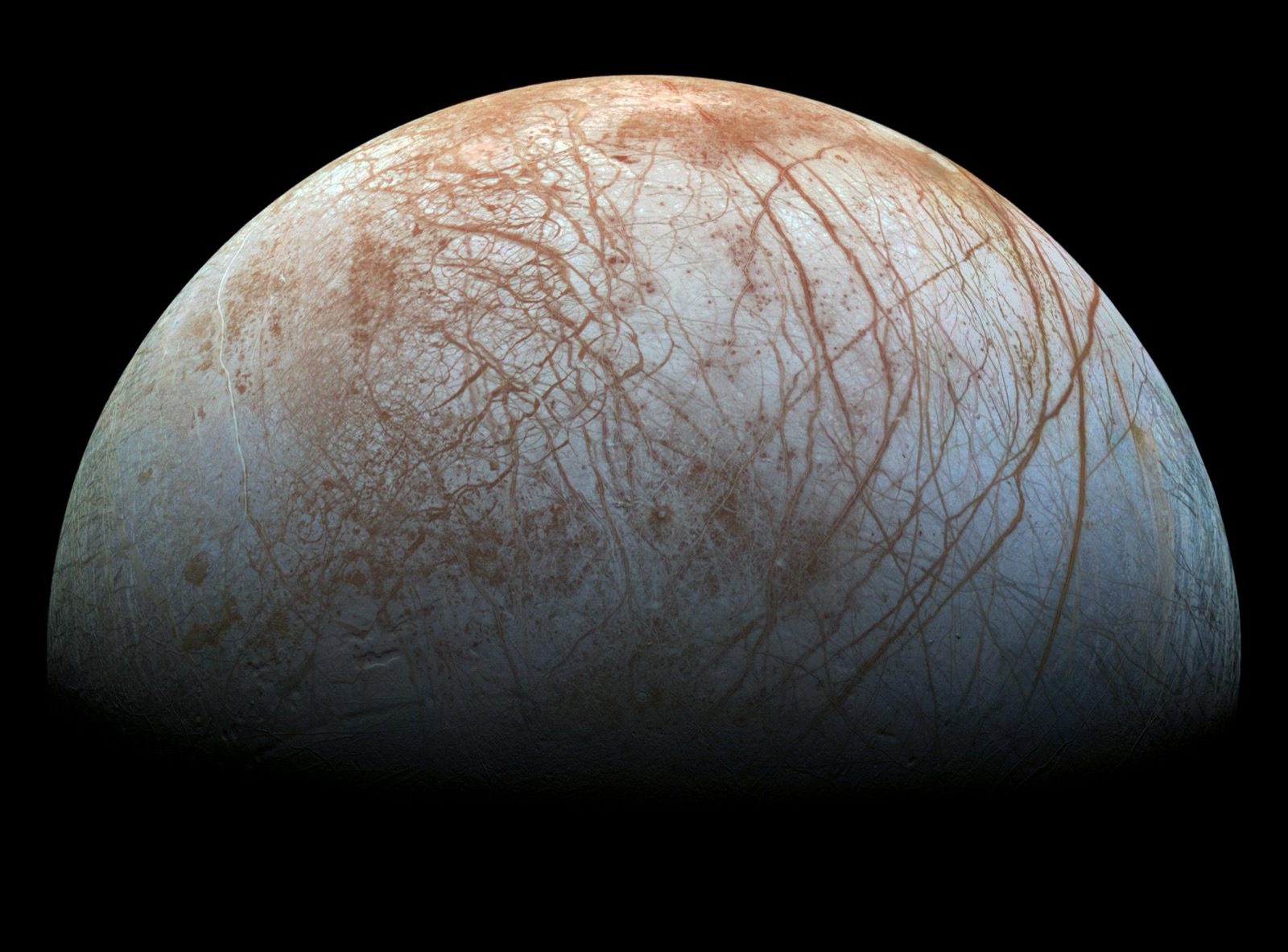
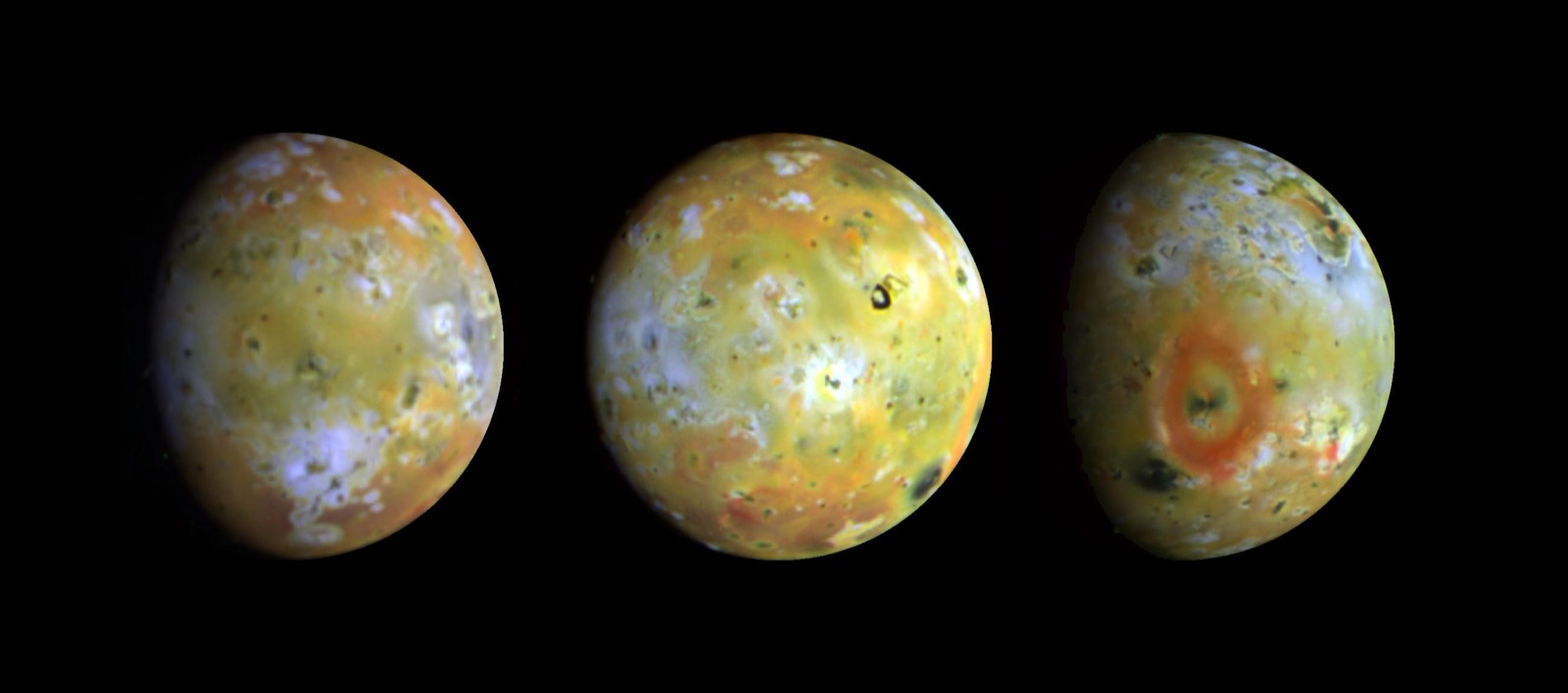
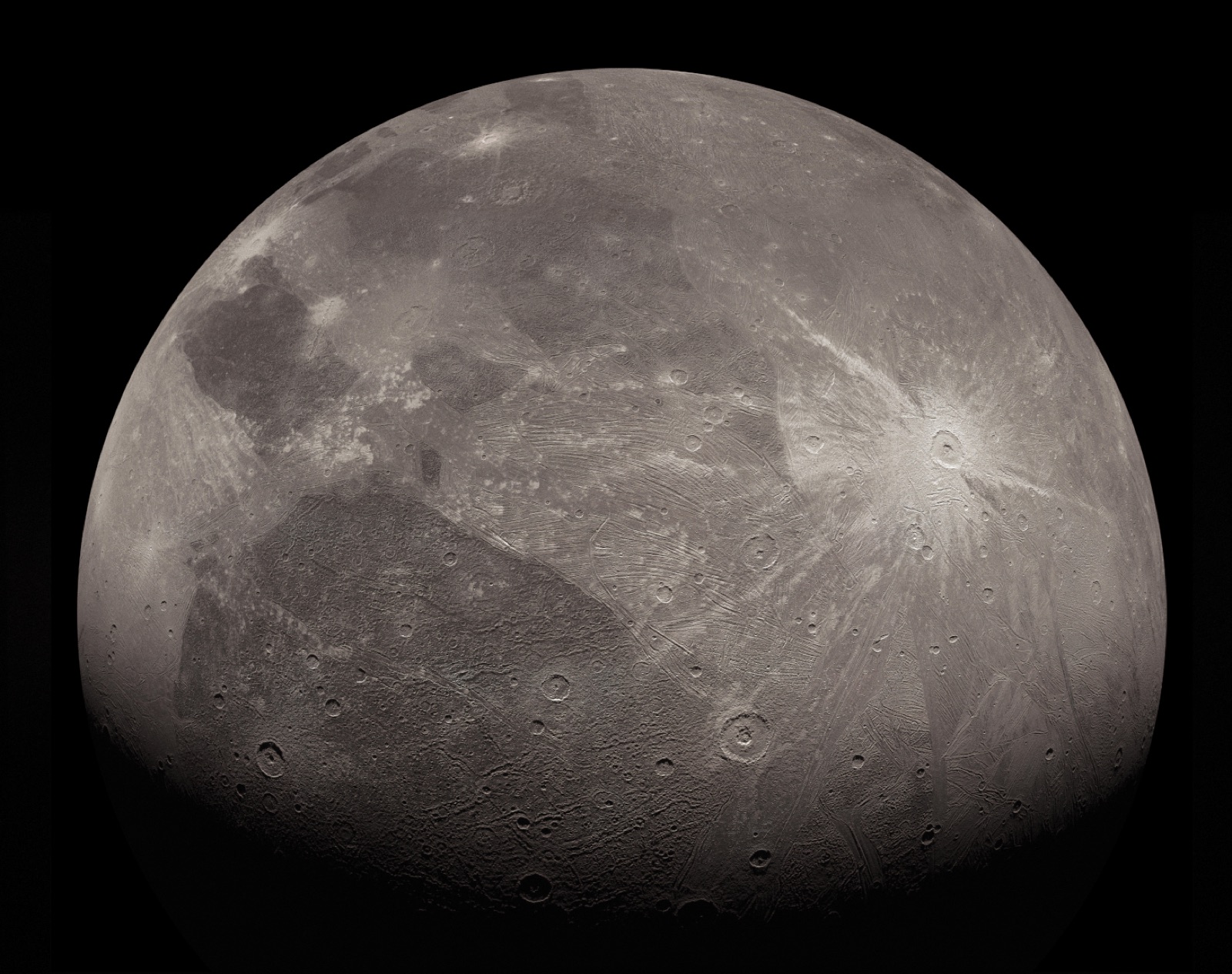
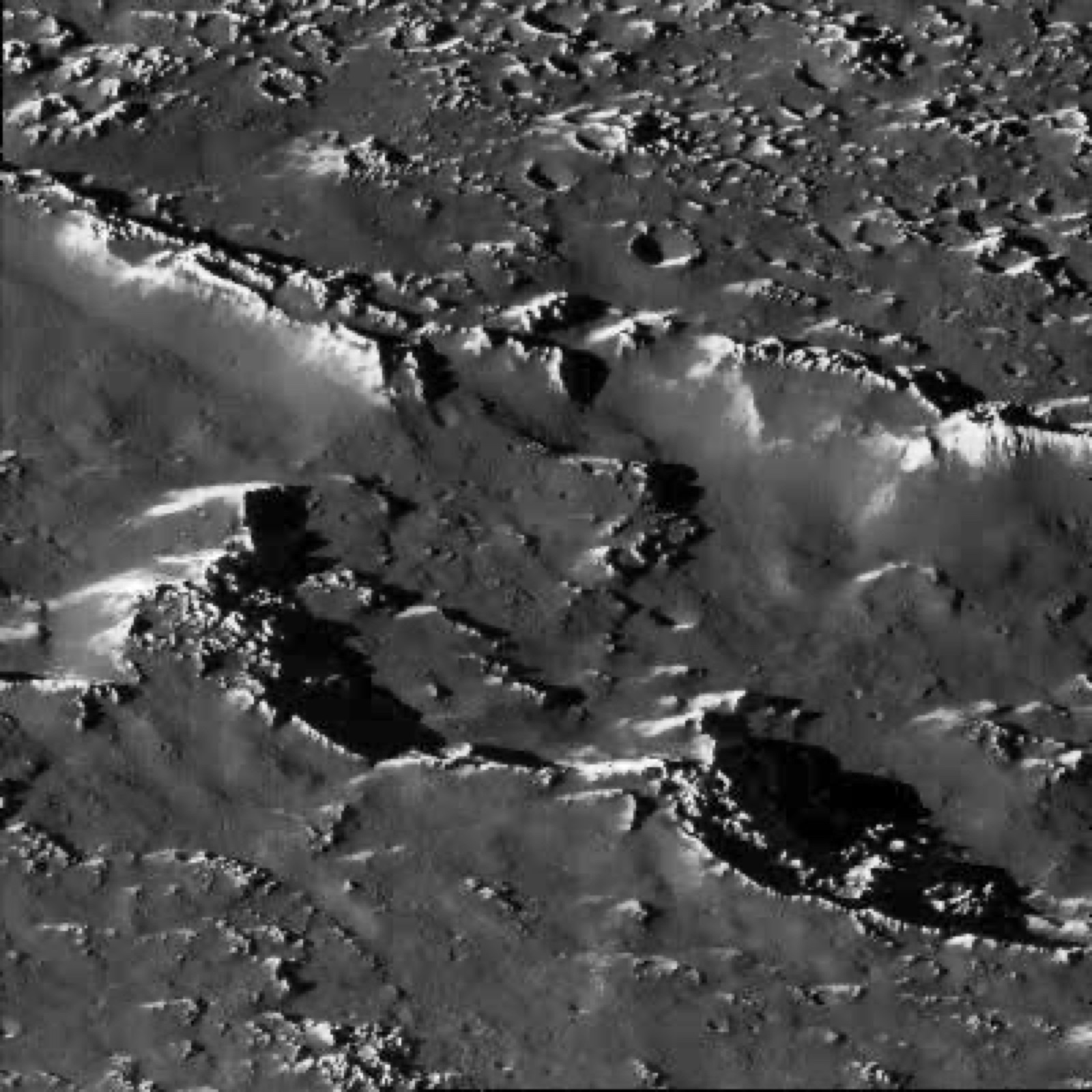
Jupiter's four big moons — Io, Europa, Ganymede, and Callisto — were discovered by Galileo in 1610 and helped prove that not everything orbits Earth. They are worlds in their own right: the most volcanic body in the Solar System, a cracked ice shell over a hidden ocean, the largest moon anywhere, and one of the most cratered. Two ocean-hunting spacecraft — Europa Clipper and ESA's JUICE — are on their way there now, arriving around 2030–31.
03 The Solar System's architect Deeper
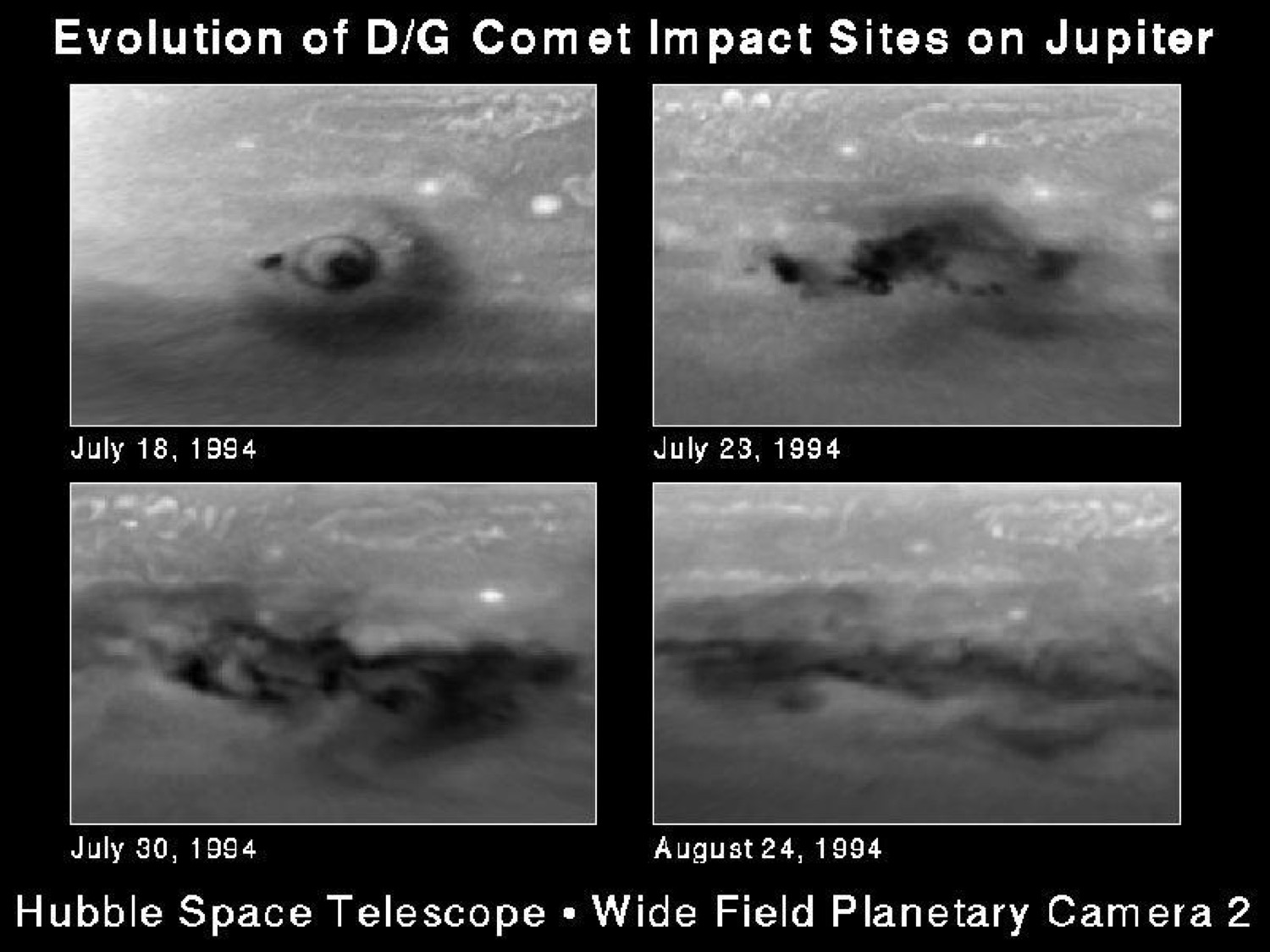
Jupiter's gravity has been the dominant sculptor of everything smaller: it prevented a planet from forming where the asteroid belt is, flings comets both toward and away from the inner planets, and in 1994 pulled comet Shoemaker–Levy 9 apart and swallowed the pieces in the first planetary impact humans ever watched happen.
04 Metallic hydrogen and the monster field Deeper
Below ~90% of Jupiter's radius, pressure turns hydrogen into an electrically conducting liquid metal. Convection in that layer, spun by the 9.9-hour rotation, generates a magnetic field ~20,000 times stronger than Earth's and radiation belts that would deliver a lethal dose to an astronaut in minutes. Io feeds the system a tonne of volcanic material per second, powering auroras larger than Earth.
 ⤢
⤢
The deep dive
Researched for the Atlas from Wikipedia — Jupiter (47,376 characters read) · updated Sep 20, 2026
05 Older than Earth by 50 million years
Jupiter is believed to be the oldest planet in the Solar System, having formed just one million years after the Sun — roughly 50 million years before Earth existed at all. It began as a solid core that grew beyond the so-called snow line, a distance from the young Sun cold enough for water and other volatiles to freeze into solid grains. Once that core exceeded about 50 Earth masses, it carved a visible gap in the surrounding gas disk, and the rest of its enormous bulk accumulated over the next 3 to 4 million years. At formation, Jupiter was hotter and roughly twice its current diameter; it has been slowly contracting ever since, shrinking by about 1 mm per year through a process called the Kelvin–Helmholtz mechanism. The exact starting distance is debated: the grand tack hypothesis puts formation at about 3.5 AU from the Sun, while composition data from Jupiter's trace elements hint at a birthplace beyond the molecular nitrogen snow line, which sits somewhere between 20 and 30 AU — farther out than Uranus orbits today.
06 The grand tack: Jupiter's wild early journey Deeper
The grand tack hypothesis proposes that the young Jupiter did not stay where it formed. As it accumulated mass, its gravitational interaction with the surrounding gas disk and orbital resonances with the forming Saturn pulled it inward, sweeping through the inner Solar System and scattering or destroying several super-Earths that had been growing there. Jupiter's inward march halted when Saturn, migrating inward faster, caught up and locked into a 3:2 mean motion resonance with Jupiter at around 1.5 AU from the Sun — closer than Mars orbits today. That gravitational coupling reversed the direction of both planets' migration, sending them outward to roughly their present positions. The entire episode unfolded over just 3 to 6 million years, with Jupiter's final outward migration taking only several hundred thousand years. Despite its elegance, the hypothesis has critics: the predicted timescales for inner-planet formation do not perfectly match the measured elemental compositions of Earth and its neighbors, and some models argue Jupiter would have become stranded much closer to the Sun had it truly ploughed through the nebula so deeply.
 ⤢
⤢
07 A possible lost fifth gas giant Deeper
Jupiter's turbulent early migration may have had an even more dramatic consequence than rearranging the rocky planets: it could have ejected an entire fifth gas giant from the Solar System. The Jumping-Jupiter scenario describes how Jupiter's gravitational influence, during its orbital wandering, may have disrupted the paths of other large planets sharing the early system. In the most extreme version of this picture, one of those planets received enough of a gravitational kick to escape altogether, leaving behind only the four gas giants we observe today. Separately, the Nice model describes a later episode in which the infall of proto-Kuiper belt objects over the first 600 million years of Solar System history drove Jupiter and Saturn into a 1:2 resonance, pushing Saturn into a higher orbit and triggering a cascade that displaced Uranus and Neptune, depleted the Kuiper belt, and is associated with the Late Heavy Bombardment of the inner Solar System — the intense cratering episode recorded on the Moon.
08 Inside Jupiter: no surface, just gradients
Jupiter has no solid surface to stand on. Instead, descending into the planet is a journey through ever-thickening layers with no sharp boundaries. At the level where atmospheric pressure equals one Earth atmosphere, the temperature is already around 165 K (−108 °C; −163 °F). Deeper still, hydrogen passes through its critical point — beyond 1.3 MPa pressure and 33 K temperature — and enters a supercritical fluid state where liquid and gas are indistinguishable. The cloud layer itself is about 50 km deep, and the entire atmosphere extends roughly 3,000 km before blending into the denser interior. The region where hydrogen transitions from a molecular fluid to a metallic fluid spans pressures of 50 to 400 GPa and temperatures of 5,000 to 8,400 K. At the center, the Juno mission has revealed not a clean rocky core but a diffuse, mixed region extending 30 to 50 percent of the planet's radius, containing heavy elements totaling 7 to 25 times the mass of Earth, possibly stirred by a giant impact with a roughly ten-Earth-mass protoplanet shortly after Jupiter formed.
09 Diamond rain and helium drizzle
Jupiter's interior hosts some of the strangest precipitation imaginable. Deep in the planet, helium atoms become slightly soluble in the surrounding metallic hydrogen and then separate out, forming helium-rich droplets that fall like rain toward the core. Calculations suggest these drops split from the metallic hydrogen at a radius of about 60,000 km from the center — about 11,000 km below the visible cloud tops — and merge back into the surrounding fluid at around 50,000 km radius, roughly 22,000 km beneath the clouds. This process also strips neon out of the upper atmosphere, which is why Jupiter's upper atmosphere contains only about one-tenth as much neon as the Sun. Separately, researchers have proposed that carbon deep in Jupiter's interior could be squeezed into diamonds, which would then fall as solid chunks through the liquid layers below — a phenomenon also proposed for Saturn, Uranus, and Neptune. Neither the diamond rain nor the full helium precipitation cycle has been directly observed, and both remain subjects of active modeling.
 ⤢
⤢
10 Jupiter's storms beyond the Great Red Spot
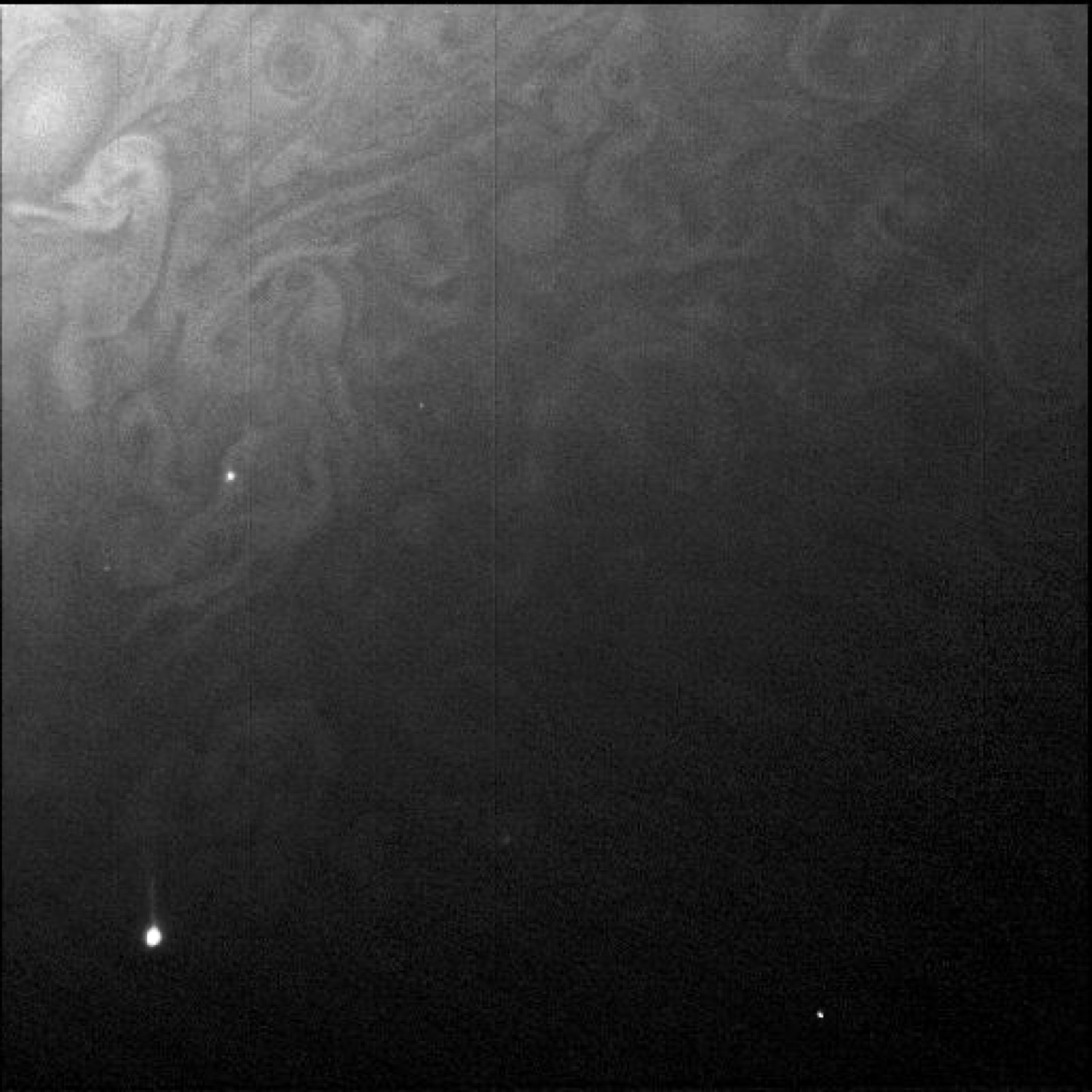
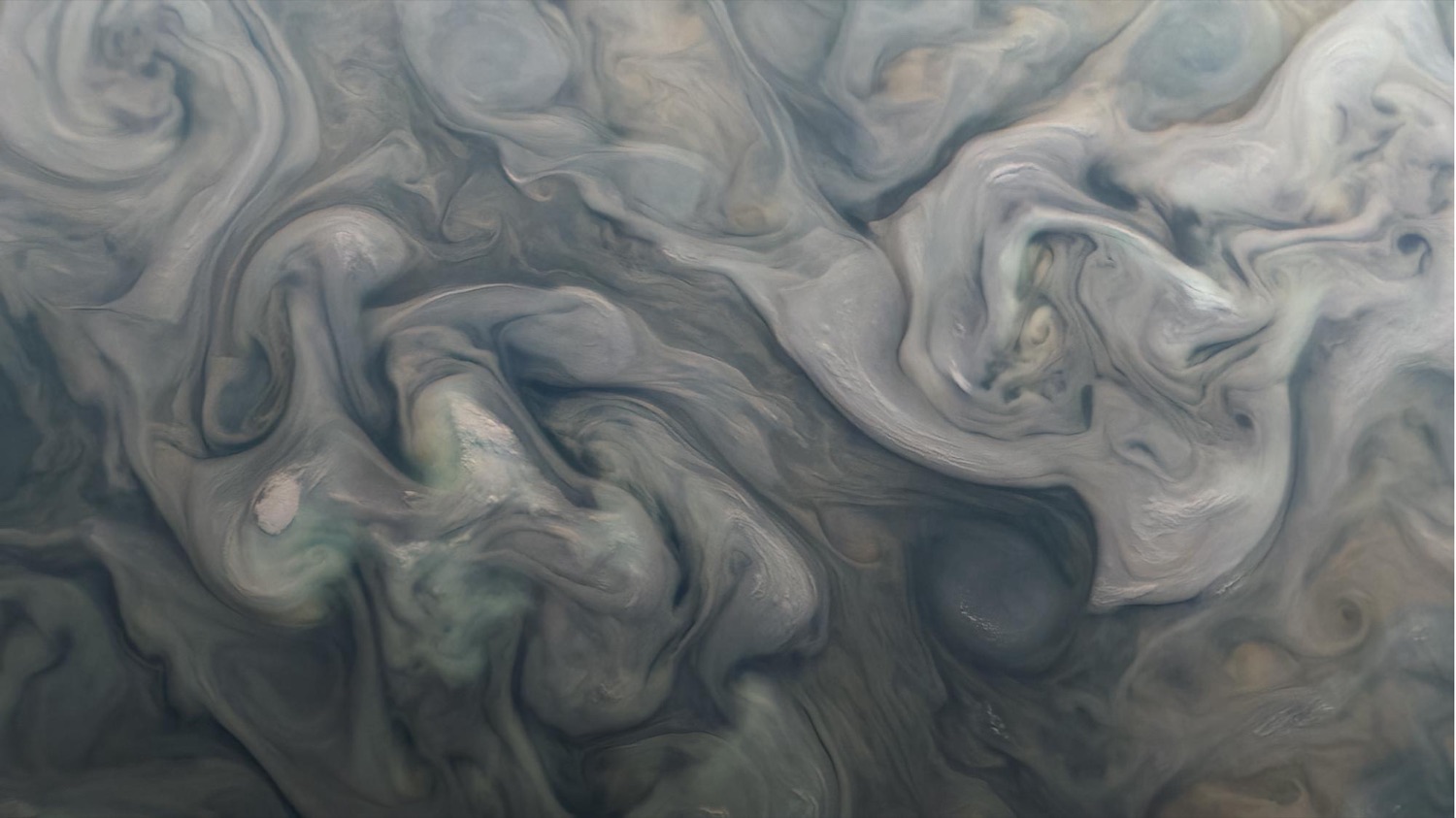
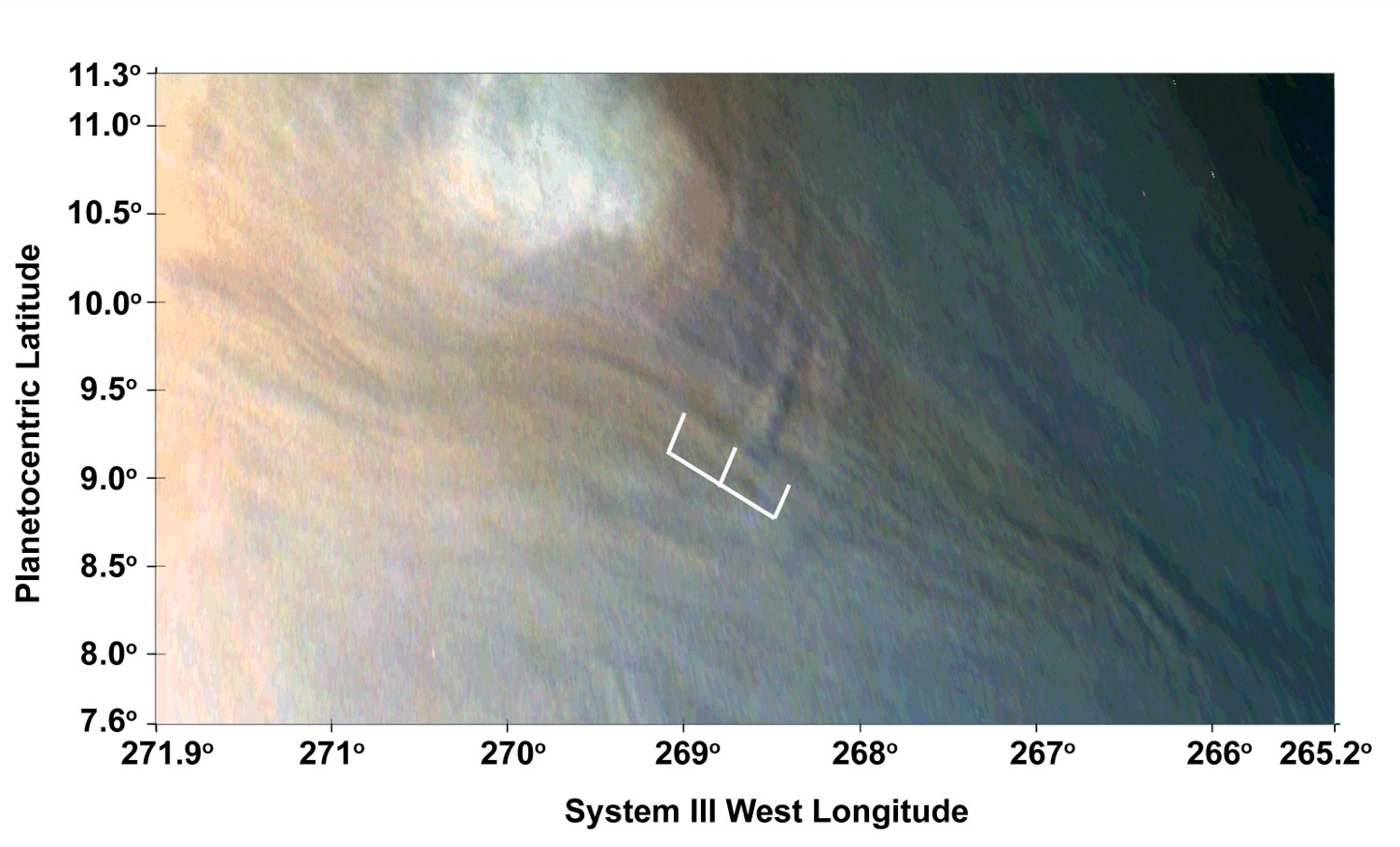
The Great Red Spot dominates Jupiter's image, but the rest of the atmosphere is equally restless. Wind speeds of 100 metres per second (360 km/h) are routine in the zonal jet streams separating the planet's bands. Lightning is common, and individual bolts can be up to a thousand times more powerful than those on Earth. In 2016, the Juno mission discovered a form of "shallow lightning" originating from ammonia-water clouds high in the atmosphere; these discharges carry frozen "mushballs" — water-ammonia slush pellets coated in ice — deep into the planet. Juno also captured blue and pink flashes called "elves" and "sprites" in Jupiter's upper atmosphere, lasting around 1.4 milliseconds. At the poles, Juno found organized clusters of cyclones: nine in the north, with one large vortex surrounded by eight others, and seven in the south, with a central vortex flanked by five large storms and one smaller one. In April 2017, astronomers also identified a "Great Cold Spot" in the thermosphere near the north pole, approximately 24,000 km across and up to 200 °C cooler than its surroundings, maintained by plasma interactions with the magnetic field.
11 Oval BA: the Little Red Spot's origin story
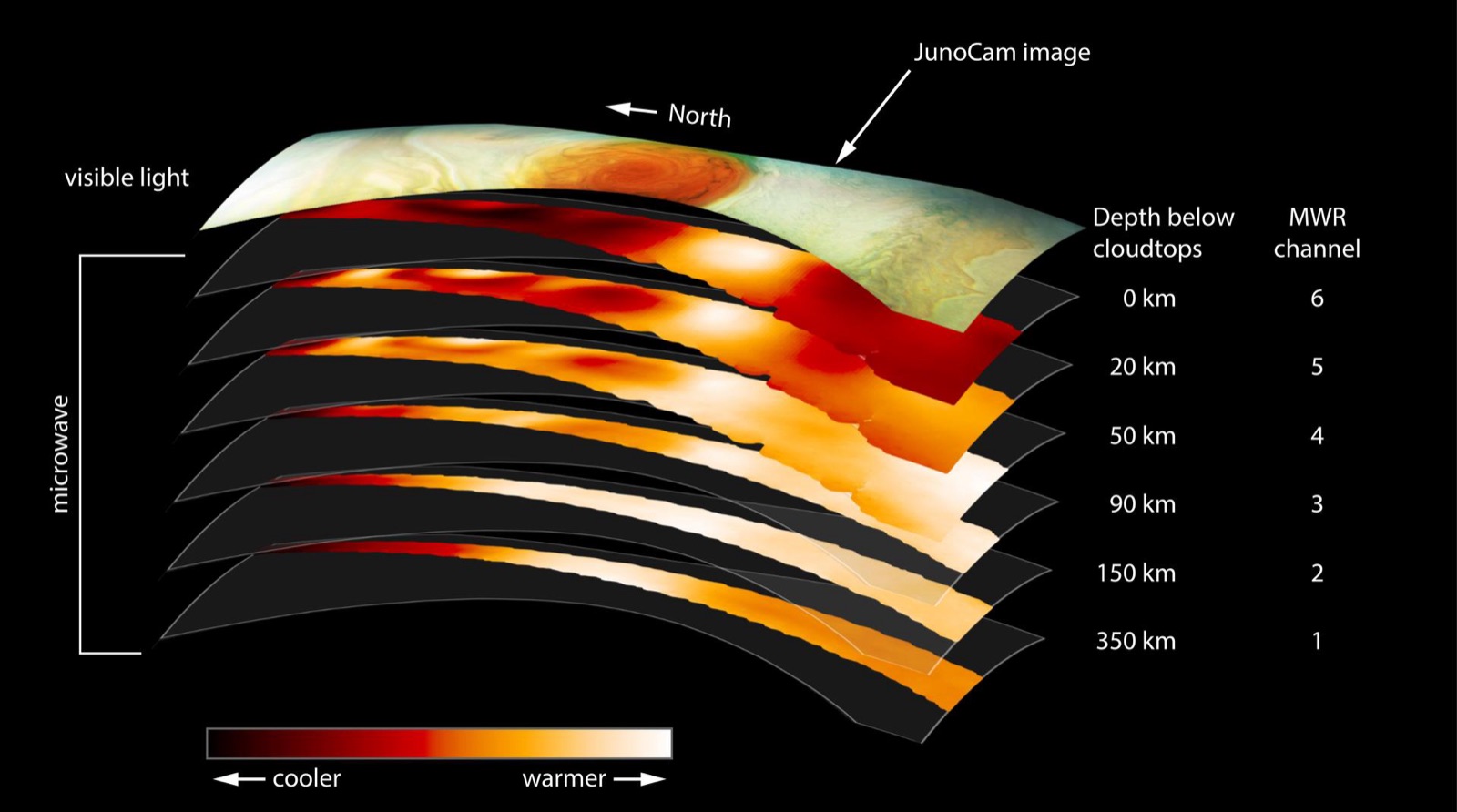
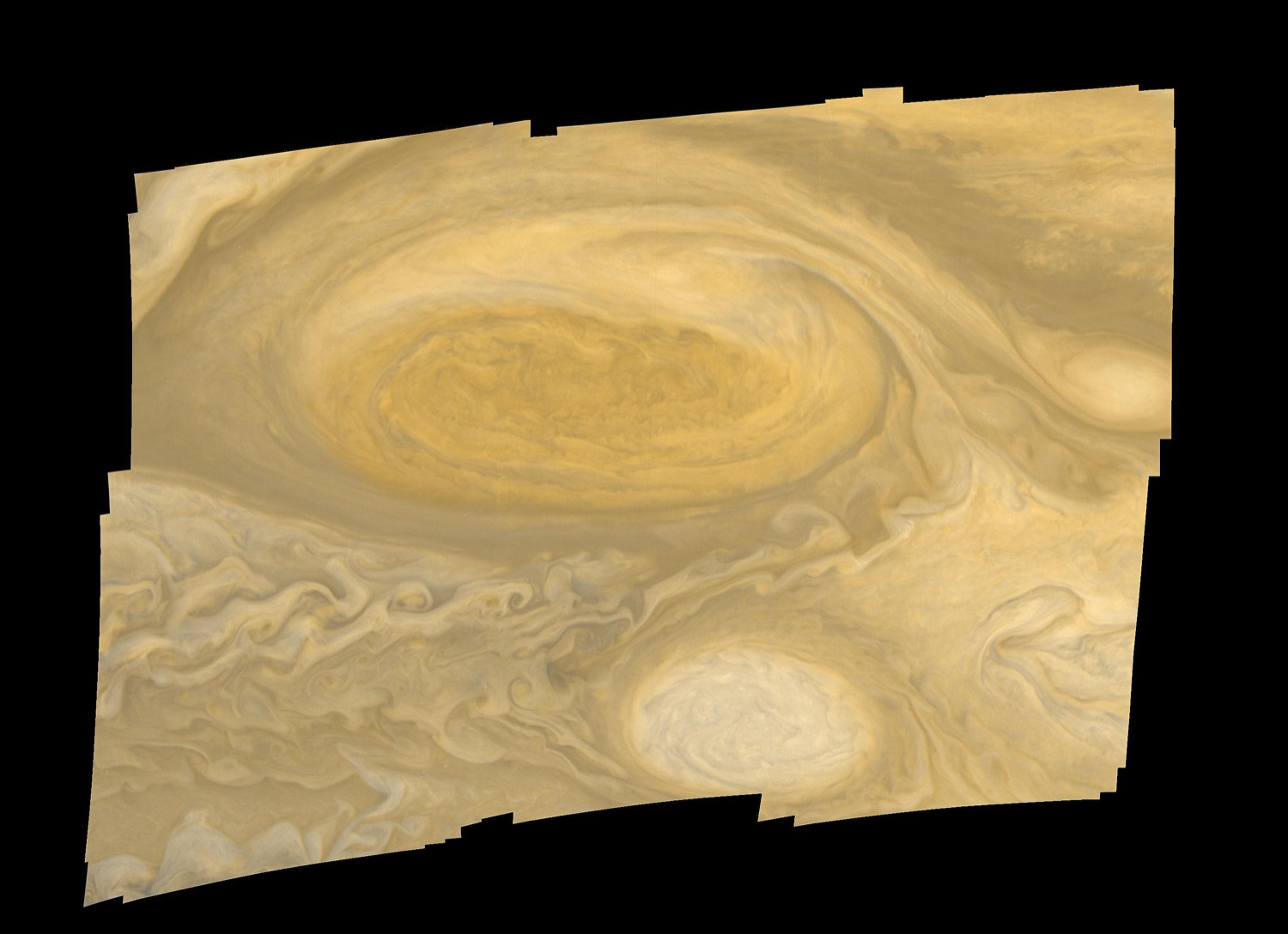
The Great Red Spot is not Jupiter's only long-lived vortex. Three white oval storms were first observed in 1939 to 1940, and for decades they drifted through the southern hemisphere without merging. Two finally combined in 1998, and that merged oval absorbed the third in 2000, producing a single feature called Oval BA. For years it appeared white, but over time it intensified and gradually turned red, earning it the nickname the "Little Red Spot." Meanwhile, the original Great Red Spot has been shrinking steadily: late-19th-century observations measured it at approximately 41,000 km across, but by 2015 it had contracted to about 16,500 by 10,940 km and was still decreasing in length by about 930 km per year. In October 2021, a Juno flyby measured the storm's vertical depth for the first time, placing it at 300 to 500 km — a surprisingly shallow structure for a feature wider than an entire planet. The exact chemistry giving these vortices their red hues remains uncertain, with photodissociated ammonia reacting with acetylene considered a likely explanation.
12 How Jupiter's radio voice was discovered Deeper
In 1955, astronomers Bernard Burke and Kenneth Franklin detected something unexpected: Jupiter was broadcasting bursts of radio waves at 22.2 MHz, frequencies in the decametric range. The timing of these bursts matched the planet's rotation, allowing scientists to pin down Jupiter's rotation rate more precisely than optical observations allowed. Later work identified three distinct types of Jovian radio emission. Decametric bursts come in long forms lasting up to several seconds and short bursts lasting less than a hundredth of a second; they are strongly influenced by the position of Io in its orbit. Decimetric emission, first observed by Frank Drake and Hein Hvatum in 1959, originates from a torus-shaped belt around Jupiter's equator, where electrons accelerated in the magnetic field produce cyclotron radiation. There is also thermal radiation from the heat of the atmosphere itself. The decametric signals are strong enough that, when Earth passes through the cone-shaped beam generated by the cyclotron maser mechanism near Jupiter's poles, the radio emissions from Jupiter can actually exceed the radio output of the Sun — and they are detectable with consumer-grade shortwave radio receivers.
 ⤢
⤢
13 Forty years of robotic visitors
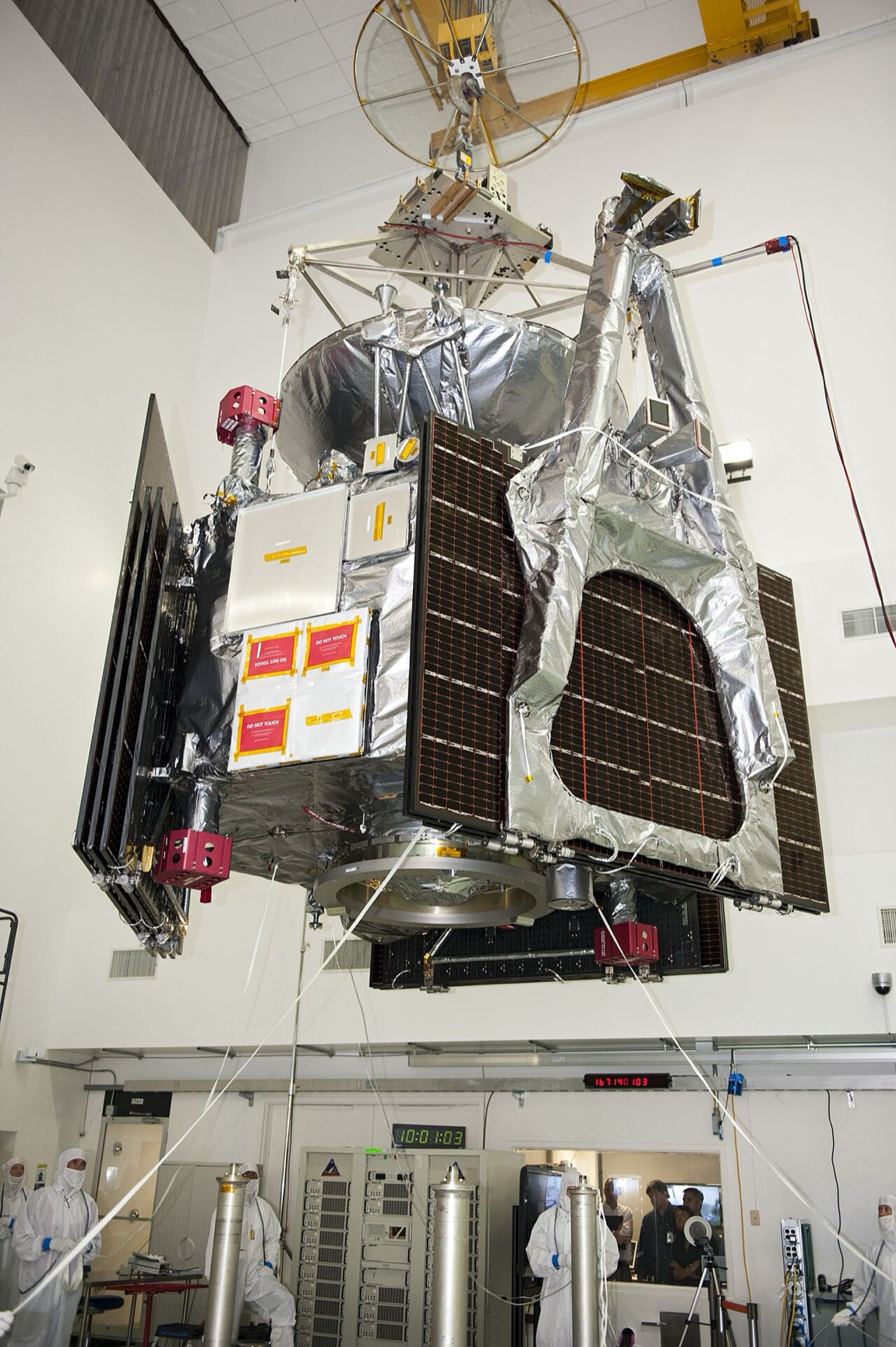
Jupiter has been visited by nine robotic spacecraft since Pioneer 10 flew past in 1973, becoming the first probe to send close-up data on Jupiter's properties. The Pioneer missions revealed that radiation near Jupiter was far stronger than expected. Six years later, the Voyager probes discovered Jupiter's rings, confirmed the Great Red Spot is anticyclonic, and found a torus of ionized material along Io's orbit fed by the moon's volcanoes. In February 1992, the Ulysses solar probe used Jupiter for a gravity assist to reach a polar orbit around the Sun, studying the magnetosphere without cameras. The Cassini probe provided higher-resolution images during a flyby in 2000, while New Horizons studied all four Galilean moons in detail during a 2007 flyby en route to Pluto. The first dedicated orbiter, Galileo, arrived on December 7, 1995, and spent over seven years conducting repeated flybys of the moons. It also released a 340-kilogram atmospheric probe that parachuted 150 km into Jupiter's atmosphere before being destroyed, collecting data for 57.6 minutes. NASA's Juno orbiter arrived on July 4, 2016, and returned the first-ever images of Jupiter's north pole on August 27 of that year.
14 Jupiter's rings: a dusty, dynamic system
Unlike Saturn's brilliant icy rings, Jupiter's ring system is faint and made mostly of dust, which is why it went undetected until the Voyager 1 flyby in 1979. Three main segments make up the system: an inner doughnut-shaped halo, a relatively bright main ring, and an outer gossamer ring. The main ring is fed by material ejected from the small moons Adrastea and Metis, which Jupiter's gravity then draws inward. The gossamer ring's two distinct components are believed to originate from the moons Thebe and Amalthea in a similar way. There may even be a fourth ring consisting of collisional debris strung along Amalthea's orbit. The rings appear reddish in visible and near-infrared light. How old the ring system is remains unknown — it could date back to Jupiter's formation, or it may be a much more recent structure sustained by ongoing moonlet impacts. The entire system is far too faint to see through a small telescope and was only confirmed when Voyager 1's cameras caught its glow backlit by the Sun.
15 Galileo's moons and how they shape each other
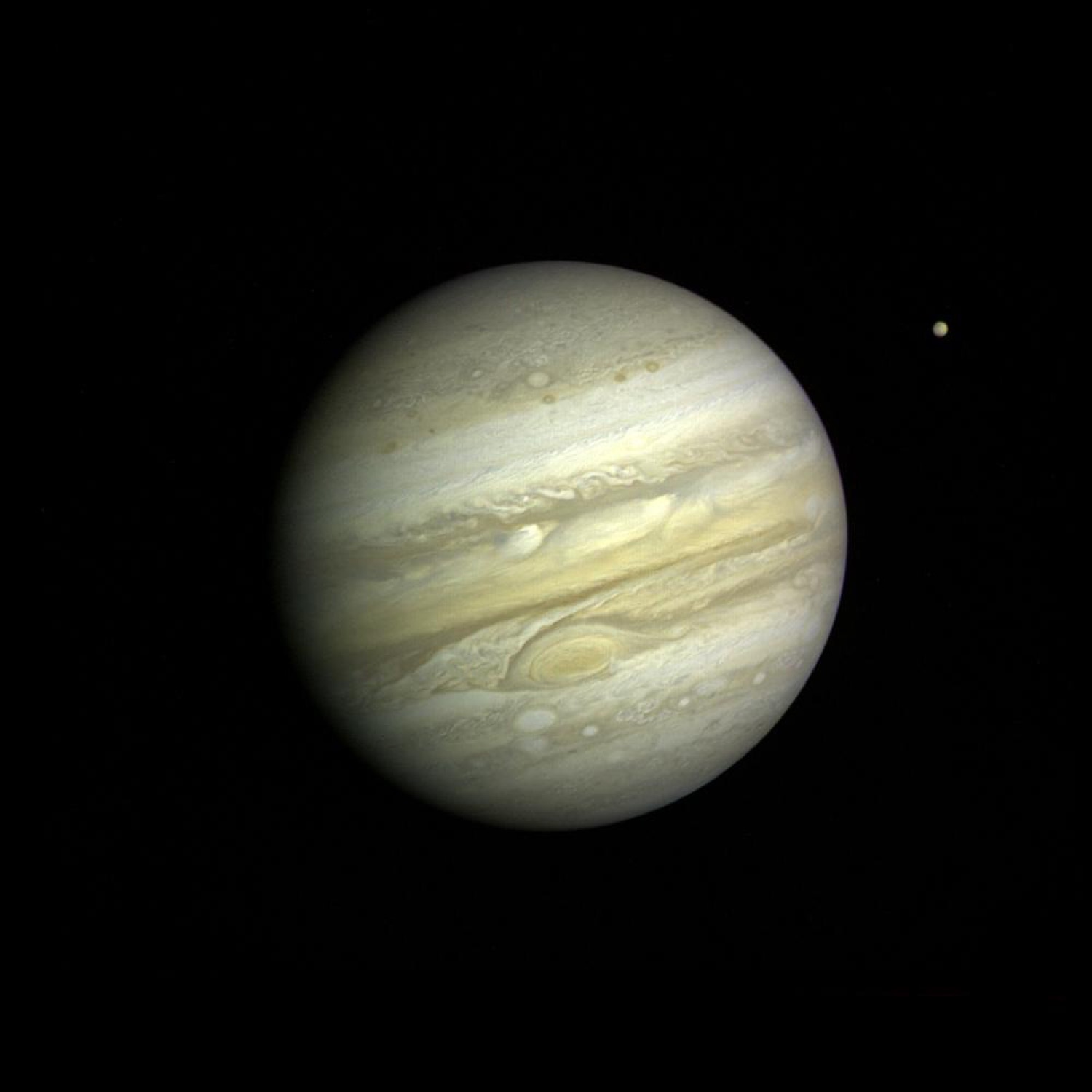
Galileo Galilei discovered the four largest moons of Jupiter in 1610 — the first telescopic discovery of moons other than Earth's. Just one day later, Simon Marius independently found them; though Galileo published first, it is Marius's names that stuck: Io, Europa, Ganymede, and Callisto. The three inner Galilean moons are locked in a Laplace resonance: for every four orbits Io completes, Europa completes exactly two and Ganymede exactly one. This rhythm keeps their orbits slightly elliptical, so each moon is tugged by its neighbors at the same point every circuit. The resulting tidal flexing generates interior heat — spectacularly so for Io, which is the most volcanically active body in the Solar System, and more subtly for Europa, whose young, repeatedly resurfaced ice shell hints at a liquid ocean beneath. Ganymede is the largest moon in the Solar System, bigger than the planet Mercury. Callisto, the outermost of the four, orbits just beyond the innermost edge of the region where the magnetosphere shields the moons from the solar wind.
 ⤢
⤢
16 Observing Jupiter from your backyard
Jupiter is usually the fourth-brightest object in the sky — surpassed only by the Sun, Moon, and Venus — though Mars can briefly outshine it near opposition. Jupiter's visual magnitude ranges from −2.94 at opposition, when it is closest and fully illuminated, to −1.66 when it is near conjunction with the Sun on the far side of its orbit, with a mean apparent magnitude of −2.20. Its angular diameter swings between 50.1 and 30.5 arc seconds depending on its distance from Earth. Because Jupiter orbits outside Earth, it always appears nearly fully lit from our perspective; crescent views of the planet were only obtained by outgoing spacecraft. A good pair of binoculars on a clear night is enough to spot the four Galilean moons as tiny points of light flanking the planet. A telescope with an aperture of just 12 cm is sufficient to see the Great Red Spot when it faces Earth. Near opposition, Jupiter goes into retrograde motion for roughly 121 days, drifting backward across the sky by about 9.9° before resuming its normal eastward path.
17 Jupiter's name across world cultures
Long before the Romans named it after their king of the gods, Jupiter was woven into the astronomy and religion of civilizations worldwide. Babylonian astronomers tracked it from at least the 7th to 8th centuries BC and associated it with Marduk, chief of their pantheon. Their observations of Jupiter's roughly 12-year orbit along the ecliptic formed the foundation of the zodiac. In China, Jupiter was called the "wood star" and also the "year star," because it advances approximately one zodiac constellation per year; this association is so deep that the Chinese word for years of age still derives from the planet's name. The ancient Chinese astronomer Gan De may have observed one of Jupiter's moons with the unaided eye, which, if confirmed, would predate Galileo by nearly two millennia. In Vedic tradition, the planet was named after Brihaspati, teacher of the gods, and called "Guru," meaning teacher. Turkic peoples in Central Asia called it Erendiz and calculated its orbital period as 11 years and 300 days. The word "jovial," used in English to mean happy or merry, comes from medieval astrologers who ascribed cheerful temperaments to those born under Jupiter's influence.
 ⤢
⤢
You would weigh…
Surface gravity 24.79 m/s² vs Earth’s 9.81 m/s². Try every world →
Could life exist here?
Jupiter itself is a hostile place for chemistry as we know it — no surface, violent mixing, and extreme conditions. Speculation about airborne life in its clouds is exactly that: speculation. The genuinely promising targets are its ocean moons, especially Europa.
Our labels: Confirmed · Strong Evidence · Estimated · Hypothesis · Theoretical · Speculative (see Methodology).
Could humans live here?
Not Jupiter itself — there is no surface, and the radiation environment is the worst in the Solar System. Far-future outposts, if any, would use distant moon Callisto, which sits outside the worst radiation.
How would we get there?
Direct transfers take about 5–6 years (Juno: 5 years; Galileo took 6 with flybys). Europa Clipper launched in October 2024 and arrives in 2030. New Horizons used a Jupiter slingshot to reach Pluto — the planet doubles as the Solar System's favorite speed boost.
| Technology | Status | Travel time (one way, straight line) |
|---|---|---|
| Apollo-style spacecraft, about 39,000 km/h | Flown technology | 2 years |
| Ion-propulsion probe, about 90,000 km/h | Flown technology | 360 days |
| Voyager 1, about 61,000 km/h | Flown technology | 530 days |
| Parker Solar Probe, about 690,000 km/h | Flown technology | 47 days |
| Nuclear-thermal rocket, about 120,000 km/h cruise | In development | 273 days |
| Laser light-sail at 20% of light speed | Proposed concept | 3.6 hours |
| Light itself, 299,792 km/s | Physical limit | 43 minutes |
Simplified straight-line times at cruise speed. Real missions fly curved orbital paths and take longer. Full travel calculator →
Weird & wonderful
- Jupiter has the shortest day of any planet despite being the biggest.
- The Great Red Spot has been shrinking for a century — nobody is sure why.
- Jupiter's magnetosphere is the largest structure in the Solar System — if it glowed, it would look bigger than the full Moon in our sky.
- It rains helium deep inside Jupiter — and possibly diamonds in thunderstorm layers (a modeled idea, not observed).
- Jupiter never became a star — it would need about 80 times more mass.
Worlds that orbit Jupiter
Latest news about Jupiter
More real images of Jupiter
Genuine spacecraft and telescope imagery, every frame credited and licensed. Tap any photo to enlarge.