Moon · Deep guide · orbits Jupiter
Elara
Also called: Jupiter VII
Himalia's little sibling, found just a month after it in 1905.
What is it?
Elara is the second-largest member of the Himalia group and one of Jupiter's bigger irregular moons, about 80 km across. Charles Perrine discovered it at Lick Observatory in January 1905, right after announcing Himalia; bad weather delayed confirmation until February. It circles Jupiter in about 259 days on a tilted, prograde orbit. Its grey colour matches C-type asteroids, supporting the idea that the Himalia family is debris from one captured body.
The deep dive
Researched for the Atlas from Wikipedia — Elara (moon) (2,666 characters read) · updated Nov 14, 2026
01 A Century-Old Discovery Made in Two Days
Elara's discovery is almost inseparable from that of its larger neighbor Himalia. Charles Dillon Perrine, working at the Lick Observatory, announced Himalia's discovery on January 5, 1905, and then found Elara the very next day, January 6, 1905. The two detections were essentially back-to-back achievements by the same astronomer at the same telescope. Despite this quick spotting, confirming Elara's existence took considerably longer — poor weather kept astronomers from verifying it until February 21, 1905, a gap of about six weeks. This kind of observational patience was routine in early twentieth-century planetary astronomy, where you could glimpse something extraordinary on a clear night and then be forced to wait through cloud cover before the scientific community would accept it as real. Perrine's double discovery in consecutive days remains one of the more remarkable coincidences in the history of Jovian moon hunting.
02 Seventy Years Without a Proper Name
For most of its known history, Elara had no official name at all. From its discovery in 1905 until 1975 — a span of seventy years — it was catalogued simply as Jupiter VII, a designation that tells you its order of discovery but nothing evocative about what it is. During a twenty-year stretch between 1955 and 1975, some astronomers informally called it "Hera," after the queen of the Greek gods, but that name never stuck officially. When a name was finally assigned in 1975, it reached into Greek mythology for a very different figure: Elara, one of Zeus's lovers and, according to the myth, the mother of the giant Tityos. The choice fits a broader naming convention for Jupiter's irregular moons, whose names are drawn from the many figures connected to Zeus in ancient stories. It is a small reminder that the bureaucratic machinery of astronomical naming can lag decades behind the act of discovery itself.
03 An Orbit That Never Quite Settles Deeper
Elara traces a prograde path around Jupiter at an average distance of 11,703,130 km, completing one orbit in 258.65 days — roughly eight and a half months. Its orbit is noticeably elongated, with an eccentricity of 0.196, meaning its distance from Jupiter swings considerably over the course of each lap. The orbital plane is tilted about 30 degrees to the ecliptic, placing Elara well outside the flat disk where Jupiter's large regular moons travel. Crucially, the article notes that Elara's orbit is continuously changing due to solar and planetary perturbations — gravitational nudges from the Sun and from other planets that slowly reshape the path over time. This dynamical instability is a hallmark of irregular satellites, which occupy loosely bound, far-flung orbits that the giant planet never fully tamed. No mission has observed this drift directly, but it is an expected and mathematically well-characterized consequence of Elara's remote position.
04 The Himalia Group: A Family of Fragments
Elara is not a lone wanderer. It belongs to the Himalia group, a cluster of prograde moons orbiting Jupiter between roughly 11 and 13 million km out, all sharing inclinations between 27 and 30 degrees and eccentricities between 0.11 and 0.24. These shared orbital fingerprints strongly suggest a common origin: astronomers think the Himalia group members are fragments of a single asteroid that was captured by Jupiter long ago and subsequently broken apart, perhaps by a collision. Elara is the second largest survivor of that family, about half the diameter of Himalia itself. The color of all the group members reinforces this shared ancestry — they all appear gray, with spectral properties typical of C-type asteroids, the dark, carbon-rich bodies common in the outer solar system. Elara, in other words, is less an individual world than a piece of ancient shrapnel, still orbiting in company with its siblings.
05 Size, Brightness, and a Very Dark Surface
With a diameter of about 80 kilometers, Elara is roughly the width of the state of Connecticut — large enough to have geological significance but tiny by planetary standards. It is currently ranked the eighth largest moon of Jupiter overall, and it is about 2.6 percent the size of Europa, one of the planet's four great Galilean moons. Despite its modest bulk, what is most striking is how dark Elara is. Its measured albedo is only about 4.6 percent, meaning it reflects less than one twentieth of the sunlight that hits it — darker than a fresh asphalt road. This extremely low reflectivity is consistent with a surface coated in the kind of carbon-rich material associated with C-type asteroids. In practical terms, it makes Elara very difficult to observe from Earth even with large telescopes, and it explains why such a sizable object was not found until the photographic era of the early twentieth century.
06 Surface Roughness and What It Tells Us Deeper
One of the more precise physical measurements made of Elara concerns the texture of its surface rather than its shape or composition. A measured low beam value of 0.79 ± 0.03 has been interpreted as indicating that Elara has considerable surface roughness. This kind of measurement comes from analyzing how the moon's brightness changes as viewing geometry shifts — a smooth surface reflects light differently than a jagged, pitted one. A rough surface is consistent with what you would expect from a captured asteroid fragment that has spent billions of years in the outer solar system, accumulating impact craters and exposed, fractured rock. It is worth noting that this roughness measurement is one of the few direct physical clues we have about Elara's surface environment, since no spacecraft has ever approached close enough to image it in detail.
07 The Stubborn Mystery of Elara's Spin Deeper
Determining how fast Elara rotates has proved surprisingly difficult. In 1987, astronomers attempted to measure its rotation period by tracking periodic changes in brightness as the moon turned, a standard technique for small bodies. The light curve turned out to be nearly flat, with brightness variations too small and too irregular to yield a reliable period. Researchers proposed three possible explanations: Elara's shape might be close to spherical, so it looks roughly the same from all angles as it rotates; its rotation pole might be pointed almost directly at Earth, again limiting the apparent brightness swing; or the rotation period might simply be too long to measure within the observing window available. Earlier studies had reported larger brightness variations, deepening the puzzle. It was not until 2020 that new observations suggested a possible rotation period of 9.596 hours — but the article frames this as a "possible" result, indicating that the question is not yet fully settled.
08 A Captured Interloper, Not a Native Moon
Elara almost certainly did not form in orbit around Jupiter. The leading scientific view, consistent with everything known about the Himalia group, is that Elara originated as a heliocentric asteroid — a body orbiting the Sun independently — that was captured by Jupiter's gravity at some point in the distant past. The mechanism of that capture is not specified in the available evidence, but gravitational capture of small bodies is a recognized process that likely occurred more frequently during the solar system's turbulent early history. Once captured, the original body eventually broke apart, and the surviving pieces, including Elara, settled into their current family of orbits. This origin story distinguishes irregular satellites like Elara sharply from Jupiter's inner regular moons, which condensed from the same disk of material that formed the planet itself. Elara is, in a real sense, a visitor from elsewhere that never left.
09 New Horizons' Fleeting Glimpse in 2007
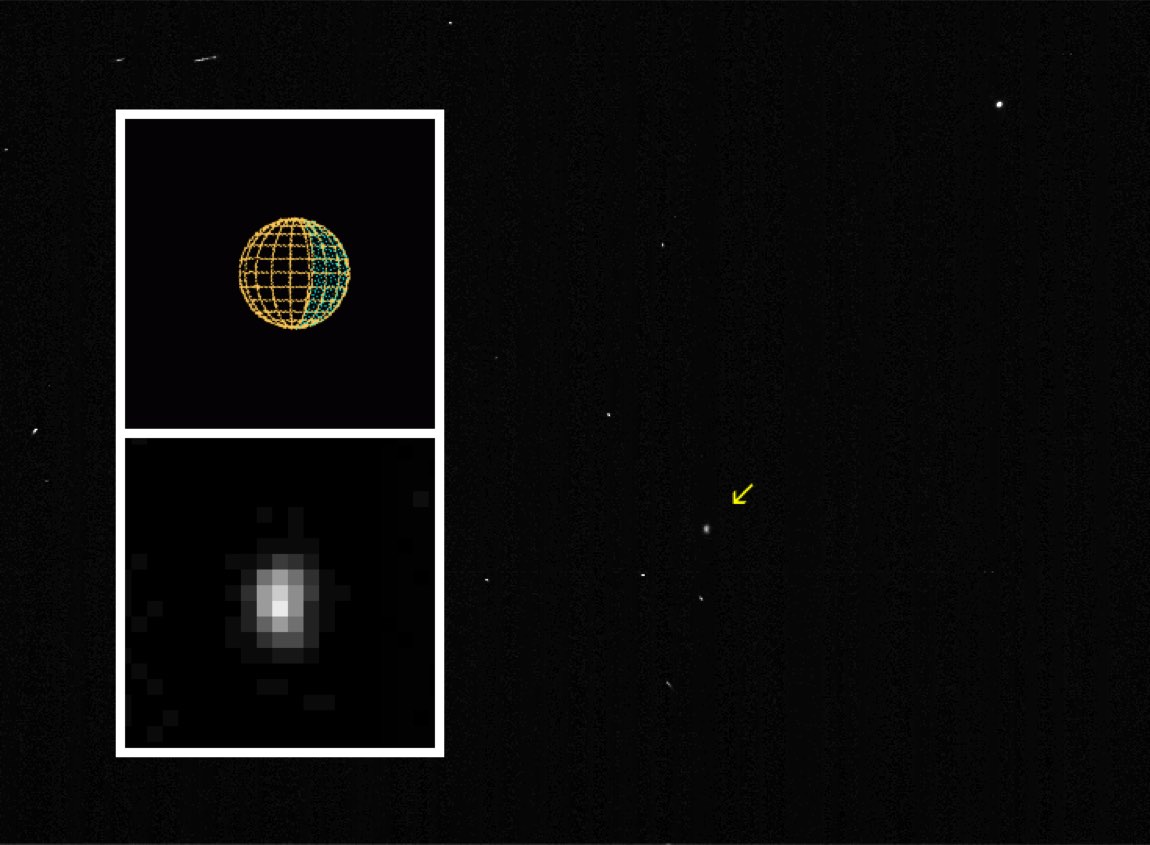
Elara has been visited — or at least photographed at a distance — exactly once by a spacecraft. In February and March of 2007, NASA's New Horizons probe, en route to its primary destination of Pluto, passed through the Jovian system and used its Long Range Reconnaissance Imager, known as LORRI, to capture Elara in several images. At the time, the spacecraft was about 8 million km (5 million miles) away from the moon — a distance that is enormous by human standards but actually relatively close in the context of Jupiter's sprawling irregular moon system. These images represent the best spacecraft observations ever made of Elara, though the distance was still far too great to resolve surface features or refine its shape in meaningful detail. New Horizons was not designed to study Jovian moons, and Elara was essentially a target of opportunity — a fleeting scientific bonus on the way to the outer solar system.
10 How Elara Compares Within Its Own Family
Among the members of the Himalia group, Elara occupies a clear second-place ranking by size. Himalia, the group's namesake and largest member, is roughly twice Elara's diameter, making Elara the runner-up in a family of fragments. All group members share the same gray color indices — B minus V of 0.66 and R minus V of 0.36 for Elara — values that align with C-type asteroid spectra and argue strongly for a common original body. The group as a whole orbits between 11 and 13 million km from Jupiter, a band that is itself distant enough that Jupiter's massive gravity exerts only a modest hold, leaving these moons vulnerable to the ongoing perturbations from the Sun and other planets that continuously reshape their orbits. Within this loosely bound family, Elara stands out mainly for being the second largest surviving piece of whatever ancient asteroid gave rise to them all.
11 Observing Elara from Earth
Elara is a challenging target for amateur and even professional observers. Its 80-kilometer diameter sounds substantial, but at Jupiter's distance and with an albedo of only about 4.6 percent, it is exceedingly faint. It was not discovered until 1905 precisely because photographic techniques capable of capturing such dim, slow-moving specks of light had only recently become practical. Even today, detecting Elara requires a large telescope and careful attention to Jupiter's glare, which overwhelms nearby faint objects. It appears as nothing more than a star-like point of light. Its prograde orbit and membership in the Himalia group mean it moves relatively predictably, which at least aids in planning observations. No surface detail is resolvable from Earth; everything we know about Elara's physical properties comes from photometric measurements — carefully tracking how much total light it reflects as a function of time and viewing angle.
12 Open Questions About a Poorly Known World Deeper
Despite more than a century having passed since its discovery, Elara remains poorly characterized. Its rotation period is listed only as a "possible" 9.596 hours based on 2020 data, with earlier measurements being entirely inconclusive. Its shape is unknown — it may be roughly spherical or it may be irregular, and no image exists with enough resolution to settle the question. The internal structure of a captured C-type asteroid fragment of this size is not well constrained; it could be a solid rocky body or a loosely bound rubble pile. The precise mechanism by which Elara and its Himalia group siblings were captured by Jupiter, and the timing of the collision that fragmented their parent body, remain active areas of theoretical work. No dedicated mission to Elara has ever been flown, and none is currently planned. In many ways, the most honest summary of Elara's status is that it is a world-sized object about which we know surprisingly little.