Moon · Deep guide · orbits Jupiter
Adrastea
Also called: Jupiter XV · S/1979 J 1
The first moon ever found by a spacecraft, a 20-km speck racing along the edge of Jupiter's ring.
What is it?
Adrastea is the smallest of Jupiter's four inner moons, only about 20 km across at its longest. It was found in July 1979 in Voyager 2 photographs, making it the first natural satellite discovered in images from an interplanetary probe rather than a telescope. Like Metis, it circles Jupiter in less than one Jovian day, skimming the outer edge of the main ring. Scientists think it is a major source of the ring's dust, but beyond its size and its tidal lock to Jupiter, little is known about it.
The deep dive
Researched for the Atlas from Wikipedia — Adrastea (moon) (4,778 characters read) · updated Nov 14, 2026
01 The discovery that changed how we find moons
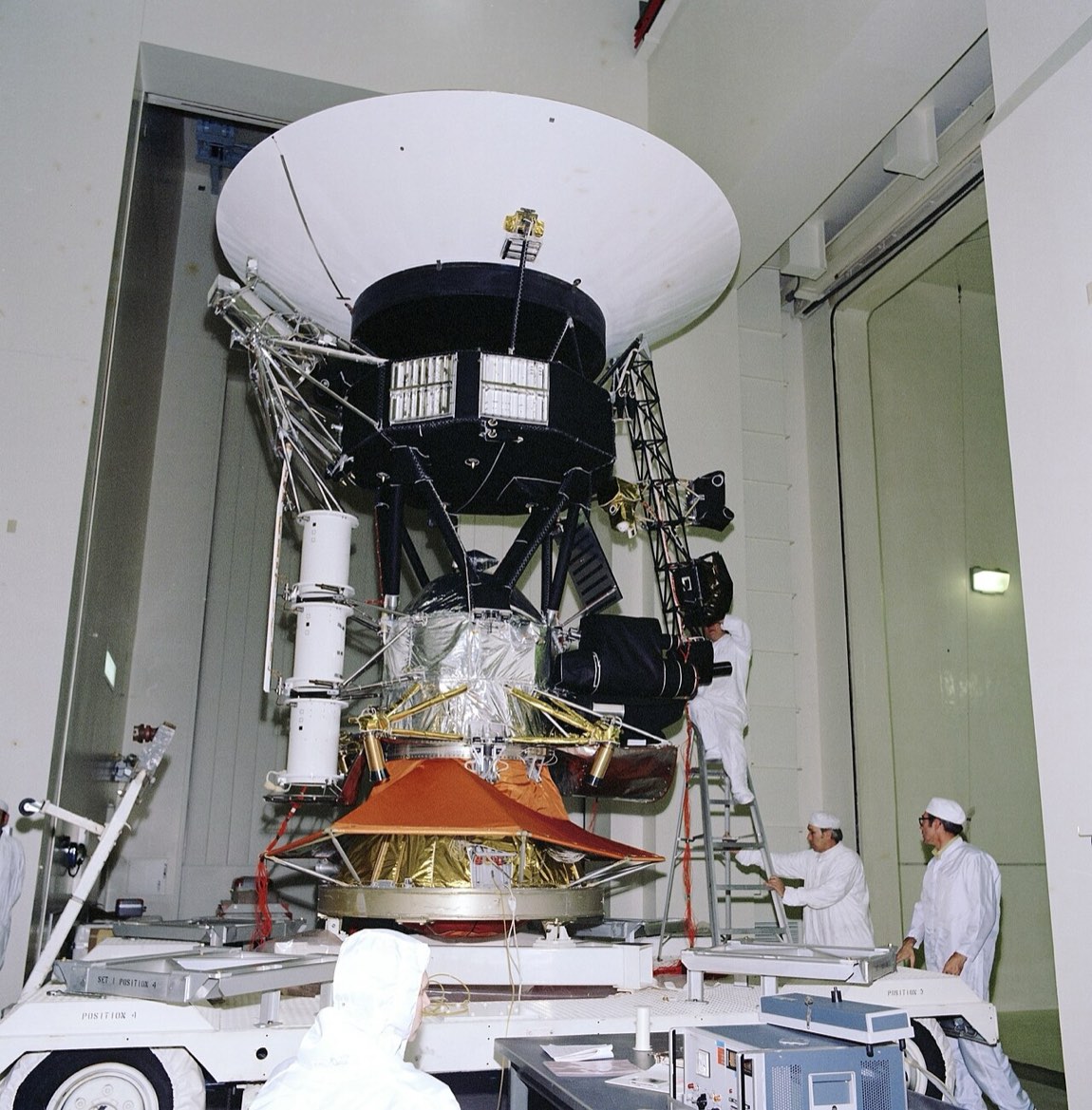
Before Adrastea, every known moon in the Solar System had been spotted through a telescope by an observer on or near Earth. That changed on July 8, 1979, when astronomers David C. Jewitt and G. Edward Danielson noticed a faint dot in photographs beamed back from Voyager 2 as it swept past Jupiter. The object received the placeholder designation S/1979 J 1 and was confirmed as a genuine satellite — the first ever discovered by an interplanetary spacecraft rather than a ground-based telescope. The achievement proved that robotic probes could do serious discovery science, not just relay pretty pictures. Almost immediately afterward, researchers combing through images taken months earlier by Voyager 1 identified two more inner moons, Thebe and Metis, hiding in the archive. Adrastea's discovery thus opened a floodgate: the idea that spacecraft imagery could systematically reveal hidden moons became a standard tool of planetary science, one that has since been applied at virtually every world visited in the outer Solar System.
02 A name from the nursery of Zeus
Four years after its discovery, in 1983, the moon was officially named Adrastea after a figure from Greek mythology: the nymph Adrasteia, daughter of Zeus and his lover Ananke, who served as the foster mother of Zeus himself. The connection to Zeus is deliberate and systematic — Jupiter's moons follow naming conventions tied to the Roman god Jupiter and his Greek counterpart, so naming a Jovian moon after Zeus's own nursemaid carries a certain elegance. The mythological Adrasteia was sometimes associated with inevitability and divine retribution, themes that feel unexpectedly apt for a moon whose orbit is slowly, inexorably decaying toward the planet it circles. The moon is also catalogued by its positional designation Jupiter XV, reflecting that it was the fifteenth Jovian moon to receive an official number. That catalog number and the proper name now coexist in the literature, with Jupiter XV appearing most often in orbital dynamics papers and Adrastea in public-facing astronomy.
03 An irregular little world: size and shape
Adrastea is not a sphere. The Galileo spacecraft determined in 1998 that it is an irregular, lumpy body measuring 20 km by 16 km by 14 km across — roughly the size of a large city, and the smallest of Jupiter's four inner moons. To put that in perspective, you could drive across its longest dimension in about twelve minutes on a highway. Despite Galileo's visit, the images remain poor in resolution, and no surface features have been named or catalogued. What little is known about its reflectivity comes from photometric measurements: its albedo is 0.10 plus or minus 0.045, meaning it reflects only about ten percent of the sunlight that strikes it, making it quite dark — comparable to asphalt. Whether its surface is smooth, cratered, or fractured in some other way remains genuinely unknown. No mission has yet returned imagery sharp enough to answer that question.
04 What Adrastea might be made of Deeper
Because Adrastea is so small and has never been visited by a spacecraft capable of measuring its gravitational pull, its mass and bulk composition are unknown. Scientists work around this by borrowing density data from its larger neighbor Amalthea, whose mean density has been measured at around 0.86 g/cm³ — lower than the density of water ice alone. Applying that figure to Adrastea's known volume yields an estimated mass of about 2×10¹⁵ kg, which is a rough guess at best. Amalthea's surprisingly low density has been interpreted to mean that it is made largely of water ice but is highly porous, with a void fraction of roughly 10 to 15 percent — more rubble pile than solid rock. If Adrastea shares that composition, it too would be a loosely packed, icy aggregate. This porosity hypothesis also has a dramatic orbital implication: if Adrastea's density truly matches Amalthea's, it would place the moon inside Jupiter's fluid Roche limit, the zone where tidal forces should tear a liquid body apart. The fact that Adrastea exists as a coherent object means it must still be outside the rigid Roche limit, held together by the structural strength of solid material rather than self-gravity alone.
05 Racing around Jupiter faster than Jupiter spins
Adrastea moves fast. It orbits Jupiter at about 113,000 km/h (70,200 mph) at a radius of roughly 129,000 km (80,000 mi) from Jupiter's center — equivalent to 1.806 Jupiter radii. That proximity puts it inside Jupiter's synchronous orbit radius, the distance at which an orbiting body would naturally match the planet's rotation rate. Because Adrastea is closer than that threshold, it completes a full orbit in less time than Jupiter takes to rotate once. This makes it one of a small number of moons in the entire Solar System with an orbital period shorter than their planet's day. The orbital geometry is also nearly perfect: eccentricity is only about 0.0015, essentially circular, and the inclination relative to Jupiter's equator is just 0.03 degrees, meaning Adrastea hugs the equatorial plane almost exactly. That tidally locked, nearly circular, nearly equatorial orbit is a signature of a moon that has been gravitationally shaped and smoothed over a very long time.
06 Tidal locking and a slow death spiral Deeper
Because Adrastea orbits inside Jupiter's synchronous radius — as does the nearby moon Metis — the tidal interaction between planet and moon works in reverse compared to our own Moon. Earth's tides are gradually pushing the Moon farther away; Jupiter's tides are gradually pulling Adrastea inward. The moon is assumed to be tidally locked, rotating synchronously so that one face always points toward Jupiter. Its long axis is probably aligned toward the planet as well, since that is the lowest-energy configuration for a tidally distorted body. Over geological timescales, frictional energy dissipation will cause Adrastea's orbit to continue decaying until the moon ultimately impacts Jupiter. When that happens is not stated precisely in current models from the available data, but the direction of travel is not in doubt. This fate — a moon slowly spiraling into its host planet — is a direct consequence of where Adrastea was placed, or migrated to, in Jupiter's inner system.
07 Adrastea as the source of Jupiter's main ring
Jupiter's rings were a surprise discovery of the Voyager missions, and ever since, scientists have wondered what keeps replenishing them. The answer, at least for the main ring, appears to be Adrastea. The moon orbits right at the outer edge of Jupiter's main ring, and the densest part of that ring coincides with Adrastea's orbit — a spatial correlation that is hard to explain as coincidence. The leading model holds that meteorites constantly bombard the surfaces of Jupiter's small inner moons, and the low gravity of those moons means that ejecta blasted off their surfaces is easily lost to space. Because the moons' surfaces sit close to the edge of their Hill spheres — the zones where their own gravity dominates over Jupiter's — impact debris escapes readily and joins the ring system. Adrastea is considered the most prolific source of this material among the four inner moons, effectively bleeding a continuous trickle of dust and particles into the main ring.
08 How ring visibility reveals ring structure Deeper
The apparent boundary of Jupiter's main ring shifts depending on how scientists image it, which reveals something fundamental about the sizes of particles present. When a camera captures ring material in forward-scattered light — sunlight bending around tiny dust grains toward the observer — Adrastea appears clearly outside the main ring's edge. But when the same region is imaged in back-scattered light, which is more sensitive to larger particles, a narrow ringlet appears just outside Adrastea's orbit. This means the ring's physical extent depends on particle size: fine dust occupies a slightly different spatial zone than the larger grains. The duality also supports the picture of Adrastea as an active supplier: freshly ejected material starts as relatively large fragments, then grinds down and spreads, explaining why the distributions of particle sizes are not identical across the ring. Understanding exactly where the ring ends and the moon begins is therefore partly a question of wavelength and scattering geometry, not just distance.
09 Galileo's visit and what it left unresolved
The Galileo spacecraft, which orbited Jupiter from 1995 until it was deliberately plunged into the planet in 2003, made observations of Adrastea in 1998 that were the most detailed ever obtained at that point. Galileo was able to determine the moon's three-dimensional shape — the 20 km by 16 km by 14 km figure that remains the standard reference — but the images are described in the scientific literature as poor in quality. No surface geology, craters, ridges, or other features were resolved. Mass, density, and interior structure remain estimates borrowed from Amalthea rather than direct measurements. Adrastea's albedo of 0.10 plus or minus 0.045 came from photometric observations during this era. After Galileo, no spacecraft specifically targeted Adrastea again for two decades, leaving the moon in a frustrating state: its basic existence and orbit are well characterized, but almost everything about what it is physically made of and what its surface looks like remains unknown.
10 Juno's planned flybys and future prospects
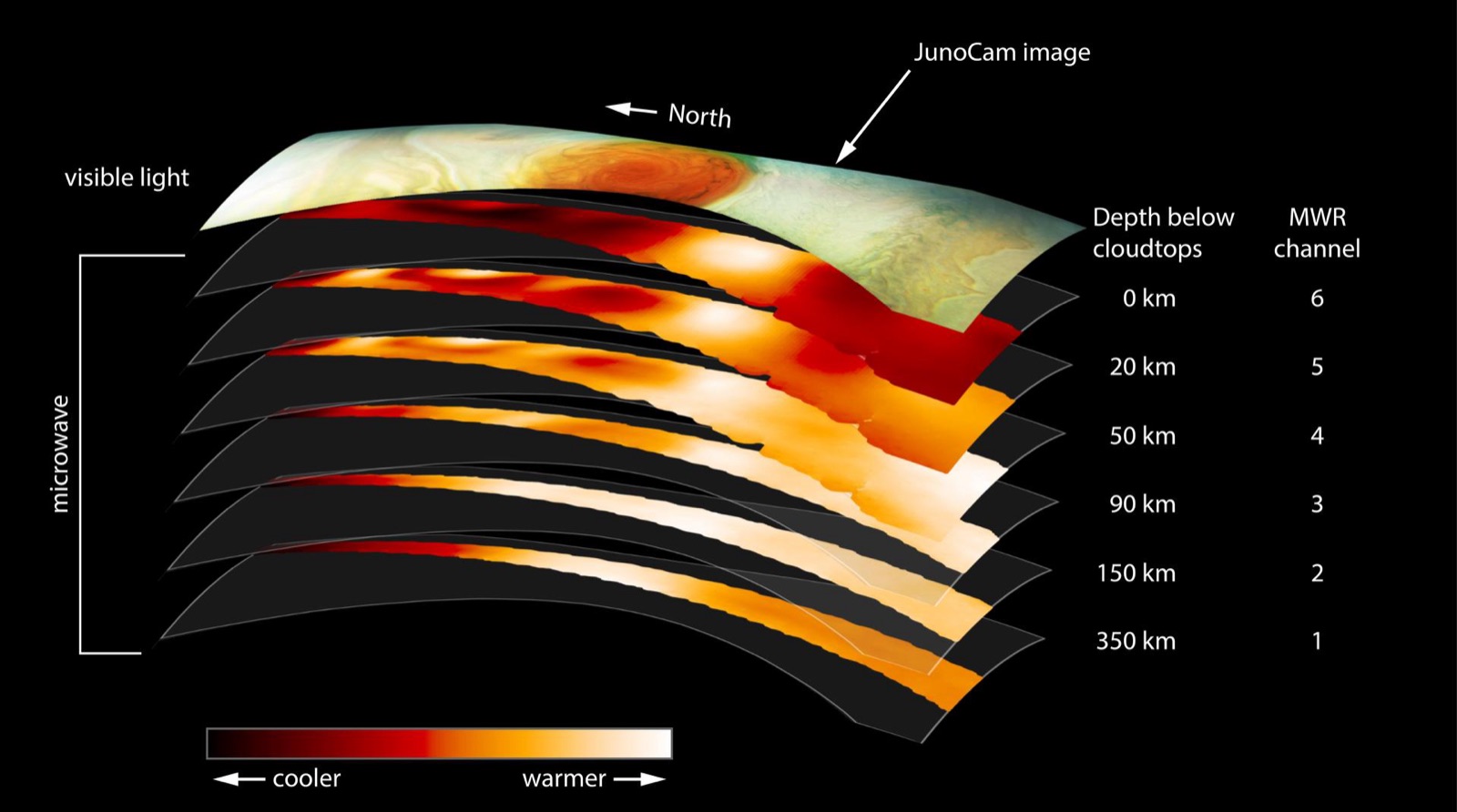
The Juno spacecraft arrived at Jupiter in 2016 and carries a wide-angle camera called JunoCam that is focused almost entirely on the planet itself. Nevertheless, mission planners identified opportunities for the probe to capture images of three inner moons, including Adrastea. A close flyby of Adrastea was planned for June 3, 2026, on Juno's 84th perijove passage — the moment when the spacecraft swings nearest to Jupiter. Sources differ on exactly how close: one account places the approach within 11,747 km of the moon, while another estimates roughly 40,000 km. A second, potentially even closer flyby within about 10,200 km was suggested for August 7, 2026, on Juno's 86th perijove. If successful, these encounters could yield the sharpest images of Adrastea ever taken, though whether they will resolve surface detail or simply confirm its shape from a new angle depends heavily on the actual distances achieved and camera pointing.
11 Adrastea among the inner moon family Deeper
Adrastea belongs to the inner Jovian satellite group along with Metis, Amalthea, and Thebe — four small, dark, irregularly shaped bodies that occupy the region between Jupiter's cloud tops and the orbit of Io. Among these four, Adrastea is the smallest and, at 129,000 km from Jupiter's center, the second-closest to the planet after Metis. The inner moons are thought to be related to the ring system in a way the larger Galilean moons are not: rather than being captured objects or bodies that formed far from Jupiter and migrated inward, the inner moons are almost certainly indigenous to the inner system, their existence intertwined with ring formation and replenishment. The fact that both Adrastea and Metis orbit inside the synchronous radius, while Amalthea and Thebe orbit outside it, marks a dynamical dividing line within the group. It also means that Adrastea and Metis are fated to spiral inward, while Amalthea and Thebe are not subject to the same inward tidal drag.
12 Open questions that keep researchers busy Deeper
Despite more than four decades since its discovery, Adrastea remains poorly understood in several fundamental ways. The moon's mass has never been measured directly, so its density, porosity, and internal structure are all inferences drawn from Amalthea's properties rather than from Adrastea itself. Whether the two moons actually share a composition is an assumption, not a confirmed fact. The albedo measurement carries an uncertainty of plus or minus 0.045 — nearly half the value itself — reflecting how difficult it is to photometrically characterize such a small, distant target. No surface feature has ever been resolved, so the geological history of the moon — how many impacts it has absorbed, whether it has any internal layering, how it has changed over time — is entirely open. The precise rate of orbital decay caused by Jovian tides is also unconstrained by observation. Each of these gaps is a potential scientific payoff for any future mission that can get a spacecraft close enough to Adrastea to do real measurements.