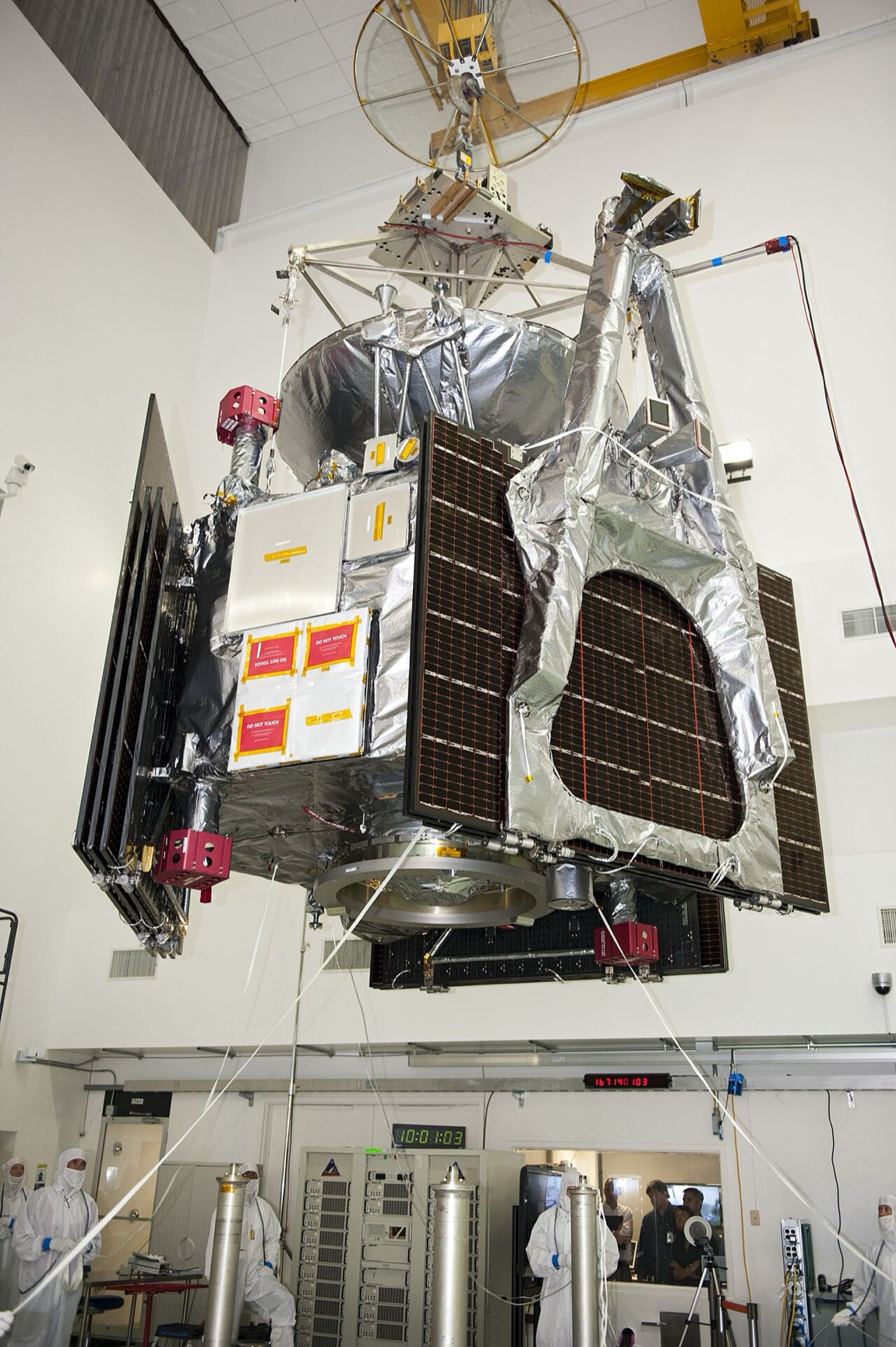
 Photograph · Kim Shiflett · Public domain
Spacecraft · Deep guide
Juno
A solar-powered orbiter that saw beneath the clouds, Juno is Jupiter's storm-chaser.
What is it?
Juno has orbited Jupiter since July 2016, skimming just thousands of kilometers over the cloud tops on long looping orbits that thread the gaps in the planet's lethal radiation belts. It mapped Jupiter's gravity and magnetic field, revealed its 'fuzzy' core and polar cyclone clusters, and — in its extended mission — flew close past Ganymede, Europa, and Io.
Go deeper
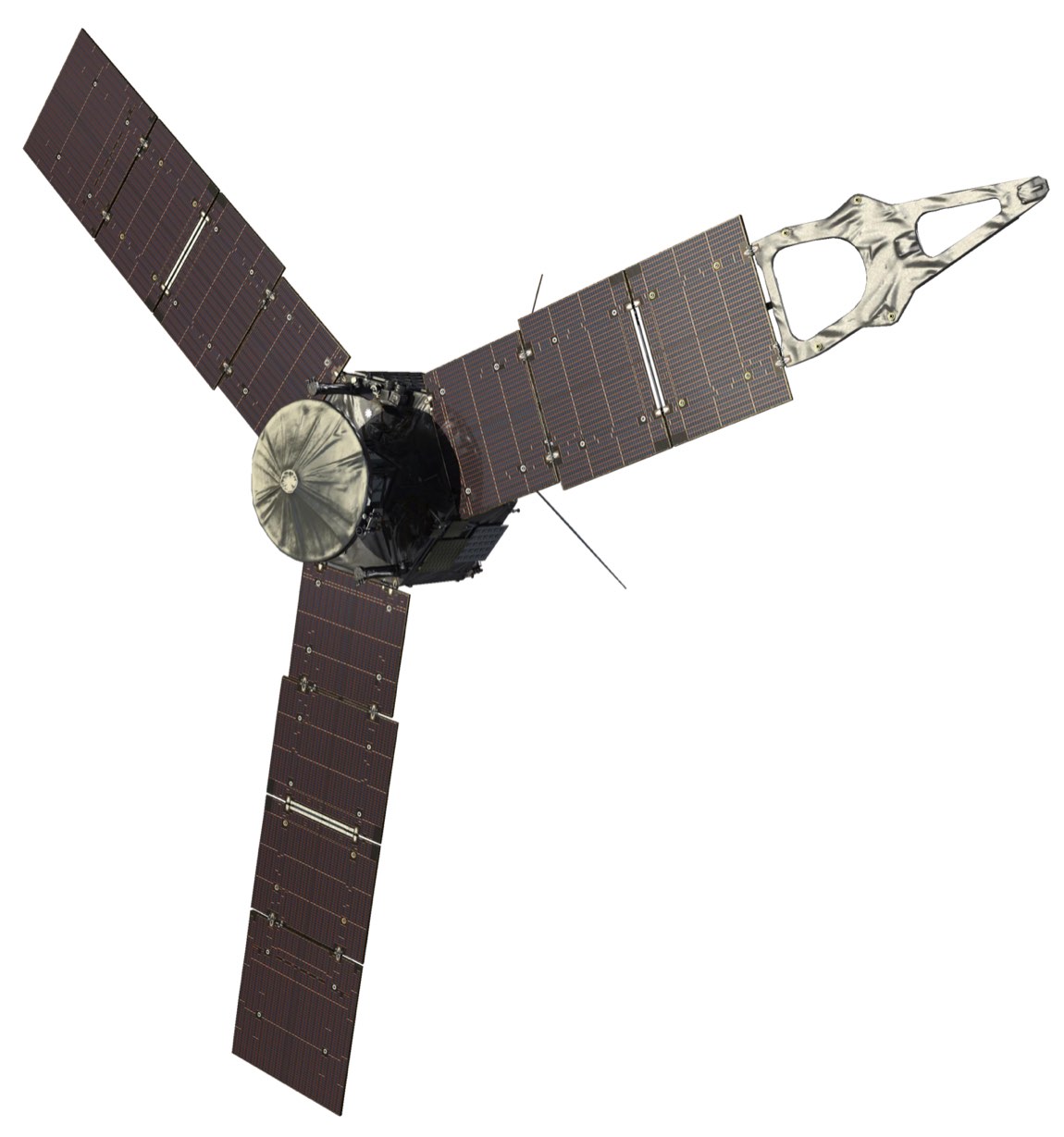
Juno is the farthest solar-powered spacecraft ever flown (three 9-m panels making ~500 W at Jupiter). Its microwave radiometer sees hundreds of km below the clouds (ammonia weather, 'mushballs'); gravity science revealed a dilute core hinting at a giant early impact or slow accretion; JunoCam ran as a public-processing citizen-science project. The extended mission ended per plan in September 2025 — its Io flybys (2023–24, within 1,500 km) delivered the volcano close-ups that capped the mission; see News for any post-2025 disposition updates.
01 Surviving the belts Deeper
Jupiter's radiation would kill ordinary electronics in days. Juno's answer: a 172-kg titanium vault, plus orbits shaped like petals — diving pole-to-pole through the thin belt gaps, gathering data fast, and retreating to safer distance. Even so, each pass degrades its camera slightly; JunoCam's survival years past its design life was a gift.
The deep dive
Researched for the Atlas from Wikipedia — Juno (spacecraft) (31,288 characters read) · updated Sep 20, 2026
02 A mythological name with a reason
The spacecraft's name is not an acronym, despite a NASA compilation once listing "Jupiter Near-polar Orbiter" as a backronym. The project team has consistently insisted the name belongs to mythology, not wordplay. In Roman myth, Jupiter wrapped himself in a veil of clouds to hide his mischief, and only his wife Juno could pierce that veil and see his true nature. That story maps neatly onto the mission's purpose: using instruments that penetrate Jupiter's thick atmosphere to reveal what lies beneath the visible cloud deck. The spacecraft carries the metaphor further — it literally rides aboard three Lego aluminum minifigures representing Juno herself (holding a magnifying glass), Jupiter (holding a lightning bolt), and Galileo Galilei (carrying his telescope). Those figures were cast from aluminum rather than the usual plastic so they could survive the harsh conditions of deep space, part of a NASA–Lego partnership aimed at inspiring children's interest in STEM subjects.
03 How Juno hitched a ride from Earth
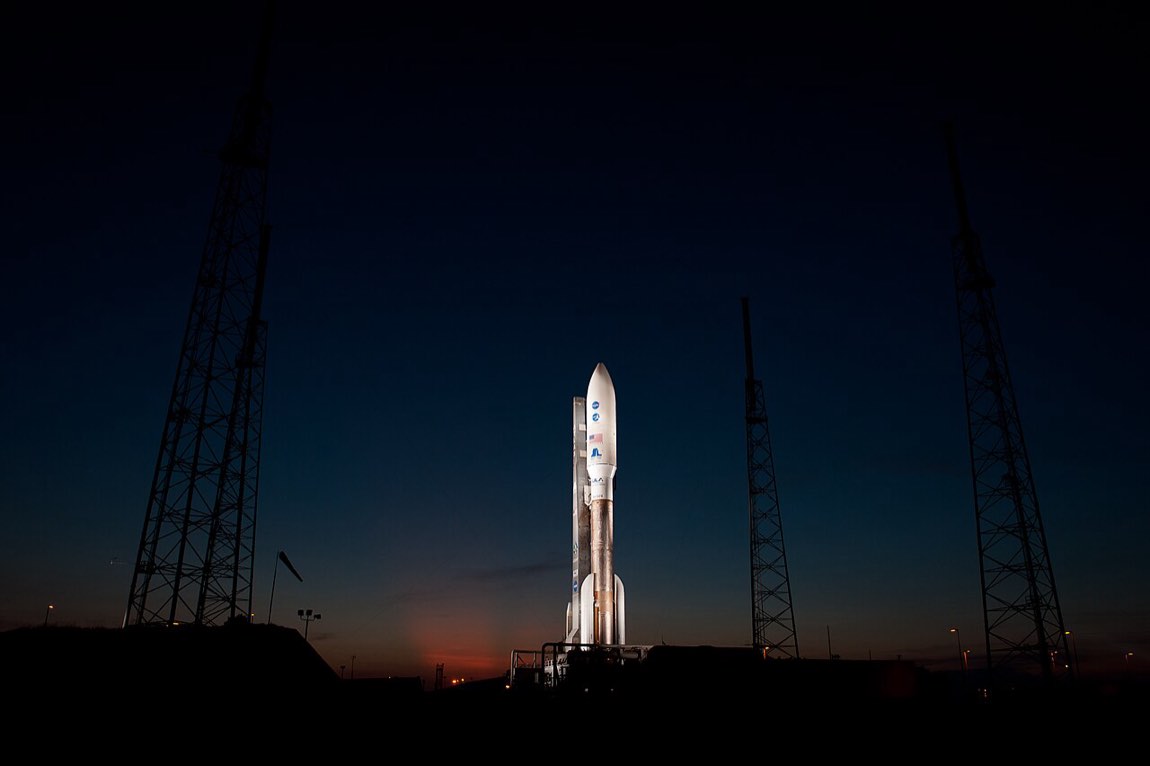
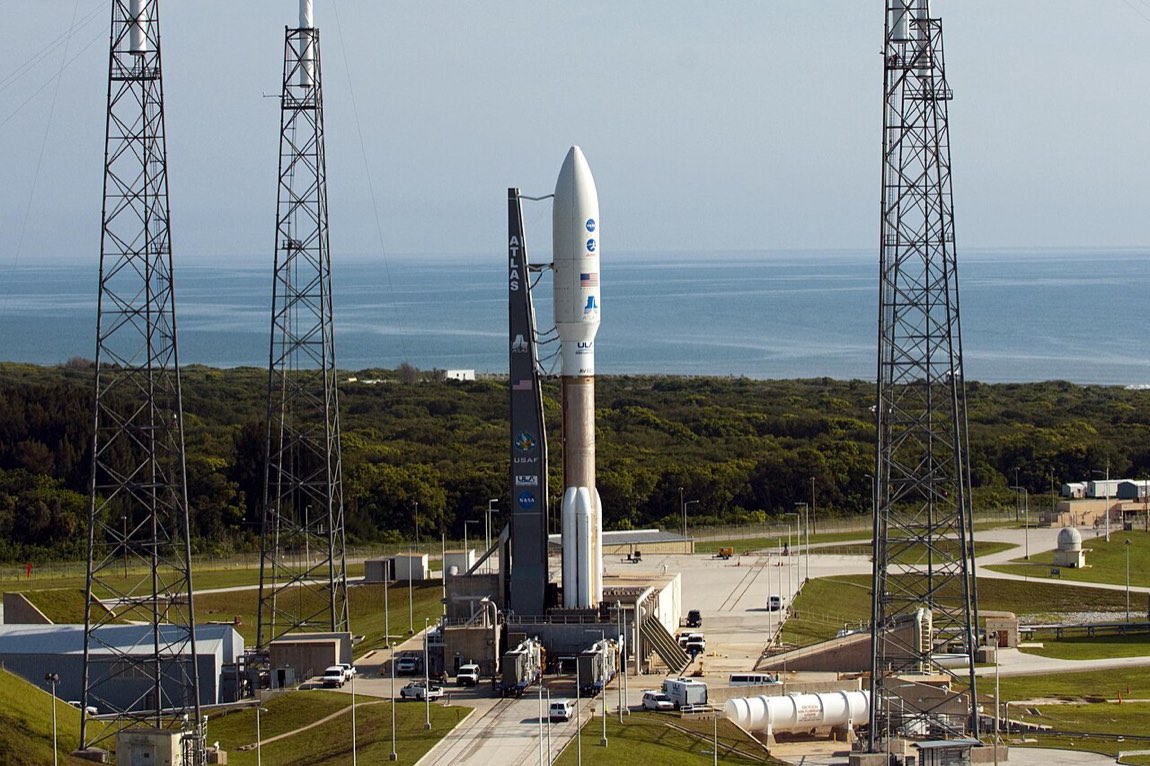
Getting a large spacecraft to Jupiter takes more than raw thrust. Juno launched atop an Atlas V in its most powerful 551 configuration on August 5, 2011, propelled by a Russian-built RD-180 main engine burning kerosene and liquid oxygen, plus five solid rocket boosters that fell away about 93 seconds into flight. After two upper-stage burns, the spacecraft entered a heliocentric orbit and coasted for roughly a year. It then fired its engine twice near aphelion — out beyond the orbit of Mars — in two deep space maneuvers in August and September 2012, reshaping its orbit so it would loop back past Earth. That Earth flyby on October 9, 2013, delivered a gravity assist that boosted Juno's speed by more than 3.9 km/s (about 8,700 mph), slingshotting it toward Jupiter. The science team also used the flyby as a dress rehearsal, testing instruments and practicing procedures before the real encounter. The total journey covered roughly 2.8 billion kilometres — about 19 astronomical units.
04 The engine problem that changed everything Deeper
Juno's original mission plan called for a tidy sequence: three wide 53-day orbits, then a Period Reduction Maneuver burn on December 11, 2016 to drop into a 14-day science orbit for 37 laps around Jupiter before a deliberate plunge into the atmosphere in February 2018. None of that happened on schedule. In October 2016, telemetry revealed that helium valves in Juno's main engine were not opening properly — the same valves that are critical during major burns. Mission managers judged that firing the engine in that condition risked putting Juno into an uncontrolled or useless orbit. They cancelled the December burn and kept the spacecraft in its 53-day orbit indefinitely. That decision meant each orbit took nearly four times longer than planned, so Juno completed only 12 science-gathering close passes during its original budgeted mission. It also meant the spacecraft survived long enough to be extended, ultimately leading to encounters with Ganymede, Europa, and Io that were never part of the original plan.
05 What the microwave eyes actually do Deeper
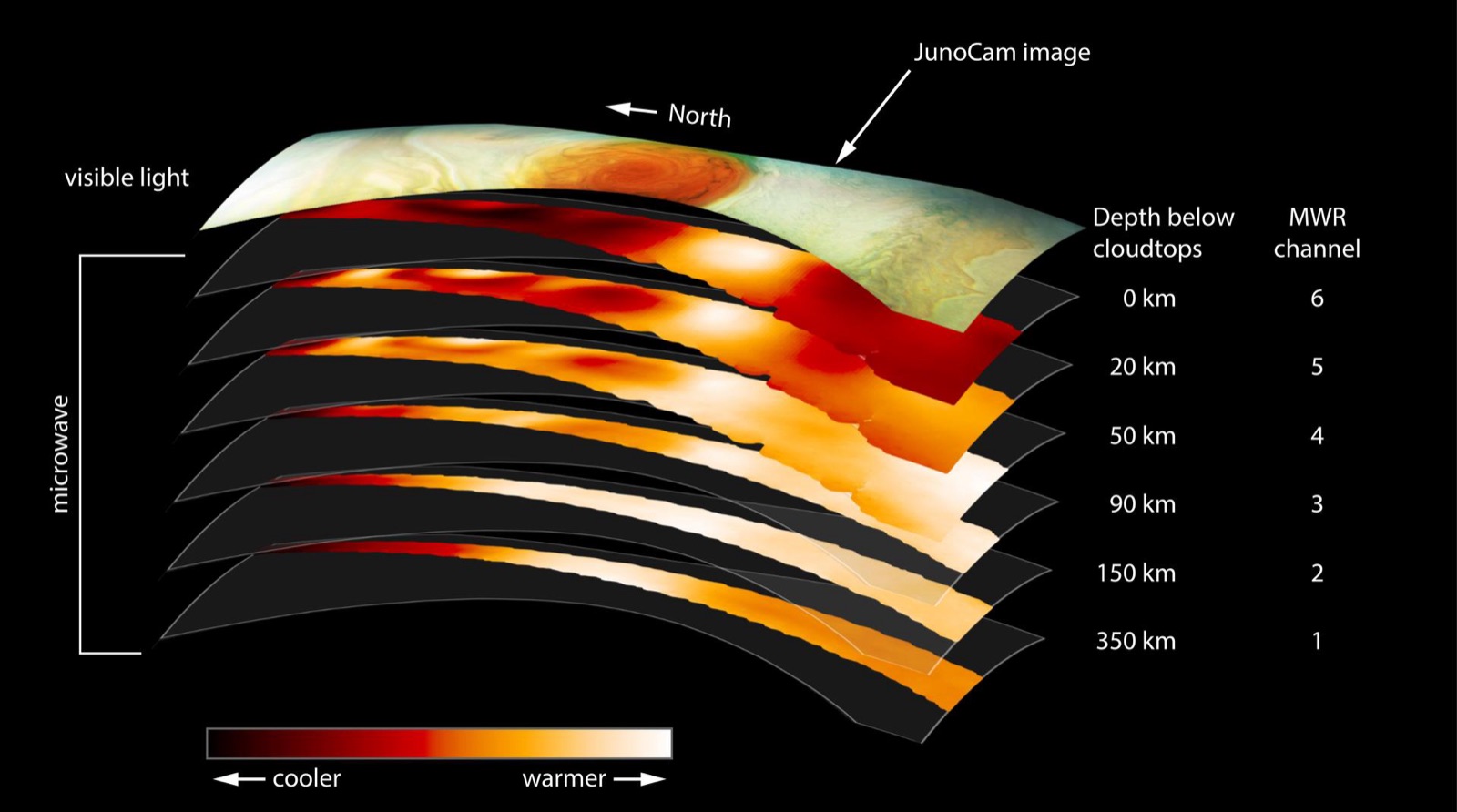
Jupiter's clouds hide almost everything below them from visible-light cameras, so Juno carries a Microwave Radiometer with six antennas operating at six specific frequencies: 600 MHz, 1.2, 2.4, 4.8, 9.6, and 22 GHz. These are the only microwave frequencies that can penetrate the thick Jovian atmosphere. By measuring thermal radiation at each frequency — which corresponds to a different depth — the instrument builds a temperature profile from the cloud tops down to pressures of about 200 bar, equivalent to depths of 500 to 600 km. That range is far deeper than any camera or infrared sensor can reach. The data reveal how much water and ammonia exist in those deep layers and whether atmospheric circulation patterns — the famous colored bands — are shallow surface phenomena or column-deep features driven from within. Juno confirmed the latter: the bands extend hundreds of kilometres into the planet. The MWR was designed to operate through at least orbit 11 of Jupiter, and the principal investigator leading it was Mike Janssen of the Jet Propulsion Laboratory.
 ⤢
⤢
06 Jupiter's fuzzy core: a new picture
Before Juno, the leading models of Jupiter's interior split into two camps: a compact rocky core surrounded by layers of metallic hydrogen, or no solid core at all. Juno's gravity science instrument detected tiny velocity changes in the spacecraft — as small as 0.01 millimetres per second, measured from more than 650 million kilometres away using a Deep Space Network antenna — as it skimmed low over the cloud deck at about 209,000 km/h. Those minute Doppler shifts map how mass is distributed inside the planet. The results pointed to something neither camp had fully anticipated: a diffuse, "fuzzy" core made of rock fragments and metallic hydrogen mixed together rather than a clean solid ball. Scientists now think this scrambled interior may be the scar of a giant impact early in Jupiter's formation, when a massive planetesimal plowed into the young planet and stirred what might otherwise have become a well-defined solid core. It is a result that challenges the simplest versions of giant-planet formation theory.
07 Cyclones at the poles — stable and strange
Before Juno, no spacecraft had photographed Jupiter's poles directly. When Juno made its first close pass on August 26, 2016, the imagery was startling: instead of the orderly bands and zones seen at lower latitudes, the poles host clusters of large, persistent cyclones that have remained stable across years of observation. Juno's data also revealed the internal structure of these storms. The cyclones are warmer on top and have lower atmospheric density there, while they are colder and denser toward the bottom. Anticyclones — systems rotating in the opposite direction — show the reverse pattern, being colder at the top and warmer at the bottom. Vertical extent proved equally surprising. Some storms reach 100 km below the cloud tops; the Great Red Spot, Jupiter's most famous feature, extends roughly 500 km below the cloud tops. That depth is extraordinary — comparable to driving from New York to Kansas City and then continuing underground. Explaining what maintains these structures over such depths is an active area of research.
08 Mapping a lopsided magnetic field Deeper
One of Juno's core tasks is mapping Jupiter's magnetic field with a precision no previous mission achieved. The spacecraft carries a Flux Gate Magnetometer paired with an Advanced Stellar Compass that monitors the exact orientation of the magnetometer sensors. Together they aim to determine not just the field's strength but where inside the planet it is generated and what drives it — questions that reach into fundamental dynamo theory. What Juno found surprised researchers: rather than the relatively orderly dipole field that Earth has, Jupiter's magnetic field is uneven and chaotic in structure. The mission also measures a general-relativistic effect called Lense–Thirring precession, or orbital frame-dragging, caused by Jupiter's rotation — potentially a new test of general relativity in the Jovian system. The magnetometer boom is mounted on the third solar panel, the one with only three segments instead of four, keeping the sensitive sensors away from electrical noise generated by the rest of the spacecraft.
09 Solar power five times farther than Earth
Every outer-solar-system spacecraft before Juno — Pioneer 10, Pioneer 11, the Voyagers, Ulysses, Cassini, New Horizons, and the Galileo orbiter — ran on radioisotope thermoelectric generators because sunlight at those distances is too faint for practical solar panels. Juno broke that tradition, driven partly by a global shortage of plutonium-238 at the time of design and partly by advances in solar cell efficiency. At Jupiter, Juno receives only 4% of the sunlight available at Earth, yet three symmetrically arranged solar panel wings — each measuring 2.7 by 8.9 metres and providing 50 square metres of active cells — generate about 486 watts on arrival, projected to decline to roughly 420 watts as radiation degrades the cells. If those same panels were operating at Earth's distance, they would produce 12 to 14 kilowatts. The combined mass of the three wings is nearly 340 kg. When deployed shortly after launch, their drag on Juno's spin dropped the rotation rate by two-thirds, from the 1.4 rpm the Centaur had imparted to maintain stability during the journey.
10 Moon encounters that were never planned
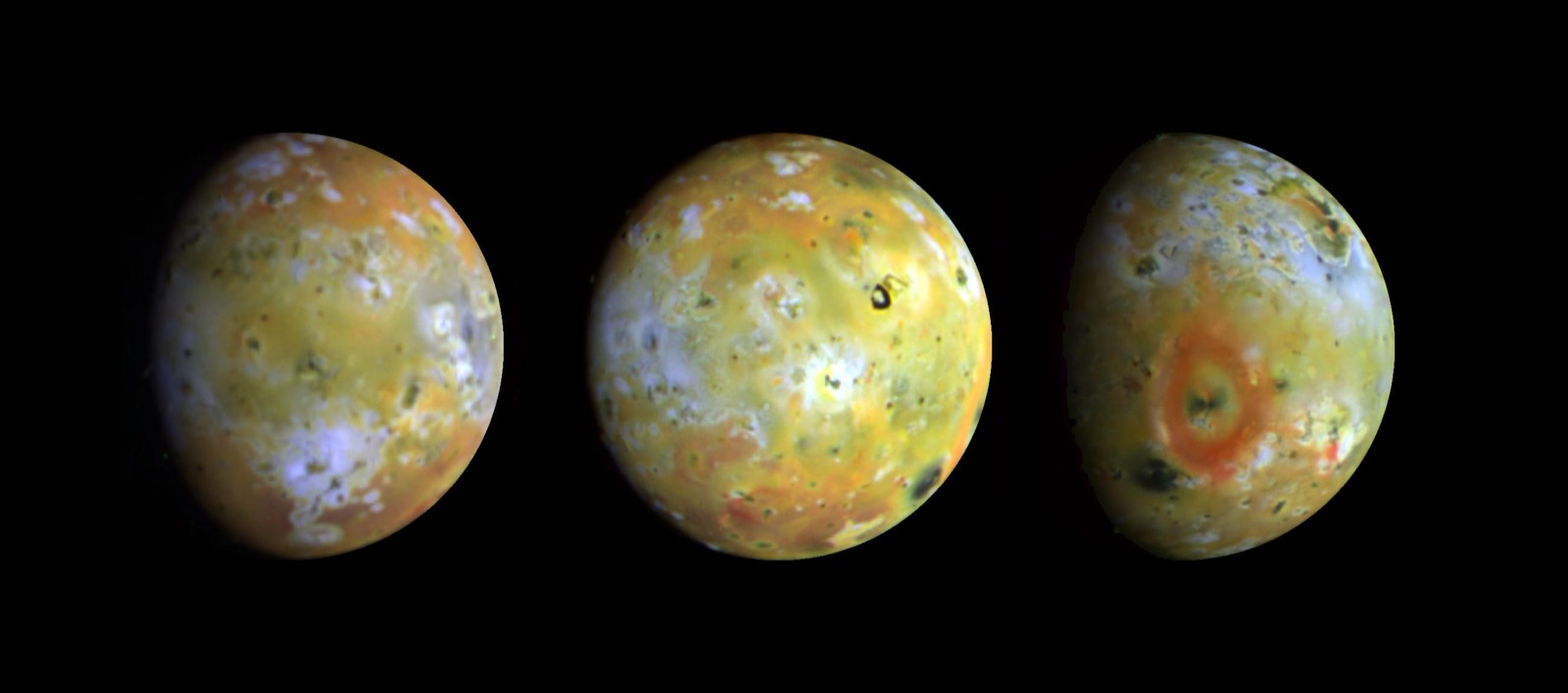
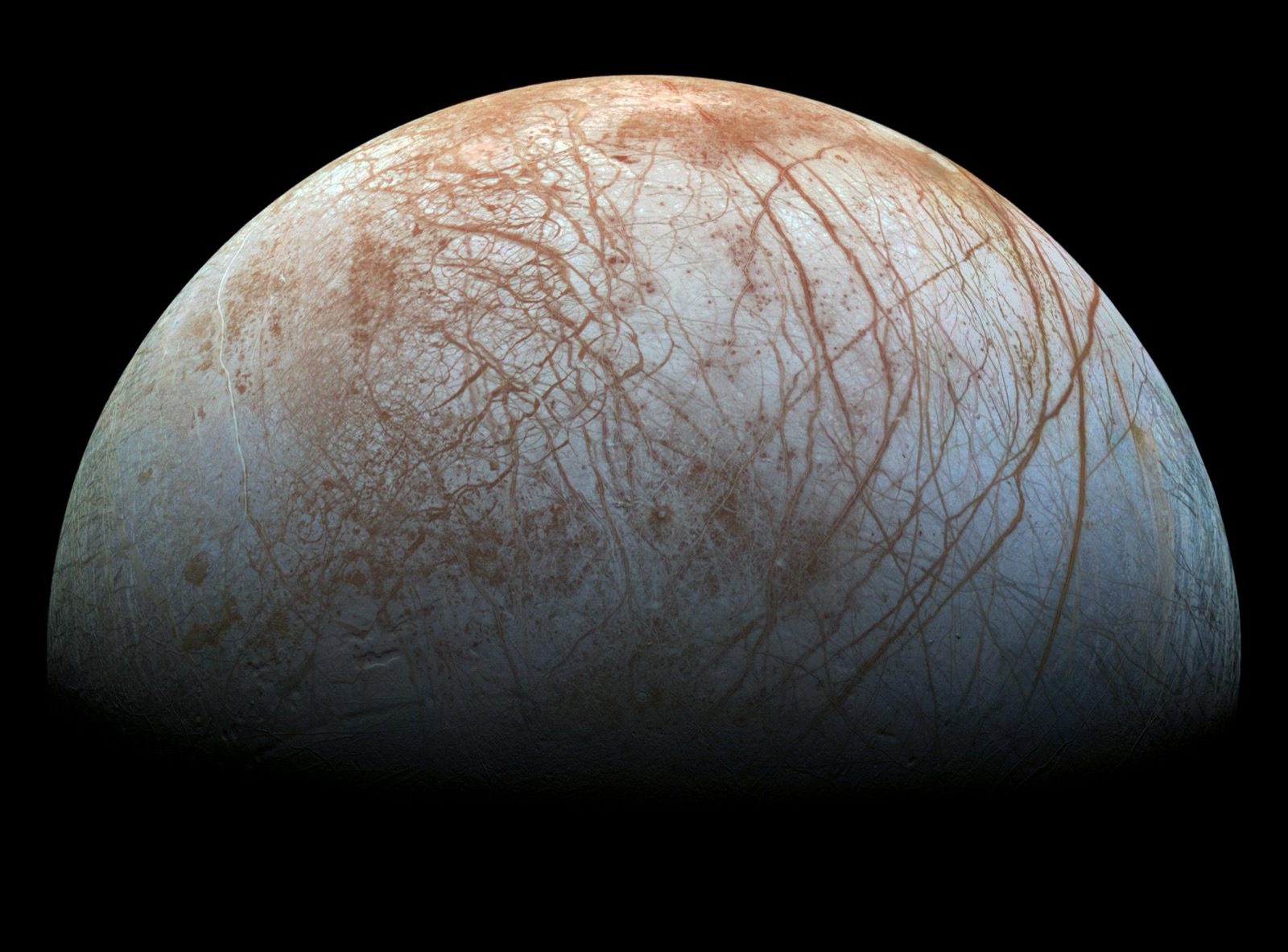
Juno's extended missions turned it into a moon explorer by accident of orbital mechanics. On June 7, 2021, the spacecraft flew within 1,038 km of Ganymede — the closest any spacecraft had come to Jupiter's largest moon since the Galileo orbiter in 2000. A Europa flyby followed on September 29, 2022, at just 352 km, close enough to gather detailed data on the icy surface. Juno then completed two Io flybys, on December 30, 2023, and February 3, 2024, collecting observations of volcanic activity on the most volcanically active body in the solar system. Each encounter used the moon's gravity to shrink Juno's orbital period; by February 2024 the period had dropped to 33 days, compared with the original 53.5 days. A second extended mission beginning in October 2025 plans to take Juno deeper still — into Jupiter's inner radiation belts where the rings and inner moons reside — with close flybys of Thebe, Amalthea, Adrastea, and Metis planned. Principal Investigator Scott Bolton described this zone as "not well explored."
 ⤢
⤢
11 The camera that keeps coming back to life
JunoCam was built for public outreach, not science, and was expected to survive only eight orbits before Jupiter's radiation destroyed it — ending operations around September 2017. In reality it outlasted that estimate dramatically, though not without damage. During orbit 47, the imager began showing hints of radiation harm; by orbit 56 nearly all images were corrupted, traced to a failed voltage regulator. Engineers found a fix: heating the camera to exactly 25 °C (77 °F) in a process called annealing essentially reset the damaged electronics. The procedure worked, and JunoCam was brought back to operations. It has been annealed periodically since then and, as of July 2025, remains in service — many years past its original expiration. The camera is limited by telecommunications: Juno can only return about 40 megabytes of JunoCam data per 11-day orbital period, which translates to roughly 10 to 100 images depending on compression, far fewer than scientists would prefer.
12 Zodiacal dust traced back to Mars Deeper
One of Juno's less expected contributions has nothing to do with Jupiter. In 2021, scientists analysing the frequency of interplanetary dust impacts recorded mainly on the backs of Juno's solar panels — as the spacecraft passed between Earth and the asteroid belt during its cruise — found a surprising result. The dust responsible for the zodiacal light, the faint glow visible along the ecliptic plane in a dark sky, appears to come from Mars rather than from comets or outer-solar-system asteroids, as had long been assumed. The evidence came from counting how often particles struck the panels and how that rate changed with heliocentric distance and direction. Mars lacks a strong enough gravity to hold on to fine material kicked up by meteorite impacts, so dust can escape relatively easily into interplanetary space and spread along the orbital plane. The finding reframes a phenomenon that has been observed since antiquity and studied for decades without a definitive source being identified.
13 A solar storm that squeezed Jupiter
In October 2024, Juno witnessed something never previously measured at Jupiter: the most extreme compression of the planet's magnetosphere ever recorded. An X1.8-class solar flare sent a powerful wave of charged particles across the solar system. When it hit Jupiter, the magnetosphere — normally extending about 80 Jupiter radii on the sunward side — was squeezed inward to less than 30 Jupiter radii. That is a reduction to less than half its normal extent, driven by a single storm. The same flare had already struck Earth earlier in October, generating auroras visible as far south as Arizona and as far north as Queensland, Australia. At Jupiter, Juno was positioned to measure the magnetospheric response directly. The event demonstrates that even Jupiter's enormous magnetic field, the strongest of any planet in the solar system, can be dramatically reshaped by violent solar activity — a fact with implications for understanding how space weather affects all planetary systems.
14 A Galileo tribute bolted to the hull
Juno carries a small plaque provided by the Italian Space Agency measuring just 7.1 by 5.1 cm and weighing 6 grams — about the mass of a few paperclips — machined from flight-grade aluminum. It depicts a portrait of Galileo Galilei alongside text in Galileo's own handwriting, written in January 1610 as he observed what he did not yet know were Jupiter's four largest moons. The passage describes his observations of three moving stars near Jupiter, noting their changing arrangement night to night and concluding that they must be orbiting the planet. It is a document of the moment a human being first understood that not everything in the sky circles Earth. The plaque connects Juno's modern investigation of Jupiter directly to that first telescopic look four centuries earlier. Galileo's moons — Io, Europa, Ganymede, and Callisto — are now known to be among the most scientifically important bodies in the outer solar system, and three of them received Juno flybys during its extended missions.
 ⤢
⤢
Weird & wonderful
- Juno carries three LEGO figurines: Jupiter, Juno, and Galileo — aluminum, radiation-proof.
- Its solar panels generate at Jupiter about what a hair dryer uses on 'low.'
- It photographed Jupiter's poles — ringed with Texas-sized cyclones locked in geometric patterns.