Moon · Deep guide · orbits Jupiter
Lysithea
Also called: Jupiter X
A 42-km dark moon found in 1938 that shares Elara's orbit almost exactly.
What is it?
Lysithea is a member of Jupiter's Himalia group, about 42 km across and very dark. Seth Nicholson discovered it at Mount Wilson Observatory in 1938. Its average distance and orbital period are almost the same as Elara's, about 11.7 million km and 259 days, on a prograde orbit tilted about 27° to the ecliptic. Its grey colour falls between C-type and P-type asteroids, and like its family it is probably a fragment of a captured object.
The deep dive
Researched for the Atlas from Wikipedia — Lysithea (moon) (1,652 characters read) · updated Nov 14, 2026
01 A Moon That Was Never Born Here
Lysithea almost certainly did not form alongside Jupiter in the early solar system. The leading explanation is that it began life as a heliocentric asteroid — an independent rocky body orbiting the Sun — before Jupiter's gravity captured it at some point in the distant past. This origin story is supported by the fact that Lysithea belongs to the Himalia group, a family of prograde moons that share suspiciously similar orbits, clustering between 11 and 13 gigametres from Jupiter with inclinations between 27 and 30 degrees and eccentricities between 0.11 and 0.24. The working hypothesis is that the entire group descends from a single larger asteroid that broke apart, either during or after capture, scattering fragments into these closely related orbits. Lysithea would then be one of the surviving chunks of that ancient collision. This family resemblance is one of the strongest clues astronomers have about how Jupiter came to accumulate its large retinue of irregular satellites.
02 An Orbit That Never Stands Still Deeper
Lysithea travels around Jupiter at an average distance of 11,700,710 kilometres, completing one orbit every 258.57 days — meaning its year is roughly eight and a half Earth months long. The orbit is not a clean, predictable ellipse. It is continuously being reshaped by gravitational perturbations from the Sun, Jupiter itself, and the other planets, so the path Lysithea traces today is not exactly the path it traced a century ago, nor the one it will trace a century from now. The orbital eccentricity currently sits at 0.148, which means Lysithea swings noticeably closer and farther from Jupiter over each circuit rather than following a tidy circle. The inclination to the ecliptic is about 27 degrees. Crucially, the orbit is prograde — Lysithea travels in the same general direction as Jupiter rotates — which puts it in a dynamically distinct category from Jupiter's retrograde irregular moons that orbit in the opposite sense.
03 How Big Is 42 Kilometres, Really?
With a diameter of about 42 kilometres, Lysithea is small enough that you could drive across its full width in roughly the same time it takes to travel from one side of a large city to the other. Despite that modest size, it earns the distinction of being the fifth largest irregular moon of Jupiter, a testament to how tiny most of Jupiter's irregular satellites truly are. Its measured albedo is about 3.6 percent, meaning it reflects only a tiny fraction of the sunlight that hits it — far less reflective than the Moon, which bounces back about 12 percent. This extreme darkness is consistent with a surface coated in primitive, carbon-rich material, the kind of dull, sooty coating common to outer solar system bodies. The low reflectivity is one of the reasons Lysithea was not discovered until 1938, even though Jupiter's largest moons have been known since Galileo's time.
04 The Gray Color and What It Tells Us Deeper
When astronomers measure Lysithea's color through different filters, they find that it appears distinctly gray. Its color indices have been measured as B−V of 0.72, V−R of 0.36, and V−I of 0.74. These values place Lysithea in an intermediate zone between C-type and P-type asteroids on the standard asteroid classification scheme. C-types are dark, carbon-rich bodies common in the outer main belt; P-types are even darker and thought to contain a mix of organic material, silicates, and possibly ice. Sitting between these two classes, Lysithea's surface composition remains somewhat ambiguous, though it is consistent with the kind of primitive, unprocessed material that has changed little since the early solar system. All the other confirmed members of the Himalia group share this same general gray appearance, reinforcing the idea that they all originated from a single parent body with a uniform surface composition before it was shattered.
05 A Rotation Period Under Debate Deeper
Measuring how fast Lysithea spins is surprisingly difficult from Earth. A rotation period of approximately 12 hours and 45.6 minutes has been reported, which would mean the moon completes roughly two full spins for every Earth day. However, a subsequent paper cast doubt on this figure, noting that the observation periods used to derive it were too short to be fully reliable. This kind of uncertainty is common for small, distant, faint bodies — getting enough continuous data on a moon like Lysithea to pin down its rotation unambiguously requires significant telescope time and favorable conditions. Until longer observation campaigns are conducted, the spin rate must be treated as a provisional estimate rather than a confirmed value. This uncertainty also means that whether Lysithea's rotation is tidally locked to Jupiter — as many inner moons are — or spins freely remains an open question.
06 Seth Nicholson and the 1938 Discovery
Lysithea was discovered in 1938 by Seth Barnes Nicholson at Mount Wilson Observatory in California. Nicholson was a remarkably productive discoverer of Jovian moons, and Lysithea was one of several outer moons he found over his career using photographic plates. At the time of discovery, the moon was simply assigned the designation Jupiter X, following the convention of numbering new Jovian moons in order of their discovery. For many years the body had no proper name at all. Between 1955 and 1975, it was informally referred to by some as Demeter, after the Greek goddess of the harvest, but that name never received official sanction. The official name Lysithea was not formally adopted until 1975, nearly four decades after the moon's discovery. The long gap between discovery and naming reflects the relatively informal state of planetary nomenclature at the time — many outer solar system bodies were catalogued long before the astronomy community settled on a naming convention for them.
07 The Myth Behind the Name
The name Lysithea connects the moon to Greek mythology through two distinct family lines. In ancient sources, Lysithea is identified as a daughter of Oceanus, the Titan god who personified the great world-ocean that the Greeks believed encircled the earth. That lineage makes her a figure associated with primordial water and cosmic boundaries. At the same time, Lysithea is counted among the many lovers of Zeus — the Greek counterpart of the Roman Jupiter — which is exactly the naming theme that has governed Jupiter's irregular moons for decades. The International Astronomical Union has traditionally named Jupiter's prograde irregular moons after lovers and daughters of Zeus, so Lysithea fits that pattern precisely. The choice of this particular name in 1975, rather than the earlier informal name Demeter, aligned the moon with a figure who had a direct mythological relationship with Jupiter's divine namesake.
08 The Himalia Group: A Shattered Family Deeper
Lysithea is not alone in its region of space around Jupiter. It belongs to the Himalia group, a cluster of prograde moons that share broadly similar orbital parameters: they orbit between 11 and 13 gigametres from Jupiter, their inclinations fall between 27 and 30 degrees, and their eccentricities range from 0.11 to 0.24. The working hypothesis is that this group represents the debris field from a single larger asteroid that was first captured by Jupiter and then broken apart, possibly by a collision with another body or through tidal stress. If that picture is correct, then Himalia, Lysithea, Elara, Leda, and the other group members are all siblings — fragments of the same ancestral rock. Lysithea's gray color, low albedo, and intermediate C/P-type asteroid signature are consistent with this interpretation, since all the members would be expected to share the same original composition. This kind of collisional family, well-known in the main asteroid belt, may be a common feature among the irregular satellite populations of the giant planets.
09 Prograde vs. Retrograde: Which Camp?
Jupiter hosts two broad populations of irregular moons: those that orbit in the same direction as the planet spins, called prograde, and those that orbit in the opposite direction, called retrograde. Lysithea firmly belongs to the prograde camp. This distinction matters because the two groups are thought to have different capture histories and may have originated from different source populations of asteroids or comets. Prograde capture from a heliocentric orbit is generally considered dynamically more demanding than retrograde capture under certain conditions, though the precise mechanisms are still debated by researchers. Lysithea's prograde orbit, combined with its membership in the Himalia group, makes it part of the largest and best-studied family of prograde irregular Jovian satellites. The fact that prograde and retrograde irregular moon families tend not to mix — they occupy distinct dynamical niches — helps astronomers use current orbital architecture to reason backward about Jupiter's ancient history of capturing small bodies.
10 Observing Lysithea from Earth
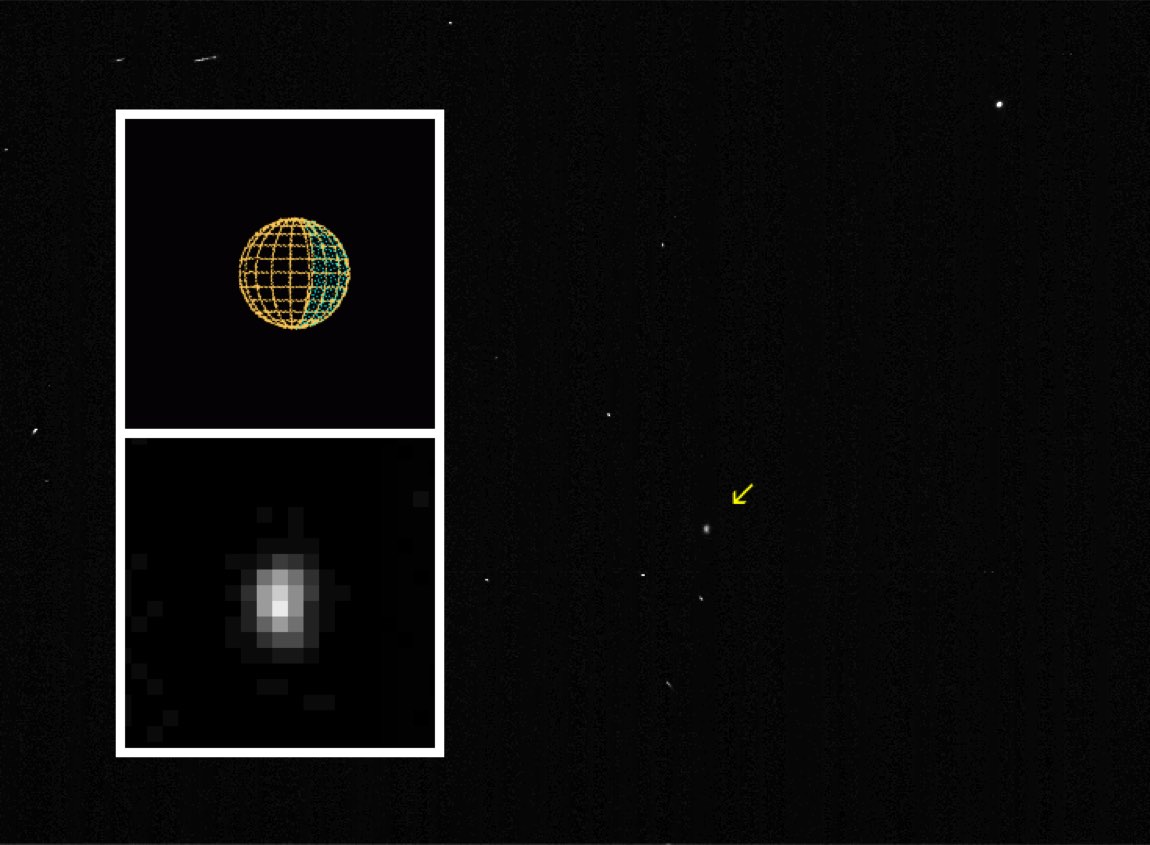
With a diameter of only about 42 kilometres and an albedo of just 3.6 percent, Lysithea is an extremely faint object even by the standards of Jupiter's outer moons. At opposition, when Jupiter is closest to Earth and best positioned for viewing, Lysithea would require a telescope capable of detecting very faint targets — far beyond the reach of typical amateur equipment used to view the Galilean moons. Its discovery required the photographic techniques and large aperture available at a professional observatory like Mount Wilson. Today, modern digital detectors and large ground-based telescopes can image Lysithea and study its color properties, as the photometric measurements of its color indices demonstrate. However, its small angular size means it appears as nothing more than a point of light from Earth. Any detail about its shape or surface must be inferred from brightness variations and color measurements rather than direct imaging.
11 Open Questions About This Small World Deeper
Despite being discovered more than eighty years ago, Lysithea remains poorly understood in several important respects. Its rotation period of approximately 12 hours and 45.6 minutes is considered uncertain because the original measurement was based on observation periods deemed too short by later analysts — meaning even something as basic as how fast it spins is unconfirmed. No spacecraft has ever visited Lysithea specifically; what is known comes entirely from ground-based telescopic observations. The internal structure is completely unconstrained, as the moon is too small and distant for any bulk density measurement to have been made from Earth-based data alone. Whether the Himalia group collision that likely spawned Lysithea happened before or after Jupiter migrated to its current position in the solar system is also unclear. These gaps mean that Lysithea, despite its long discovery history, would still yield fundamental new science if ever observed at close range by a dedicated spacecraft.