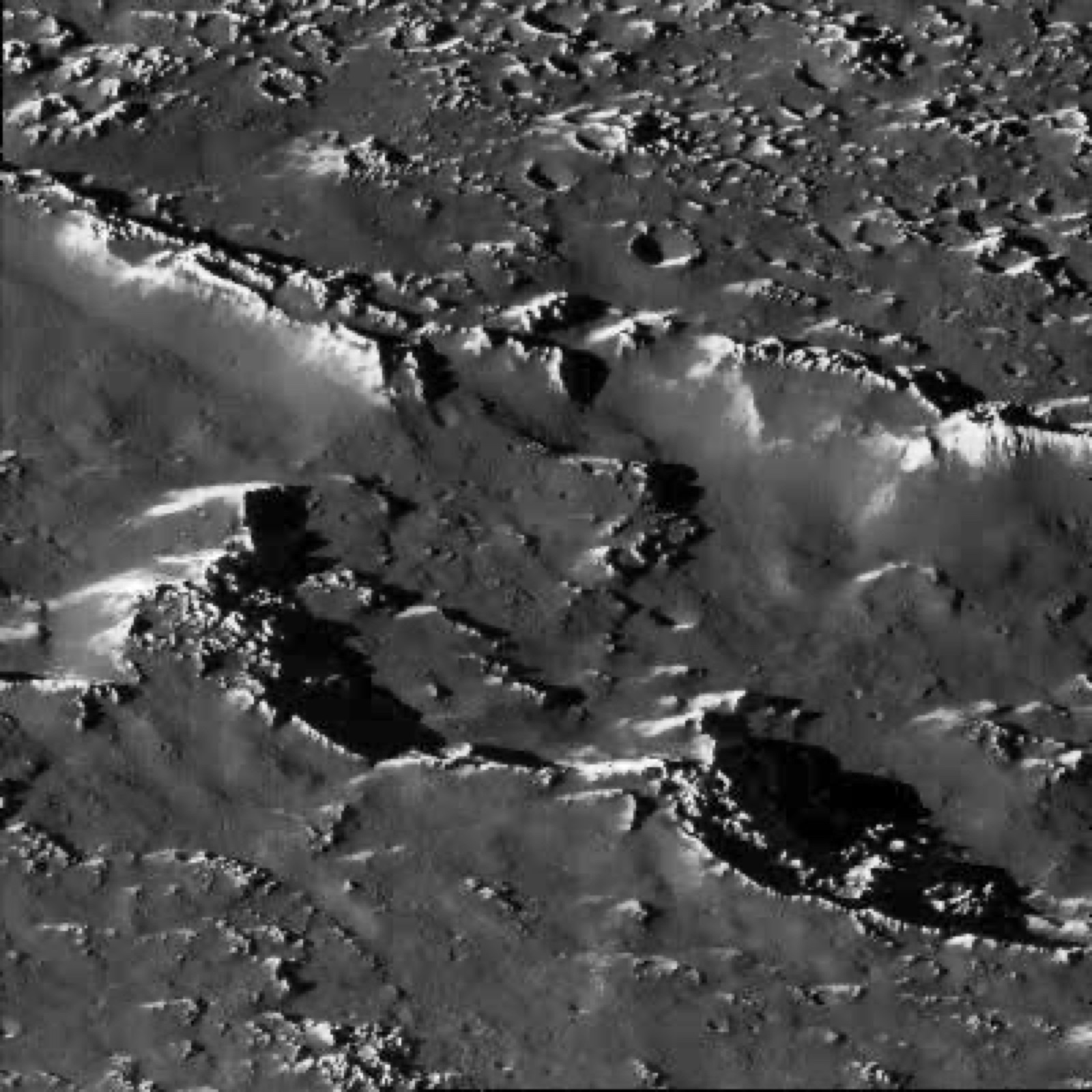
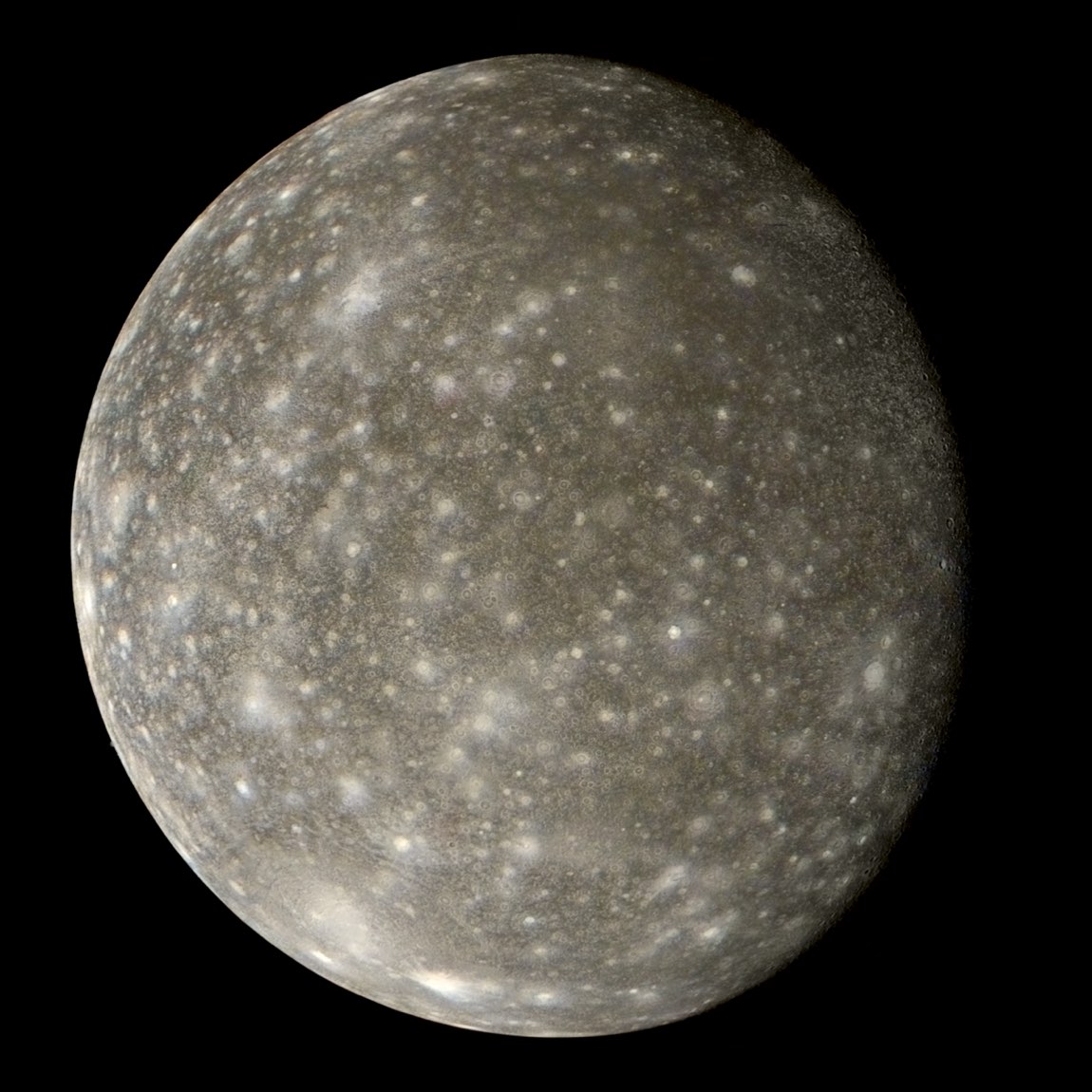
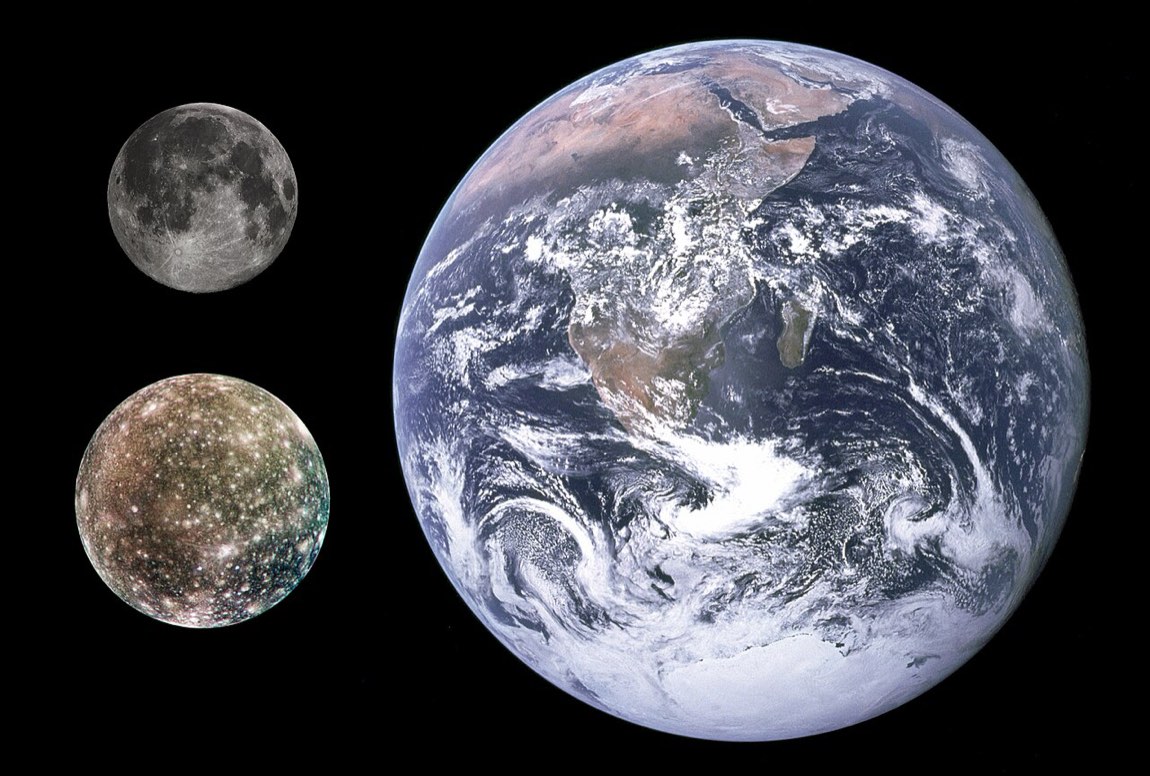
 Photograph · NASA/JPL/ASU
Moon · Deep guide · orbits Jupiter
Callisto
An ancient, quiet moon with a possible hidden ocean, and the most cratered world in the Solar System.
What is it?
Callisto is the outermost of Jupiter's four big moons and the third largest moon in the Solar System. Its dark surface is saturated with craters — the oldest, most battered landscape anywhere — because almost nothing has happened there for four billion years. That very stillness, plus its distance from Jupiter's radiation belts, makes Callisto a favorite candidate for a future human base in the Jupiter system.
Go deeper
Callisto never fully differentiated — its interior is a partly mixed jumble of rock and ice, evidence that it formed slowly and was never strongly tidally heated (it sits outside the Laplace resonance). Yet Galileo's magnetometer detected an induced field here too, hinting at a salty ocean perhaps 100+ km down. Radiation at Callisto's orbit is ~300× lower than at Europa — background-level for shielded habitats — which is why NASA's old HOPE study picked it as the sensible spot for a crewed Jupiter-system outpost.
01 A fossil world
Callisto is what a moon looks like when nothing resets the clock: no volcanoes, no shifting ice, no erosion — just every impact since the Solar System's youth, stacked crater on crater. Reading its surface is reading a four-billion-year logbook of everything that ever flew through the Jupiter system.
02 Base camp Jupiter Deeper
For humans, the Jupiter system's showstopper is radiation — except at Callisto, where doses drop to manageable levels. Studies since the early 2000s sketch the same plan: a shielded surface base on Callisto's ice, operating rovers and probes at Europa and Io by remote control, with local water ice for propellant. Status: concept studies only.
The deep dive
Researched for the Atlas from Wikipedia — Callisto (moon) (30,113 characters read) · updated Sep 20, 2026
03 Discovered twice on the same night
Callisto shares a peculiar distinction: it was discovered independently by two people almost simultaneously. Galileo Galilei and Simon Marius both identified the moon in 1610, using some of the earliest telescopes ever pointed at the sky. The naming credit, however, belongs largely to Marius, who proposed calling the four large Jovian moons after lovers and companions of the god Zeus. For Callisto, Marius drew on the myth of a nymph — or, in some versions, the daughter of King Lycaon — who was associated with the goddess Artemis. Marius noted that he owed the suggestion to Johannes Kepler. Despite this early christening, the names fell out of fashion almost immediately and remained dormant for centuries. Astronomers referred to the moon simply as Jupiter IV, following a numbering system Galileo himself introduced. It was not until the mid-twentieth century that the name Callisto returned to common astronomical use, just in time for the Space Age to give it fresh meaning.
 ⤢
⤢
04 An orbit that stands apart
Callisto orbits Jupiter at an average distance of approximately 1.88 million km — that is 26.3 times Jupiter's own radius of 71,492 km. To appreciate the gap, consider that the next closest large moon, Ganymede, orbits at only 1.07 million km; Callisto is nearly twice as far out. That extra distance has profound consequences. The three inner Galilean moons — Io, Europa and Ganymede — are locked into a gravitational dance called a mean-motion resonance, each tugging on the others in a precise 1:2:4 rhythm that pumps enormous tidal heat into their interiors. Callisto sits entirely outside this arrangement and, according to the article, probably never participated in it. However, that situation is not permanent: Callisto is expected to be captured into the resonance in about 1.5 billion years, extending the chain to a 1:2:4:8 pattern. One full orbit — which is also one Callistoan day, since its rotation is tidally locked — takes about 16.7 Earth days.
05 Inside a world that never fully sorted itself Deeper
Most large rocky and icy worlds in the Solar System underwent differentiation: heavy materials sank to form a dense core while lighter material rose to form a mantle and crust. Callisto appears to have done this only partially, and that makes it scientifically fascinating. Its average density is 1.83 g/cm³, consistent with roughly equal parts rock and ice, with ice making up 49–55% by mass. The Galileo spacecraft measured Callisto's dimensionless moment of inertia as 0.3549 ± 0.0042 during close flybys — a value that, if Callisto is in hydrostatic equilibrium, points to a partially sorted interior where rock concentration increases gradually with depth rather than forming a sharp core-mantle boundary. A small silicate core may nonetheless exist at the center, with a radius no greater than 600 km and a density between 3.1 and 3.6 g/cm³. Above that sits a cold, stiff icy lithosphere 80–150 km thick. Complicating matters, a 2011 reanalysis of Galileo data suggested Callisto may not actually be in hydrostatic equilibrium, which would allow for a more thoroughly differentiated interior with a hydrated silicate core instead.
06 How a slow birth prevented a hot interior Deeper
The reason Callisto never fully differentiated comes down to the pace of its formation. The leading model holds that Callisto accumulated slowly from gas and dust in the low-density disk surrounding the young Jupiter, a process that took somewhere between 0.1 million and 10 million years. That gradual accretion was key: it allowed heat from impacts, radioactive decay and gravitational contraction to radiate away nearly as fast as it was generated, rather than building up to the temperatures needed to melt the ice and let rock sink. After accretion ended, the interior cooled further through a process called subsolidus convection — a creeping motion of solid ice driven by temperature differences. Ice moves at roughly 1 centimeter per year in this regime, which sounds negligible, but over billions of years it is an effective way to transport heat outward. This convection is thought to operate in a stagnant-lid regime: a rigid outer layer about 100 km thick conducts heat without moving, while warmer ice below it slowly churns. The absence of any sign of volcanic or tectonic activity on the surface is considered direct evidence that this cold, immobile lid has been in place for most of Callisto's history.
 ⤢
⤢
07 A hidden ocean kept liquid by pressure
One of the more surprising findings from the Galileo mission was evidence that a salty liquid ocean may lurk inside Callisto, at depths greater than 100 km. The clue came from magnetometry: Callisto responds to Jupiter's fluctuating magnetic field as though it were a perfectly conducting sphere, meaning the field cannot penetrate its interior. That behavior points to a layer of electrically conductive fluid at least 10 km thick. Pure water ice would not conduct electricity so well, but a briny ocean would. The ocean is estimated to be 150–200 km deep, and the entire water-and-ice layer could be as thick as 250–300 km if small amounts of ammonia — up to 5% by weight — are present as antifreeze. The physics here is counterintuitive: under the pressures found at 100–200 km depth, the melting point of water ice (ice I phase) actually decreases with increasing pressure, dropping as low as 251 K at 2,070 bar (207 MPa). Even without ammonia, temperatures in that zone in realistic models approach or slightly exceed that depressed melting point, making a liquid layer plausible.
08 A crater record stretching back 4.5 billion years
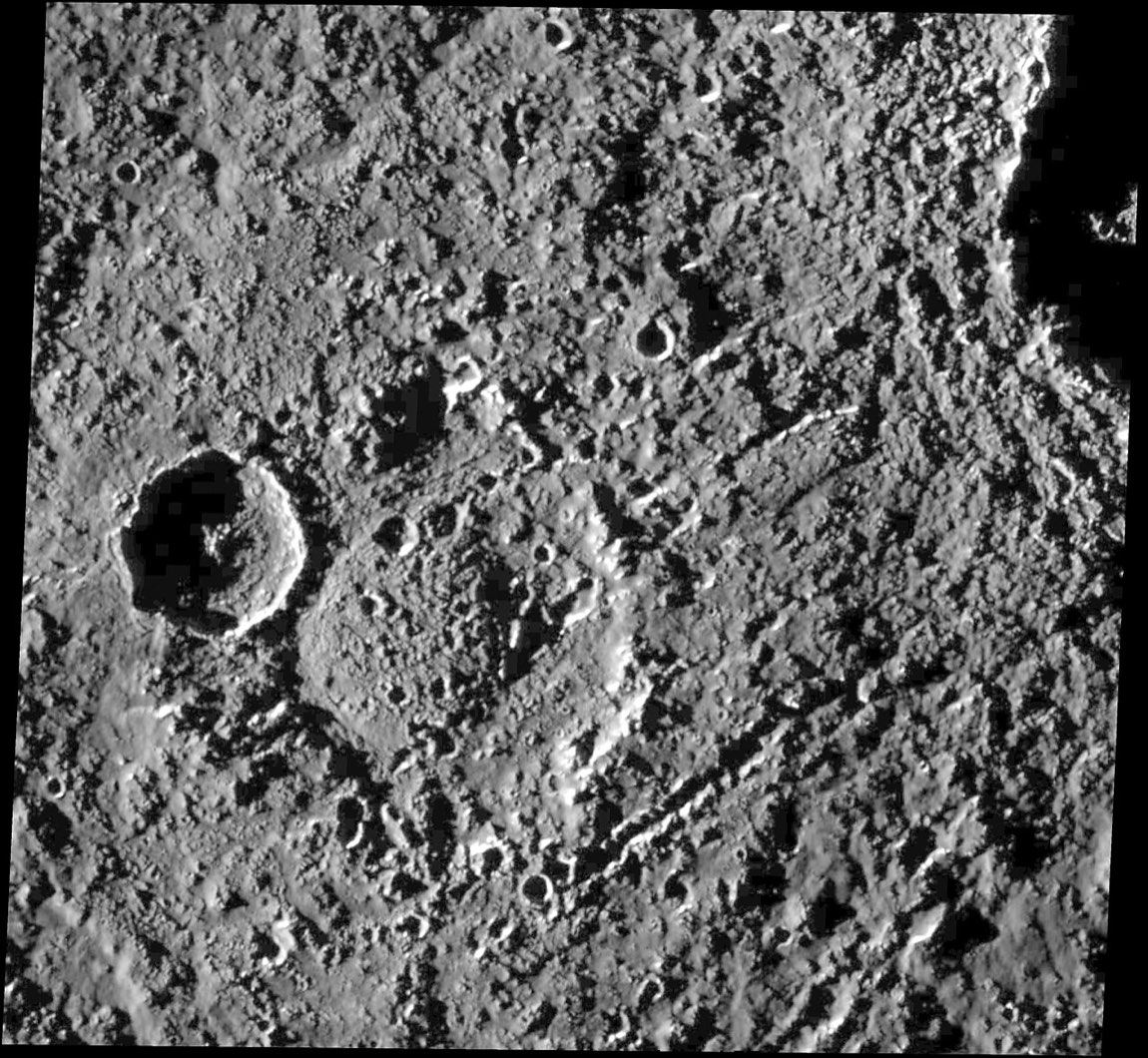
Callisto's surface is not merely old — it is, by some measures, the most heavily cratered terrain in the entire Solar System, with crater density approaching saturation. That means new impacts now tend to obliterate old craters rather than finding fresh ground. The cratered plains, which cover most of the surface, are thought to be roughly 4.5 billion years old, reaching back almost to the formation of the Solar System itself. Craters range in diameter from 0.1 km — the resolution limit of available images — to over 100 km, not counting the enormous multi-ring basins. The shape of a crater tells its story: small craters under 5 km tend to be simple bowls or flat-floored depressions; those between 5 and 40 km usually have a central peak; craters from 25 to 100 km develop central pits; and the very largest, over 60 km, can sport central domes thought to result from tectonic rebound after impact. Examples of dome-bearing craters named in the article include Doh and Hár. Callisto's craters are generally shallower than equivalent-sized craters on the Moon.
09 Valhalla: the giant scar with rings to match
The most dramatic landform on Callisto is Valhalla, the largest multi-ring impact basin known on the moon. Its bright central region spans 600 km in diameter — roughly the distance from London to Edinburgh and back — while concentric rings ripple outward to a distance of 1,800 km from the center. The second-largest structure, Asgard, measures about 1,600 km in diameter. These multi-ring basins are thought to have formed when a large impactor struck the icy crust, which at the time may have been lying atop a softer or liquid layer — possibly the subsurface ocean. The shock fractured the rigid crust concentrically outward, like the rings that spread from a stone dropped into thick ice. Scattered across the surface are also catenae: long, straight chains of craters that were probably formed when objects were torn apart by Jupiter's tidal gravity just before hitting Callisto, in a process directly analogous to what happened to Comet Shoemaker–Levy 9 before it struck Jupiter in 1994. Gomul Catena is one named example.
 ⤢
⤢
10 Why bright frost sits only on the high ground Deeper
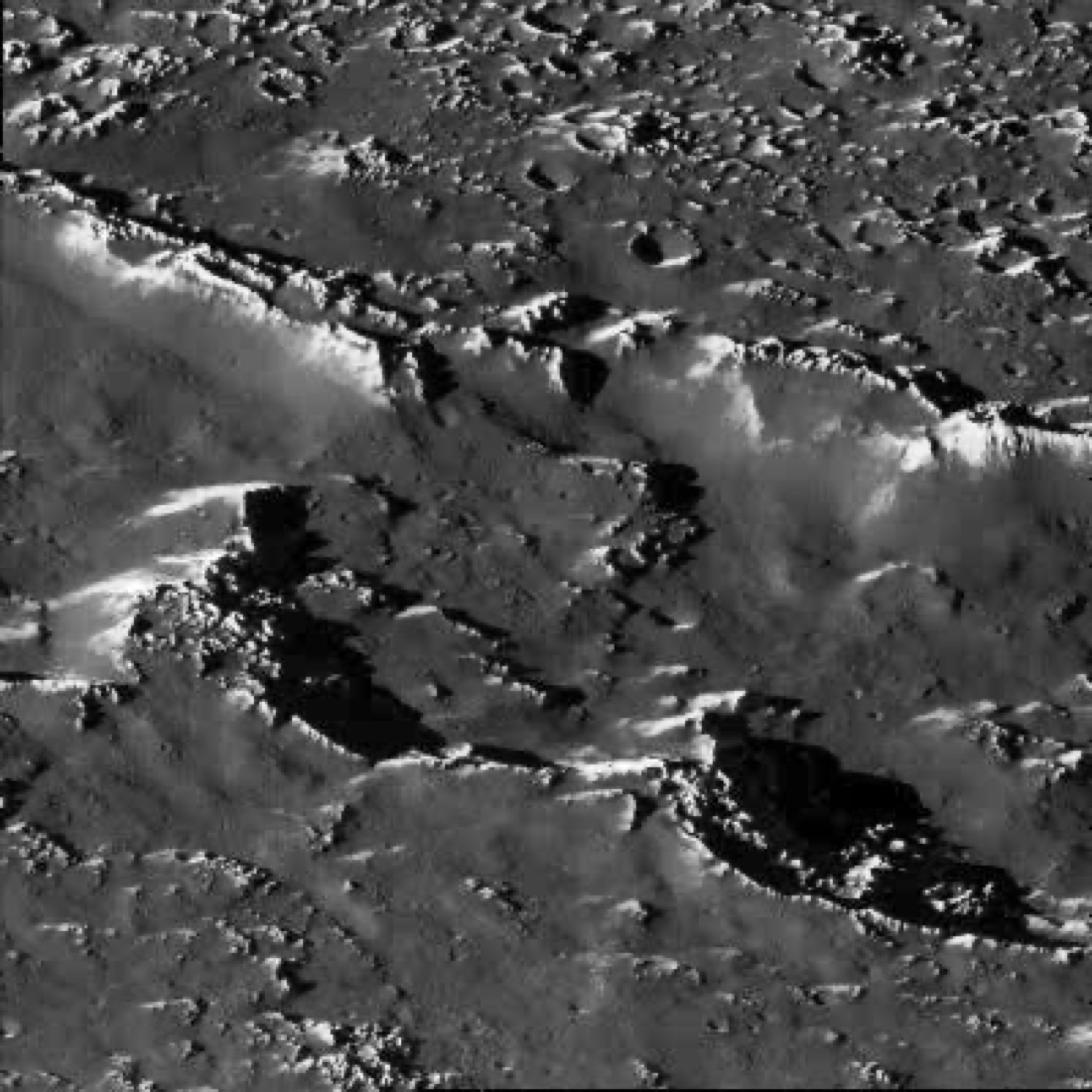
At small scales, Callisto's surface has a characteristic two-tone texture: bright, sparkly patches surrounded by dark, smooth lowland material. High-resolution Galileo images revealed that the bright patches are almost exclusively found on elevated terrain — crater rims, ridges, scarps and small knobs — rather than in the depressions between them. These bright patches are thought to be thin deposits of nearly pure water frost, with an albedo as high as 80%, while the surrounding dark material covers the low-lying areas. The mechanism behind this pattern is probably slow sublimation. Temperatures at the subsolar point can reach 165 K, warm enough for ice to gradually vaporize directly into Callisto's near-vacuum atmosphere. Over geological time, volatile ices escape from exposed surfaces, leaving behind the non-ice residue — silicates, organic compounds, dark carbonaceous material — which accumulates in the lowlands as a smooth blanket. The high spots lose their ice cover but the frost re-deposits preferentially there, while the dark debris from degraded crater rims spreads downslope as debris aprons. This sublimation hypothesis also explains why small impact craters under 1 km are scarce: they have been gradually erased, leaving behind only small knobs and pits as their remnants.
11 A gossamer atmosphere with an oxygen mystery Deeper
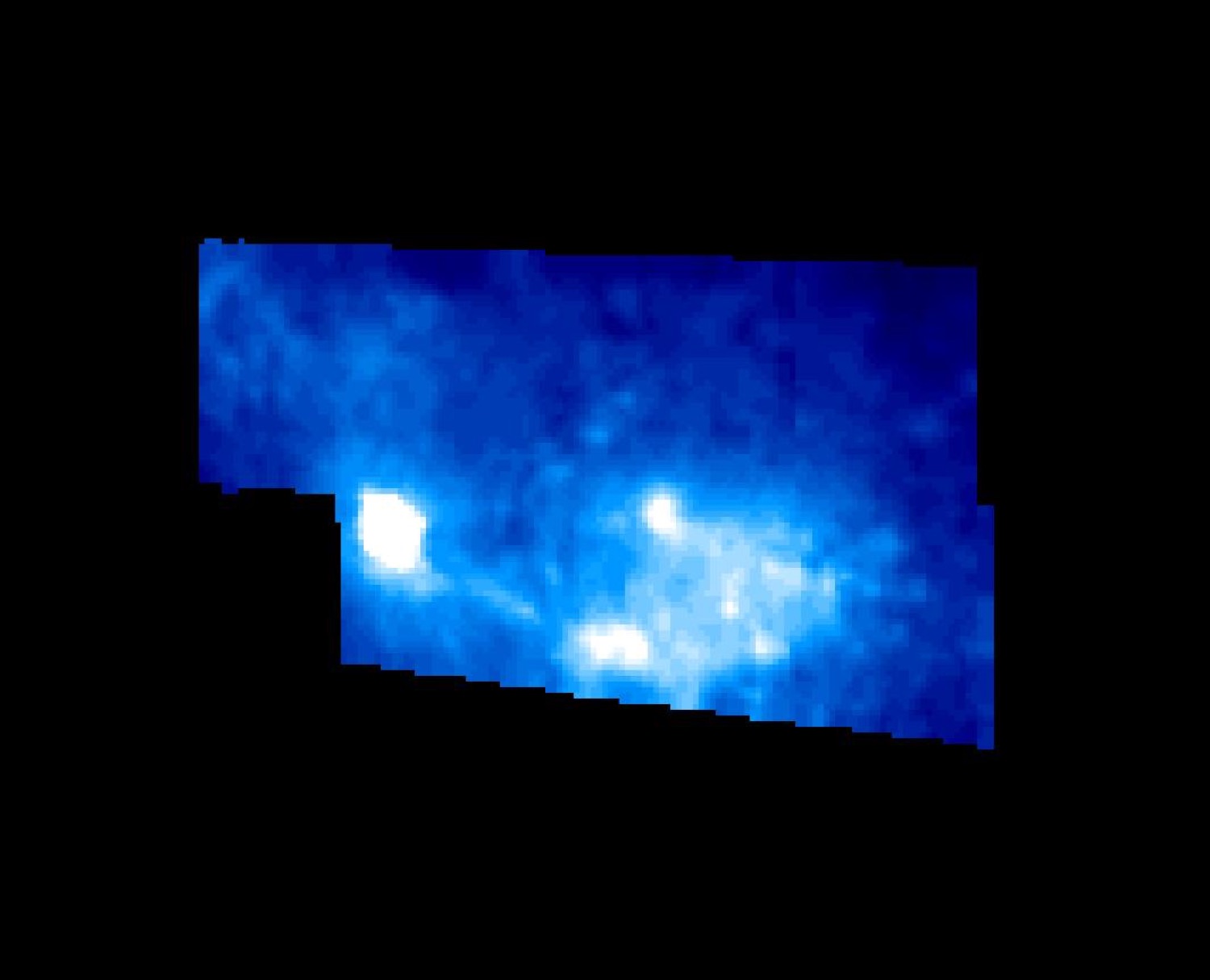
Callisto is wrapped in an extremely thin, collisionless atmosphere — technically an exosphere — with a surface pressure of just 7.5 picobar (0.75 μPa), roughly ten trillion times less than Earth's sea-level pressure. Its main detected component is carbon dioxide, first identified by the Galileo spacecraft's Near Infrared Mapping Spectrometer through an absorption feature at 4.22 μm. Ground-based spectroscopy has since confirmed that the CO2 forms a thin but global gaseous envelope rather than merely local patches. Because this exosphere would be lost to space on a timescale of about four years, it must be continuously replenished, probably by solar-driven sublimation of CO2 ice trapped in the surface regolith. Molecular oxygen has also been inferred from Callisto's ionospheric density and far-ultraviolet auroral emissions, and was directly confirmed in 2023 through the detection of forbidden oxygen emission lines during eclipse. The inferred O2 column density — between 4 × 10¹⁴ and 4 × 10¹⁵ cm⁻² — poses a serious puzzle: standard radiolysis of the surface ice falls short of producing this much oxygen by two to three orders of magnitude, even if the entire surface were assumed to be pure ice. Researchers suspect the real source may be a reservoir of O2 trapped inside porous regolith or radiation-altered ice grains that slowly releases into the atmosphere.
12 Radiation shelter at the edge of Jupiter's grip
Callisto's remote orbit places it just outside Jupiter's main radiation belt, which gives it a dramatically calmer radiation environment than the inner Galilean moons. The charged-particle flux at Callisto's surface is about 300 times lower than at Europa. Translated into a human health context, the radiation dose at Callisto's surface works out to roughly 0.01 rem (0.1 mSv) per day — just over ten times higher than Earth's average background radiation, but actually lower than the dose experienced in low Earth orbit or on the surface of Mars. This comparatively benign environment is a primary reason that mission planners and NASA's 2003 Human Outer Planets Exploration (HOPE) study identified Callisto as the most suitable location for a crewed base from which to study the Jovian system. The relative radiation shelter means that surface infrastructure and human biology would face far less ionizing damage than at any other large moon of Jupiter, while still allowing close scientific and logistical access to the wider system.
 ⤢
⤢
13 Forty years of spacecraft visits
Callisto's exploration by spacecraft spans five decades and multiple generations of missions. Pioneers 10 and 11 flew past Jupiter in the early 1970s but returned little new information about the moon beyond what Earth-based telescopes had already provided. The first real revelation came with Voyager 1 and Voyager 2 in 1979, which imaged more than half of Callisto's surface at a resolution of 1–2 km and precisely measured its temperature, mass and shape. The transformative mission was Galileo, which orbited Jupiter from 1994 to 2003 and made eight close encounters with Callisto. The final flyby, during the C30 orbit in 2001, came within just 138 km of the surface. Galileo completed global surface mapping and captured images at resolutions as fine as 15 meters in selected areas. In 2000 the Cassini spacecraft, en route to Saturn, acquired high-quality infrared spectra of Callisto. In early 2007 the New Horizons probe obtained additional images and spectra on its way to Pluto. Looking ahead, ESA's Juice mission (launched 14 April 2023) will conduct 21 close flybys between 2031 and 2034; NASA's Europa Clipper (launched 14 October 2024) will add nine more beginning in 2030; and China's Tianwen-4 mission plans to enter orbit around Callisto around 2030.
14 Callisto versus Ganymede: twins gone different ways Deeper
Callisto and Ganymede are nearly the same size and share broadly similar bulk compositions, yet their interiors and surfaces look strikingly different. Ganymede appears to be fully differentiated, with a distinct iron core, rocky mantle and icy crust, and its surface bears grooved terrain that records ancient tectonic activity. Callisto, by contrast, shows no large mountains, no volcanoes and no grooves — only craters and the quiet marks of impacts stretching back 4.5 billion years. The article identifies three proposed explanations for why these apparent twins diverged so sharply. First, their formation conditions may have differed subtly, affecting how much heat each accumulated early on. Second, Ganymede lies within Jupiter's orbital resonance chain and has experienced significantly more tidal heating than Callisto, which sits entirely outside it. Third, during the Late Heavy Bombardment Ganymede may have suffered more numerous and energetic impacts, delivering additional heat. Because Callisto avoided all these extra heat sources, it serves planetary scientists as a kind of control case — a reference world against which the effects of tidal heating, differentiation and tectonic activity on bodies like Ganymede and Europa can be clearly measured.
 ⤢
⤢
You would weigh…
Surface gravity 1.24 m/s² vs Earth’s 9.81 m/s². Try every world →
Could life exist here?
If its ocean exists, it is deep, cold, and starved of energy — sealed far from rock and sunlight alike. Not zero, but near the bottom of the ocean-worlds list.
Our labels: Confirmed · Strong Evidence · Estimated · Hypothesis · Theoretical · Speculative (see Methodology).
Could humans live here?
The most plausible human destination in the Jupiter system: tolerable radiation, abundant water ice, stable ground, and a front-row seat to the whole Jovian family. Still a far-future proposition.
How would we get there?
5–8 years, as for Jupiter. JUICE will make close Callisto flybys in the 2030s.
| Technology | Status | Travel time (one way, straight line) |
|---|---|---|
| Apollo-style spacecraft, about 39,000 km/h | Flown technology | 673 days |
| Ion-propulsion probe, about 90,000 km/h | Flown technology | 291 days |
| Voyager 1, about 61,000 km/h | Flown technology | 428 days |
| Parker Solar Probe, about 690,000 km/h | Flown technology | 38 days |
| Nuclear-thermal rocket, about 120,000 km/h cruise | In development | 220 days |
| Laser light-sail at 20% of light speed | Proposed concept | 2.9 hours |
| Light itself, 299,792 km/s | Physical limit | 35 minutes |
Simplified straight-line times at cruise speed. Real missions fly curved orbital paths and take longer. Full travel calculator →
Weird & wonderful
- Callisto's surface is the oldest unchanged landscape you can point to anywhere.
- Its giant Valhalla basin looks like the Solar System's largest bullseye.
- It is the only Galilean moon that never gets kneaded by the others — hence its quiet history.