 Photograph · NASA/JPL/USGS
Moon · Deep guide · orbits Jupiter
Io
The most volcanic world in the Solar System. Io is turning itself inside out.
What is it?
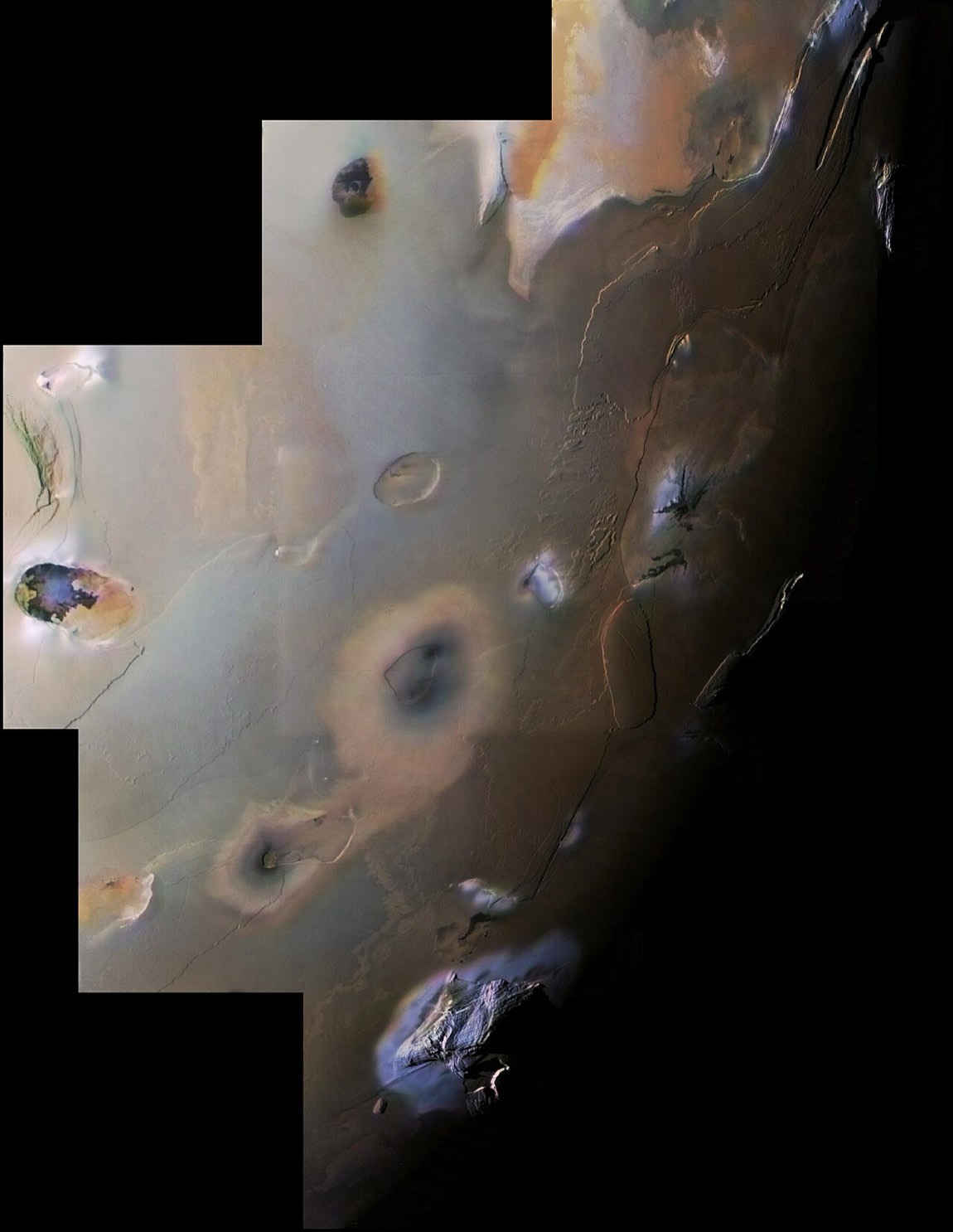
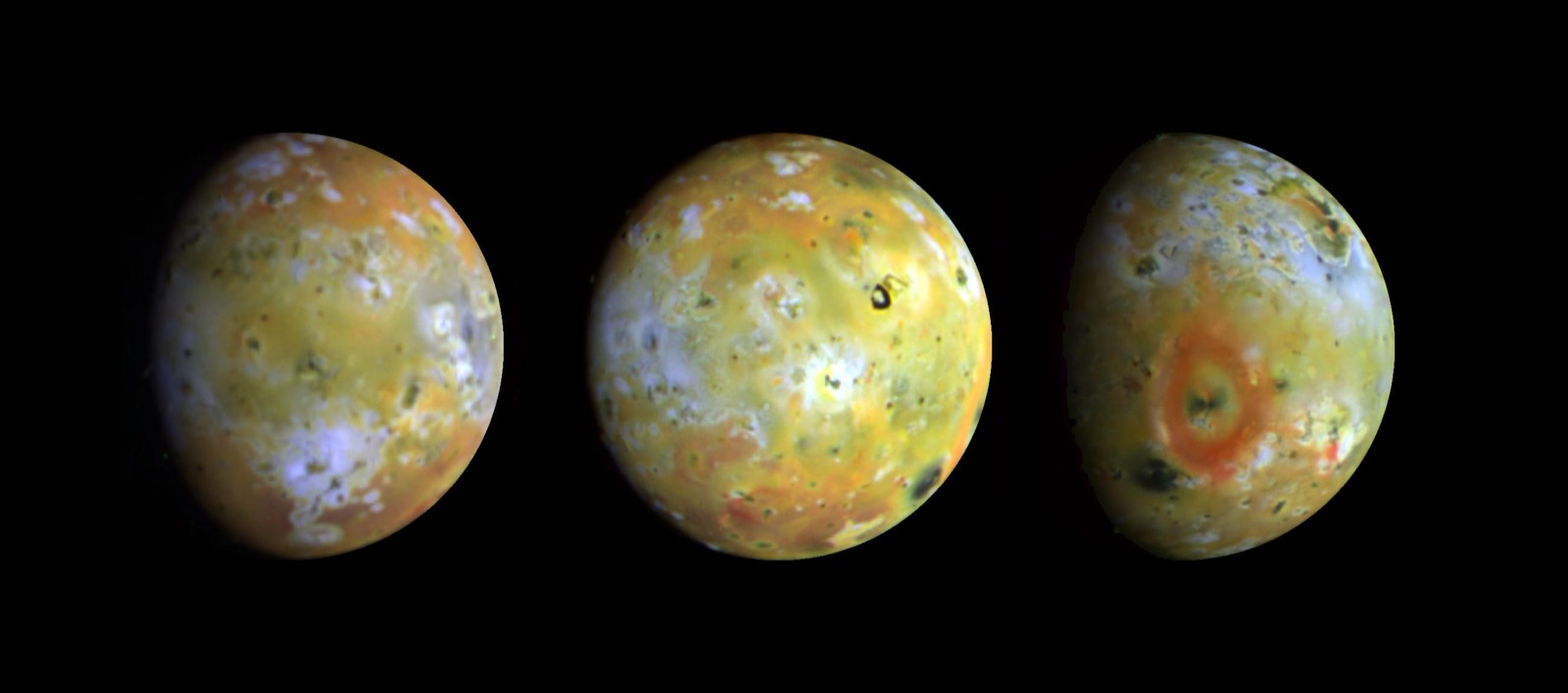
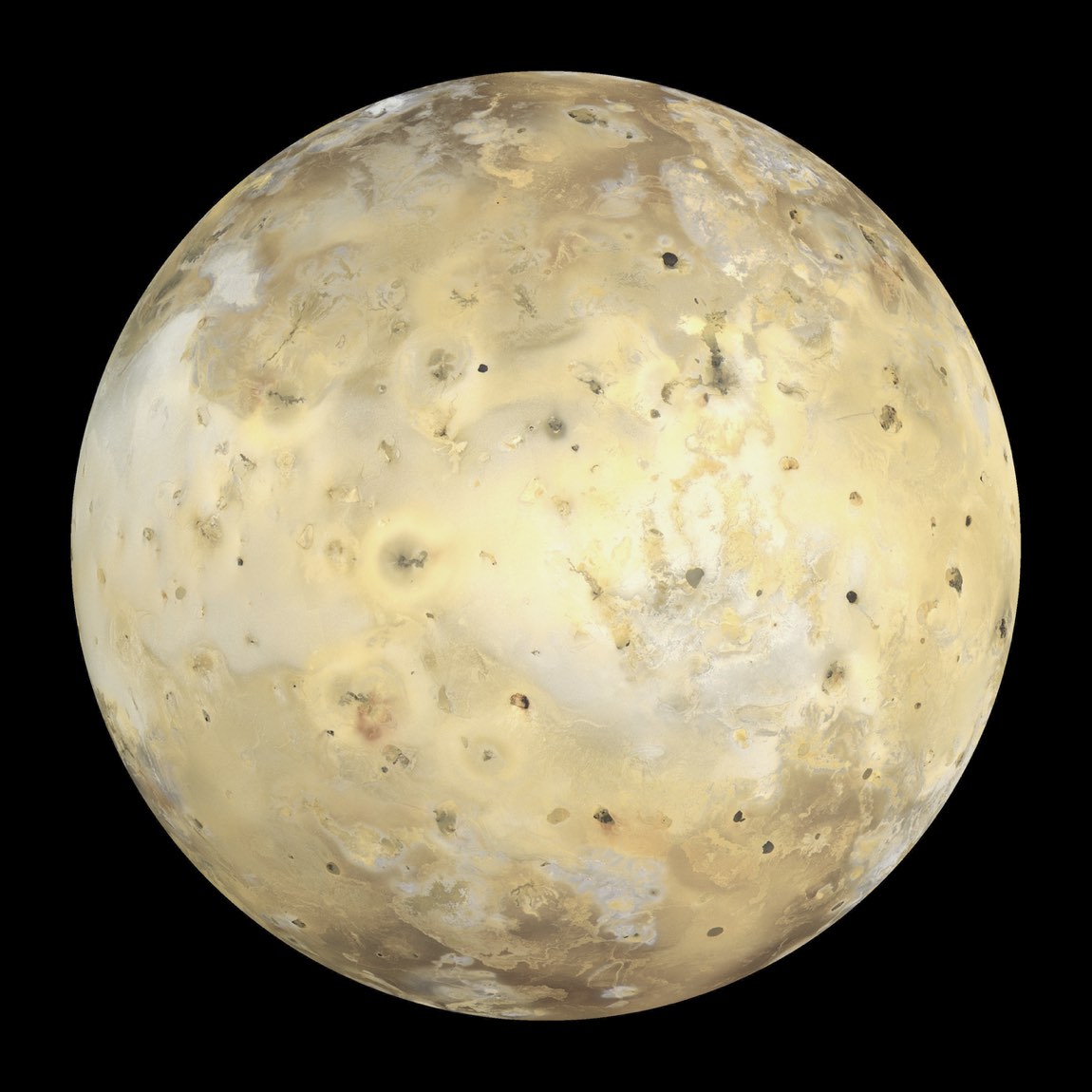
Io, the innermost of Jupiter's big moons, is the most volcanically active body known anywhere. Hundreds of volcanoes pock its yellow-orange surface — some blasting plumes hundreds of kilometers into space. Squeezed relentlessly by Jupiter's gravity, Io resurfaces itself so fast that it has no impact craters at all.
Go deeper
Io is the textbook case of tidal heating: locked in a 4:2:1 resonance with Europa and Ganymede, its orbit stays eccentric, and Jupiter's tides flex the moon's solid rock by tens of meters every 42 hours. The friction drives ~100 terawatts of heat — global lava output far beyond Earth's. Its sulfurous atmosphere feeds a plasma torus around Jupiter that lights permanent auroras. Juno's recent close flybys (2023–24) imaged fresh eruptions; a long-debated global magma ocean was NOT supported by Juno gravity data published in 2025 — Io's magma appears to sit in distributed chambers instead.
01 Why is Io so angry?
Io is caught in a gravitational tug-of-war: Jupiter pulls hard on one side while Europa and Ganymede rhythmically yank the other. The moon's rock flexes like a squeezed stress ball — and just as a bent paperclip warms, the constant kneading melts Io's insides. All that heat has to escape somewhere: everywhere, explosively.
02 A moon plugged into a planet Deeper
Io orbits inside Jupiter's magnetic field, which strips about a tonne of material from it every second into a doughnut of plasma along its orbit. A 400,000-volt electrical current flows between Io and Jupiter's poles, painting a permanent auroral footprint in Jupiter's atmosphere — a circuit connecting a moon to its planet.
The deep dive
Researched for the Atlas from Wikipedia — Io (moon) (49,575 characters read) · updated Sep 20, 2026
03 Galileo's pencil mark that changed astronomy
On 7 January 1610, Galileo Galilei pointed a 20-power refracting telescope at Jupiter from the University of Padua and recorded what he thought was a single point of light — in fact he was seeing Io and Europa merged together, too close to separate. The very next night, 8 January 1610, the two moons resolved into distinct bodies, and that date is the one the International Astronomical Union now uses as Io's official discovery date. Galileo published his findings in Sidereus Nuncius just two months later, in March 1610. The discovery hit European science like a thunderclap: here were bodies that clearly orbited something other than Earth, dealing a direct blow to the geocentric worldview. Simon Marius independently claimed a discovery dating to 29 December 1609 in the Julian calendar — which translates to 8 January 1610 in the Gregorian calendar Galileo used — so the two effectively tied, and since Galileo published first, he receives the credit. The Galilean moons as a group went on to help validate Kepler's third law of planetary motion and, crucially, gave Ole Rømer the raw material for the first measurement of the speed of light, using the timing of Io's eclipses by Jupiter.
 ⤢
⤢
04 A name pulled from myth — and then from Dante
The name Io comes from a suggestion Johannes Kepler made in October 1613 to astronomer Simon Marius: name Jupiter's moons after the god's lovers. Io, daughter of the river god Inachus and a priestess of Hera, was the innermost and so received the innermost moon. Marius wrote that he named her first because she was clandestinely courted by Jupiter — he was clearly enjoying himself. His names were not widely adopted until the mid-20th century; before that, astronomers called the moon "Jupiter I" using a Roman-numeral system Galileo himself introduced. The moon's English pronunciation is contested — the standard form rhymes roughly with "eye-oh," though purists attempt something closer to ancient Greek. As for the surface features, the International Astronomical Union has approved 249 names drawn from characters and places in the Io myth, deities of fire, volcanoes, the sun, and thunder from cultures worldwide, and — appropriately for such an infernal landscape — figures and locations from Dante's Inferno. Approved feature types include the terms patera (volcanic depression), fluctus (lava flow), vallis (lava channel), mons, mensa, planum, and tholus.
05 What Voyager's cameras found in 1979
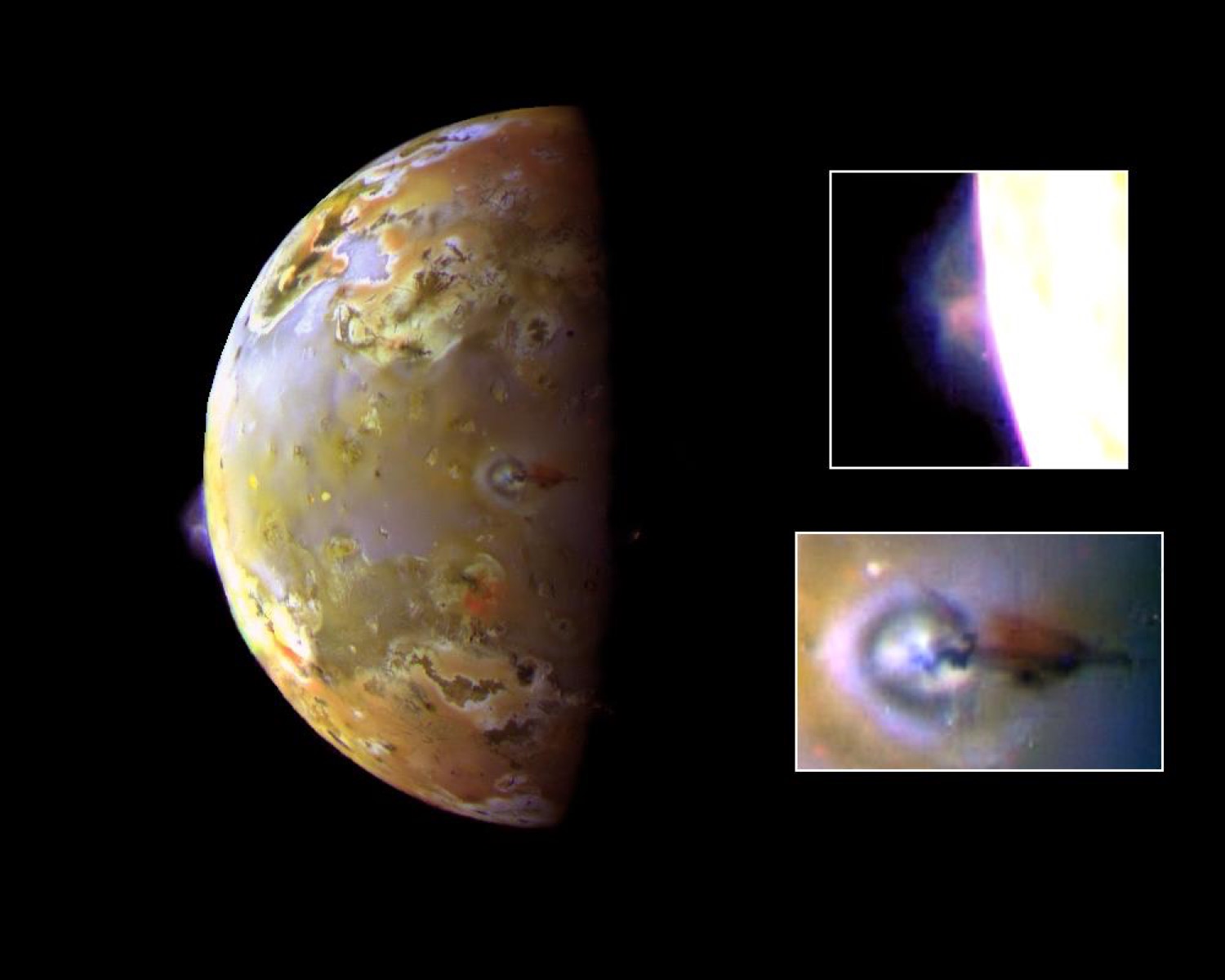
Scientists approaching the Voyager 1 flyby of 5 March 1979 — at a closest distance of 20,600 km (12,800 mi) — fully expected a battered, crater-covered world like the Moon or Mercury. What the images showed instead was a bizarre, multi-colored landscape with essentially no impact craters at all, dotted with oddly shaped pits, mountains taller than Mount Everest, and features that looked unmistakably like lava flows. The breakthrough moment came after the encounter, when Voyager navigation engineer Linda A. Morabito spotted a plume rising from the surface in one of the images. Checking further, analysts found nine such plumes scattered across Io. The discovery confirmed a theoretical prediction published just before the flyby by Stan Peale, Patrick Cassen, and R. T. Reynolds, who had calculated that tidal heating should be making Io's interior extremely hot. Voyager 2 passed on 9 July 1979 at a much more distant 1,130,000 km (700,000 mi), but comparison of the two sets of images showed that the Prometheus flow's leading edge had moved 75 to 95 km (47 to 59 mi) in just four months, and that seven of the nine plumes were still active — Pele being the only one to shut down between the two flybys.
06 Inside Io: iron core, possible magma ocean Deeper
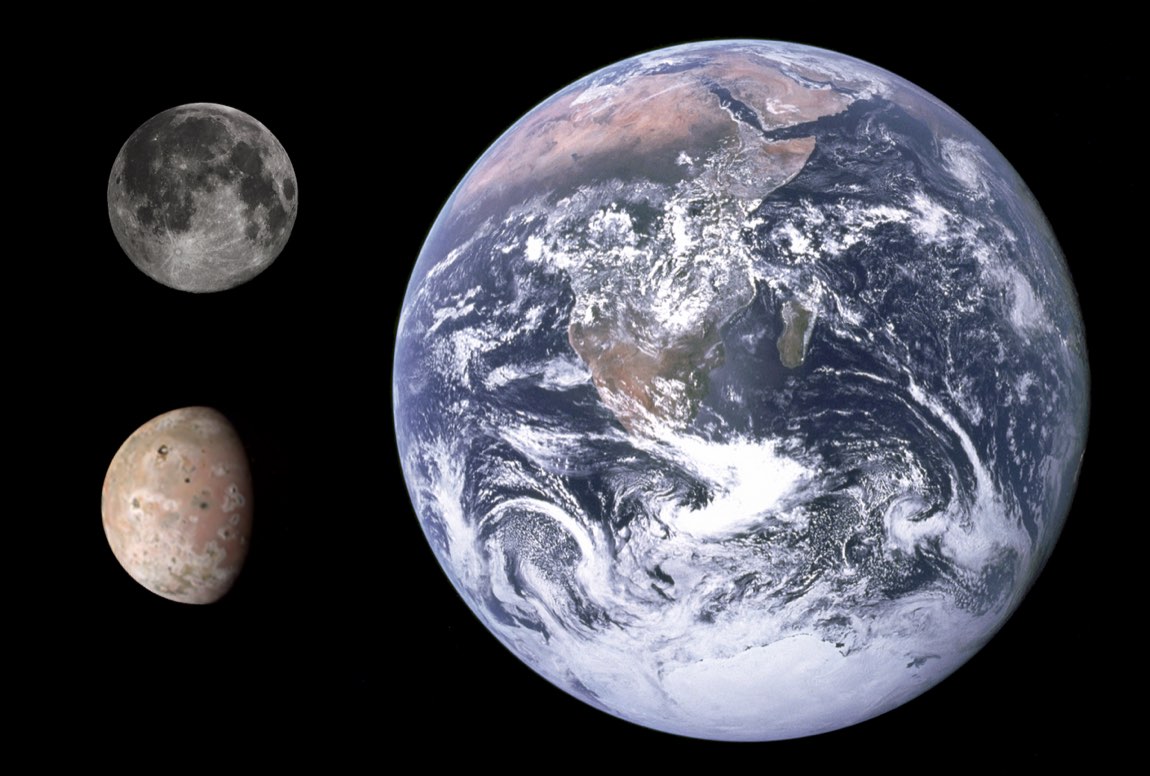
Io's interior is layered much like a rocky planet. Its overall density of 3.5275 g/cm³ — the highest of any regular moon in the Solar System and notably higher than Earth's Moon at 3.344 g/cm³ — immediately signals a silicate-and-iron composition rather than the icy mix found in most outer-Solar-System moons. Models built from Voyager and Galileo gravity measurements indicate a metallic core making up roughly 20% of Io's mass. Depending on sulfur content, that core's radius spans 350–650 km for nearly pure iron, or 550–900 km for an iron-sulfide mix. Galileo's magnetometer detected no intrinsic magnetic field, implying the core is not actively convecting. The mantle is modeled as at least 75% forsterite (a magnesium-rich mineral) with a bulk chemistry resembling L-chondrite and LL-chondrite meteorites — more iron relative to silicon than Earth or the Moon, but less than Mars. In 2009, re-analysis of Galileo magnetometer data revealed an induced magnetic field, pointing to a partially molten silicate magma ocean roughly 50 km below the surface. Follow-up analysis in 2011 provided direct evidence; the layer is estimated at 50 km thick, constituting about 10% of the mantle, at temperatures reaching 1,200 °C. A 2024 Nature study using Juno gravity data complicated the picture, arguing instead for an almost solid mantle without a global magma ocean.
 ⤢
⤢
07 How mountains grow on a volcanic world Deeper
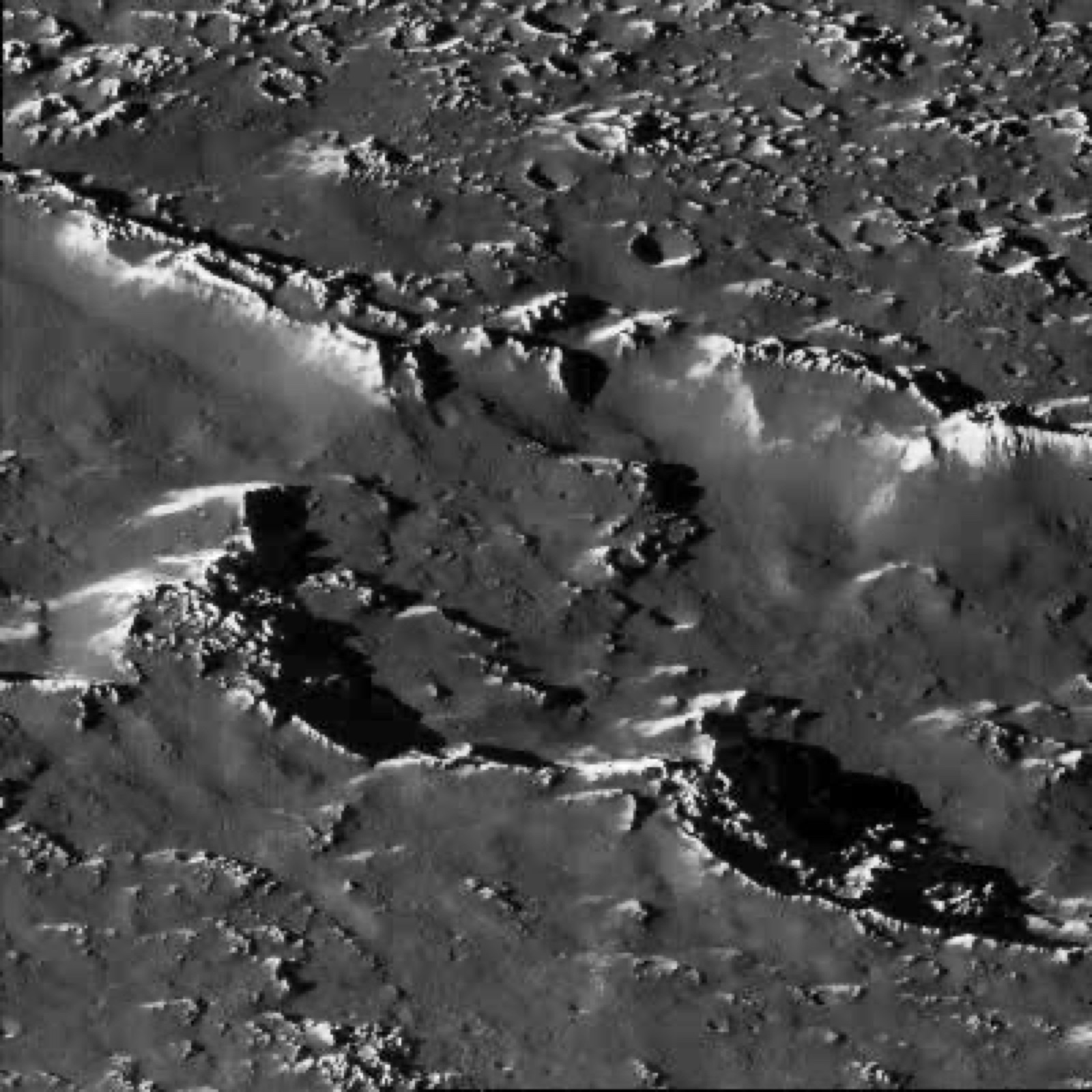
Counterintuitively, almost none of Io's 100 to 150 mountains are volcanoes. They form through compression. As volcanic material continuously buries the surface, the growing weight causes the base of Io's silicate crust to compact and buckle, building compressive stresses that thrust and tilt large crustal blocks upward through a process resembling thrust faulting on Earth. The average mountain stands about 6 km (3.7 mi) high and stretches roughly 157 km (98 mi) across. The tallest confirmed peak, South Boösaule Montes, reaches 17.5 ± 1.5 km (10.9 ± 0.9 mi) — significantly taller than Mount Everest. Most mountains are in some stage of collapse: enormous landslide deposits ring their bases, and scalloped edges along mesas and plateaus are thought to result from sulfur dioxide sapping out of the crust, weakening the rock at the margins. The global pattern of mountains and volcanoes appears to be almost complementary — where one type of feature dominates, the other is scarce — suggesting large-scale lithospheric regions alternating between compression and extension. Locally, however, paterae and mountains often sit side by side, suggesting that faults created during mountain uplift later act as pathways for magma to reach the surface.
08 The volcanoes: lakes, plumes, and outbursts
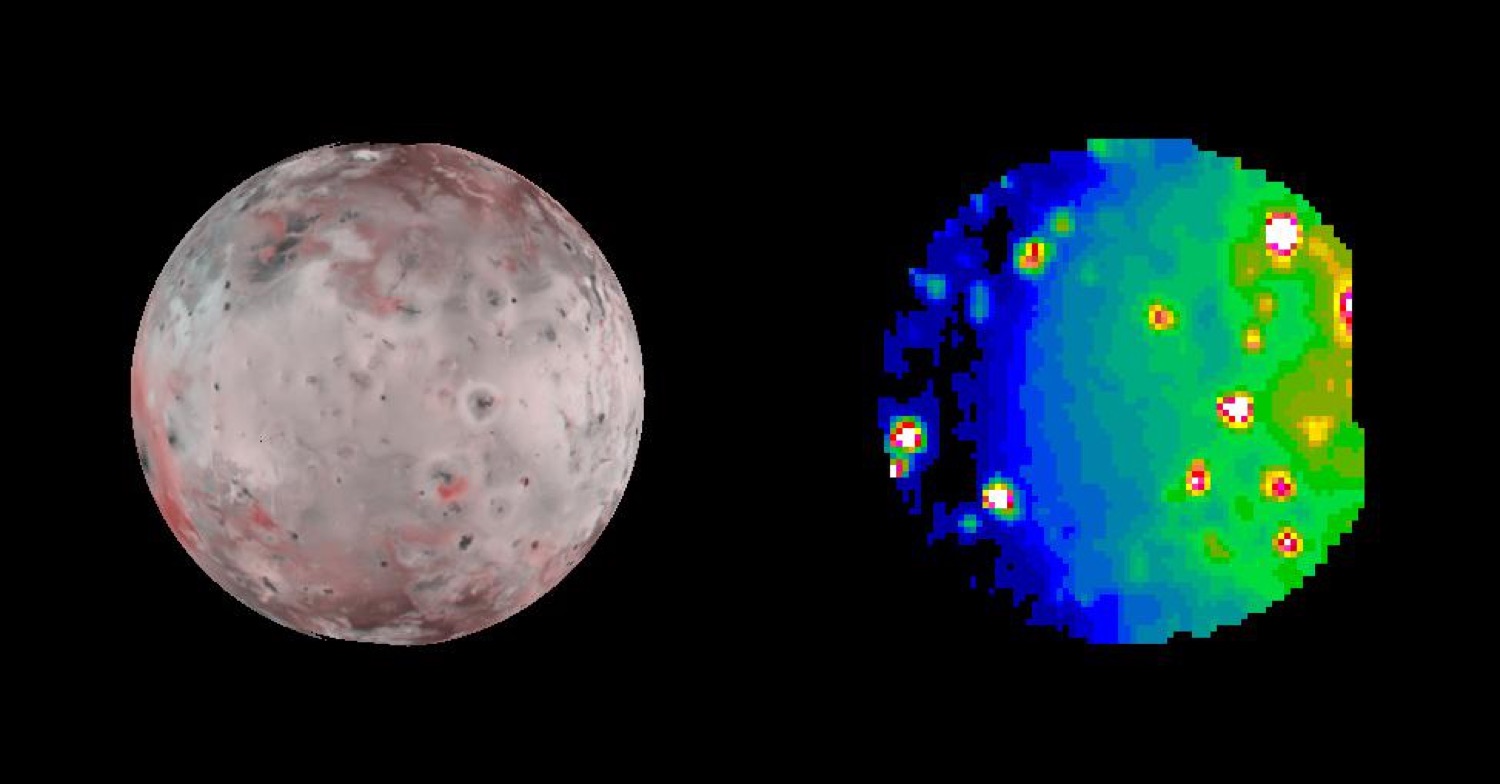
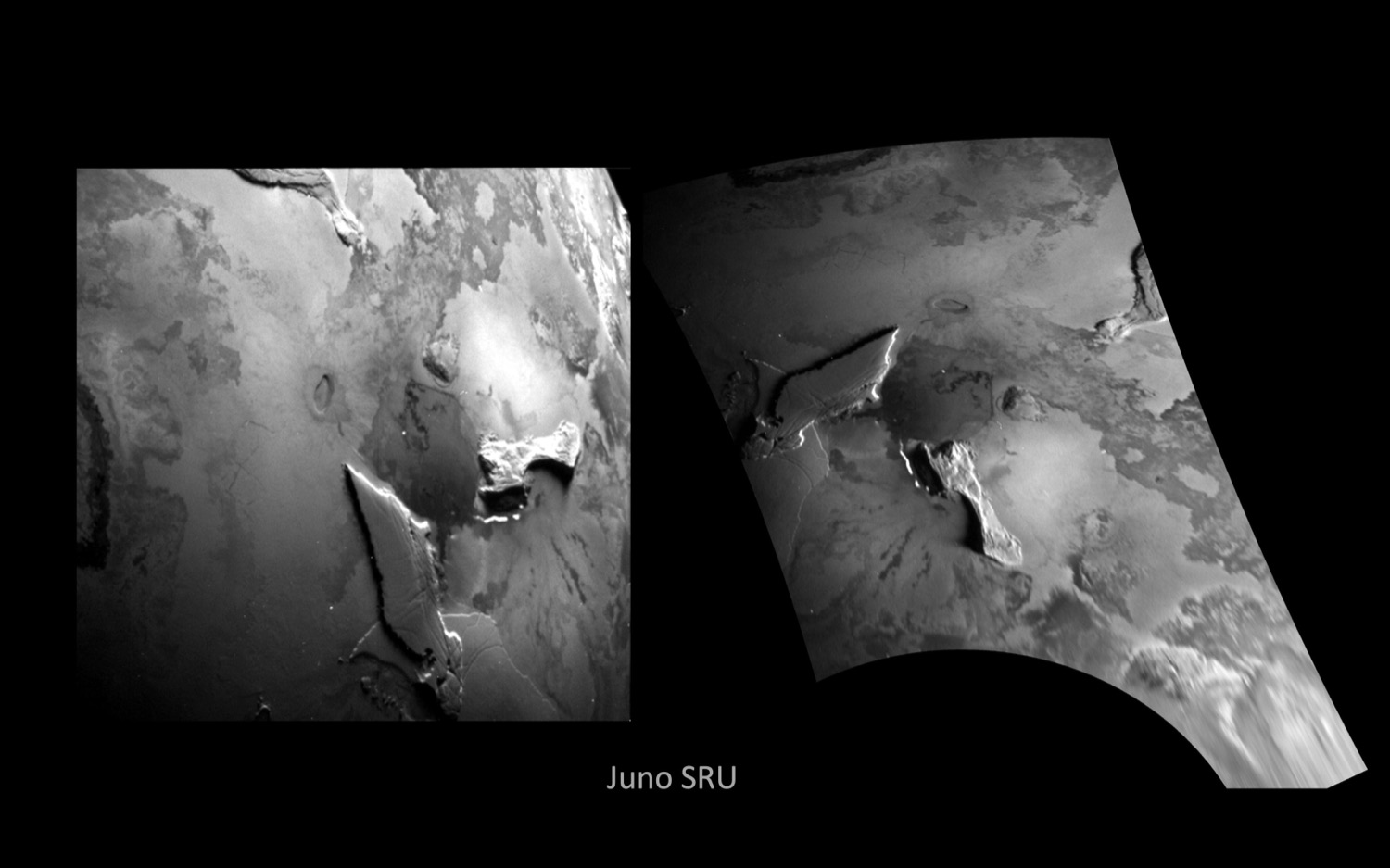
Io's volcanic depressions, called paterae, average 41 km (25 mi) in diameter and bear only a superficial resemblance to the calderas on Earth or Mars — they typically sit on flat plains rather than atop shield volcanoes, and how they form remains debated. Some researchers favor collapse over emptied lava chambers; others argue they result from the exhumation of volcanic sills. The largest is Loki Patera at 202 km (126 mi) across, and Loki is consistently the strongest single heat source on Io, contributing on average 25% of the moon's total global heat output. Lava lakes are a distinctive feature: Pele hosts one with a continuously overturning crust, while Loki's crust overturns episodically. During major eruptions, lava flows can exceed 500 km (300 mi) in length, and a single 1997 eruption at Pillan Patera produced more than 3,500 km² (1,400 sq mi) of fresh lava. The most energetic event on record, observed on 27 December 2024 by the Juno spacecraft's JIRAM instrument, covered roughly 65,000 km² — three times Loki Patera's area — and produced a power output of 140–260 TW, surpassing the previous record of about 80 TW set by the Surt eruption in 2001.
09 Two very different kinds of volcanic plumes Deeper
Io's eruption plumes fall into two broadly distinct families. The larger type originates directly at volcanic vents or lava lakes, where dissolved sulfur and sulfur dioxide gas violently degas from erupting magma, sometimes dragging silicate ash particles along. These giant plumes — Pele and Tvashtar are classic examples — can deposit red rings more than 1,000 km (620 mi) in diameter. The red color comes from short-chain molecular sulfur (3- and 4-chain forms) rather than the stable 8-chain variety, along with sulfur dioxide and possibly sulfuryl chloride. A second, gentler type forms when advancing lava flows vaporize underlying sulfur dioxide frost at the flow margins. Because the sulfur dioxide flash-vaporizes from the ground up rather than being blasted out of a vent, these plumes are typically less than 100 km (62 mi) tall, deposit bright circular patches of sulfur dioxide, and can persist for decades: Prometheus and Amirani are prime examples, with Prometheus's activity tracked continuously from Voyager in 1979 through the Galileo era. Plume ejecta travels at speeds reaching 1 km/s (0.62 mi/s). Additional materials detected in plumes include sodium, potassium, and chlorine, all of which feed Io's neutral cloud and plasma torus.
 ⤢
⤢
10 An atmosphere that freezes every night
Io's atmosphere is almost comically thin — maximum surface pressure ranges from just 3.3 × 10⁻⁵ to 3 × 10⁻⁴ pascals, billions of times less than Earth's sea-level pressure of about 101,000 pascals. Sulfur dioxide (SO₂) dominates, with minor amounts of sulfur monoxide, sodium chloride, and atomic sulfur and oxygen. Much of the dayside SO₂ is maintained by sunlight warming frozen sulfur dioxide frost into vapor, which is why the atmosphere is densest over the anti-Jupiter hemisphere where frost is most abundant, and denser when Io is closer to the Sun. At night, or when Io passes into Jupiter's shadow, the atmosphere essentially collapses: column density drops by around 80% as SO₂ vapor re-freezes onto the cold surface. This collapse was directly measured by the Gemini Observatory in 2013. Volcanic plumes pump roughly 10⁴ kg of sulfur dioxide per second into the atmosphere to keep it topped up, though most of that material promptly refreezes. At higher altitudes, temperatures climb all the way to 1,800 K — heated by plasma from the Io plasma torus and by Joule heating from the Io flux tube — even as the surface below sits at cryogenic temperatures in shadow.
11 Auroras without a magnetic field Deeper
Despite having no intrinsic magnetic field of its own, Io produces a vivid auroral glow visible in high-resolution eclipse images. The mechanism differs from Earth's polar auroras: rather than particles funneled toward the poles by a local field, electrons streaming along Jupiter's external magnetic field lines crash directly into Io's thin atmosphere wherever those field lines are tangent to the moon's limb — which happens near Io's equator rather than its poles. Because the electrons travel through the longest column of atmosphere at the tangent points, that is where the brightest emission appears. The auroral patches are seen to rock back and forth with the changing orientation of Jupiter's tilted magnetic dipole. Separate, fainter glows have been detected from oxygen atoms along Io's limb and from sodium atoms on the nightside. Io's lack of an intrinsic field is itself revealing: Galileo's magnetometer detected no internal magnetic field, suggesting the iron core is not convecting. However, the spacecraft did detect an induced magnetic field — generated by the interaction of Jupiter's changing external field with Io's partially molten interior — which became key evidence for the proposed subsurface magma ocean 50 km below the surface.
12 The plasma torus: Jupiter's neon ring Deeper
Io continuously bleeds material into space: Jupiter's magnetosphere strips roughly 1 tonne of gas per second from Io's thin atmosphere. This material — ionized and atomic sulfur, oxygen, and chlorine, plus sodium, potassium, and molecular sulfur dioxide — becomes trapped in Jupiter's magnetic field and spreads into a doughnut-shaped ring of plasma called the Io plasma torus, centered on Io's orbit. Unlike the neutral cloud that surrounds Io itself and extends up to six Io radii outward, the plasma torus co-rotates with Jupiter's magnetosphere at 74 km/s, far faster than Io's own orbital speed of 17 km/s. Ions spend an average of 40 days in the torus's "warm" outer section before escaping outward, where their outward pressure physically inflates Jupiter's already-enormous magnetosphere. The torus has three distinct zones: a warm outer torus just outside Io's orbit, a vertically extended "ribbon" at Io's orbital distance, and a cold inner torus of particles slowly spiraling toward Jupiter. Dust particles, averaging 10 μm in size and composed primarily of sodium chloride, are ejected from the Jovian system at speeds of several hundred kilometers per second — streams first detected by the Ulysses spacecraft in 1992 and confirmed by Galileo to originate from Io.
 ⤢
⤢
13 Four decades of spacecraft visits
Pioneer 10 made the first spacecraft flyby of Io on 3 December 1973, followed by Pioneer 11 on 2 December 1974. Their radio tracking pinned down Io's high density, and Pioneer 11's camera caught the moon's yellow-tinted north polar region, though Pioneer 10's close-up images were lost to radiation interference. The twin Voyagers transformed understanding in 1979, discovering active volcanism and a crater-free young surface. Galileo arrived at Jupiter in December 1995 after a six-year journey; its very first close pass, on 7 December 1995, revealed Io's large iron core. Extended missions in 1999–2000 and 2001–2002 added six more close flybys. Cassini contributed joint observations with Galileo in December 2000, revealing a new plume at Tvashtar Paterae. New Horizons, passing on 28 February 2007, captured the first detailed look at a giant Pele-class plume since 1979. The Juno spacecraft, in orbit around Jupiter since 5 July 2016, performed its closest flybys of Io on 30 December 2023 and 3 February 2024, both at altitudes of 1,500 km, using Doppler tracking to probe the gravity field and JIRAM infrared imaging to map current volcanic activity — including a record-breaking outburst discovered on 27 December 2024.
14 Open questions that keep scientists busy Deeper
Despite decades of observation, Io guards several deep mysteries. Whether a global magma ocean exists 50 km beneath the surface is genuinely contested: re-analysis of Galileo magnetometer data in 2009 and a 2011 study argued in favor of one, while a 2024 Nature paper using Juno gravity measurements argued instead for an almost-solid mantle. The pattern of volcanism is also puzzling: tidal heating theory predicts volcanoes clustered at specific latitudes and longitudes, yet the observed volcanoes are shifted 30 to 60 degrees to the east of those predictions — one proposed explanation is that the circulation of a subsurface magma layer generates additional frictional heat, displacing the hot spots. How Io's metallic core was formed and whether it is partially liquid also remains unresolved; because Galileo's magnetometer detected no intrinsic field, the core is likely not convecting today, but the full thermal history is unclear. The origin of Io's dust streams — whether from direct volcanic ejection or surface sputtering — is unknown. And the exact processes by which the Io flux tube and plasma torus modulate Jupiter's decametric radio emissions, while strongly correlated with Io's orbital position, are still being untangled by the Juno mission.
15 Watching Io from Earth
Io shines at about 5th magnitude when near Jupiter, bright enough in principle to see with the naked eye if Jupiter were not so overwhelmingly close. Through even a small telescope it appears as a bright dot, and Io moves fast enough that its position relative to Jupiter visibly changes over the course of a single night's observation — it completes one full orbit in just 42.5 hours (1.77 days). For centuries, timing the moments when Io disappears into Jupiter's shadow and reappears on the other side was astronomically important: Giovanni Cassini's eclipse tables allowed Pierre-Simon Laplace to develop the mathematical theory of the Laplace resonance, and such timings gave Ole Rømer the data to make the first measurement of the speed of light. Modern ground-based infrared telescopes and the Hubble Space Telescope can detect Io's brightest volcanic eruptions from Earth. The Gemini Observatory directly measured the collapse and reformation of Io's SO₂ atmosphere during Jupiter eclipse in 2013. In the near-infrared, Io's volcanic hot spots glow brightly enough that large ground-based telescopes can monitor new eruptions — a valuable complement to rare spacecraft flybys.
 ⤢
⤢
You would weigh…
Surface gravity 1.80 m/s² vs Earth’s 9.81 m/s². Try every world →
Could life exist here?
Relentless volcanism, sulfur chemistry, intense radiation, and no persistent liquid water: Io is a magnificent place for geology and a terrible one for biology.
Our labels: Confirmed · Strong Evidence · Estimated · Hypothesis · Theoretical · Speculative (see Methodology).
Could humans live here?
No. Between Jupiter's radiation belts (worst at Io's orbit) and ground that may erupt under you, Io is strictly for robots — preferably fast ones.
How would we get there?
Same road as Jupiter (5–6 years). No dedicated Io mission is scheduled; an 'Io Volcano Observer' concept has repeatedly reached NASA's final selection rounds.
| Technology | Status | Travel time (one way, straight line) |
|---|---|---|
| Apollo-style spacecraft, about 39,000 km/h | Flown technology | 673 days |
| Ion-propulsion probe, about 90,000 km/h | Flown technology | 291 days |
| Voyager 1, about 61,000 km/h | Flown technology | 428 days |
| Parker Solar Probe, about 690,000 km/h | Flown technology | 38 days |
| Nuclear-thermal rocket, about 120,000 km/h cruise | In development | 220 days |
| Laser light-sail at 20% of light speed | Proposed concept | 2.9 hours |
| Light itself, 299,792 km/s | Physical limit | 35 minutes |
Simplified straight-line times at cruise speed. Real missions fly curved orbital paths and take longer. Full travel calculator →
Weird & wonderful
- Io's volcano Loki out-erupts every volcano on Earth combined.
- Mountains on Io reach 17 km — taller than Everest — pushed up by the crust crumpling.
- Its eruptions can be seen by telescopes from Earth, half a billion kilometers away.
- Sulfur snow falls around its volcanoes.
More real images of Io
Genuine spacecraft and telescope imagery, every frame credited and licensed. Tap any photo to enlarge.