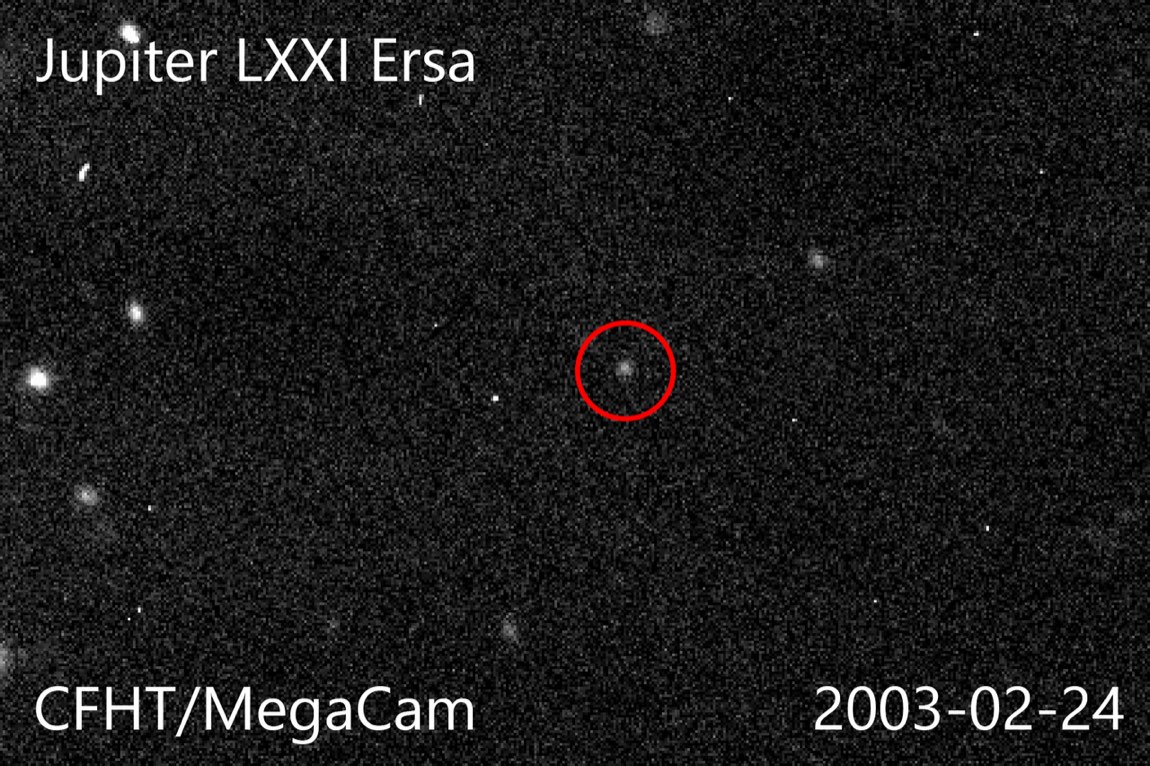
 Photograph · Scot S. Sheppard/Canadian Astronomy Data Centre · CC BY-SA 4.0
Moon · Deep guide · orbits Jupiter
Ersa
Also called: Jupiter LXXI · S/2018 J 1
A 3-km moon named by the public in a 2019 online contest.
What is it?
Ersa is one of the smallest known members of Jupiter's Himalia group, roughly 3 km across. Scott Sheppard found it in May 2018 with the 4-metre Blanco telescope at Cerro Tololo in Chile, and it was announced with nine other Jovian moons in July 2018. Older images showed it as far back as 2000. It is named after Ersa, Greek goddess of dew and daughter of Zeus and Selene, a name chosen through a Carnegie Institution naming contest on Twitter.
The deep dive
Researched for the Atlas from Wikipedia — Ersa (moon) (2,034 characters read) · updated Nov 14, 2026
01 A Moon Found Twice, Decades Apart
Ersa has a curious double discovery story. Scott S. Sheppard spotted it on 11 May 2018 using the 4.0-meter Víctor M. Blanco Telescope at Cerro Tololo Observatory in Chile, and the find was formally announced on 17 July 2018 alongside nine other Jovian moons. But the moon had actually been photographed long before anyone knew what it was. When researchers combed through archival sky surveys, they found Ersa lurking in precovery images dating as far back as 6 August 2000 — nearly two decades before its official discovery. Those old images became crucial evidence. The Minor Planet Center only assigned Ersa its provisional designation, S/2018 J 1, after observations spanning a long enough time to confirm the satellite's orbit with confidence. That confirmation process is not a formality: tiny outer moons can be confused with background asteroids or lost entirely if the orbital arc is too short. The span between that 2000 precovery image and the 2018 detection gave astronomers an unusually long baseline to pin down where Ersa was really going.
02 The Himalia Group: A Family of Fragments
Ersa belongs to the Himalia group, a tight cluster of prograde irregular moons that share similar orbits around Jupiter. The group travels at semi-major axes between 11 and 12 million km from Jupiter and maintains inclinations between 26 and 31 degrees relative to the ecliptic. Ersa's own orbit sits at a semi-major axis of about 11,401,000 km, with an inclination of about 29.1 degrees. The fact that these moons share such similar orbital parameters is not a coincidence — it strongly suggests they are fragments of a single larger body that was shattered, probably by a collision with an asteroid or comet long ago. Himalia itself, the group's namesake and largest member, is thought to be the main remnant of that original object. Ersa, tiny as it is at an estimated diameter of just 3 km, would then be one of the smaller chips of that ancient impact. Studying the group as a whole helps planetary scientists reconstruct what kinds of objects were roaming the early solar system when Jupiter was sweeping up its irregular satellite family.
03 Prograde but Still Wildly Perturbed Deeper
Most of Jupiter's irregular moons travel in retrograde — opposite to the planet's rotation — but the Himalia group, including Ersa, orbits in the prograde direction, the same way Jupiter spins. That detail matters for understanding how these moons were captured in the first place, since prograde capture requires different circumstances than retrograde capture. Yet prograde does not mean stable. At roughly 11.4 million km from Jupiter, Ersa is so far from its host planet that the gravitational pulls of the Sun and other planets constantly tug at its path. The article notes that this makes Ersa's orbit highly variable over time, meaning the precise values of its semi-major axis, inclination, and eccentricity shift measurably across centuries. This is a common challenge when cataloguing Jupiter's outer moons: the numbers published today are averages or snapshots, not permanent addresses. Long-term numerical integration of these orbits is the only way to predict where such moons will actually be in the distant future, and even those calculations carry growing uncertainty as perturbations accumulate.
04 How Small Is 3 Kilometers, Really?
Ersa's estimated diameter of 3 km — just under 2 miles — puts it among the smallest confirmed members of the Himalia group. To put that in everyday terms, 3 km is roughly the length of about 30 city blocks, or just a bit longer than New York's Central Park from north to south. An object that size would barely register as a hill if set down on Earth. The size estimate comes indirectly from Ersa's absolute magnitude of 15.9: astronomers measure how bright the object appears and then calculate how large it must be to reflect that much light, assuming a reasonable surface reflectivity. Because the reflectivity — called albedo — is not measured directly for Ersa, the 3 km figure carries some uncertainty. A darker surface would imply a larger moon; a brighter one would imply smaller. Even so, the estimate places Ersa firmly in the category of rubble-pile-scale moonlets, worlds so small that their own gravity would barely hold a person to the surface.
05 Naming a Moon on Twitter
The story of how Ersa got its name is unusually democratic. In 2019, the Carnegie Institution held a public naming contest on Twitter, inviting anyone to suggest names for newly confirmed Jovian moons, with the rule that Himalia group members must receive names ending in the letter 'a.' More than twenty separate tweets proposed the name Ersa, after the Greek goddess of dew, daughter of Zeus and Selene. The first to submit it was Aaron Quah, posting under the handle @8603103. Among the other early suggesters were the twelfth-grade students of Saint Sauveur High School in Redon, France; fifth-graders from Hillside Traditional Academy in British Columbia, Canada, whose teacher submitted on their behalf; and, perhaps most memorably, a four-year-old child who sang a song about Ersa, with the submission posted by a parent. The name also connects to another Jovian moon: Herse, designated Jupiter L, shares the same mythological figure — Herse being an alternate Greek spelling for the same goddess of dew — giving the two small moons a sibling relationship in both mythology and orbital family.
06 Mythology Behind the Name
Ersa is the Greek goddess of dew, and her parentage ties directly into the naming logic used for Jupiter's moons. She is a daughter of Zeus — the Greek counterpart of Jupiter — and of Selene, the goddess of the Moon. That divine lineage fits the International Astronomical Union's convention of naming Jupiter's satellites after figures connected to the god Jupiter or Zeus. The Himalia group specifically follows the convention of names ending in 'a,' which distinguishes prograde irregular moons from retrograde ones, which tend to receive names with different endings. The choice of a dew goddess for a 3-km chip of ancient rock orbiting 11 million km away might seem whimsical, but it reflects a genuine tradition of connecting the solar system's smallest, most distant objects to quieter, subtler figures from mythology rather than the heroic names reserved for larger worlds. Ersa's twin name, Herse — Jupiter L — honors the same goddess, making them the only pair of Jovian moons that share a single mythological identity expressed in two different languages.
07 The Telescope That Found Ersa Deeper
The discovery instrument, the Víctor M. Blanco Telescope at Cerro Tololo Inter-American Observatory in Chile, is a 4.0-meter reflector that has become one of the premier tools for finding faint solar system objects in the southern sky. Its large aperture collects enough light to detect very dim targets — a necessity when hunting for moonlets as small as Ersa at distances of tens of millions of kilometers. Scott S. Sheppard, based at the Carnegie Institution for Science, has used this and similar wide-field instruments in systematic searches for undiscovered Jovian satellites. Finding a moon like Ersa is not a single dramatic moment but a methodical process: take deep images on multiple nights, identify objects that move against the background stars at the right rate and direction, then track them long enough to confirm a closed orbit around Jupiter rather than a passing asteroid. For Ersa, that confirmation process drew on the 2000 precovery data as well as fresh 2018 observations, together providing an 18-year arc that left little ambiguity about the moon's true nature.
08 Orbital Numbers Worth Knowing Deeper
Ersa's average semi-major axis of about 11,401,000 km places it well outside Jupiter's main ring system and far beyond the orbits of the large Galilean moons. For comparison, Callisto, the outermost Galilean moon, orbits at roughly 1.9 million km — Ersa sits about six times farther out than that. The inclination of about 29.1 degrees with respect to the ecliptic is typical for the Himalia group, which collectively spans 26 to 31 degrees, suggesting that whatever collision produced these fragments did not dramatically scatter their orbits in the vertical direction. Because the orbit is perturbed significantly by the Sun and other planets, the semi-major axis and inclination values published for Ersa are best understood as mean or osculating elements valid at a particular epoch rather than fixed constants. Any detailed mission planning or long-range prediction would require ongoing orbital refinement as new positional measurements accumulate over future oppositions of Jupiter.
09 Open Questions About This Tiny World Deeper
Despite its confirmed status as a Jovian satellite, almost everything about Ersa's physical nature remains unknown. Its diameter of 3 km is an estimate dependent on an assumed albedo; no direct measurement of its surface reflectivity exists. Its composition is uncharacterized — whether it is a rocky fragment, a carbonaceous body, or something else entirely cannot be determined from current data. Its rotation period, shape, and surface geology are all unmeasured. The Himalia group as a whole is thought to represent collision debris from a larger captured body, but the size and origin of that parent object are still debated. Ersa's very small size means it would have negligible self-gravity, suggesting it might be an irregularly shaped chunk rather than a sphere, but no images resolve its disk. Future large ground-based telescopes or, more realistically, a dedicated Jupiter system mission with a wide survey mode would be needed to begin answering even the most basic physical questions about this dew-goddess moon.