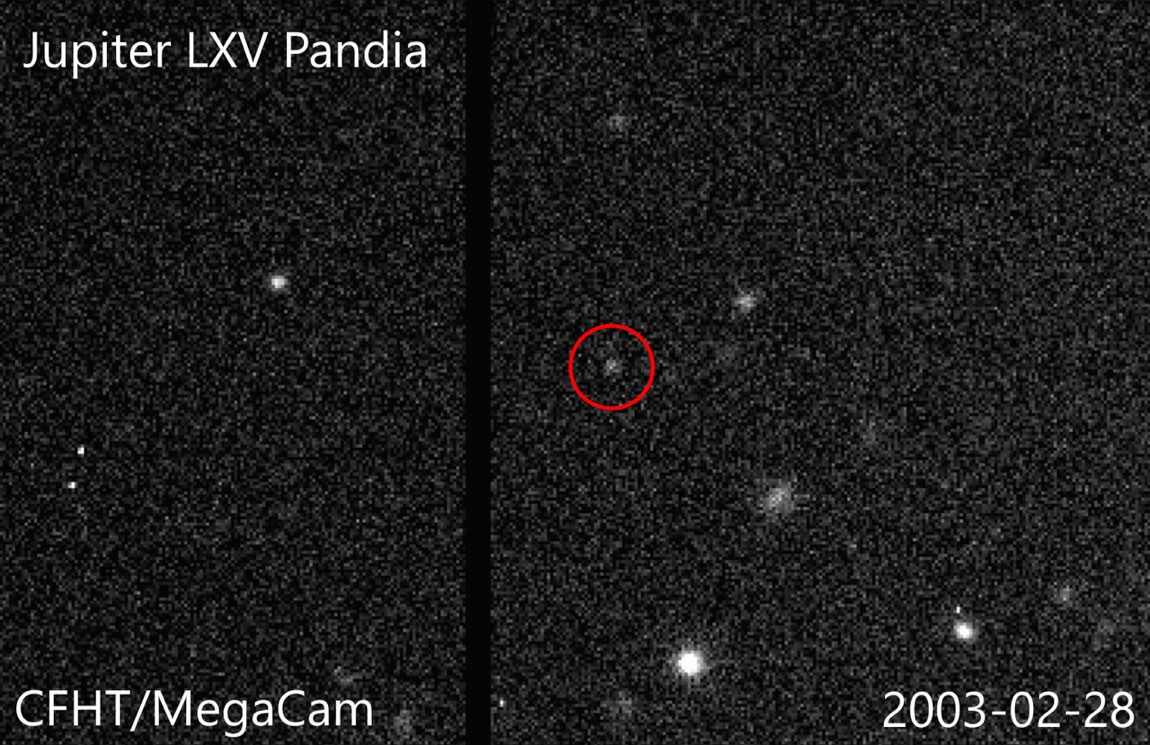
 Photograph · Brett J. Gladman/Canadian Astronomy Data Centre · CC BY-SA 4.0
Moon · Deep guide · orbits Jupiter
Pandia
Also called: Jupiter LXV · S/2017 J 4
A tiny Himalia-family moon named for the Greek goddess of the full moon.
What is it?
Pandia is a small outer moon of Jupiter, about 3 km across, in the prograde Himalia group. Scott Sheppard's team found it in March 2017 with the Dark Energy Camera at Cerro Tololo, and it was announced in July 2018. Its name, given in 2019, honours Pandia, daughter of Zeus and Selene and goddess of the full moon; a school astronomy club in Cornwall was among those who proposed it in a public contest.
The deep dive
Researched for the Atlas from Wikipedia — Pandia (moon) (2,096 characters read) · updated Nov 14, 2026
01 How Pandia was actually found
Scott S. Sheppard and his team first spotted Pandia on 23 March 2017, using the 4.0-meter Víctor M. Blanco Telescope at Cerro Tololo Observatory in Chile — one of the most powerful wide-field instruments available for hunting faint solar system objects. Despite that early detection, the discovery wasn't announced until 17 July 2018, more than a year later. The delay was deliberate: astronomers needed to track the moon across enough of its orbit to confirm that what they were seeing was genuinely a bound satellite of Jupiter and not a background asteroid drifting through the field. The Minor Planet Center gave it the provisional designation S/2017 J 4, reflecting the year of the actual observations. Pandia was announced alongside nine other newly confirmed Jovian moons in the same circular, making it part of one of the largest single-batch moon announcements in Jupiter's observational history.
02 Hidden in plain sight since 2003
Even though Pandia was formally discovered in 2017, it had already been photographed years before anyone knew what it was. Precovery observations — archival images searched after a discovery to extend the known timeline of an object — have identified Pandia in data going back to as early as 2003. This means Pandia was captured on telescope images for roughly fourteen years before it was recognized as a moon of Jupiter. Precovery is a standard and powerful technique in solar system astronomy: once you know exactly where and how fast an object moves, you can work backward through old survey data and find it hiding among the stars. These earlier detections are invaluable because they give a much longer arc of positional data, which dramatically improves the precision of the calculated orbit and helps astronomers understand how the moon's path shifts over time under gravitational pressure from the Sun and other planets.
03 A panda mascot that named a moon
In 2019, the moon officially received the name Pandia, after the Greek goddess of the full moon, who was the daughter of Zeus and Selene. The name was chosen following a public naming contest held by the Carnegie Institute on Twitter. While many suggestions came in, one stood out: a submission from the astronomy club of the Lanivet School in Cornwall, United Kingdom, put forward by Twitter user "@emmabray182" on the club's behalf. Their reasoning was charmingly local — the school's mascot is a panda, and the village of Lanivet historically supplied bamboo to a panda housed at London Zoo. The connection between "Pandia" and "panda" made the name both mythologically appropriate and personally meaningful to the students. Because Pandia belongs to the prograde Himalia group, it follows the naming convention for that cluster: all members receive names ending in the letter "a."
04 One of the tiniest Himalia group members
Pandia is estimated to be only about 3 km (1.9 mi) in diameter — roughly the length of a medium-sized city's downtown core from end to end. That makes it one of the smallest known members of the Himalia group, the cluster of prograde irregular moons that orbit Jupiter at similar distances and angles. Its absolute magnitude is 16.2, meaning it reflects very little light and would be completely invisible to any but the largest telescopes. For comparison, Himalia itself, the group's dominant member, is estimated to be around 140 km across, making it roughly 47 times wider than Pandia by diameter and thousands of times more massive by volume. Pandia's diminutive size raises the question of whether it might be a fragment chipped off a larger body long ago, a possibility consistent with the leading theory for how the Himalia group as a whole formed.
05 The Himalia group and its shared origins Deeper
Pandia belongs to the Himalia group, described as a tight cluster of prograde irregular moons that follow orbits similar to those of Himalia. All members of the group travel at semi-major axes between roughly 11 and 12 million km (6.8 to 7.5 million mi) from Jupiter and maintain inclinations relative to the ecliptic between 26° and 31°. The fact that multiple moons share such closely matched orbital parameters is the central clue to their origin: astronomers believe the Himalia group members are likely fragments of a single captured body that broke apart, either through a collision or tidal disruption, sometime in the deep past. Pandia's own semi-major axis of about 11,481,000 km and inclination of about 29.0° place it comfortably within this cluster. The group's prograde motion — orbiting Jupiter in the same direction as the planet's rotation — also distinguishes it from the outer retrograde irregular moons that dominate Jupiter's distant satellite population.
06 Why Pandia's orbit never stays still Deeper
Pandia orbits Jupiter at an average distance of about 11,481,000 km (7,134,000 mi), but that average hides a great deal of restlessness. At such a remote distance from Jupiter, the moon's path is highly subject to gravitational perturbations from the Sun and other planets, which cause the orbit to shift and evolve continuously over time. This is a property shared by all of Jupiter's irregular moons, but it is especially pronounced for the more distant ones. The semi-major axis, eccentricity, and inclination of Pandia's orbit are not fixed constants — they vary, sometimes substantially, over long timescales. This dynamical instability means that the neat orbital numbers quoted for Pandia today are snapshots of a moving target. For planetary scientists, modeling these perturbations is essential both for predicting where Pandia will be in the future and for running simulations backward in time to understand where it came from and how it ended up in the Himalia group.
07 Observing Pandia from Earth
With an absolute magnitude of 16.2 and an estimated diameter of only 3 km (1.9 mi), Pandia is far beyond the reach of amateur telescopes and even most professional instruments not specifically designed for wide-field faint-object surveys. It took a 4.0-meter class telescope — the Víctor M. Blanco Telescope at Cerro Tololo Inter-American Observatory in Chile — to detect it in the first place. Tracking it well enough to confirm its orbit required additional observations spread over a long enough time span that the Minor Planet Center could verify its motion as consistent with a bound Jovian satellite. Even with large telescopes, Pandia appears as nothing more than a point of light indistinguishable in appearance from background stars or distant asteroids. Extracting meaningful science from such a faint and tiny object requires careful image stacking, precise astrometry, and comparison against archival survey data, as the precovery observations from 2003 demonstrate.
08 Open questions Pandia leaves unanswered Deeper
Pandia's discovery raises more questions than current data can answer. Its size estimate of 3 km (1.9 mi) is based on its absolute magnitude of 16.2 combined with an assumed reflectivity, but no direct measurement of its surface albedo exists. If Pandia is darker or brighter than assumed, its true diameter could differ significantly. Its surface composition is unknown, as no spectroscopic data has been published in the article. Whether Pandia is a monolithic chunk of rock or a loosely bound rubble pile is similarly unresolved. Perhaps most fundamentally, the precise mechanism by which the Himalia group formed — a collision between a captured asteroid and an earlier Jovian satellite, or the direct tidal disruption of a captured object — remains an active area of debate. Pandia's exact relationship to other group members, and whether its orbit can be used to date the breakup event, are questions that future dedicated observations or a close spacecraft flyby would be needed to address.