Moon · Deep guide · orbits Jupiter
Valetudo
Also called: Jupiter LXII · S/2016 J 2
A 1-km 'wrong-way driver' whose forward orbit crosses the paths of backward-moving moons.
What is it?
Valetudo is one of Jupiter's tiniest named moons, only about 1 km across. Scott Sheppard's team found it in 2016 with the 6.5-metre Magellan telescope at Las Campanas, Chile, and announced it in 2018. It orbits about 19 million km out in a prograde direction, taking almost a year and a half per lap. That path crosses the orbits of several retrograde moons going the other way, so Valetudo may one day collide with one of them.
The deep dive
Researched for the Atlas from Wikipedia — Valetudo (moon) (1,747 characters read) · updated Nov 14, 2026
01 Discovered in Data, Announced Years Later
Valetudo's story began not with a dramatic night at the telescope but with patient analysis of archival images. Scott S. Sheppard and his team first captured the moon in data acquired by the 6.5-metre Magellan-Baade telescope at Las Campanas Observatory in Chile in 2016, but the discovery was not announced until 17 July 2018 — a gap of roughly two years. The announcement came through a Minor Planet Electronic Circular issued by the Minor Planet Center, the official clearinghouse for small-body discoveries in the solar system. Valetudo was not announced in isolation; the same circular reported the discovery of nine other Jovian moons simultaneously. Confirming the find required data from two additional world-class facilities: the 8.1-metre Gemini North telescope on Mauna Kea, Hawaii, and the 4.0-metre reflector at Cerro Tololo Inter-American Observatory in Chile. Using multiple large telescopes is standard practice when hunting for extremely faint, kilometre-scale objects billions of kilometres away, because a single instrument's data can harbour ambiguities that independent observations resolve.
02 A Tiny World Just One Kilometre Across
Valetudo is extraordinarily small even by the standards of Jupiter's irregular moons. Its estimated diameter is about 1 km — roughly the length of ten city blocks laid end to end. At that scale it is not a geologically complex world with mountains or valleys in any meaningful sense; it is closer in character to a large asteroid or a sizable boulder drifting through the outer Jovian system. Its mass is not stated in current literature with precision, which itself reflects how difficult it is to characterise such a faint, distant object. The 1 km diameter figure comes from brightness measurements combined with assumptions about the moon's reflectivity, so it carries inherent uncertainty. For comparison, Jupiter's large Galilean moons range from about 3,100 km to nearly 5,300 km in diameter, making Valetudo thousands of times smaller in linear scale and unimaginably less massive. Its tiny size is part of what makes its orbital behaviour so scientifically intriguing — a small body is far more vulnerable to gravitational nudges and future collisions than a large one.
03 An Orbit That Swims Against the Current Deeper
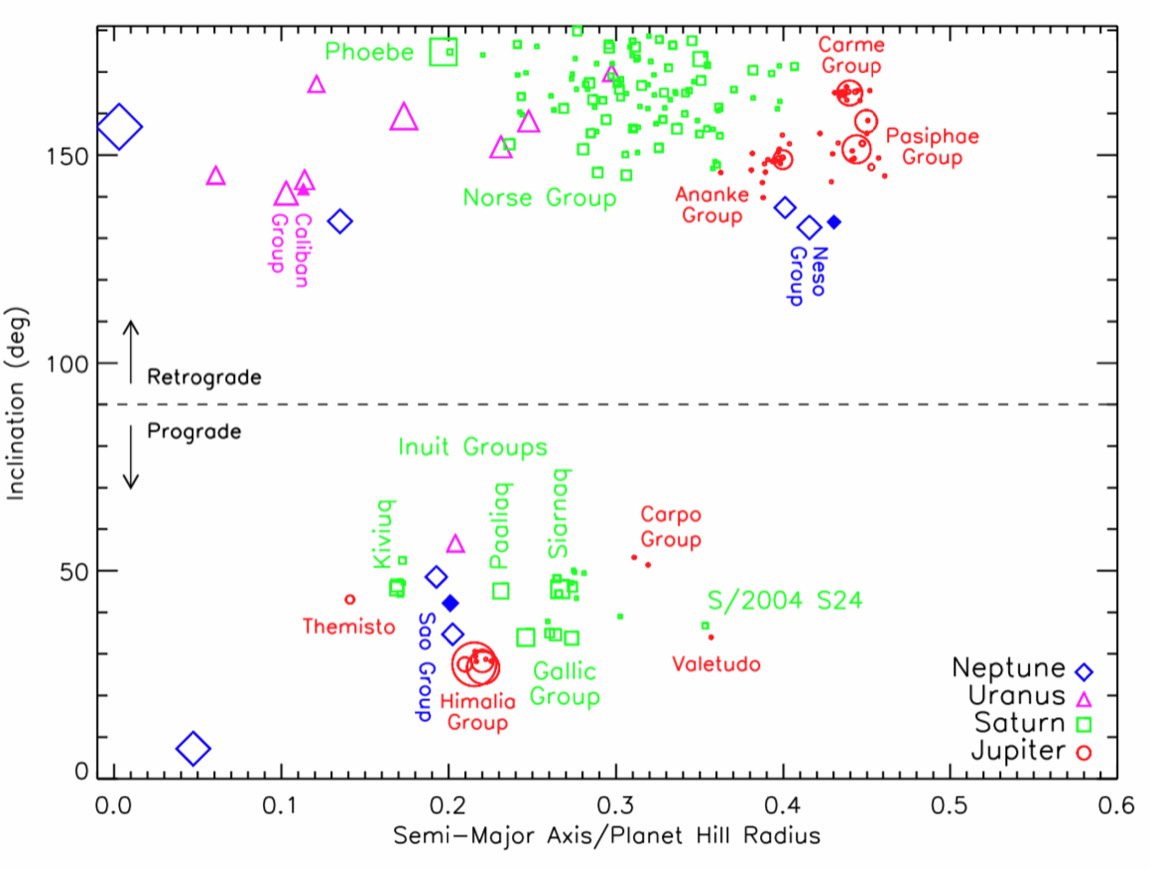
The most remarkable thing about Valetudo is not its size but its direction of travel. It moves in a prograde orbit — the same direction Jupiter rotates and the same direction most of the solar system's large bodies revolve around the Sun. That sounds ordinary, but among Jupiter's outer irregular moons it is almost unique. The vast majority of Jupiter's distant irregular satellites travel in retrograde orbits, moving opposite to the planet's rotation. Valetudo's prograde path takes it around Jupiter at a distance of about 19 million kilometres, completing one orbit in almost a year and a half. Its orbital inclination is 34 degrees and its orbital eccentricity is 0.222, meaning its path is noticeably elliptical rather than circular. This combination of eccentricity and inclination causes Valetudo's orbit to cross the paths of multiple retrograde moon groups. The result is that future collisions are not just possible but considered likely on astronomical timescales. When a prograde moon meets a retrograde moon head-on, the relative velocities are far higher than in same-direction encounters, making any collision catastrophically destructive.
04 Why Head-On Collisions Are Almost Inevitable Deeper
Because Valetudo's prograde orbit intersects the orbital zones of several retrograde irregular moon groups, astronomers consider it a collision risk over long timescales. When two moons moving in opposite directions meet, the encounter velocity is roughly the sum of their individual orbital speeds rather than the difference — the equivalent of two cars hitting head-on rather than one rear-ending the other at slow speed. Such a collision would not produce a merger; it would produce a shower of fragments. This kind of destructive encounter is thought to be one of the primary mechanisms by which irregular moon groups, sometimes called collisional families, were originally created around Jupiter. The debris from an ancient collision spreads along similar orbits, and the surviving fragments are what we recognise today as a moon group or cluster. Valetudo itself may be a surviving remnant of an earlier, larger prograde body that was already reduced by past collisions. Its current lonely status — as Jupiter's only known prograde irregular moon in its orbital zone — is consistent with that hypothesis, though direct confirmation remains out of reach with current data.
05 The Telescopes That Made the Discovery Possible
Finding a one-kilometre object roughly 19 million kilometres from Jupiter — and Jupiter itself is about 778 million kilometres from the Sun on average — demands some of the largest optical telescopes on Earth. The primary discovery data came from the Magellan-Baade telescope, a 6.5-metre instrument at Las Campanas Observatory in the Chilean Atacama desert, one of the driest and clearest sites on the planet. Confirmation relied on the 8.1-metre Gemini North telescope atop Mauna Kea in Hawaii, which at its mirror diameter ranks among the largest optical telescopes ever built, and on the 4.0-metre reflector at Cerro Tololo Inter-American Observatory, also in Chile. The involvement of three separate world-class facilities spread across two continents and two hemispheres underscores how demanding this class of discovery is. Even with instruments this powerful, Valetudo would appear as nothing more than a moving point of light — its disk is completely unresolvable. Tracking that point across multiple nights and comparing frames to distinguish it from background stars is itself a computationally intensive process.
06 Scott Sheppard and the Hunt for Small Jovian Moons
The discovery of Valetudo is credited to Scott S. Sheppard and his team. Sheppard, based at the Carnegie Institution for Science, is one of the most prolific discoverers of outer solar system bodies in the modern era, with dozens of irregular moons of the giant planets to his name. The 2018 announcement that included Valetudo simultaneously revealed nine other previously unknown Jovian moons, illustrating how systematic wide-field surveys with large telescopes can yield batch discoveries rather than single finds. Sheppard was also the person who proposed the name Valetudo to the International Astronomical Union, suggesting it in part as a personal tribute — the name alluded, he joked, to his girlfriend, whom he described as particularly clean, connecting her to a goddess of health and hygiene. That personal touch is unusual in planetary nomenclature, which is otherwise governed by strict thematic rules, but it fit within the IAU's formal conventions for Jupiter moon names.
07 The Goddess Behind the Name
Before receiving its permanent name in 2018, the moon carried the provisional designation S/2016 J 2 — a dry label indicating it was the second Jovian object reported from 2016 observations. Sheppard proposed naming it Valetudo, after the Roman goddess of personal health and hygiene. In Roman religion, Valetudo was essentially a Latin translation of the Greek goddess Hygieia, whose name gives us the modern English word "hygiene." The mythological Valetudo was also identified as a great-granddaughter of the god Jupiter himself, which satisfies the IAU's requirement that Jupiter's moons be named after figures from the myths and legends surrounding the Roman god. The name ending in the letter "o" is not arbitrary: IAU conventions specify that a Jovian moon name ending in "-o" signals a high orbital inclination, encoding orbital information directly into the name. The IAU Working Group for Planetary System Nomenclature formally approved the name on 3 October 2018, nearly two months after the discovery announcement.
08 What the "-o" Ending Actually Tells Scientists Deeper
The International Astronomical Union has established a systematic naming convention for Jupiter's irregular moons that encodes orbital geometry into the name itself. Moons with prograde orbits and high inclinations receive names ending in "-o," while retrograde moons receive names ending in "-e." Valetudo's name ending in "-o" therefore immediately communicates to any reader familiar with the convention that this is a prograde moon with a high inclination — both of which are true, with its inclination measured at 34 degrees. This convention is not merely elegant; it is practically useful. Jupiter now has well over 90 known moons, and keeping track of their orbital families by name alone would otherwise be chaotic. The naming system allows a researcher scanning a list of moon names to rapidly sort prograde from retrograde objects without consulting an orbital table. For Valetudo, the "-o" ending is particularly apt because its prograde orbit is precisely the characteristic that sets it apart from nearly all its neighbors in the outer Jovian system and makes it such an unusual and scientifically important object.
09 An Orphan Among Retrograde Neighbors Deeper
Valetudo occupies a strange position in Jupiter's moon system: it is described as the only moon of its kind in its orbital region, a prograde irregular surrounded by retrograde groups. Jupiter's irregular moons are typically organised into collisional families — clusters of objects sharing similar orbital parameters, thought to be fragments of larger bodies broken apart by ancient impacts. Valetudo does not cleanly belong to any of the named retrograde groups whose orbits it crosses. This isolation raises an unresolved question: was there once a larger prograde body in this region that broke apart, leaving Valetudo as a sole survivor, or did Valetudo migrate into its current orbit through gravitational interactions? The article does not definitively answer this, and it remains an open question in planetary science. What is clear is that Valetudo's prograde motion through a region dominated by retrograde traffic makes it statistically likely to experience a catastrophic collision at some point in the future, potentially creating a new family of fragments — and erasing the last known prograde irregular moon in Jupiter's outer system.
10 How the Provisional Designation System Works
Before Valetudo received its permanent name, it was known as S/2016 J 2 — a label that packs meaningful information into a compact code. The "S" stands for satellite, distinguishing it from asteroids or comets. "2016" indicates the year in which the discovery observations were made, even if the announcement came later. "J" identifies Jupiter as the parent planet. The "2" means it was the second Jovian satellite to be reported from 2016 data. This system is used by the Minor Planet Center to track candidate moons before formal names are assigned, allowing the scientific community to discuss and cite the object unambiguously during the often lengthy period between initial detection and official naming. In Valetudo's case, that period stretched from the 2016 observations through the July 2018 announcement and finally to the October 2018 approval of the permanent name — a total of roughly two years from discovery to official designation. Many of Jupiter's recently discovered small moons remain under provisional designations indefinitely, waiting for names.
11 Open Questions Valetudo Leaves Unanswered Deeper
Despite the excitement surrounding its discovery, Valetudo leaves several fundamental questions unanswered. Its composition is unknown — whether it is rocky, icy, or some mixture has not been determined from available data. Its internal structure is entirely unconstrained at its tiny 1 km scale. The precise mechanism that placed it in a prograde orbit while virtually all neighboring irregular moons are retrograde is debated. Its long-term orbital stability has not been fully calculated in published literature cited by the article, though the crossing of retrograde orbital zones implies eventual disruption. The timing of any future collision is unknown — it could be millions or billions of years away. These gaps exist largely because Valetudo is so small and distant that even the world's largest ground-based telescopes can capture it only as a point of light. No space mission has targeted this region of Jupiter's irregular moon system with the goal of characterising individual small moons, and none is currently planned according to the available article text. Valetudo's scientific value may ultimately lie less in what we know about it than in what its unusual orbit tells us about the history of collisions in the Jovian system.
 ⤢