Moon · Deep guide · orbits Jupiter
Leda
Also called: Jupiter XIII
One of the smallest members of the Himalia family, caught on three nights of photographic plates in 1974.
What is it?
Leda is a small, dark moon in the Himalia group, a family of prograde moons orbiting Jupiter about 11 to 13 million km out. Charles Kowal found it at Palomar in September 1974 on plates taken over three nights. About 21 km across and grey like a C-type asteroid, Leda probably did not form at Jupiter. Instead it is thought to be a piece of an asteroid that Jupiter captured and that later broke apart in a collision.
The deep dive
Researched for the Atlas from Wikipedia — Leda (moon) (1,419 characters read) · updated Nov 14, 2026
01 Three Nights of Plates and One Discovery
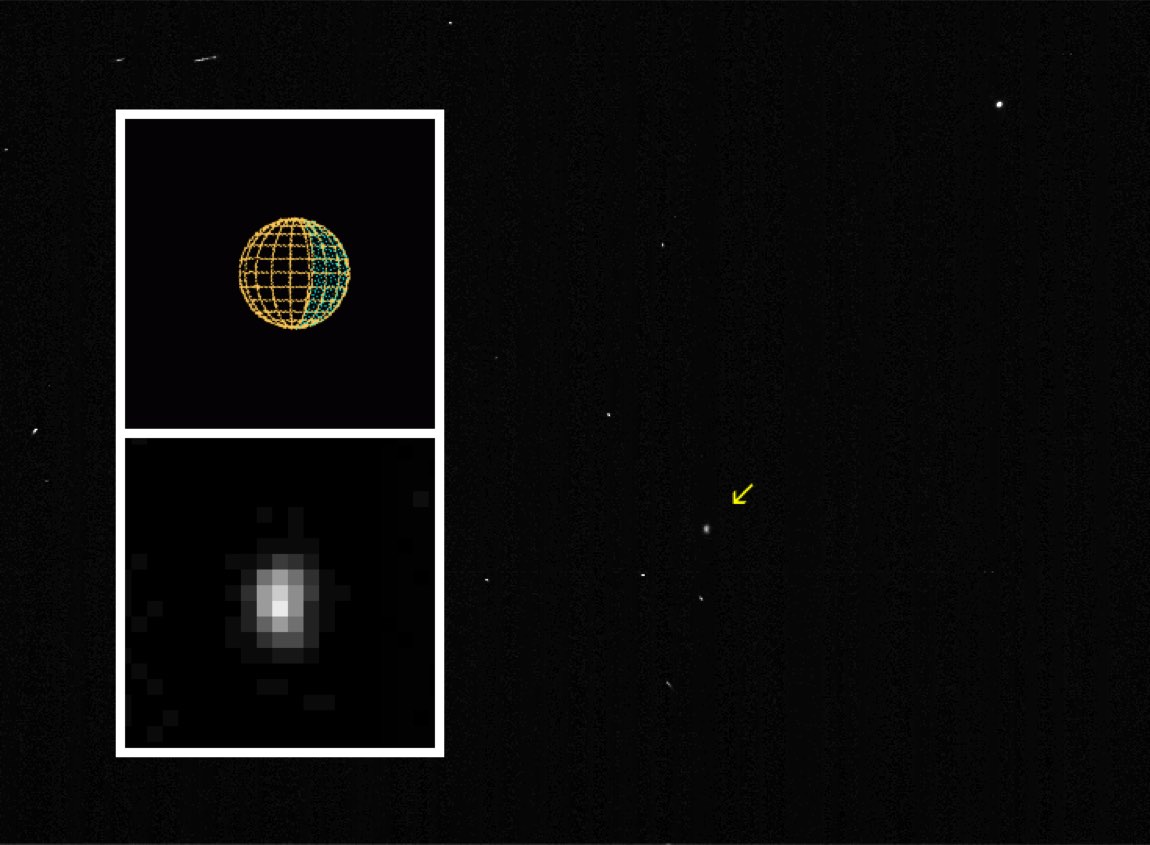
Charles T. Kowal was working at the Mount Palomar Observatory when he spotted Leda in 1974, but the find required patience rather than a single eureka moment. Kowal exposed photographic plates on the nights of September 11, 12, and 13, and when he examined them afterward he found that Leda appeared on all three — a telltale sign that he was tracking a real, moving body rather than a photographic defect or a background star. The official discovery date is recorded as September 14, 1974, the day the evidence was confirmed. Kowal himself proposed the name Leda to the International Astronomical Union, which formally endorsed it in 1975. The discovery came during a productive era of outer solar-system exploration at Palomar, when improved photographic techniques were making it possible to detect very faint, slow-moving objects that earlier generations of astronomers would simply have missed.
02 A Name Rooted in Greek Myth
The moon takes its name from Leda, a figure from Greek mythology who was assaulted by Zeus — the Greek counterpart of the Roman god Jupiter — who came to her disguised as a swan. The convention of naming Jupiter's irregular satellites after figures connected to Zeus and his mythology has been followed consistently by the IAU, so Leda fits neatly into that tradition. Because Jupiter itself is named for the Roman version of the king of the gods, all these mythological names circle back to the same divine character, just seen through different cultural lenses. The choice of Leda is a reminder that the naming of moons is not a purely scientific act — it carries cultural history, literary echoes, and sometimes uncomfortable stories from antiquity. Kowal's suggestion was accepted without alteration, giving the discoverer a lasting say in how this small, distant world would be known.
03 An Orbit Far Out and Tilted Deeper
Leda travels around Jupiter at an average distance of 11,195,980 km, completing one orbit in 242.02 days — roughly eight months, compared with our Moon's 27-day circuit of Earth. The orbit is noticeably elliptical, with an eccentricity of 0.165, meaning Leda swings considerably closer and farther from Jupiter over the course of each lap. Its orbital plane is tilted about 28° to the ecliptic, which is a substantial inclination and a key signature of an irregular satellite. Crucially, the orbit is prograde, meaning Leda travels in the same direction as Jupiter's rotation, which places it in a different dynamical category from Jupiter's retrograde irregular moons that circle in the opposite sense. This combination of large distance, significant tilt, and moderate eccentricity is exactly what astronomers expect from a moon that was captured rather than formed in place around Jupiter.
04 The Himalia Group: Leda's Orbital Family Deeper
Leda is not an isolated oddity — it belongs to the Himalia group, a cluster of prograde irregular moons that orbit Jupiter at distances between 11 and 13 million km. Members of this group share inclinations between 27° and 30° and eccentricities ranging from 0.11 to 0.24, a tight enough bundle of orbital parameters to suggest they all share a common origin. The leading hypothesis is that the Himalia group members are fragments produced when a larger captured asteroid was broken apart, probably by a collision. Rather than drifting away from each other entirely, the pieces settled into similar orbits that still reflect the trajectory of their common parent body. Leda's own numbers — 28° inclination, 0.165 eccentricity — sit comfortably within the group's range, reinforcing the idea that it and its orbital siblings are pieces of the same ancient puzzle.
05 How Small Is 21.5 Kilometers, Really?
Leda has a diameter of about 21.5 kilometers, making it a genuinely tiny world. For comparison, that is roughly the distance you might drive from one side of a mid-size city to the other. At that scale, Leda has nowhere near enough mass to pull itself into a sphere under its own gravity; it almost certainly has an irregular, lumpy shape similar to a large asteroid. Its surface area would be a small fraction of a country like Luxembourg. Despite being classified as one of the innermost of Jupiter's irregular satellites, Leda is still so small and so far away that it appears as nothing more than a point of light even in powerful telescopes. Its tiny size is part of why it went undiscovered until 1974, even though Jupiter has been studied telescopically for centuries.
06 A Very Dark Surface
With a measured albedo of about 3.4%, Leda reflects only a tiny fraction of the sunlight that strikes it. To put that in perspective, fresh asphalt reflects roughly 4–5% of incoming light, so Leda's surface is close to that dark — it is among the least reflective types of surface found in the solar system. This extreme darkness is consistent with Leda's classification as a C-type asteroid analog. C-type asteroids are rich in carbon-bearing materials and primitive, unprocessed rock, which tend to absorb rather than scatter light. The low albedo also makes Leda significantly harder to detect and study from Earth, since even the sunlit side of the moon returns very little light to observers. It contributed to the long wait before its discovery and continues to limit what ground-based telescopes can learn about its surface.
07 Gray Color and What It Tells Scientists Deeper
Photometric measurements of Leda give color indices of B-V = 0.66 ± 0.01 and R-V = 0.43 ± 0.01, which describe how the moon's brightness changes across different wavelengths of visible light. These numbers place Leda firmly in the gray category — it does not appear significantly redder or bluer than neutral sunlight when measured carefully. This gray color is described in the article as typical for C-type asteroids, a class of primitive, carbon-rich bodies. Interestingly, the other members of the Himalia group share this same gray coloration, which provides additional evidence that they all originated from the same parent body. If they had formed from different sources they might show different color signatures. The uniformity of color across the group is one of the more compelling arguments for the shared-parent-body hypothesis, complementing the orbital similarity that first drew scientists' attention.
08 Captured From the Solar System at Large
Leda almost certainly did not form alongside Jupiter from the same disk of gas and dust that built the planet and its large inner moons. Instead, the current scientific view is that Leda was originally a heliocentric asteroid — a body orbiting the Sun independently — that was captured by Jupiter's gravity at some point in the past. Exactly how and when that capture happened is not spelled out in detail, but the irregular nature of the orbit, with its high inclination and significant eccentricity, is the main clue. Moons that form in the disk around a young planet tend to end up in nearly circular, low-inclination orbits. When you find a moon on a tilted, stretched orbit, it strongly suggests the body arrived from elsewhere and was grabbed rather than grown in place. Leda's orbital characteristics make capture the most straightforward explanation.
09 A Broken Asteroid's Legacy Deeper
The hypothesis for Leda's origin goes one step further than simple capture. Scientists think that the entire Himalia group — Leda included — represents the debris field left behind after a larger captured asteroid was shattered, likely by a collision with another small body. Under this model, the original captured object was substantially bigger than any current group member, and a violent impact broke it into pieces. Because the pieces were traveling together at the moment of breakup, they inherited very similar orbital parameters and have remained on neighboring paths ever since. Leda would then be one remnant of that ancestor body, its current size of 21.5 km in diameter representing just a fragment of whatever came before. This scenario is consistent with the shared gray color and similar spectral properties across the Himalia group, though the precise timing and mechanics of the original capture and subsequent collision remain open questions.
10 Observing Leda From Earth
Because of its small size, dark surface, and enormous distance from the Sun, Leda is extremely faint and genuinely difficult to observe from Earth. It was not found until 1974 precisely because it pushes the limits of what photographic surveys could detect, and even with modern charge-coupled device cameras and large telescopes it appears only as a point of light. No surface detail has been resolved from the ground, and without a dedicated spacecraft flyby, the best data available are its brightness, color indices, and orbital parameters. The 3.4% albedo means astronomers receive very little reflected light to work with. For amateur astronomers, Leda is effectively undetectable without very large telescope apertures and long exposure times under excellent dark-sky conditions. It remains one of those objects where the mathematics of its orbit is better known than anything about what it actually looks like.
11 Open Questions About This Tiny Moon Deeper
Despite being discovered half a century ago, Leda leaves many scientific questions unanswered. Its shape is entirely unknown — the 21.5 km diameter figure is an estimate, and whether the body is roughly spherical, elongated, or highly irregular has never been directly measured. No spacecraft has visited Leda or any member of the Himalia group at close range, so there are no images of its surface, no direct measurements of its composition, and no data on its rotation period. The mass and density are unconstrained, which means scientists cannot say whether Leda is a solid rock, a loosely bound rubble pile, or something in between. The exact mechanism by which the original Himalia group parent body was captured by Jupiter and subsequently disrupted also remains a matter of theoretical modeling rather than settled fact. Each of these gaps represents a potential target for a future spacecraft mission to the Jovian system.