 Diagram · Juan L. Rizos et al. · CC BY 4.0
Moon · Deep guide · orbits Jupiter
Kallichore
Also called: Jupiter XLIV · S/2003 J 11
A small Carme-family moon that ESA's Juice spacecraft may fly past in 2031.
What is it?
Kallichore is a small, elongated retrograde moon of Jupiter, about 4 km across. Scott Sheppard discovered it at Mauna Kea in February 2003. It orbits about 23 million km from Jupiter as part of the Carme group. The European Space Agency's Juice mission is predicted to pass within about 1 million km of it on 7 October 2031, and more observations are planned to pin down its orbit in case Juice can get closer.
The deep dive
Researched for the Atlas from Wikipedia — Kallichore (moon) (9,541 characters read) · updated Nov 14, 2026
01 How Scott Sheppard Found It in 2003
Kallichore was discovered on 6 February 2003 by Scott S. Sheppard working at Mauna Kea Observatory in Hawaii. The search was a collaboration with David Jewitt, and the method was straightforward in concept but demanding in practice: systematically photograph the sky near Jupiter with large telescopes fitted with sensitive digital cameras, then look for faint moving specks that betray a moon's presence. Sheppard made the discovery images using the 3.6-meter Canada–France–Hawaii Telescope, one of the most capable instruments on the mountain at the time. The raw observations then went to Brian G. Marsden, who crunched the positional data to calculate Kallichore's orbit. The moon's existence was formally announced on 7 March 2003 by the Minor Planet Center and the Central Bureau of Astronomical Telegrams, bundled together with three other new Jovian moons found in the same campaign: S/2003 J 9, S/2003 J 10, and S/2003 J 12. Kallichore was one of 21 Jovian moons announced that year, pushing Jupiter's known satellite count to 61.
02 The Mythology Behind the Name
When the discovery was announced, the moon carried only the dry provisional label S/2003 J 11. It received its permanent name on 30 March 2005, when the International Astronomical Union's Working Group for Planetary System Nomenclature officially christened it Kallichore and assigned the Roman numeral designation Jupiter XLIV — meaning it was the 44th Jovian moon to receive a formal name. The name comes from Callichore, a figure in Greek mythology counted among the Muses and listed as one of the daughters of Zeus. The IAU has a systematic naming convention for Jupiter's irregular moons: they are named after mythological lovers or descendants of Zeus, the Greek counterpart of the Roman Jupiter. There is an additional twist built into the convention — moons with retrograde orbits, meaning they circle Jupiter in the direction opposite to the planet's own spin, are given names that end with the letter "e." Kallichore qualifies on both counts: it is a daughter of Zeus, and it does indeed travel in retrograde.
03 An Orbit That Never Quite Closes Deeper
Kallichore circles Jupiter at an average distance of 23.0 million km, completing one lap in roughly 714 days — just under two Earth years. Its orbit is tilted 164.6° relative to the ecliptic, which is what makes it retrograde: an inclination greater than 90° means the moon travels backward relative to the planet's rotation. The orbit also carries a meaningful eccentricity of 0.259, meaning the path is noticeably elliptical rather than circular. Crucially, though, the orbit is not fixed. Gravitational tugs from the Sun, Saturn, Uranus, and Neptune continuously deform it, so the orbit never traces the same closed ellipse twice. Simulations spanning 1,000 years show the semi-major axis ranging between 22.0 and 24.4 million km, the eccentricity swinging between 0.113 and 0.413, and the inclination shifting between 160.8° and 167.8°. The orbit also precesses: the ascending node completes a full cycle every 86.3 years, while the apsidal line — the axis connecting the nearest and farthest orbital points — precesses with a period of 49.1 years. A 2011 study by Julien Frouard and colleagues identified this behavior as the signature of a secular resonance linking Kallichore's precession frequencies to those of Saturn, Uranus, and Neptune simultaneously.
04 Member of the Carme Family
Kallichore is not a lone wanderer. It belongs to the Carme group, a cluster of Jovian irregular moons that share closely matched orbital characteristics with the larger moon Carme. The leading explanation for why these moons travel in such similar paths is that they are fragments — debris left over when a single captured parent body was shattered by a collision several billion years ago. That ancestral object was not born near Jupiter. Based on the colors and compositions measured across Carme group members, it most likely originated in the outer Solar System. Candidates for its identity include a D-type asteroid drawn from the Hilda or Jupiter trojan populations, or an object from the centaur or trans-Neptunian populations — the cold, distant reaches of the Solar System beyond Neptune. Kallichore's slightly reddish surface color, with a V–R color index of 0.47, and its organic-rich surface composition are consistent with the broader Carme group profile, lending support to this shared-ancestor picture.
05 A Tiny, Dark, Lumpy World
Kallichore is small even by irregular moon standards. Observations of a stellar occultation in 2025 placed its diameter between 3.5 km and 6.1 km — roughly the length of a few city blocks end to end. That size, combined with its low brightness, points to a surface that absorbs nearly all incoming light: its geometric albedo is estimated at around 3.7%, with the uncertainty running from about 1.5% to 4.4%. For comparison, fresh asphalt reflects roughly 4–5% of visible light, so Kallichore's surface is about as dark as a road surface. Its apparent visual magnitude of about 23 makes it invisible to any telescope smaller than the very large professional instruments. The surface is expected to be dusted with dark, refractory material — heat-resistant organic compounds that resist evaporation. Beneath that crust, water ice may be present, though most of it is thought to be buried too deep to be directly detected from afar.
 ⤢
06 Rubble Pile: A Moon Built from Wreckage Deeper
Kallichore is too small for its own gravity to have pulled it into a sphere, so it is irregularly shaped. The Hubble Space Telescope detected brightness variations of at least Δm ≥ 0.461 ± 0.073 magnitudes within just 1.25 hours — a relatively rapid flicker that reveals the moon is rotating and presenting different cross-sections to the observer. These variations imply a minimum semi-axis ratio of a/b ≥ 1.53 ± 0.10, meaning the moon's longest dimension is at least 53% greater than its shortest measured dimension. Such elongation is exactly what you would expect from a body that has been repeatedly struck and reshaped by collisions rather than sculpted by its own gravity. Because of this collision-dominated history, Kallichore is thought to have a rubble pile interior — a loosely packed aggregate of rocky chunks held together more by mutual gravity than by any solid bonds. The article draws a direct comparison to two well-studied asteroids: 162173 Ryugu and 101955 Bennu, both of which were visited by spacecraft and confirmed to be rubble piles of similar kilometer-scale size. Kallichore's rotation period remains unknown because its brightness changes have not yet been tracked across a full cycle.
07 Stellar Occultations: Measuring a Moon's Shadow Deeper
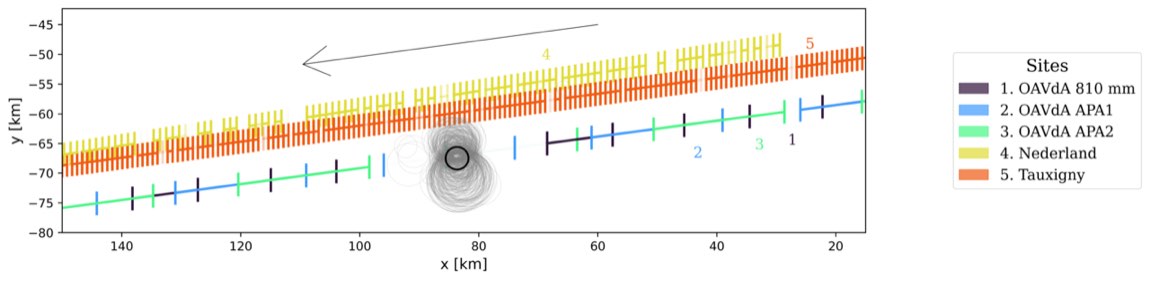
One of the most elegant techniques for pinning down a small moon's size and position is the stellar occultation: waiting for the moon to pass in front of a background star and timing how long the star disappears. In December 2025, astronomers supporting the Juice mission team used Hubble Space Telescope observations on 30 November and 4 December 2025 to refine Kallichore's orbit precisely enough to predict that such an occultation would occur on 15 December 2025. The prediction paid off. Three telescopes located in Italy successfully recorded the event, and ten additional stations across Europe and the United States recorded non-detections — also scientifically valuable because they constrain the moon's silhouette from the sides. Together, these measurements significantly tightened both Kallichore's size estimate and its positional uncertainty. As of 2026, this achievement makes Kallichore the smallest irregular moon ever measured by stellar occultation. A second occultation was predicted over Australia on 18 March 2026, with an observing campaign organized by the Instituto de Astrofísica de Andalucía aiming to further sharpen the moon's shape and orbital position.
08 Racing to Reduce Positional Uncertainty Deeper
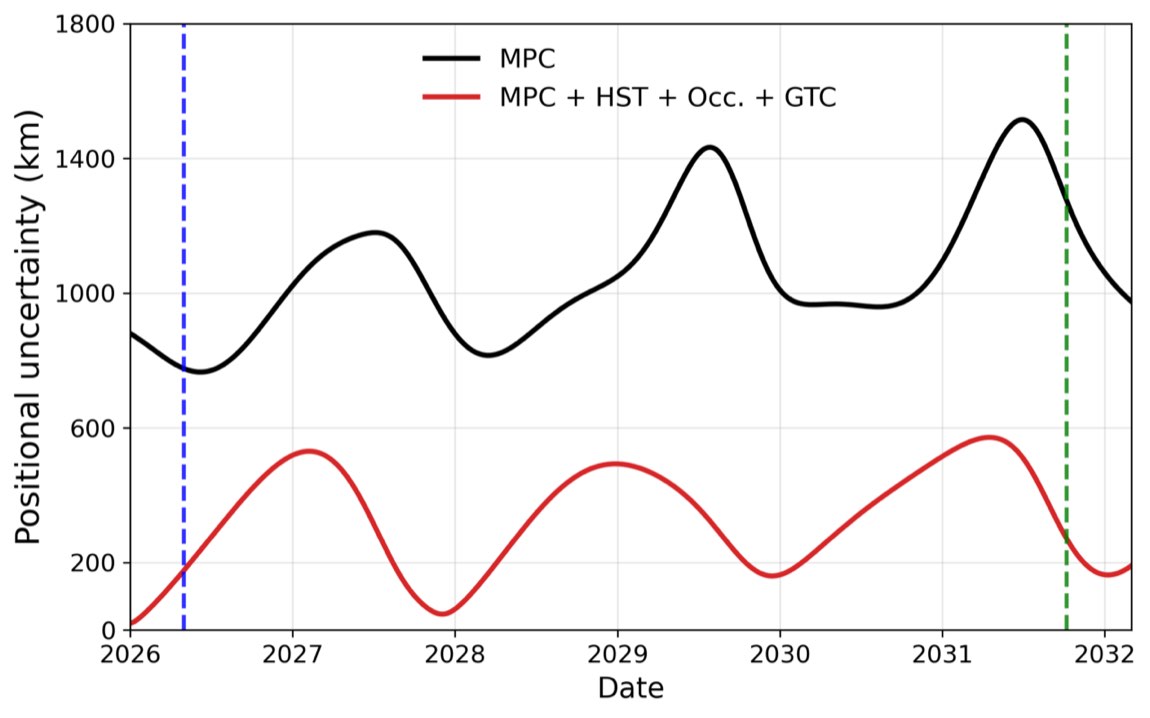
Planning a close flyby of a moon just a few kilometers across is a navigational puzzle of extraordinary precision. As of March 2026, Kallichore's predicted position on the date of Juice's expected encounter carried an uncertainty of ±272 km — a range larger than the closest proposed flyby distance of 700 km. For mission planners to safely commit Juice to a close approach, that uncertainty must be reduced to less than ±30 km before 2028. The campaign to achieve this is already underway. Between November 2025 and February 2026, a coordinated program of Hubble imaging, stellar occultation detections, and observations with the 10.4-meter Gran Telescopio Canarias on 21–22 January 2026 collectively cut the positional uncertainty on the flyby date from 1,544 km down to 265 km — a nearly sixfold improvement in just three months. Continued astrometric observations are planned to drive that number below the required threshold, at which point mission controllers could consider commanding a trajectory adjustment to bring Juice within imaging range.
09 What a 700 km Flyby Would Reveal
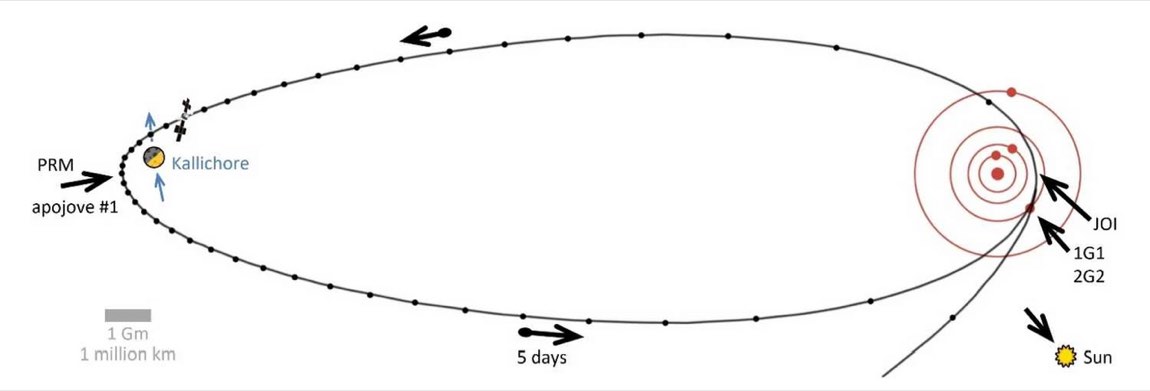
A 2026 study by Arnaud Boutonnet and Amedeo Rocchi laid out what it would take for the Juice spacecraft to get genuinely close to Kallichore. The mission is already on course to pass within 1 million km of the moon on 7 October 2031 during its first orbit around Jupiter — but that distance is far too great for detailed science. For Juice's highest-resolution camera, JANUS, to image Kallichore as more than a single featureless pixel, the spacecraft needs to come within 100,000 km. One calculated trajectory could bring Juice as close as 700 km from Kallichore on 5 October 2031. This close flyby would occur near the spacecraft's apojove — its farthest point from Jupiter — and the approach would come from Kallichore's unilluminated side, at a phase angle of roughly 145°. At that phase angle the geometry is challenging for imaging but would still allow Juice to resolve the moon's overall shape and surface features, delivering the first real portrait of this small, dark fragment from the early Solar System. Achieving that trajectory would require expending at least 23 m/s of delta-v during the energy reduction phase after Jupiter orbit insertion.
10 Open Questions Surrounding Kallichore
Despite the recent burst of observational activity, Kallichore remains poorly understood in several fundamental ways. Its rotation period is completely unknown because no one has yet monitored its brightness changes across a full spin cycle — a gap that makes it impossible to fully characterize its shape or surface variegation. The exact size is constrained only within a range of 3.5 to 6.1 km, and the albedo carries large asymmetric uncertainties. Whether the moon harbors water ice beneath its dark surface layer is suspected but unconfirmed. The nature of the organic compounds coating its surface is inferred by analogy with other Carme group members rather than measured directly. And the precise dynamical story of the Carme group — exactly when the parent body was captured, when it was disrupted, and how many fragments survive — remains an open chapter in planetary science. All of these questions make Kallichore an unusually rewarding target: a moon small enough to have been entirely overlooked for decades, now suddenly at the center of a coordinated international observation campaign with a spacecraft already en route.
 ⤢