Moon · Deep guide · orbits Jupiter
Metis
Also called: Jupiter XVI · S/1979 J 3
Jupiter's innermost moon whips around the planet faster than Jupiter itself spins.
What is it?
Metis is the closest known moon to Jupiter, a lumpy rock about 60 km long that circles inside the planet's faint main ring. It was spotted in 1979 in pictures from the Voyager 1 probe, and the Galileo orbiter later imaged most of its surface. Metis goes around Jupiter in about seven hours, quicker than one Jovian day, so tides are slowly dragging it inward. Dust knocked off Metis and its neighbour Adrastea is thought to help feed Jupiter's rings.
The deep dive
Researched for the Atlas from Wikipedia — Metis (moon) (4,116 characters read) · updated Nov 14, 2026
01 How Voyager 1 Found a Dot in the Dark
Metis was not found by a patient astronomer squinting through an eyepiece but by a scientist named Stephen P. Synnott, who combed through images sent back by the Voyager 1 spacecraft in 1979. At the time, the moon showed up as nothing more than a pinprick of light — a dot against the blackness — and was given the placeholder designation S/1979 J 3. That was essentially all anyone could say about it for nearly two decades. The photographs simply lacked the resolution to reveal anything about its shape, color, or surface. It was not until the Galileo spacecraft arrived at Jupiter and spent years observing the inner system, imaging almost all of Metis's surface and placing constraints on its composition by 1998, that scientists gained a meaningful physical picture of the moon. A provisional label became a real world only through that patient second look.
02 The Titaness Behind the Name
In 1983, the International Astronomical Union gave the moon its official name: Metis, after a Titaness from Greek mythology who was the first wife of Zeus — the Greek counterpart of the Roman god Jupiter — and who, together with Zeus, bore the goddess Athena. The name carries an interesting bureaucratic footnote. IAU convention normally requires that prograde moons of Jupiter receive names ending in the letter "a," but Metis breaks that rule. The name was approved as a formal exemption from that convention, making Metis one of the rare Jovian moons to sidestep the standard naming formula. The mythological Metis was associated with wisdom and cunning, qualities perhaps fitting for a moon that managed to hide its true nature from astronomers for so long after its discovery.
03 An Irregular Body Shaped by Collisions
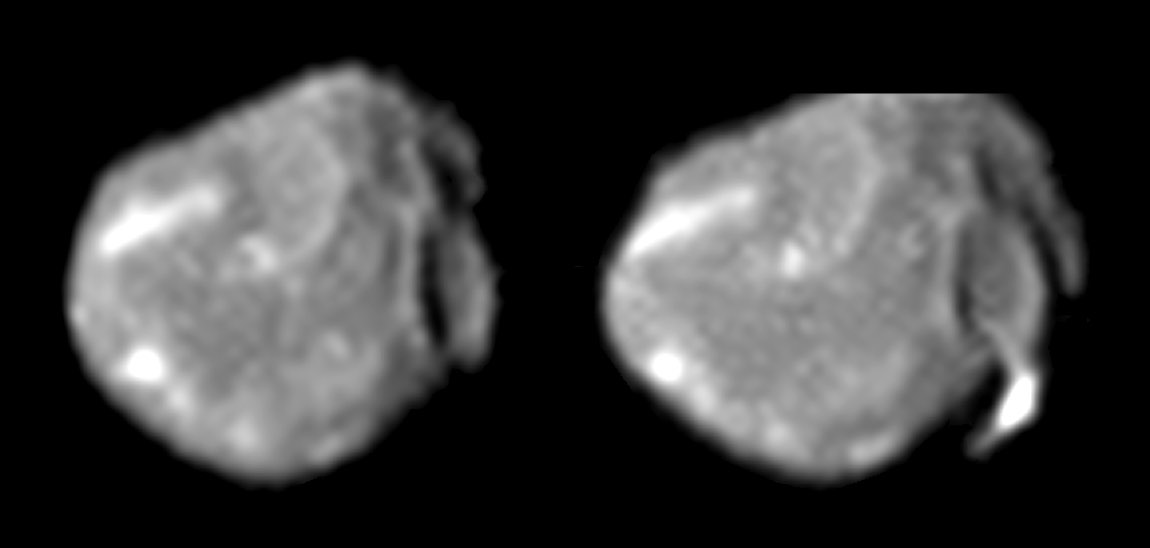
Metis is not a tidy sphere. Its dimensions are 60 km × 40 km × 34 km, meaning its largest diameter is almost twice as large as its smallest — a lopsided chunk more like a bruised potato than a ball. Among Jupiter's four inner moons, only Thebe is larger; Metis is the second smallest of the group. Its dark, reddish surface lacks the resolution in available images for individual craters to be picked out, but the dramatically irregular shape is itself a kind of fossil record: scientists interpret it as strong evidence of a heavy collisional history. Something — or many somethings — hit Metis hard enough over time to sculpt this asymmetric form. The moon's bulk composition and total mass remain uncertain, though its mass is estimated at roughly 6.2 × 10¹⁶ kg or higher, with a likely mean density above 1.5 g/cm³.
04 Why One Side of Metis Is Brighter Deeper
If you could orbit Metis and compare its two faces, you would notice a striking difference in brightness. The leading hemisphere — the side that faces forward along the direction of travel — is 1.3 times brighter than the trailing hemisphere. This asymmetry is not thought to be a coincidence or a quirk of lighting geometry. Scientists believe it arises because the leading face intercepts meteorite impacts at higher velocities and greater frequency than the trailing side. Those energetic collisions excavate material from beneath the surface, and that freshly exposed interior material appears to be bright, presumably ice. So what looks like a simple brightness difference is actually a window into what Metis is made of inside. The geometric albedo of the moon as a whole is approximately 0.061 ± 0.003 — quite dark overall, but with that telling bright patch carved out by bombardment on one side.
05 An Orbit So Fast It Laps Jupiter's Own Spin
Metis completes one orbit around Jupiter in roughly 7 hours. Jupiter itself, a giant planet, takes about 10 hours to rotate once. That means Metis is actually lapping the planet it orbits — racing around Jupiter faster than Jupiter spins. Only one other moon shares this distinction: Adrastea, its neighbor in the inner ring system. This unusual circumstance arises because Metis lies well inside Jupiter's synchronous orbit radius, the distance at which an orbital period would exactly match the planet's rotation. Being inside that radius has a consequence that plays out over geological time: tidal forces from Jupiter are gradually causing Metis's orbit to decay, slowly spiraling the moon inward.
06 Living on the Edge of the Roche Limit Deeper
The Roche limit is the distance from a planet inside which tidal forces overcome the self-gravity of an orbiting body, tearing it apart. Metis sits in a genuinely precarious position relative to this boundary. If its density is similar to that of the nearby moon Amalthea, then Metis's orbit lies within the fluid Roche limit — the threshold relevant for a body held together only by gravity with no internal strength. The fact that Metis has not been shredded tells scientists it must lie outside the rigid Roche limit, the more forgiving boundary that applies to bodies with some structural strength of their own. So Metis survives not because it is comfortably safe from tidal disruption, but because it is just barely held together by the mechanical strength of its material. It is, in a sense, a moon that is getting away with existing.
07 Metis as a Factory for Jupiter's Main Ring
Jupiter's rings are not made of ice like Saturn's; they are thin, dusty, and dark. Metis orbits about 1,000 km inside the main ring of Jupiter and is considered a major contributor to that ring's material. The mechanism is straightforward but striking: when meteorites strike Metis, they kick debris off the surface at velocities high enough to escape the moon's weak gravity. Because Metis and the other three small inner moons sit close to the edges of their Roche spheres — the region within which a moon's own gravity can hold material — ejecta is easily lost into space rather than falling back down. That liberated dust and debris feeds the ring. The same process operates on the other three small inner moons, and together they are thought to be the primary source of the main ring's dust.
08 The Gap in the Ring That Metis Carves Deeper
Although Metis contributes material to the main ring, it also does something that might seem contradictory: it appears to sweep out a gap. Metis orbits within a notch in the ring roughly 500 km wide, and the relationship between the moon and this clearing is visually apparent — but its cause has not been fully explained. Scientists recognize that the gap is clearly connected to Metis's presence, yet the precise dynamical mechanism linking a small, irregularly shaped moon to this specific gap has not been established. It is one of the open questions the inner Jovian system still poses. The situation illustrates how ring-moon interactions can be simultaneously obvious in their association and elusive in their physics, a reminder that even relatively simple-seeming ring systems contain behavior that remains poorly understood.
09 Tidal Lock and Jupiter's Long Shadow
Like Earth's Moon, Metis is tidally locked to its parent planet — it always keeps the same face pointed toward Jupiter. Its longest axis is permanently aligned in Jupiter's direction. This synchronous rotation means its day and its orbital period are identical at about 7 hours. But that short day has an unusual feature: Jupiter is so large that it casts a shadow across Metis for 68 minutes during every single Metian day. That is more than 15 percent of each orbit spent in darkness, not from nightfall but from eclipse — Jupiter simply blocking the Sun. For such a small world on such a tight orbit, the planet it circles dominates the sky completely, and the experience of a "day" on Metis would be inseparable from the overwhelming presence of Jupiter itself.
10 What Galileo Taught Us That Voyager Could Not
The contrast between what Voyager 1 saw and what Galileo revealed is a useful illustration of how much mission design matters. Voyager's images in 1979 gave Metis only as a featureless point, enough to establish its existence and rough orbital parameters but nothing more. The Galileo spacecraft, which operated at Jupiter from 1995 onward, changed that entirely. Through observations made between early 1996 and September 2003, Galileo imaged almost all of Metis's surface and provided data sufficient to constrain its composition. By 1998 it had already placed meaningful limits on what Metis is made of. The progression from dot to mapped world took nearly two decades and a dedicated orbiting mission — a reminder that discovery and understanding are very different achievements, often separated by a long gap in time and technology.
11 Open Questions Metis Still Poses Deeper
For all that Galileo added, Metis remains a moon with significant unknowns. Its bulk composition and total mass have not been directly measured; the mass estimate of roughly 6.2 × 10¹⁶ kg is a lower-bound inference based on the assumption that surface gravity everywhere points inward, requiring a mean density above 1.5 g/cm³. The nature of the bright interior material — presumed to be ice but not confirmed — remains an inference from brightness asymmetry rather than a direct detection. The mechanism connecting Metis to the 500 km gap in the main ring has not been established. And the long-term fate of the moon as its orbit slowly decays under tidal forces has not been calculated with precision, partly because the density and internal structure needed to make that calculation are themselves uncertain. Metis is well observed but not yet well understood.