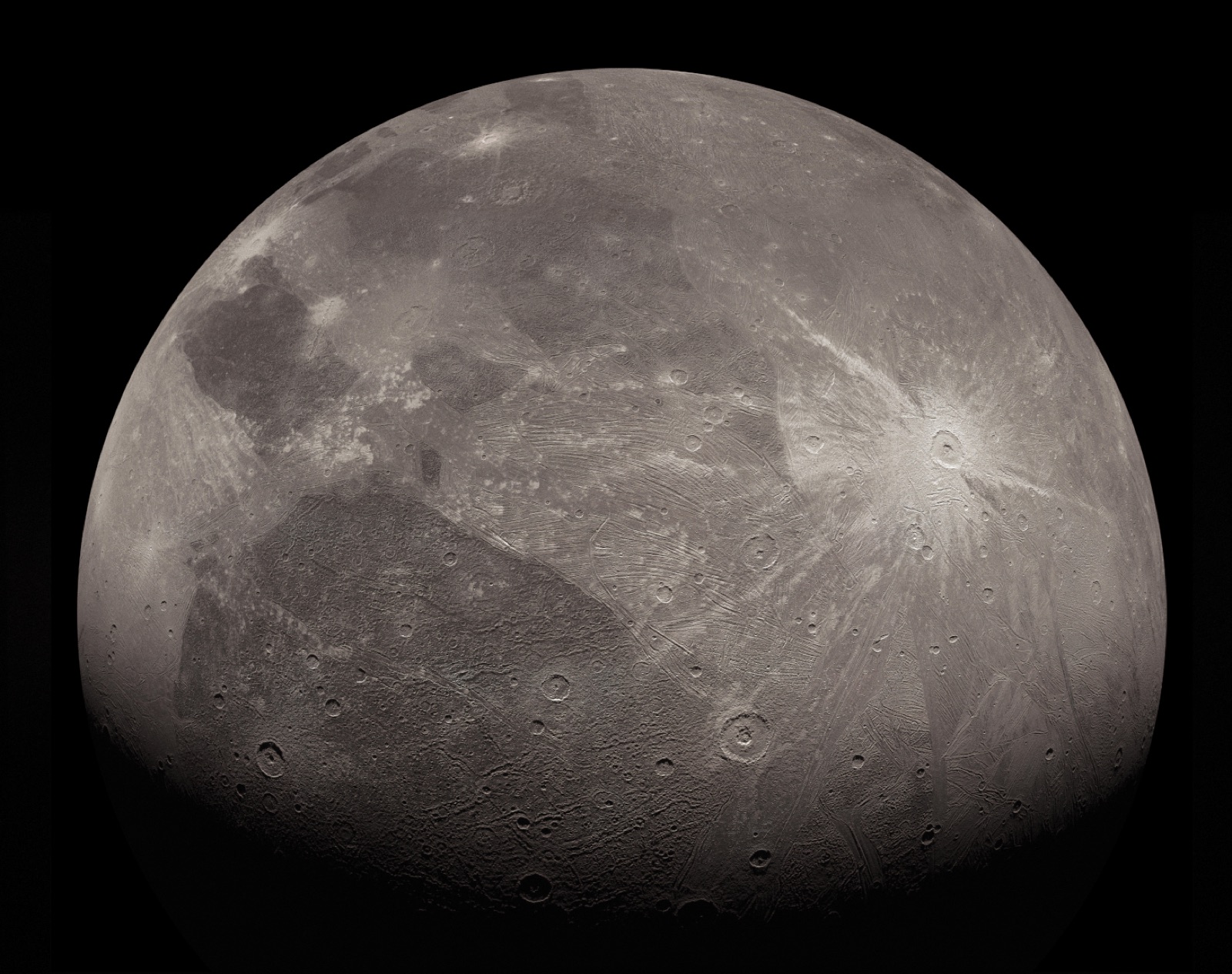
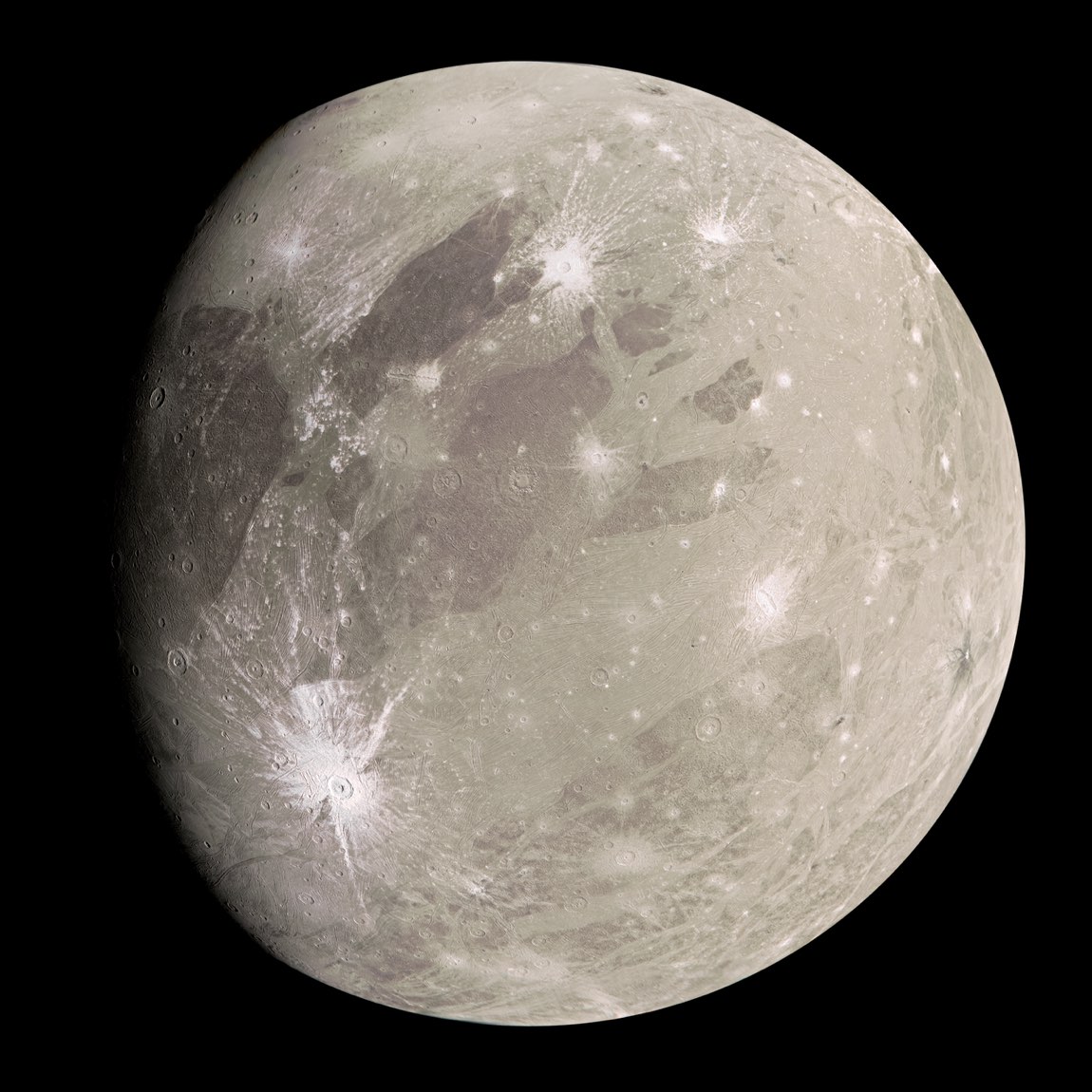
 Photograph · NASA/JPL-Caltech/SwRI/MSSS/Kalleheikki Kannisto © CC BY
Moon · Deep guide · orbits Jupiter
Ganymede
The largest moon in the Solar System is bigger than Mercury and has its own magnetic field.
What is it?
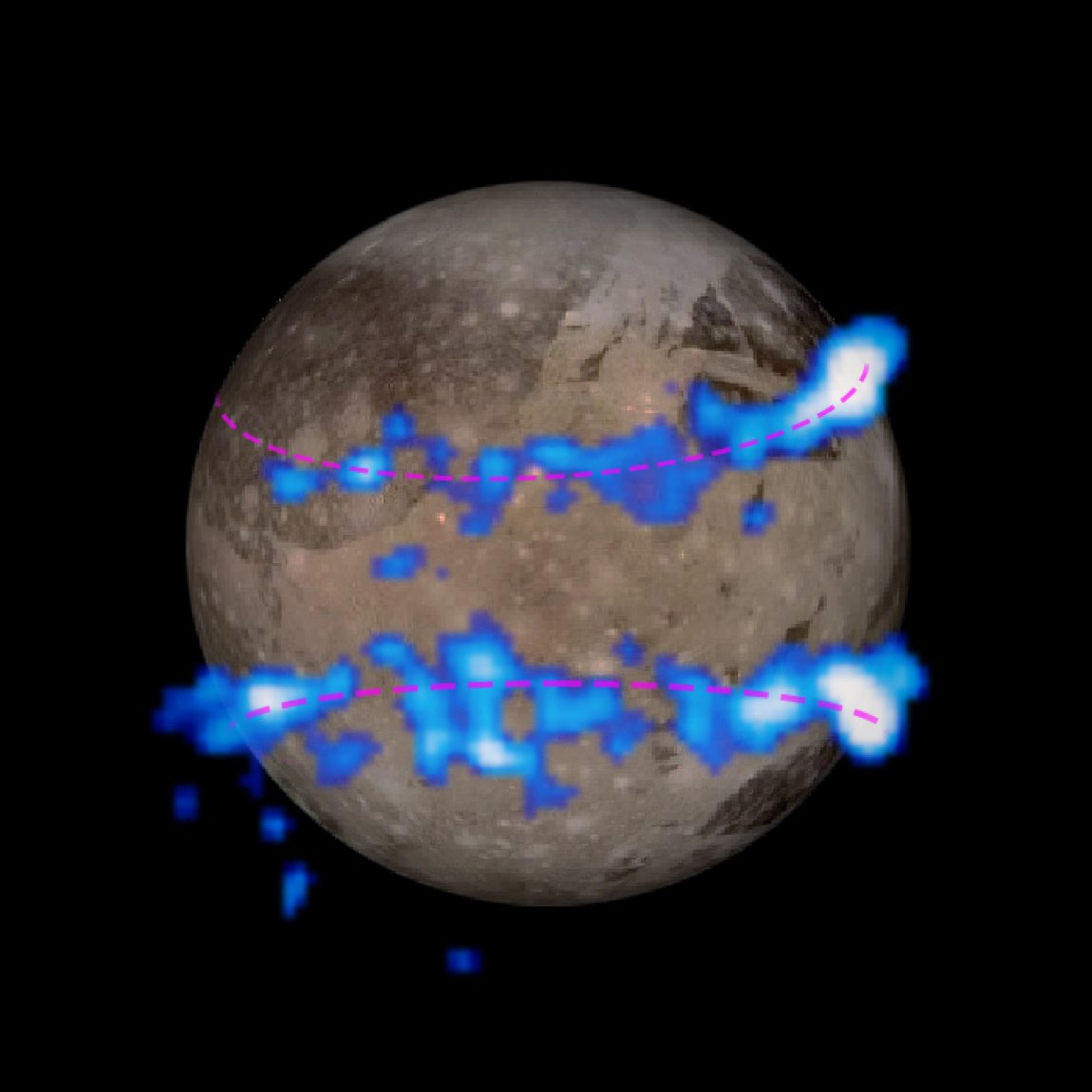
Ganymede, one of Jupiter's four Galilean moons, is the largest moon anywhere — bigger than the planet Mercury. It is the only moon known to generate its own magnetic field, complete with auroras at its poles, and it too hides a deep, salty ocean beneath its icy crust — possibly holding more water than any other world in the Solar System.
Go deeper
Ganymede's iron core still runs a dynamo — unique among moons. Hubble's aurora measurements clinched its ocean: the auroral ovals rock less than they should as Jupiter's field sweeps by, revealing a conducting saltwater layer ~150 km down that counteracts the changes. Its interior is a layered 'club sandwich' of ice phases and water. ESA's JUICE (JUpiter ICy moons Explorer) will end its mission in orbit around Ganymede in the 2030s — the first spacecraft ever to orbit another planet's moon.
01 A moon outbuilding a planet
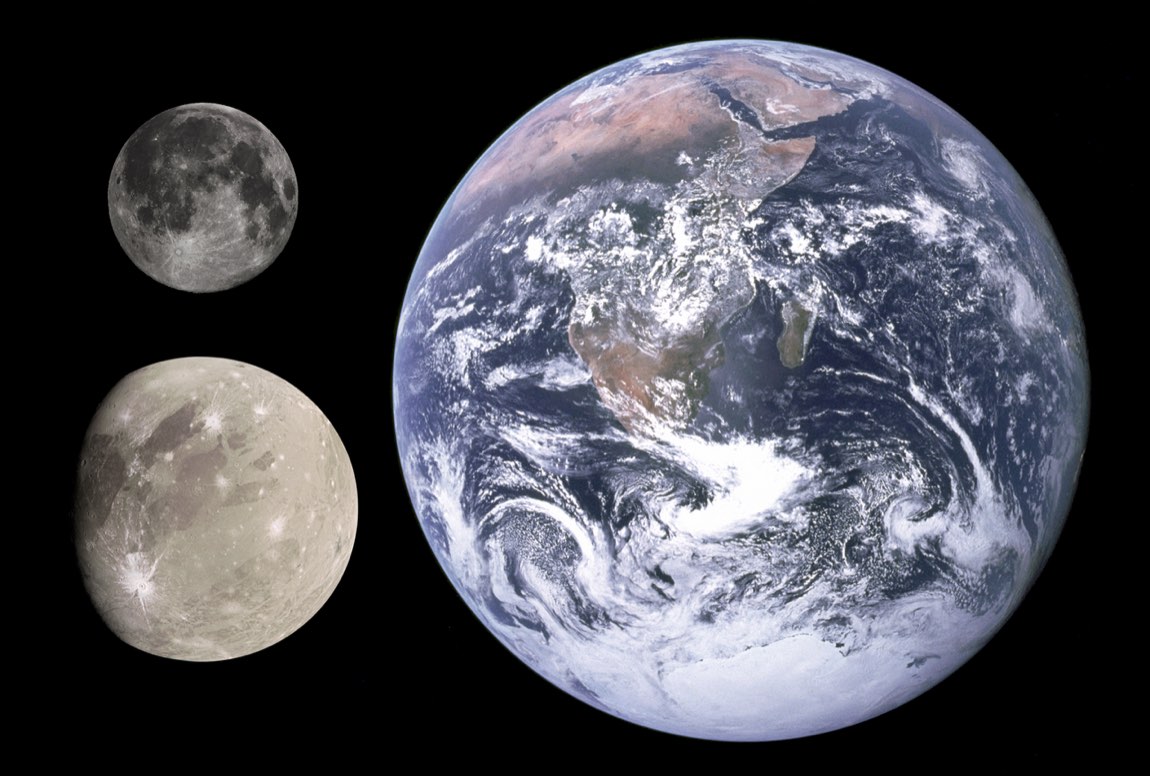
If Ganymede orbited the Sun instead of Jupiter, we would call it a planet without hesitation — it is 8% wider than Mercury (though less than half as massive). It even does planet things: generates a magnetic field, hosts auroras, and may hold the Solar System's biggest ocean.
02 Water world in layers Deeper
Models suggest Ganymede's H₂O — several times Earth's total — is stacked in layers: ice crust, salty ocean, then exotic high-pressure ices down to the rock. Whether the ocean touches rock (good for chemistry) or is sealed between ice layers is a key habitability question JUICE will probe with radar and gravity data.
The deep dive
Researched for the Atlas from Wikipedia — Ganymede (moon) (39,657 characters read) · updated Sep 20, 2026
03 A discovery four centuries in the making
The story of Ganymede's discovery is messier than textbooks usually admit. A Chinese astronomer named Gan De may have spotted something beside Jupiter with the naked eye as early as 365 BC, but his description of a reddish companion is puzzling — Ganymede is too faint for any color to be perceived without optical aid, so the identification remains uncertain. The clean modern chapter opens on January 7, 1610, when Galileo Galilei turned a telescope toward Jupiter and logged what he thought were three nearby stars. He did not immediately realize Ganymede and Callisto were moons; it took watching them shift position night after night before he concluded, by January 15, that they were bodies orbiting Jupiter. Simon Marius made independent observations around the same time and later claimed priority — a dispute that was never fully resolved. What is not disputed is that these four objects, the Galilean moons, were the first group of bodies ever confirmed to orbit something other than Earth or the Sun, a discovery that cracked open the old geocentric worldview for good.
 ⤢
⤢
04 The myth behind the name
Naming Ganymede was surprisingly contentious. Galileo called the four moons the "Medicean Stars" to flatter his patrons, while Simon Marius first proposed calling them the "Saturn of Jupiter," the "Jupiter of Jupiter" (that was Ganymede's slot), the "Venus of Jupiter," and the "Mercury of Jupiter" — a clunky scheme nobody adopted. It was Johannes Kepler who suggested drawing on Greek mythology instead, and Marius ran with the idea, ultimately publishing names drawn from lovers of Zeus. Ganymede was the handsome Trojan prince, son of King Tros, whom Zeus — disguised as an eagle — abducted and carried to Olympus to serve as cupbearer to the gods. Marius noted he chose the name for Ganymede specifically "on account of its majesty of light." Intriguingly, Ganymede is the only Galilean moon named after a male figure; Io, Europa, and Callisto are all female lovers of Zeus. The mythological names fell out of fashion for centuries, and astronomers more commonly called it Jupiter III — the third satellite — until the mid-twentieth century, when the mythological system was finally standardized.
05 Locked in a cosmic three-way rhythm Deeper
Ganymede's orbit is not simply a loop around Jupiter — it is locked into one of the most intricate gravitational dances known, called the Laplace resonance. For every single orbit Ganymede completes in 7.155 days, Europa goes around exactly twice and Io goes around exactly four times. The resonance is so precisely tuned that triple conjunctions — all three moons lining up on the same side of Jupiter simultaneously — are mathematically impossible; the longitudes of the Io–Europa and Europa–Ganymede conjunctions shift at identical rates, perpetually preventing a three-way alignment. Astronomers debate whether this resonance is primordial or whether it evolved gradually, with Io's tides nudging Jupiter, expanding Io's orbit until it caught Europa in a 2:1 lock, then the pair expanding until Europa snagged Ganymede the same way. The resonance matters for Ganymede's geology: in the past it may have pumped the moon's orbital eccentricity as high as 0.01–0.02, driving significant tidal heating that could have cracked and reshaped its icy surface into the grooved terrain visible today. Right now Ganymede's eccentricity is only about 0.0015, so tidal heating is negligible — but the scars of earlier, more violent episodes are written across its surface.
06 A metallic heart and its lingering mystery Deeper
Deep inside Ganymede sits an iron–nickel-rich liquid metallic core with a density of 5.5 to 6 grams per cubic centimeter — comparable to Earth's own core material. Above it lies a silicate mantle with a density of 3.4 to 3.6 grams per cubic centimeter, and above that, the vast layers of water ice and liquid ocean. The core's radius may reach up to 500 km, and temperatures there are estimated at 1,500 to 1,700 K under pressures up to 10 GPa (equivalent to about 99,000 atmospheres). That hot, electrically conducting liquid iron is almost certainly what drives Ganymede's magnetic field through dynamo action — similar to Earth's mechanism. Yet the very existence of an active dynamo puzzles scientists, because a body of Ganymede's modest size should have cooled enough by now for its core to solidify, shutting the dynamo off. One leading explanation is that past episodes of orbital resonance pumped tidal heat into the mantle, reducing heat flow out of the core and keeping the iron liquid and convective long enough for the dynamo to persist. Another possibility is that some magnetization is locked into silicate rocks in the mantle as a relic of a stronger ancient field.
 ⤢
⤢
07 A magnetosphere inside a magnetosphere Deeper
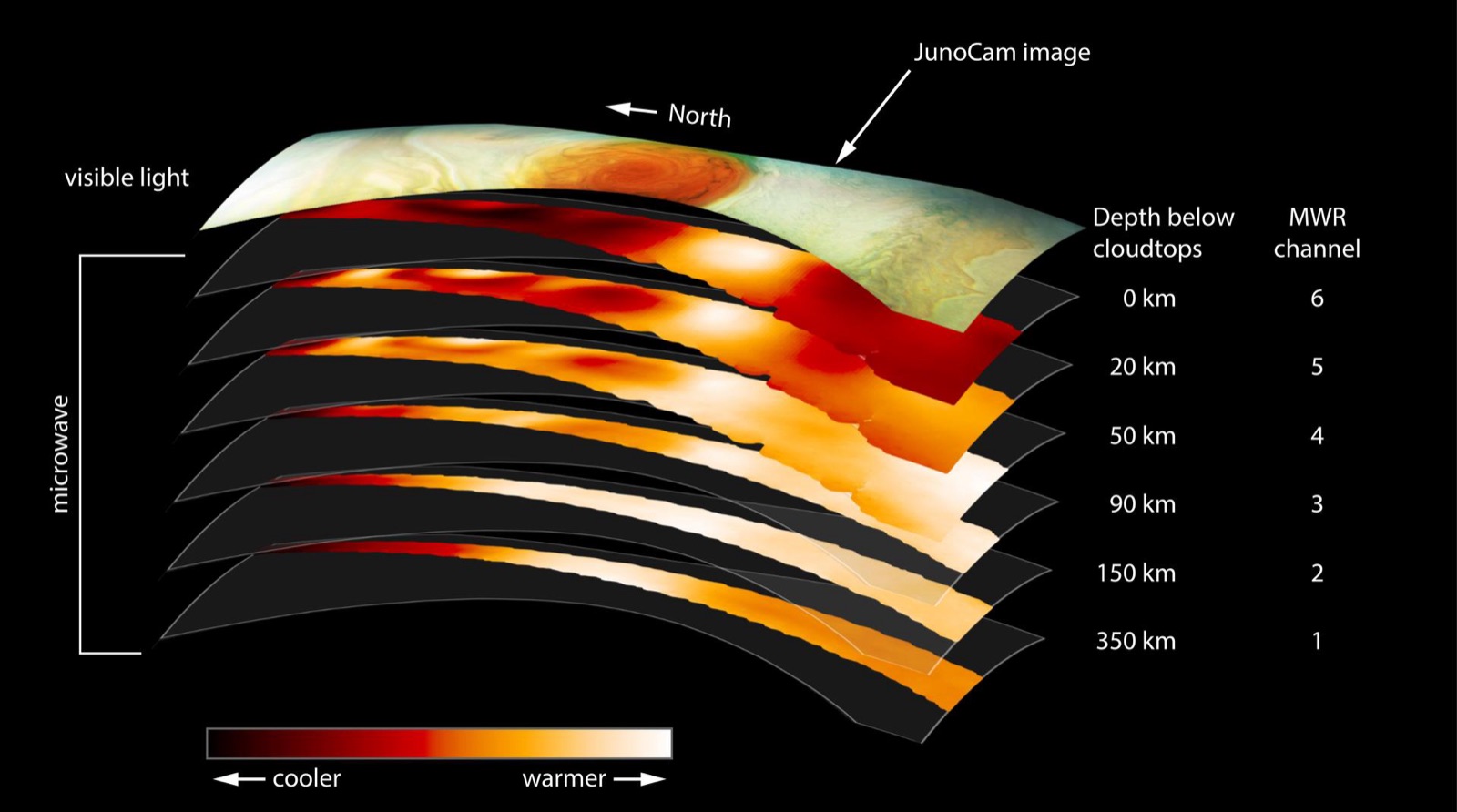
Ganymede pulls off something no other moon in the Solar System manages: it carves its own private magnetosphere out of Jupiter's enormous one. The magnetic moment Galileo measured during six close flybys between 1995 and 2000 is about 1.3 × 10¹³ T·m³ — three times larger than Mercury's magnetic moment — producing an equatorial field strength of 719 ± 2 nT. For comparison, Jupiter's own field at Ganymede's distance is only about 120 nT, so Ganymede's field locally dominates. The mini-magnetosphere extends 4 to 5 Ganymede radii in diameter. Below 30° latitude, closed field lines trap charged particles into a radiation belt; above 30° latitude, open field lines connect directly to Jupiter's ionosphere, funneling energetic electrons and ions down onto the polar surface — sputtering and darkening the ice there, and generating auroras. The interaction between Ganymede's magnetosphere and Jupiter's co-rotating plasma resembles the way the solar wind interacts with Earth's magnetosphere, with one key difference: the Jovian plasma flows past Ganymede at subsonic rather than supersonic speeds, so there is no bow shock on the trailing side. Hubble Space Telescope observations in 2015 confirmed the subsurface ocean partly by watching how these auroral bands rocked back and forth in response to Jupiter's shifting magnetic field.
08 An atmosphere measured in trillionths of a bar
Ganymede does have an atmosphere, but calling it thin is a generous understatement. In 1972 a team of Indian, British, and American astronomers thought they detected one with a surface pressure around 0.1 Pa — already extremely tenuous. Voyager 1's more sensitive ultraviolet measurements in 1979 found nothing and set an upper limit of less than 2.5 μPa (25 picobars), nearly 100,000 times less than the 1972 estimate. The true atmosphere was finally confirmed in 1995 when the Hubble Space Telescope detected airglow from atomic oxygen at wavelengths of 130.4 nm and 135.6 nm — a signature produced when radiation splits water ice molecules on the surface, releasing oxygen while the lighter hydrogen escapes to space. The surface pressure implied by Hubble's data is only 0.2 to 1.2 μPa. The atmosphere also contains molecular oxygen (O₂), and ozone (O₃) was detected in 1996. Molecular oxygen is thought to dissolve into the surface ice rather than bubble out, because the surface temperature is around 100 K. Water vapor was added to the confirmed inventory in 2021. Atomic hydrogen has been detected as far as 3,000 km above the surface, and sodium — found around nearby Europa — is at least 13 times less abundant around Ganymede, possibly because the magnetosphere shields the surface from the particle bombardment that would liberate it.
09 Two faces written in ice and ancient rock
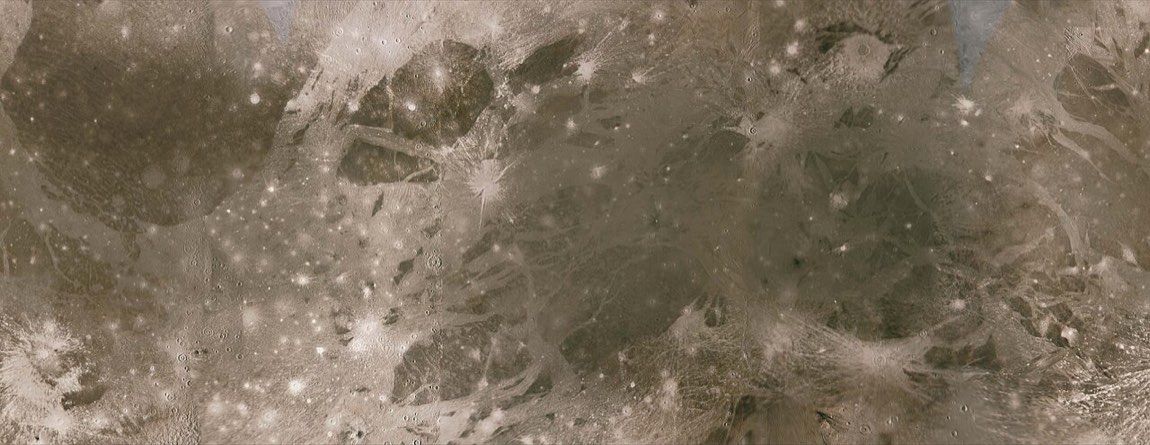
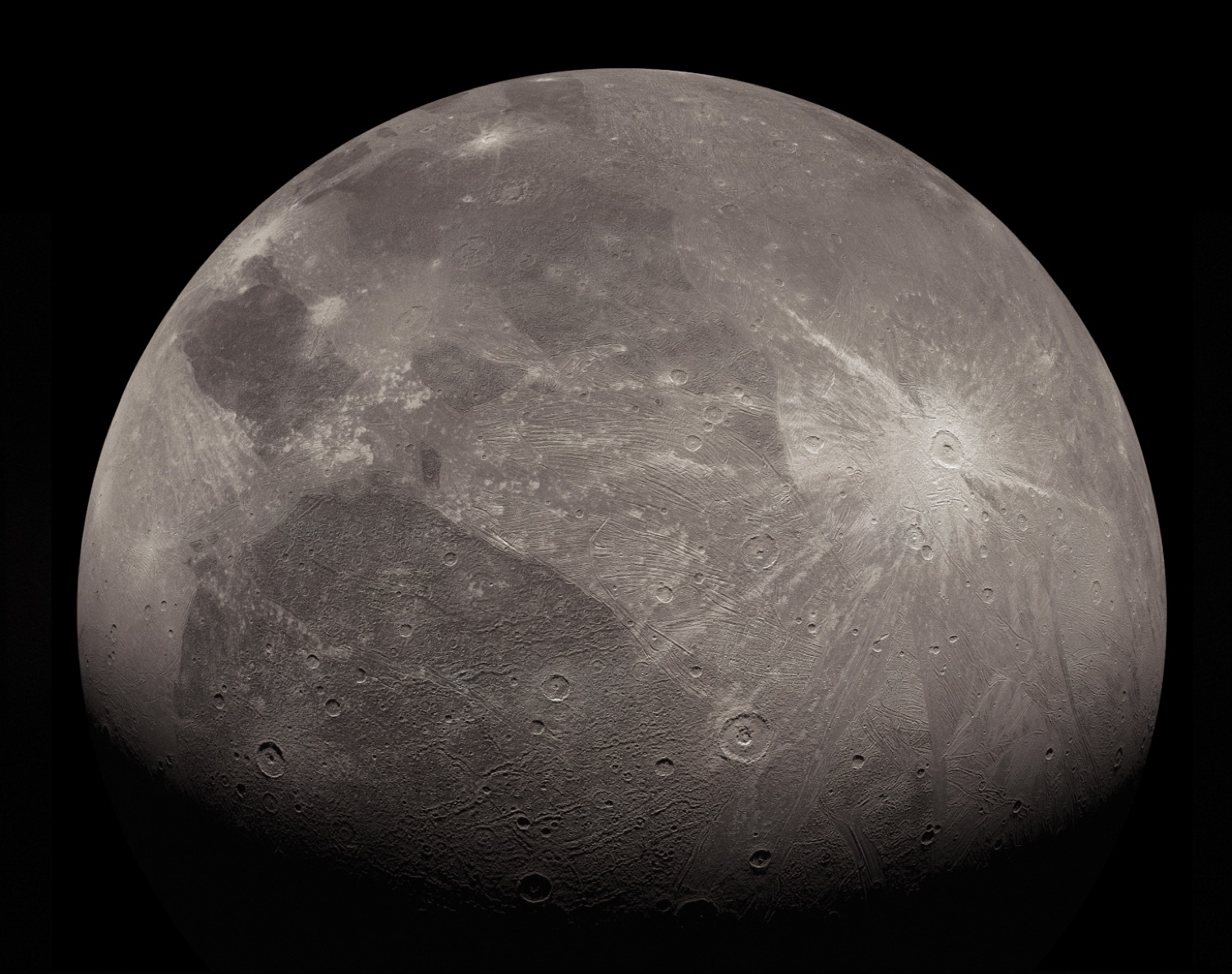
Viewed from above, Ganymede's surface splits visibly into two distinct worlds. Roughly one-third is dark, heavily cratered terrain estimated to be about 4 billion years old — as ancient as the lunar highlands — containing clays and organic materials that may record the composition of the original building blocks from which the Jovian moons assembled. The remaining two-thirds is lighter, laced with sweeping grooves and ridges, somewhat younger in age though still ancient, formed when a period of intense tectonic activity erased and rebuilt the original surface. Water ice dominates both regions, but with very different concentrations: the surface mass fraction of ice runs from 50 to 90 percent — far higher than Ganymede's bulk average of roughly 46 to 50 percent — because ice migrates toward the surface over time. Near-infrared spectroscopy has identified water-ice absorption bands at wavelengths of 1.04, 1.25, 1.5, 2.0, and 3.0 μm, alongside carbon dioxide, sulfur dioxide, and possibly cyanogen, hydrogen sulfate, and various organic compounds. Juno's instruments later added hydrated sodium chloride, ammonium chloride, and sodium bicarbonate to the surface inventory — salts that may have been deposited from the subsurface ocean during past resurfacing events and are most abundant at lower latitudes where Ganymede's small magnetosphere offers some protection.
 ⤢
⤢
10 Grooves, ghost craters, and polar frost
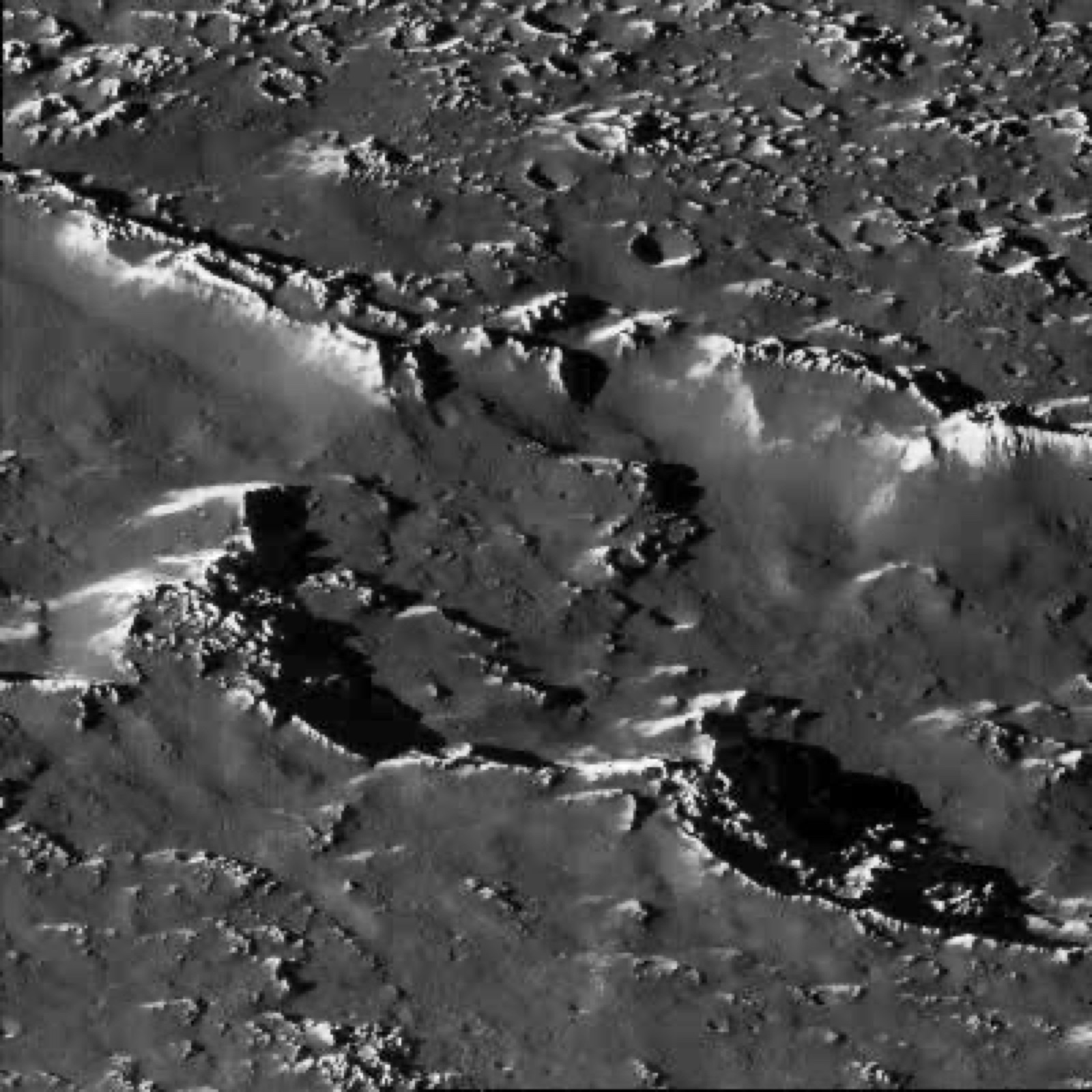
The light, grooved terrain covering about two-thirds of Ganymede is one of planetary science's unsolved puzzles. The dominant view is that it is tectonic in origin — formed when past tidal heating fractured the ice lithosphere, producing systems of parallel ridges and troughs resembling horst-and-graben faulting on Earth. Cryovolcanism may have played only a minor role, if any. Some models suggest Ganymede may have expanded by one to six percent during early core formation and subsequent heating, as phase transitions in ice and thermal expansion stretched the shell outward. Among the most dramatic surface features are palimpsests — ancient craters so thoroughly relaxed by the flow of warm ice that only a faint circular ghost remains, like Memphis Facula and Zakar. At the poles, bright caps of water frost extend down to about 40° latitude, first spotted by the Voyager spacecraft. The Galileo mission's data suggest the frost forms not simply by water migrating poleward, but because charged particle bombardment sputters surface ice and the released water molecules preferentially refreeze in colder polar patches — a process driven directly by Ganymede's magnetic field directing particle flow. Ganymede holds the record among icy moons for the greatest number of known ray craters, with fresh bright ejecta rays, though these craters are noticeably flatter than their counterparts on the Moon or Mercury because the icy crust slowly flows and softens topographic relief.
11 How Ganymede grew up faster than its twin Deeper
Ganymede and Callisto are nearly twins in mass and bulk composition, yet one is a fully differentiated, geologically complex world and the other is a largely undifferentiated body that never fully separated its rock from its ice. The explanation probably lies in how quickly each moon formed. Ganymede accreted in roughly 10,000 years in the denser, inner part of Jupiter's protoplanetary disk, while Callisto took about 100,000 years farther out where the disk was sparser. Ganymede's faster assembly trapped accretional heat inside before it could radiate away, warming the interior enough to melt ice and let rock sink to the center — a runaway differentiation process. Callisto cooled as it formed, never reaching the threshold. Once differentiated, Ganymede's rocky core began generating radiogenic heat from decaying radioactive elements, driving further separation into an inner iron–iron-sulfide core surrounded by a silicate mantle. Alternative explanations for Ganymede's greater internal heating invoke tidal flexing or more intense bombardment during the Late Heavy Bombardment roughly 3.5 to 4 billion years ago. A 2020 study by Hirata, Suetsugu, and Ohtsuki even suggests that a massive asteroid impact 4 billion years ago may have been violent enough to shift Ganymede's rotational axis, with evidence preserved in the pattern of ancient furrows on the surface.
12 Three geologic eras on an icy world Deeper
The United States Geological Survey has divided Ganymede's history into three named periods, following the same logic used for planets with long geological records. The earliest, the Nicholsonian Period, saw the moon's originally bright, icy surface gradually contaminated by dark non-ice material falling from space, darkening it much as Nicholson Regio appears today. Next came the Harpagian Period — named for the grooved terrain called Harpagia Sulcus — when sweeping tectonic activity resurfaced approximately two-thirds of the moon, erasing much of the ancient dark crust and replacing it with the bright, ridged terrain that now dominates. This was Ganymede's most geologically violent chapter. The most recent era, the Gilgameshan Period, is defined by the formation of the Gilgamesh impact basin — a collision so large it marks a new chapter the way mass extinctions mark boundaries on Earth. After that event, large-scale tectonics ceased, and the surface record became increasingly dominated by impact cratering alone. Crucially, craters from early in this period are heavily degraded, while later ones are progressively sharper and better preserved — evidence that Ganymede's internal heat was declining throughout, thickening the rigid outer ice shell and reducing the warm flow that once softened crater walls and rims.
 ⤢
⤢
13 Fifty years of spacecraft visits
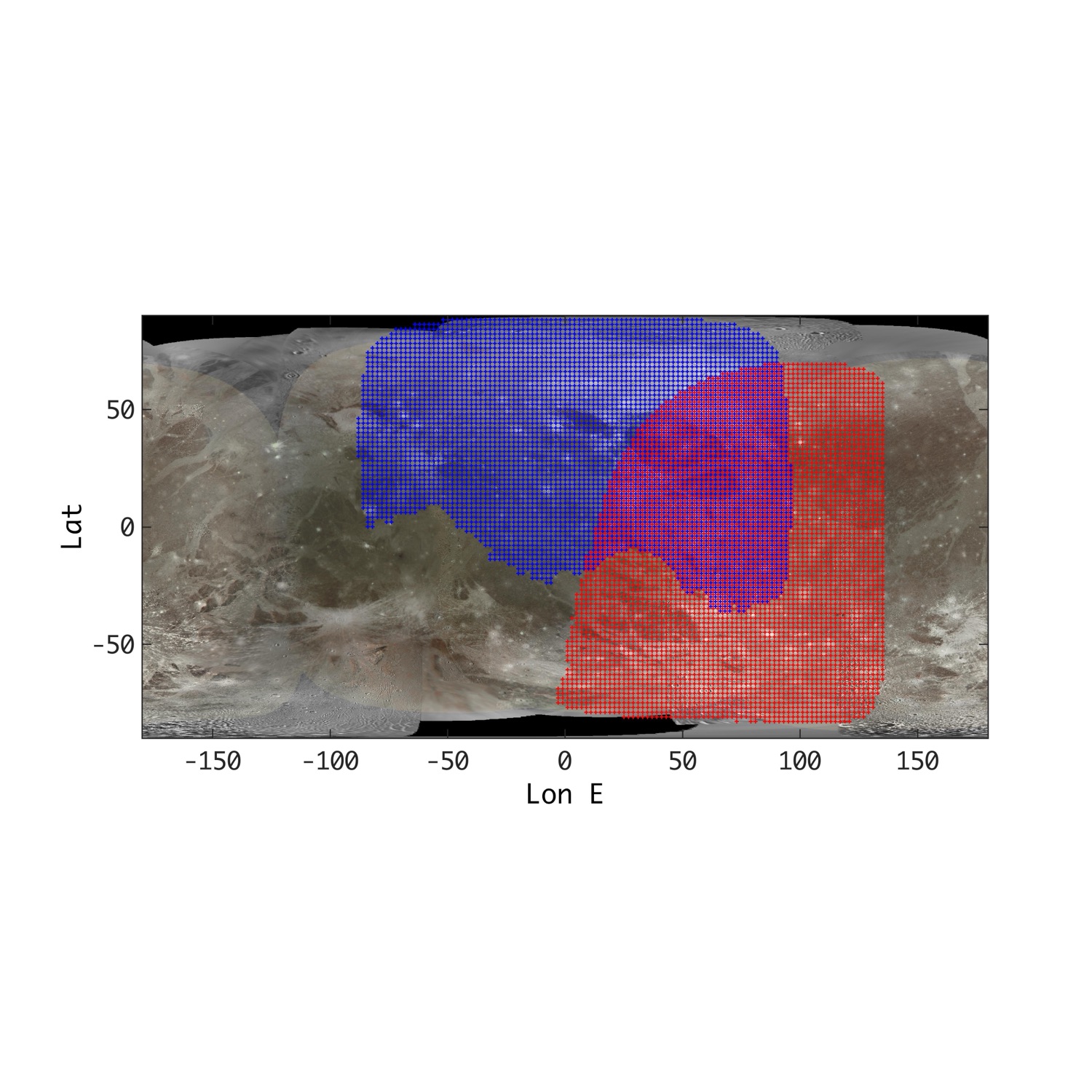
Ganymede has now been visited by seven distinct spacecraft. Pioneer 10 made the first close approach in 1973, followed by Pioneer 11 in 1974; together they returned images with resolution as coarse as 400 km per pixel, with Pioneer 10's closest approach at 446,250 km — about 85 Ganymede diameters away. Voyager 1 and Voyager 2 both flew through in 1979, delivering the first clear views of the grooved terrain and correcting a long-held misconception: Titan had been thought the Solar System's largest moon, but Voyager data showed Ganymede was bigger. The real revelations came from Galileo, which entered Jupiter orbit in 1995 and made six targeted Ganymede flybys labeled G1 through G29. During flyby G2, Galileo passed just 264 km above the surface — still the closest any spacecraft has come. G1 detected the magnetic field; later flybys established the subsurface ocean, announced in 2001. Cassini swung past at a distant 10,350,000 km in December 2000 on its way to Saturn, and New Horizons observed from 3,500,000 km in 2007. Juno made a 1,038 km flyby in June 2021, its closest, designed partly as a gravity assist to shrink Juno's orbital period from 53 to 43 days. No spacecraft has yet actually orbited Ganymede — that first will belong to ESA's Juice mission, planned to enter orbit in 2032 and ultimately impact the surface in February 2034.
14 Radiation: a real hazard at the surface
Despite having its own magnetosphere, Ganymede's surface is not a safe place by human standards when it comes to radiation. The dose at the surface is estimated at 50 to 80 millisieverts per day — equivalent to 5 to 8 rem per day. For context, the annual occupational dose limit for radiation workers in many countries is about 50 millisieverts per year, meaning a person standing unprotected on Ganymede's surface would absorb that yearly limit in a single day. The article notes bluntly that exposure over two months would cause severe illness or death. This is considerably better than the situation on Europa, where radiation is far more intense, partly because Ganymede's magnetosphere deflects some of the charged particles that Jupiter's enormous magnetic field continuously flings inward. The polar regions, where field lines are open and connect directly to Jupiter's ionosphere, receive heavier particle bombardment and experience more intense sputtering of surface ice — which also contributes to the darkening of the polar terrain and the redistribution of water frost. Any long-term human presence on Ganymede would require substantial shielding, most likely underground.
15 What remains unknown — and what comes next Deeper
For all that has been learned, Ganymede leaves scientists with a striking list of open questions. The precise structure of the subsurface ocean is unresolved: a 2014 analysis suggests not one ocean layer but a stack of several, separated by different phases of ice, with the bottom of the ocean perhaps 800 km above the rocky seafloor and temperatures there up to 40 K warmer than at the ice–water interface. Whether water actually contacts rock anywhere — a condition considered important for the origin of life — is unknown. The ionosphere is similarly ambiguous; some Galileo measurements found elevated electron densities near the surface while others found nothing, and as of the published literature the ionosphere's parameters remain poorly constrained. The exact mechanism sustaining the magnetic dynamo against the expectation that a body of Ganymede's size should have cooled and solidified is still debated. ESA's Juice spacecraft, launched April 14, 2023, is designed to attack many of these problems directly: it will perform its first Ganymede flyby in 2031, enter orbit in 2032, and spend roughly two years as the first spacecraft ever to orbit a moon other than Earth's before impacting the surface in February 2034. NASA's Europa Clipper, launched in October 2024, will also conduct four close Ganymede flybys beginning in 2030, and may itself end its mission by crashing into Ganymede to assist geochemical studies.
 ⤢
⤢
You would weigh…
Surface gravity 1.43 m/s² vs Earth’s 9.81 m/s². Try every world →
Could life exist here?
A confirmed-conductivity ocean makes Ganymede a genuine ocean world, but if high-pressure ice isolates the water from rock, chemistry may be limited. Interesting — a tier below Europa and Enceladus.
Our labels: Confirmed · Strong Evidence · Estimated · Hypothesis · Theoretical · Speculative (see Methodology).
Could humans live here?
Far-future robotic-then-outpost territory at best; radiation is gentler than at Europa but still serious. Its ice would be a resource for any Jupiter-system infrastructure.
How would we get there?
With Jupiter: 5–8 years. JUICE launched in April 2023, arrives 2031, and settles into Ganymede orbit around 2034.
| Technology | Status | Travel time (one way, straight line) |
|---|---|---|
| Apollo-style spacecraft, about 39,000 km/h | Flown technology | 673 days |
| Ion-propulsion probe, about 90,000 km/h | Flown technology | 291 days |
| Voyager 1, about 61,000 km/h | Flown technology | 428 days |
| Parker Solar Probe, about 690,000 km/h | Flown technology | 38 days |
| Nuclear-thermal rocket, about 120,000 km/h cruise | In development | 220 days |
| Laser light-sail at 20% of light speed | Proposed concept | 2.9 hours |
| Light itself, 299,792 km/s | Physical limit | 35 minutes |
Simplified straight-line times at cruise speed. Real missions fly curved orbital paths and take longer. Full travel calculator →
Weird & wonderful
- Ganymede has auroras — northern lights on a moon.
- It may contain more liquid water than Earth, Europa, or anywhere else in the Solar System.
- Galileo spotted it in 1610 with a telescope you could build from a paper tube today.
Latest news about Ganymede
More real images of Ganymede
Genuine spacecraft and telescope imagery, every frame credited and licensed. Tap any photo to enlarge.