 Photograph · NASA / JPL · Public domain
Moon · Deep guide · orbits Jupiter
Amalthea
Also called: Jupiter V
A potato-shaped, brick-red moon so light it may be half empty space inside.
What is it?
Amalthea is the largest of Jupiter's small inner moons, an elongated body about 250 km long. E. E. Barnard found it in 1892 by eye through the great 36-inch refractor at Lick Observatory — the last moon in history discovered by direct visual observation. Its surface is among the reddest in the Solar System. When the Galileo orbiter flew within 160 km in 2002, its tug revealed a density below that of water, so Amalthea is probably a porous, icy rubble pile. Dust blasted off it feeds a faint gossamer ring.
The deep dive
Researched for the Atlas from Wikipedia — Amalthea (moon) (9,572 characters read) · updated Nov 14, 2026
01 The Last Moon Spotted by Human Eyes
When Edward Emerson Barnard turned the 36-inch (91 cm) refractor at Lick Observatory toward Jupiter on the night of 9 September 1892, he made history twice over. He discovered Amalthea — the first new Jovian moon since Galileo Galilei had spotted the four large Galilean satellites in 1610, ending a gap of 282 years. More remarkably, Amalthea holds a permanent record: it was the last natural satellite of any planet ever discovered by a human being looking through an eyepiece. Every moon found after it — dozens and dozens of them — required photographic plates or digital detectors to pull faint signals out of the sky. The naked-eye tradition of planetary discovery, stretching back to antiquity, ended that September night in California. Barnard himself was one of the most skilled visual observers of his era, renowned for his sharp eyesight, and even he needed one of the largest refracting telescopes then in existence to catch Amalthea's faint glow huddled close to the overwhelming glare of Jupiter.
02 A Name Waiting 84 Years for Official Approval
The name Amalthea comes from Greek mythology, where Amalthea was the nymph who nursed the infant Zeus — the Greek counterpart of the Roman Jupiter — with goat's milk. The connection is elegant: a moon of Jupiter named for the creature that fed Jupiter's mythological self in infancy. The name was first proposed not by the discoverer Barnard, but by the French astronomer and popular science writer Camille Flammarion. For decades astronomers used it informally and affectionately, but the International Astronomical Union did not make it official until 1976 — a full 84 years after discovery. Before that formal adoption, the moon's most common designation was simply Jupiter V, reflecting its status as the fifth moon of Jupiter to be known. The geological features on its surface follow the same mythological thread: craters are named after figures from Greek mythology associated with Zeus and Amalthea, while the bright faculae are named after locations connected with Zeus.
03 An Orbit Shaped by a Distant Neighbor Deeper
Amalthea circles Jupiter at a distance of 181,000 km, or 2.54 Jupiter radii, completing each orbit in a period only about 20 percent longer than Jupiter's own rotation day. What makes its orbit scientifically interesting is that it is not perfectly circular or equatorial, as planetary scientists would naively expect for a moon sitting so deep inside Jupiter's gravitational well. Its orbital eccentricity is 0.003 and its inclination relative to Jupiter's equator is 0.37 degrees — small numbers, but unexpectedly nonzero for an inner satellite. The culprit is Io, the innermost Galilean moon. In the past, Amalthea has passed through several mean-motion resonances with Io — configurations where the ratio of the two moons' orbital periods forms a simple fraction. Each encounter through such a resonance delivered a gravitational nudge that gradually pumped up Amalthea's eccentricity and inclination to their present values. This resonance history makes Amalthea a small but useful record of the dynamical evolution of the Jovian system.
04 The Reddest Surface in the Solar System
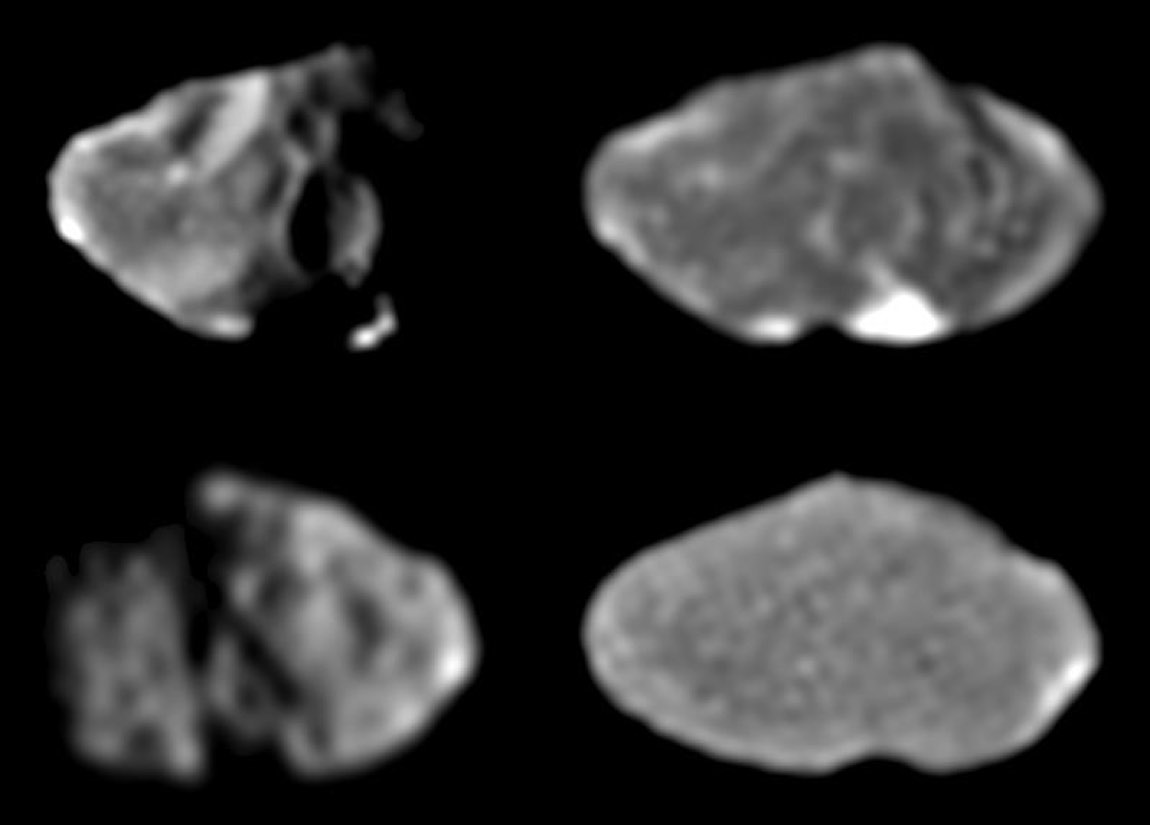
Of all the solid surfaces catalogued across the Solar System, Amalthea's is the reddest known. Scientists suspect the vivid coloration comes from sulfur delivered by Io, which constantly erupts and sprays material throughout the inner Jovian system, though other non-ice materials may also contribute and the question is not fully settled. The color is not uniform. Bright patches of less intensely red material appear on the major slopes of the moon, and their origin is currently unknown. There is also a striking brightness difference between Amalthea's two hemispheres: the leading hemisphere — the face that always pushes forward in the direction of orbital motion — is 1.3 times brighter than the trailing hemisphere. The most likely explanation is that the leading face sweeps up impactors at higher speed and frequency, and these collisions excavate fresh, bright material — probably ice — from beneath the reddened surface crust. The trailing side simply does not receive the same sandblasting, so its darker, redder coating remains intact.
 ⤢
05 A Rubble Pile Hiding Inside a Rigid-Looking Shell Deeper
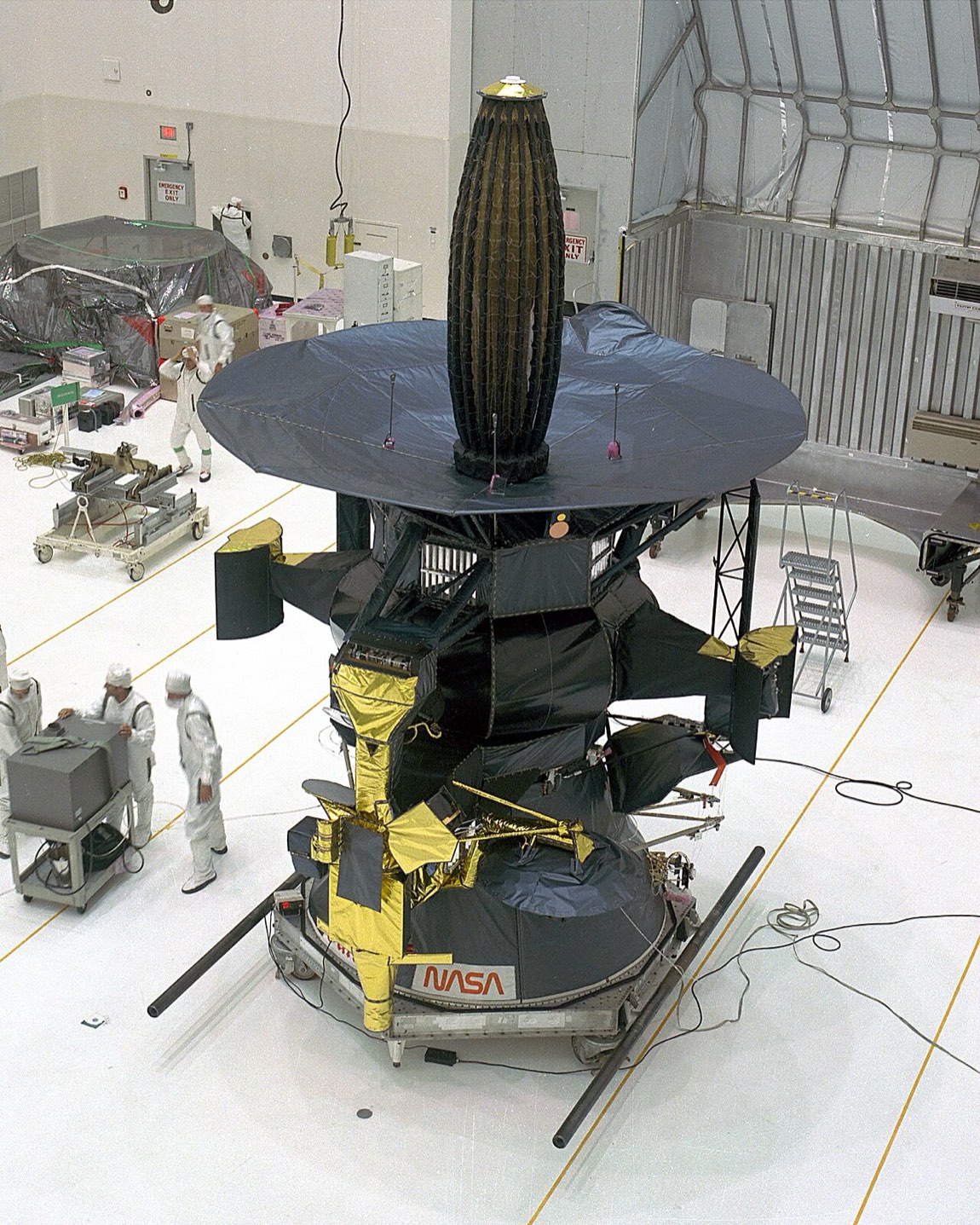
For years, astronomers looked at Amalthea's elongated, irregular shape — roughly 250 × 146 × 128 km — and assumed it had to be a sturdy, coherent rock. The reasoning was straightforward: a body made of weak material like ice should be pulled by its own gravity into something closer to a sphere. That assumption collapsed on 5 November 2002, when the Galileo spacecraft made a targeted flyby, passing within 160 km of Amalthea's surface. Tracking the tiny deflection in Galileo's trajectory allowed scientists to calculate the moon's mass for the first time. Combined with the volume previously estimated from images — accurate to within about 10 percent — the result was startling: Amalthea's density is as low as 0.86 g/cm³, less dense than liquid water. That means it must be either a very icy body, an extremely porous rubble pile, or most likely a mixture of both. The rigid-body assumption had been wrong, and Amalthea joined the growing family of small Solar System bodies now understood to be loosely consolidated heaps of debris held together more by circumstance than by strength.
06 Water Ice Far Too Close to Ancient Jupiter Deeper
Infrared spectra measured by the Subaru telescope revealed something that complicated the simple story of Amalthea forming where it now orbits. The data suggest that the moon contains hydrous minerals — minerals that incorporate water molecules into their crystal structure. This matters because the region so close to primordial Jupiter would have been intensely hot during the planet's early formation, hot enough to melt or drive off water-bearing materials. A body forming in Amalthea's current location, the argument goes, should not contain hydrous minerals at all. The implication is that Amalthea either formed much farther from Jupiter, where temperatures were cool enough to preserve such minerals, and subsequently migrated inward, or that it is an entirely captured Solar System body — a wandering object that formed elsewhere and was gravitationally snared by Jupiter. Neither scenario is proven, and the question of Amalthea's birthplace remains an open and active area of research, connecting the small moon to larger debates about how Jupiter and its satellite system assembled themselves.
07 Craters That Would Swallow Cities
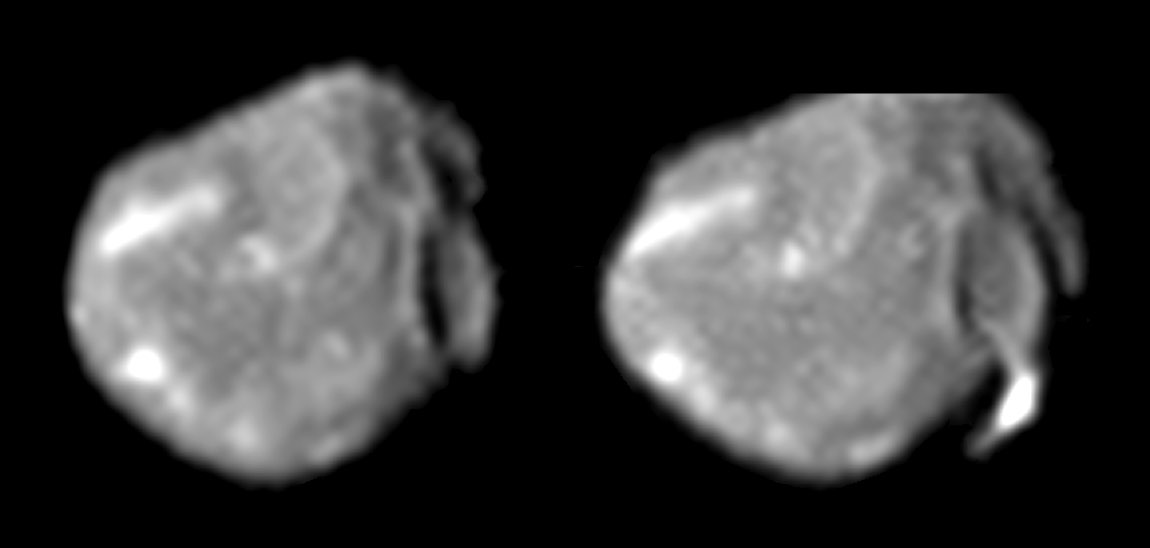
Amalthea's surface is heavily battered, and two of its craters are enormous relative to the moon's own size. Pan, the largest, stretches 100 km across and plunges at least 8 km deep — roughly the height of Mount Everest above sea level, inverted into the ground. For context, 100 km is about the distance from Washington D.C. to Baltimore, Maryland, gouged into a moon only 250 km across at its longest dimension. The second major crater, Gaea, measures 80 km in diameter and is thought to be at least twice as deep as Pan, making it one of the deepest known impact features relative to the size of its parent body. Alongside the craters, Amalthea hosts ridges, and on the edges of one of these ridges on the anti-Jupiter side sit two named bright spots, or faculae: Lyctos Facula and Ida Facula, each reaching up to 25 km in width. In total there are only four officially named geological features on the entire moon — two craters and two faculae — a reflection of how limited and low-resolution most available imagery remains.
08 How Amalthea Builds Jupiter's Gossamer Ring
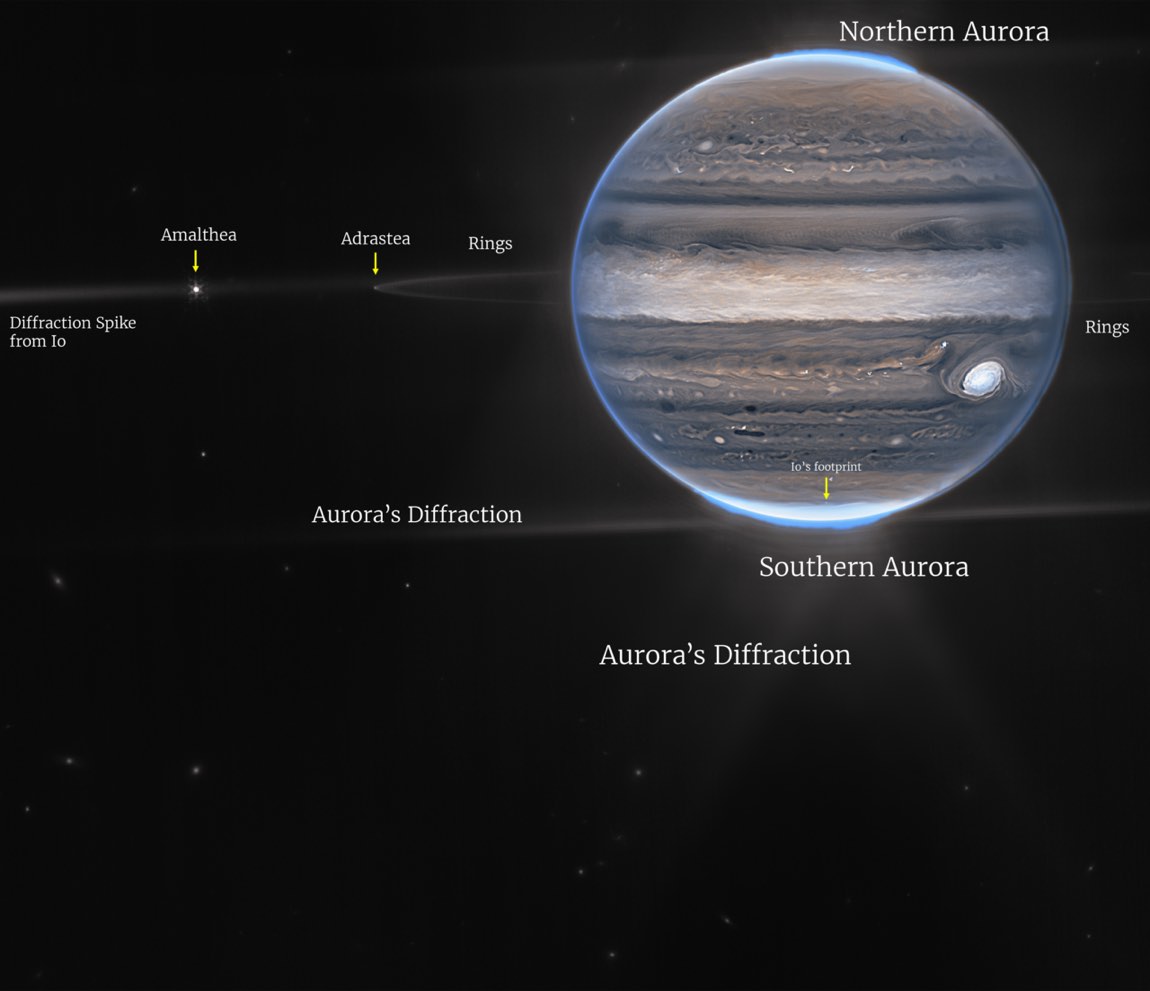
Amalthea does not just orbit inside Jupiter's ring system — it actively manufactures part of it. The moon sits at the outer edge of the Amalthea Gossamer Ring, a tenuous structure composed of dust that has escaped from Amalthea's surface. The escape process is surprisingly easy, because Amalthea's combination of low density, irregular shape, and tidal stretching by Jupiter means the escape velocity at the points on its surface nearest to and farthest from Jupiter is no more than 1 m/s — roughly a gentle jogging pace. When a micrometeorite strikes the surface, the collision kicks up debris that simply drifts away into space and spreads along the orbital path. During its final flyby, the Galileo orbiter's star scanner detected nine brief flashes suggesting small moonlets orbiting near Amalthea, ranging in size from gravel up to perhaps stadium-sized objects. On Galileo's very last orbit before its intentional destruction, one more such object was detected on the opposite side of Jupiter from Amalthea, suggesting these particles may form a continuous ring rather than being clustered near the moon itself.
 ⤢
09 Jupiter as Seen from Amalthea's Surface
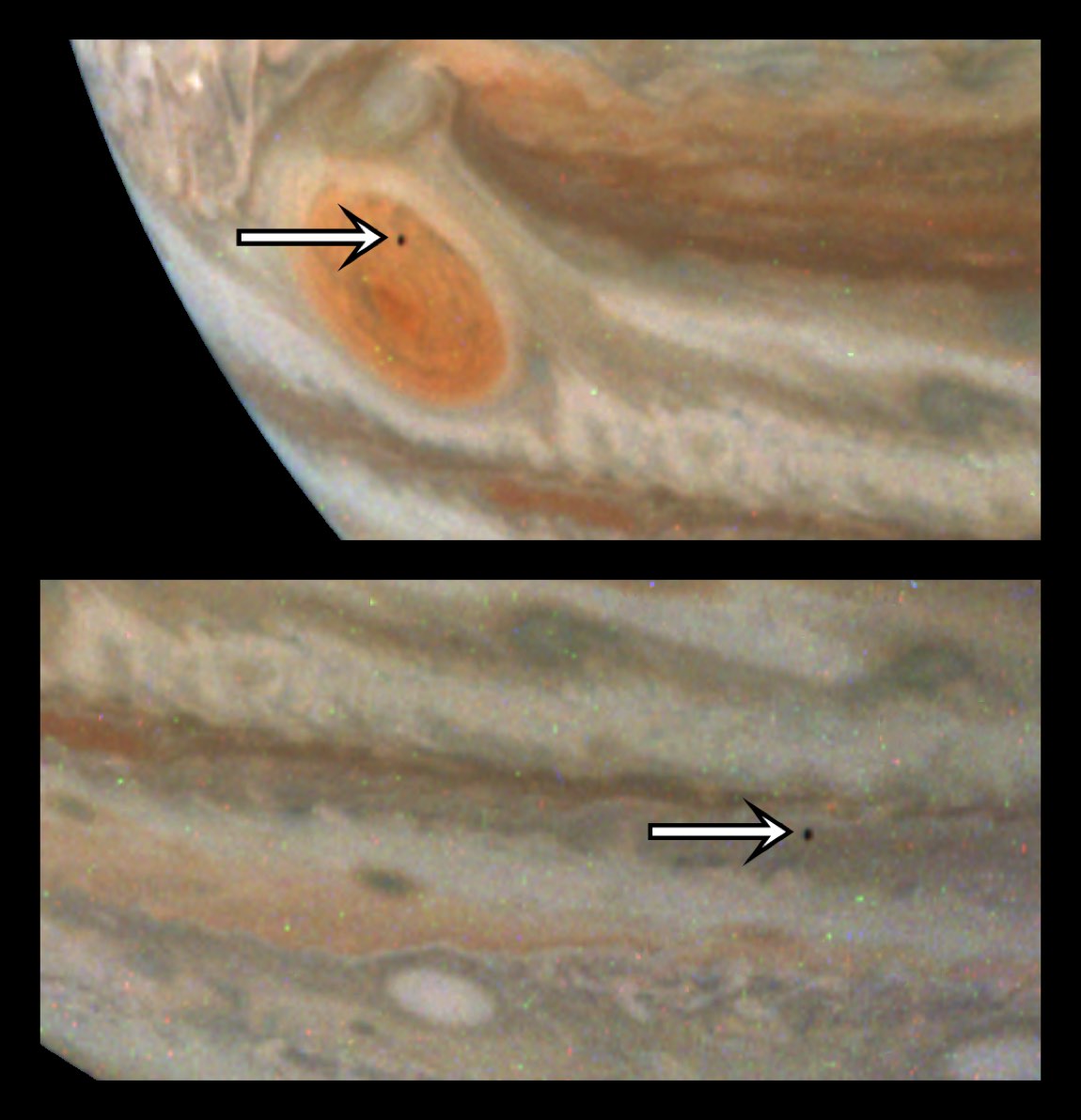
Standing on Amalthea would offer one of the most dramatic views available anywhere in the Solar System. Jupiter would span 46 degrees of sky — roughly 85 times the apparent width of the full Moon seen from Earth — and because Amalthea is tidally locked, Jupiter would hang permanently fixed overhead from one hemisphere, never rising or setting. It would be completely invisible from the opposite hemisphere. Though Jupiter would appear 900 times brighter than the full Moon, its light would be spread over an area about 8,500 times larger, so it would not appear as blindingly intense per unit of surface as those raw numbers might suggest. The Sun would disappear behind Jupiter's bulk for an hour and a half during each of Amalthea's short orbits, and the rapid rotation gives the surface just under six hours of sunlight per cycle. Amalthea also radiates slightly more heat than it receives directly from the Sun, with contributions from Jupiter's own heat flux (less than 9 kelvins), reflected sunlight from Jupiter (less than 5 K), and bombardment by charged particles (less than 2 K).
10 Barnard's Discovery and the Telescope Behind It
The instrument that made Amalthea's discovery possible was the 36-inch (91 cm) refractor at Lick Observatory on Mount Hamilton in California — at the time one of the most powerful telescopes in the world. Edward Emerson Barnard was no ordinary observer. He had a reputation for exceptional eyesight and extraordinary dedication, and he had already made a series of important discoveries before turning that great lens toward Jupiter in September 1892. Finding a fifth moon of Jupiter by eye, so close to the overwhelming glare of the planet, required both a superb instrument and a superb observer. The discovery ended a 282-year drought in Jovian moon discoveries since Galileo's work in 1610, and it simultaneously closed the entire era of visual satellite discovery. No telescope-and-eyepiece combination has found a new moon of any planet since that night. The feat stands as a kind of punctuation mark at the end of classical observational astronomy, just as the age of astrophotography was taking over.
11 Spacecraft Visits: From Voyager to Juno Deeper
The first resolved images of Amalthea's surface came in 1979, when both Voyager 1 and Voyager 2 flew through the Jovian system and trained their cameras on the small inner moon. Those flybys also captured visible and infrared spectra and measured surface temperatures. The far more detailed portrait came from the Galileo orbiter, which spent years in orbit around Jupiter through the 1990s and completed the mapping of Amalthea's surface. Galileo's final satellite encounter anywhere in the Jovian system was its 5 November 2002 flyby of Amalthea, passing about 160 to 170 km above the surface. No images were acquired — Galileo's cameras had been permanently shut down in January 2002 due to radiation damage — but the trajectory deflection data yielded Amalthea's mass. That flyby also set Galileo on a path toward its deliberate plunge into Jupiter in September 2003. In 2006, the New Horizons spacecraft refined Amalthea's orbital parameters during its Jupiter gravity-assist flyby. Looking ahead, NASA's Juno probe, which arrived at Jupiter in 2016, is scheduled to make a close flyby of Amalthea on 25 April 2027, potentially providing new data.
12 Open Questions That Still Need Answering Deeper
Despite decades of observations and two generations of spacecraft, Amalthea holds onto several genuine mysteries. The precise composition and origin of its extreme red color remains unresolved: sulfur from Io is the leading hypothesis, but other non-ice materials have not been ruled out, and the nature of the bright, less-red patches on its slopes is entirely unknown. The question of where Amalthea formed — in place, farther out in the Jovian system, or as a captured interloper from elsewhere in the Solar System — is unresolved and directly tied to debates about Jupiter's formation and the early evolution of the Solar System. The small moonlets detected by Galileo's star scanner during the final flyby have never been confirmed or characterized, and whether they constitute a coherent ring or scattered debris remains uncertain. Perhaps most fundamentally, the interior structure of the moon — how much is ice, how much is void, and how the two are arranged — is poorly constrained. The combination of low density and hydrous mineral signatures points toward a complex, layered history, but without higher-resolution images or future dedicated flybys, the details remain elusive.
 ⤢