Moon · Deep guide · orbits Jupiter
Themisto
Also called: Jupiter XVIII · S/1975 J 1 · S/2000 J 1
A moon found, lost for 25 years, then found again — orbiting alone between the Galilean moons and the rest.
What is it?
Themisto is a small irregular moon that orbits by itself, midway between Jupiter's big Galilean moons and the Himalia group farther out. Charles Kowal and Elizabeth Roemer first saw it at Palomar in 1975, but too few observations were made and it was lost. A Hawaii-based team picked it up again in November 2000 and showed it was the same object. Its orbit takes about 130 days, the shortest of any irregular moon apart from Neptune's Triton, and its reddish colour resembles D-type asteroids.
The deep dive
Researched for the Atlas from Wikipedia — Themisto (moon) (2,293 characters read) · updated Nov 14, 2026
01 Lost and Found: A Moon Twice Discovered
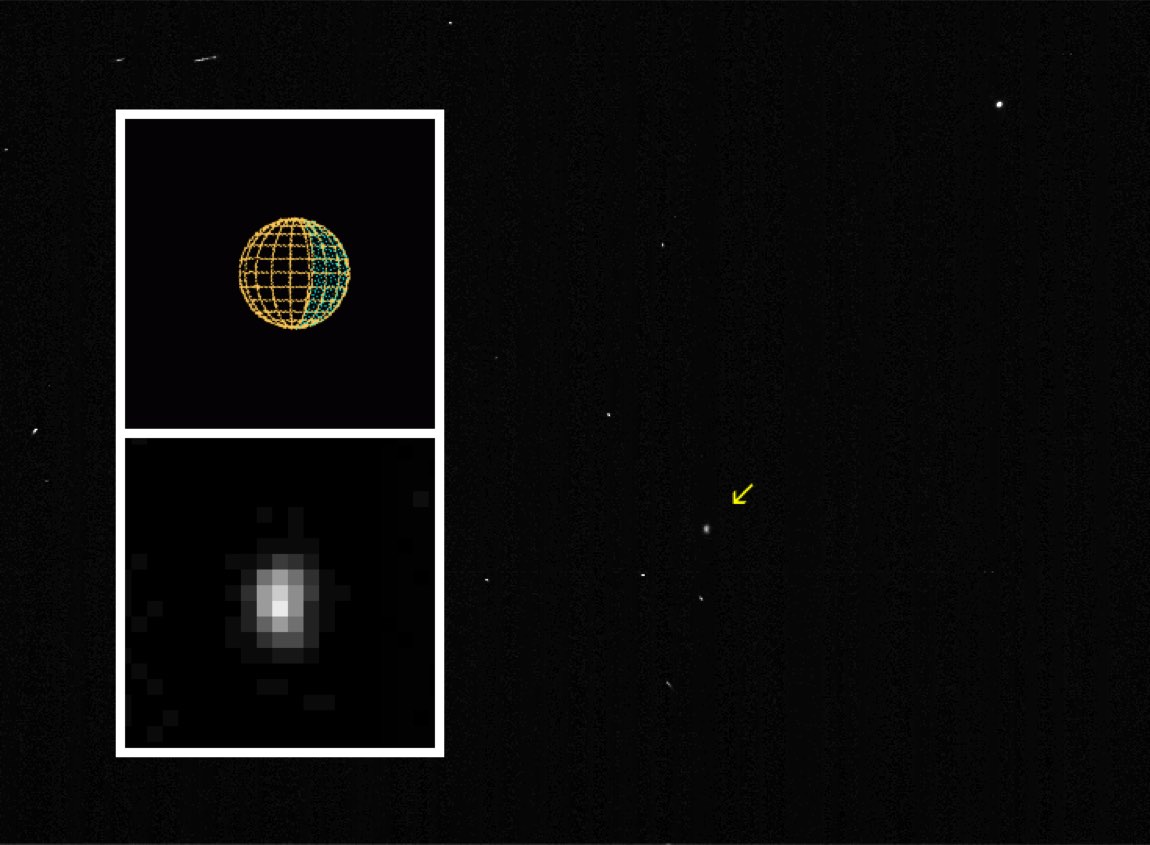
Themisto has one of the more dramatic discovery stories in planetary science. Charles T. Kowal and Elizabeth Roemer spotted it on 30 September 1975 and reported it three days later, giving it the provisional designation S/1975 J 1. But astronomers were unable to gather enough follow-up observations to pin down a reliable orbit, and the moon simply slipped away — lost in the vastness around Jupiter for a quarter of a century. Then, on 21 November 2000, a team led by Scott S. Sheppard, David C. Jewitt, Yanga R. Fernández, and Eugene A. Magnier found what looked like a brand-new satellite and called it S/2000 J 1. By computing the new object's past trajectory, researchers were able to confirm it was identical to the moon seen in 1975. Adding another layer to the story, an observation made as early as 6 August 2000 by a separate team — including Brett J. Gladman, John J. Kavelaars, and several colleagues — was quickly correlated with the same object. It had been hiding in plain sight in archival data.
02 The Mythology Behind the Name
In October 2002, the moon received its official name: Themisto. The name comes from Greek mythology, where Themisto is described as the daughter of the river god Inachus and a lover of Zeus — the Greek equivalent of Jupiter. This mythological connection follows the long-standing convention for naming Jupiter's irregular moons after figures associated with the king of the gods in classical tradition. Before this formal naming, the object had bounced between two provisional designations across a gap of twenty-five years, making its official christening a small but meaningful act of closure. The name also carries cultural resonance beyond astronomy: Inachus was considered the first king of Argos in Greek tradition, so Themisto belongs to a lineage of river gods and mortal royalty tangled up with divine affairs — exactly the kind of story the outer solar system seems to attract.
03 An Orbit Unlike Any Other Moon's Deeper
What makes Themisto genuinely strange is not just what its orbit looks like, but where it sits. The moon circles Jupiter at an average distance of 7.4 million km, completing one orbit every 130 days — the shortest orbital period of all of Jupiter's irregular moons, with the notable exception of Triton at Neptune. Its orbit is inclined about 45° to the ecliptic and carries an eccentricity of 0.252, meaning its distance from Jupiter varies considerably over the course of each trip around the planet. That inclination places it in a prograde direction, meaning it travels the same way Jupiter rotates. Crucially, Themisto does not belong to any orbital grouping. Almost all of Jupiter's other irregular moons cluster into distinct families, suggesting shared origins from breakup events. Themisto instead orbits entirely alone, positioned midway between the well-known Galilean moons and the nearest group of prograde irregular moons, the Himalia group. This isolation in orbital space is one of the central puzzles the moon poses to researchers.
04 A Tiny World Measured by Assumption
Themisto is roughly 9 km in diameter — about the length of Manhattan from end to end — but that figure comes with an important caveat. The measurement assumes an albedo of 0.04, meaning the moon reflects only 4 percent of the sunlight that hits it, making it one of the darkest possible surface types. This assumed albedo is not a measured value. The NEOWISE spacecraft, which has successfully measured the albedos of many small solar system bodies by comparing visible and infrared light, attempted to observe Themisto but was hampered by poor timing. The observations simply did not happen at a moment useful for the calculation. So the actual size of Themisto remains somewhat uncertain — if the surface turns out to be brighter than assumed, the moon would be correspondingly smaller, and vice versa. For a world already measuring only single-digit kilometers across, that uncertainty matters more than it might for a larger body.
05 Red and Dusty: What Color Tells Us Deeper
Even without a direct albedo measurement, astronomers have been able to characterize Themisto's color in meaningful detail. The moon is red in the visible spectrum, with measured color indices of B−V = 0.83, V−R = 0.46, and V−I = 0.94. These values place Themisto in the same color territory as D-type asteroids — a class of primitive, carbon-rich bodies typically found in the outer asteroid belt and among Jupiter Trojan asteroids. D-types are thought to preserve some of the most ancient, least-processed material in the solar system, their dark reddish surfaces possibly stained by complex organic compounds called tholins produced by radiation chemistry over billions of years. The color similarity to D-types provides indirect but tantalizing evidence about what Themisto is made of and where it originally came from — clues that point away from formation near Jupiter and toward a more distant origin in the outer solar system.
06 An Asteroid Captured Far From Home
Themisto almost certainly did not form where it now orbits. Current thinking holds that the moon is probably a remnant of a heliocentric asteroid — a rock that once traveled its own independent path around the Sun — that was captured by Jupiter's gravity at some point in the early solar system. The capture scenario would explain both the moon's irregular orbit and its resemblance in color to D-type asteroids, which are native to regions far from Jupiter. It is also thought to be the remnant of a body that was broken apart, perhaps by a collision, before or during the capture process. This origin story distinguishes Themisto sharply from Jupiter's large regular moons like Io, Europa, and Ganymede, which formed from the same disk of material that surrounded Jupiter as it grew. Themisto is, in a sense, an interloper — a piece of the wider solar system that Jupiter pulled into its gravitational embrace and kept.
07 Why Themisto Orbits Alone Deeper
The fact that Themisto has no orbital companions is scientifically significant. Jupiter's other irregular moons are generally organized into groups — the Himalia group, the Ananke group, the Carme group, and others — each of which likely shares a common ancestor: a larger body that was shattered by an impact, with the fragments settling into similar orbits. The existence of these families actually confirms the collision-and-breakup model of irregular moon formation. Themisto's isolation suggests it did not participate in such an event, or that any family it might have belonged to has been dispersed beyond recognition. One possibility is that Themisto is itself the surviving fragment of a captured body, with the rest of the original mass ground into dust or ejected from the Jovian system entirely. Its lonely orbit between the Galilean moons and the Himalia group could be a consequence of the specific dynamics of its capture trajectory, which left it in a region of orbital space where no other survivors ended up.
08 An Ever-Shifting Path Around Jupiter Deeper
Themisto's orbit is not static. Like all of Jupiter's distant moons, it experiences continuous gravitational nudges from the Sun and from the other planets — a phenomenon astronomers call solar and planetary perturbations. These perturbations gradually alter the shape, tilt, and orientation of the orbit over time. For a moon sitting in the dynamically complex region between the Galilean moons and the outer irregular groups, these forces are particularly significant. The 45-degree inclination and the eccentricity of 0.252 are the current values, but they were different in the past and will be different in the future. This ongoing orbital evolution makes it challenging to reconstruct Themisto's exact history just by running orbital simulations backward in time, though it was precisely such a backward calculation that confirmed the 2000 rediscovery matched the 1975 detection. The same dynamical instability that makes Themisto interesting also makes its long-term fate difficult to predict with certainty.
09 Open Questions That Remain Unanswered
For all that is known about Themisto, significant gaps remain. The true albedo has never been successfully measured, which means the actual diameter of 9 km should be treated as an estimate rather than a confirmed fact. The internal structure is entirely unknown — at 9 km across, Themisto is too small for gravity to have forced any differentiation, and it is likely a loosely consolidated rubble pile or a solid rock, but no data exist to settle the question. The precise origin and capture mechanism remain speculative; while the D-type color strongly suggests an outer solar system source, it does not pin down when or how the capture happened. Perhaps most intriguingly, the question of whether Themisto is a surviving whole body or a fragment of something larger has not been resolved. Future infrared observations or a dedicated spacecraft flyby would dramatically improve our understanding, but no such mission is currently planned.