Moon · Deep guide · orbits Jupiter
Thebe
Also called: Jupiter XIV · S/1979 J 2
A dark, cratered little moon that sheds the dust of one of Jupiter's gossamer rings.
What is it?
Thebe is the outermost and second-largest of Jupiter's four inner moons, an irregular body roughly 116 km long. Stephen Synnott found it in March 1979 in images from Voyager 1's flyby. It is dark and reddish, probably porous ice mixed with other material, and its biggest crater, Zethus, is about 40 km wide — a large scar for so small a world. Dust thrown off Thebe forms the Thebe gossamer ring, and its slightly tilted orbit hints at past nudges from Io.
The deep dive
Researched for the Atlas from Wikipedia — Thebe (moon) (4,474 characters read) · updated Nov 14, 2026
01 How Thebe Got Its Unusual Name
Most prograde moons of Jupiter are required by the International Astronomical Union to carry names ending in the letter "a" — think Io, Europa, Amalthea. Thebe breaks that rule entirely, and it was allowed to do so through a formal exemption granted by the IAU in 1983 when the name was officially approved. The moon is named for Thebe, a nymph from Greek mythology who was a lover of Zeus — the Greek counterpart of the Roman god Jupiter. There is an elegant internal logic to the choice: the only named surface feature on the moon, the large crater Zethus, is named for Zethus, who in Greek myth was the husband of the nymph Thebe. Before receiving its permanent name, the moon carried the dry provisional designation S/1979 J 2, assigned in the year of its discovery. The exemption makes Thebe something of a minor oddity in the cataloguing of Jovian moons, a small bureaucratic irregularity to match its small and irregular shape.
02 The Discovery Hidden in Voyager Images
Thebe was not discovered by a telescope pointed at the sky on a clear night, but by a scientist poring over images returned from deep space. Stephen P. Synnott found it in photographs taken by the Voyager 1 spacecraft on March 5, 1979, as the probe made its historic flyby of Jupiter. The same year, Voyager 2 also photographed Thebe during its own Jupiter encounter, adding a second data set. Despite these two visits, knowledge of the moon remained extremely limited for nearly two decades. The inner Jovian system is a difficult place to study from Earth, and neither Voyager had the time or trajectory to study Thebe in depth. It was only when the Galileo orbiter arrived at Jupiter in the 1990s and was able to image almost the entire surface in detail that scientists began to understand Thebe's shape, composition, and geology with any real confidence. More recently, on May 1, 2026, the Juno spacecraft obtained an image of Thebe from a distance of just 5,000 km.
03 An Orbit Shaped by a Distant Neighbor Deeper
For an inner satellite packed close to a giant planet, Thebe's orbit is surprisingly restless. Its eccentricity of 0.018 and inclination of 1.08° relative to Jupiter's equator are described as unusually high for a moon in this region, and the explanation points outward rather than inward — to Io, the innermost of the large Galilean moons. As Io gradually receded from Jupiter over geological time, its orbital period changed, and in doing so it swept a succession of mean-motion resonances through the region where Thebe orbits. Each resonance passage gave Thebe a gravitational nudge, incrementally pumping up the eccentricity and inclination of its orbit into the values we measure today. This makes Thebe a kind of fossil record of Io's orbital migration history. Thebe orbits at a distance of about 222,000 km from Jupiter, which works out to 3.11 Jupiter radii, placing it as the outermost of the four inner Jovian moons and just at the outer edge of the gossamer ring it creates.
04 How a Moon Builds Its Own Ring
Thebe is directly responsible for creating one of Jupiter's faint outer rings. When meteorites strike the moon's surface, they kick up dust that is then lost to space — a process made remarkably easy by the moon's location near the Roche limit. At the two surface points directly facing toward and away from Jupiter, Thebe's own gravity barely exceeds the centrifugal force acting on material at those spots, leaving the escape velocity extremely small. Dust liberated by impacts therefore drifts away without difficulty. Once free of the moon, that dust does not simply float away into space. Instead, a force called Poynting-Robertson drag — a subtle effect in which sunlight gradually robs small particles of orbital energy — causes the grains to spiral slowly inward toward Jupiter. The result is the Thebe gossamer ring, a tenuous structure that extends inward from the moon's orbital position. Thebe's orbit sits right at the outer edge of this ring, making it the source and the boundary simultaneously.
05 Inside Thebe: Ice, Voids, and Uncertainty Deeper
Thebe is thought to resemble its neighbor Amalthea in its basic makeup: a body of porous water ice mixed with unknown amounts of other materials. The porosity implied by that description is significant — these inner moons may be loosely consolidated rubble rather than solid rock or ice, which would help explain how they survive in Jupiter's intense gravitational environment. Thebe's mean density has a lower bound of 1.0 g/cm³ and is considered more likely to be closer to 1.4 g/cm³, slightly higher than the lower bound established for Amalthea. Its mass is bounded from below at 5 × 10¹⁷ kg. For context, that is about 500 trillion metric tons — enormous by everyday standards but negligible by planetary ones. The composition remains uncertain because the low geometric albedo of approximately 0.047 ± 0.003 and the reddish coloring of the surface could reflect a coating of darkened, irradiated material overlying a brighter icy interior, rather than telling us directly what the bulk of the moon is made of.
06 An Irregular Shape with Mountain-Scale Relief
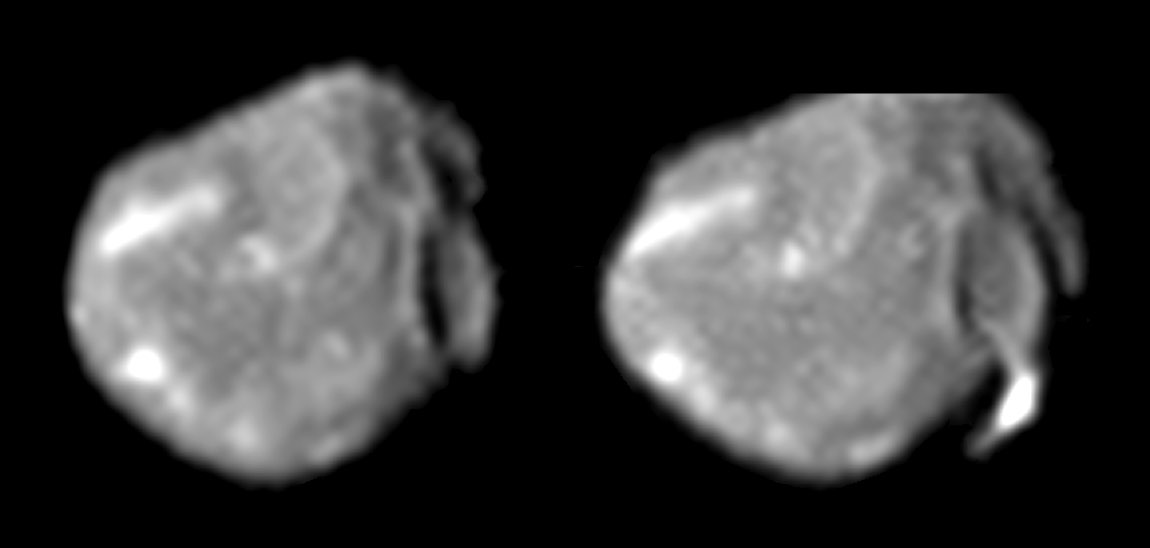
Thebe is not a sphere and makes no pretense of being one. Its shape is best approximated as a triaxial ellipsoid with dimensions of 116 × 98 × 84 km — imagine a lumpy potato roughly the size of a small city district in each direction. Like all of Jupiter's inner satellites, it rotates synchronously, meaning it completes exactly one rotation for every orbit, keeping the same face locked toward Jupiter at all times. Its long axis is permanently pointed at the planet. What makes the surface genuinely dramatic is the scale of its relief. Thebe hosts large impact craters and high mountains, and the article notes that some of these features are comparable in size to the moon itself — a remarkable statement that speaks to just how battered and topographically extreme this small world is. The largest named crater, Zethus, has a diameter of about 40 km, which on a moon only 116 km at its longest is a wound covering a substantial fraction of its width.
07 Zethus: The One Named Place on Thebe
Of all the craters, ridges, and bright patches visible on Thebe's surface, only one feature has an official name: the crater Zethus. It measures about 40 km across, making it the largest crater on the moon, and it sits on the far side of Thebe — the hemisphere that faces permanently away from Jupiter. It was identified by the Galileo spacecraft during its survey of the moon in the 1990s. The name Zethus was chosen with mythological care: in Greek legend, Zethus was the husband of the nymph Thebe, neatly pairing the crater's name with the moon's own. At the rim of Zethus there are several bright spots, which are thought to represent freshly excavated material — likely ice — exposed by whatever impact carved the crater out in the first place. The rest of Thebe's surface hosts at least three or four additional large craters that the article describes as each being roughly comparable in size to the moon itself, though none of these have yet received official names.
08 Why Thebe's Two Faces Look Different Deeper
Thebe's leading hemisphere — the face that points forward in the direction of its orbital motion — is measurably brighter than its trailing hemisphere. The ratio is 1.3 to 1, a substantial asymmetry for such a small body. The leading side gets hit more often and at higher velocities by interplanetary and circumjovian debris simply because it is sweeping through space rather than being overtaken by it. Those higher-energy impacts excavate more material per strike, digging into the dark surface coating and exposing the brighter icy material thought to lie beneath. The trailing hemisphere, struck less frequently and less energetically, remains covered by the dark, reddish surface layer. This same mechanism produces brightness asymmetries on other synchronously rotating moons throughout the solar system, but Thebe's version is particularly instructive because it supports the idea that a bright interior — consistent with water ice — underlies the dark exterior. The overall geometric albedo of about 0.047 ± 0.003 describes an extremely dark surface on average, darker than most rock on Earth.
09 The Galileo Mission's Lasting Contribution
Before the Galileo spacecraft arrived at Jupiter, Thebe was little more than a smudge in Voyager imagery with a provisional designation and uncertain dimensions. Galileo changed that comprehensively. The orbiter imaged almost the entirety of Thebe's surface, turning a vague blob into a mapped world with identifiable craters, bright spots, and measurable geometry. It was Galileo data that established the best-fit ellipsoidal dimensions, clarified the composition hypothesis pointing toward porous water ice, revealed the crater Zethus and the bright features at its rim, and documented the hemispheric brightness asymmetry. Because Galileo was an orbiter rather than a flyby probe, it could return to Jupiter's inner moon system repeatedly over the course of its mission in the 1990s, building up a picture that no single pass could provide. Without Galileo, almost everything specific that we know about Thebe's surface geology and physical characteristics would remain unknown. The subsequent Juno image taken at 5,000 km in May 2026 represents the closest dedicated look since Galileo.
10 Open Questions About This Small World Deeper
Despite the contributions of Voyager, Galileo, and Juno, Thebe remains poorly understood in several important respects. The exact amounts of non-ice material mixed into its interior are unknown, and the nature of the dark reddish coating on its surface has not been definitively identified — it could be organic compounds, sulfur compounds delivered from Io, or something else entirely. The moon's mass is known only to a lower bound of 5 × 10¹⁷ kg, meaning its true density and therefore its internal structure remain loosely constrained. The degree of porosity in its interior — whether it is a solid block of dirty ice or a loosely bound rubble pile — has not been settled. The at-least-three-or-four large craters comparable in size to the moon itself have not been fully characterized or named. And the precise history of Io's orbital recession, which is invoked to explain Thebe's unusually high eccentricity and inclination, is itself a subject of ongoing research. Thebe is a moon where the basic facts are established but the deeper details remain genuinely open.