 Photograph · NASA/JPL/University of Arizona · Public domain
Moon · Deep guide · orbits Jupiter
Himalia
Also called: Jupiter VI
Jupiter's biggest captured moon — the leader of a family of fragments from an ancient smash-up.
What is it?
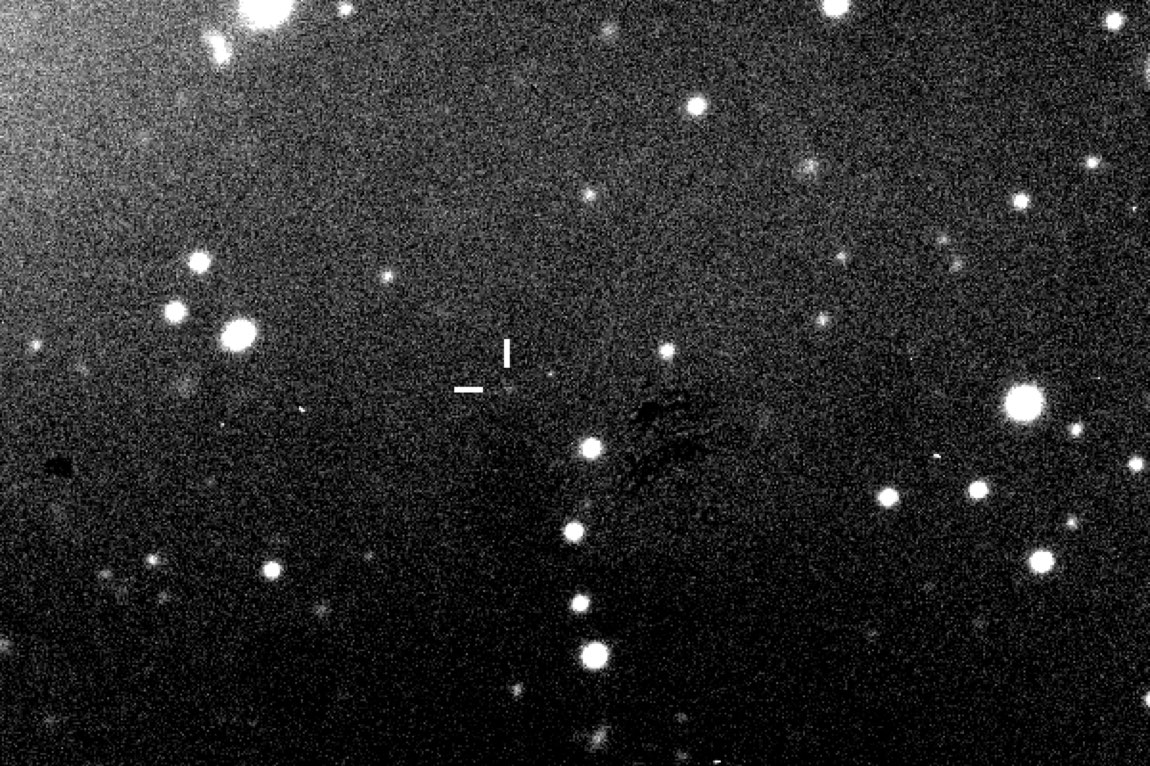
Himalia is the largest of Jupiter's irregular moons, the distant, tilted satellites thought to be captured objects. Charles Perrine found it in December 1904 on photographs taken with the Crossley reflector at Lick Observatory. About 140 km across, it heads the Himalia group, moons on similar orbits that are probably pieces of one shattered body. In 2006 the New Horizons probe spotted a possible faint ring near Himalia's orbit, perhaps debris from an impact.
The deep dive
Researched for the Atlas from Wikipedia — Himalia (moon) (9,015 characters read) · updated Nov 14, 2026
01 The discovery that almost had no name
Charles Dillon Perrine spotted Himalia on 3 December 1904 using the 36-inch Crossley reflecting telescope at Lick Observatory — an instrument he had recently rebuilt himself. Despite being one of the largest moons in the Solar System, Himalia spent the next seven decades with nothing more than the bureaucratic label "Jupiter VI." The situation frustrated astronomers almost immediately. As early as 1905, A.C.D. Crommelin complained publicly that Jupiter's satellite numbering had fallen into "precisely the same confusion" as Saturn's system once had, and urged that names replace numerals. His wish went unheeded for decades. In the interim the moon was informally called Hestia — after the Greek goddess of the hearth — from 1955 until 1975, when the International Astronomical Union finally settled on Himalia. The name honors a nymph of Greek mythology who bore three sons of Zeus, the Greek equivalent of Jupiter. It is a fitting choice: Himalia is the undisputed matriarch of an entire family of Jovian moons that now bear her name.
02 An orbit that never sits still
Himalia travels around Jupiter at an average distance of 11,388,690 km, completing one orbit every 248.29 days — just over eight months. That is far beyond the four large Galilean moons, which all orbit within about 2 million km of Jupiter. The orbit is tilted roughly 30° to the ecliptic and has an eccentricity of 0.154, meaning Himalia swings noticeably closer and farther from Jupiter over the course of each lap. Crucially, this orbit is not fixed: it shifts continuously because of gravitational tugs from the Sun and from other planets. The prograde direction of the orbit — the same direction Jupiter rotates — sets Himalia apart from the distant retrograde irregulars that orbit in the opposite sense. The Himalia group as a whole occupies a band between 11 and 13 gigametres from Jupiter, at inclinations between 27° and 30° and eccentricities ranging from 0.11 to 0.24, a tightly clustered family in orbital parameter space that hints at a shared violent origin.
03 A shattered asteroid and a family of fragments
Himalia almost certainly did not form in place. The leading hypothesis is that it — or its predecessor — was a heliocentric asteroid that Jupiter's gravity captured long ago. The other moons in the Himalia group share nearly identical orbital inclinations, eccentricities, and colors, strongly suggesting they are all fragments from a single body that was broken apart by a collision, making them a collisional family. Two specific source regions have been proposed: the Nysa–Polana asteroid complex and the Hilda group, both of which lie in the inner and outer main belt respectively. However, the members of the group are spread more widely in orbital element space than a simple smash-and-scatter scenario would predict, so researchers have proposed secondary collision events or gravitational scattering by Himalia itself to explain the extra dispersion. Neither explanation is yet definitive, leaving the precise origin story of this family an active open question in planetary science.
04 JWST rewrites Himalia's chemical identity Deeper
In 2025, observations with the James Webb Space Telescope delivered a striking result: spectroscopic data revealed phyllosilicates on Himalia's surface. Phyllosilicates are clay-like minerals that can only form in the presence of liquid water, so their detection means that at some point in its history Himalia — or its parent body — experienced aqueous alteration, the chemical transformation of rock by water. This finding drew an immediate comparison to Ceres, the dwarf planet in the asteroid belt, which is known to host significant amounts of ammoniated phyllosilicates. The resemblance suggests Himalia may have been captured from the asteroid belt rather than from the proto-Kuiper belt, the more conventional origin story for most irregular satellites under the Nice Model of Solar System evolution. An alternative interpretation is that phyllosilicates are actually common in the interiors of related objects such as Jupiter Trojans and trans-Neptunian objects, but that only in the highly collisional environment of the irregular satellite population do collisions excavate and expose these otherwise buried minerals.
 ⤢
05 How Himalia sculpts the outer Jovian system Deeper
Because Himalia is by far the largest moon in its region, it exerts a measurable gravitational influence on its neighbors — and that influence has apparently reshaped the architecture of Jupiter's outer moon system over billions of years. Himalia's size gives it a significant probability of physically impacting smaller moons across the lifetime of the Solar System. Any object it strikes is likely much smaller and would be completely destroyed. Researchers have proposed that this ongoing collisional culling is the primary reason Jupiter lacks retrograde moons with semi-major axes between roughly 0.05 and 0.11 AU (7.5 to 16.5 million km) — Himalia essentially cleared that zone. The surviving retrograde moons begin at distances above about 0.13 AU (19 million km). The conspicuous gap between Jupiter's prograde and retrograde moon populations may therefore be a scar left by Himalia's long history of gravitational and physical violence against smaller interlopers.
06 Dust from collisions rains on the Galilean moons
Every collision in the Himalia group — whether a small impactor striking Himalia or two lesser group members grazing each other — generates fine dust. That material does not stay put. It spreads throughout the Jovian system, carried by gravity and radiation pressure, and eventually settles on other moons. Studies suggest that roughly 50% of the dust produced by the Himalia group ends up on Callisto, Jupiter's outermost Galilean moon. About 20% escapes the system entirely or is absorbed by Jupiter, and the remaining 30% is distributed across Ganymede, Europa, and Io. This means that the dark, reddish dust coating parts of Callisto's surface may in part be material that originated in a violent smashup hundreds of millions of kilometres away and slowly drifted inward. It is a quiet but steady geological connection between Jupiter's outermost and innermost families of moons.
07 The brief mystery of the Himalia ring
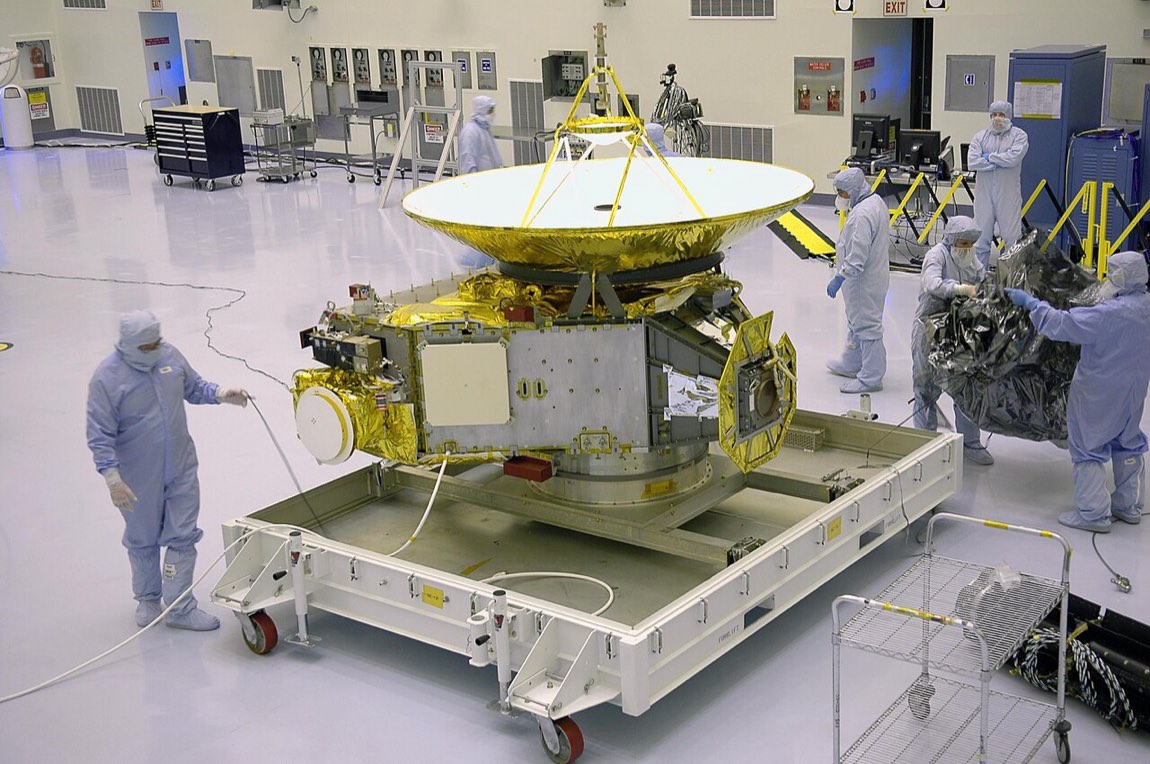
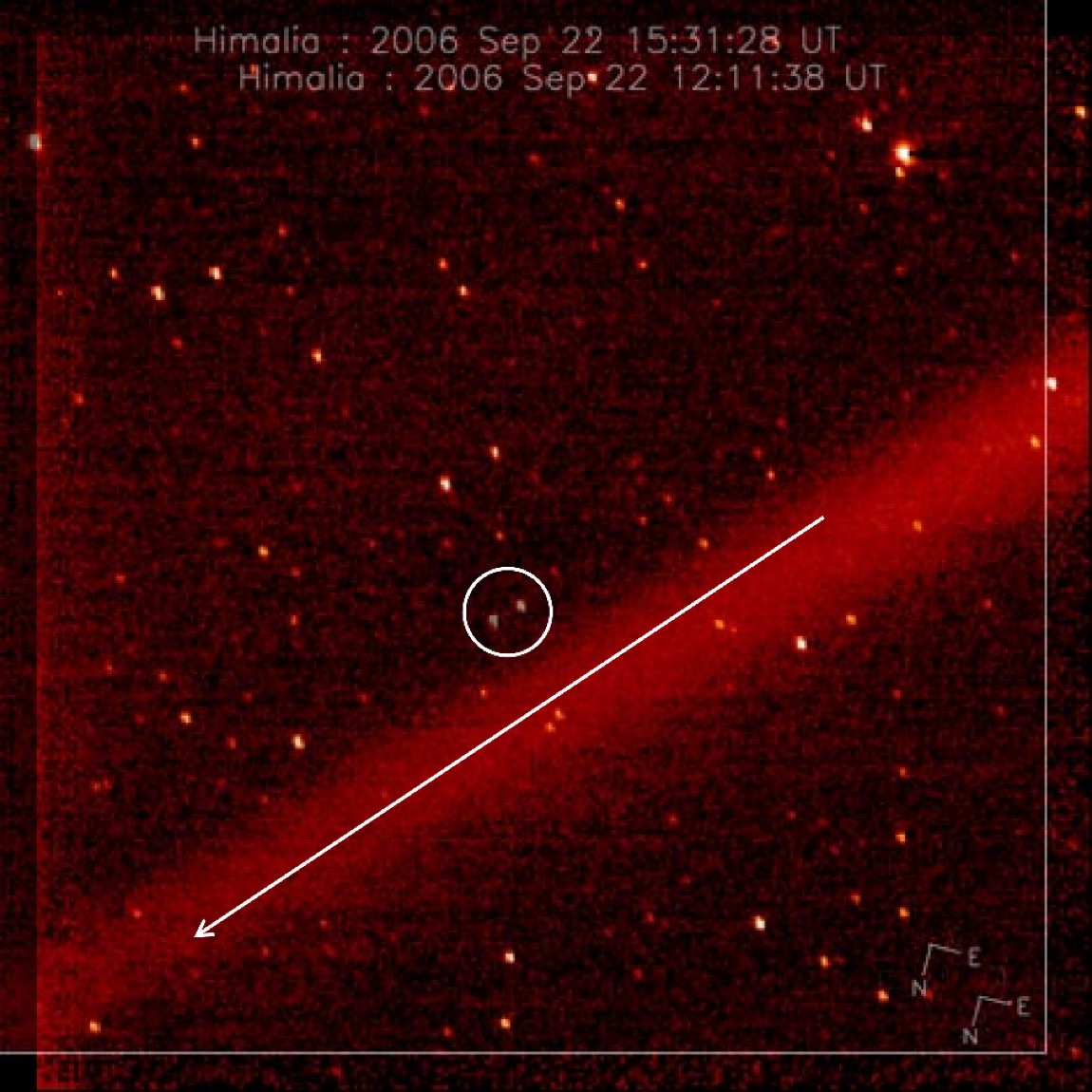
In September 2006, NASA's New Horizons spacecraft was swinging past Jupiter for a gravity assist on its way to Pluto when its cameras spotted something unexpected: a faint, tenuous ring running parallel to and slightly inside Himalia's orbit. Around the same time, astronomers noticed that Dia — a small moon just 4 km across with an orbit similar to Himalia's — had gone missing since its discovery in 2000. The tempting hypothesis was that Dia had collided with Himalia, producing the ring as a debris field. However, calculations showed that an impactor the size of Dia would have generated far more material than the ring contained, so if a collision was responsible, the culprit would have to have been an even smaller, undiscovered body. The mystery resolved itself when Dia was recovered in 2010 and 2011, proving it had survived. The true origin of the Himalia ring remains uncertain, but Dia is not the answer.
08 Pinning down size through a stellar occultation Deeper
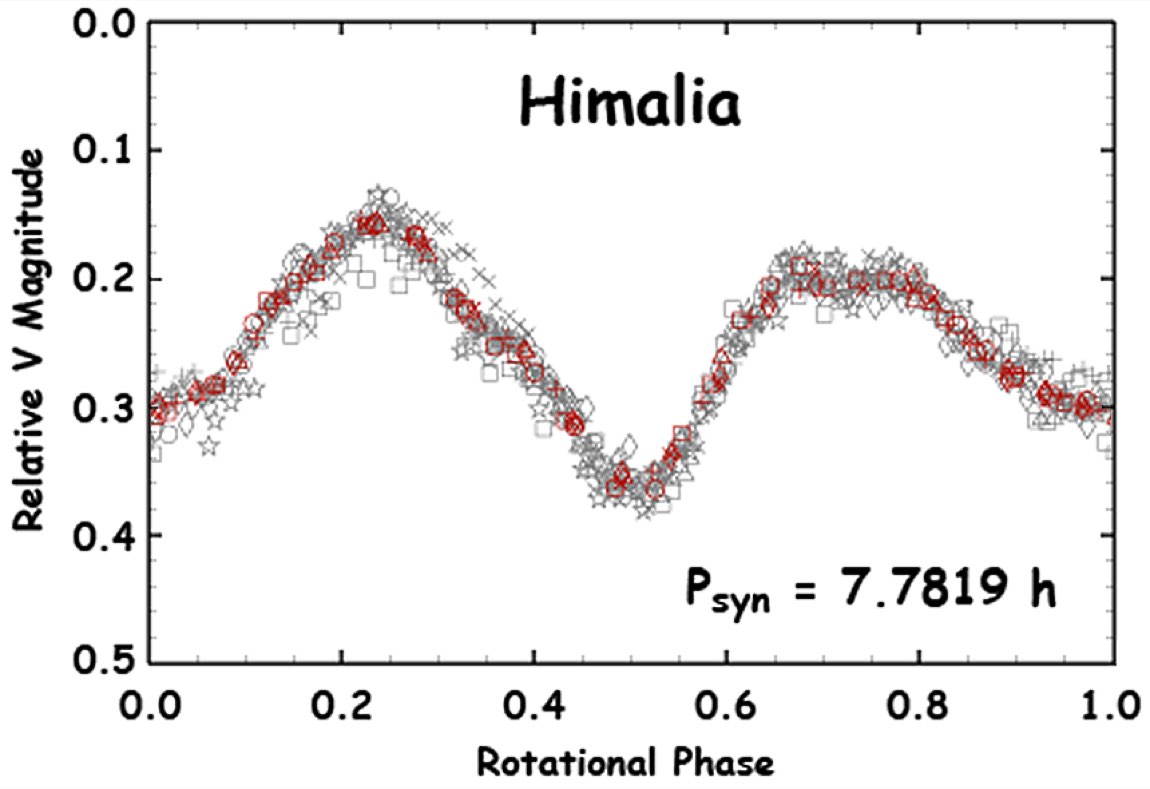
Measuring the exact size of a world only 140 km across from hundreds of millions of kilometres away is genuinely difficult. Cassini's resolved images suggested axes of 150 km × 120 km, though limb-darkening effects mean the larger dimension may better represent the true extent of the moon. Ground-based photometry had long implied a diameter around 170 km. The most precise measurement came on a specific night in May 2018, when Himalia passed directly in front of a background star — an event called a stellar occultation — as observed from the US state of Georgia. By timing exactly how long the star disappeared, observers derived a size estimate of 205.6 km × 141.3 km, the most detailed measurement yet. The fact that this figure is an ellipse rather than a circle confirms what Cassini's images hinted at: Himalia is an elongated, irregular body, not a sphere. Its rotational period has been pinned down to 7 hours 46 minutes 55 seconds, plus or minus 2 seconds.
 ⤢
09 A spectrum that echoes a specific asteroid Deeper
Himalia's surface looks grey and featureless to the eye, earning it a classification comparable to a C-type asteroid — the dark, carbon-rich class that dominates the outer main belt. Its color indices are measured at B−V = 0.62 and V−R = 0.4. Cassini confirmed a flat, featureless reflectance spectrum with one intriguing detail: a slight absorption feature at 3 micrometres, a wavelength where water ice and hydrated minerals absorb sunlight. That 3-micrometre band is not proof of ice on the surface, but it is consistent with the presence of water-bearing minerals. Notably, the spectrum bears a striking resemblance to that of the main-belt asteroid 52 Europa — a comparison that has drawn interest because it suggests a possible common origin or compositional affinity. Combined with the 2025 JWST detection of phyllosilicates, the spectral evidence increasingly points to a surface shaped by water chemistry at some point in the distant past.
10 The uncertain mass of an irregular giant Deeper
Weighing a moon with no orbiting spacecraft is an exercise in creative celestial mechanics. In 2005, Nikolai Emelyanov exploited a close gravitational encounter: on 15 July 1949, Himalia and the nearby moon Elara passed within just 65,031 kilometres of each other — about one-sixth the distance from Earth to the Moon — and the tiny deflection Himalia imprinted on Elara's path allowed him to estimate Himalia's mass as (4.2 ± 0.6) × 10¹⁸ kg. Also in 2005, Christou tested a range of masses from 1.7 to 5.2 × 10¹⁸ kg to explore whether Himalia could have gravitationally scattered other group members, finding the idea plausible only at the high end of that range. A later study argued at least twice Emelyanov's mass was needed to fully explain the group's dispersion. A 2017 analysis by Brozović and Jacobson constrained the mass to between 1.9 and 4.2 × 10¹⁸ kg, ruling out values much above Emelyanov's estimate and leaving the debate unresolved but bounded.
11 Two brief spacecraft visits, years apart
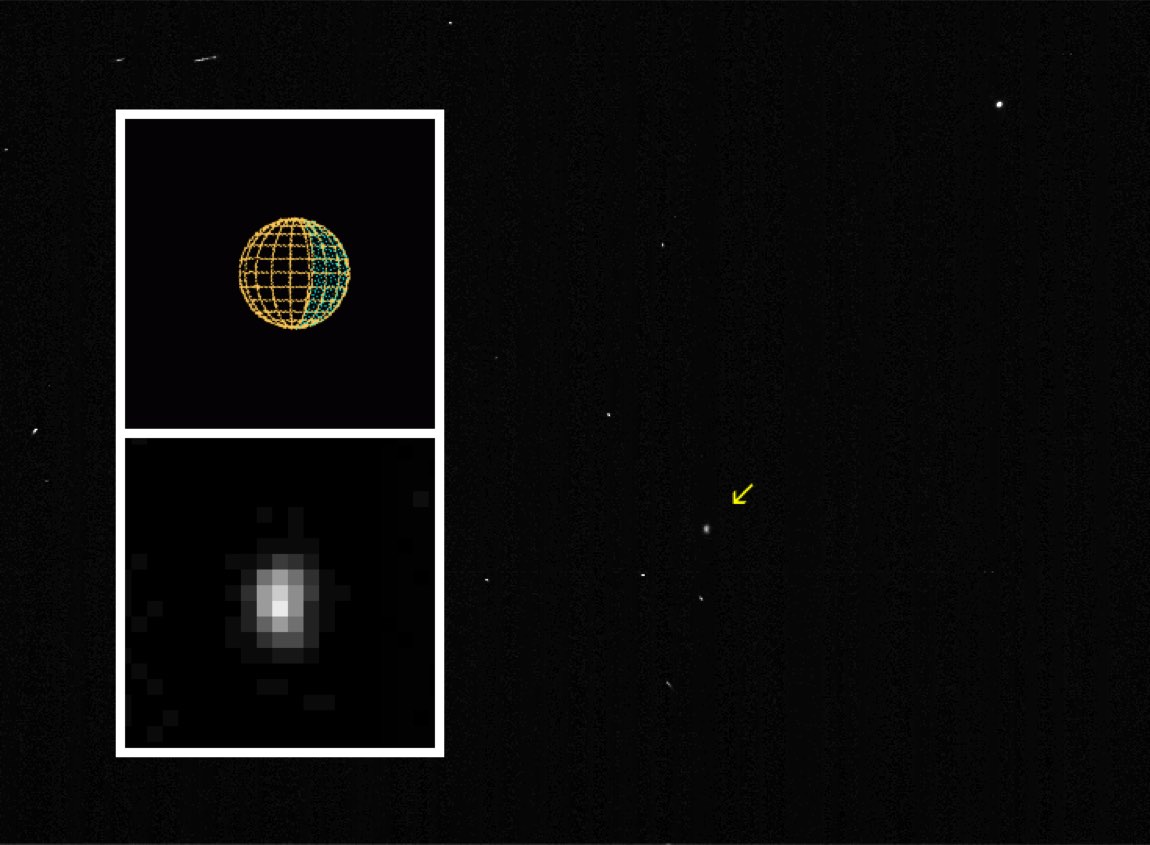
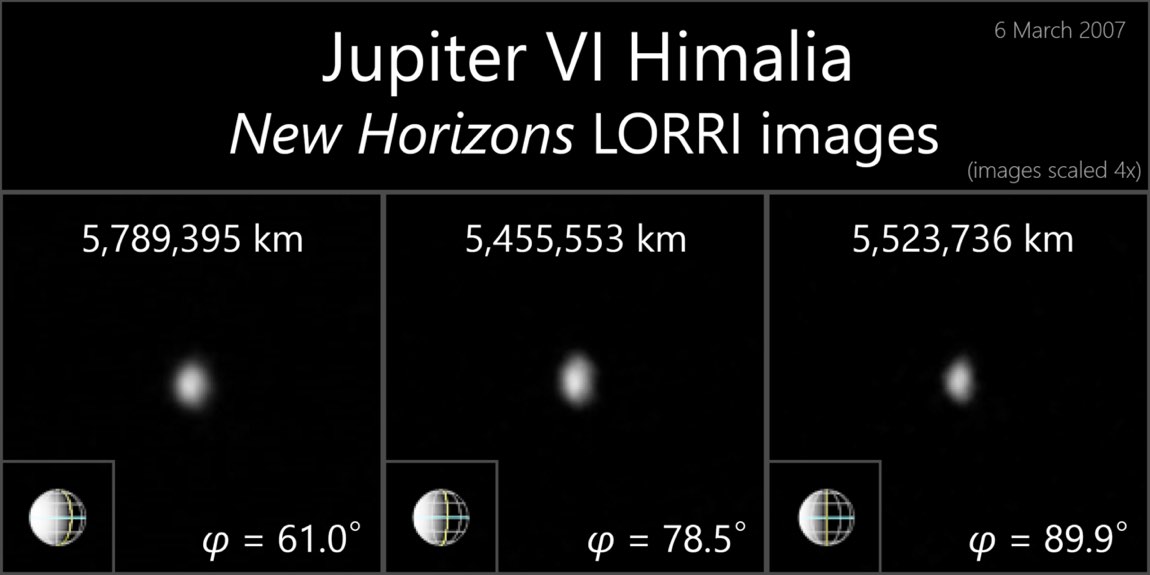
Himalia has been observed up close by exactly two spacecraft, neither of which was sent there deliberately. In November 2000, the Cassini–Huygens probe was coasting toward Saturn when it turned its cameras on Himalia and captured images from a closest distance of about 4.4 million km. At that range Himalia covered only a few pixels, but those pixels were enough to reveal an elongated shape and to confirm the 150 × 120 km size estimate, within an uncertainty of ±20 km. Seven years later, in February and March 2007, New Horizons made its own series of images during its Jupiter flyby, with its best frames taken from about 8 million km — almost twice as far as Cassini's closest approach. Again, Himalia was just a handful of pixels. Despite being among the largest uncharted moons in the inner Solar System, Himalia has never been the primary target of any mission, and no dedicated flyby or orbiter is currently planned.
12 How to find it with a backyard telescope
Among Jupiter's many small moons, Himalia is the easiest to track down from Earth, though that is very much a relative statement. Amalthea is technically brighter, but it hugs so close to Jupiter's dazzling disk that it is nearly impossible to separate from the glare. Himalia, orbiting at more than 11 million km from Jupiter, sits at a comfortable angular distance from the planet in the sky, making it accessible to dedicated amateur astronomers with moderate aperture telescopes under dark skies, provided they know exactly where to look. Its apparent magnitude hovers around 14.6 at opposition, faint enough to require a star chart and patience. Despite this relative accessibility, Himalia remains one of the largest moons in the Solar System never to have been photographed in meaningful surface detail — it is the third largest such world within Neptune's orbit, surpassed in this dubious distinction only by objects even harder to reach.
 ⤢