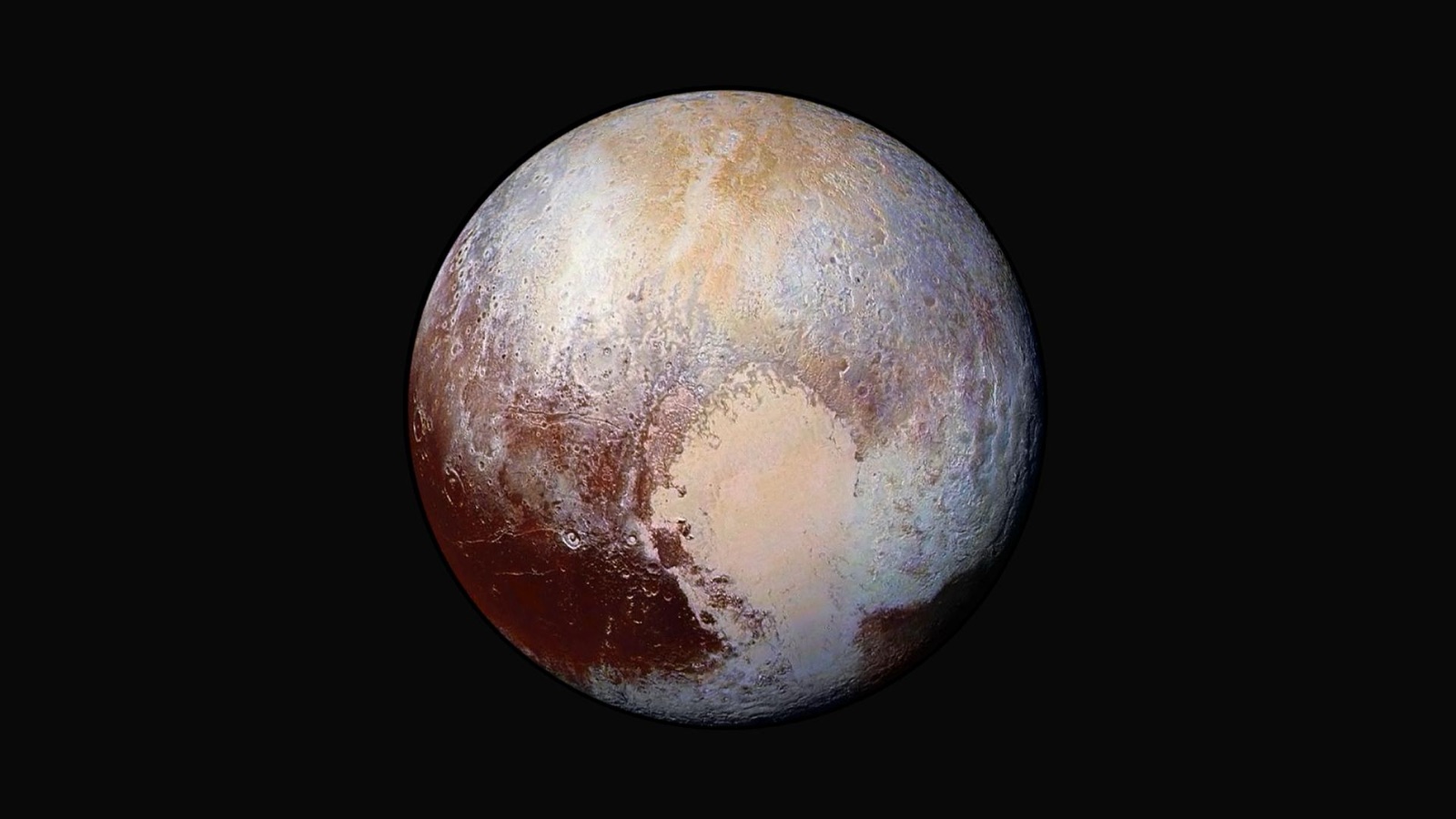
 Photograph · NASA/Johns Hopkins University Applied Physics Laboratory/Southwest Research Institute
Dwarf Planet · Deep guide · orbits The Sun
Pluto
The beloved dwarf planet, a tiny frozen world with a giant heart.
What is it?
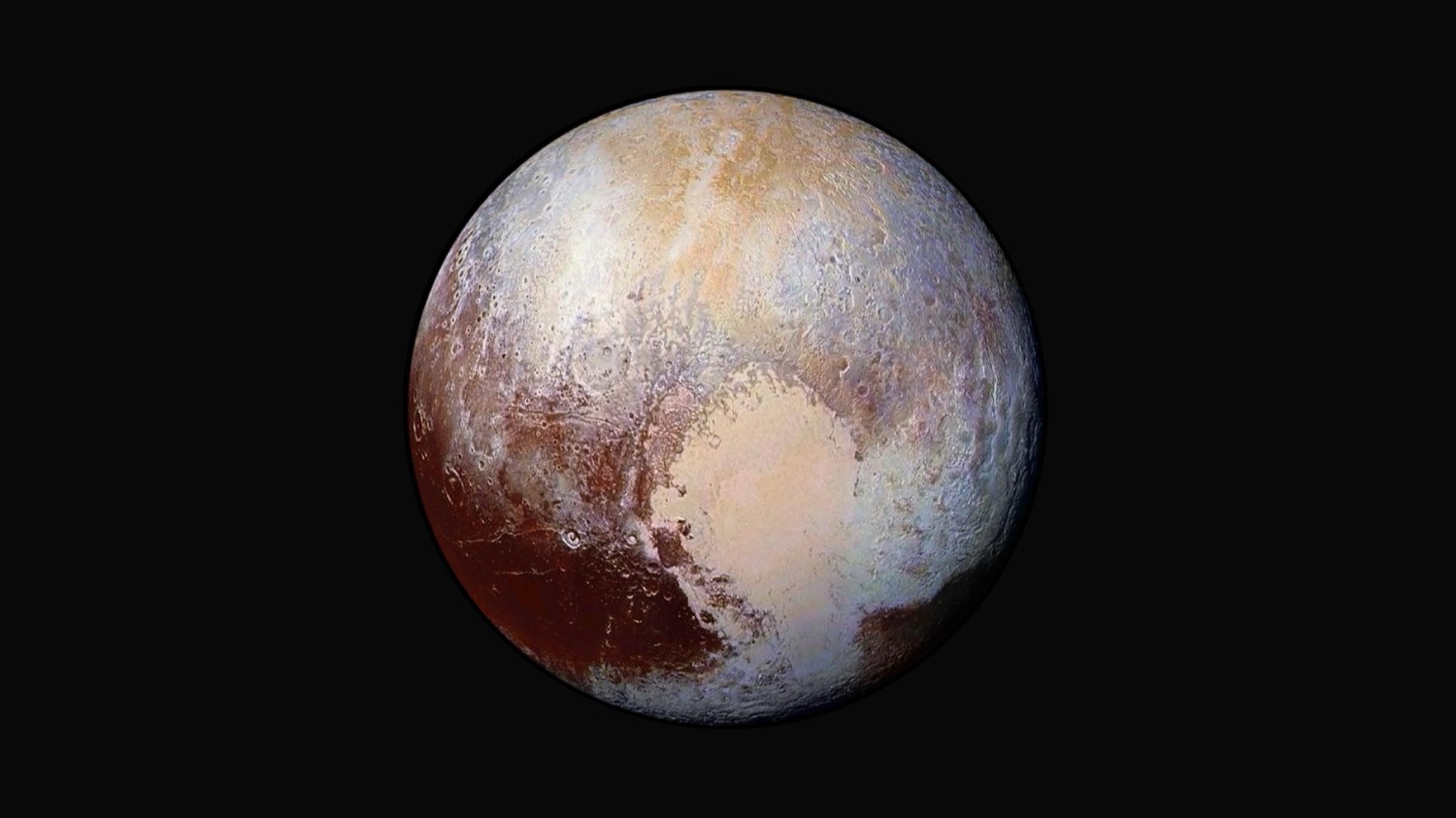
Pluto is the most famous resident of the Kuiper Belt, the ring of icy worlds beyond Neptune. Discovered in 1930 and counted as the ninth planet for 76 years, it was reclassified as a dwarf planet in 2006 — not a demotion of interest, as New Horizons proved in 2015 when it revealed a stunningly active world with ice mountains as tall as the Rockies, glaciers of frozen nitrogen, and a vast heart-shaped plain.
Go deeper
The IAU reclassified Pluto because it fails the third planet criterion: it has not 'cleared its orbital neighborhood' — it shares the Kuiper Belt with countless siblings, and its orbit is locked in a 2:3 resonance with Neptune. New Horizons transformed Pluto science: Sputnik Planitia is a churning nitrogen-ice glacier resurfacing itself with convection cells (no craters — geologically young); water-ice mountains float in it like icebergs; the thin nitrogen atmosphere cycles seasonally; and interior models plus surface fractures make a subsurface water ocean a live hypothesis. Charon, half Pluto's size, makes the pair effectively a double dwarf planet orbiting a point between them.
01 Why isn't Pluto a planet anymore?
In 2006 astronomers agreed a planet must do three things: orbit the Sun, be round, and have swept its orbital lane mostly clear. Pluto passes the first two but shares its lane with a crowd of Kuiper Belt objects — some, like Eris, nearly its size. So Pluto became the first 'dwarf planet.' Nothing about Pluto changed — only our filing system, because we finally saw how crowded the outer Solar System really is.
02 What is it like there?
High noon on Pluto is about as bright as Earth a few minutes after sunset — the Sun a brilliant star casting pale light on nitrogen snow. It is so cold that water ice is hard as granite and forms the mountains, while nitrogen ice flows like glaciers between them. From Pluto's near side, big moon Charon hangs motionless in the sky, eight times larger than our full Moon.
03 An impossible, wonderful world Deeper
Small, frozen bodies were supposed to be geologically dead — yet Pluto's Sputnik Planitia shows active convection with a crater-free surface younger than ~500,000 years, possible cryovolcanoes (Wright Mons), and a haze-layered atmosphere. The energy budget for all this activity at −229 °C is still being argued about — one reason many scientists want a Pluto orbiter as a future flagship mission.
The deep dive
Researched for the Atlas from Wikipedia — Pluto (44,080 characters read) · updated Sep 20, 2026
 ⤢
⤢
04 How Clyde Tombaugh actually found it
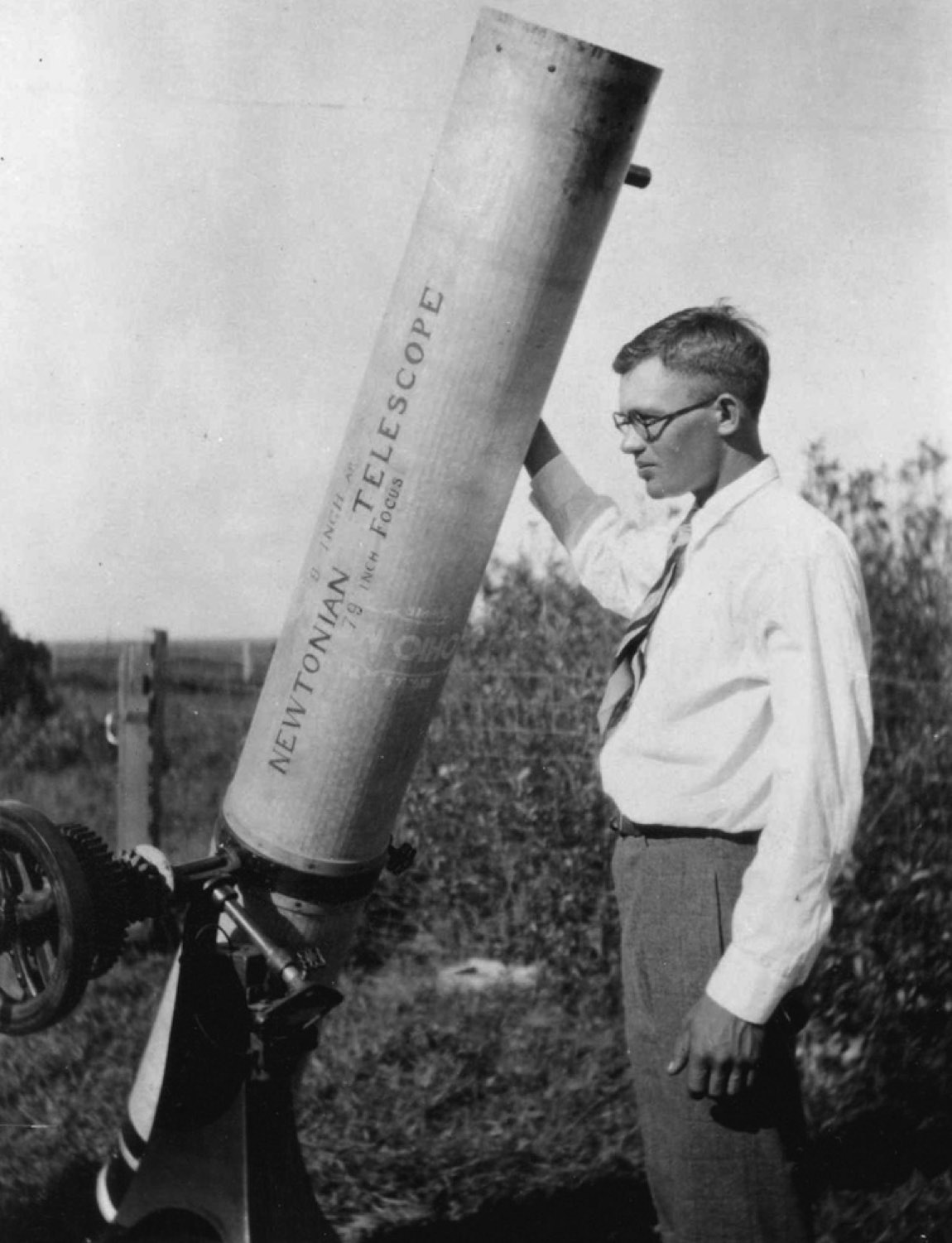
In 1929, 23-year-old Clyde Tombaugh arrived at Lowell Observatory in Flagstaff, Arizona, hired largely on the strength of his amateur astronomical drawings. His assignment was methodical and exhausting: photograph the same patch of sky on two separate nights, then use a device called a blink comparator to rapidly alternate between the two images. Any object that had moved would seem to jump back and forth against the fixed background of stars. On February 18, 1930, after nearly a year of this painstaking work, Tombaugh spotted a shifting dot on photographic plates taken on January 23 and 29, 1930. A slightly lower-quality plate from January 21 helped confirm the motion. Confirmatory photographs followed, and on March 13, 1930, news was telegraphed to the Harvard College Observatory. What makes the find stranger still: Percival Lowell's own survey had unknowingly captured Pluto in two photographs taken on March 19 and April 7, 1915, fifteen years before the official discovery, but the images were too faint to be recognized for what they were.
05 The schoolgirl who named a world
When the discovery was announced, Lowell Observatory received over a thousand name suggestions. The three finalists were Minerva, Cronus, and Pluto. Minerva was ruled out because an asteroid already bore that name; Cronus was tainted by its association with an unpopular astronomer, Thomas Jefferson Jackson See. Pluto won unanimously. Among those who proposed the name was an eleven-year-old schoolgirl in Oxford, England, named Venetia Burney, who lived from 1918 to 2009 and had a keen interest in classical mythology. She suggested it to her grandfather Falconer Madan over breakfast, after he read the discovery news aloud. Madan passed the suggestion to astronomy professor Herbert Hall Turner, who cabled it to Lowell Observatory on March 16, 1930, just three days after the announcement. The mythological fit was considered ideal: the god Pluto ruled gloomy, invisible regions, much as the distant world had hidden for so long. A convenient coincidence sealed the deal — the first two letters, P and L, were the initials of Percival Lowell, the observatory's founder who had spent years searching for exactly such a world.
06 An orbit that breaks all the rules
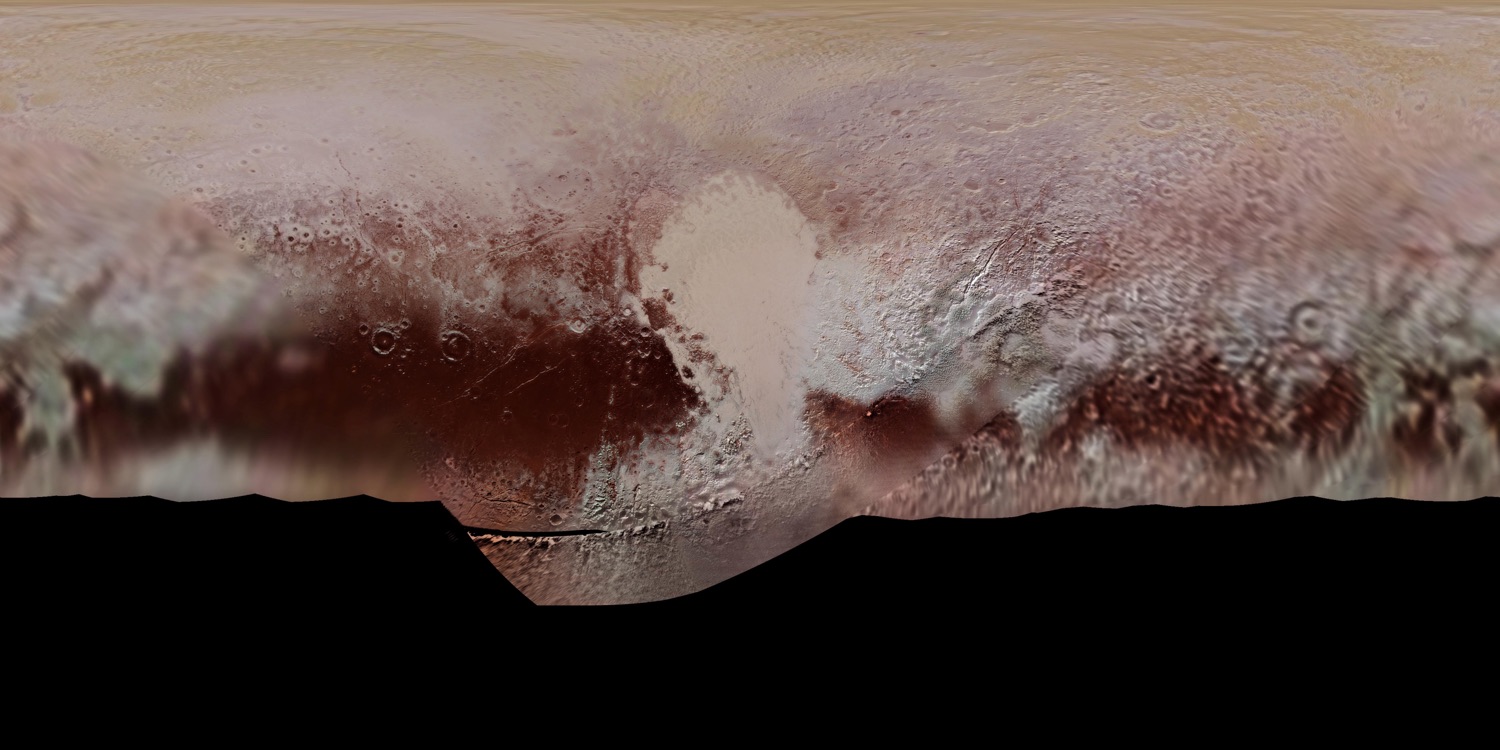
Pluto's path around the Sun bears almost no resemblance to those of the eight planets. Its orbit is tilted more than 17° relative to the ecliptic, the flat reference plane that planets follow closely, and its shape is a noticeably stretched ellipse. This eccentricity carries Pluto between 30 and 49 astronomical units from the Sun — a range of roughly 4.5 to 7.3 billion kilometres. At its closest point, called perihelion, Pluto actually dips inside Neptune's orbit; the last time this happened was from February 7, 1979, to February 11, 1999, and Pluto reached perihelion on September 5, 1989. One full trip around the Sun takes about 247.94 Earth years, meaning that in 2178 Pluto will complete its very first orbit since its discovery. To complicate things further, Pluto's orbit is technically chaotic over very long timescales: computer simulations can reliably predict its position for several million years, but beyond a Lyapunov time of 10 to 20 million years, tiny unmeasurable details of the Solar System accumulate until predictions become unreliable.
 ⤢
⤢
07 The gravitational handshake with Neptune Deeper
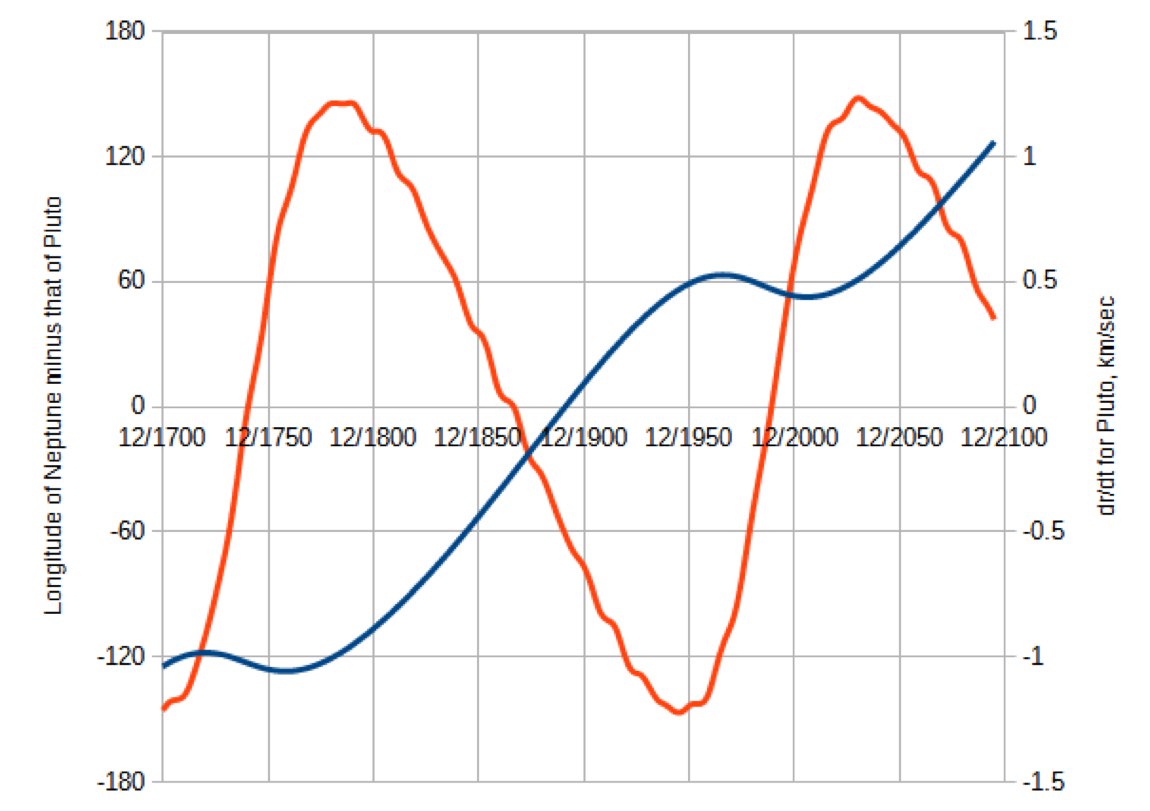
Despite appearances, Pluto and Neptune are in no danger of colliding, protected by one of the Solar System's most elegant gravitational arrangements. For every two orbits Pluto completes, Neptune completes exactly three — a 2:3 mean-motion resonance. Each full cycle of this dance takes about 495 years. Because of the geometry, Pluto's closest point to the Sun always occurs when it is farthest north of Neptune's orbital plane, about 8 AU above it. When Pluto last reached perihelion in 1989, Neptune was 57° ahead of it; by Pluto's second perihelion in the same 495-year cycle, Neptune will be 123° behind it. The minimum separation between the two bodies is over 17 AU, actually greater than Pluto's minimum separation from Uranus, which is 11 AU. Two additional stabilizing mechanisms reinforce this safety: the Kozai mechanism keeps Pluto's perihelion argument librating around 90°, and a 1:1 superresonance involving all four giant planets locks the relationship still further. The combined effect has persisted over millions of years and renders a collision essentially impossible regardless of Pluto's orbital inclination.
08 A tilted world of extreme seasons
Pluto spins on its side, with an axial tilt of 120°, placing it in the same unusual company as Uranus. The consequences for seasons are dramatic: at each solstice, one-quarter of Pluto's surface sits in continuous daylight while another quarter endures continuous darkness. Researchers at the University of Arizona have proposed that this bizarre orientation came about through polar wander, a process in which a body gradually reorients itself to put excess mass near the equator. In Pluto's case, the culprit may be enormous deposits of frozen nitrogen that accumulate in shadowed regions. Because Pluto lies so far from the Sun, equatorial temperatures can plummet to −240 °C (33.1 K), cold enough for nitrogen to freeze solid just as water ice forms on Earth. Those growing nitrogen masses shift Pluto's balance, slowly tipping it until its spin axis settled at its current extreme angle. The same polar wander mechanism would, in principle, affect Earth if the Antarctic ice sheet were several times its current size.
09 Inside Pluto: rock, ice, and hidden water Deeper
Pluto's bulk density of 1.853±0.004 g/cm³ tells scientists it is a mixture of rock and ice rather than one material alone. Heat from the slow decay of radioactive elements inside the rocky component is expected to have been sufficient to separate the two, producing a differentiated interior: a dense rocky core estimated at 1,700 km across — about 70% of Pluto's total diameter — wrapped in a mantle of water ice. More intriguingly, that radioactive heating may be ongoing, and models suggest it could maintain a liquid water ocean 100 to 180 km thick at the boundary between the core and the ice mantle. In September 2016, scientists at Brown University simulated the impact that probably excavated Sputnik Planitia and found that liquid water welling up from below best explained the basin's present form, implying a subsurface ocean at least 100 km deep at the time of impact. In June 2020, astronomers reported evidence suggesting Pluto may have harboured a subsurface ocean from the very moment of its formation, raising questions about how early potentially habitable conditions could have existed in the outer Solar System.
 ⤢
⤢
10 Sputnik Planitia: the youngest terrain known
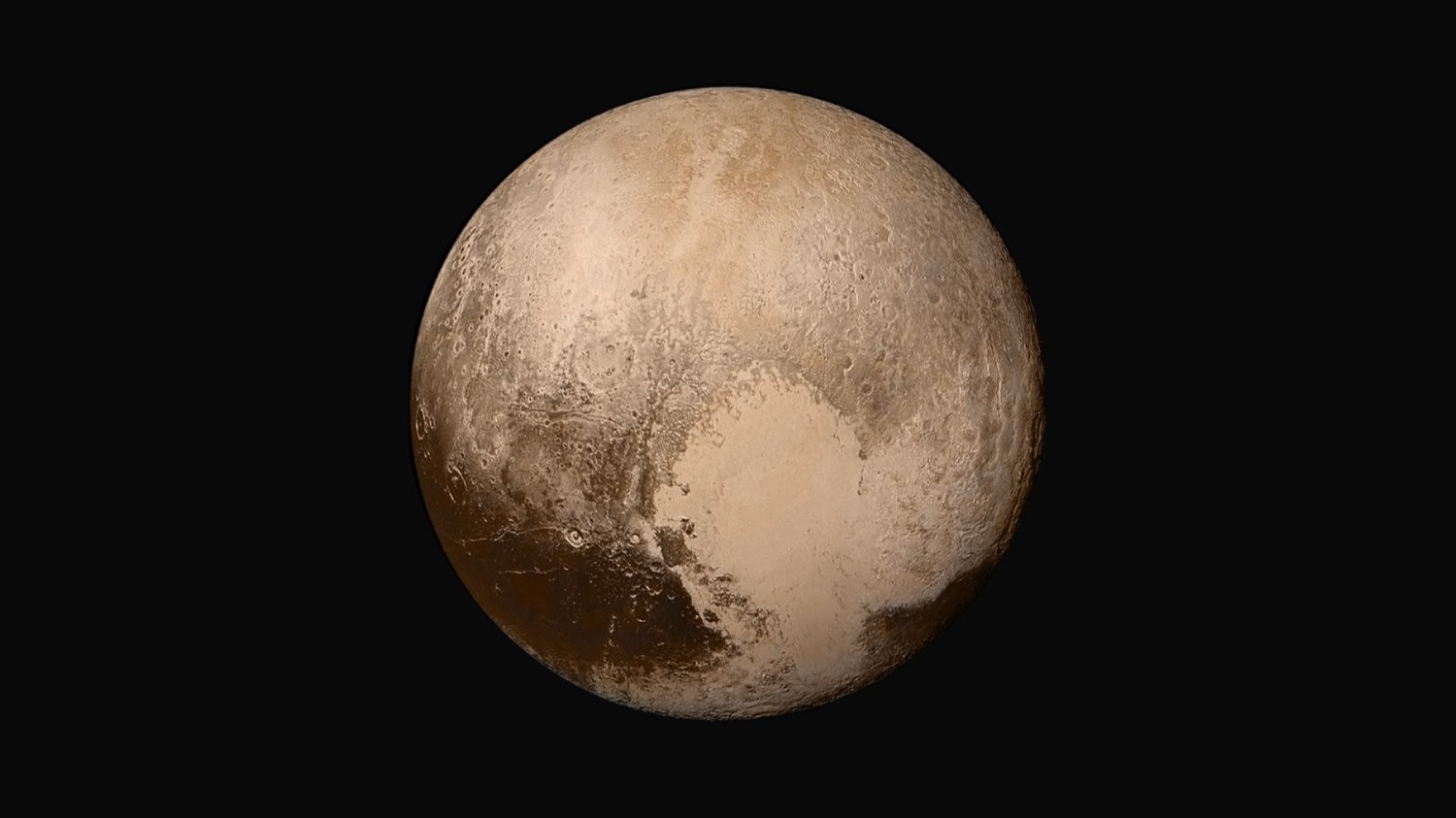
The western lobe of Pluto's famous heart-shaped bright region, called Sputnik Planitia, is one of the most geologically active surfaces ever found in the outer Solar System. It is a roughly 1,000-km-wide impact basin, about 3 km deep, flooded with frozen nitrogen and carbon monoxide. The nitrogen ice is not static: it churns slowly in convection cells, carrying floating blocks of water-ice crust and carving sublimation pits toward the cells' edges. Glacial flows both feed into and drain out of the basin. New Horizons detected no impact craters on its surface at all, indicating the terrain is geologically very young — less than 10 million years old by initial estimates, with the most refined calculations pointing to an age of just 180,000 years, with an uncertainty of roughly +90,000 to −40,000 years. Along the basin's western margins, fields of transverse dunes have been identified, with wavelengths between 0.4 and 1 km, likely composed of methane particles roughly 200 to 300 micrometres in size, blown by winds flowing outward from the center of Sputnik Planitia toward the surrounding mountains.
11 An atmosphere that defies expectations Deeper
Pluto's atmosphere is real but razor-thin. New Horizons measured a surface pressure of about 1 pascal — roughly one million to one hundred thousand times less than the pressure at Earth's sea level. The atmosphere is composed of nitrogen, methane, and carbon monoxide in equilibrium with their surface ices. Methane, a potent greenhouse gas, creates a temperature inversion: while the surface can be brutally cold, the atmosphere above it is tens of degrees warmer. Yet New Horizons found Pluto's upper atmosphere even colder than theorists expected — about 70 K rather than the predicted 100 K. The atmosphere is structured into roughly 20 regularly spaced haze layers reaching up to 150 km in altitude, thought to arise from pressure waves generated by airflow over mountains. The story of the atmosphere's long-term behaviour has proven genuinely surprising: while scientists expected it to freeze out progressively as Pluto recedes from the Sun, ground-based and New Horizons data instead suggest the atmospheric density actually increases and likely remains gaseous throughout the full 248-year orbit. Between 2016 and 2022, however, observations of stellar occultations recorded a measurable pressure drop, adding a new layer of complexity to an already puzzling system.
12 Charon and four tiny companions
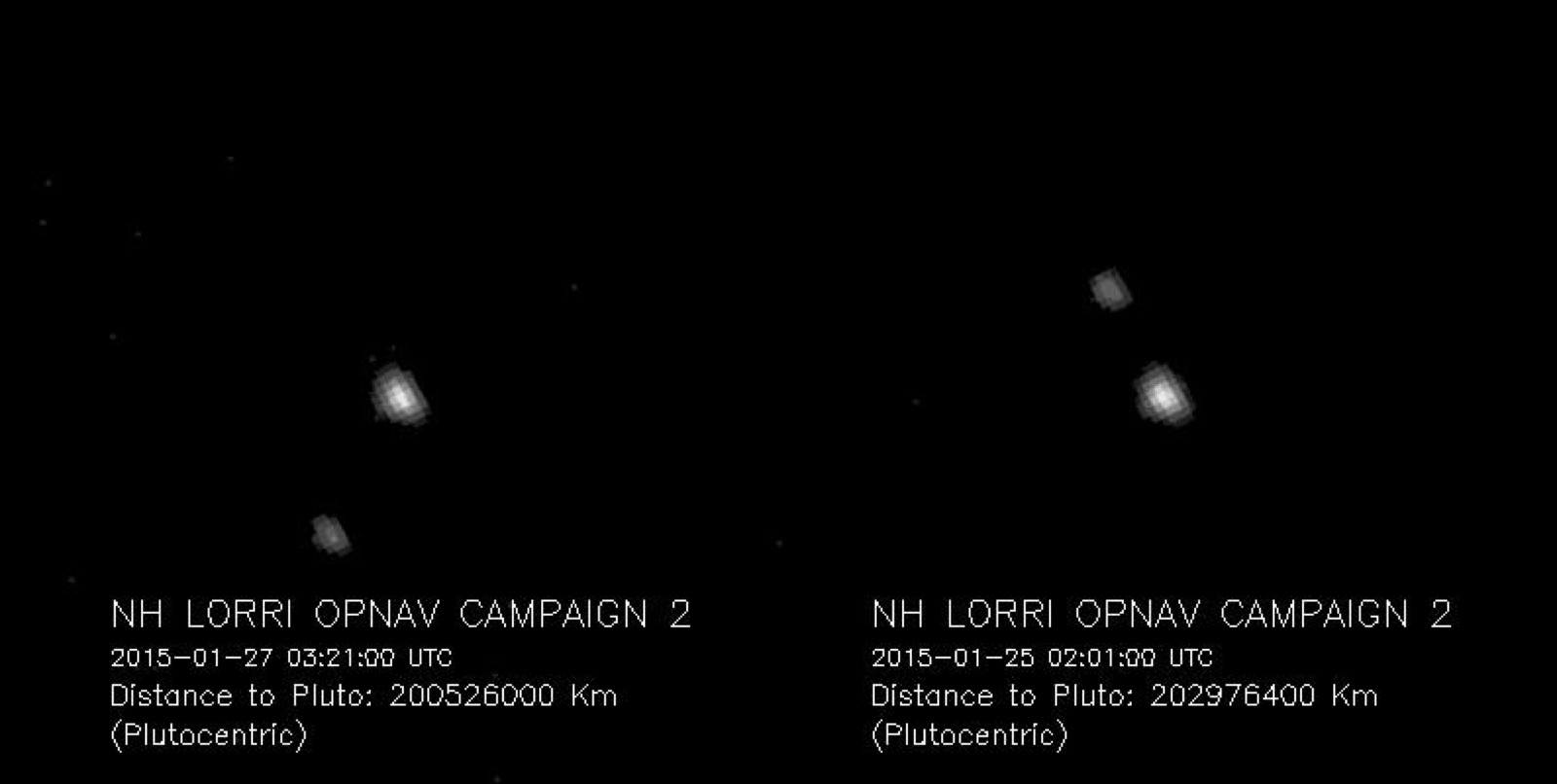
Pluto's largest moon, Charon, was discovered in 1978 by astronomer James Christy, and its detection immediately allowed the first accurate measurement of Pluto's mass. Charon's diameter is just over half that of Pluto, making the pair so similar in size that they are sometimes called a double dwarf planet. The system is one of the very few in the Solar System where the shared centre of mass lies outside both bodies entirely. Both Pluto and Charon are tidally locked to each other, meaning each always presents the same face to the other — a condition shared, as far as is known, only by Eris and its moon Dysnomia, with Orcus and Vanth as possible additional examples. Beyond Charon, four much smaller moons orbit in nearly circular, nearly coplanar paths: Styx and Nix and Hydra, discovered in 2005; Kerberos in 2011; and Styx in 2012. All five known moons are packed into the inner 3% of the region around Pluto where stable orbits in the prograde direction are possible. All are thought to have formed from debris thrown outward when Pluto collided with a similarly sized body early in Solar System history.
 ⤢
⤢
13 New Horizons: 3,462 days to a flyby
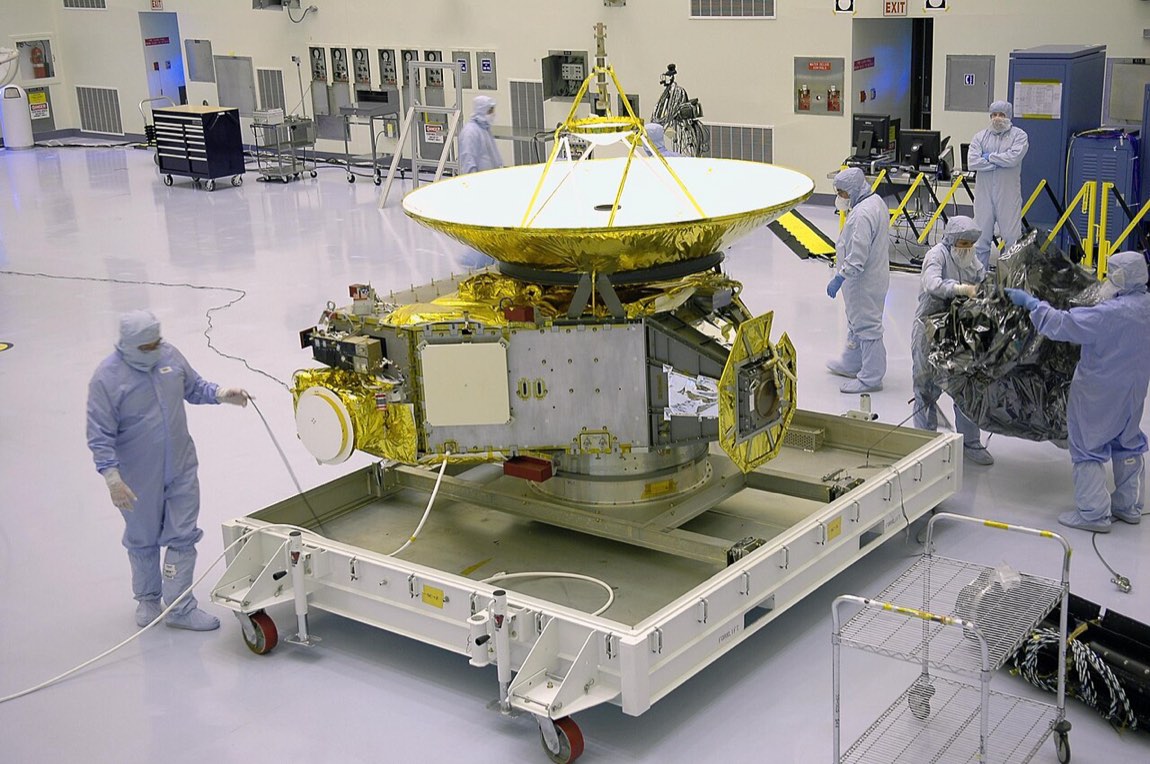
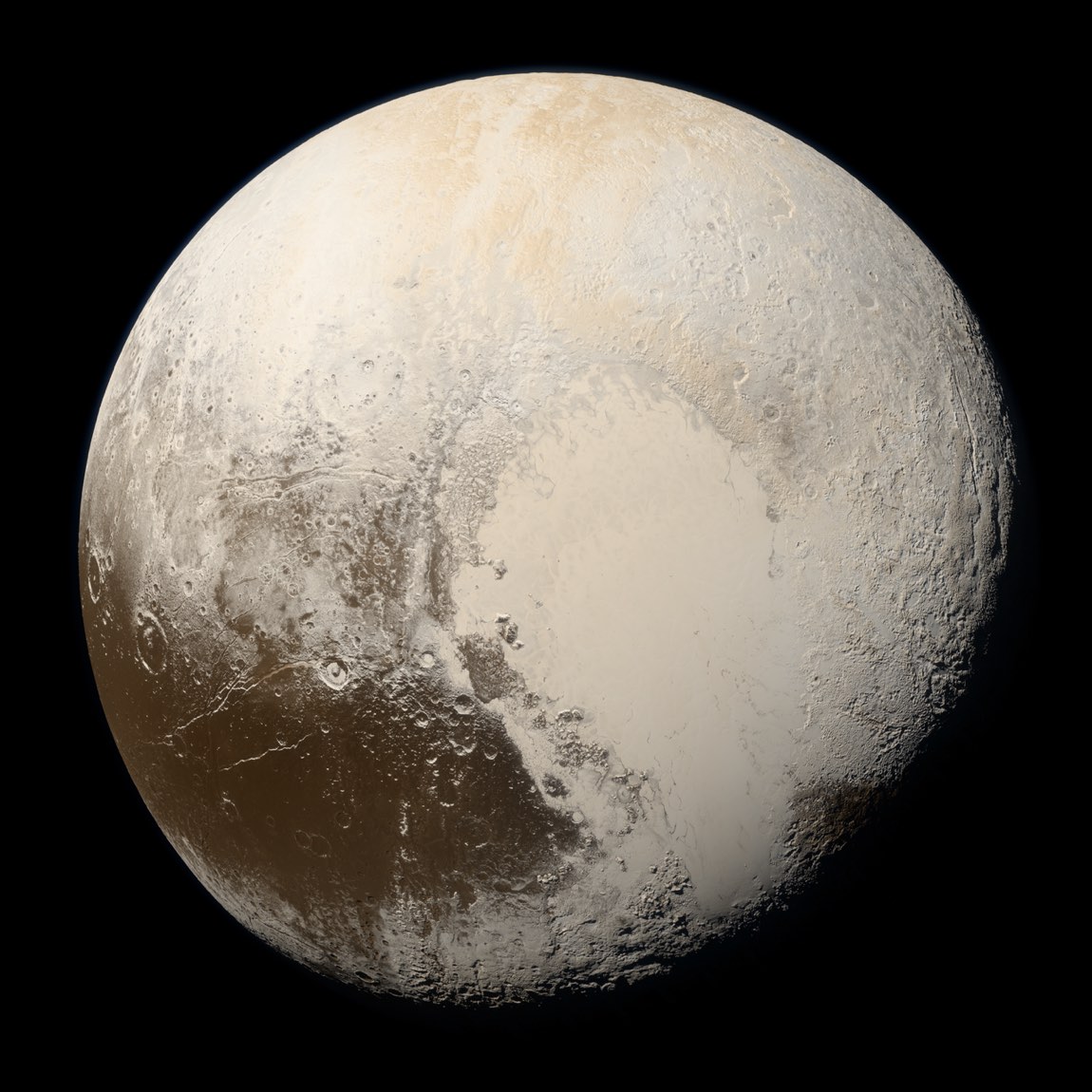
New Horizons launched in 2006 and made its closest approach to Pluto on July 14, 2015, after a journey of 3,462 days across the Solar System. Scientific observations began five months before closest approach and continued for at least a month afterward, using a remote-sensing package that combined imaging instruments, a radio science tool, and spectroscopic experiments. The mission's primary goals were to map the global geology and surface composition of Pluto and Charon and to measure Pluto's atmosphere and its rate of escape into space. Transmitting all that data back across billions of kilometres took time: the final piece of a total 50 billion bits of data — equivalent to 6.25 gigabytes — arrived on October 25, 2016. Before the flyby, the sharpest maps of Pluto had come from the Hubble Space Telescope, resolving features only several hundred kilometres across. New Horizons changed everything, revealing a world of staggering variety: glaciers, towering water-ice mountains, nitrogen dunes, haze layers, and terrain that may be geologically active today. The spacecraft had captured its very first distant image of Pluto during an instrument test in late September 2006, from approximately 4.2 billion kilometres away.
14 How scientists have weighed and measured Pluto Deeper
Determining even basic facts about Pluto proved remarkably difficult across the twentieth century. Early mass estimates in 1931 placed it near the mass of Earth, revised down to roughly the mass of Mars by 1948. Gerard Kuiper's 1950 disk observation suggested a radius of around 2,950 km, while a stellar occultation non-detection in 1965 capped that estimate at 3,400 km. By 1976, Cruikshank, Pilcher, and Morrison at the University of Hawaiʻi detected methane ice on the surface and used Pluto's resulting albedo — between 0.4 and 0.6 — to deduce it must be only 1,400 to 1,650 km in radius, smaller than the Moon, and at most 1% the mass of Earth. The breakthrough came in 1978, when Charon's discovery allowed application of Newton's version of Kepler's third law, pinning the mass at roughly 0.2% that of Earth. Decades later, New Horizons used radio occultation through its Radio Science Experiment to nail down the diameter at 2,376.6±1.6 km. That final measurement gave Pluto a surface area of 1.774443×10⁷ km², slightly larger than the country of Russia, and a surface gravity of 0.063 g — meaning an object that weighs 100 kilograms on Earth would weigh just 6.3 kilograms on Pluto.
15 Pluto's place in Solar System history Deeper
Current models suggest Pluto did not form where it now orbits. It is thought to be a residual planetesimal — a building-block remnant from the original protoplanetary disc that never fully assembled into a planet. Its current resonant position is attributed to an early migration of Neptune outward through the solar system. A 2004 computer model by Alessandro Morbidelli of the Observatoire de la Côte d'Azur proposed that this migration was itself triggered by a 1:2 resonance forming between Jupiter and Saturn, which gravitationally flung both Uranus and Neptune into wider orbits and even caused the two planets to exchange positions. As Neptune swept outward, it captured Triton as a moon, locked many objects into resonances including Pluto, and scattered others into unstable trajectories. The Nice model, as this framework is called, requires that roughly a thousand Pluto-sized bodies existed in the original planetesimal disk — a population that included Triton and Eris. The same upheaval is thought to explain the Late Heavy Bombardment, a period of intense cratering across the inner solar system that occurred about 600 million years after the Solar System formed, as well as the origin of the Jupiter Trojan asteroids. Pluto may originally have had a near-circular orbit at about 33 AU before Neptune's outward march pushed it into its current resonant, eccentric path.
 ⤢
⤢
16 How to observe Pluto from Earth
Spotting Pluto from Earth is genuinely challenging and requires a telescope — a 30-centimetre (12-inch) aperture instrument is considered desirable. Even through a large telescope, Pluto appears as nothing more than a faint, star-like point of light; its angular diameter reaches a maximum of just 0.11 arcseconds, far too small to resolve as a disk. Its visual apparent magnitude averages 15.1, brightening to 13.65 when it is nearest the Sun at perihelion. The earliest surface maps, produced in the late 1980s, were pieced together not from direct imaging but from careful measurements of how the total brightness of the Pluto-Charon system changed as the two bodies eclipsed each other. Brighter surface regions caused a larger brightness dip when covered. Later, the Hubble Space Telescope produced dramatically improved maps, resolving brightness variations across regions several hundred kilometres wide and covering roughly 85% of Pluto's surface down to about 75° South latitude. These remained the best available until New Horizons arrived in 2015. For observers who want to attempt to find Pluto, its slow drift against background stars over several nights is the telltale sign, echoing almost exactly the technique Clyde Tombaugh used to find it in 1930.
You would weigh…
Surface gravity 0.62 m/s² vs Earth’s 9.81 m/s². Try every world →
Could life exist here?
Surface conditions rule out chemistry as we know it. If the hypothesized subsurface ocean exists, Pluto joins the (long) list of icy worlds where liquid water might persist — intriguing, but far more speculative than Europa or Enceladus.
Our labels: Confirmed · Strong Evidence · Estimated · Hypothesis · Theoretical · Speculative (see Methodology).
Could humans live here?
Not with any foreseeable technology. Pluto is a robotic frontier: even New Horizons, the fastest launch in history, took 9.5 years just to fly past.
How would we get there?
New Horizons launched in 2006 at 58,000 km/h, used a Jupiter slingshot, and still took 9.5 years. It could not stop — its flyby lasted hours after a decade of travel. An orbiter with current propulsion would take decades; that is the honest cost of the outer Solar System.
| Technology | Status | Travel time (one way, straight line) |
|---|---|---|
| Apollo-style spacecraft, about 39,000 km/h | Flown technology | 17 years |
| Ion-propulsion probe, about 90,000 km/h | Flown technology | 7 years |
| Voyager 1, about 61,000 km/h | Flown technology | 11 years |
| Parker Solar Probe, about 690,000 km/h | Flown technology | 358 days |
| Nuclear-thermal rocket, about 120,000 km/h cruise | In development | 6 years |
| Laser light-sail at 20% of light speed | Proposed concept | 27.3 hours |
| Light itself, 299,792 km/s | Physical limit | 5.5 hours |
Simplified straight-line times at cruise speed. Real missions fly curved orbital paths and take longer. Full travel calculator →
Weird & wonderful
- Pluto has not completed even one orbit since its discovery — that happens in 2178.
- Pluto and Charon orbit a point in the space between them, like two dancers holding hands.
- Its heart-shaped plain, Sputnik Planitia, is a churning glacier of nitrogen ice bigger than Texas.
- From 1979 to 1999 Pluto was closer to the Sun than Neptune.
- Pluto was named by an 11-year-old girl, Venetia Burney, in 1930.
Worlds that orbit Pluto
More real images of Pluto
Genuine spacecraft and telescope imagery, every frame credited and licensed. Tap any photo to enlarge.