 Photograph · NASA/JPL-Caltech/UCLA/MPS/DLR/IDA
Dwarf Planet · Deep guide · orbits The Sun
Ceres
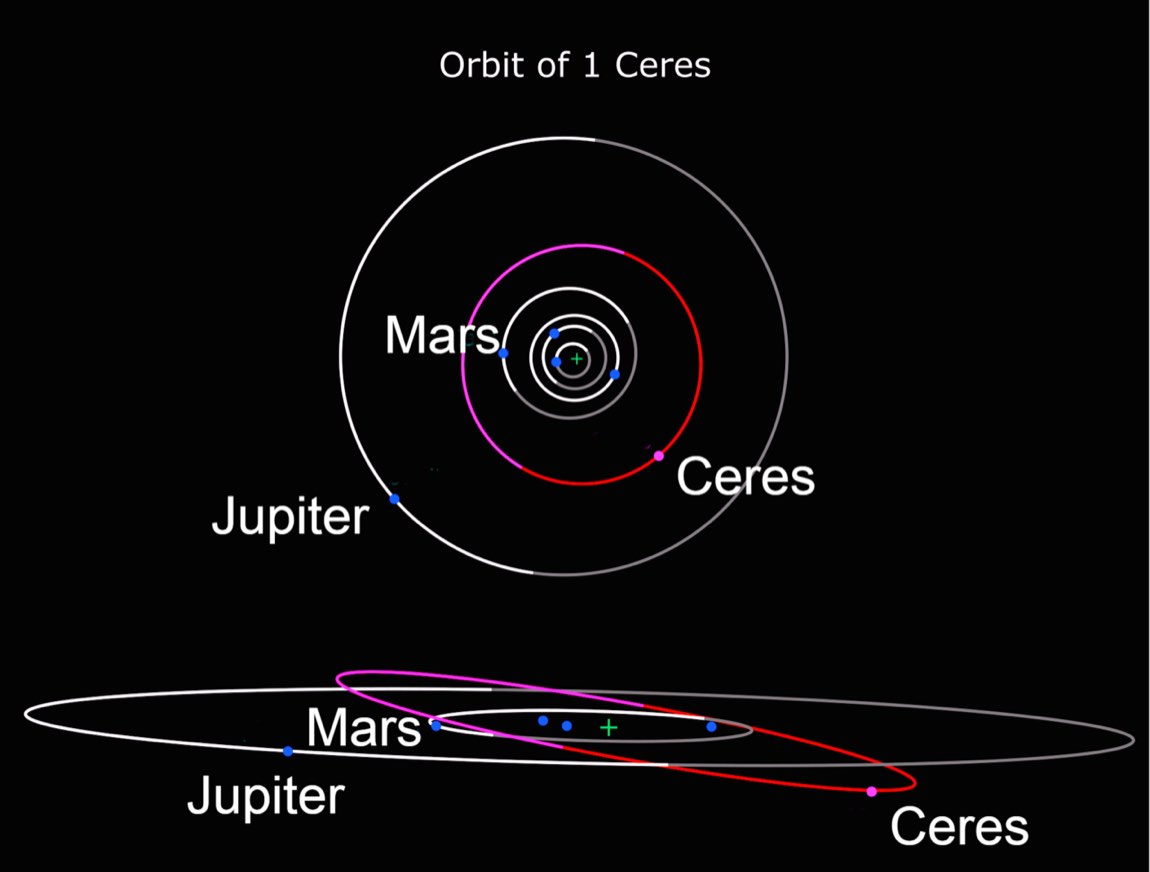
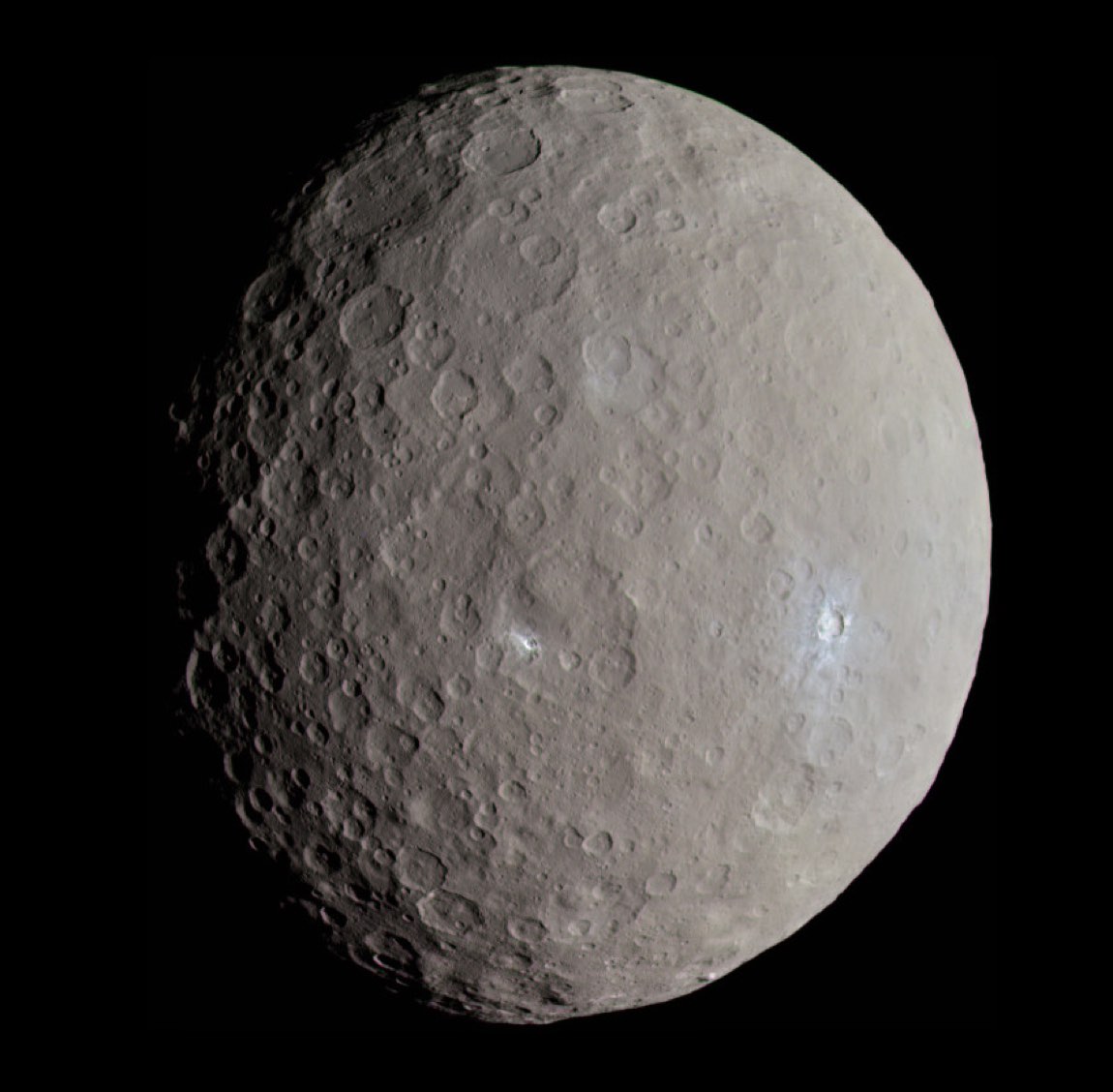
The largest object in the asteroid belt is a dwarf planet with salty bright spots and buried brine.
What is it?
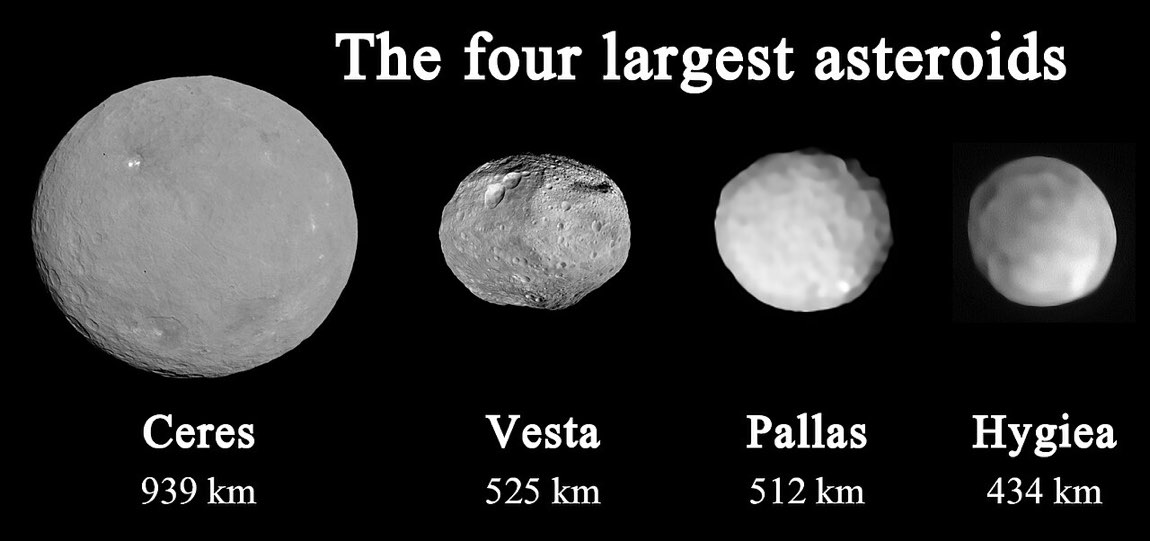
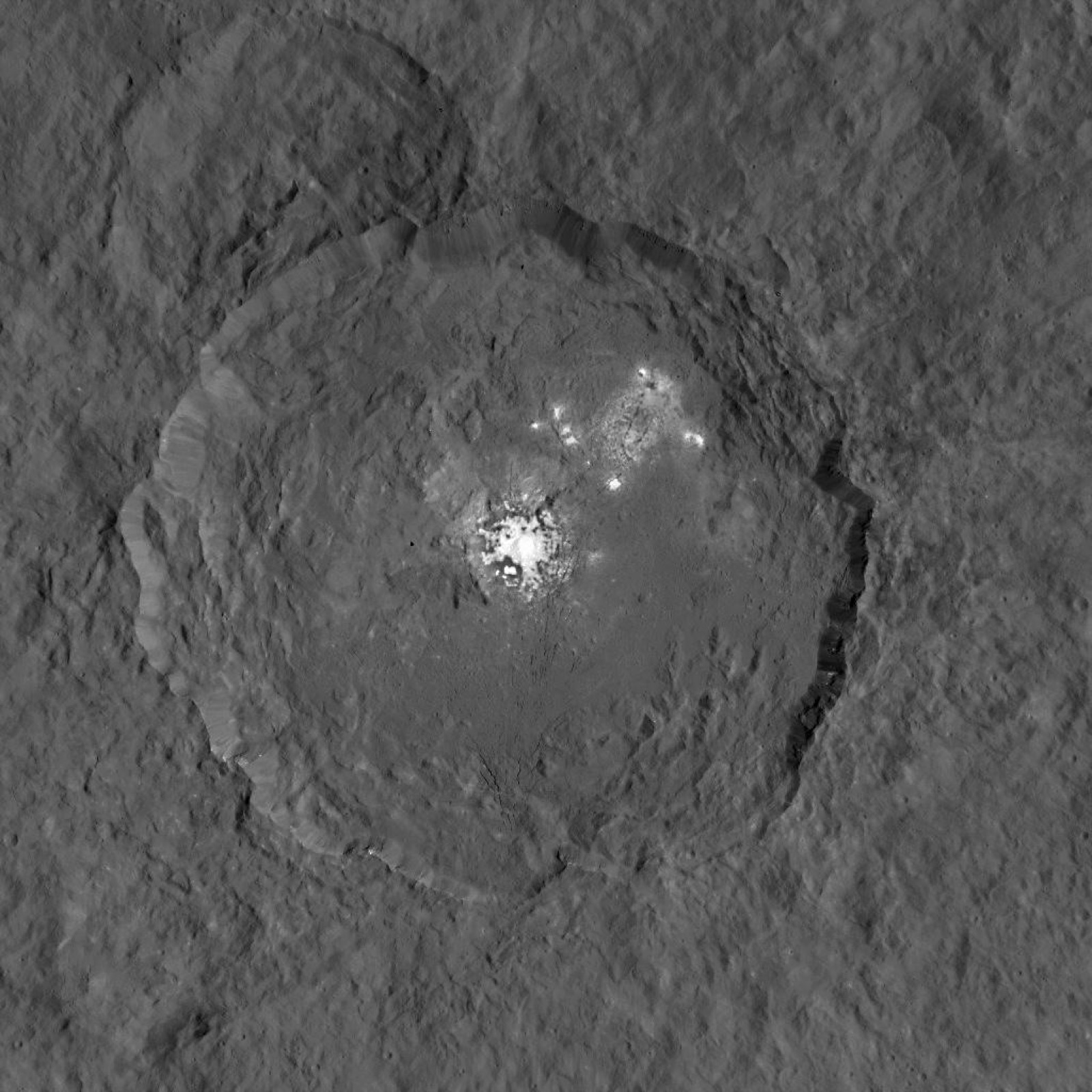
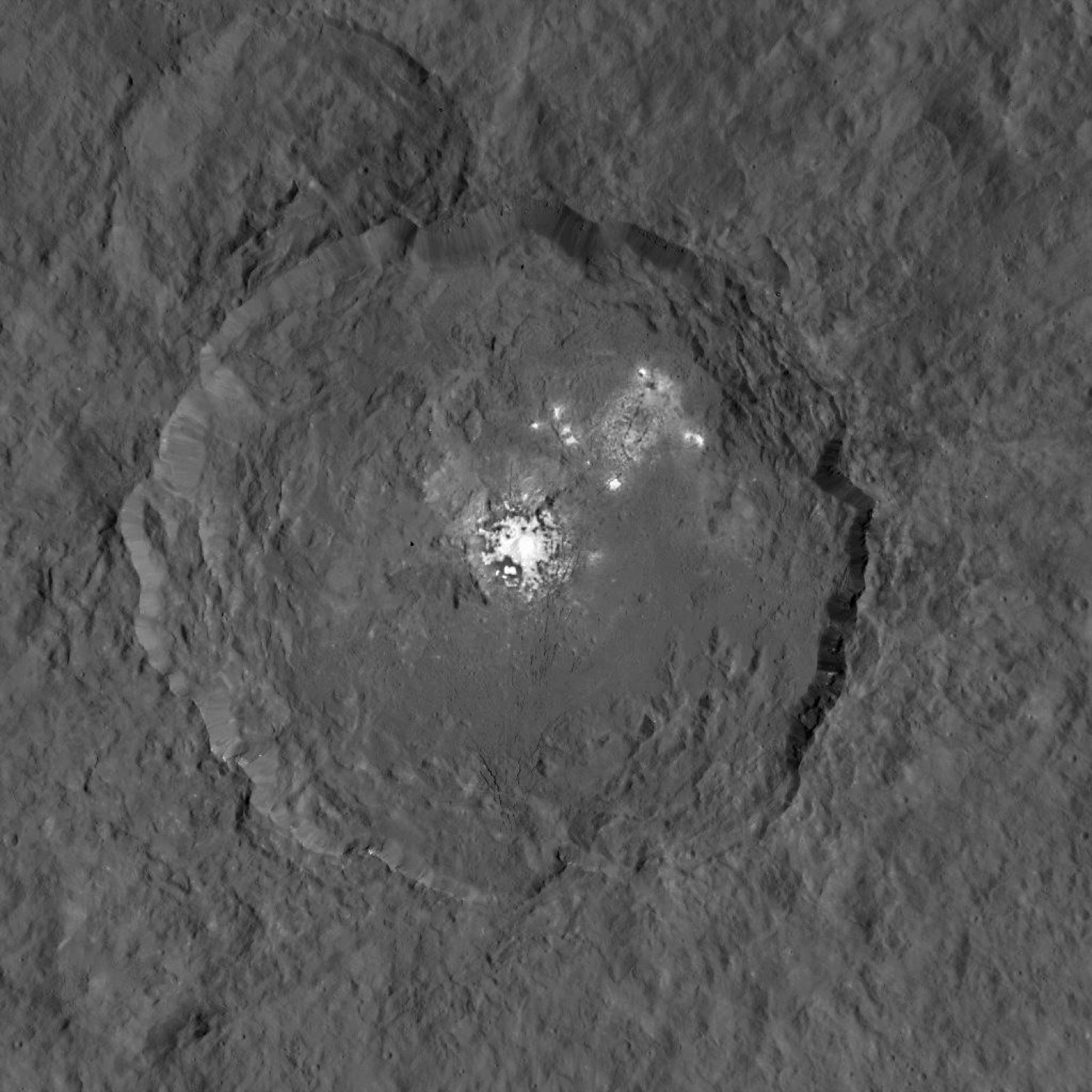
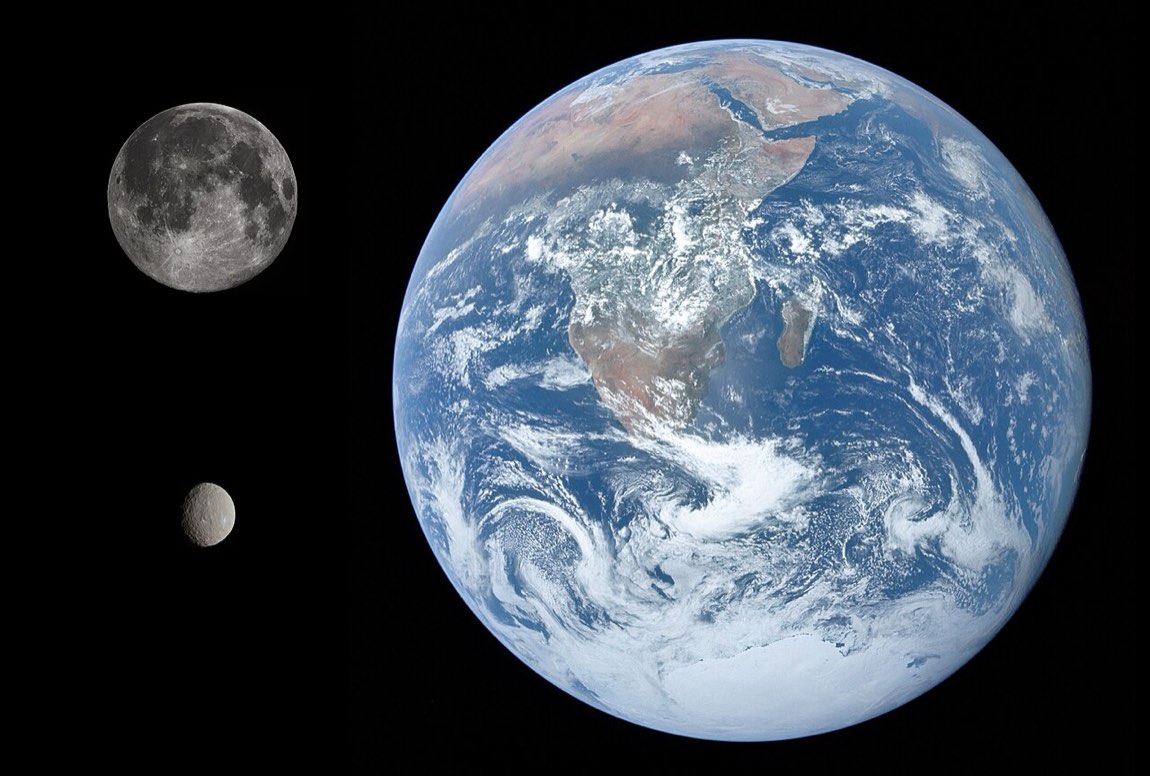
Ceres is the biggest thing in the asteroid belt between Mars and Jupiter — so big it makes up about a third of the whole belt's mass, and round enough to count as a dwarf planet. NASA's Dawn spacecraft orbited it from 2015 to 2018 and found dazzling white spots on its dark surface: salt left behind by briny water seeping up from inside.
Go deeper
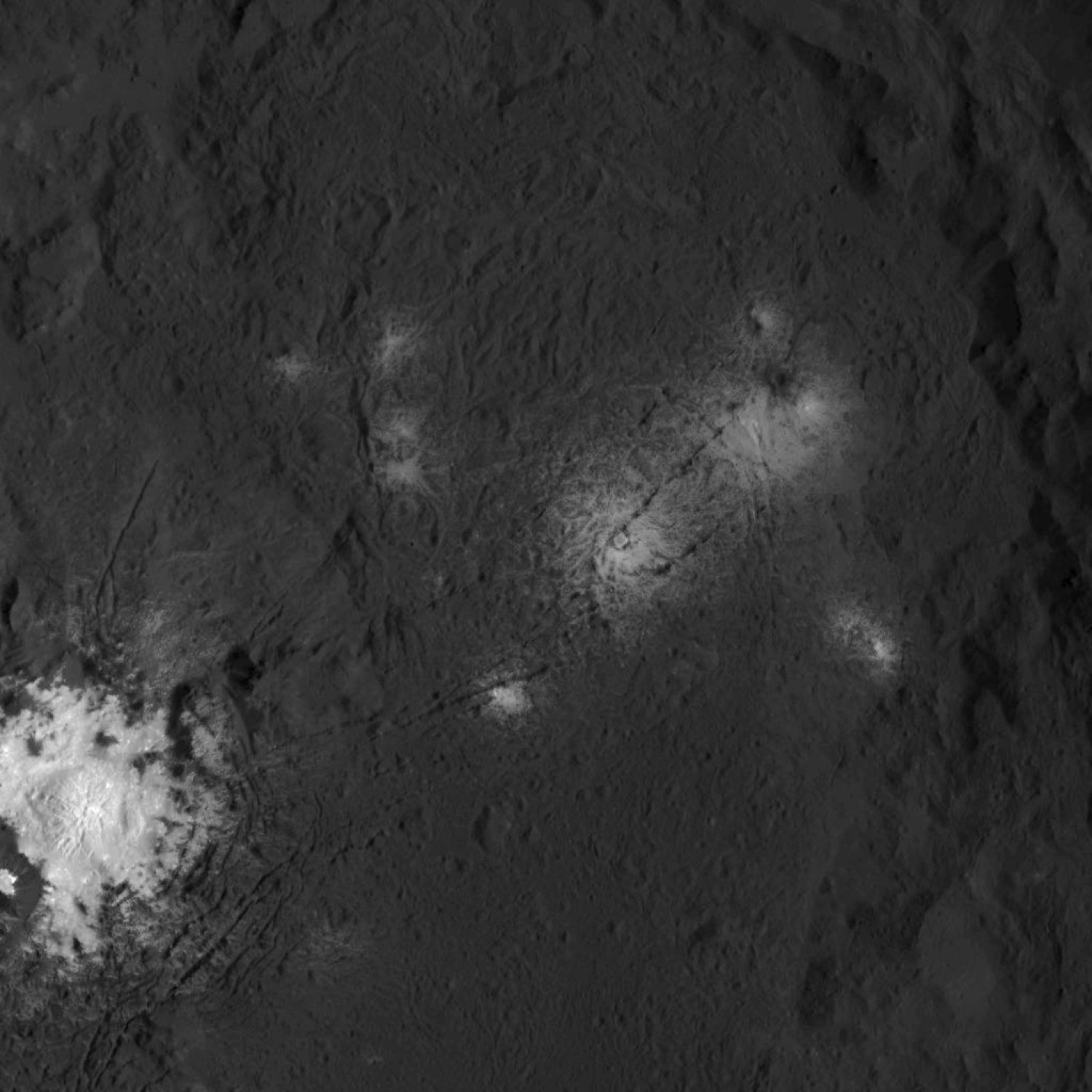
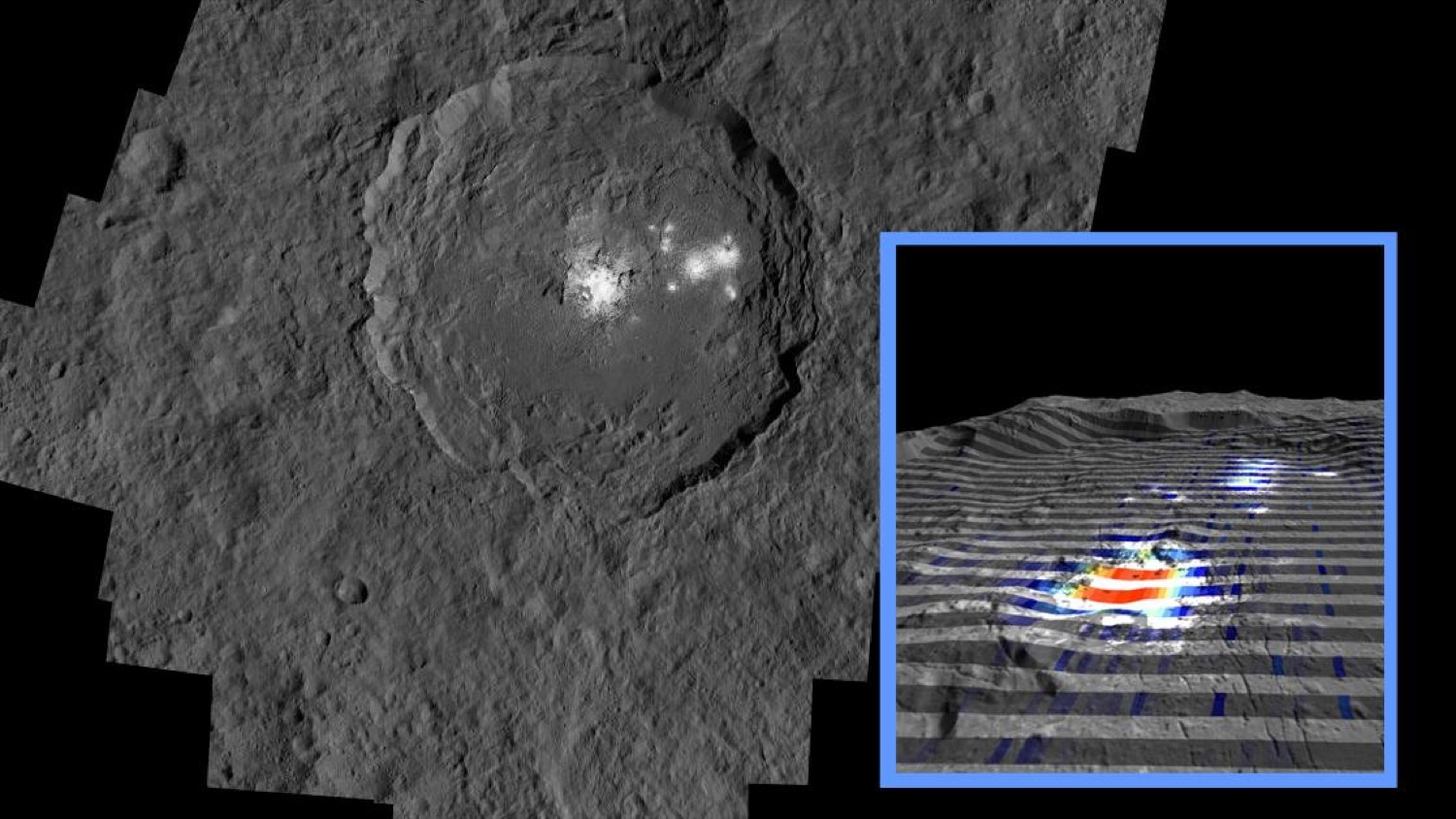
Ceres is an ice-rich survivor of the planet-forming era. Dawn showed a carbon-rich surface with ammoniated clays (hinting it — or its ingredients — formed farther out), and the Occator Crater faculae: sodium-carbonate deposits from brines that reached the surface within the last few million years, implying a deep briny reservoir persists today. That makes Ceres arguably the nearest 'ocean world' relic — and a serious astrobiology target; a sample-return concept ranked highly in the 2023 decadal survey.
01 From planet to asteroid to dwarf planet
When Piazzi found Ceres in 1801 it was hailed as a new planet. Then astronomers kept finding more objects in the same zone, and Ceres was refiled as the largest asteroid. In 2006 it was promoted again — to dwarf planet, the only one in the inner Solar System. Ceres has now held three different titles without moving an inch.
02 Why the bright spots matter Deeper
Salt on the surface means liquid water underneath — recently. Dawn's data point to brine pockets tens of kilometers down that pushed mineral-rich water up through fractures under Occator Crater. Salty liquid water plus carbon compounds plus billions of years is exactly the checklist astrobiologists carry.
The deep dive
Researched for the Atlas from Wikipedia — Ceres (dwarf planet) (38,146 characters read) · updated Sep 20, 2026
03 How Gauss rescued a lost world
When Ceres disappeared into the Sun's glare shortly after its discovery, astronomers feared they had lost it forever. The object had been tracked for only 41 days — from 1 January to 11 February 1801 — before Piazzi fell ill, giving too short an arc for the orbit-fitting methods of the time. The problem fell to Carl Friedrich Gauss, then just 24 years old, who invented an efficient new method of orbit determination specifically to solve it. Within weeks he had a predicted path precise enough to act on. On 31 December 1801, Franz Xaver von Zach and Heinrich Olbers pointed their telescopes at Gauss's coordinates and found Ceres almost exactly where he said it would be. Without that mathematical rescue, the first-known asteroid belt object might have been lost for years or decades. The episode made Gauss's reputation and his orbit-determination technique remained a cornerstone of celestial mechanics for generations afterward.
 ⤢
⤢
04 A world that formed beyond Jupiter Deeper
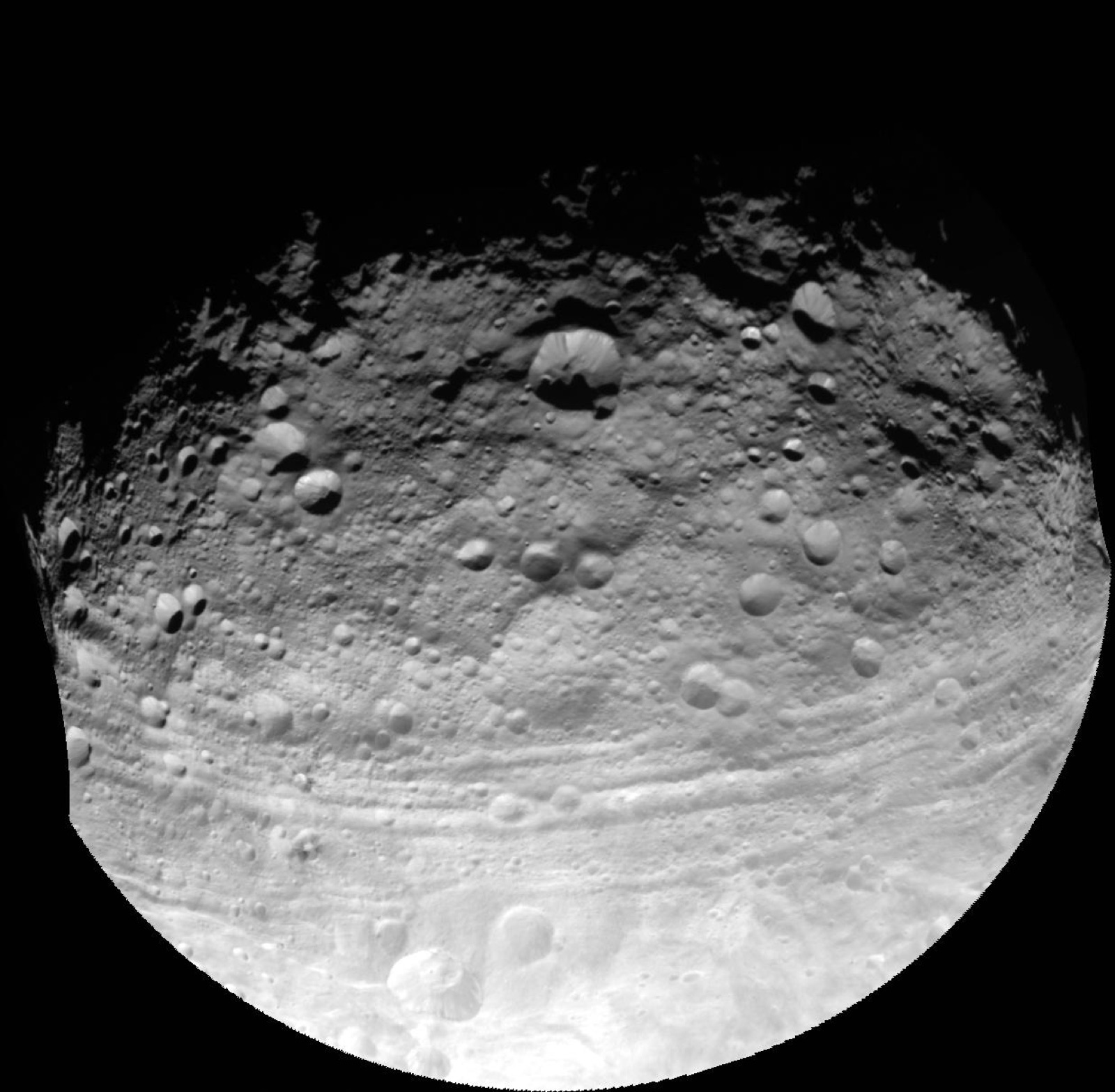
Ceres sits in the middle of the asteroid belt today, but the evidence increasingly points to a birthplace much farther from the Sun — somewhere between the orbits of Jupiter and Saturn. Its bulk composition, dominated by water ice and carbon-rich material, is inconsistent with formation in the warm inner belt. The clinching clue may be the ammonium salts found in Occator Crater: ammonia is far more abundant in the cold outer Solar System, and its presence in Cererian brines suggests the raw material that built Ceres originated there. The leading explanation is that as Jupiter migrated outward early in Solar System history, its gravitational influence deflected this icy protoplanet inward to its current orbit. Ceres is one of only three surviving protoplanets in the inner Solar System — the others are Pallas and Vesta — the rest having been merged into terrestrial planets, shattered in collisions, or ejected by Jupiter entirely. It formed approximately 4.56 billion years ago, making it nearly as old as the Sun itself.
05 Inside Ceres: ice, mud, and maybe a core Deeper
Ceres is roughly 50% water by volume — compared to just 0.1% for Earth — yet its surface preserves craters nearly 300 km across, which requires the outermost layer to be roughly 1,000 times stronger than pure water ice. Dawn's gravity measurements support a structure that no single model fully nails down. In the most detailed three-layer picture, a 40 km thick outer crust of ice, salts, and hydrated minerals sits above a 60 km transitional layer of mixed brine and rock, which in turn overlies a muddy mantle of hydrated rock such as clays. Whether a dense metallic core exists at the centre remains unknown; the low central density suggests the deep interior may retain about 10% porosity. Overall Ceres is 73% rock by mass, and its average density is 2.16 g/cm³. Because Dawn carried no magnetometer, whether Ceres generates any magnetic field at all is simply unanswered — though scientists believe it does not, because the interior is unlikely to be sufficiently electrically conductive.
06 Cryovolcanoes that slowly melt away
Ahuna Mons — Ceres's only prominent mountain — rises from an otherwise flat landscape and shows so few impact craters that it is estimated to be no more than 240 million years old, a geological infant. It appears to be a cryovolcano built from a dense slurry of brine and silicate particles pushed up from the top of the mantle through a process called diapirism, and its position is almost exactly opposite Kerwan Basin on the globe. Seismic energy from the ancient Kerwan impact may have fractured the crust on the far side, giving that slurry a pathway to the surface. But Ahuna Mons is probably not unique — a 2018 computer simulation identified 22 other surface features as strong candidates for older, relaxed cryovolcanoes that have flattened over hundreds of millions of years under their own weight. The best-preserved ancient example is Yamor Mons, which survives in better shape because it sits near the cold north pole where viscous relaxation is slower. Models suggest that on average one new cryovolcano has formed on Ceres every 50 million years over the past billion years.
 ⤢
⤢
07 The carbon-rich surface and what it means Deeper
Ceres's near-surface is extraordinarily carbon-rich — approximately 20% carbon by mass — more than five times higher than in the carbonaceous chondrite meteorites that fall to Earth and are considered the most primitive Solar System material we can handle directly. That carbon shows signs of being intimately mixed with the products of rock–water interactions, including clays, suggesting that liquid water and organic-friendly chemistry have been intertwined throughout Ceres's history. Organic compounds have been detected in and around Ernutet crater, with at least eleven other regions identified as candidates for their presence. The globally homogeneous surface is rich in carbonates and ammoniated phyllosilicates that have been chemically altered by water. Studies using the Hubble Space Telescope also found graphite, sulfur, and sulfur dioxide — the graphite attributed to space weathering on the oldest surfaces, while the volatile sulfur compounds indicate geologically recent activity. Together, the chemistry points toward a body that accreted from ultra-carbon-rich material in the presence of water, possibly in the cold outer Solar System.
08 The mystery of the missing giant craters
Before Dawn arrived, computer models predicted that Ceres should carry ten to fifteen craters wider than 400 km. The spacecraft found none. The largest confirmed impact basin, Kerwan, is 284 km across — big, but well short of what the models demanded. The most likely culprit is viscous relaxation: over geological time, Ceres's ice-rich crust slowly flows and flattens, gradually erasing the deepest, widest wounds. Early cryovolcanism probably helped erase craters outside the ancient polar regions as well. Meanwhile, the north polar region is noticeably more heavily cratered than the equatorial zone, hinting that the two areas have had different geological histories. Three large shallow basins called planitiae are interpreted as heavily eroded ancient craters; the largest, Vendimia Planitia, stretches 800 km across — the single biggest geographical feature on Ceres. Dawn also catalogued 4,423 boulders larger than 105 m in diameter, most clustered near craters, but those boulders are fragile: thermal stress and micrometeorite impacts give them a maximum estimated lifetime of only 150 million years.
09 An exosphere born fresh every few hours Deeper
Ceres has a real atmosphere, but one so thin and short-lived it barely qualifies. The Herschel Space Observatory first detected localised mid-latitude water-vapour sources in early 2014, each no more than 60 km across, releasing roughly 10²⁶ molecules — about 3 kg — of water per second. Dawn later confirmed this transient exosphere in 2017. The current total outgassing rate is just 0.003 kg/s. Ballistic trajectory models give the exosphere a half-life of only about 7 hours, meaning it must be constantly replenished. Three mechanisms feed it: impacts that expose fresh ice patches, slow diffusion of water ice through the porous crust, and solar-wind proton sputtering that intensifies during solar flares and coronal mass ejections — which is why water-vapour detections correlate with solar activity. Dawn's gamma-ray and neutron detector found that Ceres actually accelerates electrons from the solar wind, most likely through collisions between that wind and the vapour exosphere, creating a faint bow-shock structure around the dwarf planet.
 ⤢
⤢
10 Axial wobbles and ancient ice traps
Ceres currently spins with an axial tilt of just 4°, so its poles receive almost no seasonal swings of sunlight — a near-perfect arrangement for accumulating ice in permanently shadowed craters, similar to cold traps on the Moon and Mercury. About 0.14% of all water molecules released from the surface are expected to eventually land in these traps after an average of three hops. But that serenity is not permanent. Jupiter and Saturn have been gravitationally tugging on Ceres over millions of years, driving cyclical shifts in its axial tilt between 2° and 20°. The last period of significant seasonal activity is estimated to have ended roughly 14,000 years ago — essentially yesterday in geological terms. Craters that remain shadowed even during those maximum-tilt episodes are the strongest candidates for holding ancient water ice deposited by eruptions or comet impacts over the entire 4.56-billion-year history of the Solar System. The prime meridian of Ceres runs through a small equatorial crater called Kait.
11 Temporary trojan companions of Ceres
Despite its modest size, Ceres is massive enough to gravitationally capture passing asteroids into temporary 1:1 orbital resonances — making them, in effect, temporary trojans that share its orbit the way Jupiter's trojans share Jupiter's. Fifty such objects have been identified so far, each staying trapped for anywhere from a few hundred thousand to more than two million years before escaping. Ceres also sits tantalizingly close to a 1:1 mean-motion resonance with Pallas — their proper orbital periods differ by only 0.2% — but astronomers consider the two orbits not close enough to produce any significant gravitational interaction over astronomical timescales. Ceres is not a member of any established asteroid family, most likely because its high ice content means that smaller bodies sharing the same composition would have sublimated away entirely over the age of the Solar System. It was once tentatively linked to the Gefion family, but later analysis showed a different composition, making Ceres an interloper — similar orbital elements, but no shared origin.
12 How the Dawn spacecraft worked at Ceres
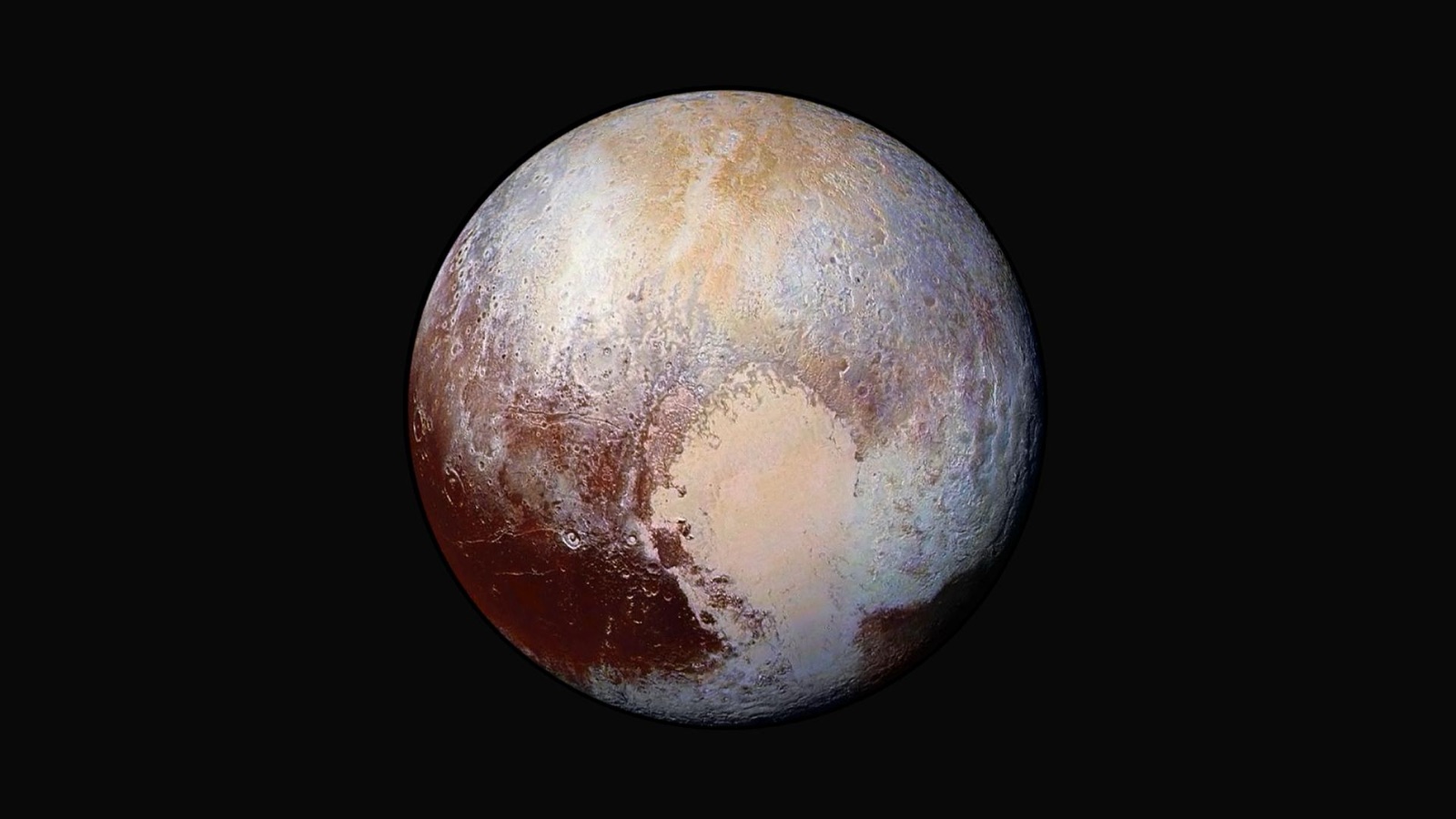
Dawn was launched on 27 September 2007 and reached Ceres on 6 March 2015, when Ceres's gravity captured it at a separation of 61,000 km — four months before the New Horizons flyby of Pluto. The spacecraft carried three instruments: a framing camera, a visual and infrared spectrometer, and a gamma-ray and neutron detector (GRaND). Its mission profile used a series of successively lower circular polar orbits: first at 13,500 km, then 4,400 km, then 1,470 km, and finally a low-altitude mapping orbit at 375 km. In 2017 the mission was extended and Dawn eventually spiraled as close as 35 km from the surface — roughly the cruising altitude of a commercial jet above Earth — before the spacecraft exhausted its hydrazine fuel and the mission ended on 1 November 2018. Before Dawn, only eleven surface features had been tentatively identified from Earth, all of uncertain nature. The spacecraft transformed that handful of blurry patches into a detailed geological map of an unexpectedly active world, revealing cryovolcanoes, brine deposits, organic compounds, and a transient atmosphere.
 ⤢
⤢
13 The naming of Ceres and its chemical legacy
Piazzi's original name for his find was Ceres Ferdinandea — Ceres for the Roman goddess of agriculture, whose oldest temple stood in Sicily, and Ferdinandea in honour of his patron King Ferdinand III of Sicily. The Ferdinandea portion was immediately rejected by other nations and dropped. Before the discovery was even confirmed, competing names circulated in Germany — von Zach called it Hera, Bode called it Juno — but once Ceres's existence was secured, astronomers settled on Piazzi's choice. The name left a chemical footprint almost immediately: cerium, a rare-earth element discovered in 1803, was named in Ceres's honour. The old astronomical symbol for Ceres is a sickle, ⟨⚳⟩, proposed independently by von Zach and Bode in 1802 and still used in astrology today. The correct adjectives for things relating to Ceres are Cererian and Cererean. The 2006 IAU debate that demoted Pluto nearly reinstated Ceres as the Solar System's fifth planet; instead it became the first officially recognised dwarf planet inside Neptune's orbit, and the only one whose orbital period is shorter than Neptune's.
14 Sample-return missions on the drawing board
Dawn answered many questions about Ceres but left scientists hungry for physical material — actual grains of those sodium carbonate bright spots and carbon-rich organics brought back to terrestrial laboratories. In 2020, an ESA team formally proposed the Calathus Mission concept, a dedicated follow-up to Occator Crater designed to collect samples of the bright carbonate faculae and the dark organic material nearby and return them to Earth. Separately, the China National Space Administration has been designing its own sample-return mission from Ceres, planned to take place during the 2020s. If either mission flies and succeeds, Ceres would join the Moon, several asteroids, and cometary dust as one of the handful of Solar System bodies from which humans have directly retrieved material. Given that the bright deposits in Occator are thought to represent brines that welled up from a deep reservoir — possibly within the last few million years — a returned sample could carry direct chemical evidence of what lies beneath Ceres's crust today.
 ⤢
⤢
You would weigh…
Surface gravity 0.28 m/s² vs Earth’s 9.81 m/s². Try every world →
Could life exist here?
No evidence of life — but Ceres has (briny) liquid water at depth, organic carbon on its surface, and a long, quiet history. It is the closest world with all three, which is why sample return is on the wish list.
Our labels: Confirmed · Strong Evidence · Estimated · Hypothesis · Theoretical · Speculative (see Methodology).
Could humans live here?
Science-fiction writers love Ceres as a belt hub (The Expanse), and its ice would indeed make useful rocket propellant. Realistically it is a robotic destination for decades to come; 3% gravity makes 'living' there more like living on a very large space station.
How would we get there?
Dawn took 7.5 years — but it stopped at asteroid Vesta for a year on the way, something only its gentle ion engines made possible. A direct chemical transfer runs about 2–3 years.
| Technology | Status | Travel time (one way, straight line) |
|---|---|---|
| Apollo-style spacecraft, about 39,000 km/h | Flown technology | 444 days |
| Ion-propulsion probe, about 90,000 km/h | Flown technology | 192 days |
| Voyager 1, about 61,000 km/h | Flown technology | 282 days |
| Parker Solar Probe, about 690,000 km/h | Flown technology | 25 days |
| Nuclear-thermal rocket, about 120,000 km/h cruise | In development | 145 days |
| Laser light-sail at 20% of light speed | Proposed concept | 115 minutes |
| Light itself, 299,792 km/s | Physical limit | 23 minutes |
Simplified straight-line times at cruise speed. Real missions fly curved orbital paths and take longer. Full travel calculator →
Weird & wonderful
- Ceres contains about a third of all the mass in the asteroid belt.
- Its bright spots are so reflective that early observers wondered about ice volcanoes — the truth (giant salt flats from escaping brine) is nearly as strange.
- Ahuna Mons on Ceres is probably a young 'mud volcano' of salty ice.
- A year there is 4.6 Earth years, but its day is just 9 hours.
More real images of Ceres
Genuine spacecraft and telescope imagery, every frame credited and licensed. Tap any photo to enlarge.