 Photograph · NASA · Public domain
Spacecraft · Deep guide
New Horizons
Nine years to Pluto for nine days of revelation, after the fastest launch in history.
What is it?
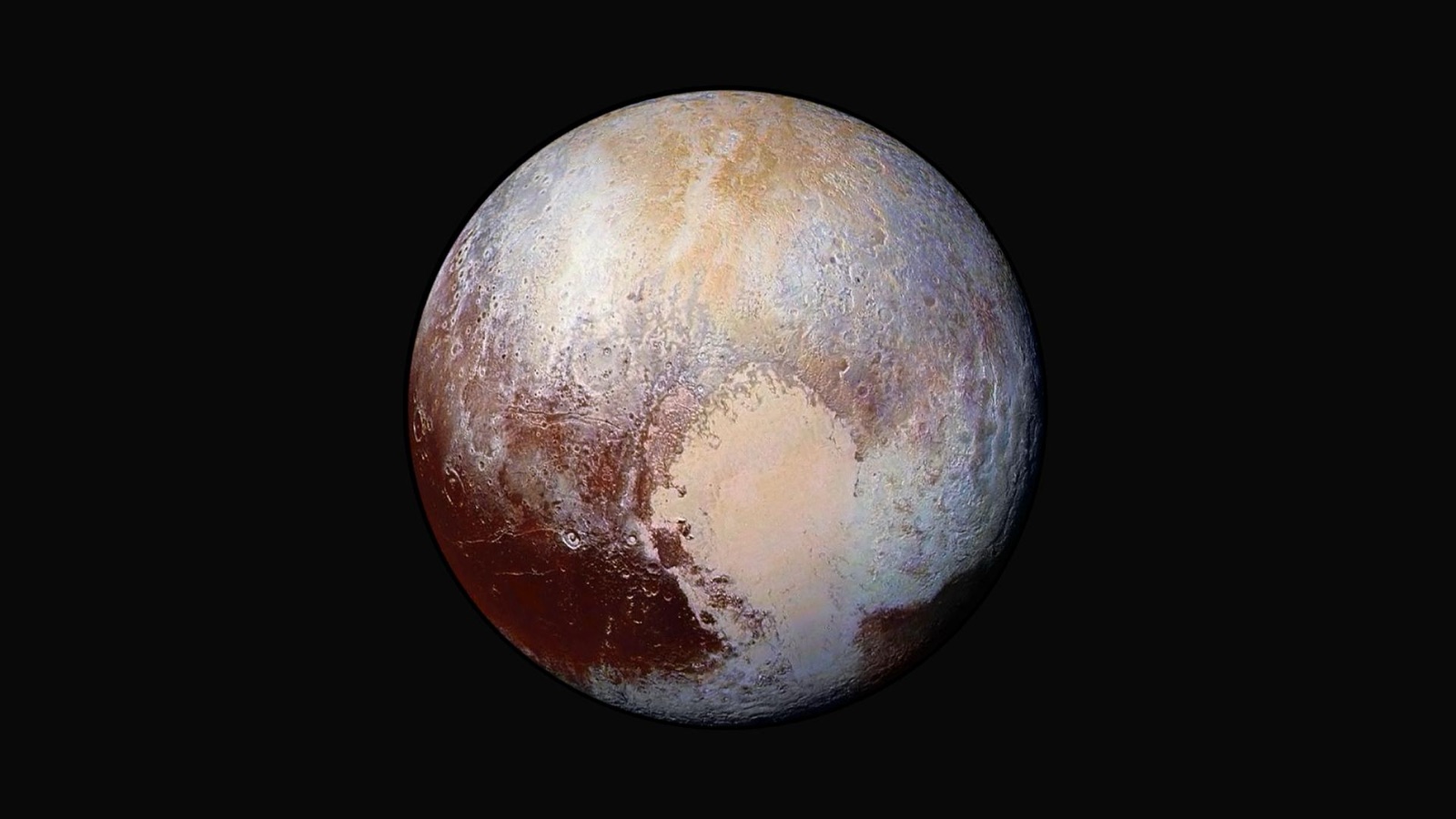
New Horizons left Earth in 2006 faster than any spacecraft before it, crossed the entire Solar System in 9.5 years, and on July 14, 2015 turned Pluto from a blurry dot into a world: nitrogen glaciers, water-ice mountains, blue skies. In 2019 it flew past Arrokoth, the most distant object ever explored — a pristine two-lobed planetesimal from the construction era.
Go deeper
Launched at 58,000 km/h direct-to-escape (passing the Moon in 9 hours), Jupiter slingshot, then hibernation cruise. The Pluto encounter was a bandwidth epic: 16 months to downlink the flyby at ~1 kbps from 33 AU. Arrokoth (2019) became the cleanest test of planetesimal formation — its gentle-contact bi-lobe shape supports streaming-instability 'cloud collapse' over violent accretion. Still healthy in the Kuiper Belt with power into the 2040s, doing heliospheric and Ly-α science; a second KBO flyby awaits a target search.
01 Nine years for nine days
New Horizons couldn't stop — carrying braking fuel would have made it too heavy to launch fast enough to arrive in a career's length. So a decade of flight bought a compressed encounter: the closest Pluto data was gathered in hours. Planetary exploration is a discipline of patience punctuated by adrenaline.
The deep dive
Researched for the Atlas from Wikipedia — New Horizons (58,000 characters read) · updated Sep 20, 2026
02 The long fight to get New Horizons built
New Horizons almost never left the ground. The idea traces back to August 1992, when JPL scientist Robert Staehle called Clyde Tombaugh — the man who discovered Pluto in 1930 — to request permission to visit his planet. Tombaugh reportedly replied that Staehle was welcome to it, though he'd have "one long, cold trip." Nearly a decade of proposed missions followed before Stamatios Krimigis and Alan Stern formed the New Horizons team in December 2000. Stern was appointed principal investigator and described by Krimigis as "the personification of the Pluto mission." The proposal beat out four others and survived a head-to-head competition with a rival concept called POSSE, led by the University of Colorado Boulder. Then NASA Administrator Sean O'Keefe, appointed by the Bush administration, effectively canceled the project by leaving it out of NASA's 2003 budget. Ed Weiler, NASA's Associate Administrator for the Science Mission Directorate, encouraged Stern to lobby hard. That effort paid off when the 2003–2013 Planetary Science Decadal Survey ranked New Horizons the highest-priority medium-size mission — ahead of proposals targeting the Moon and Jupiter. Weiler said it was a result his administration "was not going to fight," and funding was finally secured.
03 A spacecraft shaped like a grand piano
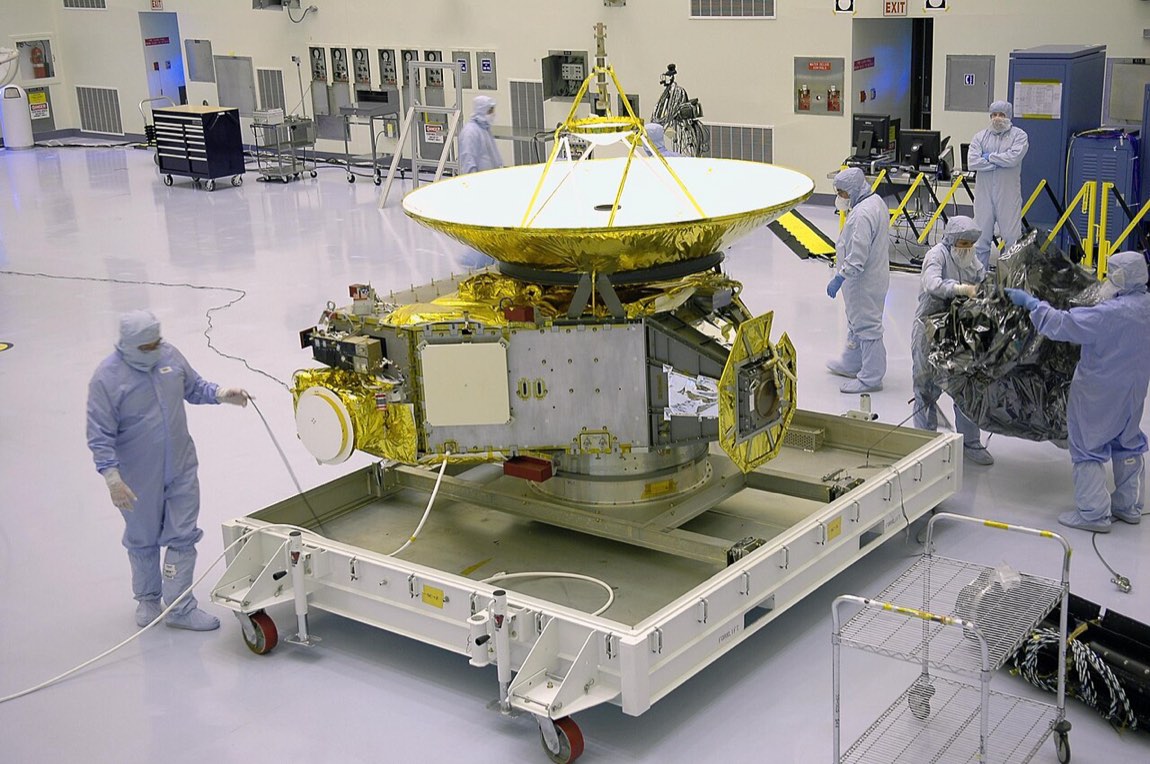
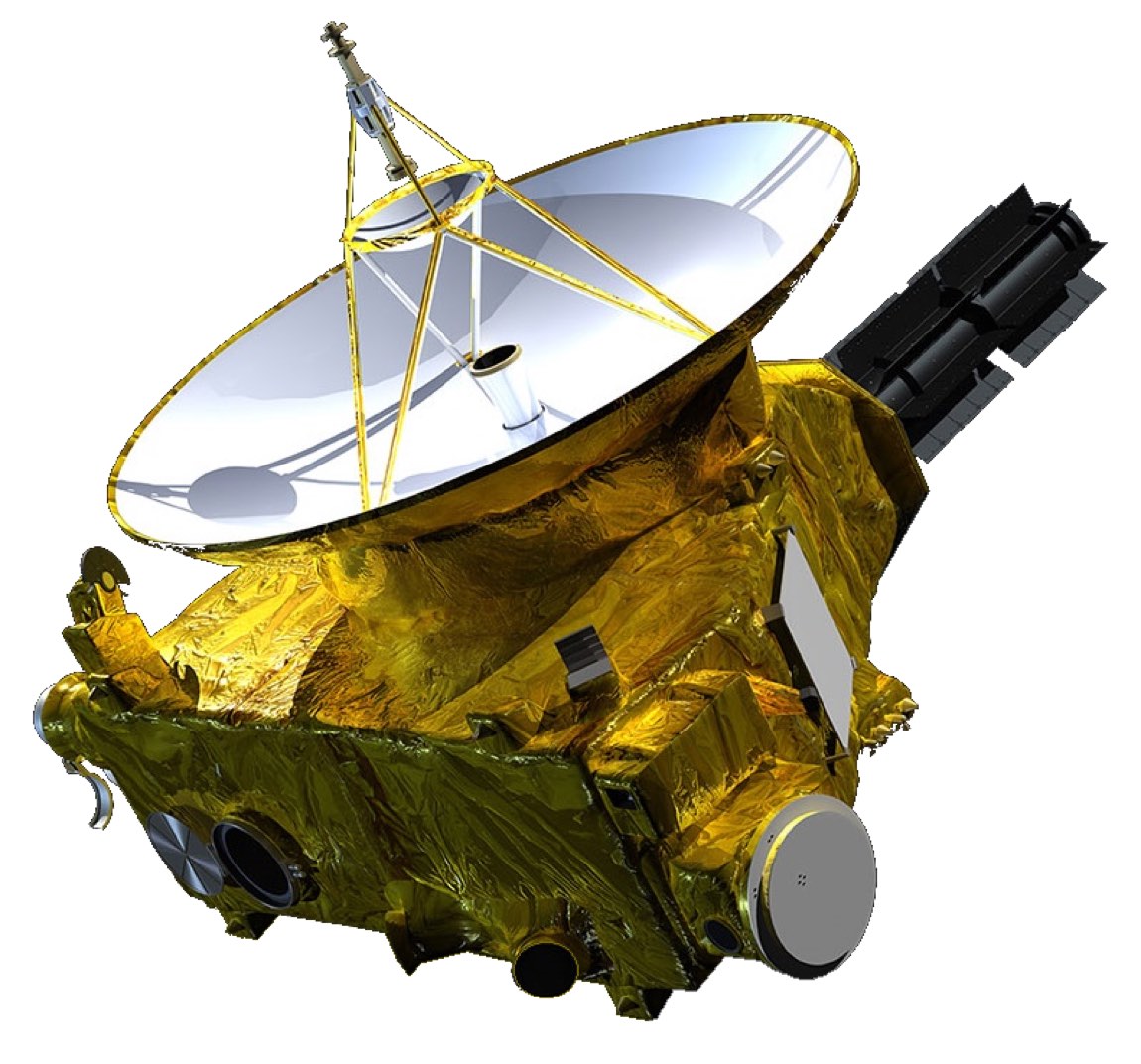
New Horizons is often compared in size and shape to a grand piano — or more precisely, to a piano glued to a cocktail bar-sized satellite dish. Its body forms a triangle almost 0.76 m (2.5 ft) thick, a shape chosen partly because spinning spacecraft need a wide mass distribution. A central column of 7075 aluminium alloy runs from the launch adapter ring at the rear to the 2.1 m (6 ft 11 in) radio dish at the front, with the titanium fuel tank inside that column. The spacecraft is wrapped in insulating blankets that even enclose the dish, trapping heat from the RTG in the frigid outer Solar System. When closer to the Sun — and therefore warmer — electronics are throttled back, power is shunted to radiators, and louvers open to bleed off excess heat. The interior walls are painted black to equalize temperature through radiative heat transfer. All seven science instruments are body-mounted rather than on a movable scan platform like those on the Voyager probes; this simplified the design and saved weight, but it means the entire spacecraft must rotate to point a camera, temporarily breaking the radio link with Earth. The spacecraft's on-orbit mass including fuel was over 470 kg (1,040 lb) on the Jupiter flyby trajectory.
04 Nuclear power far from the Sun Deeper
New Horizons carries a single radioisotope thermoelectric generator — model designation GPHS-RTG — originally a spare from the Cassini mission. At launch it provided 245.7 watts of power, decaying at roughly 3.5 watts per year, so by the time the spacecraft reached Pluto in 2015 it was delivering about 202 watts, and as of January 2019 the output had fallen to roughly 190 watts. The RTG will decay too far to power the transmitters in the 2030s. Inside the RTG are 9.75 kg (21.5 lb) of plutonium-238 oxide pellets, each clad in iridium and encased in a graphite shell — a design built to survive a launch accident. The Department of Energy estimated the chance of a launch accident releasing radiation into the atmosphere at 1 in 350; a worst-case total dispersal of the on-board plutonium would have spread radiation equivalent to 80% of the average annual North American background dose over an area with a 105 km (65 mi) radius. The original design called for 10.9 kg (24 lb) of plutonium, but security-related delays at the Department of Energy slowed production, so a less powerful unit was delivered. Mission planners had to revise their observation sequences accordingly, and even with full power, not all instruments can operate simultaneously — the rated total instrument power is just 21 watts.
05 How Jupiter made the mission possible
Without a stop at Jupiter, New Horizons would have arrived at Pluto five to six years later than it did — and might have found a thinner or frozen-out atmosphere. The spacecraft made its closest approach to Jupiter on February 28, 2007, passing within 2.3 million kilometers (1.4 million miles) of the planet. The gravitational slingshot boosted the probe's speed by 4 km/s (14,000 km/h; 9,000 mph), accelerating it to 23 km/s (83,000 km/h; 51,000 mph) relative to the Sun. Only the first twenty-three days of the January 2006 launch window allowed this Jupiter flyby; any launch after that period would have required a slower direct trajectory to Pluto. The encounter also served as a full dress rehearsal. Because Jupiter is so much closer to Earth than Pluto, the communications link could handle multiple buffer loads of data, so the mission actually returned more data from the Jovian system than it was expected to send back from Pluto. Scientists observed heat-induced lightning in Jupiter's polar regions, violent storm waves, and imaged the Little Red Spot — spanning up to 70% of Earth's diameter — up close for the first time. Three volcanic eruptions on Io were seen for the first time, including the Tvashtar plume reaching an altitude of up to 330 km (210 mi).
06 Years of hibernation across the void
After leaving Jupiter's neighborhood in mid-2007, New Horizons spent most of its cruise to Pluto in hibernation mode. Redundant components, guidance systems, and many subsystems were powered down to extend their lifetimes, cut operating costs, and free up the Deep Space Network for other missions. The onboard computer kept watch over the spacecraft's health and sent Earth a simple status code — "green" if everything was nominal, "red" if human intervention was needed. The probe woke up for roughly two months each year for calibration and system checks. Four hibernation cycles ran between June 2007 and August 2014. During a July 2012 hibernation period, controllers decided to activate SWAP, PEPSSI, and the VBSDC dust counter early to collect heliospheric data — originally only the dust counter had been planned to run. The spacecraft crossed Saturn's orbit on June 8, 2008, and Uranus's orbit on March 18, 2011. On December 6, 2014, the final "wake-up" command was sent; the spacecraft's acknowledgment reached Earth on December 7, 2014, at 02:30 UTC. The whole hibernation strategy was a calculated trade-off: less wear on hardware, lower cost, but also periods when no science was being done over billions of kilometers of the outer Solar System.
07 The instruments New Horizons carries Deeper
Seven instruments share the 21-watt science power budget. LORRI, the Long-Range Reconnaissance Imager, is a Ritchey–Chrétien telescope with a 208.3 mm (8.20 in) aperture, 1024×1024 pixel monochromatic CCD giving 5 μrad (~1 arcsec) resolution; its silicon carbide mirrors resist warping at cryogenic temperatures. The Ralph telescope — named after Alice's husband on The Honeymooners — has a 75 mm aperture and splits into two channels: MVIC for visible-light color imaging and LEISA for near-infrared spectral mapping; in June 2017 NASA renamed LEISA the "Lisa Hardaway Infrared Mapping Spectrometer" in honor of a Ball Aerospace program manager who died that year. Alice is an ultraviolet imaging spectrometer resolving 1,024 wavelength bands from 50–180 nm and weighs just 4.4 kg. SWAP measures solar-wind particles up to 6.5 keV through the largest aperture of any such instrument ever flown, necessary because the solar wind is so tenuous at Pluto's distance. PEPSSI extends that range up to 1 MeV and can distinguish protons, electrons, and heavy ions. REX uses an ultrastable crystal oscillator to perform radio science, measuring atmospheric density and planetary radii through occultations. Finally, the Venetia Burney Student Dust Counter — built by students at the University of Colorado Boulder — uses fourteen polyvinylidene difluoride panels with 0.125 m2 of collecting area to weigh dust grains in the nano- to picogram range.
08 Closest approach: twelve minutes that changed astronomy
At 11:49 UTC on July 14, 2015, New Horizons passed 12,472 km (7,750 mi) from Pluto's surface — closer than the distance across the continental United States is wide — at a speed of 13.78 km/s (49,600 km/h; 30,800 mph). The spacecraft was pointed at Pluto rather than Earth, so 22 hours of planned radio silence followed. Mission managers estimated a 1-in-10,000 chance that debris could have destroyed the probe during the flyby. Telemetry confirming a healthy spacecraft reached Earth on July 15, 2015, at 00:52:37 UTC. In those few hours of close encounter, LORRI captured images at up to 50 m (160 ft) resolution; MVIC built four-color global maps at 1.6 km (1 mi) resolution; and LEISA produced near-infrared hyperspectral maps ranging from 7 km/px globally down to 0.6 km/px for selected areas. Alice studied the atmosphere through stellar occultations and airglow. SWAP and PEPSSI sampled the upper atmosphere and its interaction with the solar wind. REX used Earth-based radio telescopes to time the disappearance and reappearance of the probe's signal as it slipped behind Pluto, resolving the planet's diameter and characterizing its atmosphere. The spacecraft also came within 28,800 km (17,900 mi) of Charon during the same pass.
09 Sending 6.25 gigabytes across 5 billion km Deeper
New Horizons recorded 6.25 gigabytes of data at Pluto — comparable to roughly 1,300 CD tracks of music — but transmitting it home took just over 15 months. The reason is geometry and physics. At Pluto's distance of roughly 4.7 billion km (2.9 billion mi), radio signals take 4 hours and 25 minutes to reach Earth one way, and the spacecraft could only transmit at 1 to 2 kilobits per second. The free-space path loss at 7 GHz was approximately 303 dB — a staggering attenuation meaning that the signal arriving at a 70 m (230 ft) Deep Space Network dish was about −148 dBm, barely above the noise floor. The high-gain antenna is a 2.1 m (6 ft 11 in) Cassegrain reflector providing over 42 dBi of gain with a half-power beam width of about one degree; that narrow beam is why the spacecraft must turn away from its targets to phone home. Two 12-watt traveling-wave tube amplifiers can be powered simultaneously to transmit a dual-polarized signal, nearly doubling the downlink rate when the power budget allows. Data are stored on two solid-state recorders holding up to 8 gigabytes each. By March 30, 2016 — nine months after the flyby — the halfway point of the data transfer had been reached. The last piece, part of a Pluto–Charon observation by Ralph/LEISA, was received on October 25, 2016, at 21:48 UTC.
10 Pluto's small moons seen up close for the first time Deeper
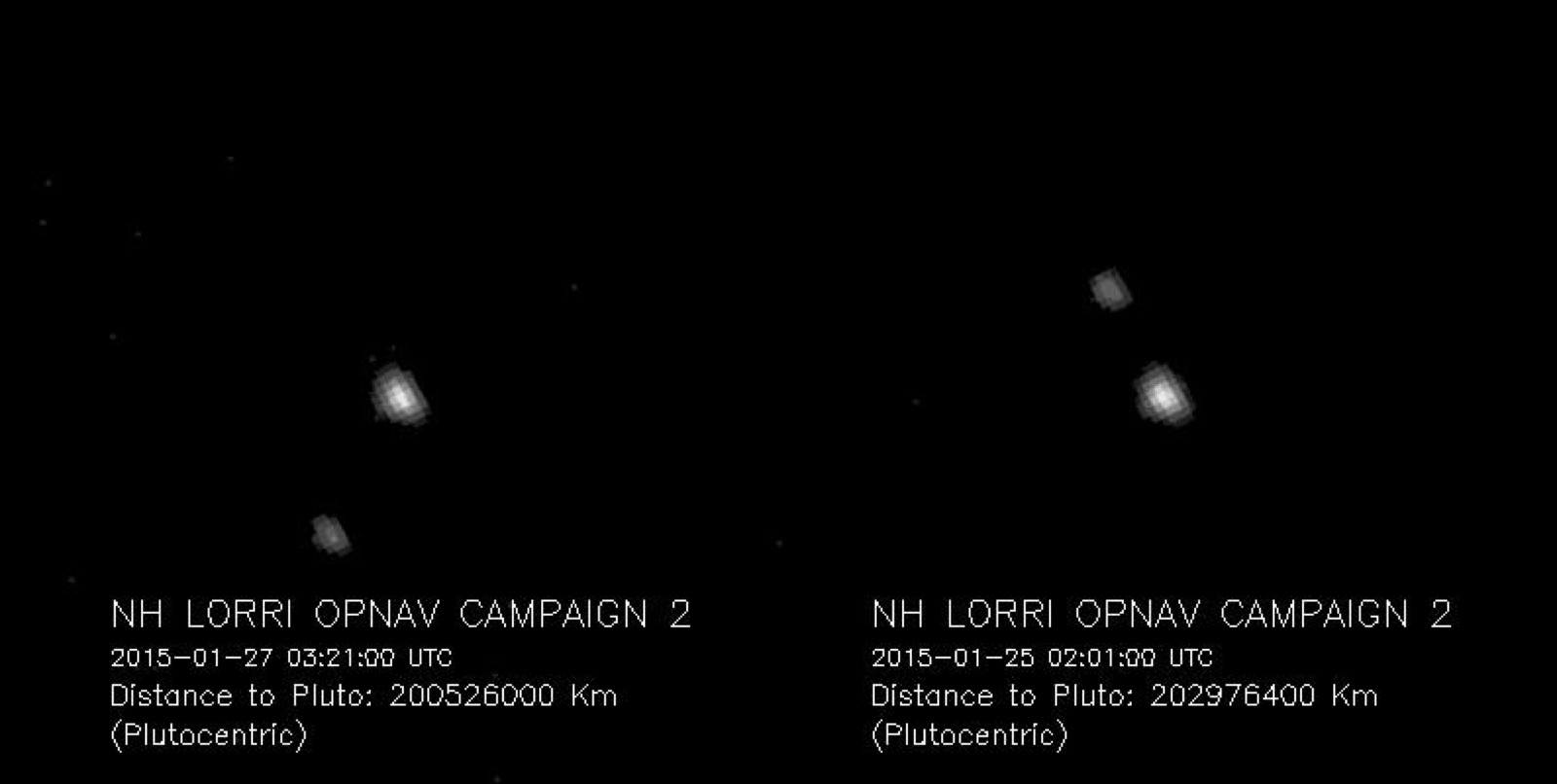
Before New Horizons arrived, Pluto's four small moons — Nix, Hydra, Kerberos, and Styx — were little more than faint specks detectable only by the Hubble Space Telescope. The flyby changed that. New Horizons achieved spatial resolutions of 330 m per pixel at Nix, 780 m per pixel at Hydra, and roughly 1.8 km per pixel at Kerberos and Styx. Measured dimensions revealed four surprisingly elongated, irregular bodies: Nix is approximately 49.8 × 33.2 × 31.1 km; Hydra roughly 50.9 × 36.1 × 30.9 km; Kerberos about 19 × 10 × 9 km; and Styx around 16 × 9 × 8 km. Kerberos in particular defied predictions — scientists had expected it to be relatively large and dark, but it turned out smaller, about 19 km (12 mi) across, with a highly reflective surface suggesting relatively clean water ice, similar to Pluto's other small moons. There is also a naming connection between the moons and the spacecraft: the first letters of Nix and Hydra — N and H — are the initials of New Horizons, a link the moons' discoverers deliberately chose when selecting the names, alongside each moon's mythological relationship to Pluto. Before the flyby, mission planners spent 18 months running computer simulations to assess the risk of the spacecraft colliding with unseen debris from these moons; the probability of a catastrophic collision was found to be less than 0.3%.
11 Confirming a hydrogen wall at the Solar System's edge
In August 2018, NASA announced that the Alice ultraviolet spectrometer aboard New Horizons had confirmed the existence of a "hydrogen wall" at the outer edges of the Solar System — a region where the Sun's outflowing solar wind slows and piles up against the interstellar medium, creating a concentration of hydrogen atoms. This wall was first detected in 1992 by the two Voyager spacecraft, but Alice's measurements provided fresh, independent confirmation from a different direction in the sky and at different wavelengths. Alice resolves 1,024 wavelength bands in the far and extreme ultraviolet between 50 and 180 nm — precisely the range needed to detect hydrogen's characteristic glow. The instrument weighs just 4.4 kg and draws 4.4 watts, yet it has produced one of the mission's most cosmically significant results. New Horizons is only the fifth spacecraft ever to achieve solar escape velocity, so its ability to study the heliosphere from the inside out — while traveling outward through the Kuiper belt — gives scientists a vantage point that no Earth-orbiting or inner-Solar-System mission can replicate. The finding adds to humanity's slowly growing picture of where the Sun's influence ends and true interstellar space begins.
12 Finding Arrokoth: a needle in a cosmic haystack
After the Pluto flyby, New Horizons had roughly 33 kg (73 lb) of hydrazine propellant left and needed a new target within a cone less than one degree wide extending from Pluto — a brutally narrow search area. The target also had to be within 55 AU of the Sun, beyond which the communications link weakens too much and RTG power output drops too far for useful science. Ground-based telescopes — including the twin 6.5 m Magellan Telescopes in Chile, the 8.2 m Subaru Observatory in Hawaii, and the Canada–France–Hawaii Telescope — scanned the sky and found roughly 143 KBOs of potential interest, but none lay close enough to New Horizons' constrained flight path. Only the Hubble Space Telescope had the sensitivity to find a suitable target in time. Hubble time was granted on June 16, 2014, and the probability of finding a reachable object was estimated at about 95% beforehand. By October 2014, three candidates had emerged, temporarily designated PT1, PT2, and PT3. All had estimated diameters in the 30–55 km (19–34 mi) range. PT1 — later formally named 486958 Arrokoth — had a magnitude of 26.8 and required about 35% of New Horizons' remaining trajectory-adjustment fuel to reach. Its flyby occurred on January 1, 2019, when the spacecraft was 43.4 AU (6.49 billion km; 4.03 billion mi) from the Sun.
13 The human touches riding to the stars
New Horizons carries nine cultural artifacts in addition to its science payload. A compact disc holds 434,738 names submitted by the public; a second CD carries images of project personnel. A piece of Scaled Composites's SpaceShipOne — the first private crewed spacecraft — travels alongside a "Not Yet Explored" US postage stamp and two copies of the American flag. About 30 grams (1 oz) of Clyde Tombaugh's ashes are aboard, honoring the astronomer who discovered Pluto in 1930 and who jokingly told Robert Staehle he was welcome to visit it. A Florida state quarter, whose design celebrates human exploration, rides as an official trim weight, and a Maryland state quarter honors the spacecraft's builders at the Johns Hopkins Applied Physics Laboratory in Howard County. The dust counter instrument is named the Venetia Burney Student Dust Counter, after the eleven-year-old girl who suggested the name "Pluto" when the planet was discovered — and the Emmy Award-winning short film about it was made by the student team at the University of Colorado Boulder who built the instrument. Mission Operations Manager Alice Bowman — known by the acronym MOM — oversaw the team that brought the spacecraft safely through its most critical encounters.
14 What comes next for New Horizons
As of April 2026, New Horizons is 64.45 AU (9.64 billion km; 5.99 billion mi) from the Sun, still traveling through the Kuiper belt and returning heliospheric science data. NASA has announced plans to keep the spacecraft operational until it exits the Kuiper belt, expected in either 2028 or 2029. The RTG power output will drop too far to run the transmitters in the 2030s, setting a hard deadline on the mission's scientific life. Funding has been contentious: the White House's proposed FY2026 budget would have cut New Horizons, but the mission's continuation was heavily debated in Congress, and a final budget of 24.44 billion USD guaranteed the program continues. The spacecraft is heading in the direction of the constellation Sagittarius at 14.10 km/s (8.76 mi/s; 2.97 AU/a) relative to the Sun — making it the fifth human-made object on a trajectory to escape the Solar System entirely. During the Kuiper Belt Extended Mission, planners hoped to conduct distant observations of roughly two dozen additional KBOs and potentially achieve another flyby. The Venetia Burney Student Dust Counter is always on, measuring interplanetary and interstellar dust grains in the nano- to picogram mass range — every day adding data from a region no dust counter has ever operated before, past the orbit of Uranus.
 ⤢
⤢
Weird & wonderful
- It reached the Moon's distance in 9 hours — Apollo took 3 days.
- Pluto's discoverer flew past Pluto — an ounce of Tombaugh's ashes rides aboard.
- Its Pluto images arrived slower than 1990s dial-up, and were worth every month.