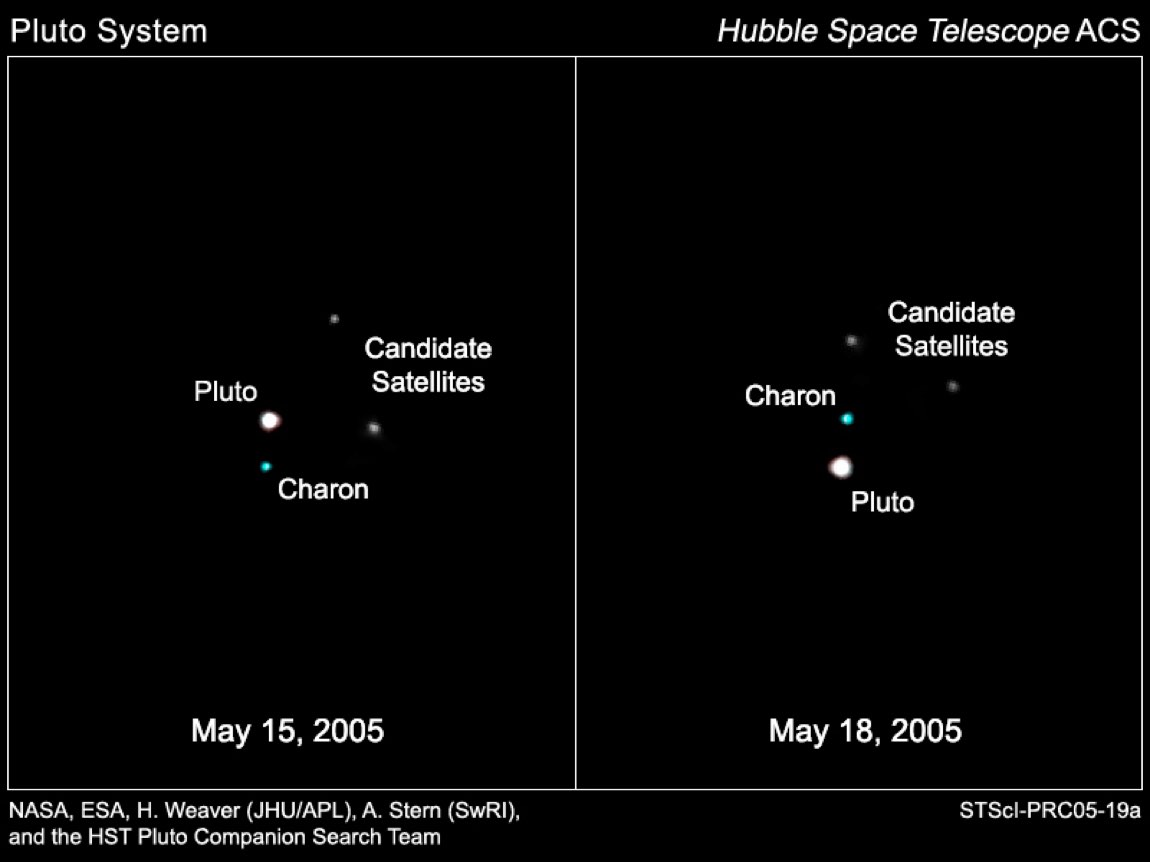
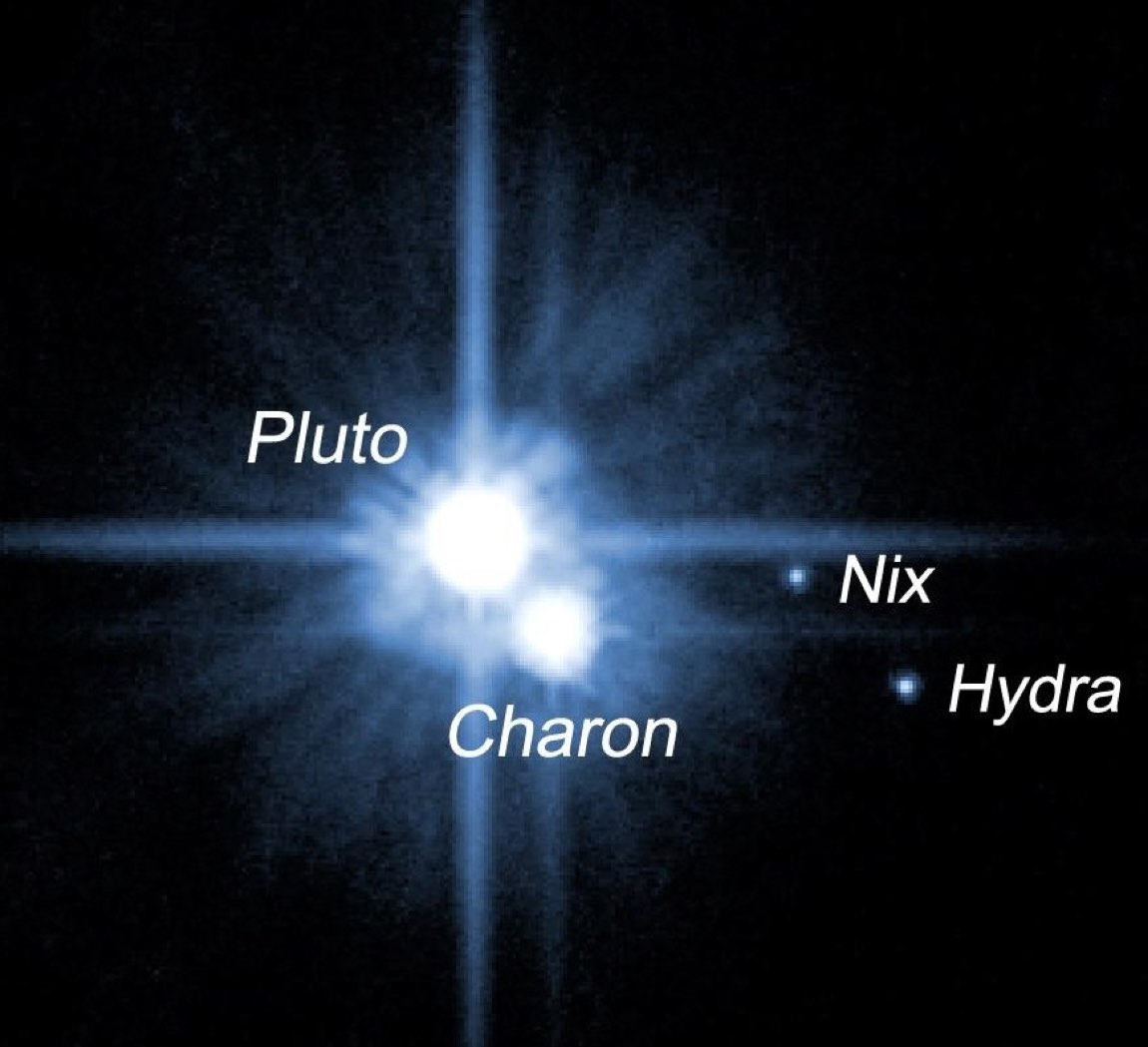
 Photograph · NASA, ESA, H. Weaver (JHU/APL), A. Stern (SwRI), and the Hubble Space Telescope · Public domain
Moon · Deep guide · orbits Pluto
Nix
Also called: Pluto II · S/2005 P 2
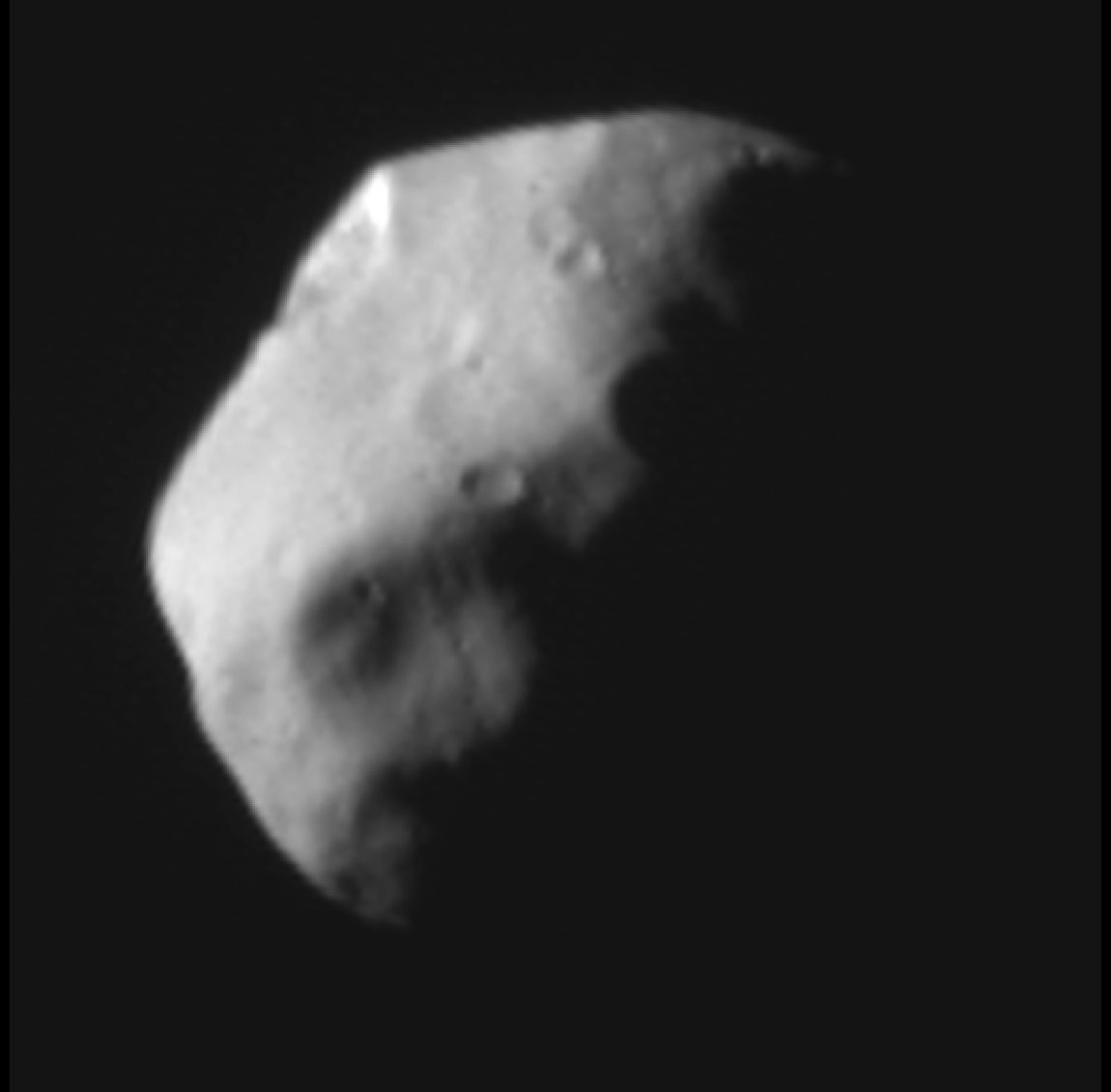
A bright, tumbling moon of Pluto with a reddish crater seen by New Horizons.
What is it?
Nix was found in Hubble Space Telescope images taken in May 2005 and announced that October with Hydra. It is about 50 km long and very reflective, thanks largely to water ice. Nix is not tidally locked: it tumbles chaotically as it orbits Pluto and Charon every 25 days. During the 2015 flyby, New Horizons spotted a reddish area about 18 km wide, probably an impact crater; two craters, Gleti and Metztli, have since been named.
The deep dive
Researched for the Atlas from Wikipedia — Nix (moon) (8,467 characters read) · updated Nov 15, 2026
01 How Nix and Hydra Were Found
The search for Pluto's smaller moons was driven by a practical concern: the New Horizons mission team worried that undiscovered debris or moons near Pluto might pose a hazard to the spacecraft. To scout ahead, astronomers Max Mutchler and Andrew Steffl, members of the Pluto Companion Search Team, turned the Hubble Space Telescope toward Pluto in 2005. The challenge was extraordinary — Nix shines about 5,000 times fainter than Pluto itself, requiring long-exposure images just to register its faint glimmer. The critical discovery images were captured on 15 May 2005 and 18 May 2005. Before the team announced anything publicly, they confirmed the find by going back through archival Hubble images of Pluto taken in 2002, a process called precovery. The official announcement came on 31 October 2005. Until formal names were assigned, the team informally called the two new moons P1 and P2, with Nix carrying the provisional designation S/2005 P 2.
02 The Mythology Behind the Name
The International Astronomical Union approved the name Nix on 21 June 2006, announcing it alongside the name Hydra in IAU Circular 8723. The moon honors Nyx, the Greek goddess of darkness and night — and crucially, the mother of Charon, the ferryman of Hades, making the mythological connection to Pluto's largest moon deliberate and fitting. The original proposal was to use the classical Greek spelling Nyx, but that spelling was already taken by asteroid 3908 Nyx, so the team adopted Nix, the Coptic version of the same name. The choice of Nix and Hydra was also a quiet tribute to the spacecraft racing toward Pluto: the initials N and H honor the New Horizons mission, just as the first two letters of Pluto's name historically honored astronomer Percival Lowell. Future surface features on Nix must, by IAU convention, be named after deities of the night drawn from literature, mythology, and history around the world.
03 A Giant Collision and a Puzzling Surface
The leading theory for Nix's origin is the same giant-impact hypothesis that explains Earth's Moon: a massive body slammed into Pluto early in the solar system's history, hurling debris into orbit around Pluto and Charon, and that debris eventually coalesced into the smaller moons including Nix. The scenario is elegant, but it runs into at least one significant problem. Nix has a remarkably high reflectivity — its surface is bright with water ice — and scientists have struggled to explain how a moon assembled from violent collision ejecta would end up so reflective. If the impacting body were dark and rocky, the resulting debris might be expected to produce a duller surface. This unresolved tension means the collisional hypothesis, while widely accepted, is not complete. The question of how Nix's surface stayed so clean and icy remains genuinely open.
 ⤢
04 Water Ice, Tholins, and That Red Spot Deeper
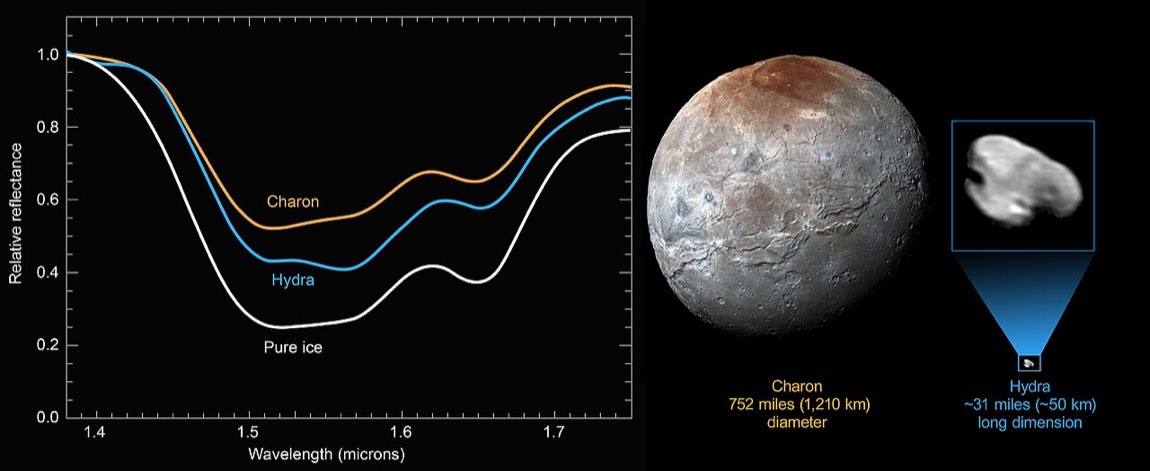
Nix's spectrum initially looked reddish to some researchers, while others found it spectrally neutral — a contradiction that puzzled scientists for years. When New Horizons swept past in July 2015, it resolved the debate visually: enhanced color images from the Ralph MVIC instrument revealed one prominent reddish region roughly 18 km (11 mi) across sitting on an otherwise neutral, water-ice-covered surface. That water ice is what gives Nix its high reflectivity. The reddish patch is most likely a large impact crater where the collision punched through the ice layer and excavated darker, redder material from beneath, depositing it as an ejecta blanket visible today. A competing explanation suggests the reddish material came from a collision with a compositionally distinct object. There is also a photochemical pathway: trace amounts of frozen methane on the surface could react with solar ultraviolet radiation to produce tholins — complex reddish organic compounds — similar to processes seen elsewhere in the outer solar system. Notably, no comparable color variations were detected at other impact craters on Nix, making the large red region distinctly unusual.
05 Nix Tumbles: Chaotic Rotation Explained Deeper
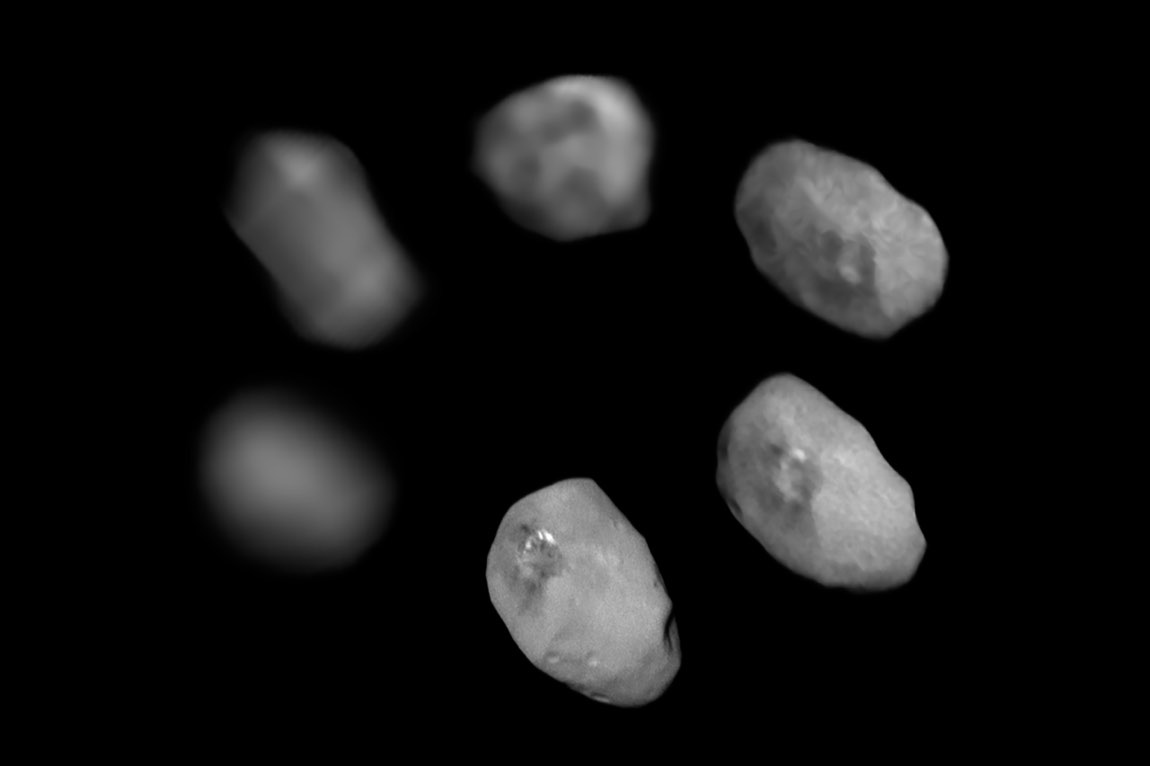
Unlike most moons in the solar system, Nix is not tidally locked to Pluto. Instead it tumbles chaotically, meaning its axial tilt and rotation period shift dramatically over short timescales and cannot be predicted far into the future. Two forces drive this chaos. First, Pluto and Charon orbit their shared center of mass — their barycenter — and that constantly shifting gravitational pull tugs on Nix from changing directions, destabilizing any settled spin. Second, Nix's own elongated shape amplifies the problem: the uneven mass distribution creates torques that push and twist the moon as it orbits. The tumbling is so extreme that Nix can occasionally flip its entire rotational axis. When New Horizons flew by in July 2015, it caught Nix spinning with a period of 43.9 hours in a retrograde direction relative to its orbit around Pluto, with an axial tilt of 132 degrees — essentially spinning backwards. Perhaps most striking, its rotation rate had already increased by 10 percent since the moon was first discovered in 2005, a measurable change over just a decade.
06 An Ancient Surface Shaped by Impacts
By counting the density of craters visible in New Horizons imagery — a standard technique for estimating surface age — scientists calculated that Nix's surface is at least four billion years old. That places its formation close to the dawn of the solar system itself, suggesting the surface has changed little since those earliest violent epochs. New Horizons resolved Nix's shape well enough for the mission team to describe it informally as a "jelly bean," with measured dimensions of 49.8 km × 33.2 km × 31.1 km (30.9 mi × 20.6 mi × 19.3 mi). Two craters on Nix have received official IAU names, both drawn from deities of the night. Gleti, the largest named crater, spans 13 km (8.1 mi) in diameter and is surrounded by a distinctive dark red ejecta blanket. Metztli, the second named crater, measures roughly 10 km (6.2 mi) across. No other craters on Nix currently carry formal names.
 ⤢
07 Orbital Mechanics and a Near-Resonance Deeper
Nix orbits the Pluto–Charon barycenter — not Pluto itself — at a distance of 48,694 km (30,257 mi), slotting in between the orbits of Styx and Kerberos. Like all of Pluto's moons, its orbit is nearly perfectly circular and lies almost exactly in the plane of Charon's orbit, with very low inclination to Pluto's equator. That tidiness is thought to be the product of tidal evolution: early in its history Nix likely had a more eccentric orbit, but gravitational interactions with Charon gradually damped that eccentricity, transferring it outward and rounding out Nix's path over billions of years. Nix's orbital period also sits tantalizingly close to a 1:4 resonance with Charon — meaning it completes roughly four orbits for every one Charon completes — but with a timing discrepancy of 2.8%, meaning no active resonance locks the two bodies together. One hypothesis proposes that this near-resonance is a relic from before Charon migrated outward after the system formed, preserved today by a periodic 9 percent fluctuation in the strength of the Pluto–Charon gravitational field.
08 New Horizons' Close Look at a Tiny World
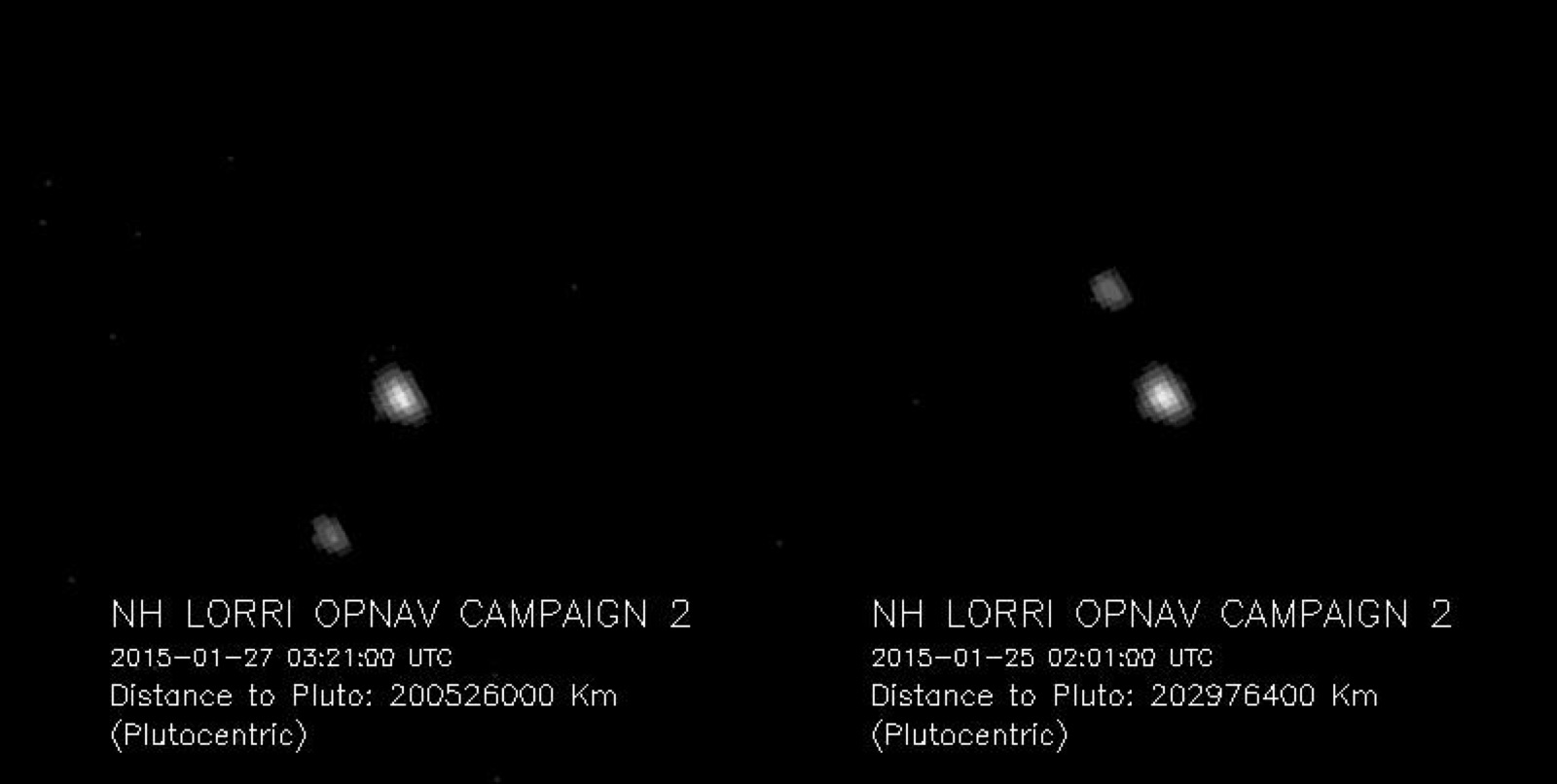
New Horizons made its closest approach to the Pluto system on 14 July 2015, and of Pluto's four smaller moons, only Nix and Hydra were photographed at resolutions sharp enough to reveal surface features. Before the flyby, the spacecraft's Long Range Reconnaissance Imager had already been used to measure Nix remotely, initially estimating its diameter at about 35 km (22 mi) — an underestimate that the close-up images would correct. The first detailed images, captured from a distance of about 231,000 km (144,000 mi), were received from the spacecraft on 18 July 2015 and released publicly on 21 July 2015. Those images carried a resolution of 3 km (1.9 mi) per pixel, enough to refine Nix's dimensions to approximately 42 km × 36 km (26 mi × 22 mi) and to reveal the prominent reddish patch that had been invisible from Earth. The flyby transformed Nix from a faint smudge in Hubble images into a mapped, geologically complex world in the span of a single afternoon.
09 Open Questions Nix Still Poses Deeper
Despite the revelations of New Horizons, Nix leaves scientists with several unresolved puzzles. The collision hypothesis for its formation is undermined by the difficulty of explaining why the surface remains so highly reflective in water ice rather than darkening as might be expected from impact-generated debris. The origin of the single large reddish crater region is debated: internal excavation, an exotic impactor, or tholin formation from methane photochemistry are all plausible but none is confirmed. The chaotic tumbling of Nix means its long-term rotational history is essentially unrecoverable — scientists cannot work backward to determine how it spun billions of years ago. The near-resonance with Charon also lacks a definitive explanation; the outward migration hypothesis is attractive but not proven. With no follow-up mission to the Pluto system currently approved, these questions may remain open for decades, making Nix a vivid example of how a single brief flyby can reveal a world just enough to deepen the mystery.
 ⤢