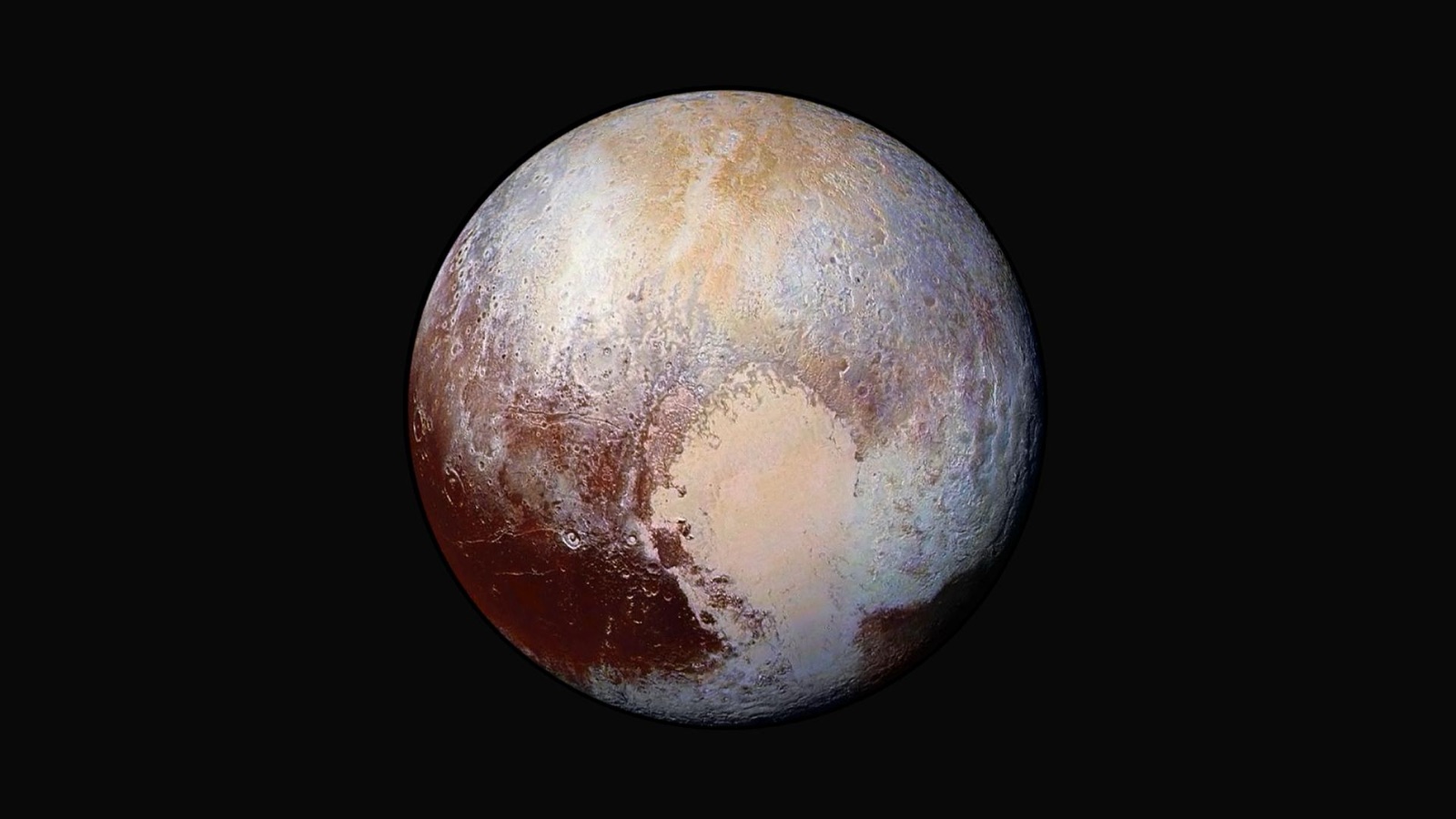
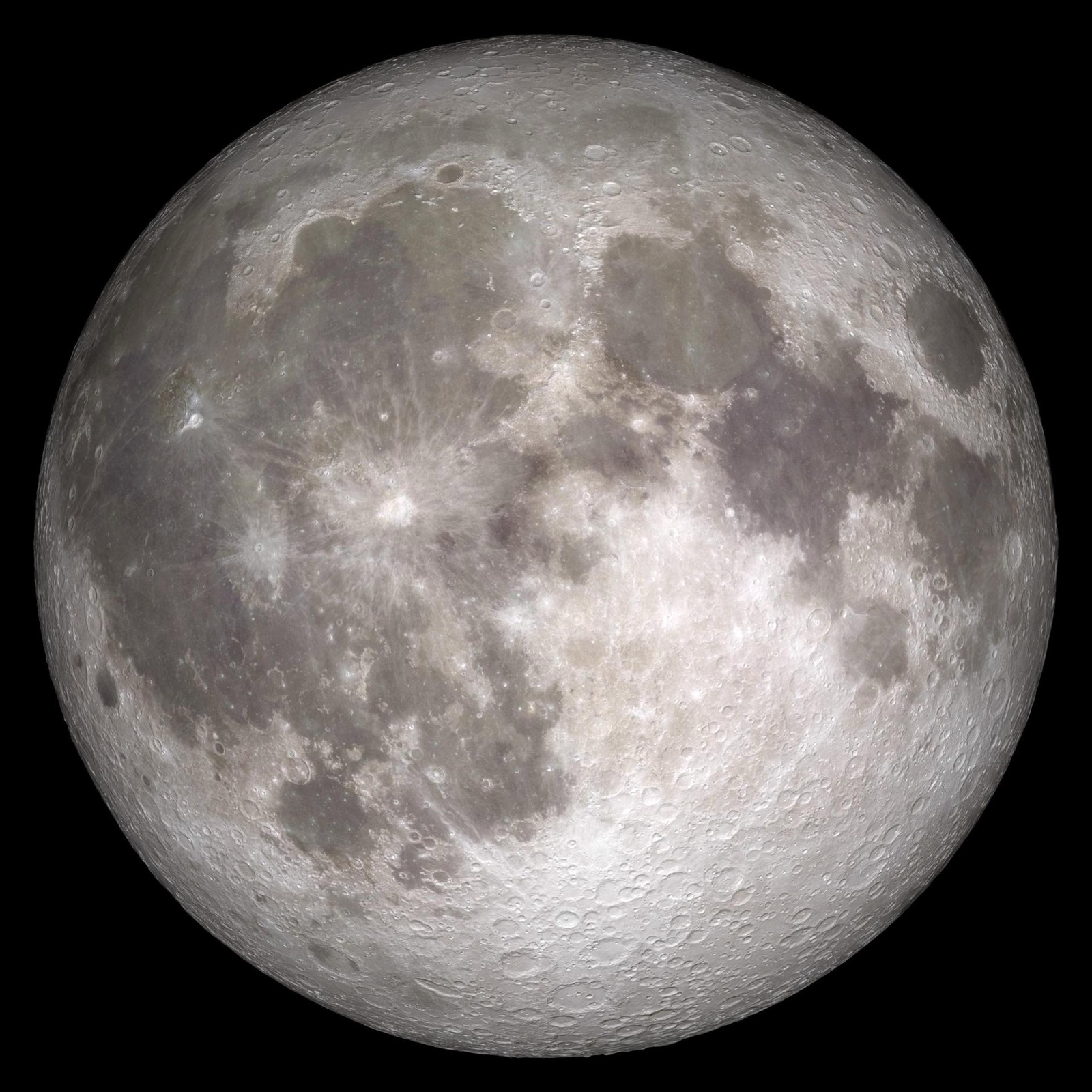
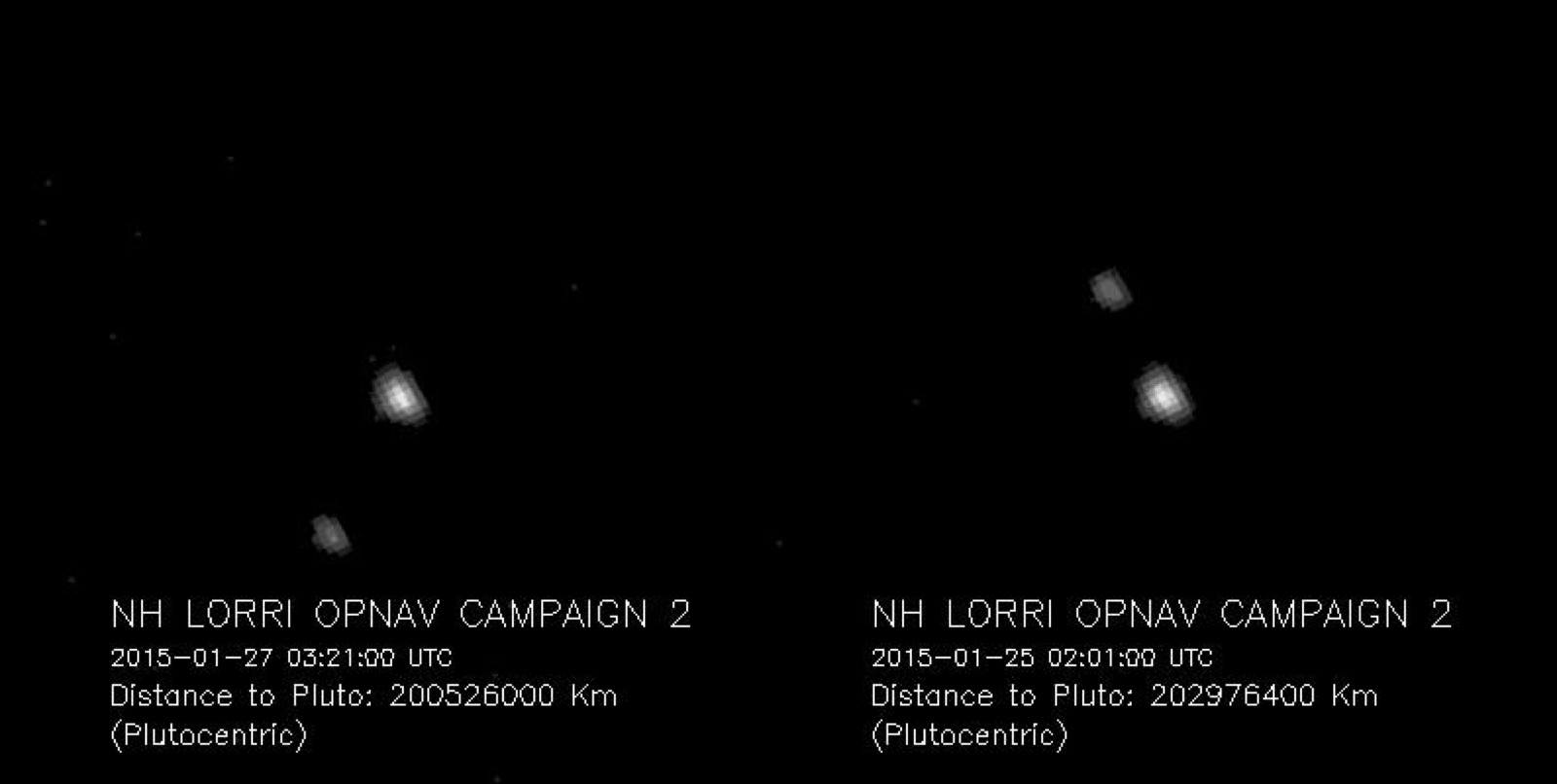
 Photograph · NASA/Johns Hopkins University Applied Physics Laboratory/Southwest Research Institute
Moon · Deep guide · orbits Pluto
Charon
Half the size of Pluto itself, this giant companion makes the pair the Solar System's great double act.
What is it?
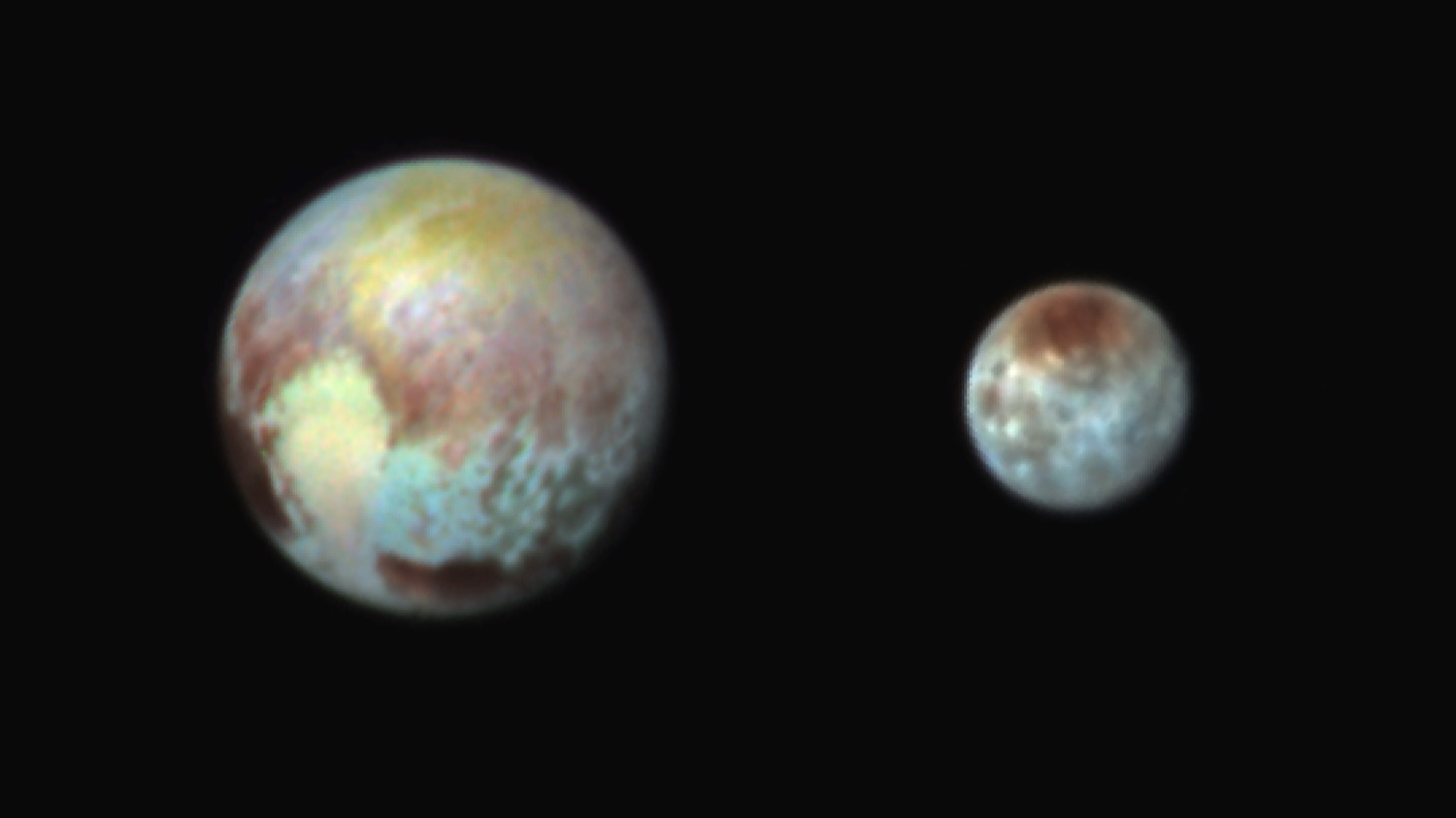
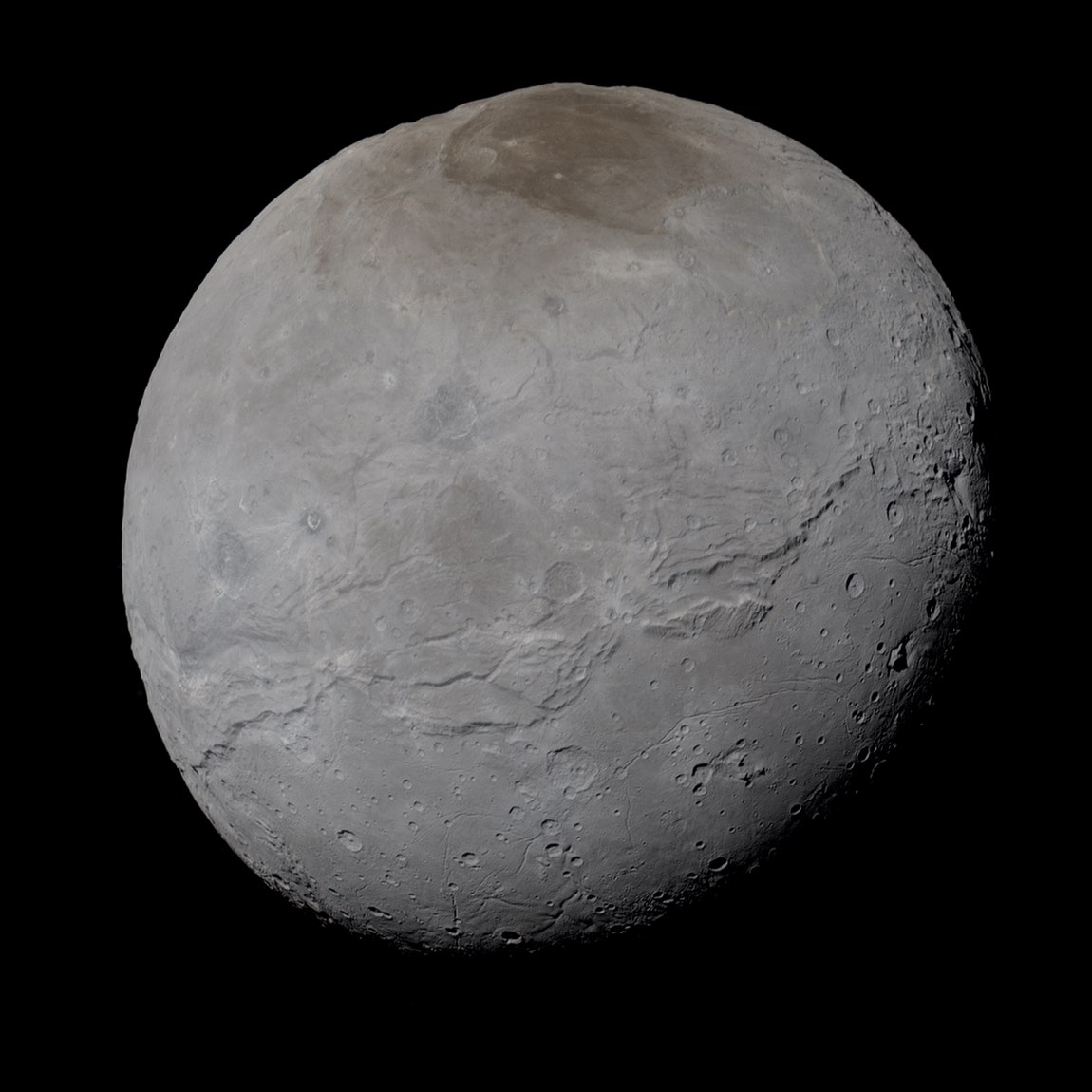
Charon is Pluto's largest moon — and at half Pluto's diameter, it is the largest moon relative to its planet anywhere. The two are so evenly matched that they orbit a point in the space between them, forever showing each other the same face: a true double world. New Horizons revealed Charon as a dramatic gray globe with a rust-red polar cap and a canyon system dwarfing the Grand Canyon.
Go deeper
Charon likely formed from a giant impact on proto-Pluto — a scaled echo of Earth's Moon story. Its Vulcan Planitia is a frozen flood plain: early cryovolcanism resurfaced half the moon as an internal ocean froze and cracked the crust (Serenity Chasma). The red polar cap (Mordor Macula) is seasonal: methane escaping Pluto snows onto Charon's winter pole and is radiation-cooked into red tholins — one world painting another.
01 A double world
Stand on Pluto's Charon-facing side and Charon never moves: it hangs at the same spot in the sky, phase after phase, eight times wider than our full Moon. From the other hemisphere, you would never see it at all. Pluto and Charon are the Solar System's clearest example of a binary — two worlds locked face to face.
02 When Charon's ocean froze Deeper
Charon probably had a subsurface ocean early on. Water expands as it freezes, and Charon wears the receipts: a globe-girdling belt of tension canyons and smooth plains where slushy water-ammonia lavas spread before freezing solid. Charon is a finished ocean world — a preview of what Europa may become when its engine stops.
The deep dive
Researched for the Atlas from Wikipedia — Charon (moon) (20,609 characters read) · updated Sep 20, 2026
03 The accidental discovery on a photo plate
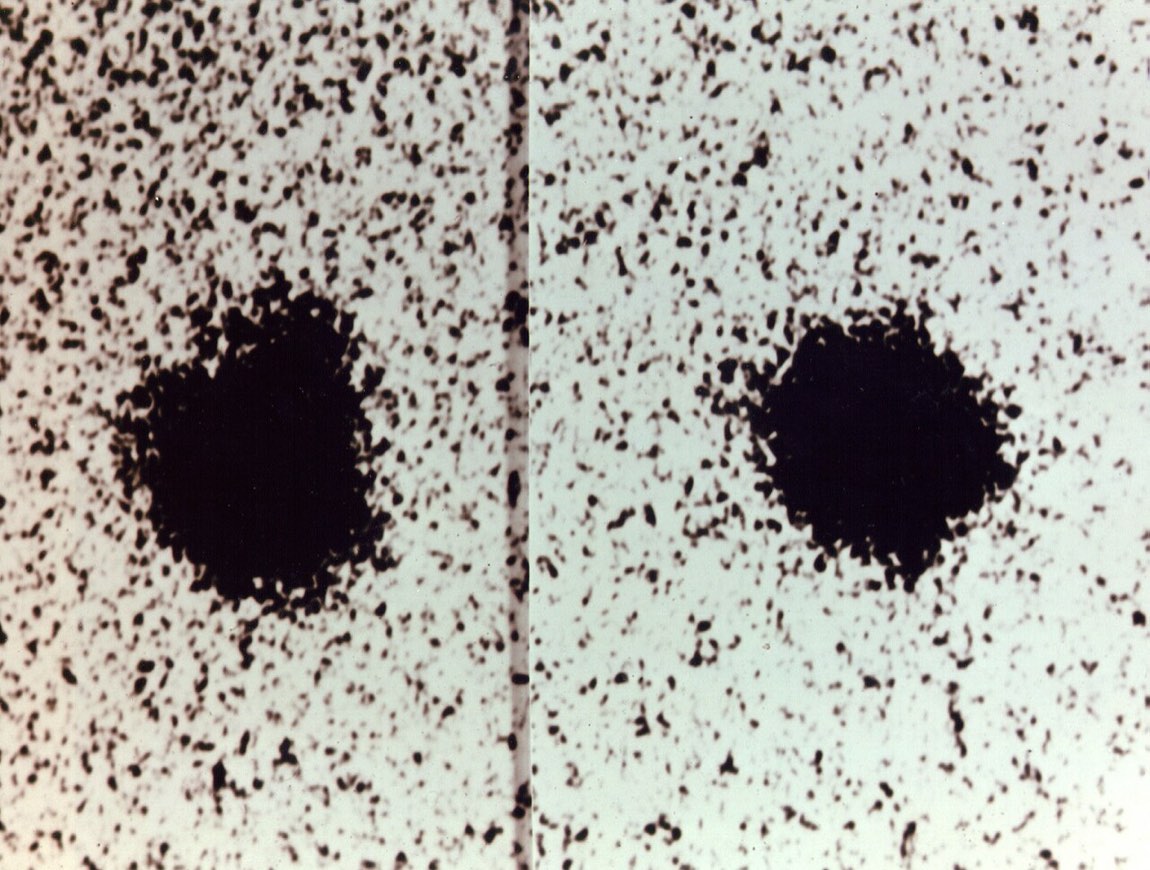
Charon was not found by pointing a telescope at the right place at the right time — it was spotted in an archive. On June 22, 1978, Naval Observatory astronomer James Christy was examining highly magnified images of Pluto on photographic plates taken two months earlier with the observatory's 1.55-meter telescope at Flagstaff, Arizona. He noticed that Pluto's disk appeared slightly elongated, and that the elongation reappeared periodically. Crucially, the period matched Pluto's already-known rotation rate, which implied a synchronous orbit — a strong sign the bulge was a real companion rather than an image artifact. Once Christy looked backward through the archive, the bulge turned out to be visible on plates dating all the way back to April 29, 1965. The International Astronomical Union formally announced the discovery on July 7, 1978. Any lingering doubts were erased between 1985 and 1990, when Charon and Pluto entered a rare five-year run of mutual eclipses and transits that only occurs twice in Pluto's 248-year orbit around the Sun.
 ⤢
⤢
04 A name born from a nickname
The story behind Charon's name is charmingly personal. Christy first suggested the name "Oz," then settled on Charon partly because it sounded scientific but was also a affectionate nod to his wife Charlene, whose nickname was "Char." Colleagues at the Naval Observatory pushed for Persephone instead, but Christy held firm — and was delighted to discover that Charon was independently a perfect mythological fit: in Greek mythology, Charon is the ferryman who carries souls of the dead across the river Styx to the underworld, closely associated with the god Pluto. The IAU officially adopted the name in late 1985, with a public announcement on January 3, 1986. There is a lingering pronunciation debate: the mythological figure takes a hard /k/ sound, and many astronomers follow that convention, but Christy himself always used a /sh/ sound after Charlene's nickname. NASA and the New Horizons team follow Christy's pronunciation. In a remarkable coincidence, science fiction writer Edmond Hamilton had invented three moons of Pluto for his 1940 novel Calling Captain Future and named them Charon, Styx, and Cerberus — nearly four decades before Charon's actual discovery.
05 How the discovery reshaped Pluto's vital statistics Deeper
Before Charon was identified as a separate body, every measurement astronomers made of Pluto actually captured the combined Pluto–Charon system. The calculated mass, brightness, and albedo had all been assigned to Pluto alone, producing a distorted picture of the dwarf planet. Once Charon was recognized, those values had to be redistributed. More powerfully, Charon's orbit gave astronomers their first precise handle on the mass of the entire Plutonian system, because a moon's orbital period and distance directly yield the total gravitational mass of the bodies it circles. The sizes of both worlds were then refined through mutual occultations — events during the 1985–1990 eclipse season when each body periodically passed in front of the other as seen from Earth. Yet even after all that work, the individual masses of Pluto and Charon remained uncertain until 2005, when the discovery of Pluto's smaller outer moons Nix and Hydra allowed researchers to detect subtle gravitational perturbations in those moons' orbits. Those perturbations revealed that Charon holds approximately 12% of Pluto's mass — a mass ratio of 0.1218:1, more than ten times larger than the Moon-to-Earth ratio of 0.0123:1.
06 Two competing stories of how Charon formed Deeper
The leading picture of Charon's origin looks familiar: a giant impact, much like the one thought to have created Earth's Moon, with simulation work published in 2005 by Robin Canup suggesting the collision happened around 4.5 billion years ago. In that model, a large Kuiper Belt object struck Pluto at high velocity, shredding itself and blasting away much of Pluto's outer mantle; Charon then coalesced from the resulting debris disk. A complication is that this scenario should have produced a much icier Charon and a rockier Pluto than scientists actually observe. An alternative picture holds that Pluto and Charon were two separate bodies that collided violently enough to boil off volatiles like methane but not violently enough to destroy either world. They may have briefly merged before tidal forces pulled them apart again while keeping them gravitationally bound. The very similar densities of the two bodies suggest their interiors were not fully differentiated at the time of impact. The internal heat generated by both the collision and subsequent tidal friction as they separated may even have been enough to produce Pluto's subsurface ocean — no radioactive heating required.
 ⤢
⤢
07 Inside Charon: rock, ice, and ancient oceans Deeper
Charon's measured density of 1.702 ± 0.017 g/cm³ points to a composition of roughly 55% rock and 45% ice, compared to Pluto's approximately 70% rock — a smaller rock fraction that is consistent with, but not perfectly explained by, a giant-impact origin. New Horizons flyby data gave strong surface evidence that Charon is differentiated, meaning heavier rock has sunk to form a core while ice dominates the outer layers. Two broad schools of thought have emerged about how that differentiation happened. The "hot start" model posits rapid accretion — within roughly 10,000 years — from a debris disk following a violent impact, trapping enough heat to partially melt Charon's outer layers and create a subsurface ocean that persisted for approximately 2 billion years. A second, radiogenically heated ocean composed of a water-ammonia mixture may have followed. The rival "cold start" model argues that Charon began as a porous, relatively homogeneous body and only developed a subsurface ocean 100 to 200 million years after formation, once radiogenic heating and a process called serpentinization generated enough warmth. Both models try to explain the same dramatic surface scars left by freezing and expansion cycles.
08 Serenity Chasma and a world that cracked apart
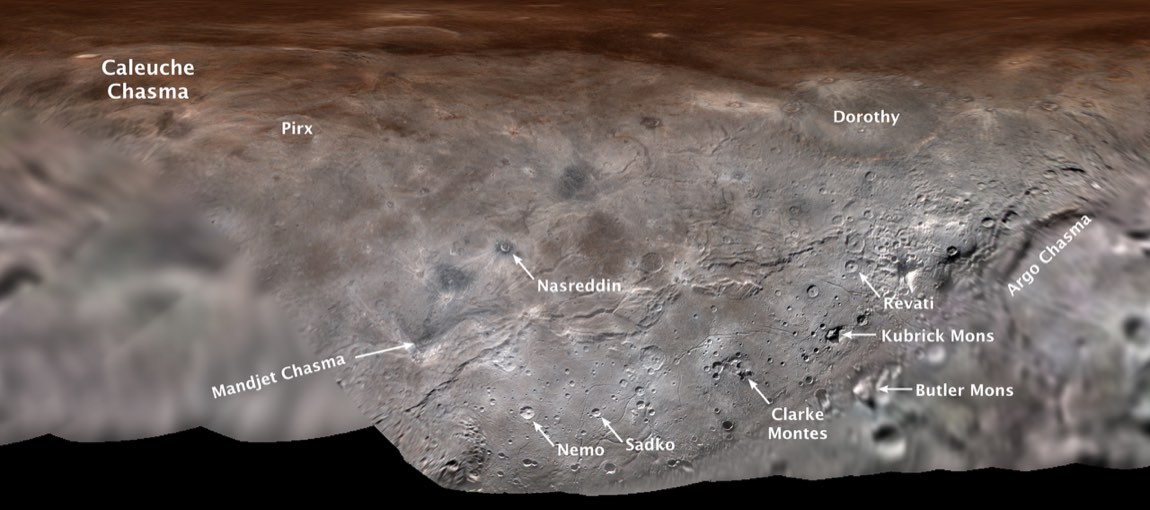
Charon's most visually striking legacy of its violent internal history is a system of enormous grabens — downfaulted valleys — and scarps that stretches across the moon as an equatorial belt for at least 1,000 km (620 mi). The grandest of these is Serenity Chasma, whose formation is linked by both the hot start and cold start models to episodes when Charon's interior expanded as freezing oceans turned to ice and ice takes up more volume than liquid water. A companion feature, Argo Chasma, potentially plunges as deep as 9 km (6 mi). Its cliffs may rival Verona Rupes on Uranus's moon Miranda for the title of the tallest cliff in the Solar System. The southern hemisphere of Charon tells another story: it has noticeably fewer craters than the north and is considerably smoother, suggesting a massive resurfacing event erased the older terrain — possibly triggered by the partial or complete freezing of an internal ocean. Named features also include Kubrick Mons and the arcuate ridges of Neverland Regio, each tied to different stages of Charon's cooling history depending on which internal model you favor.
09 Why Charon's north pole turned red
The most eye-catching thing in New Horizons images of Charon is the reddish-brown stain smeared across its north pole — a region called Neverland Regio, which the New Horizons team informally nicknamed "Mordor" before formal names were assigned. The favored explanation is a slow, planet-to-moon chemistry experiment playing out across the 19,596 km (12,176 mi) that separates Charon from Pluto. Gases including nitrogen, carbon monoxide, and methane escape from Pluto's atmosphere and drift across that gap, then condense onto Charon's pole during the brutal polar winter, when temperatures drop to −258 °C. Once bathed in solar radiation, those ices undergo chemical reactions that produce tholins — complex reddish organic molecules. When Charon's seasons shift and sunlight returns, temperatures at the pole climb to −213 °C, warm enough to send the volatile ices sublimating back into space, but the tholins are left behind. Over millions of years, layer upon layer of residual tholins accumulates, eventually obscuring the icy crust entirely. Alternatively, cryovolcanic eruptions on Charon itself could have released the source gases locally, though the atmospheric transfer explanation is currently favored.
 ⤢
⤢
10 An almost-atmosphere clinging to the surface Deeper
Charon has no significant atmosphere, but the question of whether it hosts even a gossamer-thin exosphere has generated real scientific debate. One proposed source is methane sublimating off Charon's surface during the brief warmer stretches of its extreme seasons, creating fleeting wisps of gas before centuries of dormancy follow. Pluto's own thin atmosphere provides another potential supply: nitrogen ions drift toward Charon across the 19,596 km gap, though most are captured at the gravitational midpoint between the two worlds before reaching Charon's surface. Any gas that does arrive tends to hug the surface rather than form a proper atmosphere, because Charon's relatively low gravity allows molecules to escape quickly. Paradoxically, Charon may actually shield Pluto's atmosphere from the solar wind — the wind strikes Charon first, stripping away whatever gas Charon accumulates. Stellar occultation tests conducted as far back as 1986 have failed to confirm any existing atmosphere. Water vapor and carbon dioxide have been detected on the surface, but their low vapor pressures make them poor candidates for sustaining even a thin atmospheric layer. The question remains genuinely open.
11 The 2007 cryovolcano clue that didn't hold up
In 2007, astronomers using the Gemini Observatory spotted something tantalizing on Charon's surface: patches of ammonia hydrates and crystalline water ice. The significance was in the crystal structure. Solar radiation degrades crystalline water ice into an amorphous, disordered form over roughly thirty thousand years, so finding it still in crystalline form implied it had been deposited recently. Active cryogeysers or cryovolcanoes seemed a natural explanation — something was refreshing the surface with freshly erupted material. It was an exciting result that hinted at a geologically alive Charon. When New Horizons swept through the system in 2015, however, no active cryovolcanoes or geysers were detected. Later research further complicated the picture, with some scientists proposing that ammonia is being slowly replenished not by dramatic eruptions but by passive seepage of underground material to the surface. The Gemini detection remains valid; what it means is still debated. It is a good reminder that remote spectral observations, even from world-class telescopes, can suggest mechanisms that close-up reconnaissance does not confirm.
12 New Horizons: the only visitor, ever
As of today, one spacecraft has ever visited Charon: New Horizons, built and operated by the Johns Hopkins Applied Physics Laboratory. The probe made its closest approach to the Pluto system in July 2015, coming within 27,000 km (17,000 mi) of Charon — close enough to resolve surface features that had been blurs or complete mysteries for decades. Before New Horizons, the best resolved images came from the Hubble Space Telescope, which first captured Pluto and Charon as two distinct disks in the 1990s; the clearest pre-New Horizons image was taken in 1994 by Hubble's Faint Object Camera when the system was 4.4 billion kilometers from Earth. Ground-based observers pushed the limits even further: in 2008, a group of amateur astronomers in Italy successfully resolved Charon using only a 14-inch telescope equipped with adaptive optics. James Christy, Charon's discoverer, was present at the Johns Hopkins Applied Physics Laboratory during New Horizons' closest approach, as were the children of Pluto's discoverer Clyde Tombaugh — a span of nearly four decades of history present in one room.
 ⤢
⤢
13 Is Charon really a moon, or something else?
The question of how to classify Charon is genuinely unsettled at the highest levels of planetary science. Because the center of mass of the Pluto–Charon system — the barycenter — lies outside Pluto's surface entirely, neither body technically orbits the other in the conventional sense; both orbit a point in empty space between them. The IAU currently lists Charon as a satellite of Pluto, but has acknowledged that its classification as a dwarf planet in its own right may be reconsidered. In a 2006 draft proposal that was ultimately not adopted, the IAU briefly contemplated defining a planetary satellite as one whose barycenter lies inside the larger body — under that rule, Charon would have been classified as a planet. Charon has 12.2% of Pluto's mass, making the pair far more equal than any other known planet-moon pairing. The four other moons of Pluto — Nix, Hydra, Kerberos, and Styx — orbit the same barycenter but are not massive enough to achieve a spherical shape, so they remain straightforwardly classified as satellites. Charon occupies a genuinely ambiguous middle ground that current definitions have not fully resolved.
14 Where Charon ranks among Solar System worlds
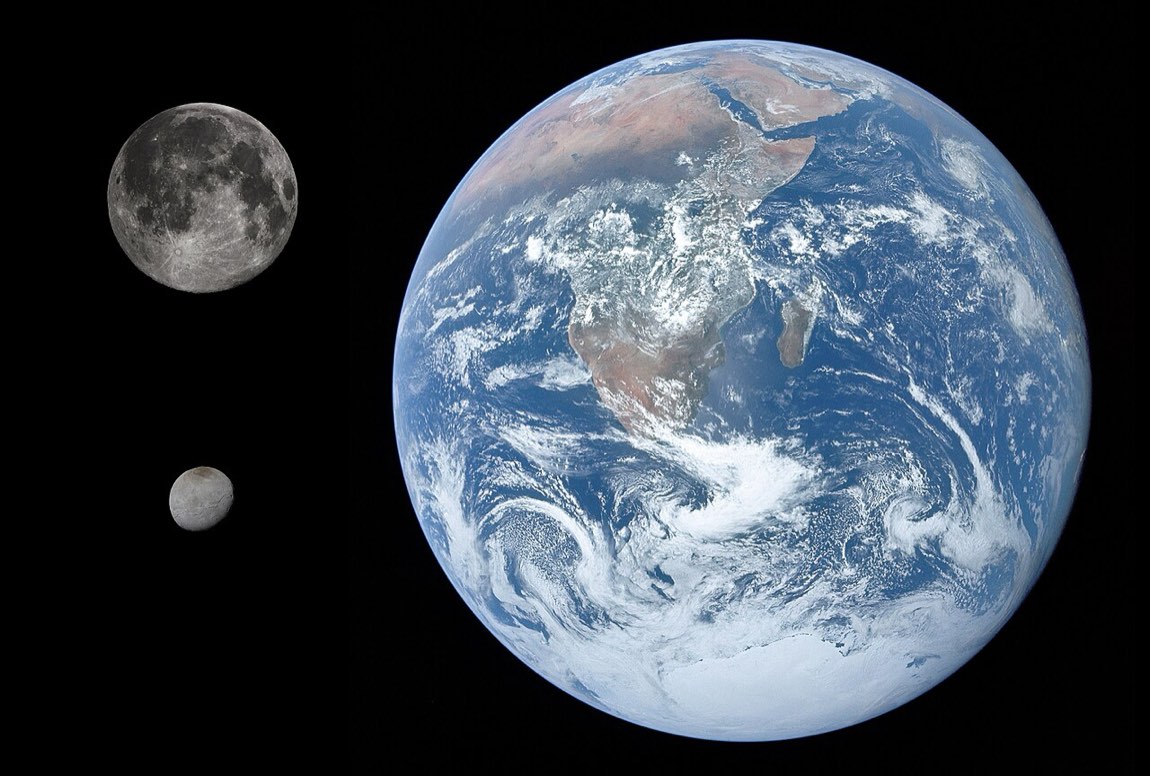
Despite being a moon, Charon is a substantial world by any measure. With a mean radius of 606 km (377 mi) and a diameter of 1,212 km (753 mi), it is larger than the dwarf planet Ceres — the largest object in the asteroid belt — and ranks as the twelfth-largest natural satellite in the entire Solar System. Among trans-Neptunian objects, it is the sixth-largest known, sitting behind only Pluto, Eris, Haumea, Makemake, and Gonggong. In size it is comparable to two of Uranus's moons, Umbriel and Ariel. Charon's shape is another point of interest: its slow rotation means there should be very little flattening at the poles or tidal bulging, and New Horizons detected no measurable deviation from a perfect sphere — consistent with a body in hydrostatic equilibrium. This contrasts with Iapetus, a Saturnian moon of similar size that retains a pronounced oblateness inherited from its faster-spinning youth. Whether Charon's roundness reflects its current equilibrium state or simply means it settled into its present slow orbit early, while still warm enough to relax into a sphere, remains an open question.
 ⤢
⤢
You would weigh…
Surface gravity 0.29 m/s² vs Earth’s 9.81 m/s². Try every world →
Could life exist here?
Its ocean froze billions of years ago; today Charon is inert at −220 °C. Scientifically rich, biologically silent.
Our labels: Confirmed · Strong Evidence · Estimated · Hypothesis · Theoretical · Speculative (see Methodology).
Could humans live here?
Robotic territory only, on the same decades-long roads as Pluto.
How would we get there?
With Pluto: New Horizons took 9.5 years for a flyby. Orbiter concepts exist on paper only.
| Technology | Status | Travel time (one way, straight line) |
|---|---|---|
| Apollo-style spacecraft, about 39,000 km/h | Flown technology | 17 years |
| Ion-propulsion probe, about 90,000 km/h | Flown technology | 7 years |
| Voyager 1, about 61,000 km/h | Flown technology | 11 years |
| Parker Solar Probe, about 690,000 km/h | Flown technology | 358 days |
| Nuclear-thermal rocket, about 120,000 km/h cruise | In development | 6 years |
| Laser light-sail at 20% of light speed | Proposed concept | 27.3 hours |
| Light itself, 299,792 km/s | Physical limit | 5.5 hours |
Simplified straight-line times at cruise speed. Real missions fly curved orbital paths and take longer. Full travel calculator →
Weird & wonderful
- Charon's canyon belt suggests the whole moon once cracked like an over-frozen bottle.
- Pluto slowly paints Charon's pole red with its own escaping atmosphere.
- If you weigh 45 kg on Earth, you'd weigh 1.3 kg on Charon.