 Photograph · NASA/Johns Hopkins University Applied Physics Laboratory/Southwest Research Inst · Public domain
Moon · Deep guide · orbits Pluto
Hydra
Also called: Pluto III · S/2005 P 1
Pluto's outermost moon, with one of the most reflective surfaces in the outer Solar System.
What is it?
Hydra was spotted in Hubble Space Telescope images in May 2005 and announced together with Nix that October. It is roughly 51 km long and astonishingly bright, reflecting most of the light that hits it because its surface is rich in water ice. Hydra orbits Pluto and Charon every 38 days, close to a 6:1 ratio with Charon's orbit, and spins in about 10 hours. New Horizons photographed it during the July 2015 flyby.
The deep dive
Researched for the Atlas from Wikipedia — Hydra (moon) (8,440 characters read) · updated Nov 15, 2026
01 How Hydra Was Found in Hubble's Data
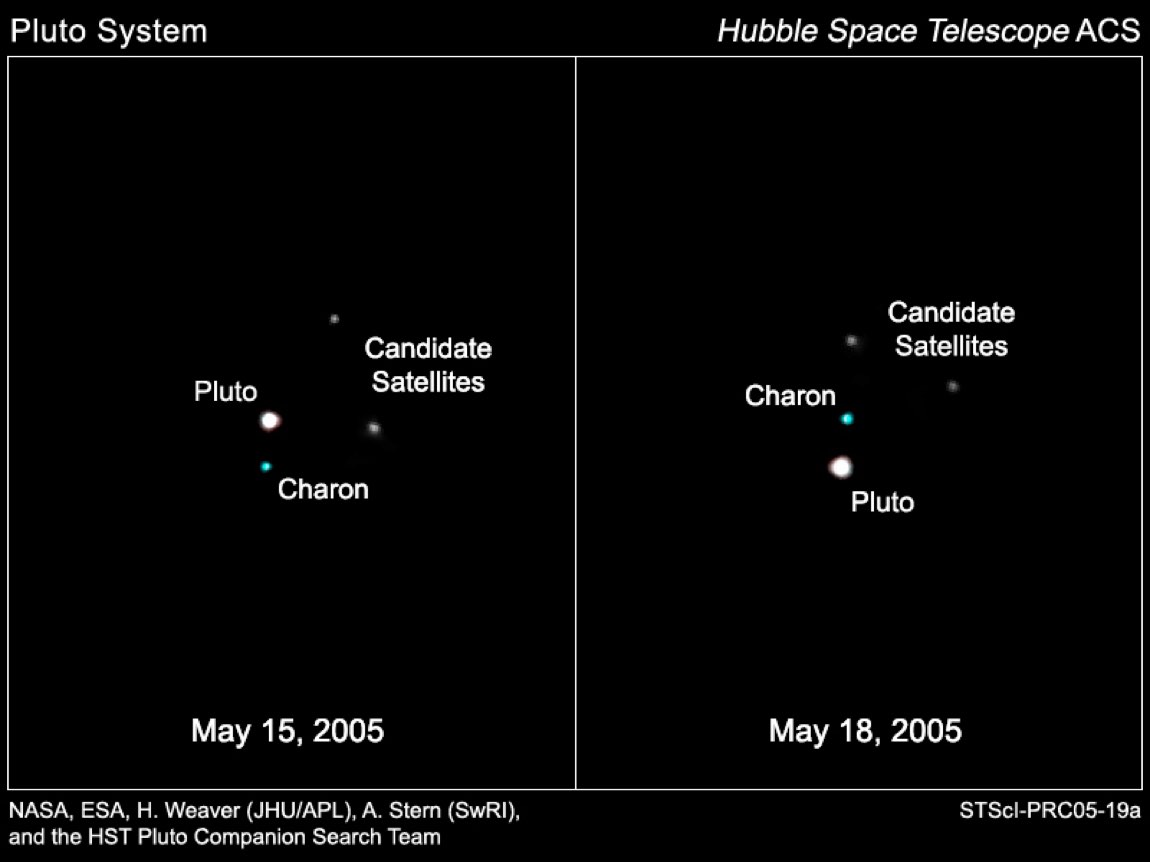
Hydra's discovery was not accidental. Members of the New Horizons mission team suspected that additional small moons might be lurking in the Pluto–Charon system, weakly held by gravity at large distances. They turned the Hubble Space Telescope toward Pluto specifically to test this idea, taking discovery images on 15 May and 18 May 2005. Two astronomers independently confirmed the find: Max J. Mutchler spotted Hydra on 15 June 2005, and Andrew J. Steffl independently identified it on 15 August 2005. The team waited several more months before going public, using the time to search archival Hubble images of Pluto from 2002 to precovery-confirm the new object's orbit. The announcement finally came on 31 October 2005. During this waiting period, Hydra was given the provisional designation S/2005 P 1, though the discovery team simply called it P1. Crucially, the survey also revealed something important by its absence: no significant moons existed anywhere in Pluto's extended gravitational sphere of influence, confirming that Nix and Hydra were surprisingly close in rather than spread across a wider zone.
02 A Name Packed with Hidden Meanings
The International Astronomical Union approved the name Hydra on 21 June 2006, announcing it alongside the naming of Nix in IAU Circular 8723. The name honors the Lernaean Hydra, the multi-headed serpent that battled Heracles in Greek and Roman mythology. But the choice carries a subtle numerical joke: the mythological Hydra has nine heads, quietly referencing Pluto's former status as the ninth planet in the solar system. The pairing of the two new moon names was equally deliberate. The initials N and H, for Nix and Hydra, were chosen to honor the New Horizons spacecraft — the same logic that led early astronomers to name Pluto partly to honor Percival Lowell, whose initials PL begin the planet's name. Looking ahead, any surface features mapped on Hydra must follow a specific naming theme set for the whole Pluto system: features on Hydra are reserved for legendary serpents and dragons drawn from literature, mythology, and history around the world.
03 Built from a Collision and a Merger Deeper
Hydra's origin story involves at least two violent events separated in time. The leading hypothesis holds that Pluto's small moons, including Hydra, grew from debris blasted into orbit during a giant collision between Pluto and another Kuiper Belt object — closely analogous to the giant-impact model for how Earth's Moon formed. The ejected material then coalesced into distinct moons. Hydra itself is thought to have formed not as a single object but from two smaller bodies that later merged into one, which could help explain its irregular, elongated shape. After formation, Hydra's story was not static. It is thought to have originally orbited closer to Pluto, then migrated outward alongside Charon through tidal interactions. As it moved, the gravitational back-and-forth with Charon acted as a damping force, gradually draining eccentricity from Hydra's orbit and rounding it into the nearly circular path seen today. This process of tidal damping left Hydra in its current position as Pluto's outermost moon, orbiting at 64,738 km from the Pluto–Charon barycenter.
04 Chaotic Tumbling Instead of Steady Spin
Unlike most large moons in the solar system, Hydra is not tidally locked — it does not keep one face permanently pointed at Pluto. Instead it tumbles chaotically, with both its rotational period and its axial tilt changing unpredictably over astronomical timescales. The root cause is the gravitational pull of Pluto and Charon, which orbit their shared center of mass rather than a fixed point, so the torque on Hydra constantly shifts. Hydra's own irregular shape makes the problem worse: an uneven body responds to gravity differently depending on its orientation, generating additional torques that feed the chaos. At the moment New Horizons flew past in July 2015, Hydra's rotation period was approximately 10 hours — faster than an Earth day — and its rotational axis was tilted about 110 degrees to its orbit, meaning it was essentially spinning sideways. That 10-hour spin is notably rapid compared to Pluto's other moons, which all have rotation periods longer than one day, and it falls within the range typical of most Kuiper Belt objects. Hydra is not spinning quite fast enough for centrifugal forces to eject surface material, but scientists note it would be at risk if the rotation rate were any higher.
05 An Irregular Shape Measured in Detail Deeper
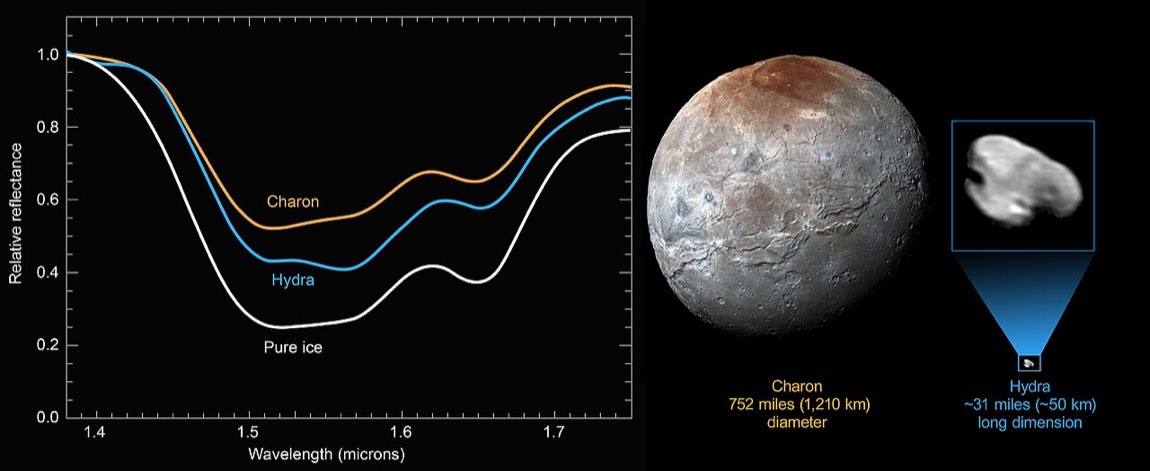
New Horizons gave astronomers their first real look at Hydra's true form, and it is not a sphere. The moon measures 50.9 km along its longest axis, 36.1 km in its middle dimension, and only 30.9 km along its shortest axis — roughly the proportions of a flattened, stretched potato. For comparison, that longest dimension is about the driving distance across the city of Los Angeles. Before the flyby, pre-encounter measurements from New Horizons' Long Range Reconnaissance Imager had estimated Hydra at roughly 45 km in diameter, treating it as a sphere. The highest-resolution flyby images, taken from a distance of 231,000 km with a resolution of 1.2 km per pixel, initially yielded an approximate size estimate of 55 km × 40 km, which was later refined to the three-axis measurement. The surface visible in those images shows large craters and indentations, which scientists interpret as evidence that Hydra has lost some of its original mass through major impact events across its history. Crater counting from the same imagery places the surface age at approximately four billion years, suggesting Hydra's outer shell has remained largely intact since the early solar system.
06 Why Hydra Gleams So Brightly
With a geometric albedo of 83 percent, Hydra reflects an extraordinary fraction of the sunlight that hits it — far more than Earth's Moon, which reflects only about 12 percent. The reason is water ice, which covers Hydra's surface and is notably pure, showing none of the significant darkening seen on Charon. Hydra's reflectivity sits between that of Pluto itself and that of Charon, occupying an intermediate position in the family. Its surface spectrum is neutral overall, similar to Pluto's other small moons, but with a subtly bluer tint that sets it apart even from Nix. Scientists attribute that blue cast to a higher concentration of water ice on Hydra compared to Nix, which may also be what drives its unusually high albedo. One puzzle is why the ice stays so clean over billions of years: micrometeorite impacts are constantly delivering dark carbonaceous material to airless surfaces throughout the outer solar system. A leading explanation is that those same impacts also eject the dark material back off Hydra's surface, continuously refreshing the bright, icy layer underneath and keeping it pristine.
07 Near but Not Quite in Orbital Resonance Deeper
Hydra's orbit sits tantalizingly close to a 1:6 resonance with Charon — meaning Charon completes almost exactly six orbits for every one orbit Hydra makes around the Pluto–Charon barycenter. The word "almost" matters: the actual timing discrepancy from a perfect 1:6 ratio is 0.3 percent, small enough to be striking but large enough to confirm it is not a true resonance lock. Astronomers have proposed an explanation rooted in orbital history. The resonance relationship is thought to have originated before Charon migrated outward following the formation of all five known moons. It has been maintained since then not by a strict gravitational lock but by a periodic fluctuation of about 5 percent in the strength of the Pluto–Charon gravitational field, which gently nudges Hydra's orbit in a regular pattern. This situation places Hydra in a dynamically interesting middle ground: it is shaped by resonance-like forces without being captured into true resonance, leaving it in a state that continues to evolve slowly over time.
08 What New Horizons Actually Saw at Flyby
When New Horizons swept through the Pluto system on 14 July 2015, Hydra was not in the most favorable position: the moon was behind Pluto relative to the spacecraft and sat at a greater distance from New Horizons at closest approach than the other moons did. That geometry directly reduced image resolution compared to what was achieved for Pluto and Charon. The first detailed image of Hydra was received on 15 July 2015, the day after the flyby. Shot from a distance of 640,000 km, it revealed brightness variations across the surface and a dark circular feature approximately 10 km across — roughly the size of a small city. The sharpest images came from a distance of 231,000 km and achieved a resolution of 1.2 km per pixel, fine enough to begin mapping the irregular surface. Even before the flyby proper, the spacecraft's Long Range Reconnaissance Imager had already been at work, measuring Hydra's size from afar and estimating it at about 45 km in diameter. The flyby data as a whole allowed scientists to determine Hydra's surface composition, precise reflectivity, and other basic physical properties for the first time.
09 Open Questions Hydra Still Poses Deeper
Despite the New Horizons flyby, Hydra remains incompletely understood. The chaotic rotation means scientists cannot easily predict the moon's orientation at any given future moment, and the precise mechanism sustaining that chaos over billions of years remains an active area of study. The exact process that keeps Hydra's water ice surface so clean and spectrally blue — and why it differs measurably from Nix despite both moons presumed sharing the same giant-impact origin — has not been definitively resolved. The near-resonance with Charon at a 0.3 percent discrepancy from a perfect 1:6 ratio raises the question of whether that relationship is slowly dissolving, deepening, or simply oscillating. The hypothesis that Hydra formed from the merger of two smaller objects is compelling given its irregular shape, but no direct structural evidence from internal measurements exists to confirm or refute it. Because Hydra was at an unfavorable position during the New Horizons flyby, the full surface was not mapped, leaving unknown terrain on a moon that crater-counting suggests has been geologically quiet for roughly four billion years. A dedicated return mission to the Pluto system would be needed to settle these questions.