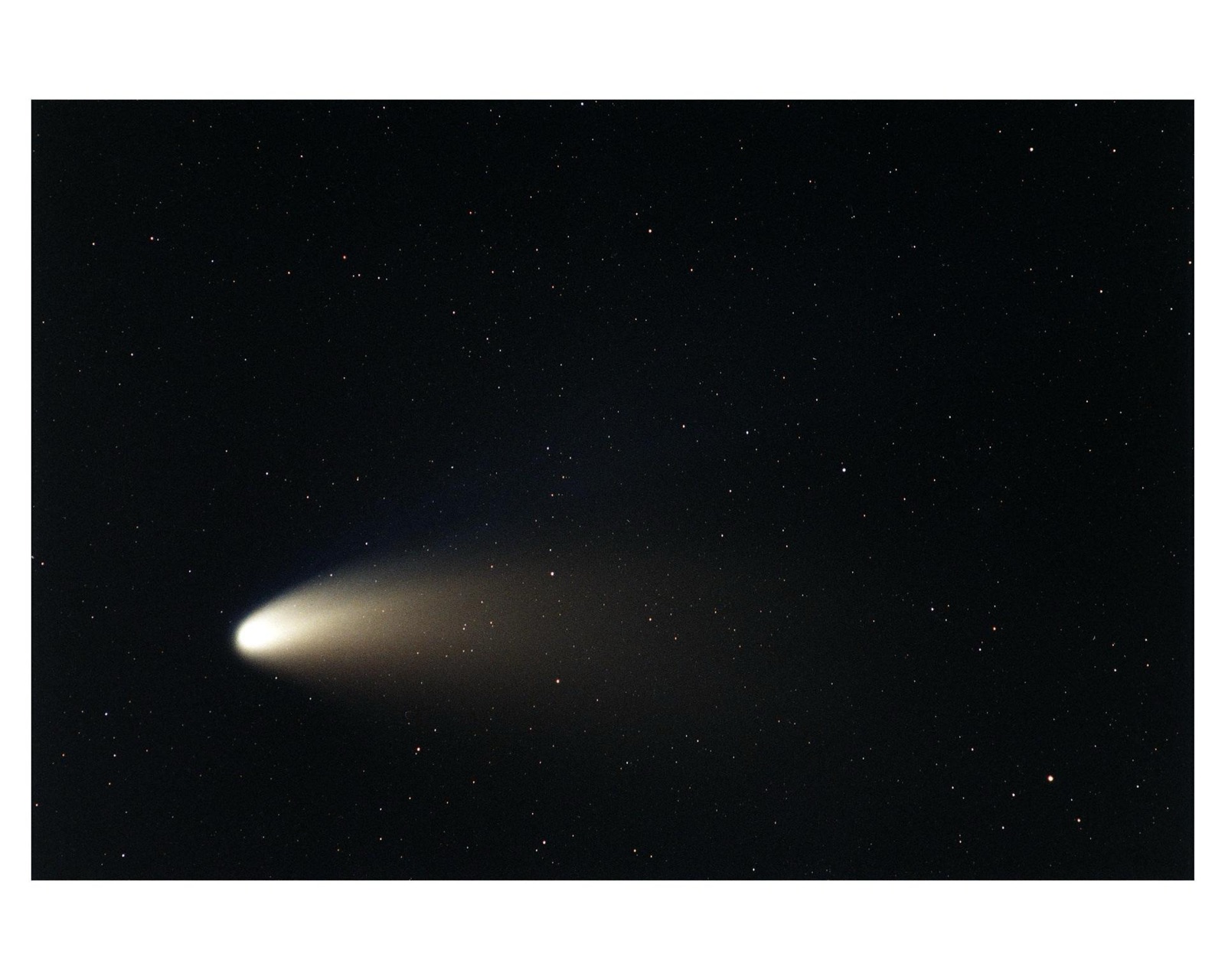
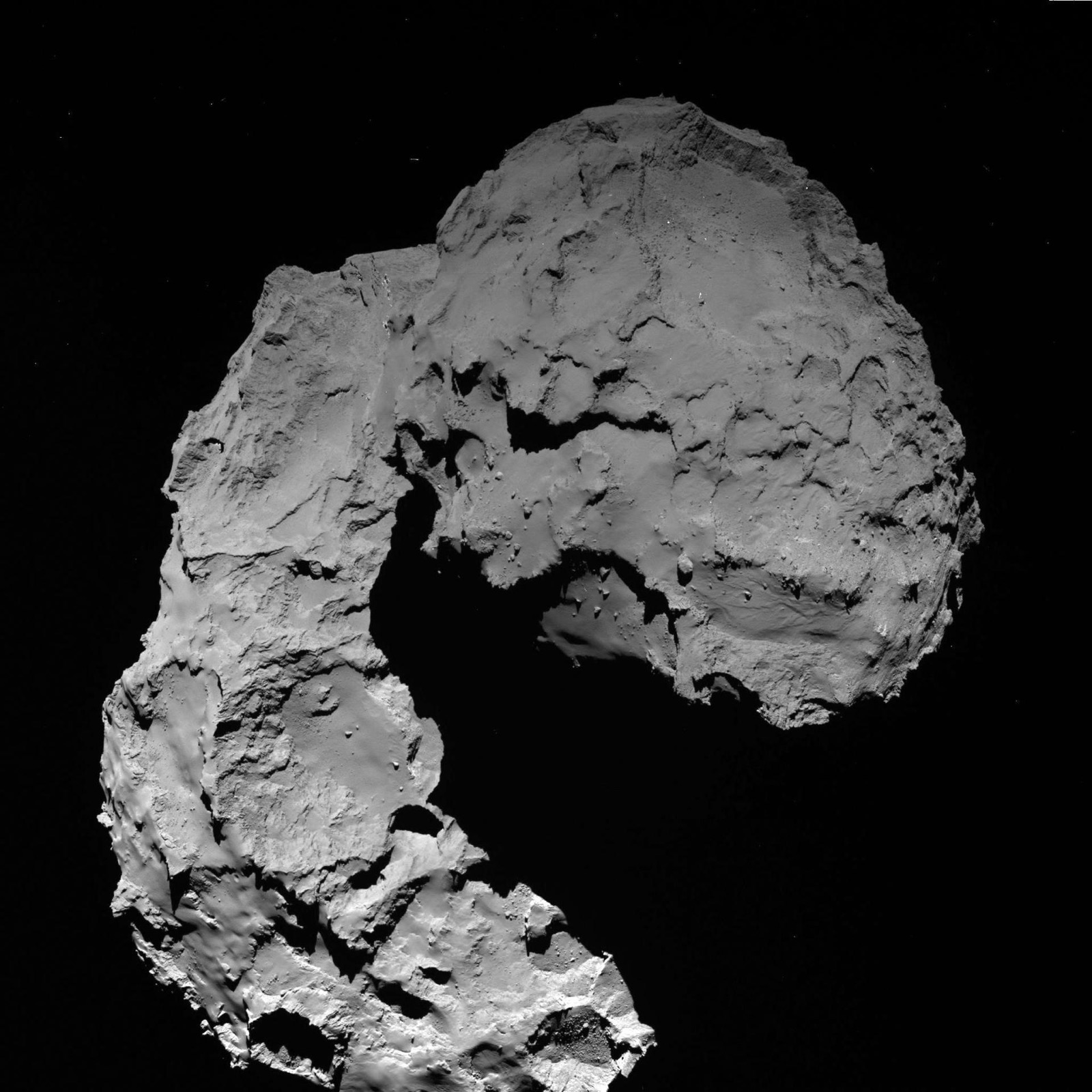
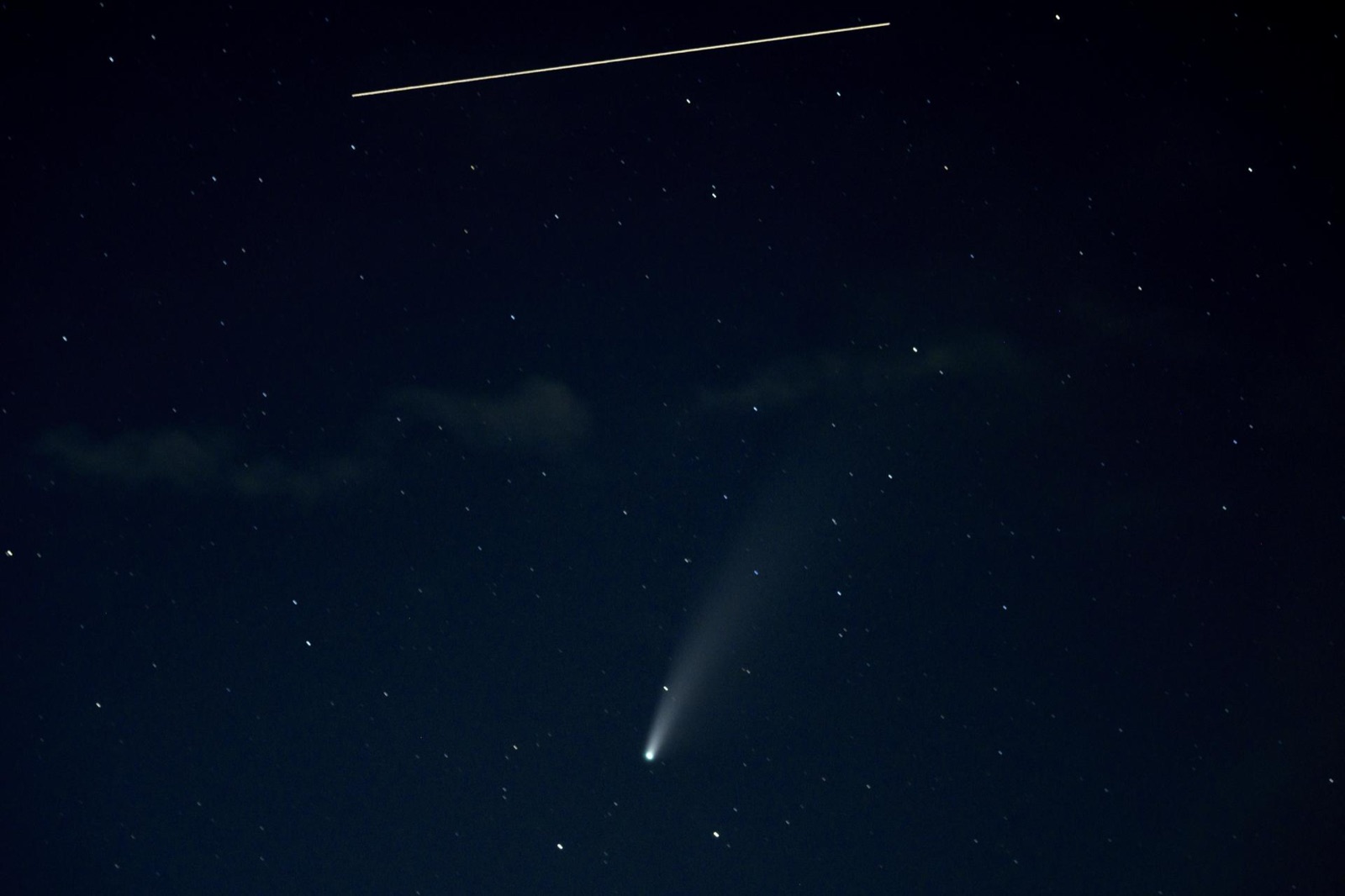
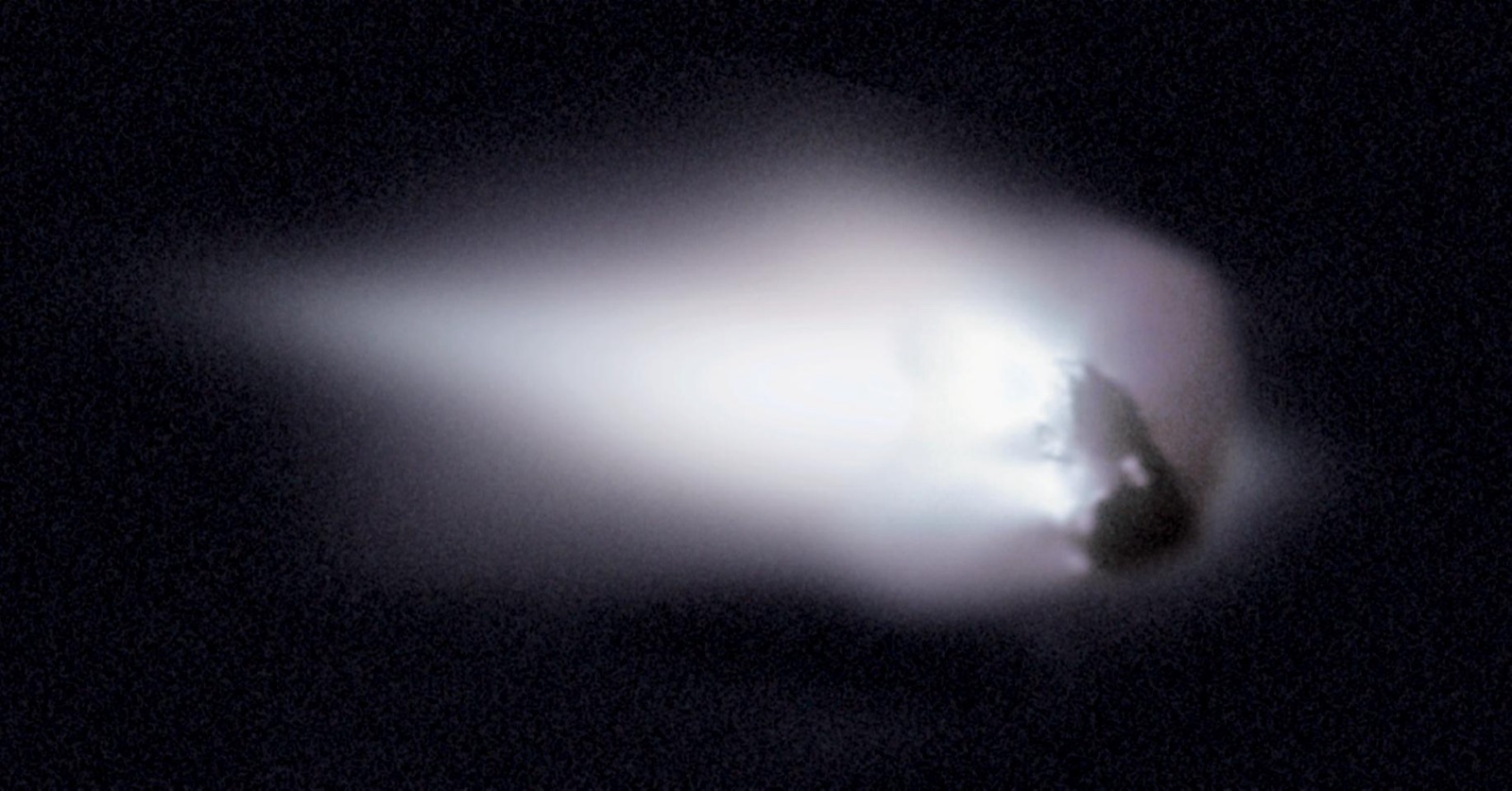
 Photograph · NASA/ESA/Giotto Project
Comet · Deep guide
Halley's Comet
Also called: 1P/Halley
The most famous comet: humanity's 76-year appointment with a piece of the ancient Solar System.
What is it?
Halley's Comet is the only bright comet that reliably returns within a human lifetime, swinging past Earth every 75–79 years. Records of its visits stretch back to at least 240 BC in Chinese chronicles; it stitched itself into history from the Bayeux Tapestry (1066) to the fleet of five spacecraft that met it in 1986. It returns next in mid-2061.
Go deeper
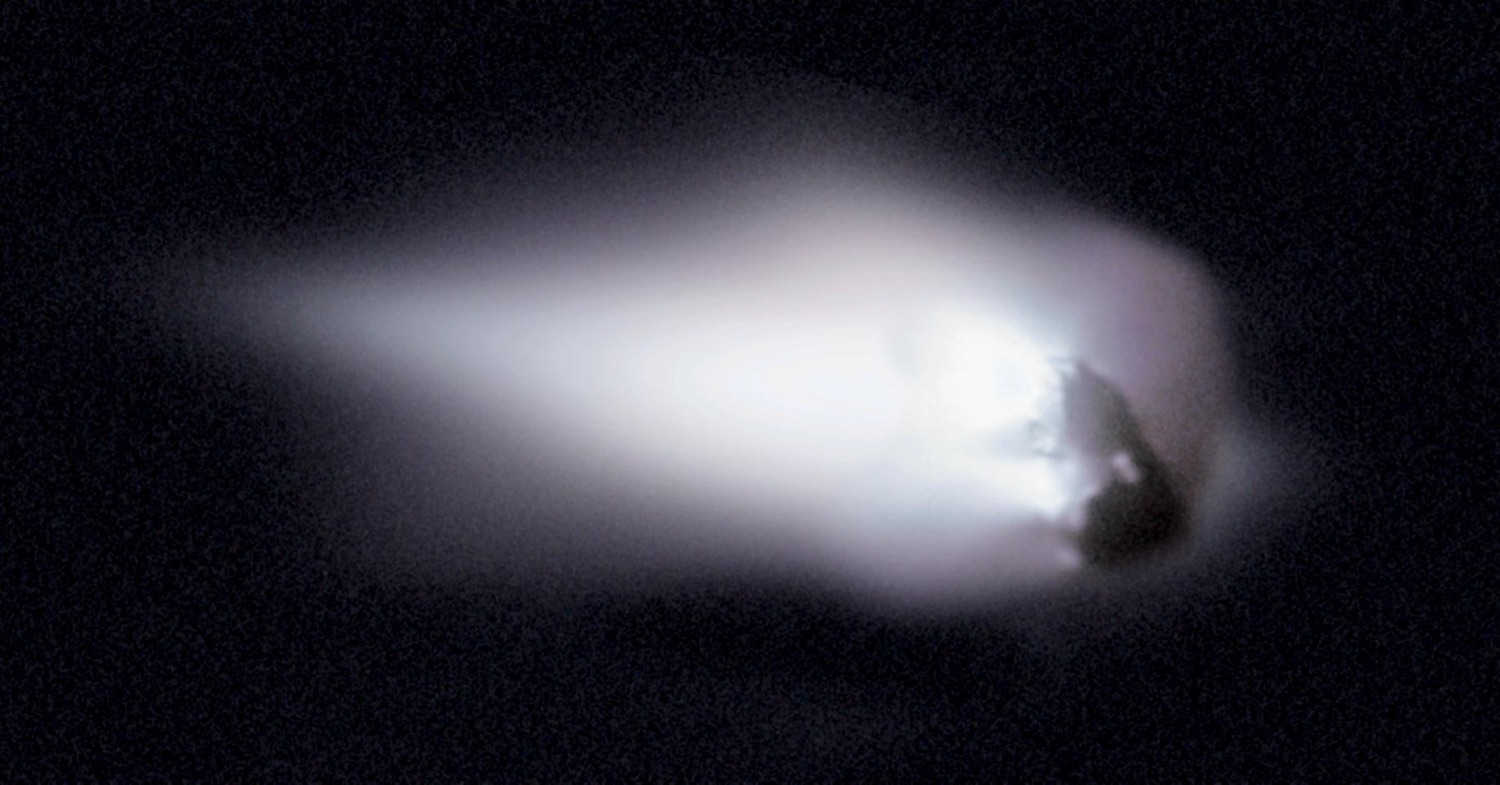
Edmond Halley's 1705 realization that the comets of 1531, 1607 and 1682 shared one orbit — and his correct prediction of a 1758 return he didn't live to see — proved comets are periodic Solar System members obeying Newton, not omens. ESA's Giotto flew within 596 km in 1986, photographing the first comet nucleus: a 15-km peanut of primordial ice and tar-black dust (albedo 4%), venting jets. Halley is the parent of two annual meteor showers, the Eta Aquariids (May) and Orionids (October) — you can watch pieces of it burn up twice a year. Aphelion took it past Neptune's orbit; it began falling back sunward in December 2023.
01 The comet that proved the clockwork sky
Before Halley, comets were terrifying one-off omens. Halley applied his friend Newton's brand-new gravity to old sightings and declared them one object on a stretched orbit — then predicted its return like an eclipse. When it came back on schedule in 1758, the message landed forever: the heavens run on physics, and physics can be used to see the future.
02 What 1986 taught us Deeper
Giotto's flyby (at 68 km/s, through the dust storm, losing its camera to impacts moments after closest approach) revealed comet nuclei as black, irregular, and mostly quiet — activity confined to discrete jets on the sunlit side. It reframed comets as 'dirty snowballs' with crusts, seeded every later comet mission, and returned the first samples of interstellar-inherited dust chemistry.
03 2061
The next apparition will be better placed than 1986's disappointing pass: Halley will brighten to around magnitude −0.3, a match for the brightest stars. A child reading this in 2026 will be telling their own children to look up.
The deep dive
Researched for the Atlas from Wikipedia — Halley's Comet (39,624 characters read) · updated Sep 20, 2026
04 How Edmond Halley cracked the puzzle
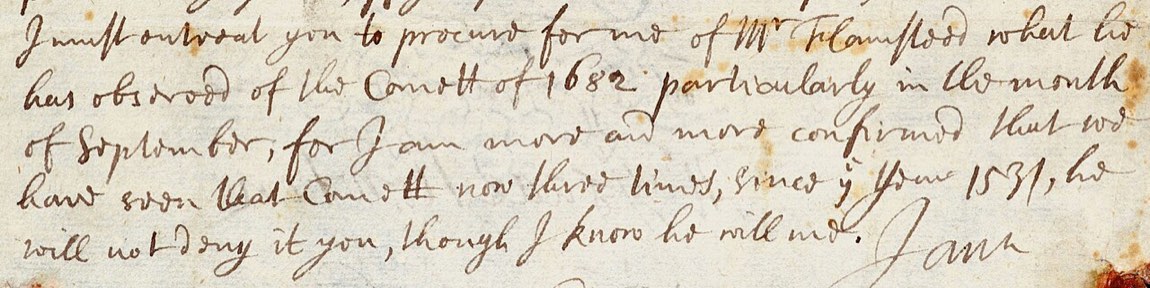
Halley's breakthrough came not from a telescope but from a ledger. In his 1705 Synopsis of the Astronomy of Comets he compiled 24 comet observations and applied Newton's newly published laws of gravity and motion to calculate how Jupiter and Saturn bent cometary paths. When he compared the orbital elements of a comet he had personally watched in September 1682 with those of comets recorded in 1531 — observed by Petrus Apianus — and 1607 — observed by Johannes Kepler — the numbers matched almost exactly. He concluded all three were the same object looping back roughly every 76 years. One nagging problem was that the gap between the 1531 and 1607 returns was more than a year longer than the gap between 1607 and 1682. Newton had guessed that other comets caused such delays; Halley showed it was Jupiter and Saturn doing the work. He predicted a return around 1758, then died in 1742 without seeing his own forecast confirmed. When German farmer and amateur astronomer Johann Georg Palitzsch spotted the comet on Christmas Day 1758, it was the first time any object other than a planet had been shown to orbit the Sun — and one of the earliest successful tests of Newtonian physics.
 ⤢
⤢
05 Forgotten confirmers of the 1759 return
The drama of the comet's 1759 return reached beyond European observatories in ways history often glosses over. The Jamaican astronomer Francis Williams independently confirmed the return, though his observations never reached Europe in time to register in official accounts. A unique portrait he commissioned tells the story instead: his hand rests on page 521 of the third edition of Newton's Principia, the section dealing with procedures for predicting comet sightings, while a white smudge in the sky represents the comet among identifiable constellations. In 2024, X-ray imaging revealed that the painting accurately depicts the star field in which the comet would have been visible in March 1759. Meanwhile, in Massachusetts, John Winthrop lectured at Harvard University specifically to explain what the comet's return meant for Newtonian mechanics and natural theology — evidence that the confirmation resonated across the Atlantic. The comet did not reach perihelion until 13 March 1759, delayed by 618 days due to gravitational tugs from Jupiter and Saturn. Three French mathematicians — Alexis Clairaut, Joseph Lalande, and Nicole-Reine Lepaute — had calculated that delay in advance, missing the correct date by only about one month. Halley's name was formally attached to the comet that same year by French astronomer Nicolas-Louis de Lacaille.
06 A retrograde oddball among short-period comets Deeper
Most short-period comets — those with periods under 200 years — travel in the same direction as the planets and stay close to the ecliptic plane. The average short-period comet has an inclination of only ten degrees and an orbital period of just 6.5 years. Halley breaks both norms dramatically. Its orbit is retrograde, meaning it circles the Sun clockwise when viewed from above the Sun's north pole, opposite to every planet. Its inclination is 18 degrees to the ecliptic, though this is conventionally expressed as 162 degrees to account for the retrograde motion. Its eccentricity of 0.967 carries it from a perihelion of 0.59 au — between the orbits of Mercury and Venus — all the way out to an aphelion of 35 au, roughly the orbital distance of Pluto. This makes Halley the prototype of a distinct category called Halley-type comets: those with periods between 20 and 200 years and inclinations from zero to more than 90 degrees. As of 2024, only 105 such comets have been identified, compared with 816 Jupiter-family comets. The leading hypothesis is that Halley-type comets were once long-period visitors from the Oort Cloud — a spherical reservoir of cometary bodies some 20,000 to 50,000 au from the Sun — whose orbits were gradually bent inward by the giant planets' gravity. A 2008 discovery complicated the picture: the trans-Neptunian object 2008 KV42 follows a retrograde orbit similar to Halley's, ranging from just outside Uranus to twice Pluto's distance, and may represent a new source population for Halley-type comets entirely.
07 The jet-black surface that surprised everyone
Before the 1986 spacecraft flybys, most astronomers expected Halley's nucleus to be a fairly reflective icy body, predicting an albedo of roughly 0.17 — about as bright as bare soil. What Giotto actually found was shocking: an albedo of about 0.04, meaning the surface reflects only 4 percent of the sunlight striking it, roughly equivalent to coal. The nucleus is, in plain terms, one of the darkest objects in the Solar System. The explanation lies in a thick crust of dark, dusty, non-volatile material that blankets most of the surface. Beneath that insulating crust, ices warm until they sublimate and burst outward through active vents, but only about 10 percent of the surface is active at any one time. The Vega 1 spacecraft found surface temperatures ranging from 300 to 400 Kelvin — that is 27 to 127 degrees Celsius — far warmer than icy material exposed to sunlight at Halley's distance should be. The dirty ice that does sublimate does so at temperatures between 170 K in higher-albedo patches and 220 K in darker regions. These findings flipped the classic picture: rather than a dirty snowball, Halley is better described as a snowy dirtball — predominantly non-volatile material with pockets of ice hidden inside.
08 Dust, gas, and the tail's violent disconnections Deeper
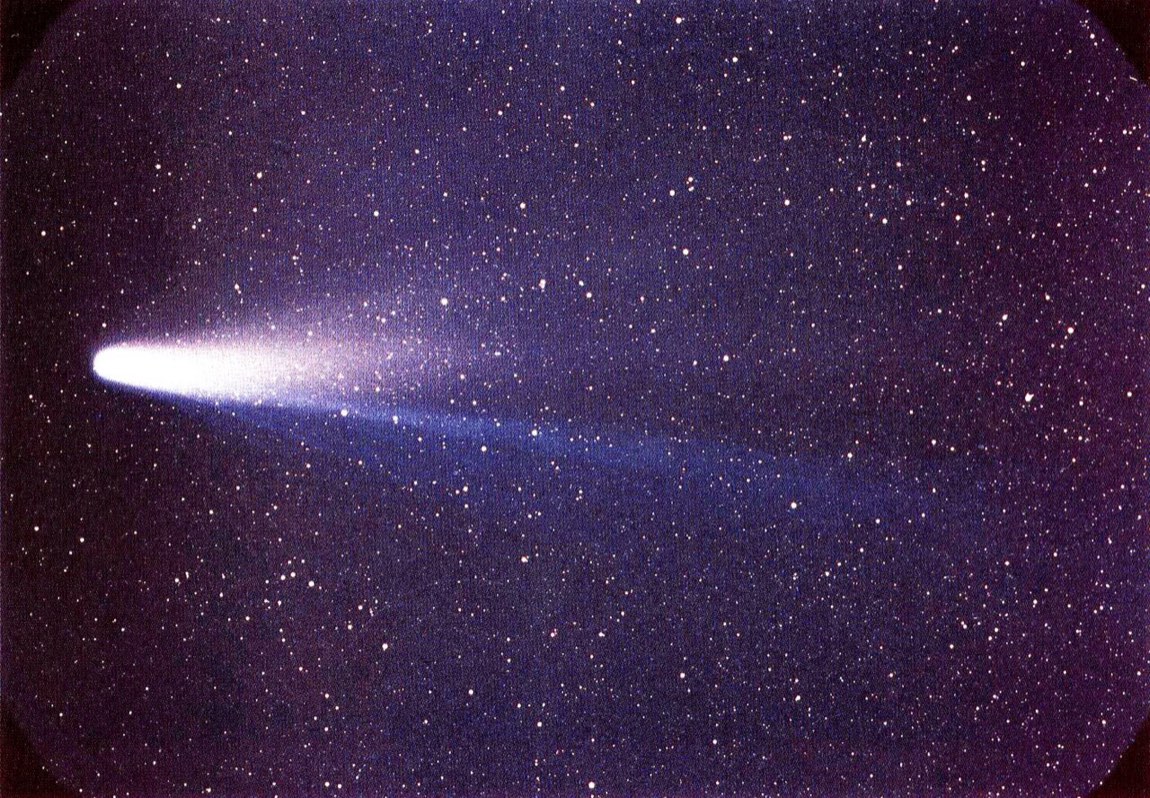
When Halley's spacecraft visitors analysed the gases jetting from the nucleus, water vapour dominated at 80 percent of total output, with carbon monoxide at 17 percent and carbon dioxide at 3 to 4 percent, plus traces of hydrocarbons; more recent sources revise carbon monoxide down to about 10 percent and add traces of methane and ammonia. The dust particles shed alongside those gases turned out to be primarily CHON compounds — mixtures of carbon, hydrogen, oxygen, and nitrogen common in the outer Solar System — combined with silicates similar to those found in terrestrial rocks. Particle sizes ranged all the way down to the detection limit of approximately 0.001 micrometres. These particles and ionised gas stream away from the nucleus to form structures of vastly different scales: the coma swells to distances up to 230,000 kilometres from the nucleus, while the ion tail can stretch more than 100 million kilometres into space — roughly two-thirds of the distance from Earth to the Sun. The solar wind — the stream of charged particles flowing outward from the Sun — is the engine behind the ion tail, and it can be violent. Sudden changes in solar-wind flow can trigger disconnection events, in which the ion tail severs completely from the nucleus and drifts away before a new tail grows. The 1910 passage included a dramatic moment on 19 May when Earth itself passed through the comet's tail, and spectroscopic analysis had detected the toxic gas cyanogen there, briefly sparking public panic.
 ⤢
⤢
09 Inside the nucleus: rubble, craters, and spin Deeper
Halley's nucleus, barely 15 kilometres long, 8 kilometres wide, and roughly 8 kilometres thick, has been likened in shape to a peanut, a potato, or an avocado. A reanalysis of Giotto and Vega images by Lamy and colleagues settled on an effective diameter of 11 kilometres. Its mass is roughly 2.2 × 10 to the 14th power kilograms, and its average density is only about 0.55 grams per cubic centimetre — less than half that of water ice. Such a low density means the interior is not solid but is instead a loosely packed rubble pile: many small fragments held together by gravity and weak cohesive forces rather than forming a continuous solid body. The surface is topographically wild, with hills, mountains, ridges, depressions, and at least one confirmed crater. Rotation adds another layer of complexity: ground-based observations of coma brightness suggested a rotation period of about 7.4 days, while jet and shell observations from the spacecraft pointed to roughly 52 hours. Given the irregular nucleus shape, the rotation is likely non-principal-axis — a tumbling, wobbling motion rather than a clean spin. The day side of the nucleus is far more active than the night side, with vigorous outgassing jets concentrated in the sunlit hemisphere, and those jets gently but measurably push the comet off its gravitational track, causing perihelion delays averaging four days per orbit.
10 The comet's long slow death
Every time Halley swings past the Sun it loses material, and the accounts of that erosion are sobering. David Hughes calculated in 1985, using data from the 1910 apparition, that the nucleus has already lost 80 to 90 percent of its original mass over the last 2,000 to 3,000 orbital revolutions, and that it will most likely vanish entirely after another 2,300 perihelion passages. More recent modelling suggests the timeline may be even shorter: Halley could evaporate completely or split in two within the next few tens of thousands of years, or alternatively be flung out of the Solar System altogether within a few hundred thousand years. Part of what makes long-term forecasting difficult is that Halley's dynamics are chaotic. In 1989, Boris Chirikov and Vitold Vecheslavov analysed 46 apparitions drawn from historical records and computer simulations and showed that the orbit becomes unpredictable on long timescales. The comet's projected dynamical lifetime is estimated at about 10 million years, but numerical integration of its orbit cannot be trusted beyond a few tens of apparitions. Even establishing close approaches before 837 AD requires anchoring the calculations with ancient Chinese observations, because a particularly close Earth approach in that year scrambles the backward integration.
11 837 AD: the closest brush in recorded history
Of all Halley's documented approaches, the one in 837 AD stands apart. The comet may have passed as close as 0.03 astronomical units from Earth — about 4.5 million kilometres, roughly twelve times the distance to the Moon — by far the nearest on record. At that distance its tail may have stretched 60 degrees across the sky, a span equal to six outstretched fists held at arm's length. Astronomers in China, Japan, Germany, the Byzantine Empire, and the Middle East all recorded it. In the Carolingian Empire, Emperor Louis the Pious observed the spectacle and responded with prayer and penance, fearing that the apparition signalled a change in the realm and the death of a prince. The 837 approach matters for modern science as well as history: researchers attempting in 1981 to calculate Halley's past orbits by numerical integration found they could not produce reliable results for any period earlier than 837, precisely because the close Earth encounter scrambled their backward calculations. They were forced to incorporate ancient Chinese comet observations to constrain the model, illustrating how the historical record and modern celestial mechanics remain intertwined for this comet.
12 When art and astronomy collided in 1301
The 1301 apparition was visually spectacular enough that Florentine chronicler Giovanni Villani wrote that the comet left great trails of fumes behind and remained visible from September 1301 until January 1302. Among those who saw it was the artist Giotto di Bondone, who appears to have been so struck by the sight that he painted the Star of Bethlehem as a fire-coloured comet in the Nativity section of his Arena Chapel cycle, completed in 1305. Art historian Roberta Olson observed that Giotto's depiction — which includes details of the coma, a sweeping tail, and the central condensation — was far more accurate than other contemporary descriptions and was not equalled in painting until the nineteenth century. That identification of Halley's Comet in Giotto's Adoration of the Magi directly inspired the European Space Agency's decision to name their 1986 spacecraft mission Giotto, after the artist. The connection between a medieval painter's careful observation and a space-age engineering project spanning nearly seven centuries captures something essential about this comet: it has always provoked people to look more carefully at the sky than they otherwise would.
 ⤢
⤢
13 A 1991 outburst far beyond the planets Deeper
Comets are not expected to be active far from the Sun's warmth, yet on 12 February 1991, when Halley was 14.3 au from the Sun — roughly as far out as Saturn — it erupted in a dramatic outburst that persisted for several months. The comet released dust with a total mass of about 100 million kilograms, which spread into an elongated cloud approximately 374,000 kilometres by 269,000 kilometres — a cloud larger than Earth itself. The brightening, which likely began in December 1990, carried the comet from about magnitude 25 to magnitude 19, a change of six magnitudes corresponding to a factor of roughly 250 in apparent brightness. Such outbursts are rare at distances beyond 5 au. Several mechanisms have been proposed, including interactions with the solar wind and a collision with an undiscovered asteroid, but the most favoured explanation combines two internal processes: the polymerisation of hydrogen cyanide and a phase transition of amorphous water ice. Together these could have raised the nucleus temperature enough for more volatile compounds on the surface to begin sublimating suddenly. The event demonstrated that even a dormant, distant Halley is not entirely inert, and that chemistry continuing deep within the nucleus can still produce dramatic surface activity.
14 Observing Halley across 2,000 years of records
Because of its intrinsic brightness, about one eighth of all comet sightings mentioned in historical records belong to Halley — a remarkable fraction given how many comets have appeared over the millennia. The earliest certain entry is from 240 BC, in the Chinese chronicle Records of the Grand Historian, which describes a comet appearing in the east and moving north. The 164 BC apparition survives only on two fragmentary Babylonian tablets rediscovered in August 1984 in the British Museum collection. By 87 BC Babylonian observers noted the comet appeared day beyond day for a month. The range of cultures that independently recorded later apparitions is striking: Chinese, Japanese, Byzantine, Arab, Irish, Armenian, Korean, Vietnamese, and Mesoamerican sources all contributed. The 1066 appearance was described in the Bayeux Tapestry, the Anglo-Saxon Chronicle, Irish annals, and Armenian chronicles simultaneously. The 1456 apparition reached Sanskrit poetry in Kashmir, a copper-plate temple inscription in southern India, and prompted the Ethiopian Emperor Zara Yaqob to found the city of Debre Berhan — City of Light — as his new capital. The comet was most recently photographed in 2003 by three of the Very Large Telescopes at Paranal, Chile, when Halley glowed at magnitude 28.2, the faintest and most distant any comet had ever been imaged.
15 The 2134 apparition: better than 2061
Most discussions of Halley's future focus on 2061, but the following return in 2134 may actually be the more impressive show. Halley is predicted to reach perihelion on 27 March 2134, and just six weeks later, on 7 May 2134, it will pass within 0.092 au — about 13.8 million kilometres — of Earth. At that distance it is expected to reach an apparent magnitude of −2.0, which would make it significantly brighter than Jupiter at its best and comparable to the brightest appearances in historical records. By contrast, the 2061 apparition is forecast at magnitude −0.3. The difference matters because magnitude is a logarithmic scale: a difference of 1.7 magnitudes corresponds to Halley appearing roughly five times brighter in 2134 than in 2061. Whether future observers will actually see magnitude −2.0 depends on uncertainties that compound over a century of non-gravitational forces, but the geometry alone — a close Earth approach just weeks after perihelion — sets 2134 up as a potentially once-in-several-generations event for whoever is watching from Earth or, perhaps, from somewhere closer.
16 Two meteor showers Halley left behind
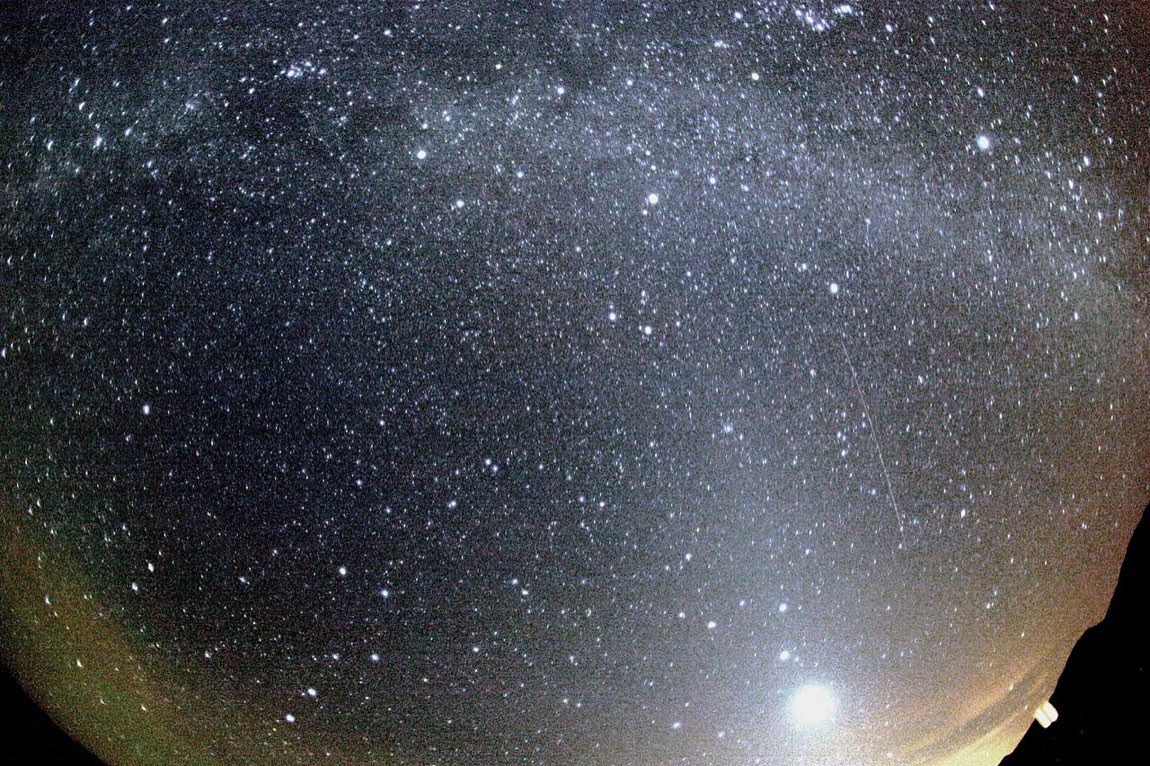
Halley's passage through the inner Solar System leaves more than memories: it deposits a trail of debris along its orbital path that Earth intersects twice every year, producing two reliable annual meteor showers. The Eta Aquariids arrive in early May, when Earth crosses the part of Halley's orbit that the comet traverses heading inward toward the Sun. The Orionids follow in late October, when Earth crosses the outbound portion of the orbit on the other side. In both cases, the meteors are not fresh material from a recent Halley pass but dust and small particles shed over many previous orbits, spread across a broad band of space. The 1910 passage illustrated just how much material the comet sheds: on 19 May of that year, Earth actually passed through the comet's tail itself. That event is also a reminder of how close Halley's orbital path comes to Earth's in two different places — a geometry made possible by the comet's steeply inclined, highly elongated, retrograde orbit cutting across the plane of the Solar System at the right angles to intersect Earth's nearly circular path at two distinct points each year.
 ⤢
⤢
Could life exist here?
Comets are ingredient trucks, not habitats — they likely helped deliver water and organics to early Earth.
Our labels: Confirmed · Strong Evidence · Estimated · Hypothesis · Theoretical · Speculative (see Methodology).
How would we get there?
The 1986 armada intercepted it at 68 km/s — you don't chase Halley, you time an ambush. ESA studied (and shelved) a 2061 rendezvous concept.
| Technology | Status | Travel time (one way, straight line) |
|---|---|---|
| Apollo-style spacecraft, about 39,000 km/h | Flown technology | 15 years |
| Ion-propulsion probe, about 90,000 km/h | Flown technology | 7 years |
| Voyager 1, about 61,000 km/h | Flown technology | 10 years |
| Parker Solar Probe, about 690,000 km/h | Flown technology | 315 days |
| Nuclear-thermal rocket, about 120,000 km/h cruise | In development | 5 years |
| Laser light-sail at 20% of light speed | Proposed concept | 24.1 hours |
| Light itself, 299,792 km/s | Physical limit | 4.8 hours |
Simplified straight-line times at cruise speed. Real missions fly curved orbital paths and take longer. Full travel calculator →
Weird & wonderful
- Mark Twain was born at Halley's 1835 visit and predicted he'd 'go out with it' — he died one day after 1910 perihelion.
- In 1910 Earth passed through Halley's tail and con men sold 'comet pills' against the (harmless) cyanogen gas.
- You can see bits of Halley burn up every May and October — no telescope needed.
- Its nucleus reflects less light than fresh asphalt.