Moon · Deep guide · orbits Pluto
Styx
Also called: Pluto V · S/2012 (134340) 1 · P5
Pluto's smallest known moon, a sliver of ice only about 16 km long.
What is it?
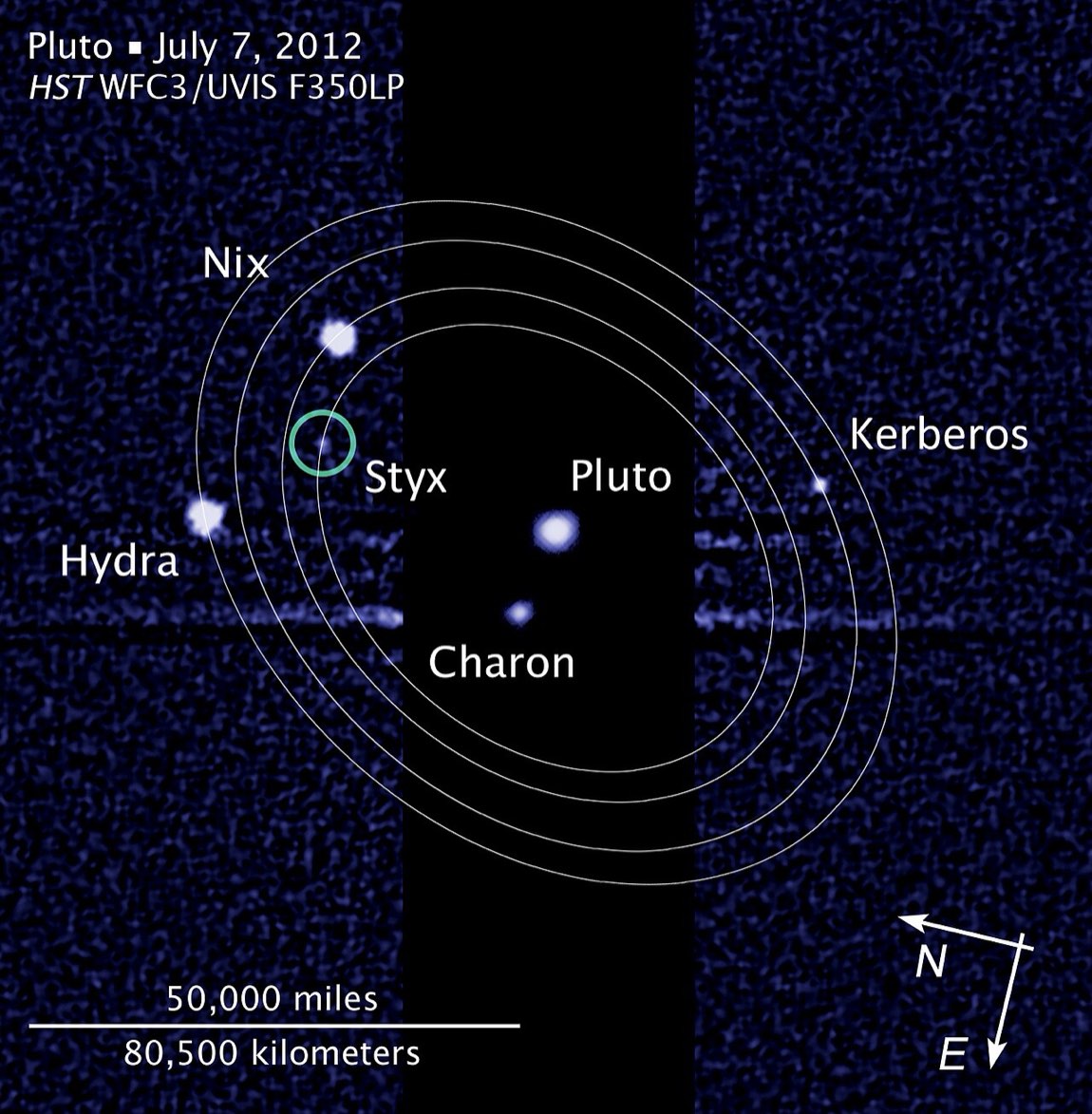
Styx was discovered in 2012 by a team led by Mark Showalter using Hubble's Wide Field Camera 3. It is an elongated chunk about 16 × 9 × 8 km that circles Pluto and Charon every 20 days. Its surface is bright, suggesting water ice, and it tumbles chaotically rather than keeping one face to Pluto. New Horizons captured only a single image of it in 2015. It is named after the river goddess of the underworld.
The deep dive
Researched for the Atlas from Wikipedia — Styx (moon) (6,037 characters read) · updated Nov 15, 2026
01 The team and tools that found Styx
Styx was found by astronomer Mark R. Showalter and his team using the Wide Field Camera 3 aboard the Hubble Space Telescope. The discovery relied on fourteen separate sets of images captured over a two-week window, from 26 June to 9 July 2012, with the announcement following just days later on 11 July. The challenge was extraordinary: Styx is roughly one hundred thousandth as bright as Pluto itself, and about half as bright as Kerberos, which had previously held the record as the dimmest known object in the Plutonian system. That extreme faintness meant Styx would have been invisible to any less capable instrument. The survey was deliberately timed to support planning for the New Horizons flyby, as scientists needed to map hazards the spacecraft might face. Instead of reassurance, the discovery of yet another tiny moon deepened concerns that still-smaller, undetectable bodies or tenuous rings might lurk along the flight path.
02 A hazard hiding in plain darkness
The discovery of Styx immediately raised alarm among mission planners for New Horizons, which was already en route to Pluto. The spacecraft would traverse the Pluto system at a speed of over 13 km/s — fast enough that even a centimeter-sized fragment could prove catastrophic. The concern was not Styx itself but what it implied: tiny moons like Saturn's Pallene are known to be associated with tenuous rings or arcs, because their weak gravity cannot hold onto debris ejected by meteoroid strikes. That loose, diffuse material represents the chief navigational hazard in such a system. Mission scientists considered routing New Horizons along a safer but less scientifically productive path. In the end, the spacecraft flew the original trajectory and passed through the Pluto system without encountering any additional moons or rings, but the months of uncertainty before that safe transit highlighted just how little was known about this distant corner of the solar system.
03 An irregular, potato-shaped little world
Before New Horizons arrived, scientists could only estimate Styx's size by combining its apparent brightness with assumed albedo values — ranging from 0.35 on the bright end to 0.04 on the dark end — yielding a wide diameter range of 10 to 25 km. The flyby in July 2015 replaced those estimates with real measurements, though only a single image of Styx was obtained, making it the least well-characterized of Pluto's moons from that encounter. What that image revealed is an elongated, irregular body with dimensions of approximately 16 km × 9 km × 8 km. Imagine something roughly the size of a small city stretching across its longest axis — Manhattan is about 21 km end to end for comparison. Styx is decidedly not a sphere; its elongated form reflects the chaotic, fragmentary process by which it likely assembled from collision debris rather than growing smoothly under its own gravity.
04 Water ice born from a violent collision Deeper
The prevailing explanation for Styx's existence points to a giant impact early in Pluto's history, when another sizable Kuiper Belt object struck Pluto and blasted enormous quantities of debris into orbit. This scenario closely mirrors the leading theory for how Earth's Moon formed. The debris cloud would have coalesced over time into the five moons we know today, with Charon being by far the largest product of that event. For Styx specifically, scientists think the violent conditions of its formation caused losses of volatile ices — particularly nitrogen and methane, the kinds found on Pluto's surface — because those materials would have escaped into space during the energetic post-impact phase. What remained, and what Styx is therefore thought to be composed of primarily, is water ice: a denser, less volatile material that could survive the heat and turbulence of formation. This expectation aligns with the composition inferred for Pluto's other small moons.
05 Nested orbits like Russian dolls
Styx orbits not Pluto alone but the shared center of mass — the barycenter — of Pluto and its giant moon Charon, at a distance of 42,656 km. That places it between the orbits of Charon and Nix, the next moon outward. What makes the entire system striking is the orderliness of the orbital arrangement. All five of Pluto's moons travel in orbits that are very nearly circular and coplanar, meaning they all lie in essentially the same flat plane. Mark Showalter, Styx's discoverer, described them as "neatly nested ... a bit like Russian dolls." Styx's orbital period is 20.16155 days, and together with Nix, Kerberos, and Hydra it participates in an unusual 1:3:4:5:6 sequence of near mean-motion resonances relative to Charon's orbital period. These resonances are thought to have acted as gravitational "ruts" that guided debris from the original impact into stable orbits.
06 Why Styx tumbles instead of facing Pluto Deeper
While Styx's orbit is tidy and nearly circular, its rotation is anything but. Unlike Charon, which is tidally locked and always shows the same face to Pluto, Styx is not tidally locked at all. Its rotation is described as chaotic, meaning it varies unpredictably over short timescales. At the time of the New Horizons flyby, Styx's rotation rate was approximately 3.239 days per turn, but that figure is not stable — it changes in ways that cannot be predicted far into the future. This chaotic spin is a property shared by Pluto's other small moons and arises from the complex gravitational tugging of both Pluto and the massive Charon acting simultaneously on an irregularly shaped body. Because Styx is elongated rather than spherical, the gravitational torques acting on it are uneven and constantly shifting, preventing it from ever settling into a simple, predictable rotation. The result is a moon that likely tumbles erratically as seen from Pluto's surface.
07 The internet vote that named a moon
The names of Pluto's small moons were not chosen behind closed doors. In 2013, Mark Showalter and the SETI Institute ran an open internet poll inviting the public to vote on names for the moons then known only as P4 and P5. Voters could select from a list of Greek mythological names connected to the underworld realm of Pluto, or could suggest their own. The campaign took an unexpected turn when William Shatner — the actor best known for playing Captain Kirk in Star Trek — proposed the names Vulcan and Romulus, intending them to reference both classical mythology and his fictional universe. Vulcan won the poll outright after Shatner promoted it on Twitter, with Cerberus second and Styx third. Despite the public mandate, the International Astronomical Union rejected Vulcan: the name had already been used for a hypothetical planet inside Mercury's orbit and was not an underworld figure. The IAU instead formally approved Styx for P5 and Kerberos for P4 on 2 July 2013.
08 A moon named before it was discovered
In a curious piece of literary foreshadowing, the name Styx was applied to a moon of Pluto more than seven decades before anyone actually found one. In his 1940 science fiction novel Calling Captain Future, author Edmond Hamilton imagined Pluto as having three moons and named them Charon, Styx, and Cerberus. When real Plutonian moons began to be discovered starting in 1978, astronomers followed the convention of naming them after figures associated with Pluto in classical mythology — the same tradition Hamilton had drawn on. Charon was indeed discovered and given that name. Styx, in classical mythology, is the goddess of the river that souls must cross to enter the underworld — a fitting name for a moon orbiting the planet named after the lord of that realm. Hamilton's imaginative choices turned out to align remarkably well with the mythological naming convention that planetary scientists would independently adopt decades later.
09 What New Horizons actually saw — and missed Deeper
When New Horizons swept through the Pluto system in July 2015 it was humanity's first and, so far, only close encounter with the Plutonian moons. For Styx, the results were limited: scientists obtained only a single image of the moon during the flyby, making it the least thoroughly characterized of the five moons from that mission. The image was enough to confirm the elongated 16 km × 9 km × 8 km shape, replacing pre-flyby estimates that had ranged anywhere from 10 to 25 km. But the single-image constraint meant that details of surface geology, precise albedo measurements, and rotation confirmation were far harder to extract than for the other moons. The spacecraft did confirm that no additional small moons or rings were present in the system, resolving the navigational anxiety that Styx's discovery had originally provoked. Despite the sparse data, the flyby remains the definitive observational reference for Styx, and no follow-up mission to the Pluto system is currently planned.
10 Open questions about Pluto's smallest moon Deeper
Even after New Horizons, Styx remains in many ways poorly understood. Its surface composition is inferred rather than directly measured — the expectation that it consists mainly of water ice rests on theoretical modeling of the collision that formed it, not on spectroscopic confirmation from the flyby. The precise nature of its chaotic rotation, while identified as such, has not been fully characterized because only a single image was captured. Researchers also do not know whether Styx has any surface features such as craters, color variations, or structural irregularities beyond its basic elongated shape. The near-resonance orbital relationships among Styx, Nix, Kerberos, and Hydra raise unanswered questions about long-term dynamical stability and whether the current configuration is a true resonance or simply a coincidence. Whether orbital resonances truly acted as collection "ruts" during the post-impact debris phase remains an active area of theoretical work.
11 How Styx got its temporary designations
Before receiving its permanent name, Styx passed through several layers of astronomical labeling. Immediately after discovery it was assigned the provisional satellite designation S/2012 (134340) 1, a systematic code that encodes the year of discovery (2012), the host body's minor planet number (134340, Pluto's official designation as a dwarf planet), and the fact that it was the first satellite discovered orbiting that body in that year. Informally within the scientific community it was called P5, simply meaning the fifth Plutonian moon found — a convenient shorthand while naming discussions proceeded. Some researchers also used the format S/2012 P 1, which follows the older pre-2006 convention when Pluto was still classified as a planet and given its own single-letter abbreviation. All of these designations became obsolete once the IAU made "Styx" official on 2 July 2013, though the formal planetary designation — (134340) Pluto V, marking it as the fifth satellite of Pluto — remains in use alongside the name.
 ⤢