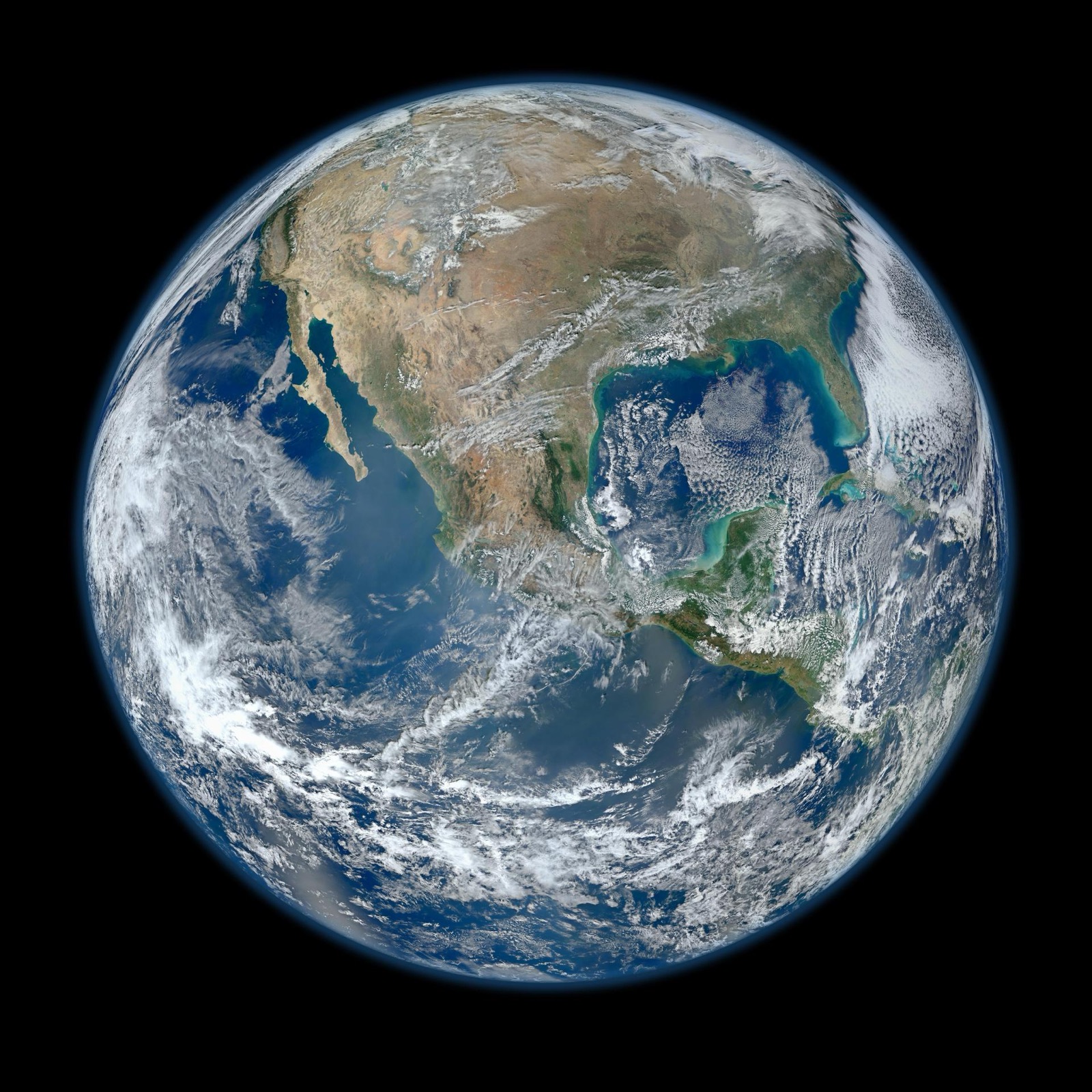
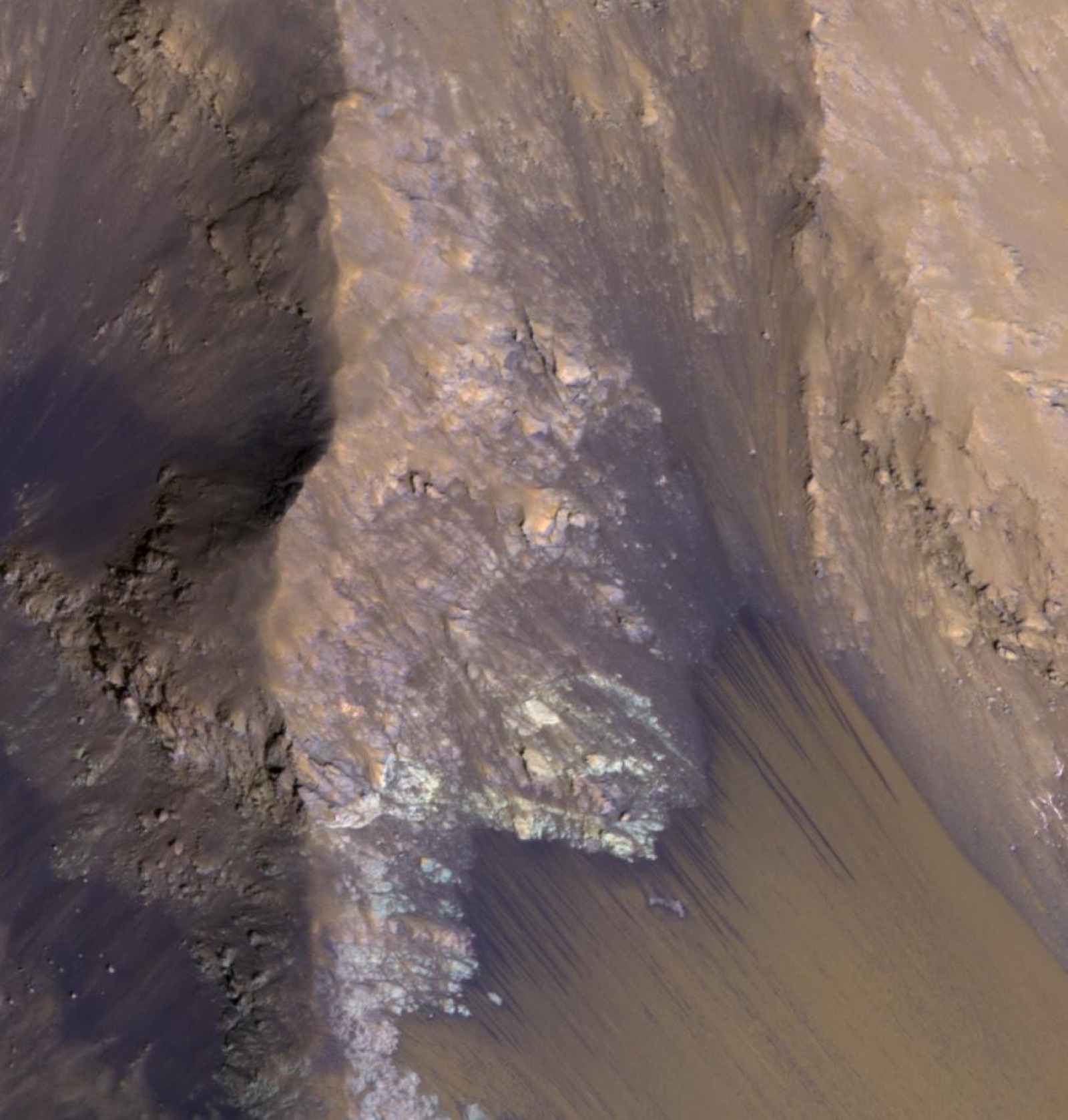
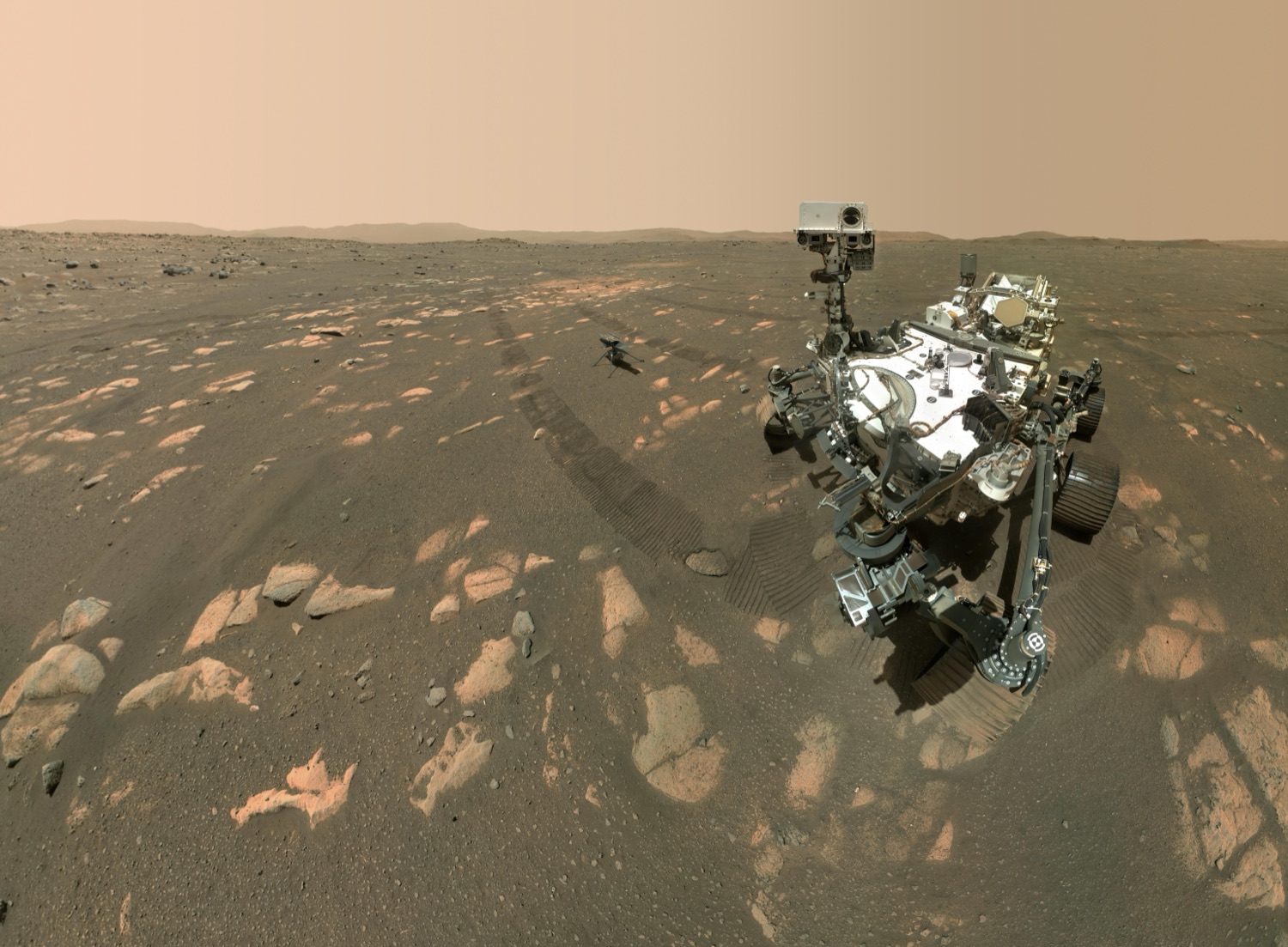
 Photograph · NASA/JPL-Caltech/Univ. of Arizona
Planet · Deep guide · orbits The Sun
Mars
Also called: The Red Planet
Once wet, now cold, the rusty desert world next door is the main target for human exploration.
What is it?
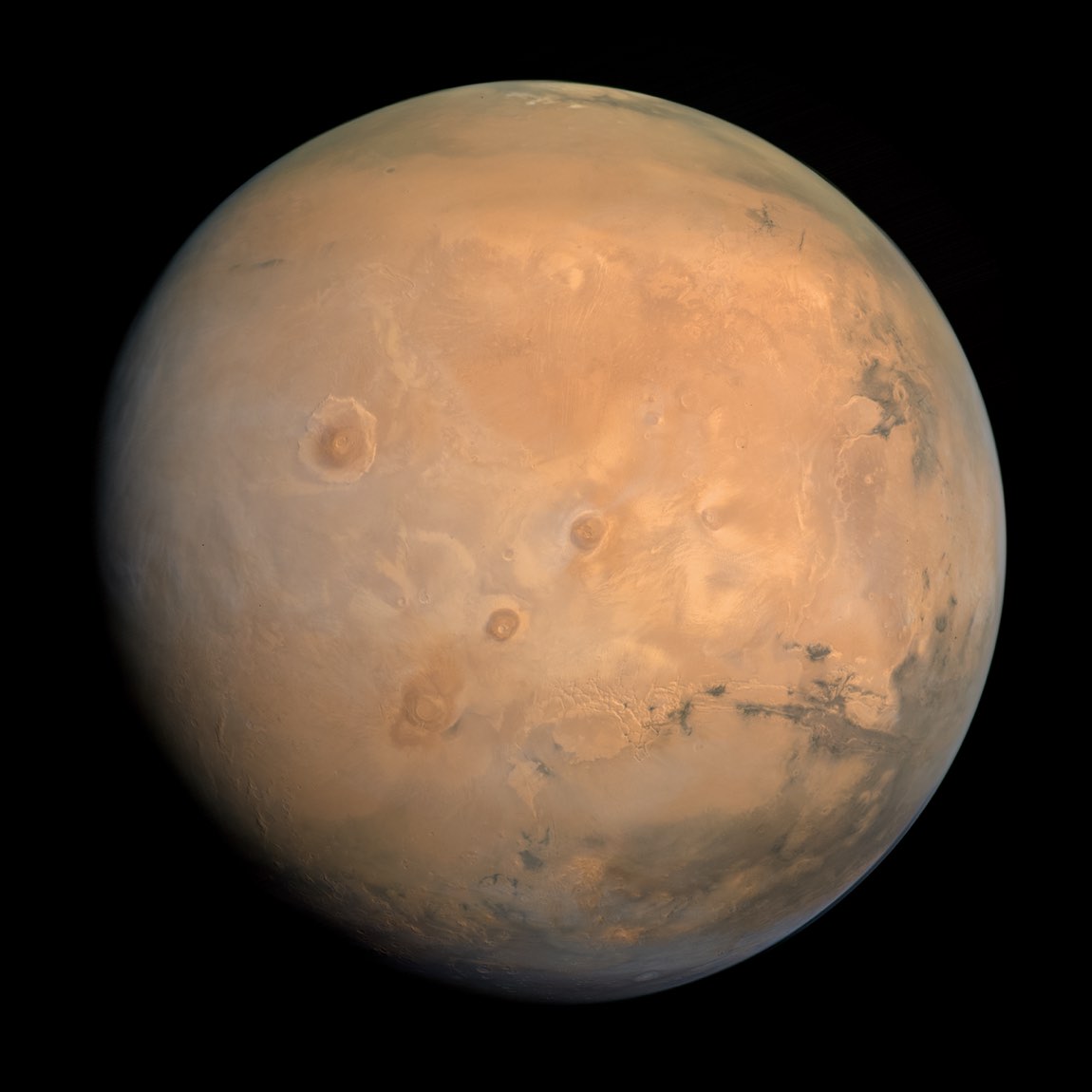
Mars is the fourth planet from the Sun, about half Earth's size, and the most explored world beyond our own. Its rusty-red color comes from iron oxide dust. Billions of years ago Mars had rivers, lakes, and possibly seas; today it is a cold desert with a whisper of an atmosphere — but water ice survives underground and at the poles, and robots are actively searching its rocks for signs of ancient life.
Go deeper
Mars preserves a 4-billion-year-old climate archive at its surface. Orbiters and rovers have confirmed ancient deltas, lakebeds, and water-formed minerals (clays, sulfates); Perseverance is caching samples in Jezero Crater — an ancient lake delta — for a planned sample-return campaign. Mars likely lost its magnetic dynamo early; solar wind then stripped most of the atmosphere (quantified by MAVEN), collapsing the greenhouse. Methane detections by Curiosity remain puzzling and contested. Subglacial brine lakes suggested by radar are debated. If life ever started there, the best evidence is probably underground.
01 What is it like there?
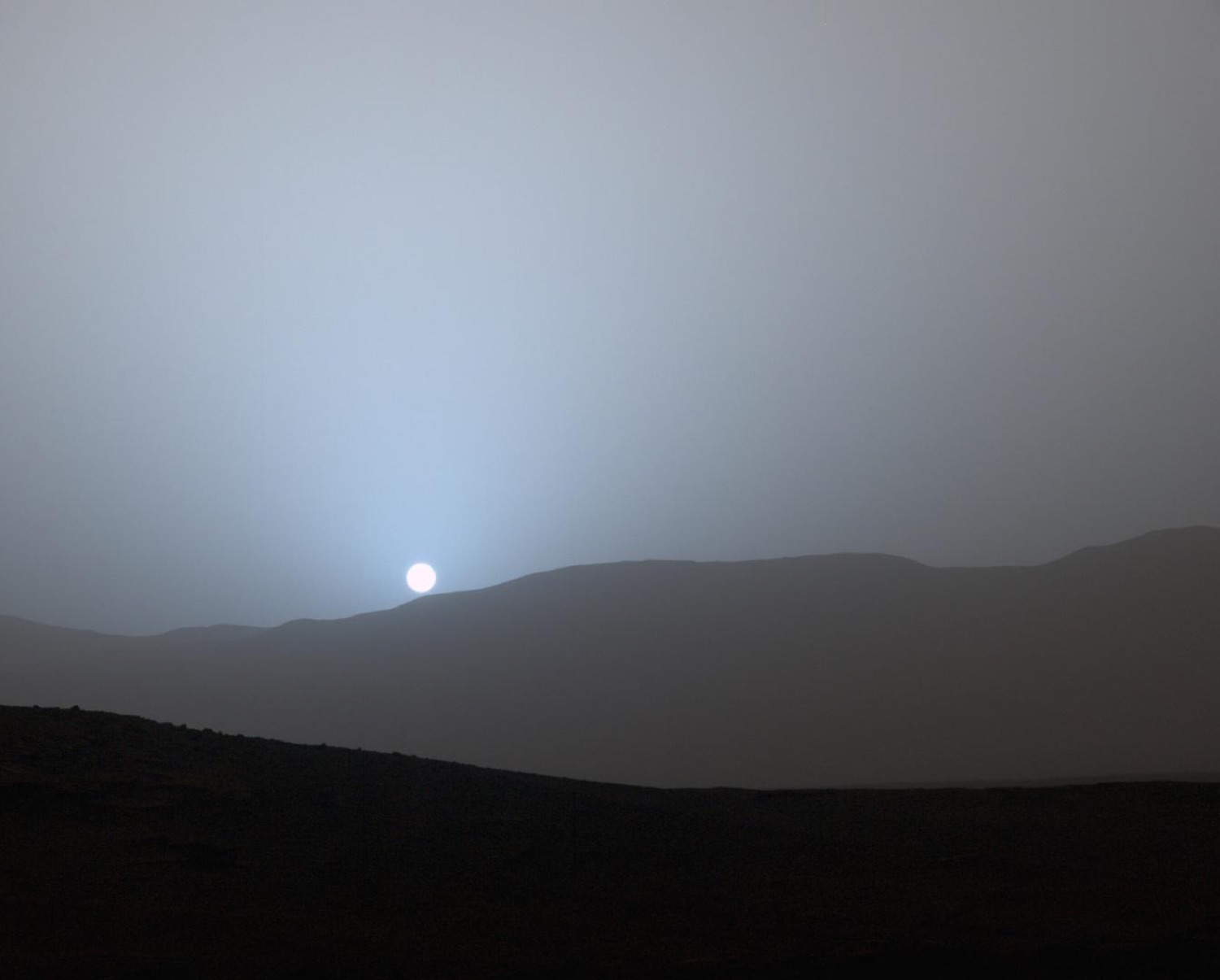
A high, cold desert under a butterscotch sky. Daytime might reach a pleasant 20 °C at the equator in summer — but the same night plunges past −70 °C. The air is unbreathable and so thin your blood would boil without a pressure suit. Dust storms can occasionally swallow the whole planet for weeks. Sunsets on Mars are blue.
02 The water story
Spacecraft keep finding the fingerprints of water everywhere: dried river deltas, lake-bottom mudstones, minerals that only form in water, and today's ice caps and buried glaciers. Mars was once wet enough, for long enough, that life could plausibly have started. That is the central question every Mars mission is really asking.
03 Robot explorers
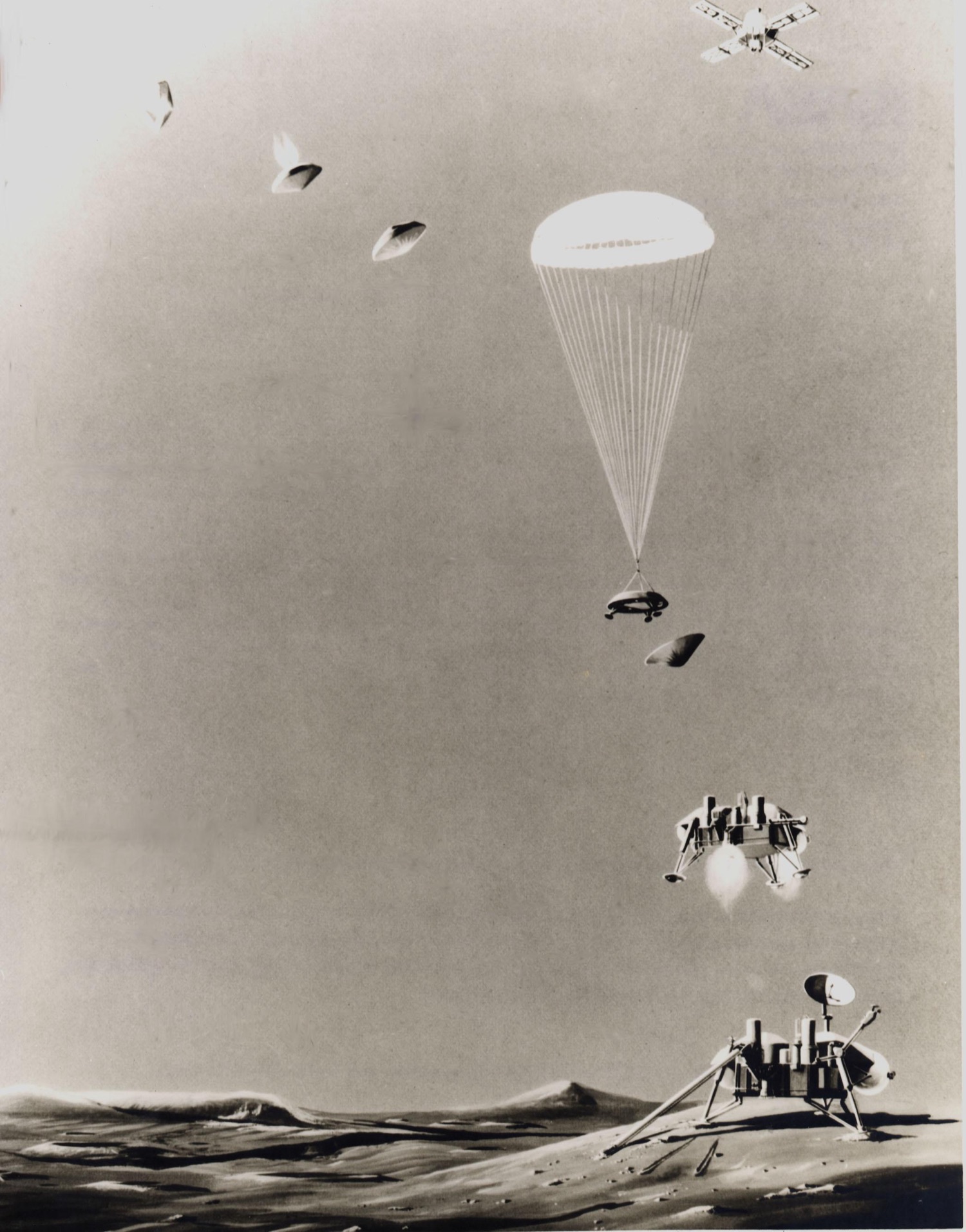
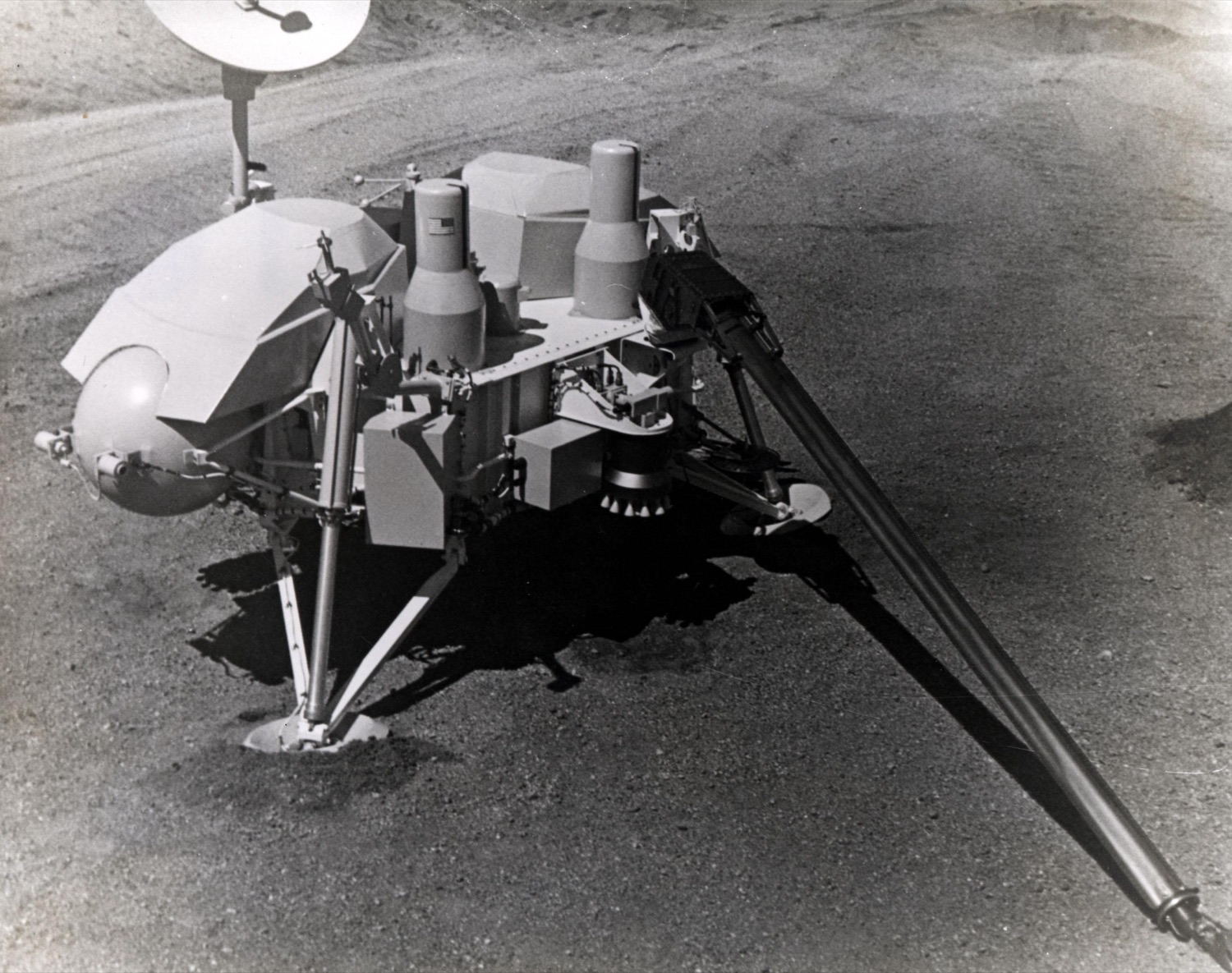
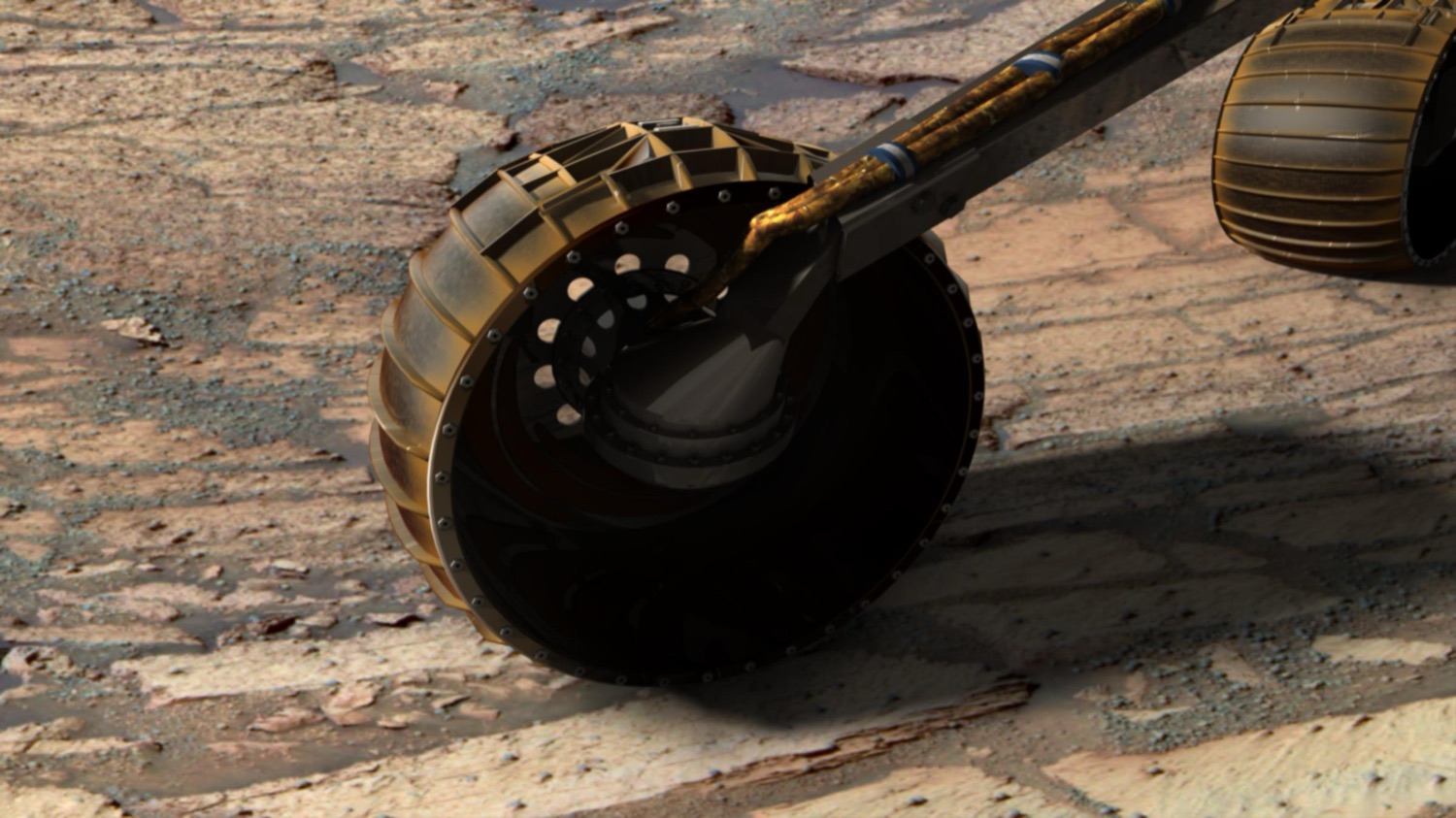
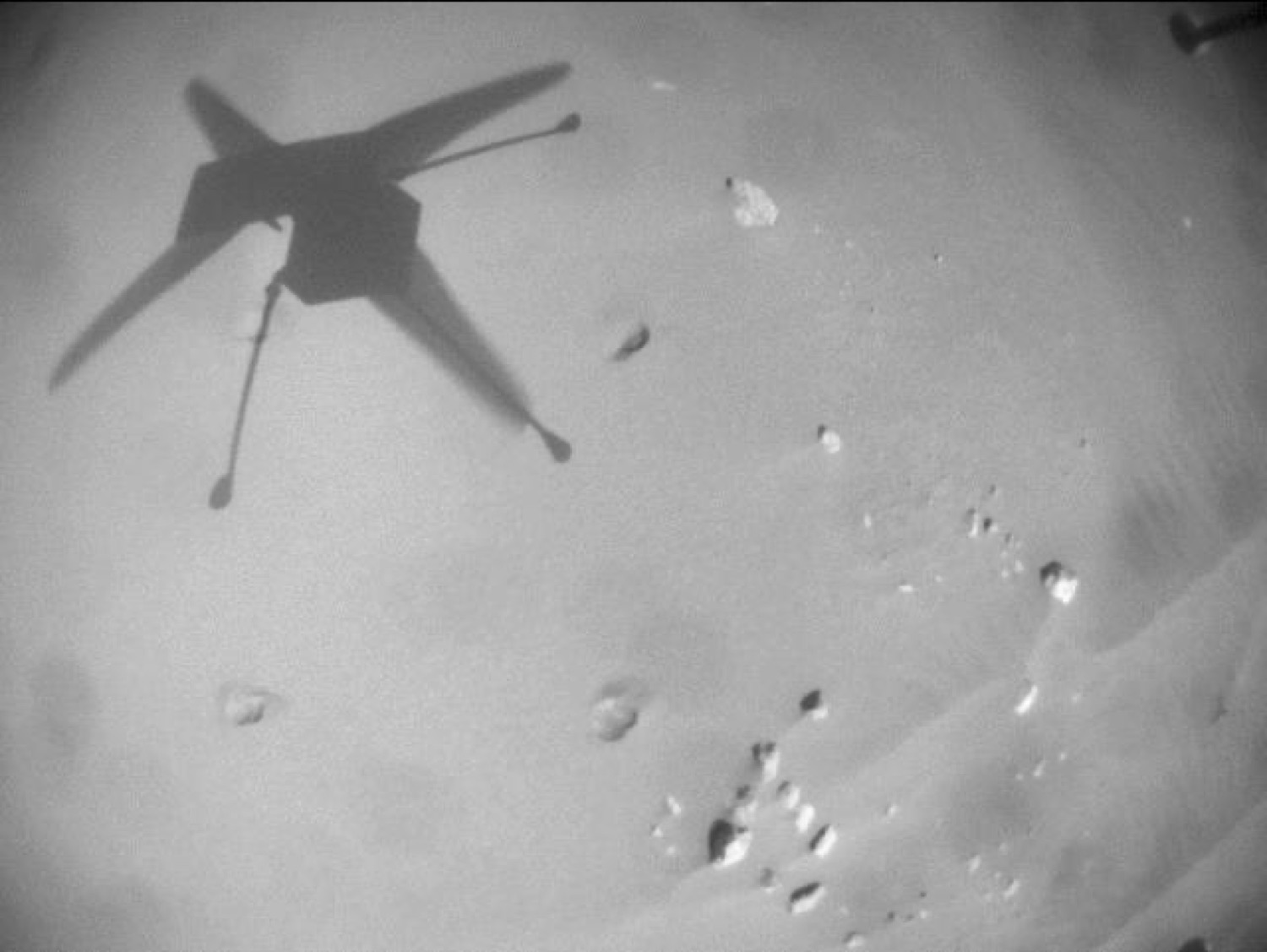
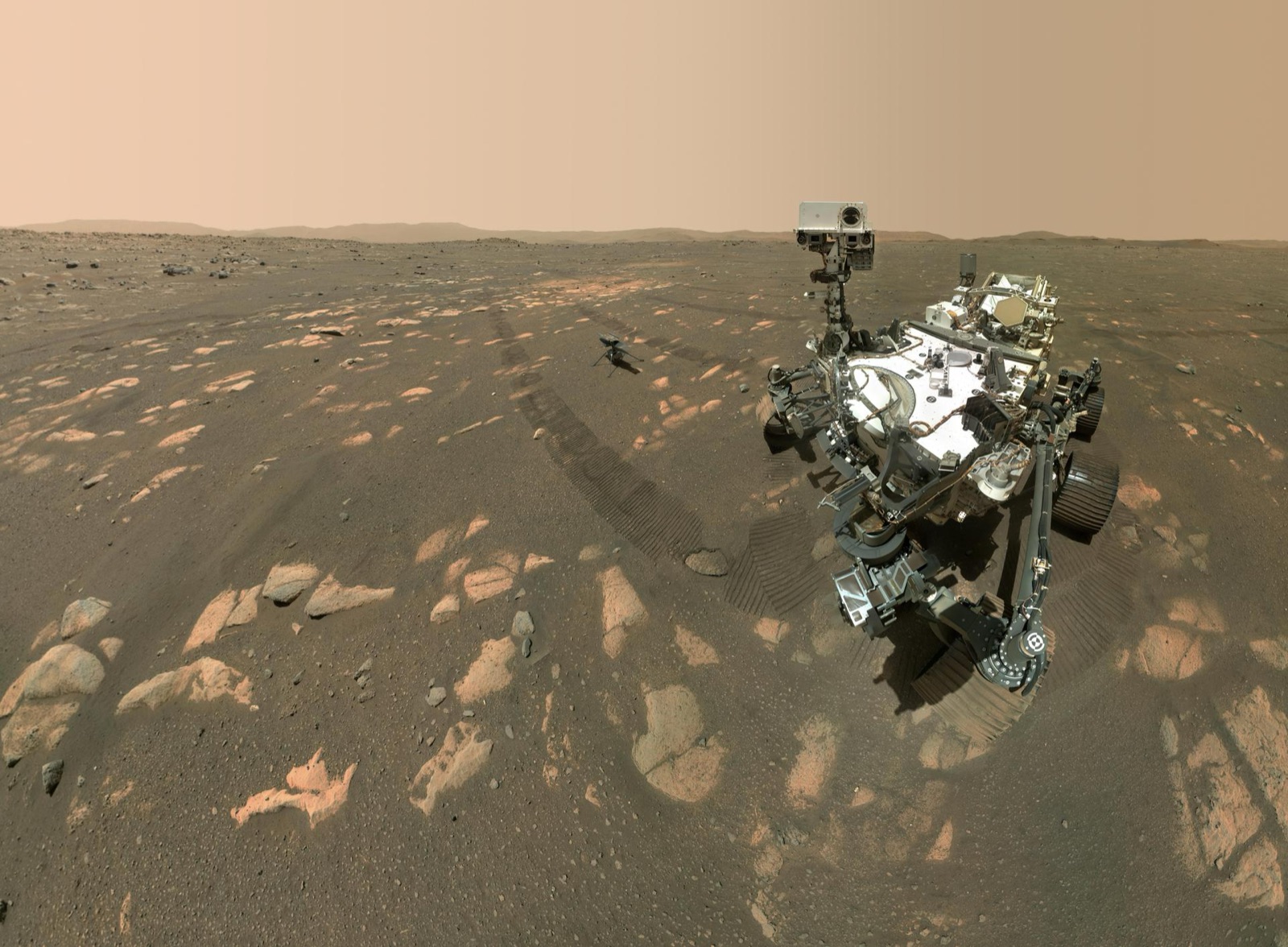
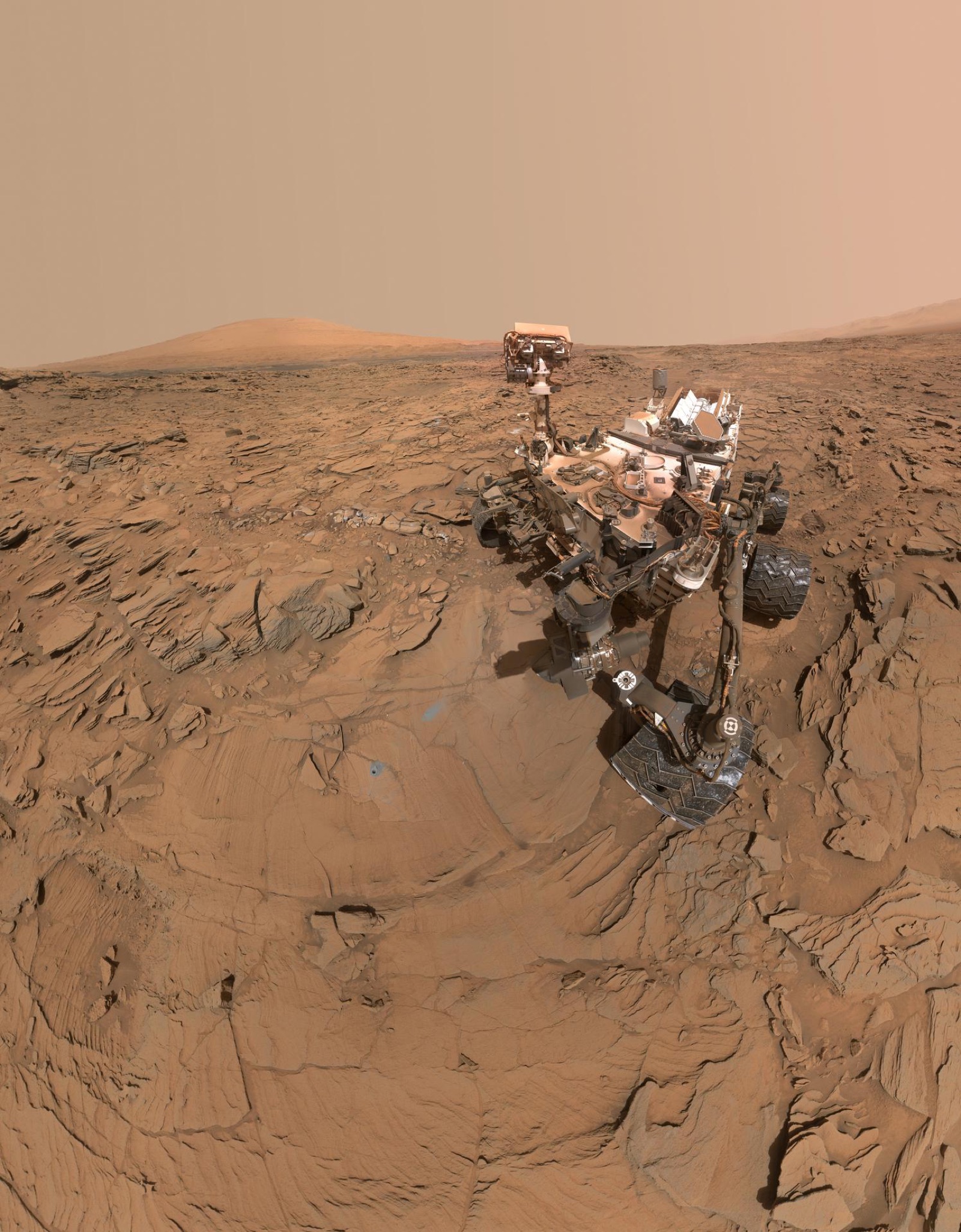
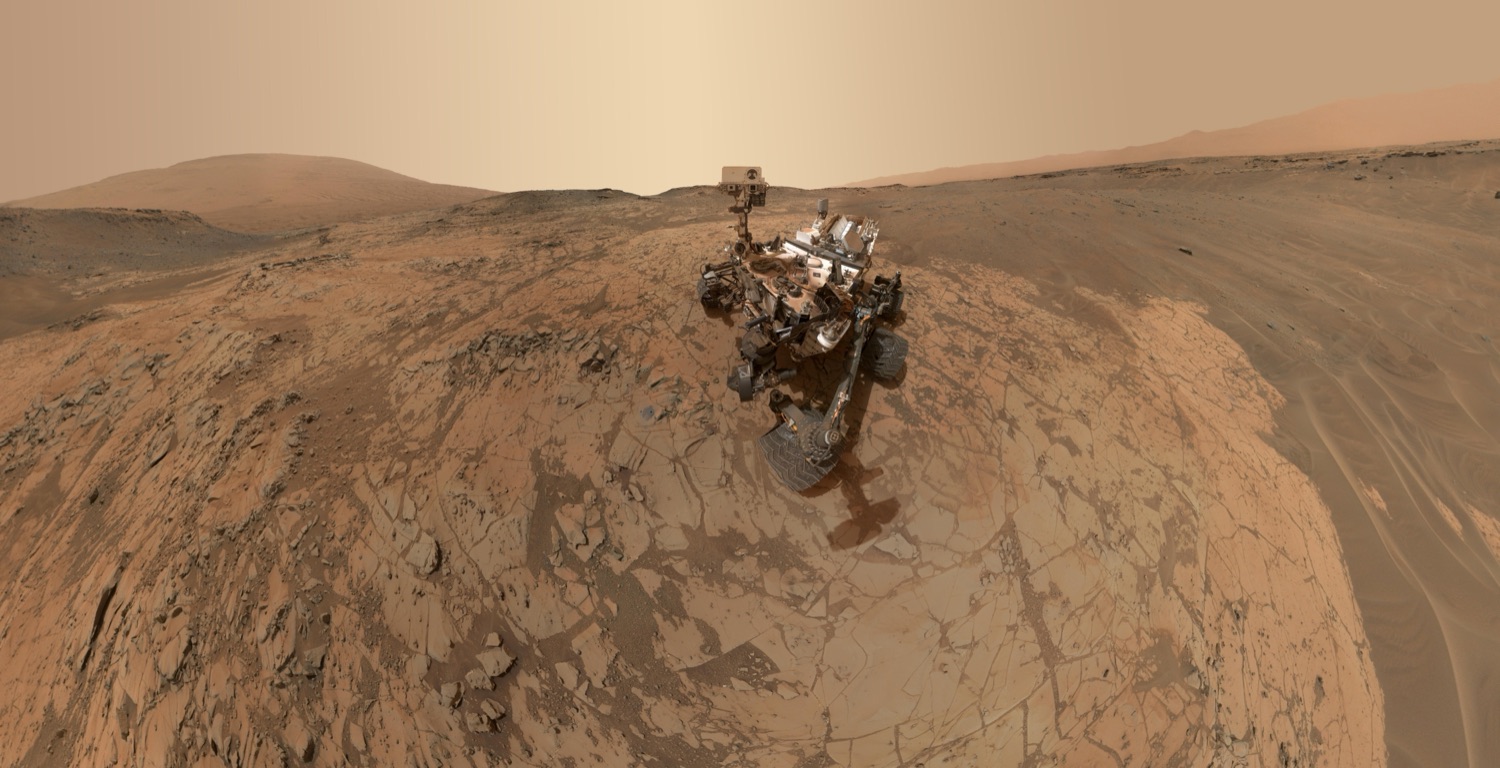
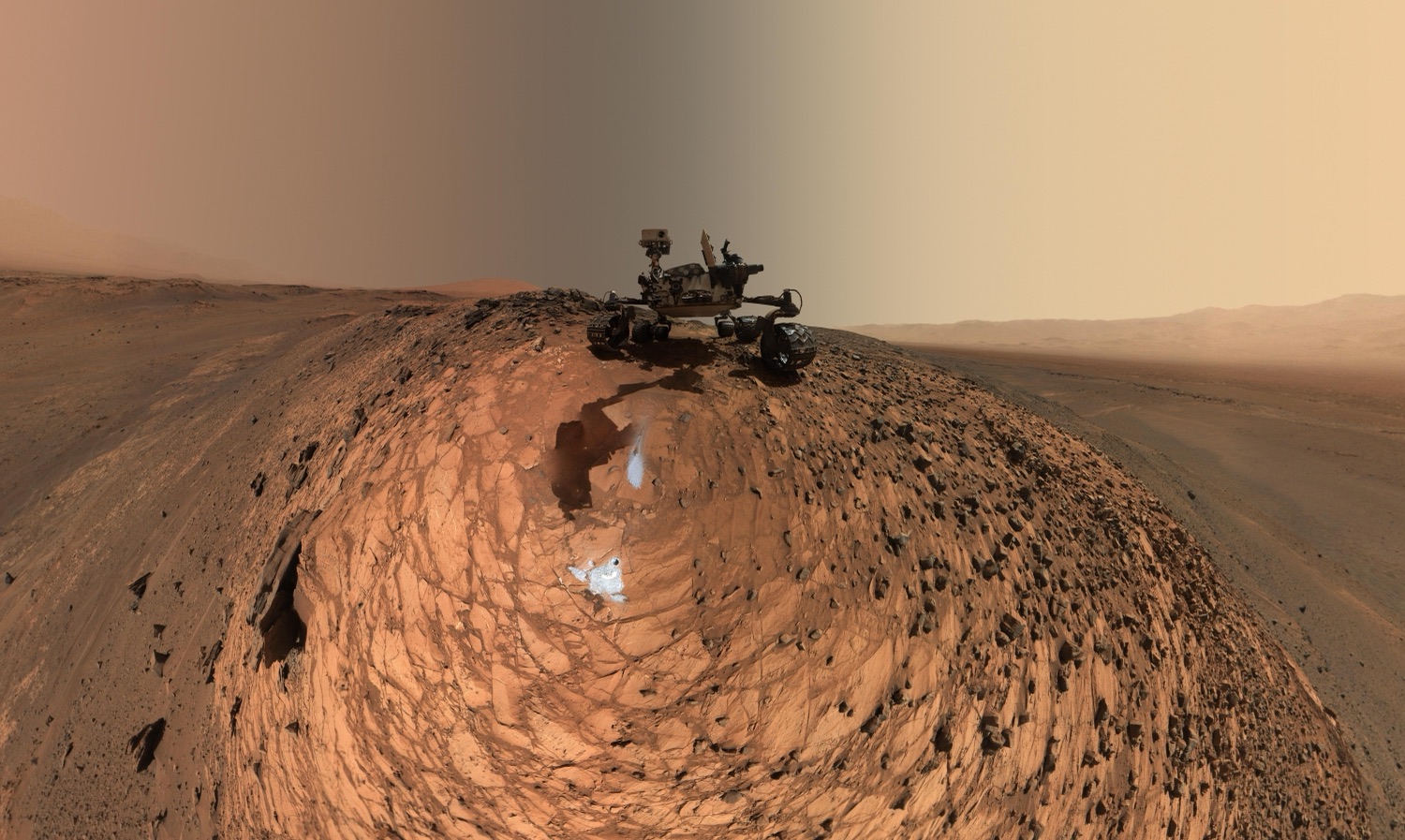
Mars is the only planet inhabited entirely by robots. Landers and rovers — Viking, Pathfinder, Spirit, Opportunity, Phoenix, Curiosity, InSight, Perseverance, and China's Zhurong — plus a fleet of orbiters have mapped it in extraordinary detail. The Ingenuity helicopter flew 72 times (2021–2024), the first powered flight on another planet.
04 Why did Mars die? Deeper
Mars is small: it cooled fast, its magnetic dynamo shut down within the first billion years, and without that shield the solar wind stripped the atmosphere molecule by molecule — a loss NASA's MAVEN orbiter has measured directly. Less air meant less greenhouse warming, and the water froze or fled underground. Size, it turns out, is destiny for rocky planets.
 ⤢
⤢
05 Terraforming — honestly Deeper
Could we give Mars back an atmosphere? Not with any near-term technology: even vaporizing both polar caps would supply a small fraction of the pressure needed (a 2018 NASA-funded study concluded the accessible CO₂ is simply insufficient). Terraforming Mars is a Theoretical concept on century-to-millennium timescales, not a plan.
The deep dive
Researched for the Atlas from Wikipedia — Mars (56,096 characters read) · updated Sep 20, 2026
06 A planet split in two: the great dichotomy
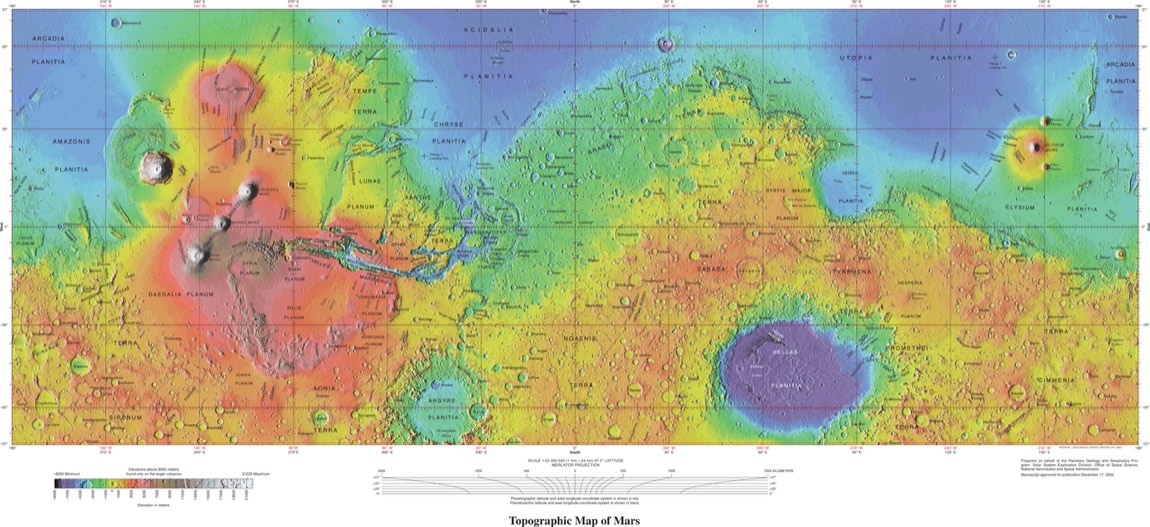
Stand on Mars and the landscape you see depends almost entirely on which hemisphere you are in. The northern lowlands are vast, smooth lava plains, astonishingly flat compared to anything on Earth. The southern highlands are ancient, battered, and pocked with enormous craters. This stark north-south divide is called the Martian dichotomy, and explaining it has occupied planetary scientists for decades. The leading hypothesis is violent: around four billion years ago, an object between one-tenth and two-thirds the size of Earth's Moon slammed into the northern hemisphere, carving a basin measuring 10,600 by 8,500 kilometres — an area roughly equal to Europe, Asia, and Australia combined. If confirmed, that makes it the largest impact basin yet found anywhere in the Solar System, dwarfing even the Moon's South Pole–Aitken basin. The collision would have resurfaced the north with a flood of melted rock, erasing the craters that still scar the south. The smooth result is called the Borealis basin, and it covers about 40% of the planet.
 ⤢
⤢
07 Inside Mars: a world that never quite finished forming Deeper
Mars is differentiated like Earth, meaning heavier material sank to the centre and lighter rock floated up, but the similarities end there. The crust averages 42 to 56 kilometres thick — up to twice as thick as Earth's average of 27.3 kilometres — and reaches a maximum of 117 kilometres beneath the southern Tharsis plateau. Below the crust, a silicate mantle stays rigid down to about 250 kilometres, giving Mars a far thicker lithosphere than Earth's. Deeper still, seismic data from the InSight lander revealed a basal liquid silicate layer roughly 150 to 180 kilometres thick sitting at the base of the mantle. The iron and nickel core is at least partially molten, spans roughly 1,650 to 1,675 kilometres in radius — about half the planet's total radius — and is enriched in light elements including sulfur, oxygen, carbon, and hydrogen. Whether a solid inner core exists is still debated: a 2023 study found no evidence for one, but a 2025 reanalysis of the same InSight data reported a solid inner core 613 kilometres in radius, plus or minus 67 kilometres. The core temperature is estimated at 2,000 to 2,400 K, far cooler than Earth's inner core at 5,400 to 6,230 K.
08 Marsquakes and a lumpy interior Deeper
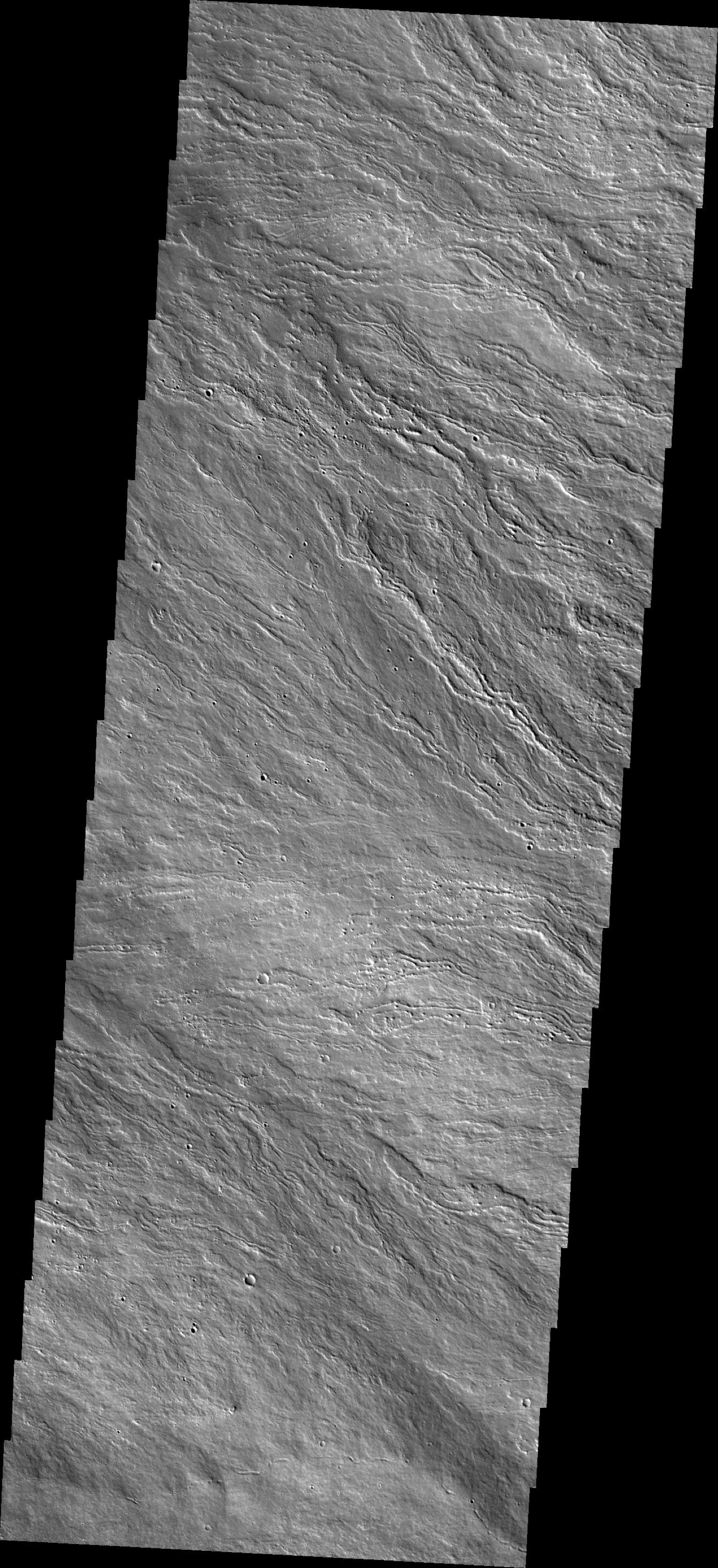
Mars is seismically active. By 2019, the InSight lander had already detected and recorded over 450 marsquakes and related seismic events, confirming that the planet is not geologically inert despite having no plate tectonics. Seismic waves passing through the Martian mantle revealed something unexpected: the interior is highly heterogeneous, containing dense fragments up to 4 kilometres across, likely debris from colossal impacts roughly 4.5 billion years ago. Because Mars lacks plate tectonics and has a sluggishly convecting interior, these fragments were never stirred in or homogenised — they have simply sat there, preserved, for billions of years. High-frequency waves from eight marsquakes slowed detectably as they passed through these regions, which are compositionally distinct from the surrounding mantle. Recent geological activity is also visible at the surface: sheet-like lava flows in the Athabasca Valles formed as recently as 200 million years ago, and water flows in the Cerberus Fossae grabens occurred less than 20 million years ago, implying volcanic intrusions equally recent.
09 Volcanoes so large they warp the planet
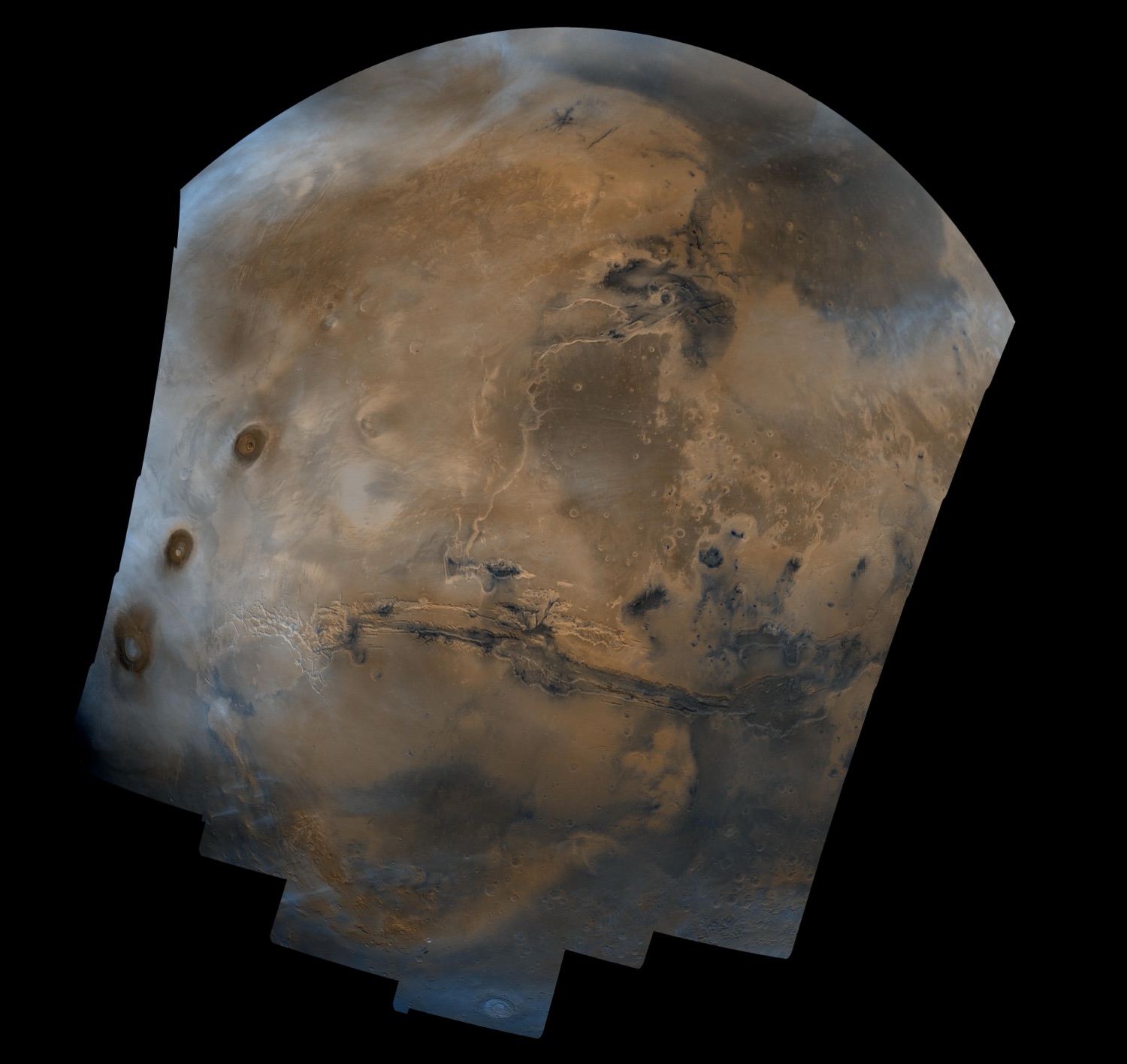
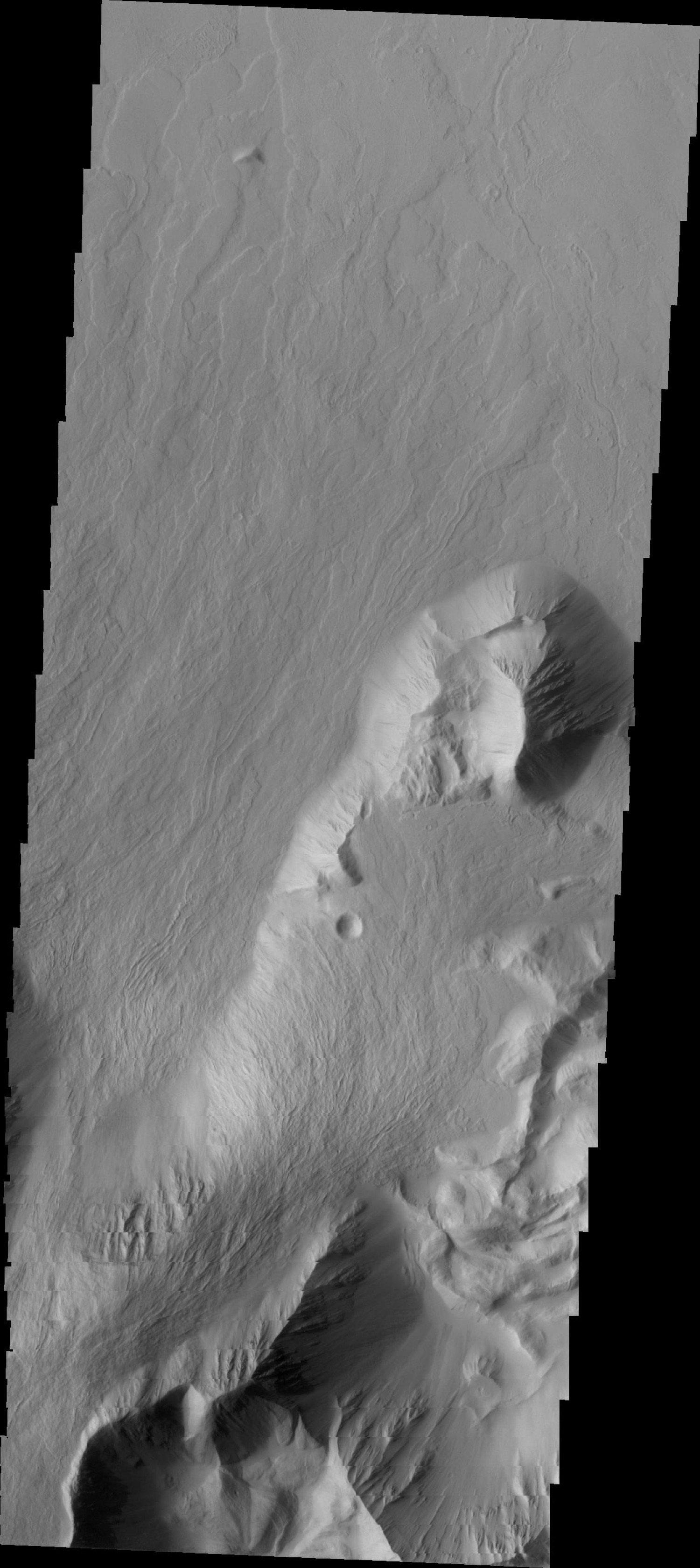
The Tharsis region is a volcanic upland so massive that its weight has deformed the crust beneath it, and it is the direct cause of Valles Marineris — the canyon formed when the swelling Tharsis bulge caused the surrounding crust to collapse. Tharsis hosts several enormous shield volcanoes, the most famous being Olympus Mons. Its edifice is over 600 kilometres wide. Measured from the foot of the cliffs on its northwest edge to its summit, the local relief exceeds 21 kilometres — more than twice the height of Mauna Kea measured from the ocean floor. Measured from the distant plains of Amazonis Planitia, the total elevation change approaches 26 kilometres, roughly three times the height of Mount Everest. Olympus Mons formed during the Amazonian period, which extends to the present day, making it geologically young by planetary standards. The only mountain in the Solar System that might rival it is the Rheasilvia peak on the asteroid Vesta, estimated at 20 to 25 kilometres. Because Mars has no plate tectonics, a volcanic hotspot keeps burning through the same patch of crust indefinitely, which is why Martian volcanoes can grow so absurdly large.
 ⤢
⤢
10 The atmosphere: thin, dusty, and surprisingly complex
The air on Mars is about 96% carbon dioxide, with 1.93% argon and 1.89% nitrogen, plus traces of oxygen and water. Surface pressure averages just 600 pascals — about 0.6% of Earth's sea-level pressure — and ranges from a low of 30 pascals on the summit of Olympus Mons to over 1,155 pascals in the depths of Hellas Planitia. The atmosphere is pervasive with dust particles about 1.5 micrometres in diameter, which tint the Martian sky a tawny colour and can take on a pink hue from suspended iron oxide. Dust storms are the largest in the Solar System, with winds exceeding 160 kilometres per hour, occasionally expanding until they enshroud the entire planet and measurably raise global temperatures. Sound behaves differently here too: using acoustic recordings from the Perseverance rover, researchers found that the speed of sound is approximately 240 metres per second for frequencies below 240 Hz and 250 metres per second for higher frequencies — slower than the 343 metres per second we experience on Earth. Methane has been repeatedly detected but its origin remains contested, with both geological processes such as serpentinization and the possibility of biological activity proposed as explanations.
11 Seasons amplified: how orbital shape tips the scales Deeper
Mars has an axial tilt of 25.19 degrees, close enough to Earth's 23.5 degrees that the planet experiences recognisable seasons. But a second factor makes Martian seasons far more uneven than Earth's: the orbital eccentricity of Mars is about 0.09, the highest of any planet in the Solar System except Mercury. Mars swings noticeably closer to the Sun at perihelion and farther away at aphelion. Crucially, Mars reaches perihelion during southern hemisphere summer — so the southern summer is both hotter and shorter, while the southern winter is longer and colder. The northern hemisphere gets the gentler end of the deal: summer temperatures there can be up to 30 degrees Celsius cooler than equivalent summer temperatures in the south. Surface temperatures overall range from about minus 110 degrees Celsius at the poles in winter to up to 35 degrees Celsius near the equator in summer. The eccentricity also cycles over geological time: 1.35 million years ago Mars's eccentricity was only about 0.002, far more circular than Earth's orbit is today, with a cycle period of 96,000 Earth years.
12 Radiation: the invisible hazard on the surface
Without a global magnetic field and with only a wisp of atmosphere for shielding, the surface of Mars is exposed to significant cosmic and solar radiation. Average surface radiation levels are about 0.64 millisieverts per day. For comparison, astronauts aboard Earth's space stations in low Earth orbit receive around 0.5 millisieverts per day, so Mars's surface is actually somewhat worse than low Earth orbit. The journey to and from Mars is more dangerous still, at about 1.84 millisieverts per day. Not everywhere on Mars is equally exposed: Hellas Planitia, the deepest impact basin on the planet, benefits from the extra overlying atmosphere and receives only about 0.342 millisieverts per day. Even more sheltered are lava tubes southwest of Hadriacus Mons, where levels could be as low as 0.064 millisieverts per day — comparable to radiation received during a long-haul flight on Earth. The cave systems on the flanks of Arsia Mons, seven known entrances between 100 and 252 metres wide and at least 73 to 96 metres deep, are similarly shielded from micrometeoroids, ultraviolet radiation, solar flares, and high-energy particles. Solar storms can spike surface levels dramatically: in September 2017, a massive solar event temporarily doubled surface radiation and produced an aurora 25 times brighter than any previously observed on Mars.
 ⤢
⤢
13 Phobos and Deimos: moons with an uncertain past
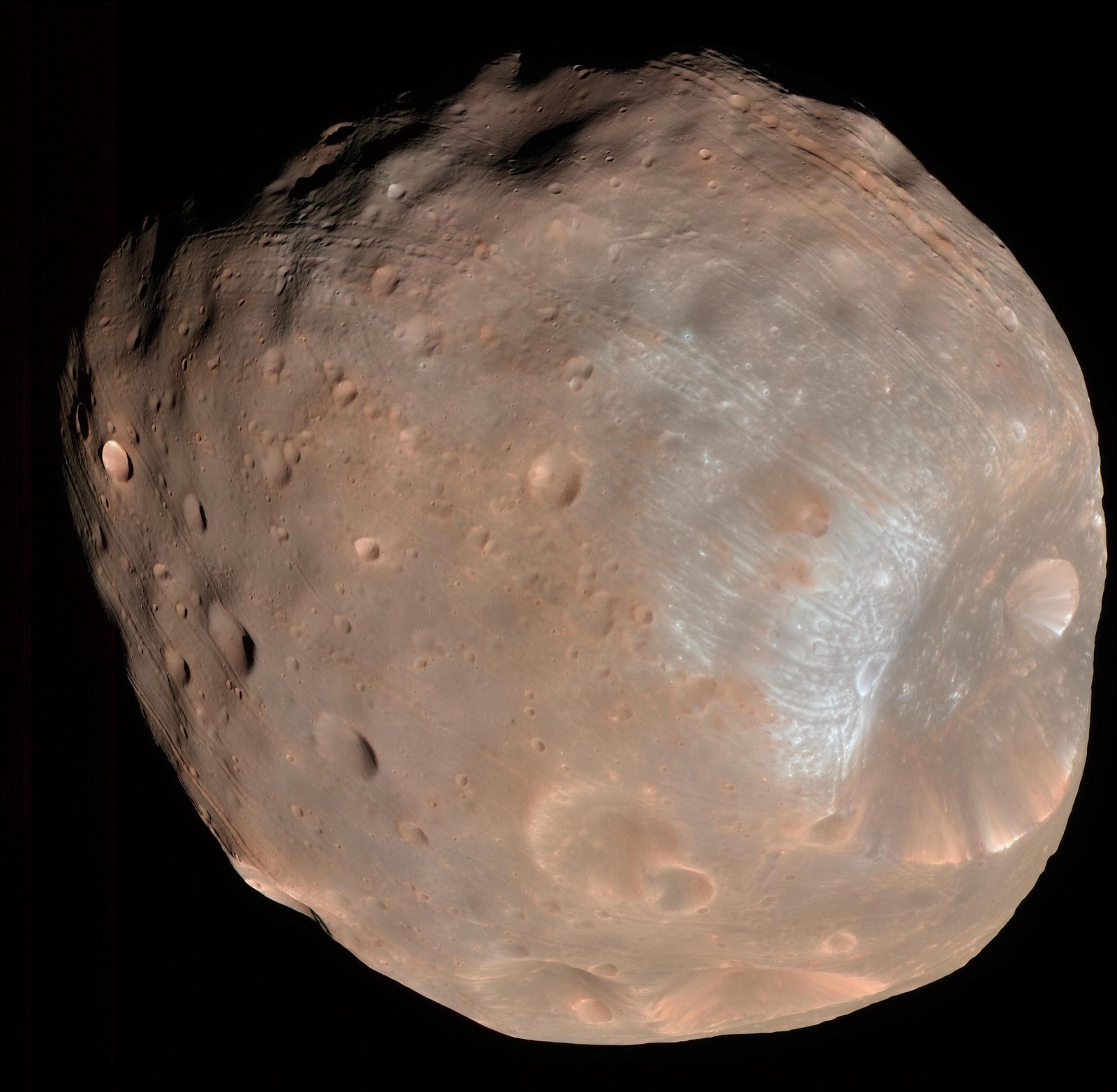
Mars's two moons, Phobos and Deimos, were discovered in 1877 by American astronomer Asaph Hall and named for the twin sons of the Greek god Ares — Phobos, deity of panic and fear, and Deimos, deity of terror and dread. Phobos is about 22 kilometres in diameter and orbits only 9,376 kilometres from the planet's surface, so close that it completes an orbit in less time than Mars rotates: it rises in the west, sets in the east, and rises again in just 11 hours. Tidal forces are dragging it inward, and within about 50 million years it will either crash into Mars or break apart into a ring. Deimos, about 12 kilometres across, orbits at 23,460 kilometres and rises in the east but so slowly it barely seems to move. Where they came from is genuinely uncertain. Their dark, carbonaceous surfaces look like outer-belt asteroids, suggesting capture, but their nearly circular equatorial orbits are unusual for captured bodies. A competing idea holds that both formed from debris ejected by a large impact on Mars itself. A 2023 study using the orbital inclination of Deimos as evidence even suggests Mars may have had a ring system 3.5 to 4 billion years ago, formed from a moon 20 times more massive than Phobos, of which Phobos itself might be a remnant.
14 How to watch Mars from your backyard
Mars is one of the most rewarding naked-eye planets precisely because it changes so dramatically. Its mean apparent magnitude is about plus 0.71, but around opposition — when Earth overtakes Mars and the two planets are closest — it can blaze at magnitude minus 3.0, making it second only to Venus in apparent brightness. At its faintest, near aphelion and conjunction, it dims to about magnitude plus 1.86. The variation is extreme because the distance between Earth and Mars swings between about 54 and 401 million kilometres depending on where both planets sit in their elliptical orbits. The best views come at perihelic oppositions, when Mars is near both its closest point to Earth and its closest point to the Sun; notable upcoming examples fall near 2035. Every opposition triggers a period of retrograde motion lasting about 72 days, during which Mars appears to reverse direction against the background stars before resuming its normal eastward track. Ground-based optical telescopes are typically limited to resolving surface features about 300 kilometres across even when Mars is closest, due to blurring by Earth's atmosphere, so even modest telescopes can show the polar ice caps and major dark regions such as Syrtis Major Planum during good oppositions.
15 Naming a world: maps, canals, and conventions
The formal mapping of Mars began in 1840 when Johann Heinrich Mädler combined a decade of observations to draw the first proper map of the planet, having first confirmed that its surface features were permanent and refined its rotation period. The planet's Prime Meridian was fixed, much like Earth's at Greenwich, at an arbitrary reference point: after Mariner 9's detailed imaging in 1972, a small crater called Airy-0 in the Sinus Meridiani region was chosen by Merton E. Davies, Harold Masursky, and Gérard de Vaucouleurs to mark zero degrees longitude. Because Mars has no oceans, there is no natural sea level either; zero altitude is defined as the height where atmospheric pressure equals 610.5 pascals, which corresponds to the triple point of water. Feature names follow formal rules: craters larger than roughly 50 kilometres are named for deceased scientists and writers; smaller craters for towns with fewer than 100,000 inhabitants; large valleys for the word 'Mars' or 'star' in various languages. Dark regions were historically named as seas — Mare Erythraeum, Mare Sirenum — because early observers mistook them for water. The United States Geological Survey divides the entire surface into thirty cartographic quadrangles, each named for a classical albedo feature it contains.
 ⤢
⤢
16 Canals, fever, and the myth that wouldn't die
On 5 September 1877, during a perihelic opposition, Italian astronomer Giovanni Schiaparelli used a 22-centimetre telescope in Milan to produce the first detailed map of Mars. He labelled linear features on the surface canali, an Italian word meaning channels or grooves, but English speakers translated it as 'canals' — implying construction. Percival Lowell, an orientalist who founded an observatory equipped with 30- and 45-centimetre telescopes, ran with the idea and published widely read books arguing that Mars was a dying world where ancient civilisations had built irrigation canals to survive. Other astronomers, including Henri Joseph Perrotin and Louis Thollon in Nice, independently reported seeing the canals using some of the largest telescopes then available. The public was captivated. By 1909, however, Antoniadi using an 84-centimetre telescope saw only irregular patterns — no straight lines. With the exception of the natural canyon Valles Marineris, the canali were eventually shown to be an optical illusion. Yet the cultural momentum outlasted the astronomy: H. G. Wells's The War of the Worlds, Ray Bradbury's The Martian Chronicles, and Edgar Rice Burroughs's Barsoom series all drew on the image of a dying Mars. High-resolution spacecraft imaging has found no artifacts of habitation, but as Carl Sagan wrote in Cosmos, 'Mars has become a kind of mythic arena onto which we have projected our Earthly hopes and fears.'
17 A brief history of spacecraft sent to Mars
The first attempt to reach Mars was the Soviet Mars 1 spacecraft in 1963; contact was lost en route. NASA's Mariner 4, launched on 28 November 1964, became the first to succeed, making its closest approach on 15 July 1965 and transmitting the first images of another planet from deep space, also detecting a weak Martian radiation belt at about 0.1% of Earth's. In 1971, Mariner 9 became the first spacecraft to orbit any body other than the Moon, Sun, or Earth; that same year Mars 2 made the first uncontrolled impact on Mars and Mars 3 achieved the first successful landing. The Viking landers of the mid-1970s carried life-detection experiments that produced ambiguous results still debated today. After Viking 1 shut down in 1982, Mars saw only failed missions until 1997, when Mars Pathfinder — the first successful rover mission beyond the Moon — and Mars Global Surveyor began an uninterrupted robotic presence that has continued ever since. As of 2023, ten functioning spacecraft operate at Mars: eight orbiters including Mars Odyssey, Mars Express, Mars Reconnaissance Orbiter, MAVEN, the ExoMars Trace Gas Orbiter, the Hope orbiter, and the Tianwen-1 orbiter, plus the Curiosity and Perseverance rovers on the surface. Future milestones include the Rosalind Franklin rover (no earlier than 2028) and China's Tianwen-3 sample-return mission targeted for 2028 or 2030.
 ⤢
⤢
You would weigh…
Surface gravity 3.71 m/s² vs Earth’s 9.81 m/s². Try every world →
Could life exist here?
No life has been found on Mars. But ancient Mars had liquid water, energy sources, and organic chemistry — the ingredients — and today's subsurface could still shelter microbes in theory. This is why sample return matters: the question is genuinely open.
Our labels: Confirmed · Strong Evidence · Estimated · Hypothesis · Theoretical · Speculative (see Methodology).
Could humans live here?
The leading candidate for the first crewed planetary landing. The hard parts: 6–9 months of deep-space radiation each way, landing heavy cargo through a thin atmosphere, living off local ice and CO₂ (making oxygen from Martian air was already demonstrated by the MOXIE experiment), and staying sane in isolation. NASA targets the 2030s–2040s; SpaceX advertises sooner. No crewed mission is officially scheduled yet.
How would we get there?
Launch windows open every 26 months. Robotic missions take 6–8 months; a crewed round trip with current propulsion means roughly 2–3 years door to door, including waiting at Mars for the planets to realign. Nuclear-thermal propulsion could cut the cruise substantially — it is in development, not yet flown.
| Technology | Status | Travel time (one way, straight line) |
|---|---|---|
| Apollo-style spacecraft, about 39,000 km/h | Flown technology | 241 days |
| Ion-propulsion probe, about 90,000 km/h | Flown technology | 104 days |
| Voyager 1, about 61,000 km/h | Flown technology | 153 days |
| Parker Solar Probe, about 690,000 km/h | Flown technology | 14 days |
| Nuclear-thermal rocket, about 120,000 km/h cruise | In development | 79 days |
| Laser light-sail at 20% of light speed | Proposed concept | 63 minutes |
| Light itself, 299,792 km/s | Physical limit | 13 minutes |
Simplified straight-line times at cruise speed. Real missions fly curved orbital paths and take longer. Full travel calculator →
Weird & wonderful
- Sunsets on Mars are blue.
- Olympus Mons is so wide that, standing on its slope, you couldn't tell you were on a mountain — it would stretch past the horizon.
- Mars's moon Phobos is spiraling inward and will be torn into a ring in ~50 million years.
- Your bathroom scale would read 62% less on Mars.
- Pieces of Mars are already on Earth — meteorites blasted off by ancient impacts.
Worlds that orbit Mars
Latest news about Mars
More real images of Mars
Genuine spacecraft and telescope imagery, every frame credited and licensed. Tap any photo to enlarge.