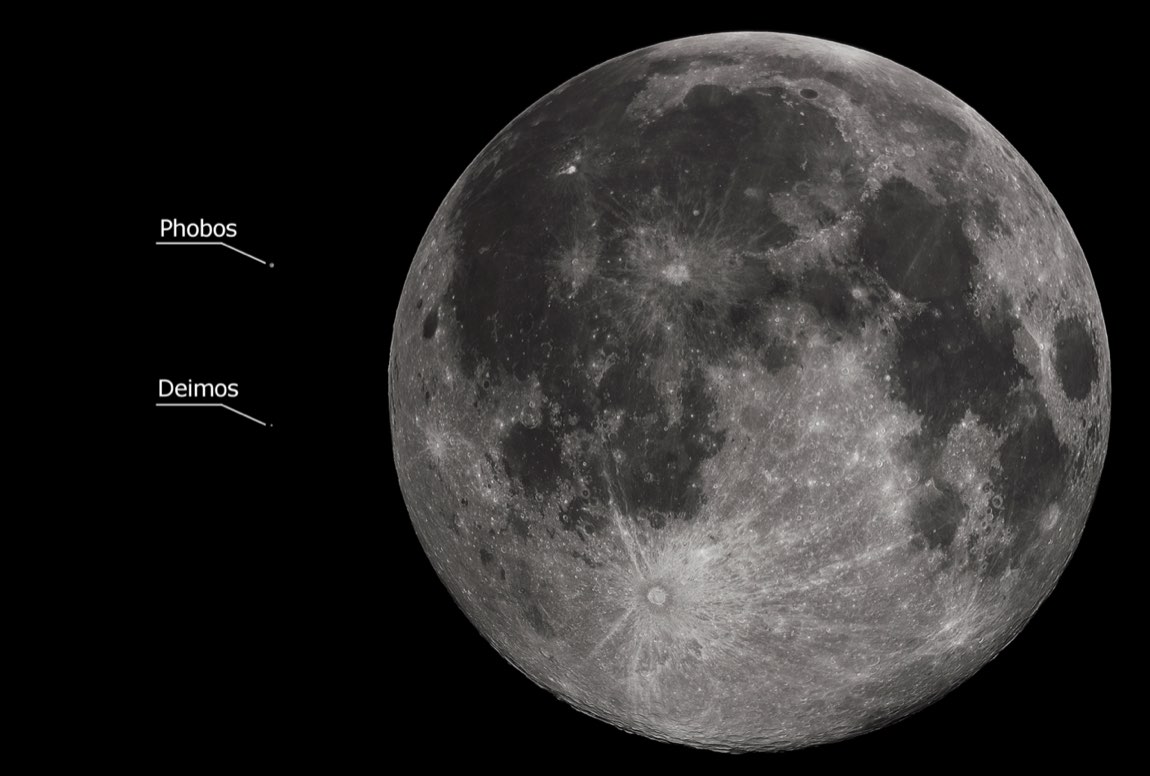
 Photograph · NASA/JPL/University of Arizona · Public domain
Moon · Deep guide · orbits Mars
Deimos
Mars's tiny outer moon is a drifting lump the size of a city.
What is it?
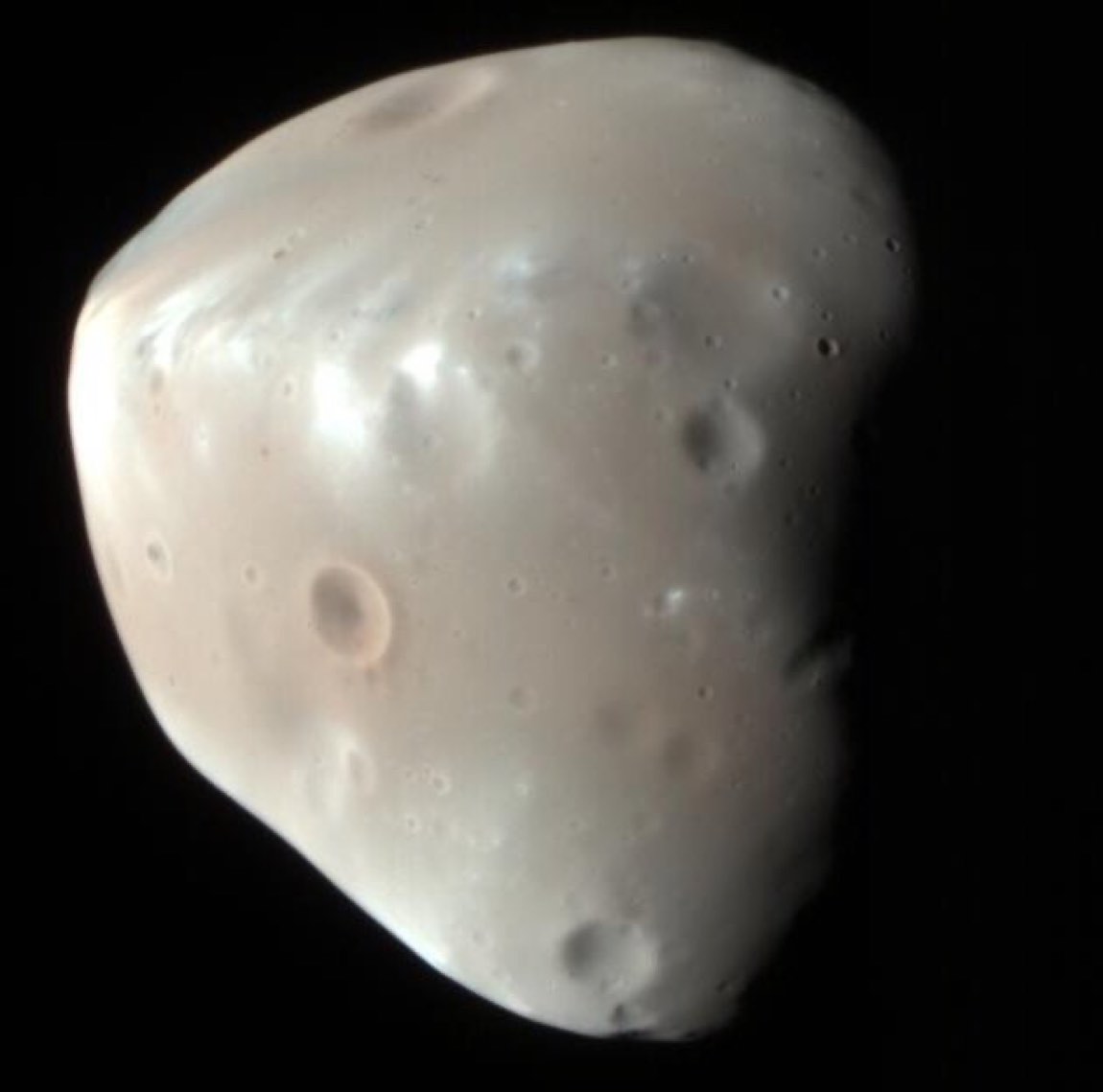
Deimos is the smaller and farther of Mars's two moons, a 12-kilometer lump of dark rock that circles the planet every 30 hours. From the Martian surface it looks like a bright, slightly unsteady star. Unlike doomed Phobos, Deimos is slowly drifting outward and will one day escape Mars entirely.
The deep dive
Researched for the Atlas from Wikipedia — Deimos (moon) (9,100 characters read) · updated Sep 20, 2026
01 Discovered in a Single August Week
Deimos was discovered by Asaph Hall at the United States Naval Observatory in Washington, D.C., on 12 August 1877, at about 07:48 UTC. Hall was on a deliberate campaign to find Martian moons, and his patience paid off twice in quick succession — he found Phobos just days later. The name was not Hall's own invention. Academic Henry Madan suggested it, drawing directly from Book XV of Homer's Iliad, where the god Ares summons both Deimos (Dread) and Phobos (Fear) into battle. Since Ares is the Greek counterpart of the Roman Mars, the pairing felt exact. Planetary moons beyond Earth's were never assigned traditional astronomical symbols, but software engineer Denis Moskowitz later proposed one for Deimos: a Greek delta — the initial of the moon's name — combined with Mars's spear. That symbol remains unofficial and is not widely used today.
02 A Lumpy World Smaller Than a City
Deimos is strikingly non-spherical. Its triaxial dimensions measure 16.1 km × 11.8 km × 10.2 km, giving it a mean diameter of just 12.5 km — roughly the distance you might drive to reach the nearest large town. That makes it about 57% the size of its companion Phobos. Its mean radius is 6.2 km. Because it is so small, the escape velocity from its surface is only 5.6 m/s — a brisk cycling pace. A long-jumper with a running start could, in principle, simply leap off the surface and drift into space. The apparent magnitude of Deimos as seen from Earth is 12.45, well beyond naked-eye visibility. Its overall color is gray, and its composition — rock rich in carbonaceous material — closely resembles C-type asteroids and carbonaceous chondrite meteorites.
03 Smoother Than Phobos, But Why? Deeper
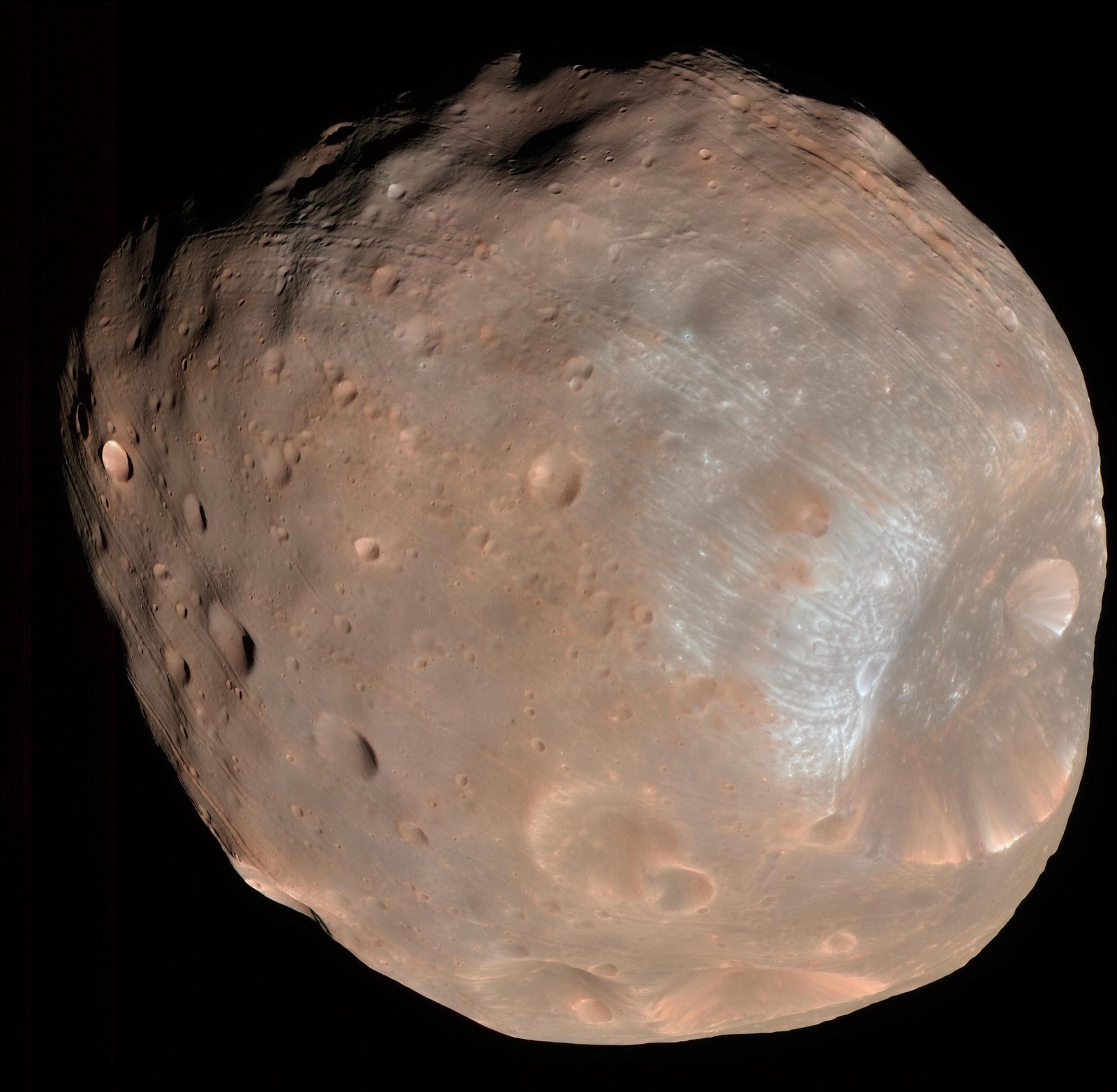
At first glance Deimos looks less battered than Phobos, and the reason involves what lies beneath the craters rather than an absence of impacts. The surface is noticeably smoother because loose material — regolith — has partially filled in older craters over time, softening their rims and floors into gentle depressions rather than sharp bowls. This regolith is remarkably porous. Radar measurements put its bulk density at only 1.471 g/cm³, which is far lower than solid rock and indicates a fluffy, loosely packed layer. Only two geological features on Deimos have been formally named: the craters Swift and Voltaire. Both are named after writers who, long before any telescope confirmed their existence, speculated in fiction that Mars possessed two moons — a remarkable guess that turned out to be correct.
04 Three Rival Stories of Its Birth Deeper
How Deimos came to orbit Mars is genuinely unresolved, and scientists argue about it seriously. One leading idea holds that it was once an asteroid from the main belt, nudged by Jupiter's gravity into a path that allowed Mars to capture it, with atmospheric drag and tidal forces then slowly rounding out what would have been an initially wild, elongated orbit. A problem: Mars's atmosphere is now far too thin to brake an object of Phobos's size, let alone Deimos's, raising questions about whether conditions were ever right. Researcher Geoffrey Landis suggested the original object might have been a binary asteroid whose components were separated by tidal forces, making capture easier. A second hypothesis proposes simple in-place accretion. A third, proposed in 2021 by Amirhossein Bagheri, Amir Khan, Michael Efroimsky and colleagues using seismic and orbital data from Mars InSight, suggests Phobos and Deimos both formed from the debris of a single parent body that was shattered by an impact somewhere between 1 and 2.7 billion years ago.
05 An Orbit That Slowly Escapes Mars
Deimos sits 23,460 km from Mars and follows a nearly circular orbit tilted only slightly away from Mars's equatorial plane, completing one lap every 30.3 hours. Unlike its inner sibling Phobos — which orbits so fast it rises in the west and sets in the east — Deimos moves more slowly than Mars rotates, so from the Martian surface it rises in the east and sets in the west, just as the Sun does. But it moves so leisurely that an observer on the equator would wait 2.48 Earth days between its rising and setting, and a full 5.466 days between successive risings. Because of tidal acceleration, Deimos's orbit is gradually expanding, and the moon is expected to eventually escape Mars's gravity entirely rather than spiral inward to destruction, which is the fate predicted for Phobos.
06 What Deimos Looks Like From Mars
Standing on the Martian surface and looking up at Deimos is a strangely underwhelming experience. Its angular diameter reaches no more than 2.5 arcminutes — one twelfth the apparent width of our Moon as seen from Earth — making it look almost like a bright star rather than a moon. At its fullest it shines about as brightly as Venus does in Earth's sky; at quarter phase it drops to roughly the brightness of Vega. A small telescope would reveal that Deimos does go through phases, completing the full cycle in 1.2648 days, its synodic period. Because of its orbital inclination being very small, Deimos cannot even be seen from Martian latitudes above 82.7°, meaning observers near the poles would never glimpse it at all. When it crosses in front of the Sun it is far too small to cause a total eclipse, appearing only as a tiny black dot transiting the solar disk.
 ⤢
⤢
07 Solar Transits Captured by Rovers
Deimos regularly passes directly in front of the Sun as seen from Mars, producing a transit rather than a true eclipse because the moon is far too small to block the entire solar disk. Its angular diameter during such a crossing is only about 2.5 times the angular diameter of Venus during a transit of Venus as seen from Earth — a useful comparison that conveys just how tiny the silhouette would appear. These transits were not merely predicted; they have been photographed. On 4 March 2004, the Mars rover Opportunity captured images of a Deimos transit, and on 13 March 2004, the rover Spirit photographed another. These observations provided a rare chance to see Deimos precisely positioned against a well-known backdrop, helping scientists refine orbital models with data from the Martian surface itself.
08 A Parade of Spacecraft Has Visited Deeper
No spacecraft has ever landed on Deimos, but several have photographed it closely as a side mission while their primary target was Mars. In March 2023, the Emirates Mars Mission conducted a rare close encounter, returning new imagery. India's Mars Orbiter Mission, with its highly elliptical orbit, captured images of Deimos's far side — a perspective rarely achieved because most Mars orbiters fly closer to the planet than Deimos's orbital distance and therefore only see the Mars-facing hemisphere. In April 2023, the Mars Hope orbiter released the first close-up global images of Deimos; the observations from that mission challenge the captured-asteroid hypothesis and instead suggest a basaltic composition pointing to a planetary rather than asteroidal origin. Most recently, ESA's Hera spacecraft took observations of Deimos in March 2025 during a Mars gravity assist on its way to asteroid 65803 Didymos, approaching within 300 km.
09 Missions Proposed, Cancelled, and Pending Deeper
Deimos has attracted serious mission planning even though nothing has yet landed there. In 1997 and 1998 the Aladdin concept reached finalist status in NASA's Discovery Program: the plan was to fire projectiles at both Phobos and Deimos during a slow flyby at roughly 1 km/s and collect the ejected material for return to Earth three years later. Its principal investigator was Carle M. Pieters of Brown University, and the total mission cost was estimated at $247.7 million. NASA ultimately chose MESSENGER instead. A sample-return mission called Gulliver was later conceptualized specifically for Deimos, aiming to return 1 kilogram of surface material. The Hall mission concept, a New Frontiers-class study begun at NASA Glenn Research Center in 2008, would use solar electric propulsion for a combined Phobos-Deimos sample return. JAXA's MMX mission, planned for launch in October 2026, will make flybys of Deimos to study its composition and structure while focusing its landing efforts on Phobos.
10 Deimos as a Stepping Stone to Mars
Scientists and mission planners have floated Deimos as a strategically useful waypoint for human exploration of Mars rather than just a scientific curiosity in its own right. Operating from Deimos's surface, astronauts could remotely control rovers on Mars with only a tiny communications delay, avoiding the many minutes of lag that plague Earth-to-Mars operations. One particularly inventive proposal suggests that the loose sandy regolith of Deimos or Phobos could be mined and used as material for aerobraking — slowing spacecraft by dragging through Mars's thin atmosphere using a shell of moon-dust as a heat shield. The moon's extremely low escape velocity of 5.6 m/s means that launching material off its surface and transferring it to Mars-orbit operations would require very little energy, which is an appealing economic argument in any future logistics chain connecting Earth to the red planet.
11 The Open Question of Its True Nature Deeper
For decades the default assumption was that Deimos, with its carbonaceous, C-type asteroid-like composition, must be a captured body from the asteroid belt. That picture is now seriously contested. The 2023 observations by the Emirates Mars Mission's Hope orbiter reported evidence of a basaltic composition, pointing instead to an origin as a fragment of early Martian planetary material rather than a wandering asteroid. The 2021 hypothesis from Bagheri, Khan, Efroimsky and colleagues further complicates the picture by suggesting that Deimos and Phobos share a common progenitor body destroyed 1 to 2.7 billion years ago. These competing lines of evidence — spectral data suggesting basalt, dynamical models suggesting a shared origin, and the compositional similarity to C-type asteroids — have not yet been reconciled into a single accepted story. The JAXA MMX mission, planned for 2026, is specifically designed to gather compositional and structural data from both moons that could finally settle the debate.
 ⤢
⤢
You would weigh…
Surface gravity 0.00 m/s² vs Earth’s 9.81 m/s². Try every world →