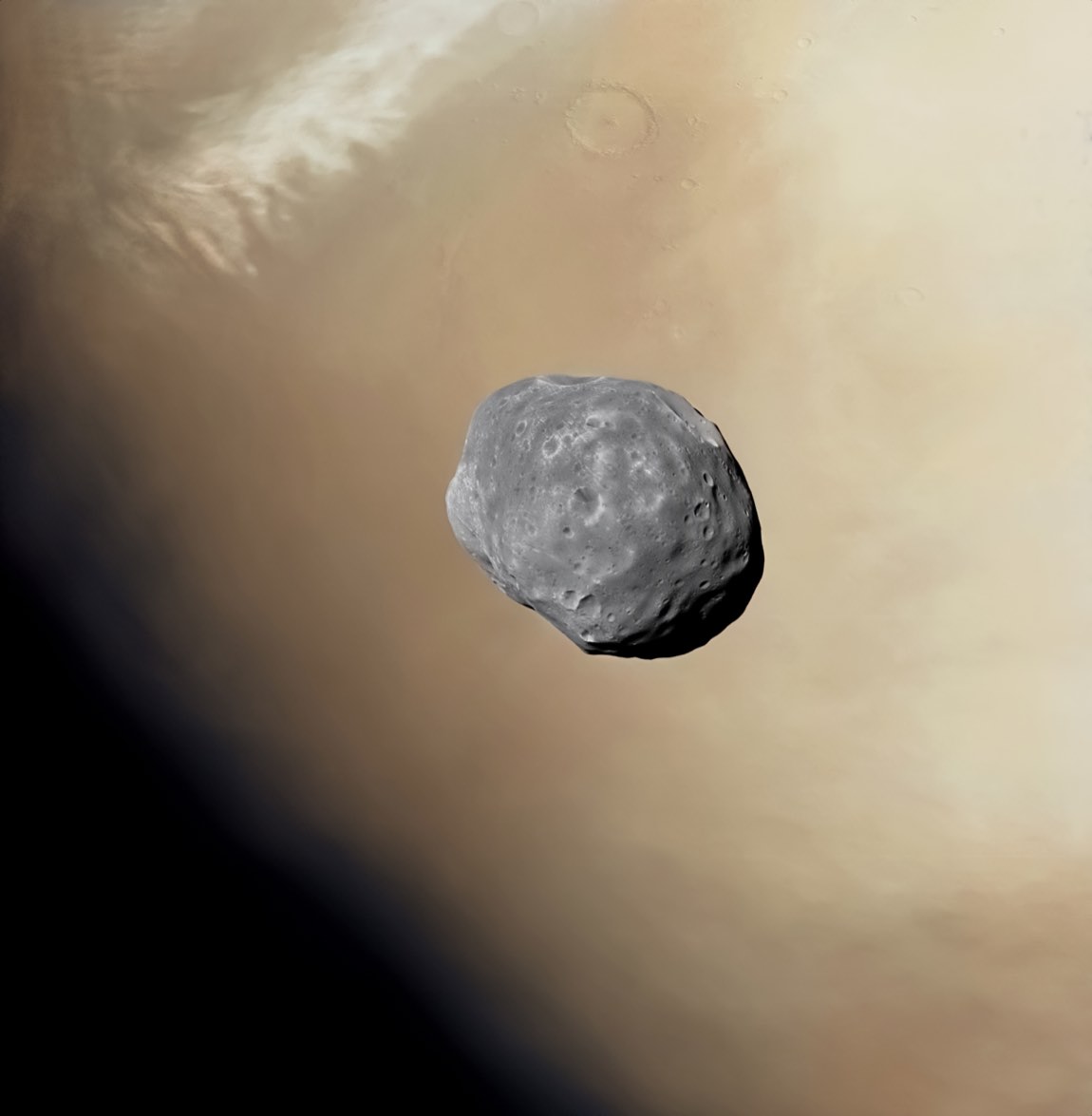
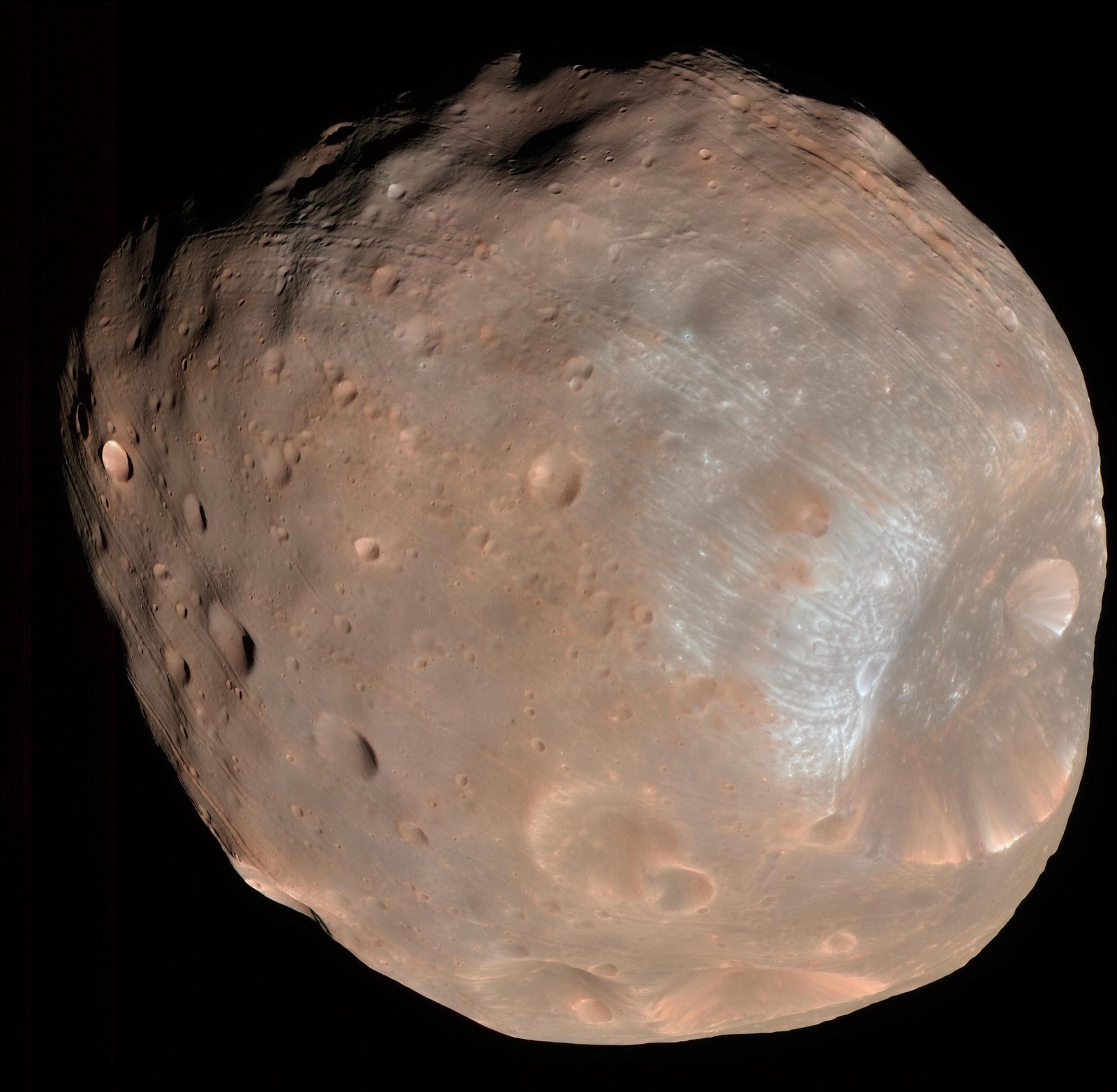
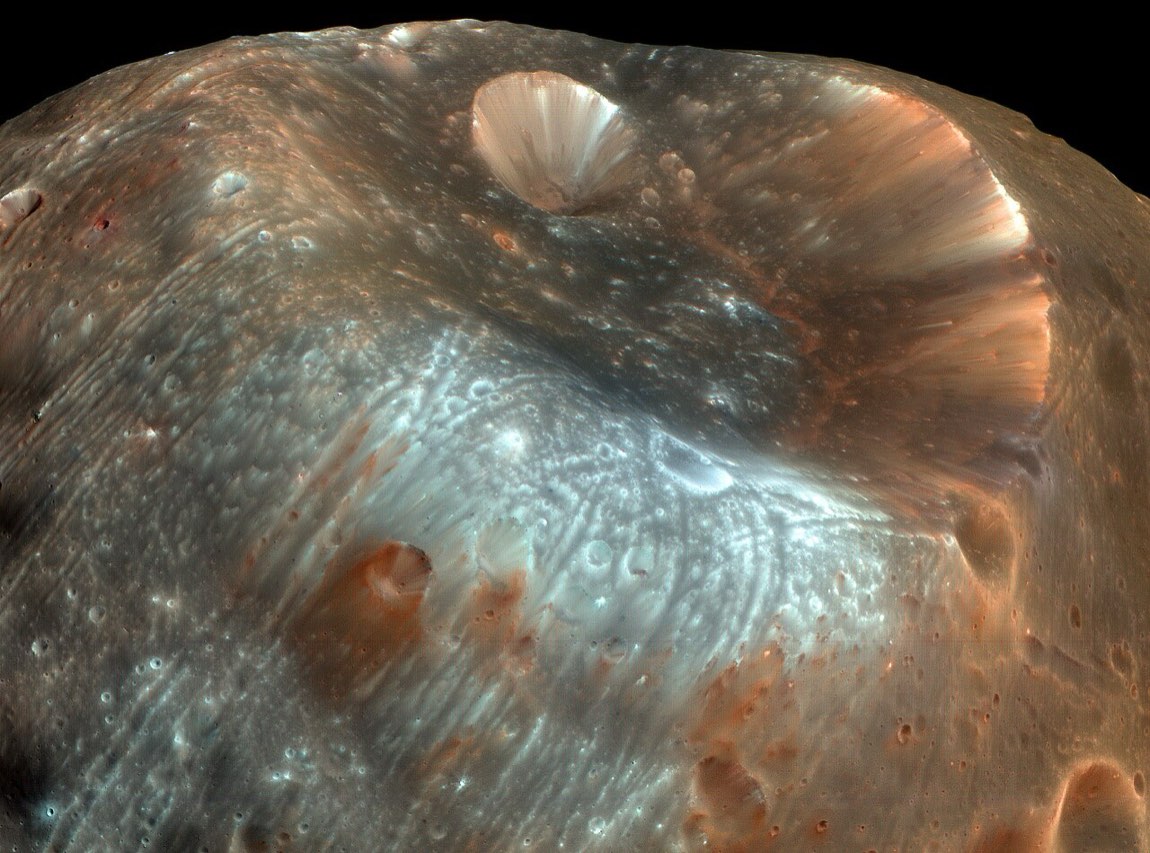
 Photograph · NASA/JPL-Caltech/University of Arizona
Moon · Deep guide · orbits Mars
Phobos
Mars's doomed potato moon is spiraling slowly toward destruction.
What is it?
Phobos is the larger of Mars's two tiny moons — a lumpy, potato-shaped rock just 27 km long that races around Mars three times a day, closer to its planet than any other moon in the Solar System. It is so close that Mars's gravity is winning: Phobos drops about 2 meters closer every century and will be torn into a ring in roughly 50 million years.
Go deeper
Phobos orbits below Mars-synchronous altitude, so tidal drag shrinks its orbit — the grooves scoring its surface may be early stretch marks of that death spiral (or chains of secondary impacts; still debated). Its origin is equally contested: captured asteroid (spectra say yes) versus impact-debris ring that condensed (dynamics say yes). JAXA's MMX mission is designed to settle it by returning a sample; launch has slipped to 2026 — see News for status. From Phobos, Mars fills a third of the sky — one reason it is proposed as a natural staging station for human Mars exploration.
01 A moon in a hurry
Phobos orbits faster than Mars spins, so from the Martian surface it rises in the WEST, crosses the sky in about four hours, and sets in the east — twice a day. It also passes through Mars's shadow constantly: rovers regularly film its lumpy silhouette crossing the Sun in hurried, off-center eclipses.
02 Why visit a potato? Deeper
Three reasons: its regolith may hold blasted-off pieces of ancient Mars (a free Mars sample); its origin story tests how moons form; and its near-zero gravity makes it a cheap staging post — land, refuel, teleoperate rovers on Mars below with a 0.1-second lag instead of minutes from Earth.
The deep dive
Researched for the Atlas from Wikipedia — Phobos (moon) (24,365 characters read) · updated Sep 20, 2026
03 The man who found fear in the sky
Asaph Hall almost gave up his search before he succeeded. Working at the United States Naval Observatory in Washington, D.C., he used the world's largest refracting telescope of the era — the 26-inch "Great Equatorial" — and spotted Phobos on 18 August 1877 at about 09:14 Greenwich Mean Time, just days after finding the outer moon Deimos. The naming credit goes not to Hall but to Henry Madan, a science master at Eton College in England, who drew on Greek mythology to propose both names. Phobos was a companion to the war god Ares — the Greek equivalent of Mars — and a twin brother to Deimos. The original spellings were "Phobus" and "Deimus." More than a century later, software engineer Denis Moskowitz proposed a symbol for Phobos: a Greek phi combined with the spear of Mars. The symbol has not caught on widely, a reminder that even small facts about a small moon can remain unsettled.
 ⤢
⤢
04 A body too porous to be solid rock Deeper
Spacecraft have measured Phobos's density directly at 1.887 g/cm³ — far too low for solid rock, which typically exceeds 2.5 g/cm³. That gap points to a body riddled with empty space. Calculations put the porosity of Phobos at 30% ± 5%, meaning roughly a quarter to a third of its interior volume is void. This extreme porosity is inconsistent with a straightforward asteroid origin, because captured asteroids of this type would be expected to be denser. The picture that emerges instead is of a rubble pile: a loose collection of fragments held together not by rigid strength but by gravity and a thin outer crust. Mars Express mapping and subsequent volume calculations reinforced this view by detecting voids inside the body. The internal structure matters enormously for Phobos's future: loosely bound rubble will eventually disperse into a planetary ring, while any fragments with strong internal cohesion will survive tidal breakup and plunge separately into the Martian atmosphere.
05 Grooves that took decades to explain
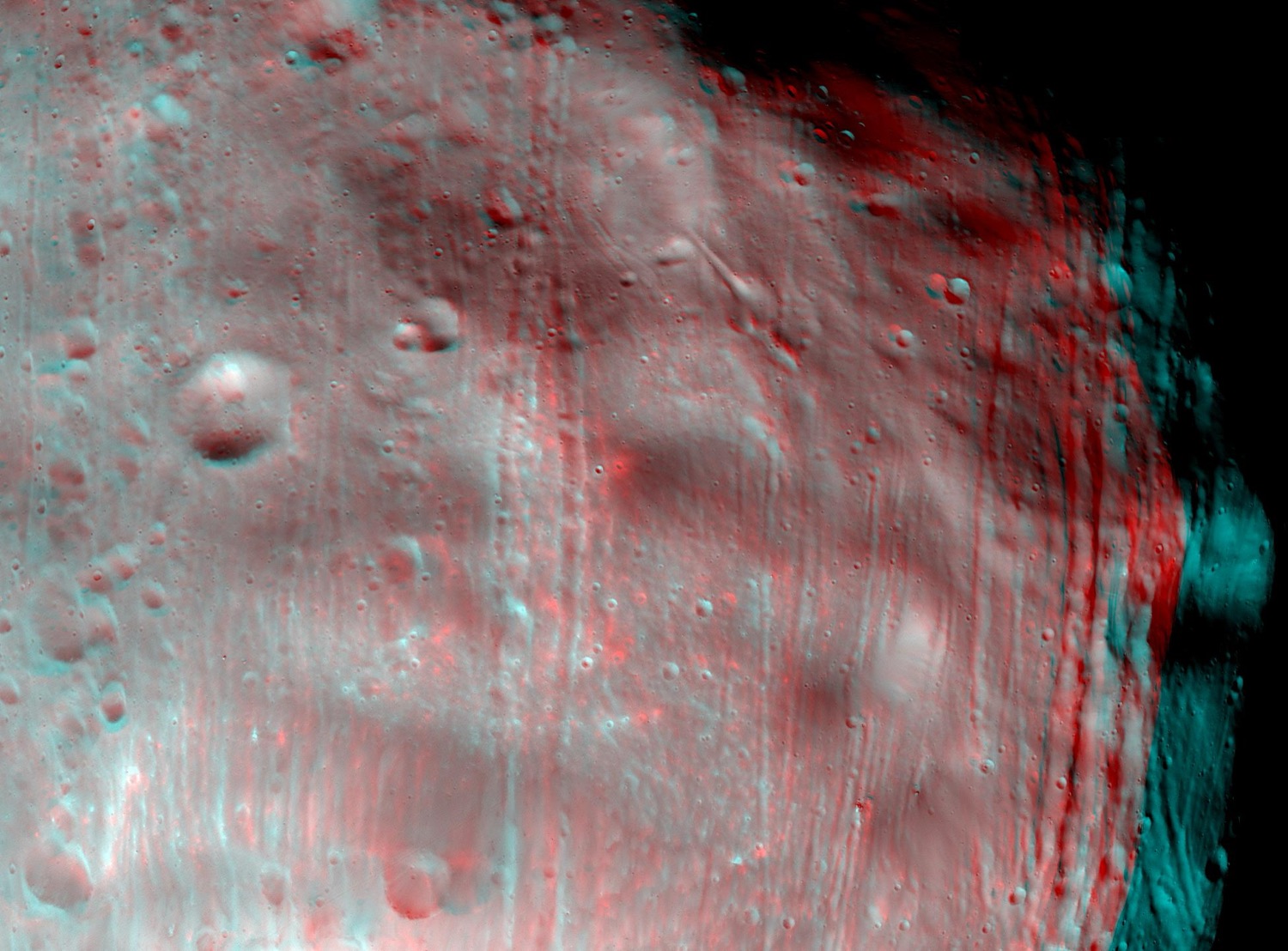
The long scratches scoring Phobos's surface have puzzled scientists since the 1970s. Early observers assumed they radiated from Stickney crater, implying they were fractures from the same catastrophic impact. That story became complicated when grooves were found inside Stickney itself, and when careful analysis from Mars Express showed the grooves are actually centered on the leading apex of Phobos in its orbit — not on Stickney. A rival idea emerged: the grooves are crater chains excavated by debris flung off Mars by impacts and then raining down on Phobos. They have been grouped into 12 or more families of different ages, each family presumably recording a separate Martian impact event. By 2015 another model proposed the grooves as "stretch marks" from tidal deformation, but later modelling found those stresses too weak unless Phobos is a rubble pile wrapped in roughly 100 m of powdery regolith. A November 2018 analysis concluded that boulders ejected from the Stickney impact rolled more than 360° around the moon, compressing the soft surface into the groove patterns seen today.
06 The hollow-moon scare that wasn't
In the late 1950s, Russian astrophysicist Iosif Samuilovich Shklovsky noticed that Phobos seemed to be losing altitude faster than gravity and atmospheric drag alone could explain. He calculated that to match the observed deceleration, Phobos would have to be extraordinarily light — one estimate produced a hollow iron sphere 16 kilometres across with walls less than 6 centimetres thick. The implication, startling at the time, was that Phobos might be an artificial satellite. Fred Singer, then science advisor to U.S. President Dwight D. Eisenhower, wrote a cautionary letter to the journal Astronautics in February 1960 pointing out that systematic errors in the old observations could invalidate the whole argument. He was right. Accurate measurements available by 1969 showed the discrepancy did not exist; earlier studies had used an overestimated altitude-loss rate of 5 centimetres per year, later revised to 1.8 centimetres per year. The secular acceleration is now understood as a tidal effect. Viking probe images from the 1970s confirmed Phobos is a natural, irregular object — not a spacecraft.
 ⤢
⤢
07 A surface of extreme contrasts
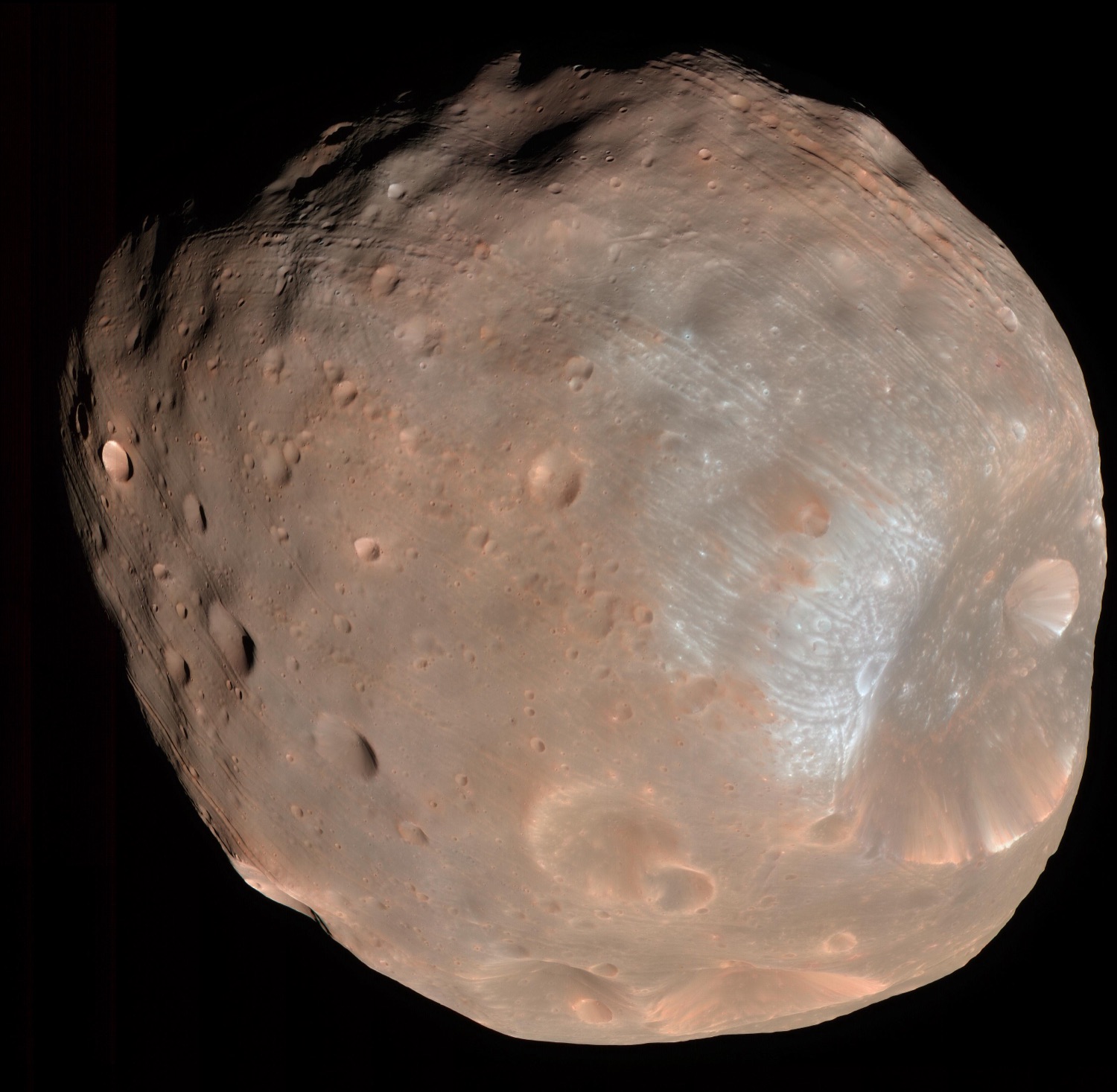
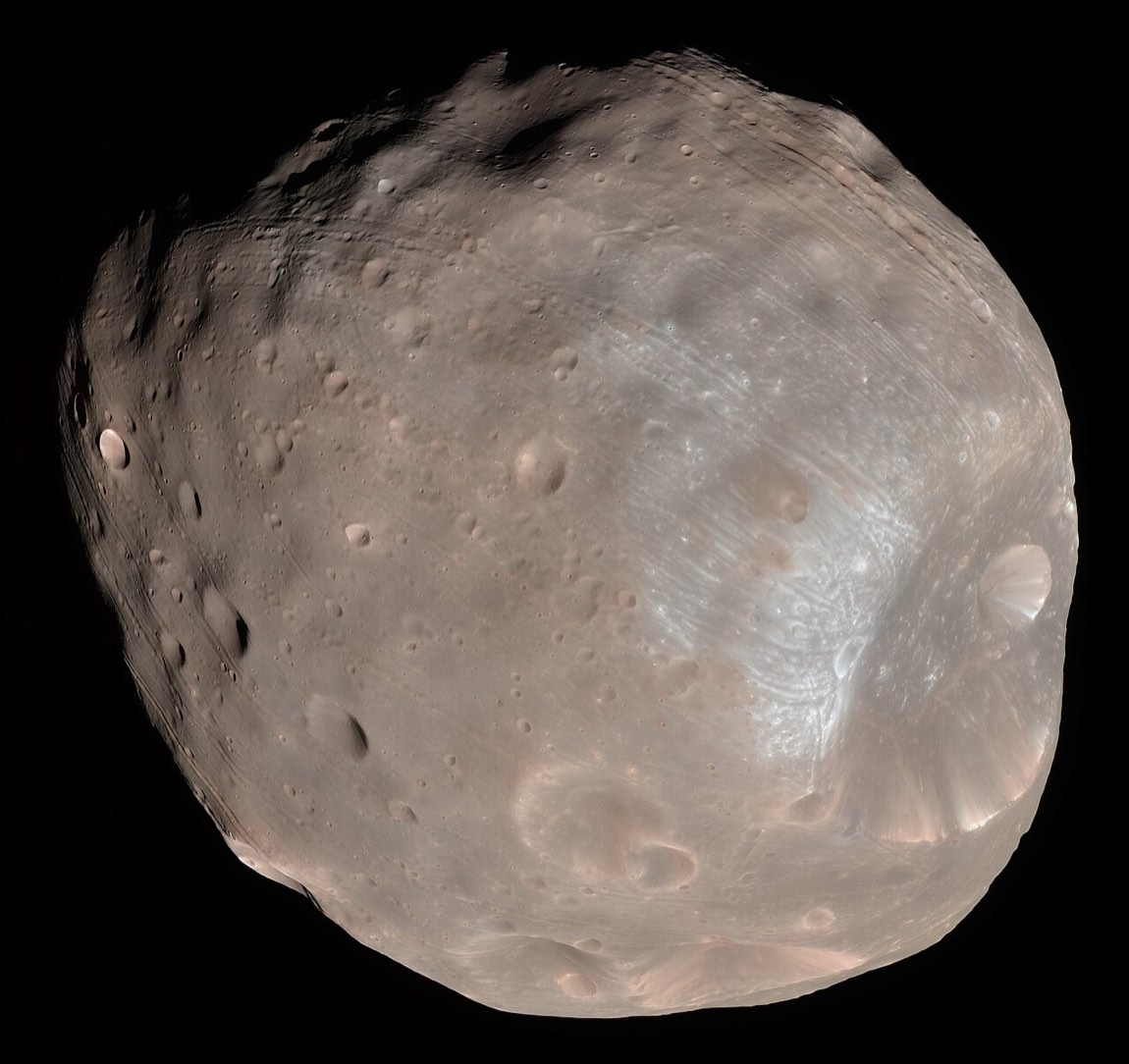
Phobos presents two very different faces depending on whether sunlight is hitting them. The sunlit side reaches about −4 °C (25 °F) — cold by Earth standards but practically balmy compared to the shadowed side, which plunges to −112 °C (−170 °F). That 108-degree swing happens across a body only 26 by 23 by 18 kilometres in size. The surface itself is blanketed by a layer of fine-grained regolith estimated to be at least 100 metres thick, thought to have been deposited by impacts from other bodies, though how the material sticks to an object with almost no gravity remains an open question. Color also varies: some areas appear reddish, others bluish. One hypothesis holds that Mars's gravity gradually pulls the older, radiation-weathered reddish regolith across the surface, exposing fresher, unweathered bluish rock beneath. Because that blue material does not match known Martian rock types, it may complicate theories that Phobos formed entirely from Mars-derived ejecta.
08 Stickney: almost the end of Phobos
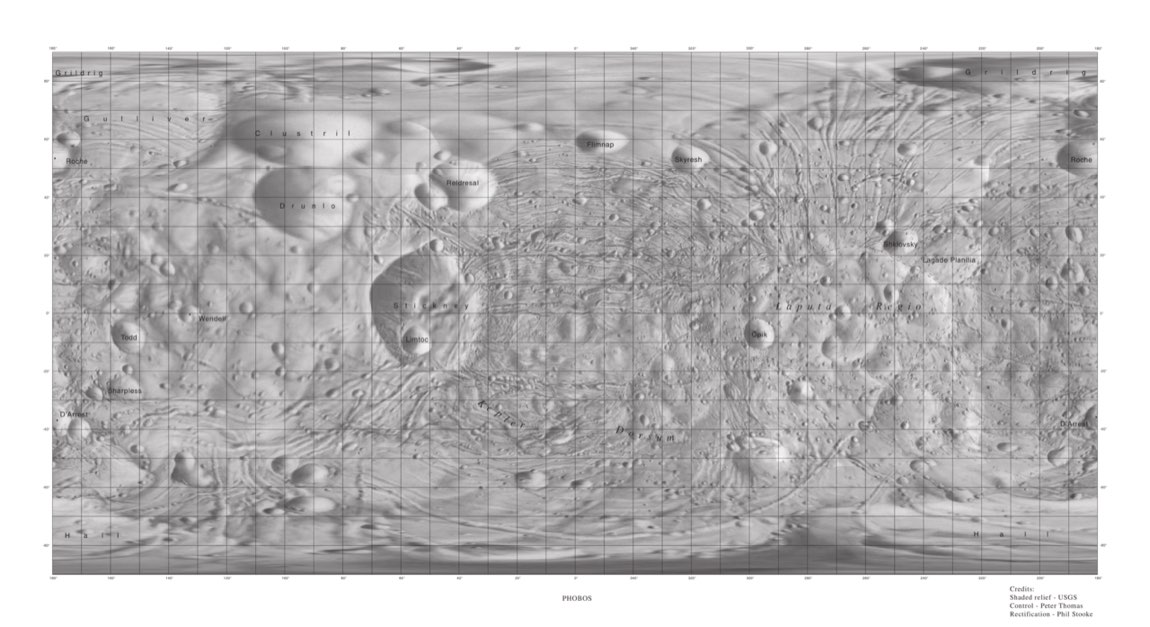
The most dramatic feature on Phobos is Stickney crater, an impact scar 9 kilometres in diameter — more than a third of the moon's mean radius of 11 kilometres. Scientists believe the impact that gouged out Stickney came close to shattering Phobos entirely, an event that would have scattered debris across the inner Martian system. The comparison often made is with Herschel crater on Saturn's moon Mimas, another case where a single blow nearly ended a small world. Stickney sits near the equator and, unusually for such a tiny moon, the crater contains a central peak — a mountain of rebounded rock that formed in the aftermath of the collision. The crater's name follows the convention of naming Phobos features after astronomers who studied the moon and characters from Jonathan Swift's Gulliver's Travels. Other named features include Laputa Regio and Lagado Planitia — both drawn from Swift's fictional geography — and Kepler Dorsum, the only named ridge on the moon, honoring the astronomer Johannes Kepler.
09 What the orbit tells us about the sky on Mars
Standing on Mars, a sky-watcher would see Phobos behave unlike any moon in our everyday experience. Because Phobos orbits at an altitude of 5,989 km below Mars's synchronous orbit radius, it laps the rotating planet and rises in the west rather than the east — the opposite of every other moon visible from a planet's surface in our Solar System (except Deimos). It crosses the sky in 4 hours and 15 minutes or less, setting in the east, and manages this twice every Martian day, which lasts about 24 hours 37 minutes. Its angular size changes noticeably as it moves: at the horizon it spans about 0.14°, swelling to 0.20° at the zenith — still only about one-third the apparent width of the full Moon as seen from Earth. The Sun in the Martian sky is about 0.35° wide, so Phobos is never large enough to cause a total solar eclipse, only an annular transit. Crucially, from latitudes above 70.4° north or south, Phobos never clears the horizon at all.
 ⤢
⤢
10 Competing theories on where Phobos came from Deeper
No single origin story for Phobos has won consensus. Phobos and Deimos both resemble carbonaceous C-type or D-type asteroids in their spectra, albedo, and density, suggesting they might be captured main-belt asteroids. But capture is notoriously difficult: a Phobos-sized object needs to shed enormous energy to shift from an elongated elliptical orbit into the nearly circular, nearly equatorial orbit Phobos occupies today. Atmospheric drag and tidal forces could help, but researchers are unsure whether Mars's current thin atmosphere suffices. Astronomer Geoffrey Landis proposed a workaround — perhaps the captured object was originally a binary asteroid that tidal forces split apart. A second hypothesis sees Phobos as second-generation material that coalesced in orbit after a large planetesimal hit Mars. Thermal infrared observations suggest phyllosilicates dominate the surface composition — minerals well known from Mars itself — and the spectra differ from all known classes of chondrite meteorites, both lines of evidence pointing away from a pure asteroid origin and toward Mars-impact debris. A 2021 study by researchers at ETH Zurich and the U.S. Naval Observatory, drawing on Mars InSight seismic and orbital data, proposed that Phobos and Deimos both formed from the disruption of a single parent body roughly 1 to 2.7 billion years ago.
11 A parade of spacecraft, most just passing by
Phobos has been photographed in close-up by a long succession of spacecraft, none of which had it as a primary target. Mariner 7 flew past in 1969, followed by Mariner 9 in 1971, Viking 1 in 1977, Phobos 2 in 1989, Mars Global Surveyor in 1998 and 2003, Mars Express in 2004, 2008, 2010, and 2019, and Mars Reconnaissance Orbiter in 2007 and 2008. On 25 August 2005, the Spirit rover caught both Martian moons in short-exposure night-sky photographs from the surface of Mars, enabled by unexpected extra energy after wind cleaned its solar panels. India's Mars Orbiter Mission captured images from 4,200 km away on 1 July 2020. Most recently, ESA's Hera spacecraft observed Phobos from less than 13,000 km during its 12 March 2025 Mars gravity assist flyby en route to asteroid 65803 Didymos. Despite decades of imagery, no mission has yet returned a physical sample of Phobos to Earth.
12 The Soviet missions that almost made history
The Soviet Union mounted the most ambitious dedicated effort to reach Phobos, launching two probes in July 1988 as part of the Phobos program. Phobos 1 never made it: an erroneous command sent from ground control in September 1988 shut it down while still en route to Mars. Phobos 2 fared better, reaching the Martian system in January 1989 and transmitting a small amount of data and imagery. Then, just as it was preparing to begin detailed examination of Phobos's surface, it abruptly stopped transmitting — most likely due to failure of the onboard computer or the radio transmitter, which was already running on backup power. Russia tried again with Fobos-Grunt, launched in November 2011 and carrying a life-science experiment from the Planetary Society called the Living Interplanetary Flight Experiment, as well as a Chinese satellite called Yinghuo-1. After reaching Earth orbit, the probe failed to fire the burns needed to depart for Mars, and crashed back to Earth in January 2012. The dream of a Phobos sample return remains unfulfilled.
 ⤢
⤢
13 The future ring of Mars Deeper
Phobos is edging toward its own destruction at a pace of roughly 2 metres per 100 years. At that rate, tidal deceleration will drag it inward until, somewhere between 30 and 50 million years from now — one study centers the estimate at about 43 million years — tidal forces will overwhelm whatever holds it together. Models that treat Phobos as a Mohr–Coulomb rubble pile predict it will begin to fragment when it reaches approximately 2.1 Mars radii from the planet's center. The looser material will fan out into a planetary ring; estimates give that ring a lifetime of 1 million to 100 million years before it disperses. The denser, more cohesive fragments will survive the ring phase and eventually fall into the Martian atmosphere as individual impactors. How much mass ends up in the ring versus raining down depends entirely on Phobos's still-unknown internal structure — one more reason that understanding what lies beneath its regolith matters well beyond pure curiosity.
14 A staircase to the rest of the Solar System
Engineers have imagined Phobos as a remarkably practical infrastructure node. Because it orbits so close to Mars and has such weak gravity, the energy cost of landing on it and launching away again requires a delta-v of only 80% of that needed for a round trip to the Moon's surface. Proposals for a Phobos-based space elevator go further: one concept calls for a cable extending 6,000 km down toward Mars's atmosphere and another 6,000 km outward in the opposite direction. A spacecraft leaving the Martian surface would need a delta-v of only 0.52 km/s to reach the lower cable — compared to over 3.6 km/s for low Mars orbit — and once attached could be lifted electrically and released from the upper cable with a hyperbolic velocity of 2.6 km/s, enough to reach Earth or travel a significant fraction of the way to the asteroid belt. The idea, first raised in fiction in 1956, also works in reverse, capturing arriving spacecraft. Phobos's large mass means elevator operations would barely perturb its orbit.
15 The MMX mission: Japan's sample grab
The next chapter in Phobos exploration is being written in Japan. On 9 June 2015, the Japan Aerospace Exploration Agency unveiled the Martian Moons eXploration mission, or MMX, designed specifically to land on Phobos multiple times and collect samples using a corer mechanism. The target is a minimum of 10 grams of material — modest in mass but potentially transformative in scientific value, since a physical sample would finally allow geochemists to test all the competing origin hypotheses against real rock. MMX will also conduct flyby observations of Deimos and monitor Martian climate from orbit. Partners include NASA, Germany's DLR, and France's CNES, which are supplying scientific instruments and a small rover named Idefix. The mission is scheduled to launch in 2026 and return its samples to Earth in 2031. If successful, it will be the first material ever retrieved from the Martian moon system and could settle the long-running debate over whether Phobos is a captured asteroid, recycled Martian ejecta, or something else entirely.
 ⤢
⤢
You would weigh…
Surface gravity 0.01 m/s² vs Earth’s 9.81 m/s². Try every world →
Could life exist here?
A dry, airless rock — though its soil may preserve molecules from early Mars.
Our labels: Confirmed · Strong Evidence · Estimated · Hypothesis · Theoretical · Speculative (see Methodology).
Could humans live here?
Plausible sooner than Mars's surface itself: docking with Phobos is more like docking with a station than landing on a planet — no atmosphere, almost no gravity. Several crewed-Mars architectures use it as base camp.
How would we get there?
Same 6–8 month road as Mars. MMX will grab samples and return them to Earth around the end of the decade.
| Technology | Status | Travel time (one way, straight line) |
|---|---|---|
| Apollo-style spacecraft, about 39,000 km/h | Flown technology | 241 days |
| Ion-propulsion probe, about 90,000 km/h | Flown technology | 104 days |
| Voyager 1, about 61,000 km/h | Flown technology | 153 days |
| Parker Solar Probe, about 690,000 km/h | Flown technology | 14 days |
| Nuclear-thermal rocket, about 120,000 km/h cruise | In development | 79 days |
| Laser light-sail at 20% of light speed | Proposed concept | 63 minutes |
| Light itself, 299,792 km/s | Physical limit | 13 minutes |
Simplified straight-line times at cruise speed. Real missions fly curved orbital paths and take longer. Full travel calculator →
Weird & wonderful
- Phobos rises in the west and sets in the east — twice a Martian day.
- An astronaut could probably jump off Phobos into orbit (escape velocity ~40 km/h).
- It is one of the darkest objects in the Solar System, blacker than asphalt.
- In ~50 million years, Mars gets a ring — with Phobos as the raw material.
More real images of Phobos
Genuine spacecraft and telescope imagery, every frame credited and licensed. Tap any photo to enlarge.